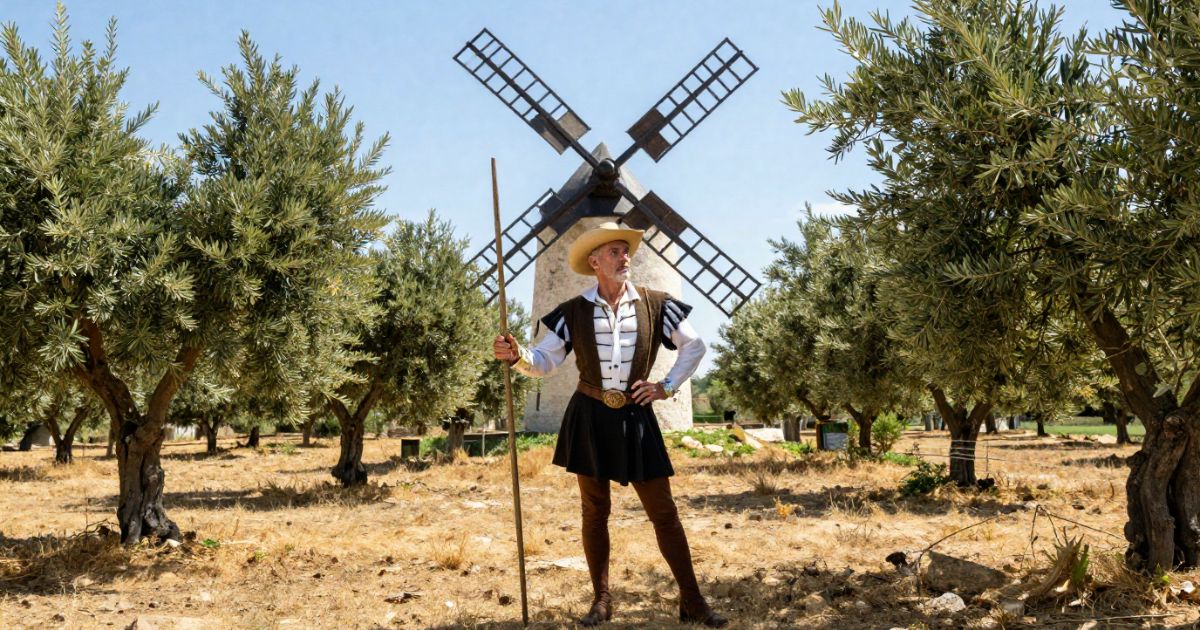
An excerpt from the original text.(complete · 4128 words)
WHICH IS RELATED THE DISCOURSE SANCHO PANZA HELD WITH HIS MASTER,
DON QUIXOTE, AND OTHER ADVENTURES WORTH RELATING
Sancho reached his master so limp and faint that he could not urge on
his beast. When Don Quixote saw the state he was in he said, “I have
now come to the conclusion, good Sancho, that this castle or inn is
beyond a doubt enchanted, because those who have so atrociously
diverted themselves with thee, what can they be but phantoms or beings
of another world? and I hold this confirmed by having noticed that when
I was by the wall of the yard witnessing the acts of thy sad tragedy,
it was out of my power to mount upon it, nor could I even dismount from
Rocinante, because they no doubt had me enchanted; for I swear to thee
by the faith of what I am that if I had been able to climb up or
dismount, I would have avenged thee in such a way that those braggart
thieves would have remembered their freak for ever, even though in so
doing I knew that I contravened the laws of chivalry, which, as I have
often told thee, do not permit a knight to lay hands on him who is not
one, save in case of urgent and great necessity in defence of his own
life and person.”
“I would have avenged myself too if I could,” said Sancho, “whether I
had been dubbed knight or not, but I could not; though for my part I am
persuaded those who amused themselves with me were not phantoms or
enchanted men, as your worship says, but men of flesh and bone like
ourselves; and they all had their names, for I heard them name them
when they were tossing me, and one was called Pedro Martinez, and
another Tenorio Hernandez, and the innkeeper, I heard, was called Juan
Palomeque the Left-handed; so that, señor, your not being able to leap
over the wall of the yard or dismount from your horse came of something
else besides enchantments; and what I make out clearly from all this
is, that these adventures we go seeking will in the end lead us into
such misadventures that we shall not know which is our right foot; and
that the best and wisest thing, according to my small wits, would be
for us to return home, now that it is harvest-time, and attend to our
business, and give over wandering from Zeca to Mecca and from pail to
bucket, as the saying is.”
“How little thou knowest about chivalry, Sancho,” replied Don Quixote;
“hold thy peace and have patience; the day will come when thou shalt
see with thine own eyes what an honourable thing it is to wander in the
pursuit of this calling; nay, tell me, what greater pleasure can there
be in the world, or what delight can equal that of winning a battle,
and triumphing over one’s enemy? None, beyond all doubt.”
“Very likely,” answered Sancho, “though I do not know it; all I know is
that since we have been knights-errant, or since your worship has been
one (for I have no right to reckon myself one of so honourable a
number) we have never won any battle except the one with the Biscayan,
and even out of that your worship came with half an ear and half a
helmet the less; and from that till now it has been all cudgellings and
more cudgellings, cuffs and more cuffs, I getting the blanketing over
and above, and falling in with enchanted persons on whom I cannot
avenge myself so as to know what the delight, as your worship calls it,
of conquering an enemy is like.”
“That is what vexes me, and what ought to vex thee, Sancho,” replied
Don Quixote; “but henceforward I will endeavour to have at hand some
sword made by such craft that no kind of enchantments can take effect
upon him who carries it, and it is even possible that fortune may
procure for me that which belonged to Amadis when he was called ‘The
Knight of the Burning Sword,’ which was one of the best swords that
ever knight in the world possessed, for, besides having the said
virtue, it cut like a razor, and there was no armour, however strong
and enchanted it might be, that could resist it.”
“Such is my luck,” said Sancho, “that even if that happened and your
worship found some such sword, it would, like the balsam, turn out
serviceable and good for dubbed knights only, and as for the squires,
they might sup sorrow.”
“Fear not that, Sancho,” said Don Quixote: “Heaven will deal better by
thee.”
Thus talking, Don Quixote and his squire were going along, when, on the
road they were following, Don Quixote perceived approaching them a
large and thick cloud of dust, on seeing which he turned to Sancho and
said:
“This is the day, Sancho, on which will be seen the boon my fortune is
reserving for me; this, I say, is the day on which as much as on any
other shall be displayed the might of my arm, and on which I shall do
deeds that shall remain written in the book of fame for all ages to
come. Seest thou that cloud of dust which rises yonder? Well, then, all
that is churned up by a vast army composed of various and countless
nations that comes marching there.”
“According to that there must be two,” said Sancho, “for on this
opposite side also there rises just such another cloud of dust.”
Don Quixote turned to look and found that it was true, and rejoicing
exceedingly, he concluded that they were two armies about to engage and
encounter in the midst of that broad plain; for at all times and
seasons his fancy was full of the battles, enchantments, adventures,
crazy feats, loves, and defiances that are recorded in the books of
chivalry, and everything he said, thought, or did had reference to such
things. Now the cloud of dust he had seen was raised by two great
droves of sheep coming along the same road in opposite directions,
which, because of the dust, did not become visible until they drew
near, but Don Quixote asserted so positively that they were armies that
Sancho was led to believe it and say, “Well, and what are we to do,
señor?”
“What?” said Don Quixote: “give aid and assistance to the weak and
those who need it; and thou must know, Sancho, that this which comes
opposite to us is conducted and led by the mighty emperor Alifanfaron,
lord of the great isle of Trapobana; this other that marches behind me
is that of his enemy the king of the Garamantas, Pentapolin of the Bare
Arm, for he always goes into battle with his right arm bare.”
“But why are these two lords such enemies?”
“They are at enmity,” replied Don Quixote, “because this Alifanfaron is
a furious pagan and is in love with the daughter of Pentapolin, who is
a very beautiful and moreover gracious lady, and a Christian, and her
father is unwilling to bestow her upon the pagan king unless he first
abandons the religion of his false prophet Mahomet, and adopts his
own.”
“By my beard,” said Sancho, “but Pentapolin does quite right, and I
will help him as much as I can.”
“In that thou wilt do what is thy duty, Sancho,” said Don Quixote; “for
to engage in battles of this sort it is not requisite to be a dubbed
knight.”
“That I can well understand,” answered Sancho; “but where shall we put
this ass where we may be sure to find him after the fray is over? for I
believe it has not been the custom so far to go into battle on a beast
of this kind.”
“That is true,” said Don Quixote, “and what you had best do with him is
to leave him to take his chance whether he be lost or not, for the
horses we shall have when we come out victors will be so many that even
Rocinante will run a risk of being changed for another. But attend to
me and observe, for I wish to give thee some account of the chief
knights who accompany these two armies; and that thou mayest the better
see and mark, let us withdraw to that hillock which rises yonder,
whence both armies may be seen.”
They did so, and placed themselves on a rising ground from which the
two droves that Don Quixote made armies of might have been plainly seen
if the clouds of dust they raised had not obscured them and blinded the
sight; nevertheless, seeing in his imagination what he did not see and
what did not exist, he began thus in a loud voice:
“That knight whom thou seest yonder in yellow armour, who bears upon
his shield a lion crowned crouching at the feet of a damsel, is the
valiant Laurcalco, lord of the Silver Bridge; that one in armour with
flowers of gold, who bears on his shield three crowns argent on an
azure field, is the dreaded Micocolembo, grand duke of Quirocia; that
other of gigantic frame, on his right hand, is the ever dauntless
Brandabarbaran de Boliche, lord of the three Arabias, who for armour
wears that serpent skin, and has for shield a gate which, according to
tradition, is one of those of the temple that Samson brought to the
ground when by his death he revenged himself upon his enemies. But turn
thine eyes to the other side, and thou shalt see in front and in the
van of this other army the ever victorious and never vanquished Timonel
of Carcajona, prince of New Biscay, who comes in armour with arms
quartered azure, vert, white, and yellow, and bears on his shield a cat
or on a field tawny with a motto which says Miau, which is the
beginning of the name of his lady, who according to report is the
peerless Miaulina, daughter of the duke Alfeniquen of the Algarve; the
other, who burdens and presses the loins of that powerful charger and
bears arms white as snow and a shield blank and without any device, is
a novice knight, a Frenchman by birth, Pierres Papin by name, lord of
the baronies of Utrique; that other, who with iron-shod heels strikes
the flanks of that nimble parti-coloured zebra, and for arms bears
azure vair, is the mighty duke of Nerbia, Espartafilardo del Bosque,
who bears for device on his shield an asparagus plant with a motto in
Castilian that says, ‘Rastrea mi suerte’.” And so he went on naming a
number of knights of one squadron or the other out of his imagination,
and to all he assigned off-hand their arms, colours, devices, and
mottoes, carried away by the illusions of his unheard-of craze; and
without a pause, he continued, “People of divers nations compose this
squadron in front; here are those that drink of the sweet waters of the
famous Xanthus, those that scour the woody Massilian plains, those that
sift the pure fine gold of Arabia Felix, those that enjoy the famed
cool banks of the crystal Thermodon, those that in many and various
ways divert the streams of the golden Pactolus, the Numidians,
faithless in their promises, the Persians renowned in archery, the
Parthians and the Medes that fight as they fly, the Arabs that ever
shift their dwellings, the Scythians as cruel as they are fair, the
Ethiopians with pierced lips, and an infinity of other nations whose
features I recognise and descry, though I cannot recall their names. In
this other squadron there come those that drink of the crystal streams
of the olive-bearing Betis, those that make smooth their countenances
with the water of the ever rich and golden Tagus, those that rejoice in
the fertilising flow of the divine Genil, those that roam the Tartesian
plains abounding in pasture, those that take their pleasure in the
Elysian meadows of Jerez, the rich Manchegans crowned with ruddy ears
of corn, the wearers of iron, old relics of the Gothic race, those that
bathe in the Pisuerga renowned for its gentle current, those that feed
their herds along the spreading pastures of the winding Guadiana famed
for its hidden course, those that tremble with the cold of the pineclad
Pyrenees or the dazzling snows of the lofty Apennine; in a word, as
many as all Europe includes and contains.”
Good God! what a number of countries and nations he named! giving to
each its proper attributes with marvellous readiness; brimful and
saturated with what he had read in his lying books! Sancho Panza hung
upon his words without speaking, and from time to time turned to try if
he could see the knights and giants his master was describing, and as
he could not make out one of them he said to him:
“Señor, devil take it if there’s a sign of any man you talk of, knight
or giant, in the whole thing; maybe it’s all enchantment, like the
phantoms last night.”
“How canst thou say that!” answered Don Quixote; “dost thou not hear
the neighing of the steeds, the braying of the trumpets, the roll of
the drums?”
“I hear nothing but a great bleating of ewes and sheep,” said Sancho;
which was true, for by this time the two flocks had come close.
“The fear thou art in, Sancho,” said Don Quixote, “prevents thee from
seeing or hearing correctly, for one of the effects of fear is to
derange the senses and make things appear different from what they are;
if thou art in such fear, withdraw to one side and leave me to myself,
for alone I suffice to bring victory to that side to which I shall give
my aid;” and so saying he gave Rocinante the spur, and putting the
lance in rest, shot down the slope like a thunderbolt. Sancho shouted
after him, crying, “Come back, Señor Don Quixote; I vow to God they are
sheep and ewes you are charging! Come back! Unlucky the father that
begot me! what madness is this! Look, there is no giant, nor knight,
nor cats, nor arms, nor shields quartered or whole, nor vair azure or
bedevilled. What are you about? Sinner that I am before God!” But not
for all these entreaties did Don Quixote turn back; on the contrary he
went on shouting out, “Ho, knights, ye who follow and fight under the
banners of the valiant emperor Pentapolin of the Bare Arm, follow me
all; ye shall see how easily I shall give him his revenge over his
enemy Alifanfaron of the Trapobana.”
So saying, he dashed into the midst of the squadron of ewes, and began
spearing them with as much spirit and intrepidity as if he were
transfixing mortal enemies in earnest. The shepherds and drovers
accompanying the flock shouted to him to desist; seeing it was no use,
they ungirt their slings and began to salute his ears with stones as
big as one’s fist. Don Quixote gave no heed to the stones, but, letting
drive right and left kept saying:
“Where art thou, proud Alifanfaron? Come before me; I am a single
knight who would fain prove thy prowess hand to hand, and make thee
yield thy life a penalty for the wrong thou dost to the valiant
Pentapolin Garamanta.” Here came a sugar-plum from the brook that
struck him on the side and buried a couple of ribs in his body. Feeling
himself so smitten, he imagined himself slain or badly wounded for
certain, and recollecting his liquor he drew out his flask, and putting
it to his mouth began to pour the contents into his stomach; but ere he
had succeeded in swallowing what seemed to him enough, there came
another almond which struck him on the hand and on the flask so fairly
that it smashed it to pieces, knocking three or four teeth and grinders
out of his mouth in its course, and sorely crushing two fingers of his
hand. Such was the force of the first blow and of the second, that the
poor knight in spite of himself came down backwards off his horse. The
shepherds came up, and felt sure they had killed him; so in all haste
they collected their flock together, took up the dead beasts, of which
there were more than seven, and made off without waiting to ascertain
anything further.
All this time Sancho stood on the hill watching the crazy feats his
master was performing, and tearing his beard and cursing the hour and
the occasion when fortune had made him acquainted with him. Seeing him,
then, brought to the ground, and that the shepherds had taken
themselves off, he ran to him and found him in very bad case, though
not unconscious; and said he:
“Did I not tell you to come back, Señor Don Quixote; and that what you
were going to attack were not armies but droves of sheep?”
“That’s how that thief of a sage, my enemy, can alter and falsify
things,” answered Don Quixote; “thou must know, Sancho, that it is a
very easy matter for those of his sort to make us believe what they
choose; and this malignant being who persecutes me, envious of the
glory he knew I was to win in this battle, has turned the squadrons of
the enemy into droves of sheep. At any rate, do this much, I beg of
thee, Sancho, to undeceive thyself, and see that what I say is true;
mount thy ass and follow them quietly, and thou shalt see that when
they have gone some little distance from this they will return to their
original shape and, ceasing to be sheep, become men in all respects as
I described them to thee at first. But go not just yet, for I want thy
help and assistance; come hither, and see how many of my teeth and
grinders are missing, for I feel as if there was not one left in my
mouth.”
Sancho came so close that he almost put his eyes into his mouth; now
just at that moment the balsam had acted on the stomach of Don Quixote,
so, at the very instant when Sancho came to examine his mouth, he
discharged all its contents with more force than a musket, and full
into the beard of the compassionate squire.
“Holy Mary!” cried Sancho, “what is this that has happened me? Clearly
this sinner is mortally wounded, as he vomits blood from the mouth;”
but considering the matter a little more closely he perceived by the
colour, taste, and smell, that it was not blood but the balsam from the
flask which he had seen him drink; and he was taken with such a
loathing that his stomach turned, and he vomited up his inside over his
very master, and both were left in a precious state. Sancho ran to his
ass to get something wherewith to clean himself, and relieve his
master, out of his alforjas; but not finding them, he well-nigh took
leave of his senses, and cursed himself anew, and in his heart resolved
to quit his master and return home, even though he forfeited the wages
of his service and all hopes of the promised island.
Don Quixote now rose, and putting his left hand to his mouth to keep
his teeth from falling out altogether, with the other he laid hold of
the bridle of Rocinante, who had never stirred from his master’s
side—so loyal and well-behaved was he—and betook himself to where the
squire stood leaning over his ass with his hand to his cheek, like one
in deep dejection. Seeing him in this mood, looking so sad, Don Quixote
said to him:
“Bear in mind, Sancho, that one man is no more than another, unless he
does more than another; all these tempests that fall upon us are signs
that fair weather is coming shortly, and that things will go well with
us, for it is impossible for good or evil to last for ever; and hence
it follows that the evil having lasted long, the good must be now nigh
at hand; so thou must not distress thyself at the misfortunes which
happen to me, since thou hast no share in them.”
“How have I not?” replied Sancho; “was he whom they blanketed yesterday
perchance any other than my father’s son? and the alforjas that are
missing to-day with all my treasures, did they belong to any other but
myself?”
“What! are the alforjas missing, Sancho?” said Don Quixote.
“Yes, they are missing,” answered Sancho.
“In that case we have nothing to eat to-day,” replied Don Quixote.
“It would be so,” answered Sancho, “if there were none of the herbs
your worship says you know in these meadows, those with which
knights-errant as unlucky as your worship are wont to supply such-like
shortcomings.”
“For all that,” answered Don Quixote, “I would rather have just now a
quarter of bread, or a loaf and a couple of pilchards’ heads, than all
the herbs described by Dioscorides, even with Doctor Laguna’s notes.
Nevertheless, Sancho the Good, mount thy beast and come along with me,
for God, who provides for all things, will not fail us (more especially
when we are so active in his service as we are), since he fails not the
midges of the air, nor the grubs of the earth, nor the tadpoles of the
water, and is so merciful that he maketh his sun to rise on the good
and on the evil, and sendeth rain on the unjust and on the just.”
“Your worship would make a better preacher than knight-errant,” said
Sancho.
“Knights-errant knew and ought to know everything, Sancho,” said Don
Quixote; “for there were knights-errant in former times as well
qualified to deliver a sermon or discourse in the middle of an
encampment, as if they had graduated in the University of Paris;
whereby we may see that the lance has never blunted the pen, nor the
pen the lance.”
“Well, be it as your worship says,” replied Sancho; “let us be off now
and find some place of shelter for the night, and God grant it may be
somewhere where there are no blankets, nor blanketeers, nor phantoms,
nor enchanted Moors; for if there are, may the devil take the whole
concern.”
“Ask that of God, my son,” said Don Quixote; and do thou lead on where
thou wilt, for this time I leave our lodging to thy choice; but reach
me here thy hand, and feel with thy finger, and find out how many of my
teeth and grinders are missing from this right side of the upper jaw,
for it is there I feel the pain.”
Sancho put in his fingers, and feeling about asked him, “How many
grinders used your worship have on this side?”
“Four,” replied Don Quixote, “besides the back-tooth, all whole and
quite sound.”
“Mind what you are saying, señor.”
“I say four, if not five,” answered Don Quixote, “for never in my life
have I had tooth or grinder drawn, nor has any fallen out or been
destroyed by any decay or rheum.”
“Well, then,” said Sancho, “in this lower side your worship has no more
than two grinders and a half, and in the upper neither a half nor any
at all, for it is all as smooth as the palm of my hand.”
“Luckless that I am!” said Don Quixote, hearing the sad news his squire
gave him; “I had rather they despoiled me of an arm, so it were not the
sword-arm; for I tell thee, Sancho, a mouth without teeth is like a
mill without a millstone, and a tooth is much more to be prized than a
diamond; but we who profess the austere order of chivalry are liable to
all this. Mount, friend, and lead the way, and I will follow thee at
whatever pace thou wilt.”
Sancho did as he bade him, and proceeded in the direction in which he
thought he might find refuge without quitting the high road, which was
there very much frequented. As they went along, then, at a slow
pace—for the pain in Don Quixote’s jaws kept him uneasy and
ill-disposed for speed—Sancho thought it well to amuse and divert him
by talk of some kind, and among the things he said to him was that
which will be told in the following chapter.
c18e.jpg (44K)
Master this chapter. Complete your experience
Purchase the complete book to access all chapters and support classic literature
As an Amazon Associate, we earn a small commission from qualifying purchases at no additional cost to you.
Available in paperback, hardcover, and e-book formats
Let's Analyse the Pattern
When someone refuses to accept reality, their delusions don't remain harmless but escalate into increasingly dangerous behavior and elaborate justifications.
Why This Matters
Connect literature to life
This chapter teaches how to recognize when someone (including yourself) is creating increasingly elaborate explanations to avoid facing uncomfortable truths.
Practice This Today
This week, notice when you find yourself blaming external forces for recurring problems—if the explanations keep getting more complex, pause and ask a trusted friend what they see.
Now let's explore the literary elements.
Key Quotes & Analysis
"I have now come to the conclusion, good Sancho, that this castle or inn is beyond a doubt enchanted"
Context: Explaining to beaten Sancho why he couldn't help him
Don Quixote immediately transforms his cowardice or inability into a supernatural explanation. Rather than admit he failed his loyal friend, he creates an elaborate fantasy about enchantment. This shows how delusion becomes a defense against guilt and responsibility.
In Today's Words:
It wasn't my fault I couldn't help you - the whole situation was rigged against me.
"I would have avenged myself too if I could, whether I had been dubbed knight or not"
Context: Responding to Don Quixote's excuse about chivalric codes
Sancho's practical response cuts through Don Quixote's elaborate justifications. He would have fought back if physically able, regardless of knightly rules. This highlights the difference between Don Quixote's theoretical honor and Sancho's real-world loyalty.
In Today's Words:
Forget the rules - if I could have fought back, I would have.
"Those are not armies thou seest there, but flocks of sheep"
Context: Desperately trying to prevent Don Quixote from attacking the sheep
Sancho's clear-eyed view of reality contrasts sharply with his master's elaborate fantasy. His desperate warning shows he knows the danger but feels powerless to stop the inevitable disaster. This moment captures the tragedy of loving someone who won't accept truth.
In Today's Words:
That's not what you think it is - you're about to make a huge mistake.
Thematic Threads
Loyalty
In This Chapter
Sancho faces the impossible choice between abandoning his friend or enabling his self-destruction
Development
Evolved from simple devotion to moral crisis
In Your Life:
You might recognize this when watching someone you care about make increasingly harmful choices while you struggle between helping and enabling
Reality
In This Chapter
Don Quixote transforms sheep into armies, creating elaborate explanations to avoid facing truth
Development
Escalated from harmless fantasy to dangerous delusion
In Your Life:
You might see this when you catch yourself creating complex explanations for simple problems rather than facing uncomfortable truths
Class
In This Chapter
Sancho's practical wisdom is dismissed while Don Quixote's educated delusions are treated as noble
Development
Continued theme of working-class insight versus upper-class fantasy
In Your Life:
You might experience this when your practical concerns are dismissed by people who think education makes them smarter than experience
Identity
In This Chapter
Don Quixote would rather be injured than admit he's not a knight
Development
Intensified from role-playing to identity protection at any cost
In Your Life:
You might recognize this when you find yourself defending a version of yourself that no longer serves you but feels too important to let go
Consequences
In This Chapter
Don Quixote loses teeth and Sancho gets beaten, but the delusion continues
Development
Physical harm now accompanies the mental damage
In Your Life:
You might see this pattern when real costs pile up but someone keeps doubling down on their story rather than changing course
You now have the context. Time to form your own thoughts.
Discussion Questions
- 1
Why does Don Quixote blame 'enchantment' for Sancho's beating instead of admitting he couldn't help?
analysis • surface - 2
What's the difference between how Sancho and Don Quixote see the same situation with the sheep?
analysis • medium - 3
Think about someone in your life who makes elaborate excuses instead of facing problems. How does their behavior affect the people around them?
application • medium - 4
If you were Sancho, at what point would you walk away from someone you care about who keeps getting you both hurt?
application • deep - 5
Why do people sometimes choose to create bigger lies rather than admit smaller truths?
reflection • deep
Critical Thinking Exercise
Track the Escalation Pattern
Think of a situation where someone you know (or you yourself) started with a small excuse or explanation that grew into something bigger and more complicated. Map out how each reality check led to a more elaborate story instead of facing the truth. What was the real cost to relationships and outcomes?
Consider:
- •Notice how each excuse had to be bigger than the last to cover the previous one
- •Consider who else got hurt or had to deal with the consequences
- •Think about what the person was really trying to protect (their image, their feelings, their sense of control)
Journaling Prompt
Write about a time when you caught yourself making excuses instead of facing a difficult truth. What were you really afraid would happen if you admitted the reality? Looking back, would the truth have been less damaging than the escalating explanations?
Coming Up Next...
Chapter 39: The Knight of the Rueful Countenance
As night falls and the battered duo searches for shelter, they encounter something that will test even Don Quixote's ability to transform reality through imagination—a mysterious procession in the darkness that may prove more genuinely ominous than his usual fantasies.