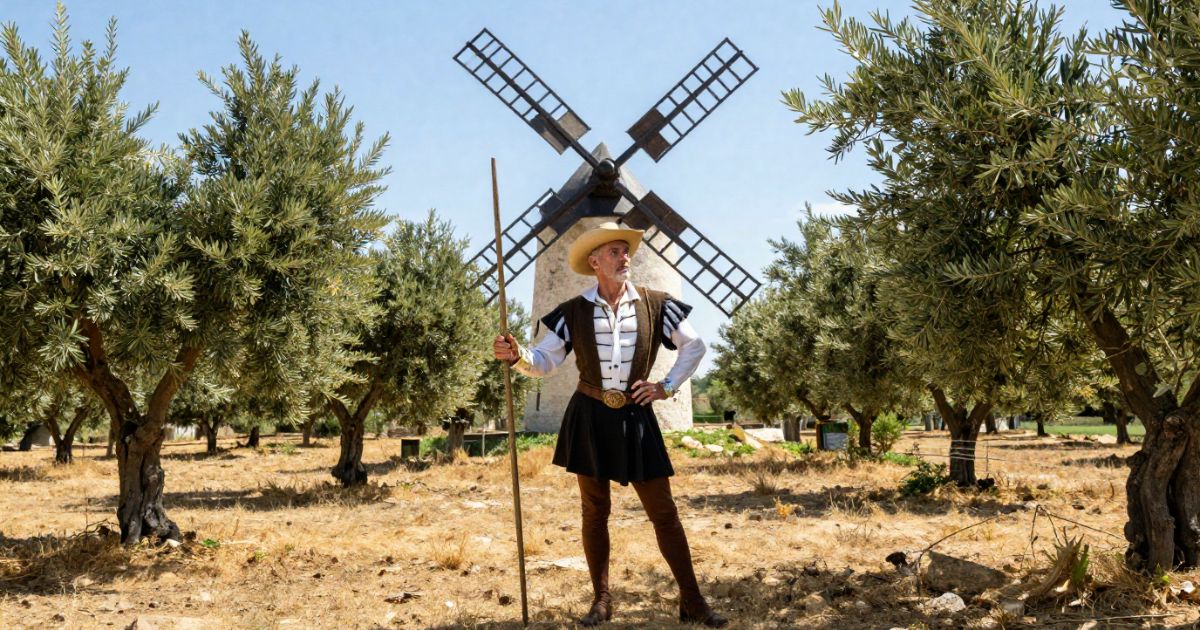
An excerpt from the original text.(complete · 3655 words)
WHICH IS ENDED THE STORY OF THE SHEPHERDESS MARCELA, WITH OTHER
INCIDENTS
But hardly had day begun to show itself through the balconies of the
east, when five of the six goatherds came to rouse Don Quixote and tell
him that if he was still of a mind to go and see the famous burial of
Chrysostom they would bear him company. Don Quixote, who desired
nothing better, rose and ordered Sancho to saddle and pannel at once,
which he did with all despatch, and with the same they all set out
forthwith. They had not gone a quarter of a league when at the meeting
of two paths they saw coming towards them some six shepherds dressed in
black sheepskins and with their heads crowned with garlands of cypress
and bitter oleander. Each of them carried a stout holly staff in his
hand, and along with them there came two men of quality on horseback in
handsome travelling dress, with three servants on foot accompanying
them. Courteous salutations were exchanged on meeting, and inquiring
one of the other which way each party was going, they learned that all
were bound for the scene of the burial, so they went on all together.
One of those on horseback addressing his companion said to him, “It
seems to me, Señor Vivaldo, that we may reckon as well spent the delay
we shall incur in seeing this remarkable funeral, for remarkable it
cannot but be judging by the strange things these shepherds have told
us, of both the dead shepherd and homicide shepherdess.”
“So I think too,” replied Vivaldo, “and I would delay not to say a day,
but four, for the sake of seeing it.”
Don Quixote asked them what it was they had heard of Marcela and
Chrysostom. The traveller answered that the same morning they had met
these shepherds, and seeing them dressed in this mournful fashion they
had asked them the reason of their appearing in such a guise; which one
of them gave, describing the strange behaviour and beauty of a
shepherdess called Marcela, and the loves of many who courted her,
together with the death of that Chrysostom to whose burial they were
going. In short, he repeated all that Pedro had related to Don Quixote.
This conversation dropped, and another was commenced by him who was
called Vivaldo asking Don Quixote what was the reason that led him to
go armed in that fashion in a country so peaceful. To which Don Quixote
replied, “The pursuit of my calling does not allow or permit me to go
in any other fashion; easy life, enjoyment, and repose were invented
for soft courtiers, but toil, unrest, and arms were invented and made
for those alone whom the world calls knights-errant, of whom I, though
unworthy, am the least of all.”
The instant they heard this all set him down as mad, and the better to
settle the point and discover what kind of madness his was, Vivaldo
proceeded to ask him what knights-errant meant.
“Have not your worships,” replied Don Quixote, “read the annals and
histories of England, in which are recorded the famous deeds of King
Arthur, whom we in our popular Castilian invariably call King Artus,
with regard to whom it is an ancient tradition, and commonly received
all over that kingdom of Great Britain, that this king did not die, but
was changed by magic art into a raven, and that in process of time he
is to return to reign and recover his kingdom and sceptre; for which
reason it cannot be proved that from that time to this any Englishman
ever killed a raven? Well, then, in the time of this good king that
famous order of chivalry of the Knights of the Round Table was
instituted, and the amour of Don Lancelot of the Lake with the Queen
Guinevere occurred, precisely as is there related, the go-between and
confidante therein being the highly honourable dame Quintañona, whence
came that ballad so well known and widely spread in our Spain—
O never surely was there knight
So served by hand of dame,
As served was he Sir Lancelot hight
When he from Britain came—
with all the sweet and delectable course of his achievements in love
and war. Handed down from that time, then, this order of chivalry went
on extending and spreading itself over many and various parts of the
world; and in it, famous and renowned for their deeds, were the mighty
Amadis of Gaul with all his sons and descendants to the fifth
generation, and the valiant Felixmarte of Hircania, and the never
sufficiently praised Tirante el Blanco, and in our own days almost we
have seen and heard and talked with the invincible knight Don Belianis
of Greece. This, then, sirs, is to be a knight-errant, and what I have
spoken of is the order of his chivalry, of which, as I have already
said, I, though a sinner, have made profession, and what the aforesaid
knights professed that same do I profess, and so I go through these
solitudes and wilds seeking adventures, resolved in soul to oppose my
arm and person to the most perilous that fortune may offer me in aid of
the weak and needy.”
By these words of his the travellers were able to satisfy themselves of
Don Quixote’s being out of his senses and of the form of madness that
overmastered him, at which they felt the same astonishment that all
felt on first becoming acquainted with it; and Vivaldo, who was a
person of great shrewdness and of a lively temperament, in order to
beguile the short journey which they said was required to reach the
mountain, the scene of the burial, sought to give him an opportunity of
going on with his absurdities. So he said to him, “It seems to me,
Señor Knight-errant, that your worship has made choice of one of the
most austere professions in the world, and I imagine even that of the
Carthusian monks is not so austere.”
“As austere it may perhaps be,” replied our Don Quixote, “but so
necessary for the world I am very much inclined to doubt. For, if the
truth is to be told, the soldier who executes what his captain orders
does no less than the captain himself who gives the order. My meaning,
is, that churchmen in peace and quiet pray to Heaven for the welfare of
the world, but we soldiers and knights carry into effect what they pray
for, defending it with the might of our arms and the edge of our
swords, not under shelter but in the open air, a target for the
intolerable rays of the sun in summer and the piercing frosts of
winter. Thus are we God’s ministers on earth and the arms by which his
justice is done therein. And as the business of war and all that
relates and belongs to it cannot be conducted without exceeding great
sweat, toil, and exertion, it follows that those who make it their
profession have undoubtedly more labour than those who in tranquil
peace and quiet are engaged in praying to God to help the weak. I do
not mean to say, nor does it enter into my thoughts, that the
knight-errant’s calling is as good as that of the monk in his cell; I
would merely infer from what I endure myself that it is beyond a doubt
a more laborious and a more belaboured one, a hungrier and thirstier, a
wretcheder, raggeder, and lousier; for there is no reason to doubt that
the knights-errant of yore endured much hardship in the course of their
lives. And if some of them by the might of their arms did rise to be
emperors, in faith it cost them dear in the matter of blood and sweat;
and if those who attained to that rank had not had magicians and sages
to help them they would have been completely baulked in their ambition
and disappointed in their hopes.”
“That is my own opinion,” replied the traveller; “but one thing among
many others seems to me very wrong in knights-errant, and that is that
when they find themselves about to engage in some mighty and perilous
adventure in which there is manifest danger of losing their lives, they
never at the moment of engaging in it think of commending themselves to
God, as is the duty of every good Christian in like peril; instead of
which they commend themselves to their ladies with as much devotion as
if these were their gods, a thing which seems to me to savour somewhat
of heathenism.”
“Sir,” answered Don Quixote, “that cannot be on any account omitted,
and the knight-errant would be disgraced who acted otherwise: for it is
usual and customary in knight-errantry that the knight-errant, who on
engaging in any great feat of arms has his lady before him, should turn
his eyes towards her softly and lovingly, as though with them
entreating her to favour and protect him in the hazardous venture he is
about to undertake, and even though no one hear him, he is bound to say
certain words between his teeth, commending himself to her with all his
heart, and of this we have innumerable instances in the histories. Nor
is it to be supposed from this that they are to omit commending
themselves to God, for there will be time and opportunity for doing so
while they are engaged in their task.”
“For all that,” answered the traveller, “I feel some doubt still,
because often I have read how words will arise between two
knights-errant, and from one thing to another it comes about that their
anger kindles and they wheel their horses round and take a good stretch
of field, and then without any more ado at the top of their speed they
come to the charge, and in mid-career they are wont to commend
themselves to their ladies; and what commonly comes of the encounter is
that one falls over the haunches of his horse pierced through and
through by his antagonist’s lance, and as for the other, it is only by
holding on to the mane of his horse that he can help falling to the
ground; but I know not how the dead man had time to commend himself to
God in the course of such rapid work as this; it would have been better
if those words which he spent in commending himself to his lady in the
midst of his career had been devoted to his duty and obligation as a
Christian. Moreover, it is my belief that all knights-errant have not
ladies to commend themselves to, for they are not all in love.”
“That is impossible,” said Don Quixote: “I say it is impossible that
there could be a knight-errant without a lady, because to such it is as
natural and proper to be in love as to the heavens to have stars: most
certainly no history has been seen in which there is to be found a
knight-errant without an amour, and for the simple reason that without
one he would be held no legitimate knight but a bastard, and one who
had gained entrance into the stronghold of the said knighthood, not by
the door, but over the wall like a thief and a robber.”
“Nevertheless,” said the traveller, “if I remember rightly, I think I
have read that Don Galaor, the brother of the valiant Amadis of Gaul,
never had any special lady to whom he might commend himself, and yet he
was not the less esteemed, and was a very stout and famous knight.”
To which our Don Quixote made answer, “Sir, one solitary swallow does
not make summer; moreover, I know that knight was in secret very deeply
in love; besides which, that way of falling in love with all that took
his fancy was a natural propensity which he could not control. But, in
short, it is very manifest that he had one alone whom he made mistress
of his will, to whom he commended himself very frequently and very
secretly, for he prided himself on being a reticent knight.”
“Then if it be essential that every knight-errant should be in love,”
said the traveller, “it may be fairly supposed that your worship is so,
as you are of the order; and if you do not pride yourself on being as
reticent as Don Galaor, I entreat you as earnestly as I can, in the
name of all this company and in my own, to inform us of the name,
country, rank, and beauty of your lady, for she will esteem herself
fortunate if all the world knows that she is loved and served by such a
knight as your worship seems to be.”
At this Don Quixote heaved a deep sigh and said, “I cannot say
positively whether my sweet enemy is pleased or not that the world
should know I serve her; I can only say in answer to what has been so
courteously asked of me, that her name is Dulcinea, her country El
Toboso, a village of La Mancha, her rank must be at least that of a
princess, since she is my queen and lady, and her beauty superhuman,
since all the impossible and fanciful attributes of beauty which the
poets apply to their ladies are verified in her; for her hairs are
gold, her forehead Elysian fields, her eyebrows rainbows, her eyes
suns, her cheeks roses, her lips coral, her teeth pearls, her neck
alabaster, her bosom marble, her hands ivory, her fairness snow, and
what modesty conceals from sight such, I think and imagine, as rational
reflection can only extol, not compare.”
“We should like to know her lineage, race, and ancestry,” said Vivaldo.
To which Don Quixote replied, “She is not of the ancient Roman Curtii,
Caii, or Scipios, nor of the modern Colonnas or Orsini, nor of the
Moncadas or Requesenes of Catalonia, nor yet of the Rebellas or
Villanovas of Valencia; Palafoxes, Nuzas, Rocabertis, Corellas, Lunas,
Alagones, Urreas, Foces, or Gurreas of Aragon; Cerdas, Manriques,
Mendozas, or Guzmans of Castile; Alencastros, Pallas, or Meneses of
Portugal; but she is of those of El Toboso of La Mancha, a lineage that
though modern, may furnish a source of gentle blood for the most
illustrious families of the ages that are to come, and this let none
dispute with me save on the condition that Zerbino placed at the foot
of the trophy of Orlando’s arms, saying,
These let none move
Who dareth not his might with Roland prove.”
“Although mine is of the Cachopins of Laredo,” said the traveller, “I
will not venture to compare it with that of El Toboso of La Mancha,
though, to tell the truth, no such surname has until now ever reached
my ears.”
“What!” said Don Quixote, “has that never reached them?”
The rest of the party went along listening with great attention to the
conversation of the pair, and even the very goatherds and shepherds
perceived how exceedingly out of his wits our Don Quixote was. Sancho
Panza alone thought that what his master said was the truth, knowing
who he was and having known him from his birth; and all that he felt
any difficulty in believing was that about the fair Dulcinea del
Toboso, because neither any such name nor any such princess had ever
come to his knowledge though he lived so close to El Toboso. They were
going along conversing in this way, when they saw descending a gap
between two high mountains some twenty shepherds, all clad in
sheepskins of black wool, and crowned with garlands which, as
afterwards appeared, were, some of them of yew, some of cypress. Six of
the number were carrying a bier covered with a great variety of flowers
and branches, on seeing which one of the goatherds said, “Those who
come there are the bearers of Chrysostom’s body, and the foot of that
mountain is the place where he ordered them to bury him.” They
therefore made haste to reach the spot, and did so by the time those
who came had laid the bier upon the ground, and four of them with sharp
pickaxes were digging a grave by the side of a hard rock. They greeted
each other courteously, and then Don Quixote and those who accompanied
him turned to examine the bier, and on it, covered with flowers, they
saw a dead body in the dress of a shepherd, to all appearance of one
thirty years of age, and showing even in death that in life he had been
of comely features and gallant bearing. Around him on the bier itself
were laid some books, and several papers open and folded; and those who
were looking on as well as those who were opening the grave and all the
others who were there preserved a strange silence, until one of those
who had borne the body said to another, “Observe carefully, Ambrosio if
this is the place Chrysostom spoke of, since you are anxious that what
he directed in his will should be so strictly complied with.”
“This is the place,” answered Ambrosio “for in it many a time did my
poor friend tell me the story of his hard fortune. Here it was, he told
me, that he saw for the first time that mortal enemy of the human race,
and here, too, for the first time he declared to her his passion, as
honourable as it was devoted, and here it was that at last Marcela
ended by scorning and rejecting him so as to bring the tragedy of his
wretched life to a close; here, in memory of misfortunes so great, he
desired to be laid in the bowels of eternal oblivion.” Then turning to
Don Quixote and the travellers he went on to say, “That body, sirs, on
which you are looking with compassionate eyes, was the abode of a soul
on which Heaven bestowed a vast share of its riches. That is the body
of Chrysostom, who was unrivalled in wit, unequalled in courtesy,
unapproached in gentle bearing, a phœnix in friendship, generous
without limit, grave without arrogance, gay without vulgarity, and, in
short, first in all that constitutes goodness and second to none in all
that makes up misfortune. He loved deeply, he was hated; he adored, he
was scorned; he wooed a wild beast, he pleaded with marble, he pursued
the wind, he cried to the wilderness, he served ingratitude, and for
reward was made the prey of death in the mid-course of life, cut short
by a shepherdess whom he sought to immortalise in the memory of man, as
these papers which you see could fully prove, had he not commanded me
to consign them to the fire after having consigned his body to the
earth.”
“You would deal with them more harshly and cruelly than their owner
himself,” said Vivaldo, “for it is neither right nor proper to do the
will of one who enjoins what is wholly unreasonable; it would not have
been reasonable in Augustus Cæsar had he permitted the directions left
by the divine Mantuan in his will to be carried into effect. So that,
Señor Ambrosio while you consign your friend’s body to the earth, you
should not consign his writings to oblivion, for if he gave the order
in bitterness of heart, it is not right that you should irrationally
obey it. On the contrary, by granting life to those papers, let the
cruelty of Marcela live for ever, to serve as a warning in ages to come
to all men to shun and avoid falling into like danger; or I and all of
us who have come here know already the story of this your love-stricken
and heart-broken friend, and we know, too, your friendship, and the
cause of his death, and the directions he gave at the close of his
life; from which sad story may be gathered how great was the cruelty of
Marcela, the love of Chrysostom, and the loyalty of your friendship,
together with the end awaiting those who pursue rashly the path that
insane passion opens to their eyes. Last night we learned the death of
Chrysostom and that he was to be buried here, and out of curiosity and
pity we left our direct road and resolved to come and see with our eyes
that which when heard of had so moved our compassion, and in
consideration of that compassion and our desire to prove it if we might
by condolence, we beg of you, excellent Ambrosio, or at least I on my
own account entreat you, that instead of burning those papers you allow
me to carry away some of them.”
And without waiting for the shepherd’s answer, he stretched out his
hand and took up some of those that were nearest to him; seeing which
Ambrosio said, “Out of courtesy, señor, I will grant your request as to
those you have taken, but it is idle to expect me to abstain from
burning the remainder.”
Vivaldo, who was eager to see what the papers contained, opened one of
them at once, and saw that its title was “Lay of Despair.”
Ambrosio hearing it said, “That is the last paper the unhappy man
wrote; and that you may see, señor, to what an end his misfortunes
brought him, read it so that you may be heard, for you will have time
enough for that while we are waiting for the grave to be dug.”
“I will do so very willingly,” said Vivaldo; and as all the bystanders
were equally eager they gathered round him, and he, reading in a loud
voice, found that it ran as follows.
c13e.jpg (15K)
Master this chapter. Complete your experience
Purchase the complete book to access all chapters and support classic literature
As an Amazon Associate, we earn a small commission from qualifying purchases at no additional cost to you.
Available in paperback, hardcover, and e-book formats
Let's Analyse the Pattern
The stronger our core beliefs are challenged, the more passionately we defend them rather than examining whether they serve us.
Why This Matters
Connect literature to life
This chapter teaches how to spot when passionate explanations mask inner doubt and fear.
Practice This Today
This week, notice when you find yourself giving elaborate explanations for your choices—that's your signal to pause and ask what you're really protecting.
Now let's explore the literary elements.
Key Quotes & Analysis
"What the soldier does in defending what his captain commands him, the knight-errant does in defending what his God commands him."
Context: When Vivaldo questions his sanity and purpose as a knight-errant
Don Quixote elevates his delusions to a religious calling, making his quest seem noble and divinely inspired. This shows how he transforms criticism into validation for his beliefs, refusing to acknowledge any contradiction between his ideals and reality.
In Today's Words:
I'm not crazy - I'm following a higher purpose that you just don't understand.
"It is the duty of knights-errant to have a lady to be enamoured of, for those who have not are like trees without leaves, buildings without foundations, and shadows without bodies that cast them."
Context: Explaining why he must have a lady to serve, even if she's imaginary
Don Quixote reveals that having an idealized love is essential to his identity as a knight. He uses poetic metaphors to justify his need for Dulcinea, showing how he romanticizes even the most basic human needs for connection and purpose.
In Today's Words:
A man needs a woman to inspire him, or else what's the point of anything?
"I know who I am, and I know too that I am capable of being not only all those I have mentioned, but all the Twelve Peers of France and all the Nine Worthies as well."
Context: When defending his identity against those who question his sanity
This shows Don Quixote's complete break from reality - he believes he can be any legendary hero he chooses. His certainty about his impossible identity reveals how deeply his delusions have taken root and how he's created an alternate reality to escape his mundane life.
In Today's Words:
I can be whoever I want to be, and I choose to be a hero.
Thematic Threads
Identity
In This Chapter
Don Quixote's entire sense of self depends on being a knight-errant, making any challenge to this role an existential threat
Development
Deepening from earlier chapters where his delusions seemed harmless—now we see how identity investment makes change nearly impossible
In Your Life:
You might recognize this when someone questions a role you've built your whole life around—parent, provider, caretaker—and you react with anger rather than curiosity
Class
In This Chapter
Don Quixote elevates knighthood above other professions, claiming knights protect what priests only pray for
Development
Continuing his need to justify his elevated status despite his obvious poverty and questionable sanity
In Your Life:
You see this when people defend their job's importance by putting down other work, especially when they feel insecure about their own position
Love
In This Chapter
The contrast between Chrysostom's destructive obsession with Marcela and Don Quixote's idealized devotion to imaginary Dulcinea
Development
Introduced here as a parallel to Don Quixote's delusions—both men love impossibly perfect women who don't really exist
In Your Life:
You might see this pattern when someone stays devoted to an idealized version of a person rather than accepting who they actually are
Social Expectations
In This Chapter
The travelers expect Don Quixote to behave rationally and are confused by his unwavering commitment to an obviously impossible mission
Development
Building on earlier encounters where society consistently fails to understand or accommodate Don Quixote's worldview
In Your Life:
You experience this when your life choices don't match what others expect, and you have to decide whether to conform or hold your ground
Human Relationships
In This Chapter
Sancho's loyalty despite knowing Don Quixote's beliefs are false, and Ambrosio's grief over his friend's self-destructive love
Development
Expanding the exploration of how we navigate relationships when someone we care about holds harmful or unrealistic beliefs
In Your Life:
You face this dilemma when someone you love is making choices you know are harmful, and you must balance support with honesty
You now have the context. Time to form your own thoughts.
Discussion Questions
- 1
When the travelers question Don Quixote's sanity, how does he respond? What does his defense reveal about how he sees himself?
analysis • surface - 2
Why does Don Quixote become more passionate in defending his beliefs when challenged, rather than questioning them? What is he really protecting?
analysis • medium - 3
Think of someone you know who gets defensive when their choices are questioned. What pattern do you see between their reaction and Don Quixote's elaborate justifications?
application • medium - 4
When you catch yourself building elaborate explanations for your choices after someone questions them, what should you do instead of getting defensive?
application • deep - 5
What does this chapter suggest about the difference between beliefs that serve us and beliefs that trap us? How can you tell which is which?
reflection • deep
Critical Thinking Exercise
Map Your Defense Patterns
Think of the last time someone questioned a major choice you made - your job, relationship, parenting style, or life direction. Write down exactly how you responded. Did you get defensive? Build elaborate justifications? Get angry? Now imagine you're an outside observer watching this conversation. What would you notice about your reaction pattern?
Consider:
- •What specific words or phrases do you use when defending your choices?
- •Do you attack the questioner's credibility rather than address their actual point?
- •How does your body language change when your core beliefs are challenged?
Journaling Prompt
Write about a belief or choice you defend passionately. Ask yourself: 'What would I lose if this weren't the right path?' That fear is what you're really protecting. Is that fear helping you grow or keeping you stuck?
Coming Up Next...
Chapter 34: Marcela's Defense and Chrysostom's Funeral
Chrysostom's final poem will be read aloud, revealing the depths of his obsession and the true nature of his relationship with Marcela. The verses promise to shed new light on whether his love was noble devotion or something darker.