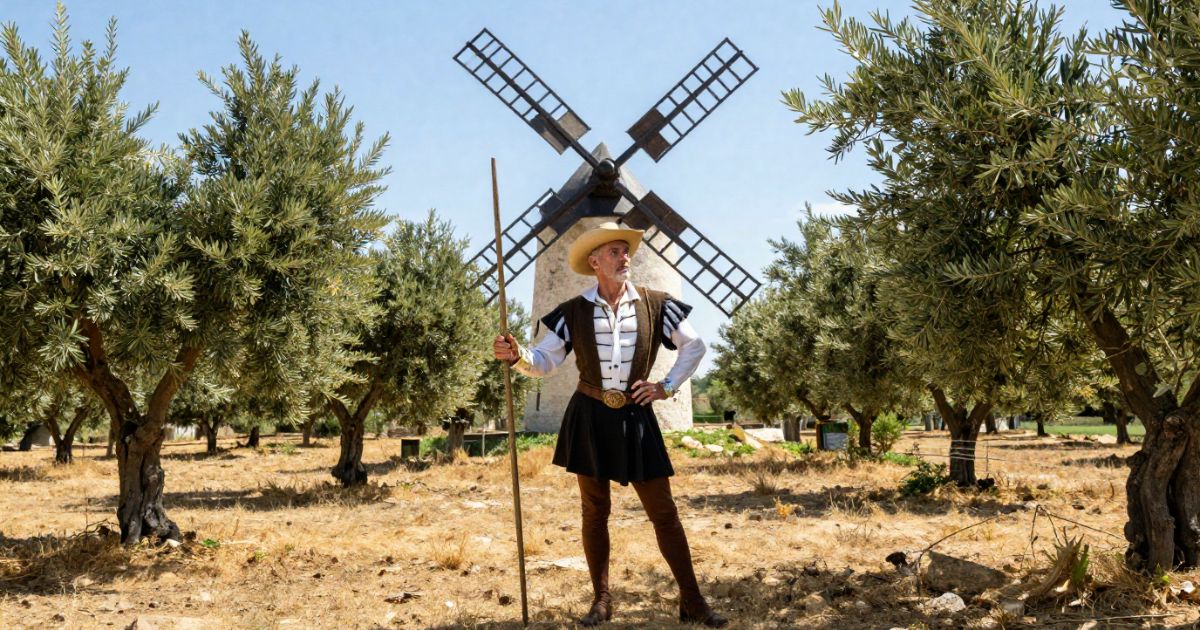
An excerpt from the original text.(complete · 2468 words)
OF WHAT A GOATHERD RELATED TO THOSE WITH DON QUIXOTE
Just then another young man, one of those who fetched their provisions
from the village, came up and said, “Do you know what is going on in
the village, comrades?”
“How could we know it?” replied one of them.
“Well, then, you must know,” continued the young man, “this morning
that famous student-shepherd called Chrysostom died, and it is rumoured
that he died of love for that devil of a village girl the daughter of
Guillermo the Rich, she that wanders about the wolds here in the dress
of a shepherdess.”
“You mean Marcela?” said one.
“Her I mean,” answered the goatherd; “and the best of it is, he has
directed in his will that he is to be buried in the fields like a Moor,
and at the foot of the rock where the Cork-tree spring is, because, as
the story goes (and they say he himself said so), that was the place
where he first saw her. And he has also left other directions which the
clergy of the village say should not and must not be obeyed because
they savour of paganism. To all which his great friend Ambrosio the
student, he who, like him, also went dressed as a shepherd, replies
that everything must be done without any omission according to the
directions left by Chrysostom, and about this the village is all in
commotion; however, report says that, after all, what Ambrosio and all
the shepherds his friends desire will be done, and to-morrow they are
coming to bury him with great ceremony where I said. I am sure it will
be something worth seeing; at least I will not fail to go and see it
even if I knew I should not return to the village to-morrow.”
“We will do the same,” answered the goatherds, “and cast lots to see
who must stay to mind the goats of all.”
“Thou sayest well, Pedro,” said one, “though there will be no need of
taking that trouble, for I will stay behind for all; and don’t suppose
it is virtue or want of curiosity in me; it is that the splinter that
ran into my foot the other day will not let me walk.”
“For all that, we thank thee,” answered Pedro.
Don Quixote asked Pedro to tell him who the dead man was and who the
shepherdess, to which Pedro replied that all he knew was that the dead
man was a wealthy gentleman belonging to a village in those mountains,
who had been a student at Salamanca for many years, at the end of which
he returned to his village with the reputation of being very learned
and deeply read. “Above all, they said, he was learned in the science
of the stars and of what went on yonder in the heavens and the sun and
the moon, for he told us of the cris of the sun and moon to exact
time.”
“Eclipse it is called, friend, not cris, the darkening of those two
luminaries,” said Don Quixote; but Pedro, not troubling himself with
trifles, went on with his story, saying, “Also he foretold when the
year was going to be one of abundance or estility.”
“Sterility, you mean,” said Don Quixote.
“Sterility or estility,” answered Pedro, “it is all the same in the
end. And I can tell you that by this his father and friends who
believed him grew very rich because they did as he advised them,
bidding them ‘sow barley this year, not wheat; this year you may sow
pulse and not barley; the next there will be a full oil crop, and the
three following not a drop will be got.’”
“That science is called astrology,” said Don Quixote.
“I do not know what it is called,” replied Pedro, “but I know that he
knew all this and more besides. But, to make an end, not many months
had passed after he returned from Salamanca, when one day he appeared
dressed as a shepherd with his crook and sheepskin, having put off the
long gown he wore as a scholar; and at the same time his great friend,
Ambrosio by name, who had been his companion in his studies, took to
the shepherd’s dress with him. I forgot to say that Chrysostom, who is
dead, was a great man for writing verses, so much so that he made
carols for Christmas Eve, and plays for Corpus Christi, which the young
men of our village acted, and all said they were excellent. When the
villagers saw the two scholars so unexpectedly appearing in shepherd’s
dress, they were lost in wonder, and could not guess what had led them
to make so extraordinary a change. About this time the father of our
Chrysostom died, and he was left heir to a large amount of property in
chattels as well as in land, no small number of cattle and sheep, and a
large sum of money, of all of which the young man was left dissolute
owner, and indeed he was deserving of it all, for he was a very good
comrade, and kind-hearted, and a friend of worthy folk, and had a
countenance like a benediction. Presently it came to be known that he
had changed his dress with no other object than to wander about these
wastes after that shepherdess Marcela our lad mentioned a while ago,
with whom the deceased Chrysostom had fallen in love. And I must tell
you now, for it is well you should know it, who this girl is; perhaps,
and even without any perhaps, you will not have heard anything like it
all the days of your life, though you should live more years than
sarna.”
“Say Sarra,” said Don Quixote, unable to endure the goatherd’s
confusion of words.
“The sarna lives long enough,” answered Pedro; “and if, señor, you must
go finding fault with words at every step, we shall not make an end of
it this twelvemonth.”
“Pardon me, friend,” said Don Quixote; “but, as there is such a
difference between sarna and Sarra, I told you of it; however, you have
answered very rightly, for sarna lives longer than Sarra: so continue
your story, and I will not object any more to anything.”
“I say then, my dear sir,” said the goatherd, “that in our village
there was a farmer even richer than the father of Chrysostom, who was
named Guillermo, and upon whom God bestowed, over and above great
wealth, a daughter at whose birth her mother died, the most respected
woman there was in this neighbourhood; I fancy I can see her now with
that countenance which had the sun on one side and the moon on the
other; and moreover active, and kind to the poor, for which I trust
that at the present moment her soul is in bliss with God in the other
world. Her husband Guillermo died of grief at the death of so good a
wife, leaving his daughter Marcela, a child and rich, to the care of an
uncle of hers, a priest and prebendary in our village. The girl grew up
with such beauty that it reminded us of her mother’s, which was very
great, and yet it was thought that the daughter’s would exceed it; and
so when she reached the age of fourteen to fifteen years nobody beheld
her but blessed God that had made her so beautiful, and the greater
number were in love with her past redemption. Her uncle kept her in
great seclusion and retirement, but for all that the fame of her great
beauty spread so that, as well for it as for her great wealth, her
uncle was asked, solicited, and importuned, to give her in marriage not
only by those of our town but of those many leagues round, and by the
persons of highest quality in them. But he, being a good Christian man,
though he desired to give her in marriage at once, seeing her to be old
enough, was unwilling to do so without her consent, not that he had any
eye to the gain and profit which the custody of the girl’s property
brought him while he put off her marriage; and, faith, this was said in
praise of the good priest in more than one set in the town. For I would
have you know, Sir Errant, that in these little villages everything is
talked about and everything is carped at, and rest assured, as I am,
that the priest must be over and above good who forces his parishioners
to speak well of him, especially in villages.”
“That is the truth,” said Don Quixote; “but go on, for the story is
very good, and you, good Pedro, tell it with very good grace.”
“May that of the Lord not be wanting to me,” said Pedro; “that is the
one to have. To proceed; you must know that though the uncle put before
his niece and described to her the qualities of each one in particular
of the many who had asked her in marriage, begging her to marry and
make a choice according to her own taste, she never gave any other
answer than that she had no desire to marry just yet, and that being so
young she did not think herself fit to bear the burden of matrimony. At
these, to all appearance, reasonable excuses that she made, her uncle
ceased to urge her, and waited till she was somewhat more advanced in
age and could mate herself to her own liking. For, said he—and he said
quite right—parents are not to settle children in life against their
will. But when one least looked for it, lo and behold! one day the
demure Marcela makes her appearance turned shepherdess; and, in spite
of her uncle and all those of the town that strove to dissuade her,
took to going a-field with the other shepherd-lasses of the village,
and tending her own flock. And so, since she appeared in public, and
her beauty came to be seen openly, I could not well tell you how many
rich youths, gentlemen and peasants, have adopted the costume of
Chrysostom, and go about these fields making love to her. One of these,
as has been already said, was our deceased friend, of whom they say
that he did not love but adore her. But you must not suppose, because
Marcela chose a life of such liberty and independence, and of so little
or rather no retirement, that she has given any occasion, or even the
semblance of one, for disparagement of her purity and modesty; on the
contrary, such and so great is the vigilance with which she watches
over her honour, that of all those that court and woo her not one has
boasted, or can with truth boast, that she has given him any hope
however small of obtaining his desire. For although she does not avoid
or shun the society and conversation of the shepherds, and treats them
courteously and kindly, should any one of them come to declare his
intention to her, though it be one as proper and holy as that of
matrimony, she flings him from her like a catapult. And with this kind
of disposition she does more harm in this country than if the plague
had got into it, for her affability and her beauty draw on the hearts
of those that associate with her to love her and to court her, but her
scorn and her frankness bring them to the brink of despair; and so they
know not what to say save to proclaim her aloud cruel and hard-hearted,
and other names of the same sort which well describe the nature of her
character; and if you should remain here any time, señor, you would
hear these hills and valleys resounding with the laments of the
rejected ones who pursue her. Not far from this there is a spot where
there are a couple of dozen of tall beeches, and there is not one of
them but has carved and written on its smooth bark the name of Marcela,
and above some a crown carved on the same tree as though her lover
would say more plainly that Marcela wore and deserved that of all human
beauty. Here one shepherd is sighing, there another is lamenting; there
love songs are heard, here despairing elegies. One will pass all the
hours of the night seated at the foot of some oak or rock, and there,
without having closed his weeping eyes, the sun finds him in the
morning bemused and bereft of sense; and another without relief or
respite to his sighs, stretched on the burning sand in the full heat of
the sultry summer noontide, makes his appeal to the compassionate
heavens, and over one and the other, over these and all, the beautiful
Marcela triumphs free and careless. And all of us that know her are
waiting to see what her pride will come to, and who is to be the happy
man that will succeed in taming a nature so formidable and gaining
possession of a beauty so supreme. All that I have told you being such
well-established truth, I am persuaded that what they say of the cause
of Chrysostom’s death, as our lad told us, is the same. And so I advise
you, señor, fail not to be present to-morrow at his burial, which will
be well worth seeing, for Chrysostom had many friends, and it is not
half a league from this place to where he directed he should be
buried.”
“I will make a point of it,” said Don Quixote, “and I thank you for the
pleasure you have given me by relating so interesting a tale.”
“Oh,” said the goatherd, “I do not know even the half of what has
happened to the lovers of Marcela, but perhaps to-morrow we may fall in
with some shepherd on the road who can tell us; and now it will be well
for you to go and sleep under cover, for the night air may hurt your
wound, though with the remedy I have applied to you there is no fear of
an untoward result.”
Sancho Panza, who was wishing the goatherd’s loquacity at the devil, on
his part begged his master to go into Pedro’s hut to sleep. He did so,
and passed all the rest of the night in thinking of his lady Dulcinea,
in imitation of the lovers of Marcela. Sancho Panza settled himself
between Rocinante and his ass, and slept, not like a lover who had been
discarded, but like a man who had been soundly kicked.
c12e.jpg (42K)
Master this chapter. Complete your experience
Purchase the complete book to access all chapters and support classic literature
As an Amazon Associate, we earn a small commission from qualifying purchases at no additional cost to you.
Available in paperback, hardcover, and e-book formats
Let's Analyse the Pattern
When someone's gifts or qualities create unrealistic expectations that make every choice wrong in others' eyes.
Why This Matters
Connect literature to life
This chapter teaches how to spot when others reframe your normal boundaries as character flaws to manipulate your behavior.
Practice This Today
This week, notice when someone makes your 'no' about your morality rather than their disappointment—that's the pattern in action.
Now let's explore the literary elements.
Key Quotes & Analysis
"he died of love for that devil of a village girl"
Context: When explaining Chrysostom's death to Don Quixote and his companions
Shows how the community blames Marcela for Chrysostom's death simply because she wouldn't return his love. The word 'devil' reveals the misogyny - a woman who won't submit is seen as evil.
In Today's Words:
He killed himself over that heartless girl who wouldn't give him the time of day
"he is to be buried in the fields like a Moor"
Context: Describing Chrysostom's scandalous burial instructions
Reveals the religious and cultural tensions of the time. Being buried 'like a Moor' (Muslim) was shocking to Christian villagers and showed Chrysostom's complete rejection of social norms.
In Today's Words:
He wants to be buried outside the cemetery like some kind of heathen
"the village is all in commotion"
Context: Describing the community's reaction to the burial controversy
Shows how individual choices become public entertainment in small communities. Everyone has an opinion about private matters that don't really affect them.
In Today's Words:
The whole town is losing their minds over this drama
Thematic Threads
Individual Freedom
In This Chapter
Marcela chooses independence over marriage despite social pressure and consequences
Development
Builds on Don Quixote's own rejection of conventional life for his chosen path
In Your Life:
You might face pressure to conform to others' expectations about how you should use your talents or live your life
Social Expectations
In This Chapter
The village expects beautiful women to marry and fulfill others' romantic fantasies
Development
Continues the theme of society demanding conformity to traditional roles
In Your Life:
You might encounter situations where your community has unspoken rules about what people like you 'should' do
Destructive Love
In This Chapter
Chrysostom's unrequited love becomes obsession that literally kills him
Development
Contrasts with Don Quixote's idealized but life-giving love for Dulcinea
In Your Life:
You might recognize when attraction becomes unhealthy fixation that harms rather than nurtures
Class and Privilege
In This Chapter
Wealthy Marcela has choices unavailable to poor women, but those choices bring their own burdens
Development
Explores how privilege creates different but still limiting expectations
In Your Life:
You might see how having advantages in one area can create pressure and resentment in unexpected ways
Community Judgment
In This Chapter
The village creates entertainment from Marcela's story, turning her life into public spectacle
Development
Shows how communities police individual choices through gossip and narrative
In Your Life:
You might notice how your personal decisions become topics of discussion and judgment among people who barely know you
You now have the context. Time to form your own thoughts.
Discussion Questions
- 1
What impossible choice does Marcela face, and how does the community react to whatever she decides?
analysis • surface - 2
Why does the community blame Marcela for Chrysostom's death when she never promised him anything?
analysis • medium - 3
Where do you see people today being blamed for others' reactions to their normal boundaries or choices?
application • medium - 4
How would you handle a situation where your talents or qualities make others expect you to sacrifice your own needs?
application • deep - 5
What does this story reveal about how communities punish people who don't conform to expected roles?
reflection • deep
Critical Thinking Exercise
Rewrite the Village Gossip
Imagine you're a villager who actually knows Marcela personally, not just the dramatic stories about her. Write a short defense of her choices that you might give to counter the gossip. Focus on her actual behavior versus the stories people tell about her motives.
Consider:
- •What facts about Marcela's behavior do we actually know versus assumptions?
- •How might her story sound different if told by someone who respects her autonomy?
- •What would you want people to understand about your own difficult choices?
Journaling Prompt
Write about a time when others had strong opinions about a choice you made for your own wellbeing. How did their reactions affect you, and what would you want them to understand about your situation?
Coming Up Next...
Chapter 33: The Knight's Philosophy on Love and Duty
Don Quixote will witness Chrysostom's unconventional funeral, where the community gathers to see how this tragic love story ends. But will the mysterious Marcela herself appear to defend her choices?