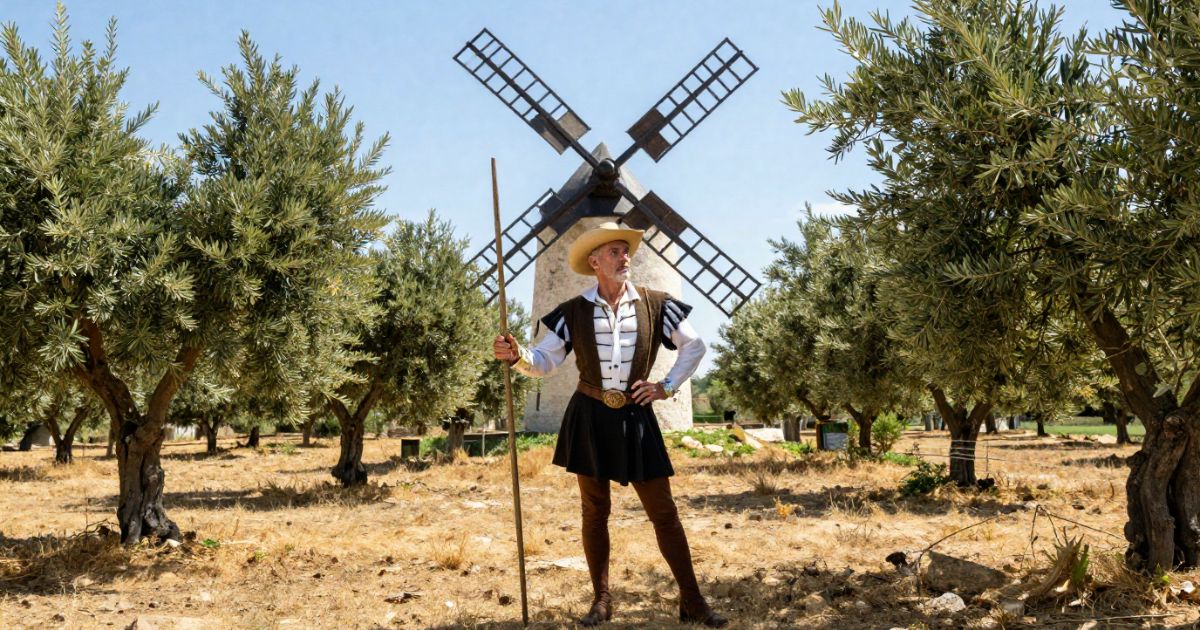
An excerpt from the original text.(complete · 2207 words)
WHAT BEFELL DON QUIXOTE WITH CERTAIN GOATHERDS
He was cordially welcomed by the goatherds, and Sancho, having as best
he could put up Rocinante and the ass, drew towards the fragrance that
came from some pieces of salted goat simmering in a pot on the fire;
and though he would have liked at once to try if they were ready to be
transferred from the pot to the stomach, he refrained from doing so as
the goatherds removed them from the fire, and laying sheepskins on the
ground, quickly spread their rude table, and with signs of hearty
good-will invited them both to share what they had. Round the skins six
of the men belonging to the fold seated themselves, having first with
rough politeness pressed Don Quixote to take a seat upon a trough which
they placed for him upside down. Don Quixote seated himself, and Sancho
remained standing to serve the cup, which was made of horn. Seeing him
standing, his master said to him:
“That thou mayest see, Sancho, the good that knight-errantry contains
in itself, and how those who fill any office in it are on the high road
to be speedily honoured and esteemed by the world, I desire that thou
seat thyself here at my side and in the company of these worthy people,
and that thou be one with me who am thy master and natural lord, and
that thou eat from my plate and drink from whatever I drink from; for
the same may be said of knight-errantry as of love, that it levels
all.”
“Great thanks,” said Sancho, “but I may tell your worship that provided
I have enough to eat, I can eat it as well, or better, standing, and by
myself, than seated alongside of an emperor. And indeed, if the truth
is to be told, what I eat in my corner without form or fuss has much
more relish for me, even though it be bread and onions, than the
turkeys of those other tables where I am forced to chew slowly, drink
little, wipe my mouth every minute, and cannot sneeze or cough if I
want or do other things that are the privileges of liberty and
solitude. So, señor, as for these honours which your worship would put
upon me as a servant and follower of knight-errantry, exchange them for
other things which may be of more use and advantage to me; for these,
though I fully acknowledge them as received, I renounce from this
moment to the end of the world.”
“For all that,” said Don Quixote, “thou must seat thyself, because him
who humbleth himself God exalteth;” and seizing him by the arm he
forced him to sit down beside himself.
The goatherds did not understand this jargon about squires and
knights-errant, and all they did was to eat in silence and stare at
their guests, who with great elegance and appetite were stowing away
pieces as big as one’s fist. The course of meat finished, they spread
upon the sheepskins a great heap of parched acorns, and with them they
put down a half cheese harder than if it had been made of mortar. All
this while the horn was not idle, for it went round so constantly, now
full, now empty, like the bucket of a water-wheel, that it soon drained
one of the two wine-skins that were in sight. When Don Quixote had
quite appeased his appetite he took up a handful of the acorns, and
contemplating them attentively delivered himself somewhat in this
fashion:
“Happy the age, happy the time, to which the ancients gave the name of
golden, not because in that fortunate age the gold so coveted in this
our iron one was gained without toil, but because they that lived in it
knew not the two words “mine” and “thine”! In that blessed age all
things were in common; to win the daily food no labour was required of
any save to stretch forth his hand and gather it from the sturdy oaks
that stood generously inviting him with their sweet ripe fruit. The
clear streams and running brooks yielded their savoury limpid waters in
noble abundance. The busy and sagacious bees fixed their republic in
the clefts of the rocks and hollows of the trees, offering without
usance the plenteous produce of their fragrant toil to every hand. The
mighty cork trees, unenforced save of their own courtesy, shed the
broad light bark that served at first to roof the houses supported by
rude stakes, a protection against the inclemency of heaven alone. Then
all was peace, all friendship, all concord; as yet the dull share of
the crooked plough had not dared to rend and pierce the tender bowels
of our first mother that without compulsion yielded from every portion
of her broad fertile bosom all that could satisfy, sustain, and delight
the children that then possessed her. Then was it that the innocent and
fair young shepherdess roamed from vale to vale and hill to hill, with
flowing locks, and no more garments than were needful modestly to cover
what modesty seeks and ever sought to hide. Nor were their ornaments
like those in use to-day, set off by Tyrian purple, and silk tortured
in endless fashions, but the wreathed leaves of the green dock and ivy,
wherewith they went as bravely and becomingly decked as our Court dames
with all the rare and far-fetched artifices that idle curiosity has
taught them. Then the love-thoughts of the heart clothed themselves
simply and naturally as the heart conceived them, nor sought to commend
themselves by forced and rambling verbiage. Fraud, deceit, or malice
had then not yet mingled with truth and sincerity. Justice held her
ground, undisturbed and unassailed by the efforts of favour and of
interest, that now so much impair, pervert, and beset her. Arbitrary
law had not yet established itself in the mind of the judge, for then
there was no cause to judge and no one to be judged. Maidens and
modesty, as I have said, wandered at will alone and unattended, without
fear of insult from lawlessness or libertine assault, and if they were
undone it was of their own will and pleasure. But now in this hateful
age of ours not one is safe, not though some new labyrinth like that of
Crete conceal and surround her; even there the pestilence of gallantry
will make its way to them through chinks or on the air by the zeal of
its accursed importunity, and, despite of all seclusion, lead them to
ruin. In defence of these, as time advanced and wickedness increased,
the order of knights-errant was instituted, to defend maidens, to
protect widows and to succour the orphans and the needy. To this order
I belong, brother goatherds, to whom I return thanks for the
hospitality and kindly welcome ye offer me and my squire; for though by
natural law all living are bound to show favour to knights-errant, yet,
seeing that without knowing this obligation ye have welcomed and
feasted me, it is right that with all the good-will in my power I
should thank you for yours.”
All this long harangue (which might very well have been spared) our
knight delivered because the acorns they gave him reminded him of the
golden age; and the whim seized him to address all this unnecessary
argument to the goatherds, who listened to him gaping in amazement
without saying a word in reply. Sancho likewise held his peace and ate
acorns, and paid repeated visits to the second wine-skin, which they
had hung up on a cork tree to keep the wine cool.
Don Quixote was longer in talking than the supper in finishing, at the
end of which one of the goatherds said, “That your worship, señor
knight-errant, may say with more truth that we show you hospitality
with ready good-will, we will give you amusement and pleasure by making
one of our comrades sing: he will be here before long, and he is a very
intelligent youth and deep in love, and what is more he can read and
write and play on the rebeck to perfection.”
The goatherd had hardly done speaking, when the notes of the rebeck
reached their ears; and shortly after, the player came up, a very
good-looking young man of about two-and-twenty. His comrades asked him
if he had supped, and on his replying that he had, he who had already
made the offer said to him:
“In that case, Antonio, thou mayest as well do us the pleasure of
singing a little, that the gentleman, our guest, may see that even in
the mountains and woods there are musicians: we have told him of thy
accomplishments, and we want thee to show them and prove that we say
true; so, as thou livest, pray sit down and sing that ballad about thy
love that thy uncle the prebendary made thee, and that was so much
liked in the town.”
“With all my heart,” said the young man, and without waiting for more
pressing he seated himself on the trunk of a felled oak, and tuning his
rebeck, presently began to sing to these words.
ANTONIO’S BALLAD
Thou dost love me well, Olalla;
Well I know it, even though
Love’s mute tongues, thine eyes, have never
By their glances told me so.
For I know my love thou knowest,
Therefore thine to claim I dare:
Once it ceases to be secret,
Love need never feel despair.
True it is, Olalla, sometimes
Thou hast all too plainly shown
That thy heart is brass in hardness,
And thy snowy bosom stone.
Yet for all that, in thy coyness,
And thy fickle fits between,
Hope is there—at least the border
Of her garment may be seen.
Lures to faith are they, those glimpses,
And to faith in thee I hold;
Kindness cannot make it stronger,
Coldness cannot make it cold.
If it be that love is gentle,
In thy gentleness I see
Something holding out assurance
To the hope of winning thee.
If it be that in devotion
Lies a power hearts to move,
That which every day I show thee,
Helpful to my suit should prove.
Many a time thou must have noticed—
If to notice thou dost care—
How I go about on Monday
Dressed in all my Sunday wear.
Love’s eyes love to look on brightness;
Love loves what is gaily drest;
Sunday, Monday, all I care is
Thou shouldst see me in my best.
No account I make of dances,
Or of strains that pleased thee so,
Keeping thee awake from midnight
Till the cocks began to crow;
Or of how I roundly swore it
That there’s none so fair as thou;
True it is, but as I said it,
By the girls I’m hated now.
For Teresa of the hillside
At my praise of thee was sore;
Said, “You think you love an angel;
It’s a monkey you adore;
“Caught by all her glittering trinkets,
And her borrowed braids of hair,
And a host of made-up beauties
That would Love himself ensnare.”
’Twas a lie, and so I told her,
And her cousin at the word
Gave me his defiance for it;
And what followed thou hast heard.
Mine is no high-flown affection,
Mine no passion par amours—
As they call it—what I offer
Is an honest love, and pure.
Cunning cords the holy Church has,
Cords of softest silk they be;
Put thy neck beneath the yoke, dear;
Mine will follow, thou wilt see.
Else—and once for all I swear it
By the saint of most renown—
If I ever quit the mountains,
’Twill be in a friar’s gown.
Here the goatherd brought his song to an end, and though Don Quixote
entreated him to sing more, Sancho had no mind that way, being more
inclined for sleep than for listening to songs; so said he to his
master, “Your worship will do well to settle at once where you mean to
pass the night, for the labour these good men are at all day does not
allow them to spend the night in singing.”
“I understand thee, Sancho,” replied Don Quixote; “I perceive clearly
that those visits to the wine-skin demand compensation in sleep rather
than in music.”
“It’s sweet to us all, blessed be God,” said Sancho.
“I do not deny it,” replied Don Quixote; “but settle thyself where thou
wilt; those of my calling are more becomingly employed in watching than
in sleeping; still it would be as well if thou wert to dress this ear
for me again, for it is giving me more pain than it need.”
Sancho did as he bade him, but one of the goatherds, seeing the wound,
told him not to be uneasy, as he would apply a remedy with which it
would be soon healed; and gathering some leaves of rosemary, of which
there was a great quantity there, he chewed them and mixed them with a
little salt, and applying them to the ear he secured them firmly with a
bandage, assuring him that no other treatment would be required, and so
it proved.
c11e.jpg (37K)
Master this chapter. Complete your experience
Purchase the complete book to access all chapters and support classic literature
As an Amazon Associate, we earn a small commission from qualifying purchases at no additional cost to you.
Available in paperback, hardcover, and e-book formats
Let's Analyse the Pattern
When someone tries to elevate your status through ceremony or gesture, it feels uncomfortable because authentic dignity comes from being true to yourself, not from borrowed status.
Why This Matters
Connect literature to life
This chapter teaches how to distinguish between genuine respect and performative elevation that serves someone else's agenda.
Practice This Today
This week, notice when someone suddenly treats you differently after learning your job title, income, or connections—trust your gut about whether it feels authentic or calculated.
Now let's explore the literary elements.
Key Quotes & Analysis
"That thou mayest see, Sancho, the good that knight-errantry contains in itself, and how those who fill any office in it are on the high road to be speedily honoured and esteemed by the world, I desire that thou seat thyself here at my side"
Context: Don Quixote insists Sancho sit beside him as an equal at the goatherds' meal
This shows Don Quixote's genuine belief in equality and his desire to elevate his servant. However, it also reveals his need to turn every moment into a lesson about his knightly mission.
In Today's Words:
Sit next to me so people can see that working with me makes you important too
"I am very well here, and if you will give me leave, sir, I will eat standing, and by myself, though it were in a corner"
Context: Sancho's polite refusal of Don Quixote's offer to sit as his equal
Sancho understands that real dignity comes from being comfortable with who you are, not from artificial ceremonies. His wisdom often surpasses his master's grand gestures.
In Today's Words:
Thanks, but I'm good eating over here where I can relax and be myself
"Happy the age, happy the time, to which the ancients gave the name of golden, not because gold was then abundant, but because those who lived in it knew not the two words 'mine' and 'thine'"
Context: The beginning of his long speech about the Golden Age triggered by eating acorns
Don Quixote romanticizes a past that never existed while missing the genuine goodness happening right in front of him with the goatherds' hospitality.
In Today's Words:
Back in the day, people didn't fight over stuff because nobody was greedy like they are now
Thematic Threads
Class
In This Chapter
Sancho politely refuses Don Quixote's attempt to elevate his social position, preferring authentic comfort to artificial ceremony
Development
Evolved from earlier class tensions - now showing how working-class wisdom can reject false elevation
In Your Life:
You might feel this when someone suddenly treats you differently after learning your job title or income level
Identity
In This Chapter
Sancho demonstrates that knowing who you are means not needing to pretend to be someone else, even when offered the chance
Development
Building on Sancho's growing self-awareness - he's becoming more confident in his authentic self
In Your Life:
You experience this when staying true to yourself feels more important than impressing others
Social Expectations
In This Chapter
Don Quixote expects ceremony and hierarchy while the goatherds offer genuine hospitality without pretense
Development
Continuing contrast between artificial social rules and natural human warmth
In Your Life:
You see this in the difference between formal workplace interactions and genuine connections with colleagues
Human Relationships
In This Chapter
The goatherds show real community through sharing food and stories, while Don Quixote pontificates about imaginary golden ages
Development
Reinforcing that authentic relationships are built on present reality, not idealized fantasies
In Your Life:
You experience this when someone's grand promises matter less than their everyday kindness
Personal Growth
In This Chapter
Sancho's polite refusal shows growth in self-knowledge - he knows what honors him and what doesn't
Development
Sancho is becoming more sophisticated in understanding dignity versus status
In Your Life:
You feel this when you're confident enough to decline opportunities that don't align with who you really are
You now have the context. Time to form your own thoughts.
Discussion Questions
- 1
Why does Sancho politely refuse to sit beside Don Quixote as an equal, even though it would give him higher status?
analysis • surface - 2
What's the difference between the goatherds' genuine hospitality and Don Quixote's attempt to create artificial equality through seating arrangements?
analysis • medium - 3
Think about times when someone has tried to elevate your status artificially - at work, in family situations, or socially. How did it feel different from genuine respect?
application • medium - 4
When facing artificial honor that doesn't match your reality, how can you respond like Sancho - appreciating the gesture while staying true to yourself?
application • deep - 5
What does Sancho's response teach us about the relationship between authentic dignity and borrowed status?
reflection • deep
Critical Thinking Exercise
Spot the Artificial Honor
Think of three situations where someone offered you artificial elevation or honor that felt uncomfortable or forced. For each situation, identify what made it feel artificial versus genuine respect. Then consider how you could respond authentically while still being gracious, like Sancho did.
Consider:
- •Notice the difference between consistent actions and grand gestures
- •Pay attention to whether the elevation matches your actual relationship with the person
- •Consider whether the honor comes with strings attached or expectations
Journaling Prompt
Write about a time when you felt pressured to accept artificial status or honor. How did you handle it, and what would you do differently now that you understand this pattern?
Coming Up Next...
Chapter 32: The Shepherdess Who Breaks Hearts
A messenger arrives from the village with news that will interrupt the peaceful evening. The goatherds are about to share a story that will reveal how even in remote mountains, the complications of love and betrayal find their way to disrupt simple lives.