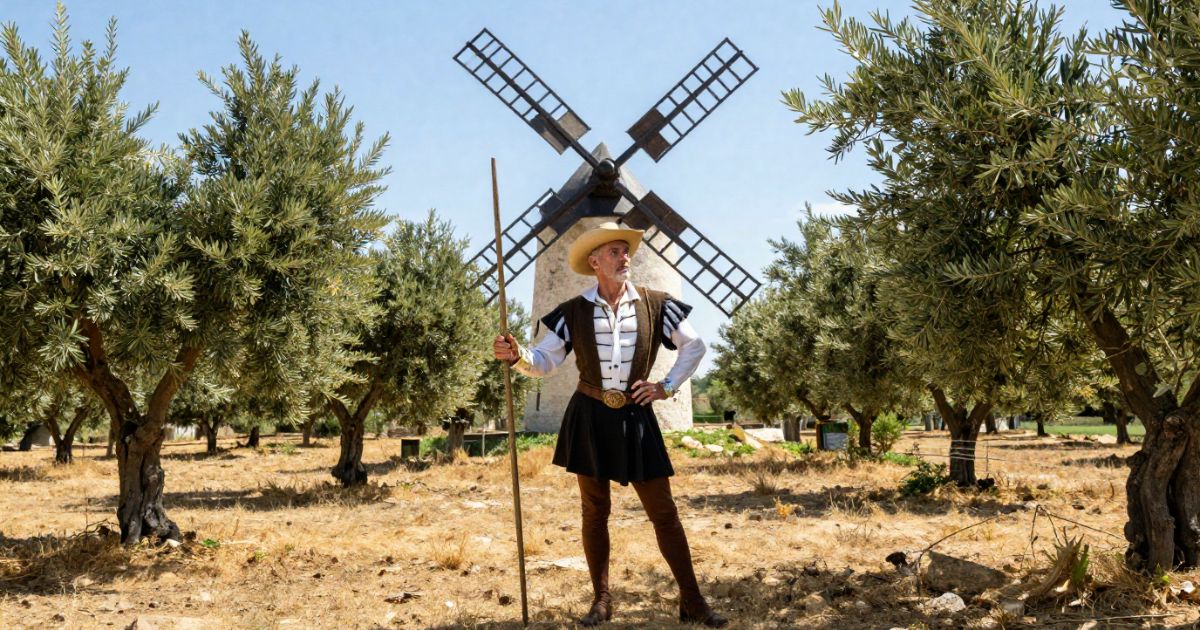
An excerpt from the original text.(complete · 2520 words)
WHEREIN IS RELATED THE DROLL WAY IN WHICH DON QUIXOTE HAD HIMSELF
DUBBED A KNIGHT
Harassed by this reflection, he made haste with his scanty pothouse
supper, and having finished it called the landlord, and shutting
himself into the stable with him, fell on his knees before him, saying,
“From this spot I rise not, valiant knight, until your courtesy grants
me the boon I seek, one that will redound to your praise and the
benefit of the human race.” The landlord, seeing his guest at his feet
and hearing a speech of this kind, stood staring at him in
bewilderment, not knowing what to do or say, and entreating him to
rise, but all to no purpose until he had agreed to grant the boon
demanded of him. “I looked for no less, my lord, from your High
Magnificence,” replied Don Quixote, “and I have to tell you that the
boon I have asked and your liberality has granted is that you shall dub
me knight to-morrow morning, and that to-night I shall watch my arms in
the chapel of this your castle; thus to-morrow, as I have said, will be
accomplished what I so much desire, enabling me lawfully to roam
through all the four quarters of the world seeking adventures on behalf
of those in distress, as is the duty of chivalry and of knights-errant
like myself, whose ambition is directed to such deeds.”
The landlord, who, as has been mentioned, was something of a wag, and
had already some suspicion of his guest’s want of wits, was quite
convinced of it on hearing talk of this kind from him, and to make
sport for the night he determined to fall in with his humour. So he
told him he was quite right in pursuing the object he had in view, and
that such a motive was natural and becoming in cavaliers as
distinguished as he seemed and his gallant bearing showed him to be;
and that he himself in his younger days had followed the same
honourable calling, roaming in quest of adventures in various parts of
the world, among others the Curing-grounds of Malaga, the Isles of
Riaran, the Precinct of Seville, the Little Market of Segovia, the
Olivera of Valencia, the Rondilla of Granada, the Strand of San Lucar,
the Colt of Cordova, the Taverns of Toledo, and divers other quarters,
where he had proved the nimbleness of his feet and the lightness of his
fingers, doing many wrongs, cheating many widows, ruining maids and
swindling minors, and, in short, bringing himself under the notice of
almost every tribunal and court of justice in Spain; until at last he
had retired to this castle of his, where he was living upon his
property and upon that of others; and where he received all
knights-errant of whatever rank or condition they might be, all for the
great love he bore them and that they might share their substance with
him in return for his benevolence. He told him, moreover, that in this
castle of his there was no chapel in which he could watch his armour,
as it had been pulled down in order to be rebuilt, but that in a case
of necessity it might, he knew, be watched anywhere, and he might watch
it that night in a courtyard of the castle, and in the morning, God
willing, the requisite ceremonies might be performed so as to have him
dubbed a knight, and so thoroughly dubbed that nobody could be more so.
He asked if he had any money with him, to which Don Quixote replied
that he had not a farthing, as in the histories of knights-errant he
had never read of any of them carrying any. On this point the landlord
told him he was mistaken; for, though not recorded in the histories,
because in the author’s opinion there was no need to mention anything
so obvious and necessary as money and clean shirts, it was not to be
supposed therefore that they did not carry them, and he might regard it
as certain and established that all knights-errant (about whom there
were so many full and unimpeachable books) carried well-furnished
purses in case of emergency, and likewise carried shirts and a little
box of ointment to cure the wounds they received. For in those plains
and deserts where they engaged in combat and came out wounded, it was
not always that there was someone to cure them, unless indeed they had
for a friend some sage magician to succour them at once by fetching
through the air upon a cloud some damsel or dwarf with a vial of water
of such virtue that by tasting one drop of it they were cured of their
hurts and wounds in an instant and left as sound as if they had not
received any damage whatever. But in case this should not occur, the
knights of old took care to see that their squires were provided with
money and other requisites, such as lint and ointments for healing
purposes; and when it happened that knights had no squires (which was
rarely and seldom the case) they themselves carried everything in
cunning saddle-bags that were hardly seen on the horse’s croup, as if
it were something else of more importance, because, unless for some
such reason, carrying saddle-bags was not very favourably regarded
among knights-errant. He therefore advised him (and, as his godson so
soon to be, he might even command him) never from that time forth to
travel without money and the usual requirements, and he would find the
advantage of them when he least expected it.
Don Quixote promised to follow his advice scrupulously, and it was
arranged forthwith that he should watch his armour in a large yard at
one side of the inn; so, collecting it all together, Don Quixote placed
it on a trough that stood by the side of a well, and bracing his
buckler on his arm he grasped his lance and began with a stately air to
march up and down in front of the trough, and as he began his march
night began to fall.
The landlord told all the people who were in the inn about the craze of
his guest, the watching of the armour, and the dubbing ceremony he
contemplated. Full of wonder at so strange a form of madness, they
flocked to see it from a distance, and observed with what composure he
sometimes paced up and down, or sometimes, leaning on his lance, gazed
on his armour without taking his eyes off it for ever so long; and as
the night closed in with a light from the moon so brilliant that it
might vie with his that lent it, everything the novice knight did was
plainly seen by all.
Meanwhile one of the carriers who were in the inn thought fit to water
his team, and it was necessary to remove Don Quixote’s armour as it lay
on the trough; but he seeing the other approach hailed him in a loud
voice, “O thou, whoever thou art, rash knight that comest to lay hands
on the armour of the most valorous errant that ever girt on sword, have
a care what thou dost; touch it not unless thou wouldst lay down thy
life as the penalty of thy rashness.” The carrier gave no heed to these
words (and he would have done better to heed them if he had been
heedful of his health), but seizing it by the straps flung the armour
some distance from him. Seeing this, Don Quixote raised his eyes to
heaven, and fixing his thoughts, apparently, upon his lady Dulcinea,
exclaimed, “Aid me, lady mine, in this the first encounter that
presents itself to this breast which thou holdest in subjection; let
not thy favour and protection fail me in this first jeopardy;” and,
with these words and others to the same purpose, dropping his buckler
he lifted his lance with both hands and with it smote such a blow on
the carrier’s head that he stretched him on the ground, so stunned that
had he followed it up with a second there would have been no need of a
surgeon to cure him. This done, he picked up his armour and returned to
his beat with the same serenity as before.
Shortly after this, another, not knowing what had happened (for the
carrier still lay senseless), came with the same object of giving water
to his mules, and was proceeding to remove the armour in order to clear
the trough, when Don Quixote, without uttering a word or imploring aid
from anyone, once more dropped his buckler and once more lifted his
lance, and without actually breaking the second carrier’s head into
pieces, made more than three of it, for he laid it open in four. At the
noise all the people of the inn ran to the spot, and among them the
landlord. Seeing this, Don Quixote braced his buckler on his arm, and
with his hand on his sword exclaimed, “O Lady of Beauty, strength and
support of my faint heart, it is time for thee to turn the eyes of thy
greatness on this thy captive knight on the brink of so mighty an
adventure.” By this he felt himself so inspired that he would not have
flinched if all the carriers in the world had assailed him. The
comrades of the wounded perceiving the plight they were in began from a
distance to shower stones on Don Quixote, who screened himself as best
he could with his buckler, not daring to quit the trough and leave his
armour unprotected. The landlord shouted to them to leave him alone,
for he had already told them that he was mad, and as a madman he would
not be accountable even if he killed them all. Still louder shouted Don
Quixote, calling them knaves and traitors, and the lord of the castle,
who allowed knights-errant to be treated in this fashion, a villain and
a low-born knight whom, had he received the order of knighthood, he
would call to account for his treachery. “But of you,” he cried, “base
and vile rabble, I make no account; fling, strike, come on, do all ye
can against me, ye shall see what the reward of your folly and
insolence will be.” This he uttered with so much spirit and boldness
that he filled his assailants with a terrible fear, and as much for
this reason as at the persuasion of the landlord they left off stoning
him, and he allowed them to carry off the wounded, and with the same
calmness and composure as before resumed the watch over his armour.
But these freaks of his guest were not much to the liking of the
landlord, so he determined to cut matters short and confer upon him at
once the unlucky order of knighthood before any further misadventure
could occur; so, going up to him, he apologised for the rudeness which,
without his knowledge, had been offered to him by these low people,
who, however, had been well punished for their audacity. As he had
already told him, he said, there was no chapel in the castle, nor was
it needed for what remained to be done, for, as he understood the
ceremonial of the order, the whole point of being dubbed a knight lay
in the accolade and in the slap on the shoulder, and that could be
administered in the middle of a field; and that he had now done all
that was needful as to watching the armour, for all requirements were
satisfied by a watch of two hours only, while he had been more than
four about it. Don Quixote believed it all, and told him he stood there
ready to obey him, and to make an end of it with as much despatch as
possible; for, if he were again attacked, and felt himself to be dubbed
knight, he would not, he thought, leave a soul alive in the castle,
except such as out of respect he might spare at his bidding.
Thus warned and menaced, the castellan forthwith brought out a book in
which he used to enter the straw and barley he served out to the
carriers, and, with a lad carrying a candle-end, and the two damsels
already mentioned, he returned to where Don Quixote stood, and bade him
kneel down. Then, reading from his account-book as if he were repeating
some devout prayer, in the middle of his delivery he raised his hand
and gave him a sturdy blow on the neck, and then, with his own sword, a
smart slap on the shoulder, all the while muttering between his teeth
as if he was saying his prayers. Having done this, he directed one of
the ladies to gird on his sword, which she did with great
self-possession and gravity, and not a little was required to prevent a
burst of laughter at each stage of the ceremony; but what they had
already seen of the novice knight’s prowess kept their laughter within
bounds. On girding him with the sword the worthy lady said to him, “May
God make your worship a very fortunate knight, and grant you success in
battle.” Don Quixote asked her name in order that he might from that
time forward know to whom he was beholden for the favour he had
received, as he meant to confer upon her some portion of the honour he
acquired by the might of his arm. She answered with great humility that
she was called La Tolosa, and that she was the daughter of a cobbler of
Toledo who lived in the stalls of Sanchobienaya, and that wherever she
might be she would serve and esteem him as her lord. Don Quixote said
in reply that she would do him a favour if thenceforward she assumed
the “Don” and called herself Doña Tolosa. She promised she would, and
then the other buckled on his spur, and with her followed almost the
same conversation as with the lady of the sword. He asked her name, and
she said it was La Molinera, and that she was the daughter of a
respectable miller of Antequera; and of her likewise Don Quixote
requested that she would adopt the “Don” and call herself Doña
Molinera, making offers to her further services and favours.
Having thus, with hot haste and speed, brought to a conclusion these
never-till-now-seen ceremonies, Don Quixote was on thorns until he saw
himself on horseback sallying forth in quest of adventures; and
saddling Rocinante at once he mounted, and embracing his host, as he
returned thanks for his kindness in knighting him, he addressed him in
language so extraordinary that it is impossible to convey an idea of it
or report it. The landlord, to get him out of the inn, replied with no
less rhetoric though with shorter words, and without calling upon him
to pay the reckoning let him go with a Godspeed.
Master this chapter. Complete your experience
Purchase the complete book to access all chapters and support classic literature
As an Amazon Associate, we earn a small commission from qualifying purchases at no additional cost to you.
Available in paperback, hardcover, and e-book formats
Let's Analyse the Pattern
When people provide fake validation and hollow ceremonies rather than honest feedback, feeding delusions instead of addressing real needs.
Why This Matters
Connect literature to life
This chapter teaches how to recognize when people are giving you hollow validation instead of genuine help.
Practice This Today
This week, notice when someone agrees with you too quickly—real supporters usually ask questions or raise concerns before offering encouragement.
Now let's explore the literary elements.
Key Quotes & Analysis
"From this spot I rise not, valiant knight, until your courtesy grants me the boon I seek"
Context: Don Quixote kneels before the innkeeper, refusing to get up until he agrees to knight him
Shows how Don Quixote uses dramatic gestures and formal language to force others into his fantasy world. He's essentially holding himself hostage to get what he wants.
In Today's Words:
I'm not moving until you give me what I want, and I'm going to make this as awkward as possible for everyone.
"The landlord, who was something of a wag, and had already some suspicion of his guest's want of wits"
Context: Describing the innkeeper's realization that Don Quixote is mentally unstable
The innkeeper recognizes Don Quixote's mental state but chooses to find it amusing rather than concerning. This reveals society's tendency to exploit rather than help vulnerable people.
In Today's Words:
The guy running the place could tell his customer wasn't all there, but thought it was funny instead of worrying about it.
"You must carry money and clean shirts and a little box of ointments for the wounds you will receive"
Context: Giving Don Quixote practical advice about what real knights need to carry
The innkeeper accidentally provides the most sensible advice in the chapter, showing the gap between romantic fantasy and practical reality. Real adventures require mundane preparations.
In Today's Words:
Look, if you're really going to do this crazy thing, at least bring cash, clean clothes, and a first aid kit.
Thematic Threads
Class
In This Chapter
The innkeeper treats Don Quixote's knighthood as performance while giving practical advice about supplies—revealing the gap between fantasy and reality
Development
Developed from earlier chapters where class differences were ignored—now they're acknowledged but still manipulated
In Your Life:
You might see this when service workers humor customers' unrealistic demands rather than set boundaries
Identity
In This Chapter
Don Quixote's identity as a knight becomes 'official' through a ceremony, but it's built on lies and performance
Development
Evolved from his self-proclaimed identity to seeking external validation—which he gets, but it's hollow
In Your Life:
You might see this when you seek validation for roles you're not ready for instead of doing the actual work
Violence
In This Chapter
Don Quixote seriously injures two innocent men defending his fantasy armor, showing how delusions can harm others
Development
Introduced here as the first real consequence of his fantasy—others pay the price for his beliefs
In Your Life:
You might see this when someone's stubborn refusal to face reality starts hurting the people around them
Enabling
In This Chapter
The innkeeper, prostitutes, and others participate in Don Quixote's fantasy rather than challenge it
Development
Introduced here as a new dynamic—society's role in feeding delusions
In Your Life:
You might see this when you go along with someone's bad decisions to avoid conflict
Ceremony
In This Chapter
The knighting ceremony is performed with makeshift props and fake solemnity, but feels real to Don Quixote
Development
Introduced here as the power of ritual to create psychological reality even when it's meaningless
In Your Life:
You might see this when formal recognition doesn't match actual competence or readiness
You now have the context. Time to form your own thoughts.
Discussion Questions
- 1
Why does the innkeeper agree to perform the knighting ceremony even though he knows Don Quixote isn't really a knight?
analysis • surface - 2
What does the innkeeper gain by playing along with Don Quixote's fantasy instead of telling him the truth?
analysis • medium - 3
Think about times when people have told you what you wanted to hear instead of what you needed to hear. How did that turn out?
application • medium - 4
When someone you care about has an unrealistic plan or belief, how do you balance being supportive with being honest?
application • deep - 5
What's the difference between encouragement that helps someone grow and validation that keeps them stuck in harmful patterns?
reflection • deep
Critical Thinking Exercise
Spot the Enablers
Think of a situation in your life where someone is struggling with unrealistic expectations or harmful behavior. Map out who in their circle is giving honest feedback versus who is just going along to avoid conflict. Include yourself in this analysis - are you being a truth-teller or an enabler?
Consider:
- •Notice the difference between people who challenge ideas and people who just agree
- •Consider what each person gains by their response - comfort, entertainment, avoiding drama
- •Think about the long-term consequences of each approach for the struggling person
Journaling Prompt
Write about a time when someone gave you hard truth instead of easy comfort. How did it feel in the moment, and how do you feel about it now?
Coming Up Next...
Chapter 24: Cardenio's Story Continues
Newly dubbed as a knight, Don Quixote sets out from the inn in the early dawn, bursting with joy and ready for adventure. But his host's practical advice about money and supplies weighs on his mind, leading him to make a crucial decision about returning home first.