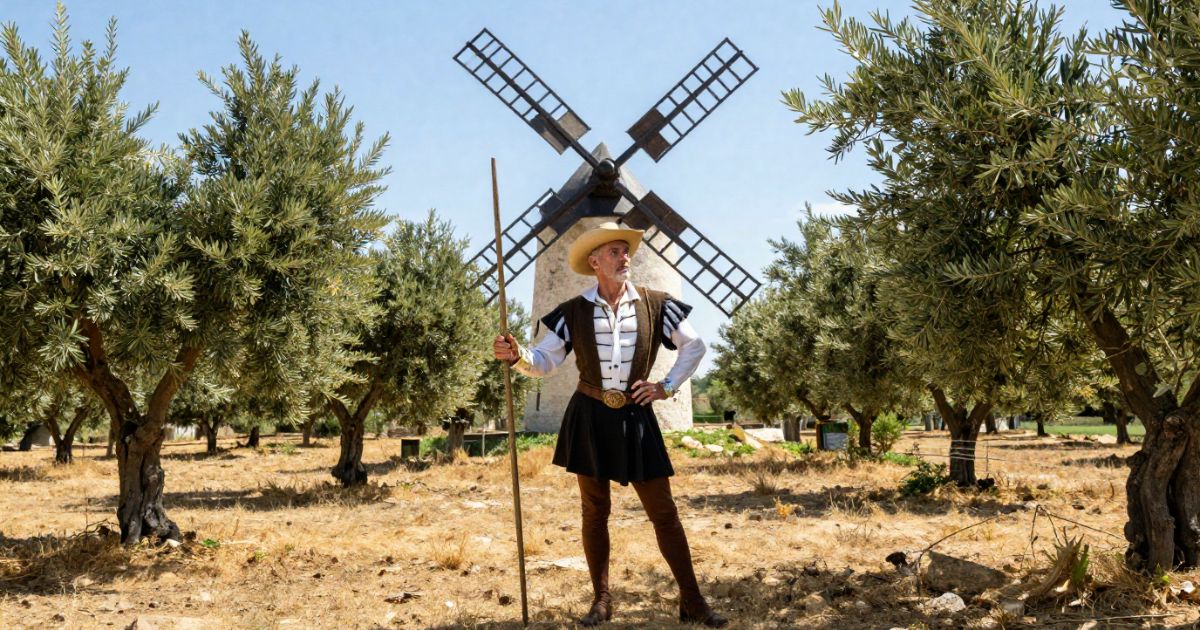
An excerpt from the original text.(complete · 2368 words)
WHICH TREATS OF THE FIRST SALLY THE INGENIOUS DON QUIXOTE MADE FROM
HOME
These preliminaries settled, he did not care to put off any longer the
execution of his design, urged on to it by the thought of all the world
was losing by his delay, seeing what wrongs he intended to right,
grievances to redress, injustices to repair, abuses to remove, and
duties to discharge. So, without giving notice of his intention to
anyone, and without anybody seeing him, one morning before the dawning
of the day (which was one of the hottest of the month of July) he
donned his suit of armour, mounted Rocinante with his patched-up helmet
on, braced his buckler, took his lance, and by the back door of the
yard sallied forth upon the plain in the highest contentment and
satisfaction at seeing with what ease he had made a beginning with his
grand purpose. But scarcely did he find himself upon the open plain,
when a terrible thought struck him, one all but enough to make him
abandon the enterprise at the very outset. It occurred to him that he
had not been dubbed a knight, and that according to the law of chivalry
he neither could nor ought to bear arms against any knight; and that
even if he had been, still he ought, as a novice knight, to wear white
armour, without a device upon the shield until by his prowess he had
earned one. These reflections made him waver in his purpose, but his
craze being stronger than any reasoning, he made up his mind to have
himself dubbed a knight by the first one he came across, following the
example of others in the same case, as he had read in the books that
brought him to this pass. As for white armour, he resolved, on the
first opportunity, to scour his until it was whiter than an ermine; and
so comforting himself he pursued his way, taking that which his horse
chose, for in this he believed lay the essence of adventures.
Thus setting out, our new-fledged adventurer paced along, talking to
himself and saying, “Who knows but that in time to come, when the
veracious history of my famous deeds is made known, the sage who writes
it, when he has to set forth my first sally in the early morning, will
do it after this fashion? ‘Scarce had the rubicund Apollo spread o’er
the face of the broad spacious earth the golden threads of his bright
hair, scarce had the little birds of painted plumage attuned their
notes to hail with dulcet and mellifluous harmony the coming of the
rosy Dawn, that, deserting the soft couch of her jealous spouse, was
appearing to mortals at the gates and balconies of the Manchegan
horizon, when the renowned knight Don Quixote of La Mancha, quitting
the lazy down, mounted his celebrated steed Rocinante and began to
traverse the ancient and famous Campo de Montiel;’” which in fact he
was actually traversing. “Happy the age, happy the time,” he continued,
“in which shall be made known my deeds of fame, worthy to be moulded in
brass, carved in marble, limned in pictures, for a memorial for ever.
And thou, O sage magician, whoever thou art, to whom it shall fall to
be the chronicler of this wondrous history, forget not, I entreat thee,
my good Rocinante, the constant companion of my ways and wanderings.”
Presently he broke out again, as if he were love-stricken in earnest,
“O Princess Dulcinea, lady of this captive heart, a grievous wrong hast
thou done me to drive me forth with scorn, and with inexorable obduracy
banish me from the presence of thy beauty. O lady, deign to hold in
remembrance this heart, thy vassal, that thus in anguish pines for love
of thee.”
So he went on stringing together these and other absurdities, all in
the style of those his books had taught him, imitating their language
as well as he could; and all the while he rode so slowly and the sun
mounted so rapidly and with such fervour that it was enough to melt his
brains if he had any. Nearly all day he travelled without anything
remarkable happening to him, at which he was in despair, for he was
anxious to encounter someone at once upon whom to try the might of his
strong arm.
Writers there are who say the first adventure he met with was that of
Puerto Lapice; others say it was that of the windmills; but what I have
ascertained on this point, and what I have found written in the annals
of La Mancha, is that he was on the road all day, and towards nightfall
his hack and he found themselves dead tired and hungry, when, looking
all around to see if he could discover any castle or shepherd’s shanty
where he might refresh himself and relieve his sore wants, he perceived
not far out of his road an inn, which was as welcome as a star guiding
him to the portals, if not the palaces, of his redemption; and
quickening his pace he reached it just as night was setting in. At the
door were standing two young women, girls of the district as they call
them, on their way to Seville with some carriers who had chanced to
halt that night at the inn; and as, happen what might to our
adventurer, everything he saw or imagined seemed to him to be and to
happen after the fashion of what he read of, the moment he saw the inn
he pictured it to himself as a castle with its four turrets and
pinnacles of shining silver, not forgetting the drawbridge and moat and
all the belongings usually ascribed to castles of the sort. To this
inn, which to him seemed a castle, he advanced, and at a short distance
from it he checked Rocinante, hoping that some dwarf would show himself
upon the battlements, and by sound of trumpet give notice that a knight
was approaching the castle. But seeing that they were slow about it,
and that Rocinante was in a hurry to reach the stable, he made for the
inn door, and perceived the two gay damsels who were standing there,
and who seemed to him to be two fair maidens or lovely ladies taking
their ease at the castle gate.
At this moment it so happened that a swineherd who was going through
the stubbles collecting a drove of pigs (for, without any apology, that
is what they are called) gave a blast of his horn to bring them
together, and forthwith it seemed to Don Quixote to be what he was
expecting, the signal of some dwarf announcing his arrival; and so with
prodigious satisfaction he rode up to the inn and to the ladies, who,
seeing a man of this sort approaching in full armour and with lance and
buckler, were turning in dismay into the inn, when Don Quixote,
guessing their fear by their flight, raising his pasteboard visor,
disclosed his dry dusty visage, and with courteous bearing and gentle
voice addressed them, “Your ladyships need not fly or fear any
rudeness, for that it belongs not to the order of knighthood which I
profess to offer to anyone, much less to highborn maidens as your
appearance proclaims you to be.” The girls were looking at him and
straining their eyes to make out the features which the clumsy visor
obscured, but when they heard themselves called maidens, a thing so
much out of their line, they could not restrain their laughter, which
made Don Quixote wax indignant, and say, “Modesty becomes the fair, and
moreover laughter that has little cause is great silliness; this,
however, I say not to pain or anger you, for my desire is none other
than to serve you.”
The incomprehensible language and the unpromising looks of our cavalier
only increased the ladies’ laughter, and that increased his irritation,
and matters might have gone farther if at that moment the landlord had
not come out, who, being a very fat man, was a very peaceful one. He,
seeing this grotesque figure clad in armour that did not match any more
than his saddle, bridle, lance, buckler, or corselet, was not at all
indisposed to join the damsels in their manifestations of amusement;
but, in truth, standing in awe of such a complicated armament, he
thought it best to speak him fairly, so he said, “Señor Caballero, if
your worship wants lodging, bating the bed (for there is not one in the
inn) there is plenty of everything else here.” Don Quixote, observing
the respectful bearing of the Alcaide of the fortress (for so innkeeper
and inn seemed in his eyes), made answer, “Sir Castellan, for me
anything will suffice, for
‘My armour is my only wear,
My only rest the fray.’”
The host fancied he called him Castellan because he took him for a
“worthy of Castile,” though he was in fact an Andalusian, and one from
the strand of San Lucar, as crafty a thief as Cacus and as full of
tricks as a student or a page. “In that case,” said he,
“‘Your bed is on the flinty rock,
Your sleep to watch alway;’
and if so, you may dismount and safely reckon upon any quantity of
sleeplessness under this roof for a twelvemonth, not to say for a
single night.” So saying, he advanced to hold the stirrup for Don
Quixote, who got down with great difficulty and exertion (for he had
not broken his fast all day), and then charged the host to take great
care of his horse, as he was the best bit of flesh that ever ate bread
in this world. The landlord eyed him over but did not find him as good
as Don Quixote said, nor even half as good; and putting him up in the
stable, he returned to see what might be wanted by his guest, whom the
damsels, who had by this time made their peace with him, were now
relieving of his armour. They had taken off his breastplate and
backpiece, but they neither knew nor saw how to open his gorget or
remove his make-shift helmet, for he had fastened it with green
ribbons, which, as there was no untying the knots, required to be cut.
This, however, he would not by any means consent to, so he remained all
the evening with his helmet on, the drollest and oddest figure that can
be imagined; and while they were removing his armour, taking the
baggages who were about it for ladies of high degree belonging to the
castle, he said to them with great sprightliness:
“Oh, never, surely, was there knight
So served by hand of dame,
As served was he, Don Quixote hight,
When from his town he came;
With maidens waiting on himself,
Princesses on his hack—
—or Rocinante, for that, ladies mine, is my horse’s name, and Don
Quixote of La Mancha is my own; for though I had no intention of
declaring myself until my achievements in your service and honour had
made me known, the necessity of adapting that old ballad of Lancelot to
the present occasion has given you the knowledge of my name altogether
prematurely. A time, however, will come for your ladyships to command
and me to obey, and then the might of my arm will show my desire to
serve you.”
The girls, who were not used to hearing rhetoric of this sort, had
nothing to say in reply; they only asked him if he wanted anything to
eat. “I would gladly eat a bit of something,” said Don Quixote, “for I
feel it would come very seasonably.” The day happened to be a Friday,
and in the whole inn there was nothing but some pieces of the fish they
call in Castile “abadejo,” in Andalusia “bacallao,” and in some places
“curadillo,” and in others “troutlet;” so they asked him if he thought
he could eat troutlet, for there was no other fish to give him. “If
there be troutlets enough,” said Don Quixote, “they will be the same
thing as a trout; for it is all one to me whether I am given eight
reals in small change or a piece of eight; moreover, it may be that
these troutlets are like veal, which is better than beef, or kid, which
is better than goat. But whatever it be let it come quickly, for the
burden and pressure of arms cannot be borne without support to the
inside.” They laid a table for him at the door of the inn for the sake
of the air, and the host brought him a portion of ill-soaked and worse
cooked stockfish, and a piece of bread as black and mouldy as his own
armour; but a laughable sight it was to see him eating, for having his
helmet on and the beaver up, he could not with his own hands put
anything into his mouth unless someone else placed it there, and this
service one of the ladies rendered him. But to give him anything to
drink was impossible, or would have been so had not the landlord bored
a reed, and putting one end in his mouth poured the wine into him
through the other; all which he bore with patience rather than sever
the ribbons of his helmet.
While this was going on there came up to the inn a sowgelder, who, as
he approached, sounded his reed pipe four or five times, and thereby
completely convinced Don Quixote that he was in some famous castle, and
that they were regaling him with music, and that the stockfish was
trout, the bread the whitest, the wenches ladies, and the landlord the
castellan of the castle; and consequently he held that his enterprise
and sally had been to some purpose. But still it distressed him to
think he had not been dubbed a knight, for it was plain to him he could
not lawfully engage in any adventure without receiving the order of
knighthood.
e02.jpg (39K)
Master this chapter. Complete your experience
Purchase the complete book to access all chapters and support classic literature
As an Amazon Associate, we earn a small commission from qualifying purchases at no additional cost to you.
Available in paperback, hardcover, and e-book formats
Let's Analyse the Pattern
When we claim roles or expertise we haven't earned, we must constantly distort reality to protect the lie, making competent action impossible.
Why This Matters
Connect literature to life
This chapter teaches how to spot when someone is performing competence rather than demonstrating it—including yourself.
Practice This Today
This week, notice when someone uses jargon instead of clear explanations, or deflects specific questions with vague answers—these are often signs of unearned authority.
Now let's explore the literary elements.
Key Quotes & Analysis
"Without giving notice of his intention to anyone, and without anybody seeing him, one morning before the dawning of the day he donned his suit of armour"
Context: Don Quixote sneaks out to begin his quest
Shows his impulsiveness and secrecy. He doesn't tell anyone because deep down he knows they'd try to stop him. The pre-dawn departure suggests shame or awareness that his plan is questionable.
In Today's Words:
He snuck out before anyone could talk sense into him
"A terrible thought struck him, one all but enough to make him abandon the enterprise at the very outset. It occurred to him that he had not been dubbed a knight"
Context: Don Quixote realizes he lacks basic qualifications for his quest
The moment when reality briefly breaks through his fantasy. He almost gives up when he realizes he's not actually qualified, but his obsession overrides logic.
In Today's Words:
Oh crap, I don't actually have the credentials for this
"He fancied he saw a castle with four towers and spires of shining silver, not forgetting the drawbridge and moat"
Context: Don Quixote's first view of an ordinary roadside inn
Perfect example of how his delusions transform reality. A simple inn becomes a magnificent castle in his mind, showing how we can see what we want to see rather than what's actually there.
In Today's Words:
He convinced himself the dive bar was a five-star resort
Thematic Threads
Identity
In This Chapter
Don Quixote struggles between who he really is (a middle-aged man with books) and who he wants to be (a knight-errant)
Development
Introduced here as the central conflict driving all his delusions
In Your Life:
You might recognize this when you're trying to be someone you think you should be rather than developing who you actually are.
Class
In This Chapter
He transforms working women and an innkeeper into nobility because his fantasy requires the right social backdrop
Development
Introduced here as his need to elevate everyone around him to match his imagined status
In Your Life:
You might see this when you judge situations by surface appearances rather than actual substance.
Social Expectations
In This Chapter
Don Quixote expects to be treated as a knight despite having no legitimate claim to that status
Development
Introduced here as the gap between his expectations and social reality
In Your Life:
You might notice this when you expect treatment or respect you haven't actually earned through your actions.
Personal Growth
In This Chapter
His refusal to acknowledge his unpreparedness prevents any real learning or development
Development
Introduced here as the cost of maintaining false identity over genuine growth
In Your Life:
You might recognize this when pride keeps you from admitting what you don't know and asking for help.
You now have the context. Time to form your own thoughts.
Discussion Questions
- 1
What realization almost stops Don Quixote from continuing his adventure, and how does he solve this problem?
analysis • surface - 2
Why does Don Quixote transform the inn into a castle and the working women into noble ladies in his mind?
analysis • medium - 3
Where have you seen someone claim authority or expertise they didn't actually have? What happened?
application • medium - 4
When you're in over your head at work or in life, what's the difference between 'fake it till you make it' and dangerous self-deception?
application • deep - 5
What does Don Quixote's need to transform reality teach us about how we protect our self-image when it's threatened?
reflection • deep
Critical Thinking Exercise
Authority Audit
Think of a role or responsibility you currently have - at work, at home, or in your community. Write down three areas where you feel confident and competent, and three areas where you're still learning or feel uncertain. For each uncertain area, identify one specific action you could take to build real competence rather than just projecting confidence.
Consider:
- •Real authority comes from serving others effectively, not from titles or appearances
- •Admitting what you don't know is often the first step toward genuine expertise
- •People usually respect honesty about limitations more than they respect fake confidence
Journaling Prompt
Write about a time when you had to choose between admitting you didn't know something and pretending you did. What did you choose and why? What would you do differently now?
Coming Up Next...
Chapter 23: Into the Sierra Morena
Still convinced he's in a castle, Don Quixote faces his next challenge: getting himself officially knighted. But will the bemused innkeeper play along with this strange man's delusions, and what unexpected ceremony awaits?