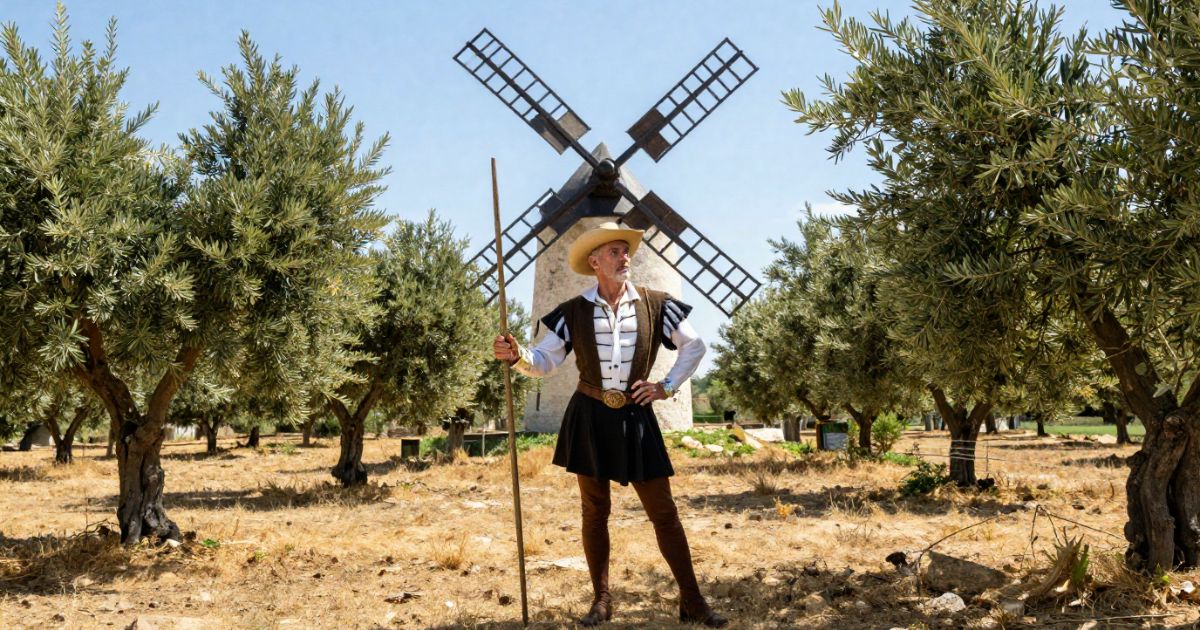
An excerpt from the original text.(complete · 502 words)
: HICH TREATS OF THE EXALTED ADVENTURE AND RICH PRIZE OF MAMBRINO'S HELMET
After the fulling hammers embarrassment, they continued on. Don Quixote soon spotted a man on a gray donkey with something shining on his head. "Do you see that, Sancho? There comes a knight riding toward us with the Helmet of Mambrino on his head!"
Sancho looked and saw a man on a donkey with something bright on his head. The man was actually a barber from a nearby town, riding his donkey in the rain. He'd put his brass shaving basin on his head to protect his hat from getting wet. When the sun hit it, it shone like gold.
"It seems to me," said Sancho, "that this is no knight but a man on a donkey like mine, with something shiny on his head."
"That is the Helmet of Mambrino!" said Don Quixote. "Stand aside and leave me alone with him. You will see how, without wasting words, I will bring this adventure to a close and possess myself of the helmet I have so longed for."
"I'll take care to stand aside," said Sancho, "but God grant it may turn out to be marjoram and not fulling hammers."
Don Quixote charged at full gallop. The barber, seeing an armed madman charging at him, threw himself off his donkey and ran across the fields faster than the wind, leaving his basin on the ground.
Don Quixote was delighted. He picked up the basin, put it on his head—it fit perfectly. He examined it and, not seeing the visor, said: "Doubtless the pagan for whom this famous helmet was originally made had a very large head. The worst of it is that half of it is missing"—meaning the visor, because it was just a basin.
When Sancho heard it called a basin, he couldn't control his laughter. Don Quixote asked what amused him.
"I am laughing to think of the great head the pagan owner of this helmet must have had. It looks exactly like a barber's basin."
"Do you know what I suspect, Sancho? This piece of that enchanted helmet must have fallen by some strange accident into the hands of someone who, not knowing its worth as the helmet of Mambrino, and seeing it was pure gold, melted down the other half for the value of the metal and made from this half what looks like a barber's basin. But be it what it may, for one who knows what it really is, its transformation makes no difference. I will have it repaired at the first opportunity, and meanwhile I will wear it as it is, for it will serve to ward off blows."
"That it will," said Sancho, "if they don't throw stones with slings as they did in the battle of the two armies when they knocked out your worship's teeth and smashed the flask with that blessed potion."
Don Quixote rode on wearing his barber's basin, convinced he possessed the magical Helmet of Mambrino.
Master this chapter. Complete your experience
Purchase the complete book to access all chapters and support classic literature
As an Amazon Associate, we earn a small commission from qualifying purchases at no additional cost to you.
Available in paperback, hardcover, and e-book formats
Let's Analyse the Pattern
When ordinary life feels insufficient, people transform themselves by adopting grand missions that may be disconnected from reality.
Why This Matters
Connect literature to life
This chapter teaches how to spot when someone (including yourself) is making major life decisions based on elaborate fantasies rather than realistic assessment.
Practice This Today
This week, notice when you or others use phrases like 'I'm going to revolutionize' or 'I have a vision for' - ask what concrete steps and resources actually exist to support these claims.
Now let's explore the literary elements.
Key Quotes & Analysis
"In short, his wits being quite gone, he hit upon the strangest notion that ever madman in this world hit upon, and that was that he fancied it was right and requisite, as well for the support of his own honour as for the service of his country, that he should make a knight-errant of himself."
Context: After describing how reading chivalric romances consumed Don Quixote's mind completely
This moment captures the exact point where fantasy becomes delusion. Don Quixote doesn't just enjoy these stories - he believes the world needs him to live them. It shows how someone can rationalize any decision by making it about honor or service.
In Today's Words:
He completely lost touch with reality and convinced himself that becoming a wandering hero was not only a good idea, but his duty.
"He spent whole days and nights over his books; and thus with little sleeping and much reading his brains dried up to such a degree that he lost the use of his reason."
Context: Explaining how Don Quixote's obsessive reading led to his mental transformation
This perfectly describes information overload and obsession. Cervantes shows how consuming too much of any media without balance can warp our perception of reality. It's a warning about moderation that feels very modern.
In Today's Words:
He was online so much, day and night, that he completely lost touch with the real world.
"It is not the part of a knight-errant to discover whether the afflicted, the enchained and oppressed whom he encounters on the road are reduced to these circumstances and suffer this distress for their vices, or for their virtues: the knight's sole business is to succour them as persons in need of help."
Context: Explaining his philosophy of helping people without judging whether they deserve it
This reveals Don Quixote's genuinely noble heart beneath his delusions. He wants to help people unconditionally, which is actually admirable. It shows that even misguided idealism can contain real virtue.
In Today's Words:
A true helper doesn't ask if someone deserves help - they just help because that's what good people do.
Thematic Threads
Identity
In This Chapter
Quixano completely reinvents himself, changing his name, appearance, mission, and entire worldview to become Don Quixote
Development
Introduced here
In Your Life:
You might recognize this when someone in your life suddenly adopts a dramatically new persona or lifestyle.
Class
In This Chapter
A minor gentleman with declining fortunes seeks to elevate himself by adopting the role of a noble knight-errant
Development
Introduced here
In Your Life:
You might see this in people who try to appear more successful or important than their actual circumstances allow.
Social Expectations
In This Chapter
Quixano rejects the expectations of quiet country life and creates his own set of chivalric rules to follow
Development
Introduced here
In Your Life:
You might recognize this when you feel trapped by what others expect of you and consider radical changes to break free.
Personal Growth
In This Chapter
The transformation represents a desire for self-improvement, though based on fantasy rather than realistic development
Development
Introduced here
In Your Life:
You might see this in your own tendency to seek dramatic transformation rather than gradual, sustainable change.
Human Relationships
In This Chapter
Quixano creates an idealized love relationship with Dulcinea, based on a real person but transformed by his imagination
Development
Introduced here
In Your Life:
You might recognize this pattern of idealizing others rather than accepting them as they really are.
You now have the context. Time to form your own thoughts.
Discussion Questions
- 1
What specific steps did Alonso take to transform himself from a country gentleman into Don Quixote?
analysis • surface - 2
Why do you think reading chivalric romances affected Alonso so powerfully that he lost touch with reality?
analysis • medium - 3
Where do you see people today creating elaborate new identities or missions to escape ordinary life?
application • medium - 4
How can someone tell the difference between healthy personal growth and dangerous fantasy-based thinking?
application • deep - 5
What does Alonso's transformation reveal about how humans cope with feeling insignificant or purposeless?
reflection • deep
Critical Thinking Exercise
Map Your Own Mission Creep
Think of a time when you became deeply absorbed in an idea, hobby, or cause that started to take over your thinking. Write down the progression: what attracted you initially, how it grew, and what real need it was trying to fill. Then identify whether this was healthy growth or fantasy escape.
Consider:
- •What gap between your real life and ideal life was this trying to fill?
- •Did this absorption help you solve actual problems or avoid them?
- •How did the people around you react to your new focus or identity?
Journaling Prompt
Write about a time when you had to choose between pursuing an inspiring but unrealistic dream and accepting your current circumstances. How did you decide what to do, and what did you learn from that choice?
Coming Up Next...
Chapter 22: Freeing the Galley Slaves
Don Quixote will encounter chained prisoners being taken to forced labor. Hearing they're being taken 'against their will,' he'll attack the guards and free them. The freed criminals will thank him by trying to kill him with stones.