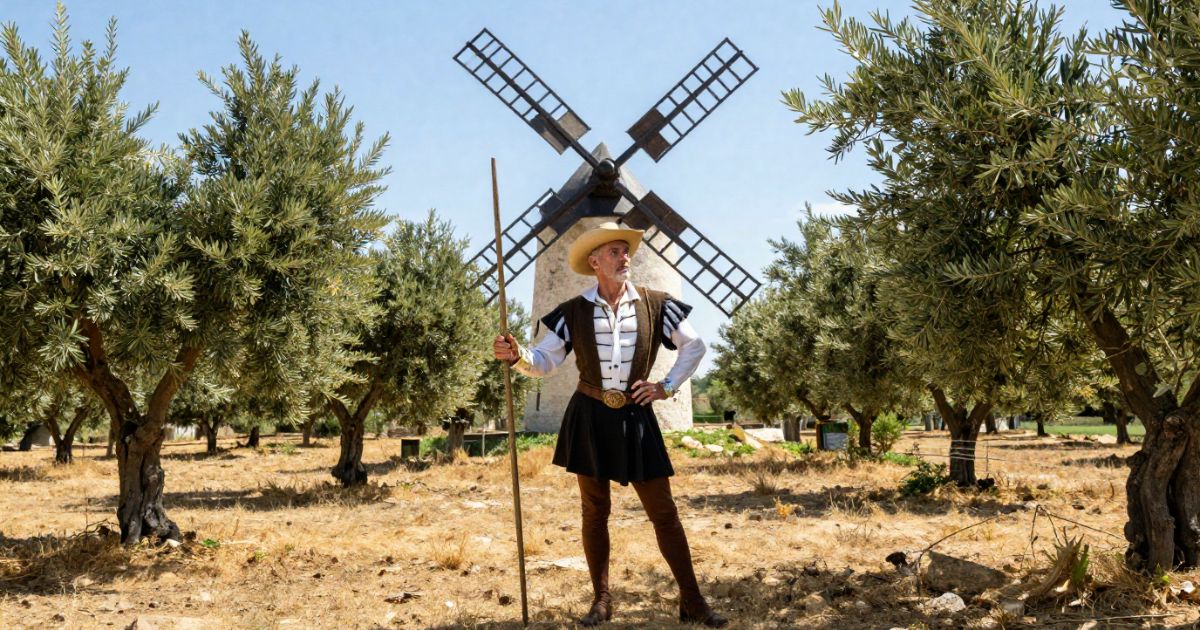
An excerpt from the original text.(complete · 20470 words)
OF WHAT PASSED BETWEEN DON QUIXOTE AND HIS SQUIRE SANCHO ON THE WAY TO THEIR VILLAGE
CHAPTER LXXII OF HOW DON QUIXOTE AND SANCHO REACHED THEIR VILLAGE
CHAPTER
LXXIII OF THE OMENS DON QUIXOTE HAD AS HE ENTERED HIS OWN VILLAGE, AND
OTHER INCIDENTS THAT EMBELLISH AND GIVE A COLOUR TO THIS GREAT HISTORY
CHAPTER LXXIV OF HOW DON QUIXOTE FELL SICK,
AND OF THE WILL HE MADE, AND HOW HE DIED
INTRODUCTION
PREFARATORY
It was with considerable reluctance that I abandoned in favour of the
present undertaking what had long been a favourite project: that of a
new edition of Shelton’s “Don Quixote,” which has now become a somewhat
scarce book. There are some—and I confess myself to be one—for whom
Shelton’s racy old version, with all its defects, has a charm that no
modern translation, however skilful or correct, could possess. Shelton
had the inestimable advantage of belonging to the same generation as
Cervantes; “Don Quixote” had to him a vitality that only a contemporary
could feel; it cost him no dramatic effort to see things as Cervantes
saw them; there is no anachronism in his language; he put the Spanish
of Cervantes into the English of Shakespeare. Shakespeare himself most
likely knew the book; he may have carried it home with him in his
saddle-bags to Stratford on one of his last journeys, and under the
mulberry tree at New Place joined hands with a kindred genius in its
pages.
But it was soon made plain to me that to hope for even a moderate
popularity for Shelton was vain. His fine old crusted English would, no
doubt, be relished by a minority, but it would be only by a minority.
His warmest admirers must admit that he is not a satisfactory
representative of Cervantes. His translation of the First Part was very
hastily made and was never revised by him. It has all the freshness and
vigour, but also a full measure of the faults, of a hasty production.
It is often very literal—barbarously literal frequently—but just as
often very loose. He had evidently a good colloquial knowledge of
Spanish, but apparently not much more. It never seems to occur to him
that the same translation of a word will not suit in every case.
It is often said that we have no satisfactory translation of “Don
Quixote.” To those who are familiar with the original, it savours of
truism or platitude to say so, for in truth there can be no thoroughly
satisfactory translation of “Don Quixote” into English or any other
language. It is not that the Spanish idioms are so utterly
unmanageable, or that the untranslatable words, numerous enough no
doubt, are so superabundant, but rather that the sententious terseness
to which the humour of the book owes its flavour is peculiar to
Spanish, and can at best be only distantly imitated in any other
tongue.
The history of our English translations of “Don Quixote” is
instructive. Shelton’s, the first in any language, was made,
apparently, about 1608, but not published till 1612. This of course was
only the First Part. It has been asserted that the Second, published in
1620, is not the work of Shelton, but there is nothing to support the
assertion save the fact that it has less spirit, less of what we
generally understand by “go,” about it than the first, which would be
only natural if the first were the work of a young man writing
currente calamo, and the second that of a middle-aged man writing for
a bookseller. On the other hand, it is closer and more literal, the
style is the same, the very same translations, or mistranslations,
occur in it, and it is extremely unlikely that a new translator would,
by suppressing his name, have allowed Shelton to carry off the credit.
In 1687 John Phillips, Milton’s nephew, produced a “Don Quixote” “made
English,” he says, “according to the humour of our modern language.”
His “Quixote” is not so much a translation as a travesty, and a
travesty that for coarseness, vulgarity, and buffoonery is almost
unexampled even in the literature of that day.
Ned Ward’s “Life and Notable Adventures of Don Quixote, merrily
translated into Hudibrastic Verse” (1700), can scarcely be reckoned a
translation, but it serves to show the light in which “Don Quixote” was
regarded at the time.
A further illustration may be found in the version published in 1712 by
Peter Motteux, who had then recently combined tea-dealing with
literature. It is described as “translated from the original by several
hands,” but if so all Spanish flavour has entirely evaporated under the
manipulation of the several hands. The flavour that it has, on the
other hand, is distinctly Franco-cockney. Anyone who compares it
carefully with the original will have little doubt that it is a
concoction from Shelton and the French of Filleau de Saint Martin, eked
out by borrowings from Phillips, whose mode of treatment it adopts. It
is, to be sure, more decent and decorous, but it treats “Don Quixote”
in the same fashion as a comic book that cannot be made too comic.
To attempt to improve the humour of “Don Quixote” by an infusion of
cockney flippancy and facetiousness, as Motteux’s operators did, is not
merely an impertinence like larding a sirloin of prize beef, but an
absolute falsification of the spirit of the book, and it is a proof of
the uncritical way in which “Don Quixote” is generally read that this
worse than worthless translation—worthless as failing to represent,
worse than worthless as misrepresenting—should have been favoured as it
has been.
It had the effect, however, of bringing out a translation undertaken
and executed in a very different spirit, that of Charles Jervas, the
portrait painter, and friend of Pope, Swift, Arbuthnot, and Gay. Jervas
has been allowed little credit for his work, indeed it may be said
none, for it is known to the world in general as Jarvis’s. It was not
published until after his death, and the printers gave the name
according to the current pronunciation of the day. It has been the most
freely used and the most freely abused of all the translations. It has
seen far more editions than any other, it is admitted on all hands to
be by far the most faithful, and yet nobody seems to have a good word
to say for it or for its author. Jervas no doubt prejudiced readers
against himself in his preface, where among many true words about
Shelton, Stevens, and Motteux, he rashly and unjustly charges Shelton
with having translated not from the Spanish, but from the Italian
version of Franciosini, which did not appear until ten years after
Shelton’s first volume. A suspicion of incompetence, too, seems to have
attached to him because he was by profession a painter and a mediocre
one (though he has given us the best portrait we have of Swift), and
this may have been strengthened by Pope’s remark that he “translated
‘Don Quixote’ without understanding Spanish.” He has been also charged
with borrowing from Shelton, whom he disparaged. It is true that in a
few difficult or obscure passages he has followed Shelton, and gone
astray with him; but for one case of this sort, there are fifty where
he is right and Shelton wrong. As for Pope’s dictum, anyone who
examines Jervas’s version carefully, side by side with the original,
will see that he was a sound Spanish scholar, incomparably a better one
than Shelton, except perhaps in mere colloquial Spanish. He was, in
fact, an honest, faithful, and painstaking translator, and he has left
a version which, whatever its shortcomings may be, is singularly free
from errors and mistranslations.
The charge against it is that it is stiff, dry—“wooden” in a word,—and
no one can deny that there is a foundation for it. But it may be
pleaded for Jervas that a good deal of this rigidity is due to his
abhorrence of the light, flippant, jocose style of his predecessors. He
was one of the few, very few, translators that have shown any
apprehension of the unsmiling gravity which is the essence of Quixotic
humour; it seemed to him a crime to bring Cervantes forward smirking
and grinning at his own good things, and to this may be attributed in a
great measure the ascetic abstinence from everything savouring of
liveliness which is the characteristic of his translation. In most
modern editions, it should be observed, his style has been smoothed and
smartened, but without any reference to the original Spanish, so that
if he has been made to read more agreeably he has also been robbed of
his chief merit of fidelity.
Smollett’s version, published in 1755, may be almost counted as one of
these. At any rate it is plain that in its construction Jervas’s
translation was very freely drawn upon, and very little or probably no
heed given to the original Spanish.
The later translations may be dismissed in a few words. George Kelly’s,
which appeared in 1769, “printed for the Translator,” was an impudent
imposture, being nothing more than Motteux’s version with a few of the
words, here and there, artfully transposed; Charles Wilmot’s (1774) was
only an abridgment like Florian’s, but not so skilfully executed; and
the version published by Miss Smirke in 1818, to accompany her
brother’s plates, was merely a patchwork production made out of former
translations. On the latest, Mr. A. J. Duffield’s, it would be in every
sense of the word impertinent in me to offer an opinion here. I had not
even seen it when the present undertaking was proposed to me, and since
then I may say vidi tantum, having for obvious reasons resisted the
temptation which Mr. Duffield’s reputation and comely volumes hold out
to every lover of Cervantes.
From the foregoing history of our translations of “Don Quixote,” it
will be seen that there are a good many people who, provided they get
the mere narrative with its full complement of facts, incidents, and
adventures served up to them in a form that amuses them, care very
little whether that form is the one in which Cervantes originally
shaped his ideas. On the other hand, it is clear that there are many
who desire to have not merely the story he tells, but the story as he
tells it, so far at least as differences of idiom and circumstances
permit, and who will give a preference to the conscientious translator,
even though he may have acquitted himself somewhat awkwardly.
But after all there is no real antagonism between the two classes;
there is no reason why what pleases the one should not please the
other, or why a translator who makes it his aim to treat “Don Quixote”
with the respect due to a great classic, should not be as acceptable
even to the careless reader as the one who treats it as a famous old
jest-book. It is not a question of caviare to the general, or, if it
is, the fault rests with him who makes so. The method by which
Cervantes won the ear of the Spanish people ought, mutatis mutandis, to
be equally effective with the great majority of English readers. At any
rate, even if there are readers to whom it is a matter of indifference,
fidelity to the method is as much a part of the translator’s duty as
fidelity to the matter. If he can please all parties, so much the
better; but his first duty is to those who look to him for as faithful
a representation of his author as it is in his power to give them,
faithful to the letter so long as fidelity is practicable, faithful to
the spirit so far as he can make it.
My purpose here is not to dogmatise on the rules of translation, but to
indicate those I have followed, or at least tried to the best of my
ability to follow, in the present instance. One which, it seems to me,
cannot be too rigidly followed in translating “Don Quixote,” is to
avoid everything that savours of affectation. The book itself is,
indeed, in one sense a protest against it, and no man abhorred it more
than Cervantes. For this reason, I think, any temptation to use
antiquated or obsolete language should be resisted. It is after all an
affectation, and one for which there is no warrant or excuse. Spanish
has probably undergone less change since the seventeenth century than
any language in Europe, and by far the greater and certainly the best
part of “Don Quixote” differs but little in language from the
colloquial Spanish of the present day. Except in the tales and Don
Quixote’s speeches, the translator who uses the simplest and plainest
everyday language will almost always be the one who approaches nearest
to the original.
Seeing that the story of “Don Quixote” and all its characters and
incidents have now been for more than two centuries and a half familiar
as household words in English mouths, it seems to me that the old
familiar names and phrases should not be changed without good reason.
Of course a translator who holds that “Don Quixote” should receive the
treatment a great classic deserves, will feel himself bound by the
injunction laid upon the Morisco in Chap. IX not to omit or add
anything.
CERVANTES
Four generations had laughed over “Don Quixote” before it occurred to
anyone to ask, who and what manner of man was this Miguel de Cervantes
Saavedra whose name is on the title-page; and it was too late for a
satisfactory answer to the question when it was proposed to add a life
of the author to the London edition published at Lord Carteret’s
instance in 1738. All traces of the personality of Cervantes had by
that time disappeared. Any floating traditions that may once have
existed, transmitted from men who had known him, had long since died
out, and of other record there was none; for the sixteenth and
seventeenth centuries were incurious as to “the men of the time,” a
reproach against which the nineteenth has, at any rate, secured itself,
if it has produced no Shakespeare or Cervantes. All that Mayans y
Siscar, to whom the task was entrusted, or any of those who followed
him, Rios, Pellicer, or Navarrete, could do was to eke out the few
allusions Cervantes makes to himself in his various prefaces with such
pieces of documentary evidence bearing upon his life as they could
find.
This, however, has been done by the last-named biographer to such good
purpose that he has superseded all predecessors. Thoroughness is the
chief characteristic of Navarrete’s work. Besides sifting, testing, and
methodising with rare patience and judgment what had been previously
brought to light, he left, as the saying is, no stone unturned under
which anything to illustrate his subject might possibly be found.
Navarrete has done all that industry and acumen could do, and it is no
fault of his if he has not given us what we want. What Hallam says of
Shakespeare may be applied to the almost parallel case of Cervantes:
“It is not the register of his baptism, or the draft of his will, or
the orthography of his name that we seek; no letter of his writing, no
record of his conversation, no character of him drawn ... by a
contemporary has been produced.”
It is only natural, therefore, that the biographers of Cervantes,
forced to make brick without straw, should have recourse largely to
conjecture, and that conjecture should in some instances come by
degrees to take the place of established fact. All that I propose to do
here is to separate what is matter of fact from what is matter of
conjecture, and leave it to the reader’s judgment to decide whether the
data justify the inference or not.
The men whose names by common consent stand in the front rank of
Spanish literature, Cervantes, Lope de Vega, Quevedo, Calderon,
Garcilaso de la Vega, the Mendozas, Gongora, were all men of ancient
families, and, curiously, all, except the last, of families that traced
their origin to the same mountain district in the North of Spain. The
family of Cervantes is commonly said to have been of Galician origin,
and unquestionably it was in possession of lands in Galicia at a very
early date; but I think the balance of the evidence tends to show that
the “solar,” the original site of the family, was at Cervatos in the
north-west corner of Old Castile, close to the junction of Castile,
Leon, and the Asturias. As it happens, there is a complete history of
the Cervantes family from the tenth century down to the seventeenth
extant under the title of “Illustrious Ancestry, Glorious Deeds, and
Noble Posterity of the Famous Nuno Alfonso, Alcaide of Toledo,” written
in 1648 by the industrious genealogist Rodrigo Mendez Silva, who
availed himself of a manuscript genealogy by Juan de Mena, the poet
laureate and historiographer of John II.
The origin of the name Cervantes is curious. Nuno Alfonso was almost as
distinguished in the struggle against the Moors in the reign of Alfonso
VII as the Cid had been half a century before in that of Alfonso VI,
and was rewarded by divers grants of land in the neighbourhood of
Toledo. On one of his acquisitions, about two leagues from the city, he
built himself a castle which he called Cervatos, because “he was lord
of the solar of Cervatos in the Montana,” as the mountain region
extending from the Basque Provinces to Leon was always called. At his
death in battle in 1143, the castle passed by his will to his son
Alfonso Munio, who, as territorial or local surnames were then coming
into vogue in place of the simple patronymic, took the additional name
of Cervatos. His eldest son Pedro succeeded him in the possession of
the castle, and followed his example in adopting the name, an
assumption at which the younger son, Gonzalo, seems to have taken
umbrage.
Everyone who has paid even a flying visit to Toledo will remember the
ruined castle that crowns the hill above the spot where the bridge of
Alcántara spans the gorge of the Tagus, and with its broken outline and
crumbling walls makes such an admirable pendant to the square solid
Alcazar towering over the city roofs on the opposite side. It was
built, or as some say restored, by Alfonso VI shortly after his
occupation of Toledo in 1085, and called by him San Servando after a
Spanish martyr, a name subsequently modified into San Servan (in which
form it appears in the “Poem of the Cid”), San Servantes, and San
Cervantes: with regard to which last the “Handbook for Spain” warns its
readers against the supposition that it has anything to do with the
author of “Don Quixote.” Ford, as all know who have taken him for a
companion and counsellor on the roads of Spain, is seldom wrong in
matters of literature or history. In this instance, however, he is in
error. It has everything to do with the author of “Don Quixote,” for it
is in fact these old walls that have given to Spain the name she is
proudest of to-day. Gonzalo, above mentioned, it may be readily
conceived, did not relish the appropriation by his brother of a name to
which he himself had an equal right, for though nominally taken from
the castle, it was in reality derived from the ancient territorial
possession of the family, and as a set-off, and to distinguish himself
(diferenciarse) from his brother, he took as a surname the name of the
castle on the bank of the Tagus, in the building of which, according to
a family tradition, his great-grandfather had a share.
Both brothers founded families. The Cervantes branch had more tenacity;
it sent offshoots in various directions, Andalusia, Estremadura,
Galicia, and Portugal, and produced a goodly line of men distinguished
in the service of Church and State. Gonzalo himself, and apparently a
son of his, followed Ferdinand III in the great campaign of 1236-48
that gave Cordova and Seville to Christian Spain and penned up the
Moors in the kingdom of Granada, and his descendants intermarried with
some of the noblest families of the Peninsula and numbered among them
soldiers, magistrates, and Church dignitaries, including at least two
cardinal-archbishops.
Of the line that settled in Andalusia, Deigo de Cervantes, Commander of
the Order of Santiago, married Juana Avellaneda, daughter of Juan Arias
de Saavedra, and had several sons, of whom one was Gonzalo Gomez,
Corregidor of Jerez and ancestor of the Mexican and Columbian branches
of the family; and another, Juan, whose son Rodrigo married Doña Leonor
de Cortinas, and by her had four children, Rodrigo, Andrea, Luisa, and
Miguel, our author.
The pedigree of Cervantes is not without its bearing on “Don Quixote.”
A man who could look back upon an ancestry of genuine knights-errant
extending from well-nigh the time of Pelayo to the siege of Granada was
likely to have a strong feeling on the subject of the sham chivalry of
the romances. It gives a point, too, to what he says in more than one
place about families that have once been great and have tapered away
until they have come to nothing, like a pyramid. It was the case of his
own.
He was born at Alcalá de Henares and baptised in the church of Santa
Maria Mayor on the 9th of October, 1547. Of his boyhood and youth we
know nothing, unless it be from the glimpse he gives us in the preface
to his “Comedies” of himself as a boy looking on with delight while
Lope de Rueda and his company set up their rude plank stage in the
plaza and acted the rustic farces which he himself afterwards took as
the model of his interludes. This first glimpse, however, is a
significant one, for it shows the early development of that love of the
drama which exercised such an influence on his life and seems to have
grown stronger as he grew older, and of which this very preface,
written only a few months before his death, is such a striking proof.
He gives us to understand, too, that he was a great reader in his
youth; but of this no assurance was needed, for the First Part of “Don
Quixote” alone proves a vast amount of miscellaneous reading, romances
of chivalry, ballads, popular poetry, chronicles, for which he had no
time or opportunity except in the first twenty years of his life; and
his misquotations and mistakes in matters of detail are always, it may
be noticed, those of a man recalling the reading of his boyhood.
Other things besides the drama were in their infancy when Cervantes was
a boy. The period of his boyhood was in every way a transition period
for Spain. The old chivalrous Spain had passed away. The new Spain was
the mightiest power the world had seen since the Roman Empire and it
had not yet been called upon to pay the price of its greatness. By the
policy of Ferdinand and Ximenez the sovereign had been made absolute,
and the Church and Inquisition adroitly adjusted to keep him so. The
nobles, who had always resisted absolutism as strenuously as they had
fought the Moors, had been divested of all political power, a like fate
had befallen the cities, the free constitutions of Castile and Aragon
had been swept away, and the only function that remained to the Cortés
was that of granting money at the King’s dictation.
The transition extended to literature. Men who, like Garcilaso de la
Vega and Diego Hurtado de Mendoza, followed the Italian wars, had
brought back from Italy the products of the post-Renaissance
literature, which took root and flourished and even threatened to
extinguish the native growths. Damon and Thyrsis, Phyllis and Chloe had
been fairly naturalised in Spain, together with all the devices of
pastoral poetry for investing with an air of novelty the idea of a
dispairing shepherd and inflexible shepherdess. As a set-off against
this, the old historical and traditional ballads, and the true
pastorals, the songs and ballads of peasant life, were being collected
assiduously and printed in the cancioneros that succeeded one another
with increasing rapidity. But the most notable consequence, perhaps, of
the spread of printing was the flood of romances of chivalry that had
continued to pour from the press ever since Garci Ordoñez de Montalvo
had resuscitated “Amadis of Gaul” at the beginning of the century.
For a youth fond of reading, solid or light, there could have been no
better spot in Spain than Alcalá de Henares in the middle of the
sixteenth century. It was then a busy, populous university town,
something more than the enterprising rival of Salamanca, and altogether
a very different place from the melancholy, silent, deserted Alcalá the
traveller sees now as he goes from Madrid to Saragossa. Theology and
medicine may have been the strong points of the university, but the
town itself seems to have inclined rather to the humanities and light
literature, and as a producer of books Alcalá was already beginning to
compete with the older presses of Toledo, Burgos, Salamanca and
Seville.
A pendant to the picture Cervantes has given us of his first playgoings
might, no doubt, have been often seen in the streets of Alcalá at that
time; a bright, eager, tawny-haired boy peering into a book-shop where
the latest volumes lay open to tempt the public, wondering, it may be,
what that little book with the woodcut of the blind beggar and his boy,
that called itself “Vida de Lazarillo de Tormes, segunda impresion,”
could be about; or with eyes brimming over with merriment gazing at one
of those preposterous portraits of a knight-errant in outrageous
panoply and plumes with which the publishers of chivalry romances loved
to embellish the title-pages of their folios. If the boy was the father
of the man, the sense of the incongruous that was strong at fifty was
lively at ten, and some such reflections as these may have been the
true genesis of “Don Quixote.”
For his more solid education, we are told, he went to Salamanca. But
why Rodrigo de Cervantes, who was very poor, should have sent his son
to a university a hundred and fifty miles away when he had one at his
own door, would be a puzzle, if we had any reason for supposing that he
did so. The only evidence is a vague statement by Professor Tomas
Gonzalez, that he once saw an old entry of the matriculation of a
Miguel de Cervantes. This does not appear to have been ever seen again;
but even if it had, and if the date corresponded, it would prove
nothing, as there were at least two other Miguels born about the middle
of the century; one of them, moreover, a Cervantes Saavedra, a cousin,
no doubt, who was a source of great embarrassment to the biographers.
That he was a student neither at Salamanca nor at Alcalá is best proved
by his own works. No man drew more largely upon experience than he did,
and he has nowhere left a single reminiscence of student life—for the
“Tia Fingida,” if it be his, is not one—nothing, not even “a college
joke,” to show that he remembered days that most men remember best. All
that we know positively about his education is that Juan Lopez de
Hoyos, a professor of humanities and belles-lettres of some eminence,
calls him his “dear and beloved pupil.” This was in a little collection
of verses by different hands on the death of Isabel de Valois, second
queen of Philip II., published by the professor in 1569, to which
Cervantes contributed four pieces, including an elegy, and an epitaph
in the form of a sonnet. It is only by a rare chance that a “Lycidas”
finds its way into a volume of this sort, and Cervantes was no Milton.
His verses are no worse than such things usually are; so much, at
least, may be said for them.
By the time the book appeared he had left Spain, and, as fate ordered
it, for twelve years, the most eventful ones of his life. Giulio,
afterwards Cardinal, Acquaviva had been sent at the end of 1568 to
Philip II. by the Pope on a mission, partly of condolence, partly
political, and on his return to Rome, which was somewhat brusquely
expedited by the King, he took Cervantes with him as his camarero
(chamberlain), the office he himself held in the Pope’s household. The
post would no doubt have led to advancement at the Papal Court had
Cervantes retained it, but in the summer of 1570 he resigned it and
enlisted as a private soldier in Captain Diego Urbina’s company,
belonging to Don Miguel de Moncada’s regiment, but at that time forming
a part of the command of Marc Antony Colonna. What impelled him to this
step we know not, whether it was distaste for the career before him, or
purely military enthusiasm. It may well have been the latter, for it
was a stirring time; the events, however, which led to the alliance
between Spain, Venice, and the Pope, against the common enemy, the
Porte, and to the victory of the combined fleets at Lepanto, belong
rather to the history of Europe than to the life of Cervantes. He was
one of those that sailed from Messina, in September 1571, under the
command of Don John of Austria; but on the morning of the 7th of
October, when the Turkish fleet was sighted, he was lying below ill
with fever. At the news that the enemy was in sight he rose, and, in
spite of the remonstrances of his comrades and superiors, insisted on
taking his post, saying he preferred death in the service of God and
the King to health. His galley, the Marquesa, was in the thick of the
fight, and before it was over he had received three gunshot wounds, two
in the breast and one in the left hand or arm. On the morning after the
battle, according to Navarrete, he had an interview with the
commander-in-chief, Don John, who was making a personal inspection of
the wounded, one result of which was an addition of three crowns to his
pay, and another, apparently, the friendship of his general.
How severely Cervantes was wounded may be inferred from the fact, that
with youth, a vigorous frame, and as cheerful and buoyant a temperament
as ever invalid had, he was seven months in hospital at Messina before
he was discharged. He came out with his left hand permanently disabled;
he had lost the use of it, as Mercury told him in the “Viaje del
Parnaso” for the greater glory of the right. This, however, did not
absolutely unfit him for service, and in April 1572 he joined Manuel
Ponce de Leon’s company of Lope de Figueroa’s regiment, in which, it
seems probable, his brother Rodrigo was serving, and shared in the
operations of the next three years, including the capture of the
Goletta and Tunis. Taking advantage of the lull which followed the
recapture of these places by the Turks, he obtained leave to return to
Spain, and sailed from Naples in September 1575 on board the Sun
galley, in company with his brother Rodrigo, Pedro Carrillo de Quesada,
late Governor of the Goletta, and some others, and furnished with
letters from Don John of Austria and the Duke of Sesa, the Viceroy of
Sicily, recommending him to the King for the command of a company, on
account of his services; a dono infelice as events proved. On the
26th they fell in with a squadron of Algerine galleys, and after a
stout resistance were overpowered and carried into Algiers.
By means of a ransomed fellow-captive the brothers contrived to inform
their family of their condition, and the poor people at Alcalá at once
strove to raise the ransom money, the father disposing of all he
possessed, and the two sisters giving up their marriage portions. But
Dali Mami had found on Cervantes the letters addressed to the King by
Don John and the Duke of Sesa, and, concluding that his prize must be a
person of great consequence, when the money came he refused it
scornfully as being altogether insufficient. The owner of Rodrigo,
however, was more easily satisfied; ransom was accepted in his case,
and it was arranged between the brothers that he should return to Spain
and procure a vessel in which he was to come back to Algiers and take
off Miguel and as many of their comrades as possible. This was not the
first attempt to escape that Cervantes had made. Soon after the
commencement of his captivity he induced several of his companions to
join him in trying to reach Oran, then a Spanish post, on foot; but
after the first day’s journey, the Moor who had agreed to act as their
guide deserted them, and they had no choice but to return. The second
attempt was more disastrous. In a garden outside the city on the
sea-shore, he constructed, with the help of the gardener, a Spaniard, a
hiding-place, to which he brought, one by one, fourteen of his
fellow-captives, keeping them there in secrecy for several months, and
supplying them with food through a renegade known as El Dorador, “the
Gilder.” How he, a captive himself, contrived to do all this, is one of
the mysteries of the story. Wild as the project may appear, it was very
nearly successful. The vessel procured by Rodrigo made its appearance
off the coast, and under cover of night was proceeding to take off the
refugees, when the crew were alarmed by a passing fishing boat, and
beat a hasty retreat. On renewing the attempt shortly afterwards, they,
or a portion of them at least, were taken prisoners, and just as the
poor fellows in the garden were exulting in the thought that in a few
moments more freedom would be within their grasp, they found themselves
surrounded by Turkish troops, horse and foot. The Dorador had revealed
the whole scheme to the Dey Hassan.
When Cervantes saw what had befallen them, he charged his companions to
lay all the blame upon him, and as they were being bound he declared
aloud that the whole plot was of his contriving, and that nobody else
had any share in it. Brought before the Dey, he said the same. He was
threatened with impalement and with torture; and as cutting off ears
and noses were playful freaks with the Algerines, it may be conceived
what their tortures were like; but nothing could make him swerve from
his original statement that he and he alone was responsible. The upshot
was that the unhappy gardener was hanged by his master, and the
prisoners taken possession of by the Dey, who, however, afterwards
restored most of them to their masters, but kept Cervantes, paying Dali
Mami 500 crowns for him. He felt, no doubt, that a man of such
resource, energy, and daring, was too dangerous a piece of property to
be left in private hands; and he had him heavily ironed and lodged in
his own prison. If he thought that by these means he could break the
spirit or shake the resolution of his prisoner, he was soon undeceived,
for Cervantes contrived before long to despatch a letter to the
Governor of Oran, entreating him to send him someone that could be
trusted, to enable him and three other gentlemen, fellow-captives of
his, to make their escape; intending evidently to renew his first
attempt with a more trustworthy guide. Unfortunately the Moor who
carried the letter was stopped just outside Oran, and the letter being
found upon him, he was sent back to Algiers, where by the order of the
Dey he was promptly impaled as a warning to others, while Cervantes was
condemned to receive two thousand blows of the stick, a number which
most likely would have deprived the world of “Don Quixote,” had not
some persons, who they were we know not, interceded on his behalf.
After this he seems to have been kept in still closer confinement than
before, for nearly two years passed before he made another attempt.
This time his plan was to purchase, by the aid of a Spanish renegade
and two Valencian merchants resident in Algiers, an armed vessel in
which he and about sixty of the leading captives were to make their
escape; but just as they were about to put it into execution one Doctor
Juan Blanco de Paz, an ecclesiastic and a compatriot, informed the Dey
of the plot. Cervantes by force of character, by his self-devotion, by
his untiring energy and his exertions to lighten the lot of his
companions in misery, had endeared himself to all, and become the
leading spirit in the captive colony, and, incredible as it may seem,
jealousy of his influence and the esteem in which he was held, moved
this man to compass his destruction by a cruel death. The merchants
finding that the Dey knew all, and fearing that Cervantes under torture
might make disclosures that would imperil their own lives, tried to
persuade him to slip away on board a vessel that was on the point of
sailing for Spain; but he told them they had nothing to fear, for no
tortures would make him compromise anybody, and he went at once and
gave himself up to the Dey.
As before, the Dey tried to force him to name his accomplices.
Everything was made ready for his immediate execution; the halter was
put round his neck and his hands tied behind him, but all that could be
got from him was that he himself, with the help of four gentlemen who
had since left Algiers, had arranged the whole, and that the sixty who
were to accompany him were not to know anything of it until the last
moment. Finding he could make nothing of him, the Dey sent him back to
prison more heavily ironed than before.
The poverty-stricken Cervantes family had been all this time trying
once more to raise the ransom money, and at last a sum of three hundred
ducats was got together and entrusted to the Redemptorist Father Juan
Gil, who was about to sail for Algiers. The Dey, however, demanded more
than double the sum offered, and as his term of office had expired and
he was about to sail for Constantinople, taking all his slaves with
him, the case of Cervantes was critical. He was already on board
heavily ironed, when the Dey at length agreed to reduce his demand by
one-half, and Father Gil by borrowing was able to make up the amount,
and on September 19, 1580, after a captivity of five years all but a
week, Cervantes was at last set free. Before long he discovered that
Blanco de Paz, who claimed to be an officer of the Inquisition, was now
concocting on false evidence a charge of misconduct to be brought
against him on his return to Spain. To checkmate him Cervantes drew up
a series of twenty-five questions, covering the whole period of his
captivity, upon which he requested Father Gil to take the depositions
of credible witnesses before a notary. Eleven witnesses taken from
among the principal captives in Algiers deposed to all the facts above
stated and to a great deal more besides. There is something touching in
the admiration, love, and gratitude we see struggling to find
expression in the formal language of the notary, as they testify one
after another to the good deeds of Cervantes, how he comforted and
helped the weak-hearted, how he kept up their drooping courage, how he
shared his poor purse with this deponent, and how “in him this deponent
found father and mother.”
On his return to Spain he found his old regiment about to march for
Portugal to support Philip’s claim to the crown, and utterly penniless
now, had no choice but to rejoin it. He was in the expeditions to the
Azores in 1582 and the following year, and on the conclusion of the war
returned to Spain in the autumn of 1583, bringing with him the
manuscript of his pastoral romance, the “Galatea,” and probably also,
to judge by internal evidence, that of the first portion of “Persiles
and Sigismunda.” He also brought back with him, his biographers assert,
an infant daughter, the offspring of an amour, as some of them with
great circumstantiality inform us, with a Lisbon lady of noble birth,
whose name, however, as well as that of the street she lived in, they
omit to mention. The sole foundation for all this is that in 1605 there
certainly was living in the family of Cervantes a Doña Isabel de
Saavedra, who is described in an official document as his natural
daughter, and then twenty years of age.
With his crippled left hand promotion in the army was hopeless, now
that Don John was dead and he had no one to press his claims and
services, and for a man drawing on to forty life in the ranks was a
dismal prospect; he had already a certain reputation as a poet; he made
up his mind, therefore, to cast his lot with literature, and for a
first venture committed his “Galatea” to the press. It was published,
as Salva y Mallen shows conclusively, at Alcalá, his own birth-place,
in 1585 and no doubt helped to make his name more widely known, but
certainly did not do him much good in any other way.
While it was going through the press, he married Doña Catalina de
Palacios Salazar y Vozmediano, a lady of Esquivias near Madrid, and
apparently a friend of the family, who brought him a fortune which may
possibly have served to keep the wolf from the door, but if so, that
was all. The drama had by this time outgrown market-place stages and
strolling companies, and with his old love for it he naturally turned
to it for a congenial employment. In about three years he wrote twenty
or thirty plays, which he tells us were performed without any throwing
of cucumbers or other missiles, and ran their course without any
hisses, outcries, or disturbance. In other words, his plays were not
bad enough to be hissed off the stage, but not good enough to hold
their own upon it. Only two of them have been preserved, but as they
happen to be two of the seven or eight he mentions with complacency, we
may assume they are favourable specimens, and no one who reads the
“Numancia” and the “Trato de Argel” will feel any surprise that they
failed as acting dramas. Whatever merits they may have, whatever
occasional they may show, they are, as regards construction, incurably
clumsy. How completely they failed is manifest from the fact that with
all his sanguine temperament and indomitable perseverance he was unable
to maintain the struggle to gain a livelihood as a dramatist for more
than three years; nor was the rising popularity of Lope the cause, as
is often said, notwithstanding his own words to the contrary. When Lope
began to write for the stage is uncertain, but it was certainly after
Cervantes went to Seville.
Among the “Nuevos Documentos” printed by Señor Asensio y Toledo is one
dated 1592, and curiously characteristic of Cervantes. It is an
agreement with one Rodrigo Osorio, a manager, who was to accept six
comedies at fifty ducats (about 6l.) apiece, not to be paid in any case
unless it appeared on representation that the said comedy was one of
the best that had ever been represented in Spain. The test does not
seem to have been ever applied; perhaps it was sufficiently apparent to
Rodrigo Osorio that the comedies were not among the best that had ever
been represented. Among the correspondence of Cervantes there might
have been found, no doubt, more than one letter like that we see in the
“Rake’s Progress,” “Sir, I have read your play, and it will not doo.”
He was more successful in a literary contest at Saragossa in 1595 in
honour of the canonisation of St. Jacinto, when his composition won the
first prize, three silver spoons. The year before this he had been
appointed a collector of revenues for the kingdom of Granada. In order
to remit the money he had collected more conveniently to the treasury,
he entrusted it to a merchant, who failed and absconded; and as the
bankrupt’s assets were insufficient to cover the whole, he was sent to
prison at Seville in September 1597. The balance against him, however,
was a small one, about 26l., and on giving security for it he was
released at the end of the year.
It was as he journeyed from town to town collecting the king’s taxes,
that he noted down those bits of inn and wayside life and character
that abound in the pages of “Don Quixote:” the Benedictine monks with
spectacles and sunshades, mounted on their tall mules; the strollers in
costume bound for the next village; the barber with his basin on his
head, on his way to bleed a patient; the recruit with his breeches in
his bundle, tramping along the road singing; the reapers gathered in
the venta gateway listening to “Felixmarte of Hircania” read out to
them; and those little Hogarthian touches that he so well knew how to
bring in, the ox-tail hanging up with the landlord’s comb stuck in it,
the wine-skins at the bed-head, and those notable examples of hostelry
art, Helen going off in high spirits on Paris’s arm, and Dido on the
tower dropping tears as big as walnuts. Nay, it may well be that on
those journeys into remote regions he came across now and then a
specimen of the pauper gentleman, with his lean hack and his greyhound
and his books of chivalry, dreaming away his life in happy ignorance
that the world had changed since his great-grandfather’s old helmet was
new. But it was in Seville that he found out his true vocation, though
he himself would not by any means have admitted it to be so. It was
there, in Triana, that he was first tempted to try his hand at drawing
from life, and first brought his humour into play in the exquisite
little sketch of “Rinconete y Cortadillo,” the germ, in more ways than
one, of “Don Quixote.”
Where and when that was written, we cannot tell. After his imprisonment
all trace of Cervantes in his official capacity disappears, from which
it may be inferred that he was not reinstated. That he was still in
Seville in November 1598 appears from a satirical sonnet of his on the
elaborate catafalque erected to testify the grief of the city at the
death of Philip II, but from this up to 1603 we have no clue to his
movements. The words in the preface to the First Part of “Don Quixote”
are generally held to be conclusive that he conceived the idea of the
book, and wrote the beginning of it at least, in a prison, and that he
may have done so is extremely likely.
There is a tradition that Cervantes read some portions of his work to a
select audience at the Duke of Bejar’s, which may have helped to make
the book known; but the obvious conclusion is that the First Part of
“Don Quixote” lay on his hands some time before he could find a
publisher bold enough to undertake a venture of so novel a character;
and so little faith in it had Francisco Robles of Madrid, to whom at
last he sold it, that he did not care to incur the expense of securing
the copyright for Aragon or Portugal, contenting himself with that for
Castile. The printing was finished in December, and the book came out
with the new year, 1605. It is often said that “Don Quixote” was at
first received coldly. The facts show just the contrary. No sooner was
it in the hands of the public than preparations were made to issue
pirated editions at Lisbon and Valencia, and to bring out a second
edition with the additional copyrights for Aragon and Portugal, which
he secured in February.
No doubt it was received with something more than coldness by certain
sections of the community. Men of wit, taste, and discrimination among
the aristocracy gave it a hearty welcome, but the aristocracy in
general were not likely to relish a book that turned their favourite
reading into ridicule and laughed at so many of their favourite ideas.
The dramatists who gathered round Lope as their leader regarded
Cervantes as their common enemy, and it is plain that he was equally
obnoxious to the other clique, the culto poets who had Gongora for
their chief. Navarrete, who knew nothing of the letter above mentioned,
tries hard to show that the relations between Cervantes and Lope were
of a very friendly sort, as indeed they were until “Don Quixote” was
written. Cervantes, indeed, to the last generously and manfully
declared his admiration of Lope’s powers, his unfailing invention, and
his marvellous fertility; but in the preface of the First Part of “Don
Quixote” and in the verses of “Urganda the Unknown,” and one or two
other places, there are, if we read between the lines, sly hits at
Lope’s vanities and affectations that argue no personal good-will; and
Lope openly sneers at “Don Quixote” and Cervantes, and fourteen years
after his death gives him only a few lines of cold commonplace in the
“Laurel de Apolo,” that seem all the colder for the eulogies of a host
of nonentities whose names are found nowhere else.
In 1601 Valladolid was made the seat of the Court, and at the beginning
of 1603 Cervantes had been summoned thither in connection with the
balance due by him to the Treasury, which was still outstanding. He
remained at Valladolid, apparently supporting himself by agencies and
scrivener’s work of some sort; probably drafting petitions and drawing
up statements of claims to be presented to the Council, and the like.
So, at least, we gather from the depositions taken on the occasion of
the death of a gentleman, the victim of a street brawl, who had been
carried into the house in which he lived. In these he himself is
described as a man who wrote and transacted business, and it appears
that his household then consisted of his wife, the natural daughter
Isabel de Saavedra already mentioned, his sister Andrea, now a widow,
her daughter Constanza, a mysterious Magdalena de Sotomayor calling
herself his sister, for whom his biographers cannot account, and a
servant-maid.
Meanwhile “Don Quixote” had been growing in favour, and its author’s
name was now known beyond the Pyrenees. In 1607 an edition was printed
at Brussels. Robles, the Madrid publisher, found it necessary to meet
the demand by a third edition, the seventh in all, in 1608. The
popularity of the book in Italy was such that a Milan bookseller was
led to bring out an edition in 1610; and another was called for in
Brussels in 1611. It might naturally have been expected that, with such
proofs before him that he had hit the taste of the public, Cervantes
would have at once set about redeeming his rather vague promise of a
second volume.
But, to all appearance, nothing was farther from his thoughts. He had
still by him one or two short tales of the same vintage as those he had
inserted in “Don Quixote” and instead of continuing the adventures of
Don Quixote, he set to work to write more of these “Novelas Exemplares”
as he afterwards called them, with a view to making a book of them.
The novels were published in the summer of 1613, with a dedication to
the Conde de Lemos, the Maecenas of the day, and with one of those
chatty confidential prefaces Cervantes was so fond of. In this, eight
years and a half after the First Part of “Don Quixote” had appeared, we
get the first hint of a forthcoming Second Part. “You shall see
shortly,” he says, “the further exploits of Don Quixote and humours of
Sancho Panza.” His idea of “shortly” was a somewhat elastic one, for,
as we know by the date to Sancho’s letter, he had barely one-half of
the book completed that time twelvemonth.
But more than poems, or pastorals, or novels, it was his dramatic
ambition that engrossed his thoughts. The same indomitable spirit that
kept him from despair in the bagnios of Algiers, and prompted him to
attempt the escape of himself and his comrades again and again, made
him persevere in spite of failure and discouragement in his efforts to
win the ear of the public as a dramatist. The temperament of Cervantes
was essentially sanguine. The portrait he draws in the preface to the
novels, with the aquiline features, chestnut hair, smooth untroubled
forehead, and bright cheerful eyes, is the very portrait of a sanguine
man. Nothing that the managers might say could persuade him that the
merits of his plays would not be recognised at last if they were only
given a fair chance. The old soldier of the Spanish Salamis was bent on
being the Aeschylus of Spain. He was to found a great national drama,
based on the true principles of art, that was to be the envy of all
nations; he was to drive from the stage the silly, childish plays, the
“mirrors of nonsense and models of folly” that were in vogue through
the cupidity of the managers and shortsightedness of the authors; he
was to correct and educate the public taste until it was ripe for
tragedies on the model of the Greek drama—like the “Numancia” for
instance—and comedies that would not only amuse but improve and
instruct. All this he was to do, could he once get a hearing: there was
the initial difficulty.
He shows plainly enough, too, that “Don Quixote” and the demolition of
the chivalry romances was not the work that lay next his heart. He was,
indeed, as he says himself in his preface, more a stepfather than a
father to “Don Quixote.” Never was great work so neglected by its
author. That it was written carelessly, hastily, and by fits and
starts, was not always his fault, but it seems clear he never read what
he sent to the press. He knew how the printers had blundered, but he
never took the trouble to correct them when the third edition was in
progress, as a man who really cared for the child of his brain would
have done. He appears to have regarded the book as little more than a
mere libro de entretenimiento, an amusing book, a thing, as he says in
the “Viaje,” “to divert the melancholy moody heart at any time or
season.” No doubt he had an affection for his hero, and was very proud
of Sancho Panza. It would have been strange indeed if he had not been
proud of the most humorous creation in all fiction. He was proud, too,
of the popularity and success of the book, and beyond measure
delightful is the naivete with which he shows his pride in a dozen
passages in the Second Part. But it was not the success he coveted. In
all probability he would have given all the success of “Don Quixote,”
nay, would have seen every copy of “Don Quixote” burned in the Plaza
Mayor, for one such success as Lope de Vega was enjoying on an average
once a week.
And so he went on, dawdling over “Don Quixote,” adding a chapter now
and again, and putting it aside to turn to “Persiles and
Sigismunda”—which, as we know, was to be the most entertaining book in
the language, and the rival of “Theagenes and Chariclea”—or finishing
off one of his darling comedies; and if Robles asked when “Don Quixote”
would be ready, the answer no doubt was: En breve—shortly, there was
time enough for that. At sixty-eight he was as full of life and hope
and plans for the future as a boy of eighteen.
Nemesis was coming, however. He had got as far as Chapter LIX, which at
his leisurely pace he could hardly have reached before October or
November 1614, when there was put into his hand a small octave lately
printed at Tarragona, and calling itself “Second Volume of the
Ingenious Gentleman Don Quixote of La Mancha: by the Licentiate Alonso
Fernandez de Avellaneda of Tordesillas.” The last half of Chapter LIX
and most of the following chapters of the Second Part give us some idea
of the effect produced upon him, and his irritation was not likely to
be lessened by the reflection that he had no one to blame but himself.
Had Avellaneda, in fact, been content with merely bringing out a
continuation to “Don Quixote,” Cervantes would have had no reasonable
grievance. His own intentions were expressed in the very vaguest
language at the end of the book; nay, in his last words, “forse altro
cantera con miglior plettro,” he seems actually to invite someone else
to continue the work, and he made no sign until eight years and a half
had gone by; by which time Avellaneda’s volume was no doubt written.
In fact Cervantes had no case, or a very bad one, as far as the mere
continuation was concerned. But Avellaneda chose to write a preface to
it, full of such coarse personal abuse as only an ill-conditioned man
could pour out. He taunts Cervantes with being old, with having lost
his hand, with having been in prison, with being poor, with being
friendless, accuses him of envy of Lope’s success, of petulance and
querulousness, and so on; and it was in this that the sting lay.
Avellaneda’s reason for this personal attack is obvious enough. Whoever
he may have been, it is clear that he was one of the dramatists of
Lope’s school, for he has the impudence to charge Cervantes with
attacking him as well as Lope in his criticism on the drama. His
identification has exercised the best critics and baffled all the
ingenuity and research that has been brought to bear on it. Navarrete
and Ticknor both incline to the belief that Cervantes knew who he was;
but I must say I think the anger he shows suggests an invisible
assailant; it is like the irritation of a man stung by a mosquito in
the dark. Cervantes from certain solecisms of language pronounces him
to be an Aragonese, and Pellicer, an Aragonese himself, supports this
view and believes him, moreover, to have been an ecclesiastic, a
Dominican probably.
Any merit Avellaneda has is reflected from Cervantes, and he is too
dull to reflect much. “Dull and dirty” will always be, I imagine, the
verdict of the vast majority of unprejudiced readers. He is, at best, a
poor plagiarist; all he can do is to follow slavishly the lead given
him by Cervantes; his only humour lies in making Don Quixote take inns
for castles and fancy himself some legendary or historical personage,
and Sancho mistake words, invert proverbs, and display his gluttony;
all through he shows a proclivity to coarseness and dirt, and he has
contrived to introduce two tales filthier than anything by the
sixteenth century novellieri and without their sprightliness.
But whatever Avellaneda and his book may be, we must not forget the
debt we owe them. But for them, there can be no doubt, “Don Quixote”
would have come to us a mere torso instead of a complete work. Even if
Cervantes had finished the volume he had in hand, most assuredly he
would have left off with a promise of a Third Part, giving the further
adventures of Don Quixote and humours of Sancho Panza as shepherds. It
is plain that he had at one time an intention of dealing with the
pastoral romances as he had dealt with the books of chivalry, and but
for Avellaneda he would have tried to carry it out. But it is more
likely that, with his plans, and projects, and hopefulness, the volume
would have remained unfinished till his death, and that we should have
never made the acquaintance of the Duke and Duchess, or gone with
Sancho to Barataria.
From the moment the book came into his hands he seems to have been
haunted by the fear that there might be more Avellanedas in the field,
and putting everything else aside, he set himself to finish off his
task and protect Don Quixote in the only way he could, by killing him.
The conclusion is no doubt a hasty and in some places clumsy piece of
work and the frequent repetition of the scolding administered to
Avellaneda becomes in the end rather wearisome; but it is, at any rate,
a conclusion and for that we must thank Avellaneda.
The new volume was ready for the press in February, but was not printed
till the very end of 1615, and during the interval Cervantes put
together the comedies and interludes he had written within the last few
years, and, as he adds plaintively, found no demand for among the
managers, and published them with a preface, worth the book it
introduces tenfold, in which he gives an account of the early Spanish
stage, and of his own attempts as a dramatist. It is needless to say
they were put forward by Cervantes in all good faith and full
confidence in their merits. The reader, however, was not to suppose
they were his last word or final effort in the drama, for he had in
hand a comedy called “Engano a los ojos,” about which, if he mistook
not, there would be no question.
Of this dramatic masterpiece the world has no opportunity of judging;
his health had been failing for some time, and he died, apparently of
dropsy, on the 23rd of April, 1616, the day on which England lost
Shakespeare, nominally at least, for the English calendar had not yet
been reformed. He died as he had lived, accepting his lot bravely and
cheerfully.
Was it an unhappy life, that of Cervantes? His biographers all tell us
that it was; but I must say I doubt it. It was a hard life, a life of
poverty, of incessant struggle, of toil ill paid, of disappointment,
but Cervantes carried within himself the antidote to all these evils.
His was not one of those light natures that rise above adversity merely
by virtue of their own buoyancy; it was in the fortitude of a high
spirit that he was proof against it. It is impossible to conceive
Cervantes giving way to despondency or prostrated by dejection. As for
poverty, it was with him a thing to be laughed over, and the only sigh
he ever allows to escape him is when he says, “Happy he to whom Heaven
has given a piece of bread for which he is not bound to give thanks to
any but Heaven itself.” Add to all this his vital energy and mental
activity, his restless invention and his sanguine temperament, and
there will be reason enough to doubt whether his could have been a very
unhappy life. He who could take Cervantes’ distresses together with his
apparatus for enduring them would not make so bad a bargain, perhaps,
as far as happiness in life is concerned.
Of his burial-place nothing is known except that he was buried, in
accordance with his will, in the neighbouring convent of Trinitarian
nuns, of which it is supposed his daughter, Isabel de Saavedra, was an
inmate, and that a few years afterwards the nuns removed to another
convent, carrying their dead with them. But whether the remains of
Cervantes were included in the removal or not no one knows, and the
clue to their resting-place is now lost beyond all hope. This furnishes
perhaps the least defensible of the items in the charge of neglect
brought against his contemporaries. In some of the others there is a
good deal of exaggeration. To listen to most of his biographers one
would suppose that all Spain was in league not only against the man but
against his memory, or at least that it was insensible to his merits,
and left him to live in misery and die of want. To talk of his hard
life and unworthy employments in Andalusia is absurd. What had he done
to distinguish him from thousands of other struggling men earning a
precarious livelihood? True, he was a gallant soldier, who had been
wounded and had undergone captivity and suffering in his country’s
cause, but there were hundreds of others in the same case. He had
written a mediocre specimen of an insipid class of romance, and some
plays which manifestly did not comply with the primary condition of
pleasing: were the playgoers to patronise plays that did not amuse
them, because the author was to produce “Don Quixote” twenty years
afterwards?
The scramble for copies which, as we have seen, followed immediately on
the appearance of the book, does not look like general insensibility to
its merits. No doubt it was received coldly by some, but if a man
writes a book in ridicule of periwigs he must make his account with
being coldly received by the periwig wearers and hated by the whole
tribe of wigmakers. If Cervantes had the chivalry-romance readers, the
sentimentalists, the dramatists, and the poets of the period all
against him, it was because “Don Quixote” was what it was; and if the
general public did not come forward to make him comfortable for the
rest of his days, it is no more to be charged with neglect and
ingratitude than the English-speaking public that did not pay off
Scott’s liabilities. It did the best it could; it read his book and
liked it and bought it, and encouraged the bookseller to pay him well
for others.
It has been also made a reproach to Spain that she has erected no
monument to the man she is proudest of; no monument, that is to say, of
him; for the bronze statue in the little garden of the Plaza de las
Cortés, a fair work of art no doubt, and unexceptionable had it been
set up to the local poet in the market-place of some provincial town,
is not worthy of Cervantes or of Madrid. But what need has Cervantes of
“such weak witness of his name;” or what could a monument do in his
case except testify to the self-glorification of those who had put it
up? Si monumentum quoeris, circumspice. The nearest bookseller’s shop
will show what bathos there would be in a monument to the author of
“Don Quixote.”
‘DON QUIXOTE’
Nine editions of the First Part of “Don Quixote” had already appeared
before Cervantes died, thirty thousand copies in all, according to his
own estimate, and a tenth was printed at Barcelona the year after his
death. So large a number naturally supplied the demand for some time,
but by 1634 it appears to have been exhausted; and from that time down
to the present day the stream of editions has continued to flow rapidly
and regularly. The translations show still more clearly in what request
the book has been from the very outset. In seven years from the
completion of the work it had been translated into the four leading
languages of Europe. Except the Bible, in fact, no book has been so
widely diffused as “Don Quixote.” The “Imitatio Christi” may have been
translated into as many different languages, and perhaps “Robinson
Crusoe” and the “Vicar of Wakefield” into nearly as many, but in
multiplicity of translations and editions “Don Quixote” leaves them all
far behind.
Still more remarkable is the character of this wide diffusion. “Don
Quixote” has been thoroughly naturalised among people whose ideas about
knight-errantry, if they had any at all, were of the vaguest, who had
never seen or heard of a book of chivalry, who could not possibly feel
the humour of the burlesque or sympathise with the author’s purpose.
Another curious fact is that this, the most cosmopolitan book in the
world, is one of the most intensely national. “Manon Lescaut” is not
more thoroughly French, “Tom Jones” not more English, “Rob Roy” not
more Scotch, than “Don Quixote” is Spanish, in character, in ideas, in
sentiment, in local colour, in everything. What, then, is the secret of
this unparalleled popularity, increasing year by year for well-nigh
three centuries? One explanation, no doubt, is that of all the books in
the world, “Don Quixote” is the most catholic. There is something in it
for every sort of reader, young or old, sage or simple, high or low. As
Cervantes himself says with a touch of pride, “It is thumbed and read
and got by heart by people of all sorts; the children turn its leaves,
the young people read it, the grown men understand it, the old folk
praise it.”
But it would be idle to deny that the ingredient which, more than its
humour, or its wisdom, or the fertility of invention or knowledge of
human nature it displays, has insured its success with the multitude,
is the vein of farce that runs through it. It was the attack upon the
sheep, the battle with the wine-skins, Mambrino’s helmet, the balsam of
Fierabras, Don Quixote knocked over by the sails of the windmill,
Sancho tossed in the blanket, the mishaps and misadventures of master
and man, that were originally the great attraction, and perhaps are so
still to some extent with the majority of readers. It is plain that
“Don Quixote” was generally regarded at first, and indeed in Spain for
a long time, as little more than a queer droll book, full of laughable
incidents and absurd situations, very amusing, but not entitled to much
consideration or care. All the editions printed in Spain from 1637 to
1771, when the famous printer Ibarra took it up, were mere trade
editions, badly and carelessly printed on vile paper and got up in the
style of chap-books intended only for popular use, with, in most
instances, uncouth illustrations and clap-trap additions by the
publisher.
To England belongs the credit of having been the first country to
recognise the right of “Don Quixote” to better treatment than this. The
London edition of 1738, commonly called Lord Carteret’s from having
been suggested by him, was not a mere édition de luxe. It produced
“Don Quixote” in becoming form as regards paper and type, and
embellished with plates which, if not particularly happy as
illustrations, were at least well intentioned and well executed, but it
also aimed at correctness of text, a matter to which nobody except the
editors of the Valencia and Brussels editions had given even a passing
thought; and for a first attempt it was fairly successful, for though
some of its emendations are inadmissible, a good many of them have been
adopted by all subsequent editors.
The zeal of publishers, editors, and annotators brought about a
remarkable change of sentiment with regard to “Don Quixote.” A vast
number of its admirers began to grow ashamed of laughing over it. It
became almost a crime to treat it as a humorous book. The humour was
not entirely denied, but, according to the new view, it was rated as an
altogether secondary quality, a mere accessory, nothing more than the
stalking-horse under the presentation of which Cervantes shot his
philosophy or his satire, or whatever it was he meant to shoot; for on
this point opinions varied. All were agreed, however, that the object
he aimed at was not the books of chivalry. He said emphatically in the
preface to the First Part and in the last sentence of the Second, that
he had no other object in view than to discredit these books, and this,
to advanced criticism, made it clear that his object must have been
something else.
One theory was that the book was a kind of allegory, setting forth the
eternal struggle between the ideal and the real, between the spirit of
poetry and the spirit of prose; and perhaps German philosophy never
evolved a more ungainly or unlikely camel out of the depths of its
inner consciousness. Something of the antagonism, no doubt, is to be
found in “Don Quixote,” because it is to be found everywhere in life,
and Cervantes drew from life. It is difficult to imagine a community in
which the never-ceasing game of cross-purposes between Sancho Panza and
Don Quixote would not be recognised as true to nature. In the stone
age, among the lake dwellers, among the cave men, there were Don
Quixotes and Sancho Panzas; there must have been the troglodyte who
never could see the facts before his eyes, and the troglodyte who could
see nothing else. But to suppose Cervantes deliberately setting himself
to expound any such idea in two stout quarto volumes is to suppose
something not only very unlike the age in which he lived, but
altogether unlike Cervantes himself, who would have been the first to
laugh at an attempt of the sort made by anyone else.
The extraordinary influence of the romances of chivalry in his day is
quite enough to account for the genesis of the book. Some idea of the
prodigious development of this branch of literature in the sixteenth
century may be obtained from the scrutiny of Chapter VII, if the reader
bears in mind that only a portion of the romances belonging to by far
the largest group are enumerated. As to its effect upon the nation,
there is abundant evidence. From the time when the Amadises and
Palmerins began to grow popular down to the very end of the century,
there is a steady stream of invective, from men whose character and
position lend weight to their words, against the romances of chivalry
and the infatuation of their readers. Ridicule was the only besom to
sweep away that dust.
That this was the task Cervantes set himself, and that he had ample
provocation to urge him to it, will be sufficiently clear to those who
look into the evidence; as it will be also that it was not chivalry
itself that he attacked and swept away. Of all the absurdities that,
thanks to poetry, will be repeated to the end of time, there is no
greater one than saying that “Cervantes smiled Spain’s chivalry away.”
In the first place there was no chivalry for him to smile away. Spain’s
chivalry had been dead for more than a century. Its work was done when
Granada fell, and as chivalry was essentially republican in its nature,
it could not live under the rule that Ferdinand substituted for the
free institutions of mediaeval Spain. What he did smile away was not
chivalry but a degrading mockery of it.
The true nature of the “right arm” and the “bright array,” before
which, according to the poet, “the world gave ground,” and which
Cervantes’ single laugh demolished, may be gathered from the words of
one of his own countrymen, Don Felix Pacheco, as reported by Captain
George Carleton, in his “Military Memoirs from 1672 to 1713.” “Before
the appearance in the world of that labour of Cervantes,” he said, “it
was next to an impossibility for a man to walk the streets with any
delight or without danger. There were seen so many cavaliers prancing
and curvetting before the windows of their mistresses, that a stranger
would have imagined the whole nation to have been nothing less than a
race of knight-errants. But after the world became a little acquainted
with that notable history, the man that was seen in that once
celebrated drapery was pointed at as a Don Quixote, and found himself
the jest of high and low. And I verily believe that to this, and this
only, we owe that dampness and poverty of spirit which has run through
all our councils for a century past, so little agreeable to those
nobler actions of our famous ancestors.”
To call “Don Quixote” a sad book, preaching a pessimist view of life,
argues a total misconception of its drift. It would be so if its moral
were that, in this world, true enthusiasm naturally leads to ridicule
and discomfiture. But it preaches nothing of the sort; its moral, so
far as it can be said to have one, is that the spurious enthusiasm that
is born of vanity and self-conceit, that is made an end in itself, not
a means to an end, that acts on mere impulse, regardless of
circumstances and consequences, is mischievous to its owner, and a very
considerable nuisance to the community at large. To those who cannot
distinguish between the one kind and the other, no doubt “Don Quixote”
is a sad book; no doubt to some minds it is very sad that a man who had
just uttered so beautiful a sentiment as that “it is a hard case to
make slaves of those whom God and Nature made free,” should be
ungratefully pelted by the scoundrels his crazy philanthropy had let
loose on society; but to others of a more judicial cast it will be a
matter of regret that reckless self-sufficient enthusiasm is not
oftener requited in some such way for all the mischief it does in the
world.
A very slight examination of the structure of “Don Quixote” will
suffice to show that Cervantes had no deep design or elaborate plan in
his mind when he began the book. When he wrote those lines in which
“with a few strokes of a great master he sets before us the pauper
gentleman,” he had no idea of the goal to which his imagination was
leading him. There can be little doubt that all he contemplated was a
short tale to range with those he had already written, a tale setting
forth the ludicrous results that might be expected to follow the
attempt of a crazy gentleman to act the part of a knight-errant in
modern life.
It is plain, for one thing, that Sancho Panza did not enter into the
original scheme, for had Cervantes thought of him he certainly would
not have omitted him in his hero’s outfit, which he obviously meant to
be complete. Him we owe to the landlord’s chance remark in Chapter III
that knights seldom travelled without squires. To try to think of a Don
Quixote without Sancho Panza is like trying to think of a one-bladed
pair of scissors.
The story was written at first, like the others, without any division
and without the intervention of Cid Hamete Benengeli; and it seems not
unlikely that Cervantes had some intention of bringing Dulcinea, or
Aldonza Lorenzo, on the scene in person. It was probably the ransacking
of the Don’s library and the discussion on the books of chivalry that
first suggested it to him that his idea was capable of development.
What, if instead of a mere string of farcical misadventures, he were to
make his tale a burlesque of one of these books, caricaturing their
style, incidents, and spirit?
In pursuance of this change of plan, he hastily and somewhat clumsily
divided what he had written into chapters on the model of “Amadis,”
invented the fable of a mysterious Arabic manuscript, and set up Cid
Hamete Benengeli in imitation of the almost invariable practice of the
chivalry-romance authors, who were fond of tracing their books to some
recondite source. In working out the new ideas, he soon found the value
of Sancho Panza. Indeed, the keynote, not only to Sancho’s part, but to
the whole book, is struck in the first words Sancho utters when he
announces his intention of taking his ass with him. “About the ass,” we
are told, “Don Quixote hesitated a little, trying whether he could call
to mind any knight-errant taking with him an esquire mounted on
ass-back; but no instance occurred to his memory.” We can see the whole
scene at a glance, the stolid unconsciousness of Sancho and the
perplexity of his master, upon whose perception the incongruity has
just forced itself. This is Sancho’s mission throughout the book; he is
an unconscious Mephistopheles, always unwittingly making mockery of his
master’s aspirations, always exposing the fallacy of his ideas by some
unintentional ad absurdum, always bringing him back to the world of
fact and commonplace by force of sheer stolidity.
By the time Cervantes had got his volume of novels off his hands, and
summoned up resolution enough to set about the Second Part in earnest,
the case was very much altered. Don Quixote and Sancho Panza had not
merely found favour, but had already become, what they have never since
ceased to be, veritable entities to the popular imagination. There was
no occasion for him now to interpolate extraneous matter; nay, his
readers told him plainly that what they wanted of him was more Don
Quixote and more Sancho Panza, and not novels, tales, or digressions.
To himself, too, his creations had become realities, and he had become
proud of them, especially of Sancho. He began the Second Part,
therefore, under very different conditions, and the difference makes
itself manifest at once. Even in translation the style will be seen to
be far easier, more flowing, more natural, and more like that of a man
sure of himself and of his audience. Don Quixote and Sancho undergo a
change also. In the First Part, Don Quixote has no character or
individuality whatever. He is nothing more than a crazy representative
of the sentiments of the chivalry romances. In all that he says and
does he is simply repeating the lesson he has learned from his books;
and therefore, it is absurd to speak of him in the gushing strain of
the sentimental critics when they dilate upon his nobleness,
disinterestedness, dauntless courage, and so forth. It was the business
of a knight-errant to right wrongs, redress injuries, and succour the
distressed, and this, as a matter of course, he makes his business when
he takes up the part; a knight-errant was bound to be intrepid, and so
he feels bound to cast fear aside. Of all Byron’s melodious nonsense
about Don Quixote, the most nonsensical statement is that “’tis his
virtue makes him mad!” The exact opposite is the truth; it is his
madness makes him virtuous.
In the Second Part, Cervantes repeatedly reminds the reader, as if it
was a point upon which he was anxious there should be no mistake, that
his hero’s madness is strictly confined to delusions on the subject of
chivalry, and that on every other subject he is discreto, one, in fact,
whose faculty of discernment is in perfect order. The advantage of this
is that he is enabled to make use of Don Quixote as a mouthpiece for
his own reflections, and so, without seeming to digress, allow himself
the relief of digression when he requires it, as freely as in a
commonplace book.
It is true the amount of individuality bestowed upon Don Quixote is not
very great. There are some natural touches of character about him, such
as his mixture of irascibility and placability, and his curious
affection for Sancho together with his impatience of the squire’s
loquacity and impertinence; but in the main, apart from his craze, he
is little more than a thoughtful, cultured gentleman, with instinctive
good taste and a great deal of shrewdness and originality of mind.
As to Sancho, it is plain, from the concluding words of the preface to
the First Part, that he was a favourite with his creator even before he
had been taken into favour by the public. An inferior genius, taking
him in hand a second time, would very likely have tried to improve him
by making him more comical, clever, amiable, or virtuous. But Cervantes
was too true an artist to spoil his work in this way. Sancho, when he
reappears, is the old Sancho with the old familiar features; but with a
difference; they have been brought out more distinctly, but at the same
time with a careful avoidance of anything like caricature; the outline
has been filled in where filling in was necessary, and, vivified by a
few touches of a master’s hand, Sancho stands before us as he might in
a character portrait by Velazquez. He is a much more important and
prominent figure in the Second Part than in the First; indeed, it is
his matchless mendacity about Dulcinea that to a great extent supplies
the action of the story.
His development in this respect is as remarkable as in any other. In
the First Part he displays a great natural gift of lying. His lies are
not of the highly imaginative sort that liars in fiction commonly
indulge in; like Falstaff’s, they resemble the father that begets them;
they are simple, homely, plump lies; plain working lies, in short. But
in the service of such a master as Don Quixote he develops rapidly, as
we see when he comes to palm off the three country wenches as Dulcinea
and her ladies in waiting. It is worth noticing how, flushed by his
success in this instance, he is tempted afterwards to try a flight
beyond his powers in his account of the journey on Clavileño.
In the Second Part it is the spirit rather than the incidents of the
chivalry romances that is the subject of the burlesque. Enchantments of
the sort travestied in those of Dulcinea and the Trifaldi and the cave
of Montesinos play a leading part in the later and inferior romances,
and another distinguishing feature is caricatured in Don Quixote’s
blind adoration of Dulcinea. In the romances of chivalry love is either
a mere animalism or a fantastic idolatry. Only a coarse-minded man
would care to make merry with the former, but to one of Cervantes’
humour the latter was naturally an attractive subject for ridicule.
Like everything else in these romances, it is a gross exaggeration of
the real sentiment of chivalry, but its peculiar extravagance is
probably due to the influence of those masters of hyperbole, the
Provencal poets. When a troubadour professed his readiness to obey his
lady in all things, he made it incumbent upon the next comer, if he
wished to avoid the imputation of tameness and commonplace, to declare
himself the slave of her will, which the next was compelled to cap by
some still stronger declaration; and so expressions of devotion went on
rising one above the other like biddings at an auction, and a
conventional language of gallantry and theory of love came into being
that in time permeated the literature of Southern Europe, and bore
fruit, in one direction in the transcendental worship of Beatrice and
Laura, and in another in the grotesque idolatry which found exponents
in writers like Feliciano de Silva. This is what Cervantes deals with
in Don Quixote’s passion for Dulcinea, and in no instance has he
carried out the burlesque more happily. By keeping Dulcinea in the
background, and making her a vague shadowy being of whose very
existence we are left in doubt, he invests Don Quixote’s worship of her
virtues and charms with an additional extravagance, and gives still
more point to the caricature of the sentiment and language of the
romances.
One of the great merits of “Don Quixote,” and one of the qualities that
have secured its acceptance by all classes of readers and made it the
most cosmopolitan of books, is its simplicity. There are, of course,
points obvious enough to a Spanish seventeenth century audience which
do not immediately strike a reader now-a-days, and Cervantes often
takes it for granted that an allusion will be generally understood
which is only intelligible to a few. For example, on many of his
readers in Spain, and most of his readers out of it, the significance
of his choice of a country for his hero is completely lost. It would be
going too far to say that no one can thoroughly comprehend “Don
Quixote” without having seen La Mancha, but undoubtedly even a glimpse
of La Mancha will give an insight into the meaning of Cervantes such as
no commentator can give. Of all the regions of Spain it is the last
that would suggest the idea of romance. Of all the dull central plateau
of the Peninsula it is the dullest tract. There is something impressive
about the grim solitudes of Estremadura; and if the plains of Leon and
Old Castile are bald and dreary, they are studded with old cities
renowned in history and rich in relics of the past. But there is no
redeeming feature in the Manchegan landscape; it has all the sameness
of the desert without its dignity; the few towns and villages that
break its monotony are mean and commonplace, there is nothing venerable
about them, they have not even the picturesqueness of poverty; indeed,
Don Quixote’s own village, Argamasilla, has a sort of oppressive
respectability in the prim regularity of its streets and houses;
everything is ignoble; the very windmills are the ugliest and shabbiest
of the windmill kind.
To anyone who knew the country well, the mere style and title of “Don
Quixote of La Mancha” gave the key to the author’s meaning at once. La
Mancha as the knight’s country and scene of his chivalries is of a
piece with the pasteboard helmet, the farm-labourer on ass-back for a
squire, knighthood conferred by a rascally ventero, convicts taken for
victims of oppression, and the rest of the incongruities between Don
Quixote’s world and the world he lived in, between things as he saw
them and things as they were.
It is strange that this element of incongruity, underlying the whole
humour and purpose of the book, should have been so little heeded by
the majority of those who have undertaken to interpret “Don Quixote.”
It has been completely overlooked, for example, by the illustrators. To
be sure, the great majority of the artists who illustrated “Don
Quixote” knew nothing whatever of Spain. To them a venta conveyed no
idea but the abstract one of a roadside inn, and they could not
therefore do full justice to the humour of Don Quixote’s misconception
in taking it for a castle, or perceive the remoteness of all its
realities from his ideal. But even when better informed they seem to
have no apprehension of the full force of the discrepancy. Take, for
instance, Gustave Doré’s drawing of Don Quixote watching his armour in
the inn-yard. Whether or not the Venta de Quesada on the Seville road
is, as tradition maintains, the inn described in “Don Quixote,” beyond
all question it was just such an inn-yard as the one behind it that
Cervantes had in his mind’s eye, and it was on just such a rude stone
trough as that beside the primitive draw-well in the corner that he
meant Don Quixote to deposit his armour. Gustave Doré makes it an
elaborate fountain such as no arriero ever watered his mules at in the
corral of any venta in Spain, and thereby entirely misses the point
aimed at by Cervantes. It is the mean, prosaic, commonplace character
of all the surroundings and circumstances that gives a significance to
Don Quixote’s vigil and the ceremony that follows.
Cervantes’ humour is for the most part of that broader and simpler
sort, the strength of which lies in the perception of the incongruous.
It is the incongruity of Sancho in all his ways, words, and works, with
the ideas and aims of his master, quite as much as the wonderful
vitality and truth to nature of the character, that makes him the most
humorous creation in the whole range of fiction. That unsmiling gravity
of which Cervantes was the first great master, “Cervantes’ serious
air,” which sits naturally on Swift alone, perhaps, of later
humourists, is essential to this kind of humour, and here again
Cervantes has suffered at the hands of his interpreters. Nothing,
unless indeed the coarse buffoonery of Phillips, could be more out of
place in an attempt to represent Cervantes, than a flippant, would-be
facetious style, like that of Motteux’s version for example, or the
sprightly, jaunty air, French translators sometimes adopt. It is the
grave matter-of-factness of the narrative, and the apparent
unconsciousness of the author that he is saying anything ludicrous,
anything but the merest commonplace, that give its peculiar flavour to
the humour of Cervantes. His, in fact, is the exact opposite of the
humour of Sterne and the self-conscious humourists. Even when Uncle
Toby is at his best, you are always aware of “the man Sterne” behind
him, watching you over his shoulder to see what effect he is producing.
Cervantes always leaves you alone with Don Quixote and Sancho. He and
Swift and the great humourists always keep themselves out of sight, or,
more properly speaking, never think about themselves at all, unlike our
latter-day school of humourists, who seem to have revived the old
horse-collar method, and try to raise a laugh by some grotesque
assumption of ignorance, imbecility, or bad taste.
It is true that to do full justice to Spanish humour in any other
language is well-nigh an impossibility. There is a natural gravity and
a sonorous stateliness about Spanish, be it ever so colloquial, that
make an absurdity doubly absurd, and give plausibility to the most
preposterous statement. This is what makes Sancho Panza’s drollery the
despair of the conscientious translator. Sancho’s curt comments can
never fall flat, but they lose half their flavour when transferred from
their native Castilian into any other medium. But if foreigners have
failed to do justice to the humour of Cervantes, they are no worse than
his own countrymen. Indeed, were it not for the Spanish peasant’s
relish of “Don Quixote,” one might be tempted to think that the great
humourist was not looked upon as a humourist at all in his own country.
The craze of Don Quixote seems, in some instances, to have communicated
itself to his critics, making them see things that are not in the book
and run full tilt at phantoms that have no existence save in their own
imaginations. Like a good many critics now-a-days, they forget that
screams are not criticism, and that it is only vulgar tastes that are
influenced by strings of superlatives, three-piled hyperboles, and
pompous epithets. But what strikes one as particularly strange is that
while they deal in extravagant eulogies, and ascribe all manner of
imaginary ideas and qualities to Cervantes, they show no perception of
the quality that ninety-nine out of a hundred of his readers would rate
highest in him, and hold to be the one that raises him above all
rivalry.
To speak of “Don Quixote” as if it were merely a humorous book would be
a manifest misdescription. Cervantes at times makes it a kind of
commonplace book for occasional essays and criticisms, or for the
observations and reflections and gathered wisdom of a long and stirring
life. It is a mine of shrewd observation on mankind and human nature.
Among modern novels there may be, here and there, more elaborate
studies of character, but there is no book richer in individualised
character. What Coleridge said of Shakespeare in minimis is true of
Cervantes; he never, even for the most temporary purpose, puts forward
a lay figure. There is life and individuality in all his characters,
however little they may have to do, or however short a time they may be
before the reader. Samson Carrasco, the curate, Teresa Panza,
Altisidora, even the two students met on the road to the cave of
Montesinos, all live and move and have their being; and it is
characteristic of the broad humanity of Cervantes that there is not a
hateful one among them all. Even poor Maritornes, with her deplorable
morals, has a kind heart of her own and “some faint and distant
resemblance to a Christian about her;” and as for Sancho, though on
dissection we fail to find a lovable trait in him, unless it be a sort
of dog-like affection for his master, who is there that in his heart
does not love him?
But it is, after all, the humour of “Don Quixote” that distinguishes it
from all other books of the romance kind. It is this that makes it, as
one of the most judicial-minded of modern critics calls it, “the best
novel in the world beyond all comparison.” It is its varied humour,
ranging from broad farce to comedy as subtle as Shakespeare’s or
Molière’s that has naturalised it in every country where there are
readers, and made it a classic in every language that has a literature.
THE AUTHOR’S PREFACE
Idle reader: thou mayest believe me without any oath that I would this
book, as it is the child of my brain, were the fairest, gayest, and
cleverest that could be imagined. But I could not counteract Nature’s
law that everything shall beget its like; and what, then, could this
sterile, illtilled wit of mine beget but the story of a dry,
shrivelled, whimsical offspring, full of thoughts of all sorts and such
as never came into any other imagination—just what might be begotten in
a prison, where every misery is lodged and every doleful sound makes
its dwelling? Tranquillity, a cheerful retreat, pleasant fields, bright
skies, murmuring brooks, peace of mind, these are the things that go
far to make even the most barren muses fertile, and bring into the
world births that fill it with wonder and delight. Sometimes when a
father has an ugly, loutish son, the love he bears him so blindfolds
his eyes that he does not see his defects, or, rather, takes them for
gifts and charms of mind and body, and talks of them to his friends as
wit and grace. I, however—for though I pass for the father, I am but
the stepfather to “Don Quixote”—have no desire to go with the current
of custom, or to implore thee, dearest reader, almost with tears in my
eyes, as others do, to pardon or excuse the defects thou wilt perceive
in this child of mine. Thou art neither its kinsman nor its friend, thy
soul is thine own and thy will as free as any man’s, whate’er he be,
thou art in thine own house and master of it as much as the king of his
taxes and thou knowest the common saying, “Under my cloak I kill the
king;” all which exempts and frees thee from every consideration and
obligation, and thou canst say what thou wilt of the story without fear
of being abused for any ill or rewarded for any good thou mayest say of
it.
My wish would be simply to present it to thee plain and unadorned,
without any embellishment of preface or uncountable muster of customary
sonnets, epigrams, and eulogies, such as are commonly put at the
beginning of books. For I can tell thee, though composing it cost me
some labour, I found none greater than the making of this Preface thou
art now reading. Many times did I take up my pen to write it, and many
did I lay it down again, not knowing what to write. One of these times,
as I was pondering with the paper before me, a pen in my ear, my elbow
on the desk, and my cheek in my hand, thinking of what I should say,
there came in unexpectedly a certain lively, clever friend of mine,
who, seeing me so deep in thought, asked the reason; to which I, making
no mystery of it, answered that I was thinking of the Preface I had to
make for the story of “Don Quixote,” which so troubled me that I had a
mind not to make any at all, nor even publish the achievements of so
noble a knight.
“For, how could you expect me not to feel uneasy about what that
ancient lawgiver they call the Public will say when it sees me, after
slumbering so many years in the silence of oblivion, coming out now
with all my years upon my back, and with a book as dry as a rush,
devoid of invention, meagre in style, poor in thoughts, wholly wanting
in learning and wisdom, without quotations in the margin or annotations
at the end, after the fashion of other books I see, which, though all
fables and profanity, are so full of maxims from Aristotle, and Plato,
and the whole herd of philosophers, that they fill the readers with
amazement and convince them that the authors are men of learning,
erudition, and eloquence. And then, when they quote the Holy
Scriptures!—anyone would say they are St. Thomases or other doctors of
the Church, observing as they do a decorum so ingenious that in one
sentence they describe a distracted lover and in the next deliver a
devout little sermon that it is a pleasure and a treat to hear and
read. Of all this there will be nothing in my book, for I have nothing
to quote in the margin or to note at the end, and still less do I know
what authors I follow in it, to place them at the beginning, as all do,
under the letters A, B, C, beginning with Aristotle and ending with
Xenophon, or Zoilus, or Zeuxis, though one was a slanderer and the
other a painter. Also my book must do without sonnets at the beginning,
at least sonnets whose authors are dukes, marquises, counts, bishops,
ladies, or famous poets. Though if I were to ask two or three obliging
friends, I know they would give me them, and such as the productions of
those that have the highest reputation in our Spain could not equal.
“In short, my friend,” I continued, “I am determined that Señor Don
Quixote shall remain buried in the archives of his own La Mancha until
Heaven provide someone to garnish him with all those things he stands
in need of; because I find myself, through my shallowness and want of
learning, unequal to supplying them, and because I am by nature shy and
careless about hunting for authors to say what I myself can say without
them. Hence the cogitation and abstraction you found me in, and reason
enough, what you have heard from me.”
Hearing this, my friend, giving himself a slap on the forehead and
breaking into a hearty laugh, exclaimed, “Before God, Brother, now am I
disabused of an error in which I have been living all this long time I
have known you, all through which I have taken you to be shrewd and
sensible in all you do; but now I see you are as far from that as the
heaven is from the earth. Is it possible that things of so little
moment and so easy to set right can occupy and perplex a ripe wit like
yours, fit to break through and crush far greater obstacles? By my
faith, this comes, not of any want of ability, but of too much
indolence and too little knowledge of life. Do you want to know if I am
telling the truth? Well, then, attend to me, and you will see how, in
the opening and shutting of an eye, I sweep away all your difficulties,
and supply all those deficiencies which you say check and discourage
you from bringing before the world the story of your famous Don
Quixote, the light and mirror of all knight-errantry.”
“Say on,” said I, listening to his talk; “how do you propose to make up
for my diffidence, and reduce to order this chaos of perplexity I am
in?”
To which he made answer, “Your first difficulty about the sonnets,
epigrams, or complimentary verses which you want for the beginning, and
which ought to be by persons of importance and rank, can be removed if
you yourself take a little trouble to make them; you can afterwards
baptise them, and put any name you like to them, fathering them on
Prester John of the Indies or the Emperor of Trebizond, who, to my
knowledge, were said to have been famous poets: and even if they were
not, and any pedants or bachelors should attack you and question the
fact, never care two maravedis for that, for even if they prove a lie
against you they cannot cut off the hand you wrote it with.
“As to references in the margin to the books and authors from whom you
take the aphorisms and sayings you put into your story, it is only
contriving to fit in nicely any sentences or scraps of Latin you may
happen to have by heart, or at any rate that will not give you much
trouble to look up; so as, when you speak of freedom and captivity, to
insert
Non bene pro toto libertas venditur auro;
and then refer in the margin to Horace, or whoever said it; or, if you
allude to the power of death, to come in with—
Pallida mors æquo pulsat pede pauperum tabernas,
Regumque turres.
“If it be friendship and the love God bids us bear to our enemy, go at
once to the Holy Scriptures, which you can do with a very small amount
of research, and quote no less than the words of God himself: Ego
autem dico vobis: diligite inimicos vestros. If you speak of evil
thoughts, turn to the Gospel: De corde exeunt cogitationes malæ. If
of the fickleness of friends, there is Cato, who will give you his
distich:
Donec eris felix multos numerabis amicos,
Tempora si fuerint nubila, solus eris.
“With these and such like bits of Latin they will take you for a
grammarian at all events, and that now-a-days is no small honour and
profit.
“With regard to adding annotations at the end of the book, you may
safely do it in this way. If you mention any giant in your book
contrive that it shall be the giant Goliath, and with this alone, which
will cost you almost nothing, you have a grand note, for you can
put—The giant Golias or Goliath was a Philistine whom the shepherd
David slew by a mighty stone-cast in the Terebinth valley, as is
related in the Book of Kings—in the chapter where you find it written.
“Next, to prove yourself a man of erudition in polite literature and
cosmography, manage that the river Tagus shall be named in your story,
and there you are at once with another famous annotation, setting
forth—The river Tagus was so called after a King of Spain: it has its
source in such and such a place and falls into the ocean, kissing the
walls of the famous city of Lisbon, and it is a common belief that it
has golden sands, etc. If you should have anything to do with robbers,
I will give you the story of Cacus, for I have it by heart; if with
loose women, there is the Bishop of Mondonedo, who will give you the
loan of Lamia, Laida, and Flora, any reference to whom will bring you
great credit; if with hard-hearted ones, Ovid will furnish you with
Medea; if with witches or enchantresses, Homer has Calypso, and Virgil
Circe; if with valiant captains, Julius Cæsar himself will lend you
himself in his own ‘Commentaries,’ and Plutarch will give you a
thousand Alexanders. If you should deal with love, with two ounces you
may know of Tuscan you can go to Leon the Hebrew, who will supply you
to your heart’s content; or if you should not care to go to foreign
countries you have at home Fonseca’s ‘Of the Love of God,’ in which is
condensed all that you or the most imaginative mind can want on the
subject. In short, all you have to do is to manage to quote these
names, or refer to these stories I have mentioned, and leave it to me
to insert the annotations and quotations, and I swear by all that’s
good to fill your margins and use up four sheets at the end of the
book.
“Now let us come to those references to authors which other books have,
and you want for yours. The remedy for this is very simple: You have
only to look out for some book that quotes them all, from A to Z as you
say yourself, and then insert the very same alphabet in your book, and
though the imposition may be plain to see, because you have so little
need to borrow from them, that is no matter; there will probably be
some simple enough to believe that you have made use of them all in
this plain, artless story of yours. At any rate, if it answers no other
purpose, this long catalogue of authors will serve to give a surprising
look of authority to your book. Besides, no one will trouble himself to
verify whether you have followed them or whether you have not, being no
way concerned in it; especially as, if I mistake not, this book of
yours has no need of any one of those things you say it wants, for it
is, from beginning to end, an attack upon the books of chivalry, of
which Aristotle never dreamt, nor St. Basil said a word, nor Cicero had
any knowledge; nor do the niceties of truth nor the observations of
astrology come within the range of its fanciful vagaries; nor have
geometrical measurements or refutations of the arguments used in
rhetoric anything to do with it; nor does it mean to preach to anybody,
mixing up things human and divine, a sort of motley in which no
Christian understanding should dress itself. It has only to avail
itself of truth to nature in its composition, and the more perfect the
imitation the better the work will be. And as this piece of yours aims
at nothing more than to destroy the authority and influence which books
of chivalry have in the world and with the public, there is no need for
you to go a-begging for aphorisms from philosophers, precepts from Holy
Scripture, fables from poets, speeches from orators, or miracles from
saints; but merely to take care that your style and diction run
musically, pleasantly, and plainly, with clear, proper, and well-placed
words, setting forth your purpose to the best of your power, and
putting your ideas intelligibly, without confusion or obscurity.
Strive, too, that in reading your story the melancholy may be moved to
laughter, and the merry made merrier still; that the simple shall not
be wearied, that the judicious shall admire the invention, that the
grave shall not despise it, nor the wise fail to praise it. Finally,
keep your aim fixed on the destruction of that ill-founded edifice of
the books of chivalry, hated by some and praised by many more; for if
you succeed in this you will have achieved no small success.”
In profound silence I listened to what my friend said, and his
observations made such an impression on me that, without attempting to
question them, I admitted their soundness, and out of them I determined
to make this Preface; wherein, gentle reader, thou wilt perceive my
friend’s good sense, my good fortune in finding such an adviser in such
a time of need, and what thou hast gained in receiving, without
addition or alteration, the story of the famous Don Quixote of La
Mancha, who is held by all the inhabitants of the district of the Campo
de Montiel to have been the chastest lover and the bravest knight that
has for many years been seen in that neighbourhood. I have no desire to
magnify the service I render thee in making thee acquainted with so
renowned and honoured a knight, but I do desire thy thanks for the
acquaintance thou wilt make with the famous Sancho Panza, his squire,
in whom, to my thinking, I have given thee condensed all the squirely
drolleries that are scattered through the swarm of the vain books of
chivalry. And so—may God give thee health, and not forget me. Vale.
SOME COMMENDATORY VERSES
URGANDA THE UNKNOWN
To the book of Don Quixote of la Mancha
If to be welcomed by the good,
O Book! thou make thy steady aim,
No empty chatterer will dare
To question or dispute thy claim.
But if perchance thou hast a mind
To win of idiots approbation,
Lost labour will be thy reward,
Though they’ll pretend appreciation.
They say a goodly shade he finds
Who shelters ’neath a goodly tree;
And such a one thy kindly star
In Bejar bath provided thee:
A royal tree whose spreading boughs
A show of princely fruit display;
A tree that bears a noble Duke,
The Alexander of his day.
Of a Manchegan gentleman
Thy purpose is to tell the story,
Relating how he lost his wits
O’er idle tales of love and glory,
Of “ladies, arms, and cavaliers:”
A new Orlando Furioso—
Innamorato, rather—who
Won Dulcinea del Toboso.
Put no vain emblems on thy shield;
All figures—that is bragging play.
A modest dedication make,
And give no scoffer room to say,
“What! Álvaro de Luna here?
Or is it Hannibal again?
Or does King Francis at Madrid
Once more of destiny complain?”
Since Heaven it hath not pleased on thee
Deep erudition to bestow,
Or black Latino’s gift of tongues,
No Latin let thy pages show.
Ape not philosophy or wit,
Lest one who cannot comprehend,
Make a wry face at thee and ask,
“Why offer flowers to me, my friend?”
Be not a meddler; no affair
Of thine the life thy neighbours lead:
Be prudent; oft the random jest
Recoils upon the jester’s head.
Thy constant labour let it be
To earn thyself an honest name,
For fooleries preserved in print
Are perpetuity of shame.
A further counsel bear in mind:
If that thy roof be made of glass,
It shows small wit to pick up stones
To pelt the people as they pass.
Win the attention of the wise,
And give the thinker food for thought;
Whoso indites frivolities,
Will but by simpletons be sought.
AMADIS OF GAUL
To Don Quixote of la Mancha
SONNET
Thou that didst imitate that life of mine
When I in lonely sadness on the great
Rock Peña Pobre sat disconsolate,
In self-imposed penance there to pine;
Thou, whose sole beverage was the bitter brine
Of thine own tears, and who withouten plate
Of silver, copper, tin, in lowly state
Off the bare earth and on earth’s fruits didst dine;
Live thou, of thine eternal glory sure.
So long as on the round of the fourth sphere
The bright Apollo shall his coursers steer,
In thy renown thou shalt remain secure,
Thy country’s name in story shall endure,
And thy sage author stand without a peer.
DON BELIANIS OF GREECE
To Don Quixote of la Mancha
SONNET
In slashing, hewing, cleaving, word and deed,
I was the foremost knight of chivalry,
Stout, bold, expert, as e’er the world did see;
Thousands from the oppressor’s wrong I freed;
Great were my feats, eternal fame their meed;
In love I proved my truth and loyalty;
The hugest giant was a dwarf for me;
Ever to knighthood’s laws gave I good heed.
My mastery the Fickle Goddess owned,
And even Chance, submitting to control,
Grasped by the forelock, yielded to my will.
Yet—though above yon horned moon enthroned
My fortune seems to sit—great Quixote, still
Envy of thy achievements fills my soul.
THE LADY OF ORIANA
To Dulcinea del Toboso
SONNET
Oh, fairest Dulcinea, could it be!
It were a pleasant fancy to suppose so—
Could Miraflores change to El Toboso,
And London’s town to that which shelters thee!
Oh, could mine but acquire that livery
Of countless charms thy mind and body show so!
Or him, now famous grown—thou mad’st him grow so—
Thy knight, in some dread combat could I see!
Oh, could I be released from Amadis
By exercise of such coy chastity
As led thee gentle Quixote to dismiss!
Then would my heavy sorrow turn to joy;
None would I envy, all would envy me,
And happiness be mine without alloy.
GANDALIN, SQUIRE OF AMADIS OF GAUL,
To Sancho Panza, squire of Don Quixote
SONNET
All hail, illustrious man! Fortune, when she
Bound thee apprentice to the esquire trade,
Her care and tenderness of thee displayed,
Shaping thy course from misadventure free.
No longer now doth proud knight-errantry
Regard with scorn the sickle and the spade;
Of towering arrogance less count is made
Than of plain esquire-like simplicity.
I envy thee thy Dapple, and thy name,
And those alforjas thou wast wont to stuff
With comforts that thy providence proclaim.
Excellent Sancho! hail to thee again!
To thee alone the Ovid of our Spain
Does homage with the rustic kiss and cuff.
FROM EL DONOSO, THE MOTLEY POET,
On Sancho Panza and Rocinante
ON SANCHO
I am the esquire Sancho Pan—
Who served Don Quixote of La Man—;
But from his service I retreat—,
Resolved to pass my life discreet—;
For Villadiego, called the Si—,
Maintained that only in reti—
Was found the secret of well-be—,
According to the “Celesti—:”
A book divine, except for sin—
By speech too plain, in my opin—
ON ROCINANTE
I am that Rocinante fa—,
Great-grandson of great Babie—,
Who, all for being lean and bon—,
Had one Don Quixote for an own—;
But if I matched him well in weak—,
I never took short commons meek—,
But kept myself in corn by steal—,
A trick I learned from Lazaril—,
When with a piece of straw so neat—
The blind man of his wine he cheat—.
ORLANDO FURIOSO
To Don Quixote of La Mancha
SONNET
If thou art not a Peer, peer thou hast none;
Among a thousand Peers thou art a peer;
Nor is there room for one when thou art near,
Unvanquished victor, great unconquered one!
Orlando, by Angelica undone,
Am I; o’er distant seas condemned to steer,
And to Fame’s altars as an offering bear
Valour respected by Oblivion.
I cannot be thy rival, for thy fame
And prowess rise above all rivalry,
Albeit both bereft of wits we go.
But, though the Scythian or the Moor to tame
Was not thy lot, still thou dost rival me:
Love binds us in a fellowship of woe.
THE KNIGHT OF PHŒBUS
To Don Quixote of La Mancha
My sword was not to be compared with thine
Phœbus of Spain, marvel of courtesy,
Nor with thy famous arm this hand of mine
That smote from east to west as lightnings fly.
I scorned all empire, and that monarchy
The rosy east held out did I resign
For one glance of Claridiana’s eye,
The bright Aurora for whose love I pine.
A miracle of constancy my love;
And banished by her ruthless cruelty,
This arm had might the rage of Hell to tame.
But, Gothic Quixote, happier thou dost prove,
For thou dost live in Dulcinea’s name,
And famous, honoured, wise, she lives in thee.
FROM SOLISDAN
To Don Quixote of La Mancha
SONNET
Your fantasies, Sir Quixote, it is true,
That crazy brain of yours have quite upset,
But aught of base or mean hath never yet
Been charged by any in reproach to you.
Your deeds are open proof in all men’s view;
For you went forth injustice to abate,
And for your pains sore drubbings did you get
From many a rascally and ruffian crew.
If the fair Dulcinea, your heart’s queen,
Be unrelenting in her cruelty,
If still your woe be powerless to move her,
In such hard case your comfort let it be
That Sancho was a sorry go-between:
A booby he, hard-hearted she, and you no lover.
DIALOGUE
Between Babieca and Rocinante
SONNET
B. “How comes it, Rocinante, you’re so lean?”
R. “I’m underfed, with overwork I’m worn.”
B. “But what becomes of all the hay and corn?”
R. “My master gives me none; he’s much too mean.”
B. “Come, come, you show ill-breeding, sir, I ween;
’Tis like an ass your master thus to scorn.”
R. He is an ass, will die an ass, an ass was born;
Why, he’s in love; what’s plainer to be seen?”
B. “To be in love is folly?”—R. “No great sense.”
B. “You’re metaphysical.”—R. “From want of food.”
B. “Rail at the squire, then.”—R. “Why, what’s the good?
I might indeed complain of him, I grant ye,
But, squire or master, where’s the difference?
They’re both as sorry hacks as Rocinante.”
DEDICATION OF PART I
TO THE DUKE OF BEJAR, MARQUIS OF GIBRALEON, COUNT OF BENALCAZAR AND
BANARES, VICECOUNT OF THE PUEBLA DE ALCOCER, MASTER OF THE TOWNS OF
CAPILLA, CURIEL AND BURGUILLOS
In belief of the good reception and honours that Your Excellency
bestows on all sort of books, as prince so inclined to favor good arts,
chiefly those who by their nobleness do not submit to the service and
bribery of the vulgar, I have determined bringing to light The
Ingenious Gentleman Don Quixote of la Mancha, in shelter of Your
Excellency’s glamorous name, to whom, with the obeisance I owe to such
grandeur, I pray to receive it agreeably under his protection, so that
in this shadow, though deprived of that precious ornament of elegance
and erudition that clothe the works composed in the houses of those who
know, it dares appear with assurance in the judgment of some who,
trespassing the bounds of their own ignorance, use to condemn with more
rigour and less justice the writings of others. It is my earnest hope
that Your Excellency’s good counsel in regard to my honourable purpose,
will not disdain the littleness of so humble a service.
Miguel de Cervantes
e00.jpg (24K)
Master this chapter. Complete your experience
Purchase the complete book to access all chapters and support classic literature
As an Amazon Associate, we earn a small commission from qualifying purchases at no additional cost to you.
Available in paperback, hardcover, and e-book formats
Let's Analyse the Pattern
Honest intention and admitted limitations create more lasting impact than impressive credentials and perfect presentations.
Why This Matters
Connect literature to life
This chapter teaches how to recognize when someone (including yourself) is performing expertise versus genuinely trying to help.
Practice This Today
This week, notice when you're tempted to use complicated words or add unnecessary details to seem more credible—then try the simple version instead.
Now let's explore the literary elements.
Key Quotes & Analysis
"It cannot be, señor, but that this grass is a proof that there must be hard by some spring or brook to give it moisture."
Context: Suggesting they find water
Sancho using logical deduction from evidence—grass means water nearby. This is the last calm moment before terror.
In Today's Words:
The grass here means there must be water somewhere close.
"I am he for whom perils, mighty achievements, and valiant deeds are reserved."
Context: Preparing to face the mysterious pounding
Quixote's grandiose self-declaration before discovering the peril is fulling hammers. His inflated rhetoric makes the mundane revelation more humiliating.
In Today's Words:
I am the one destined for great and dangerous adventures!
Thematic Threads
Class
In This Chapter
Cervantes positions himself as serving ordinary readers rather than impressing scholarly elites
Development
Introduced here
In Your Life:
You might feel pressure to sound smarter or more sophisticated than you are in professional settings.
Identity
In This Chapter
Cervantes calls himself 'stepfather' to his work, accepting a humble role rather than claiming grand authorship
Development
Introduced here
In Your Life:
You might struggle with taking credit for achievements or feel like an imposter in your accomplishments.
Social Expectations
In This Chapter
The pressure to include scholarly references and elaborate presentations that Cervantes consciously rejects
Development
Introduced here
In Your Life:
You might feel expected to follow certain formats or styles that don't match your authentic voice.
Personal Growth
In This Chapter
Cervantes' friend advises him to trust his natural storytelling ability rather than forcing artificial sophistication
Development
Introduced here
In Your Life:
You might need to learn when to trust your instincts rather than copying what others do.
You now have the context. Time to form your own thoughts.
Discussion Questions
- 1
Why does Cervantes admit he feels inadequate compared to other scholarly books, and what does his friend advise him to do instead?
analysis • surface - 2
What pattern do you notice in how Cervantes chooses to present his work versus how other authors of his time presented theirs?
analysis • medium - 3
Where do you see people today choosing impressive presentation over authentic intention - in work, social media, or relationships?
application • medium - 4
Think of a time when someone's honesty about their limitations actually made you trust them more. What does this tell you about how to build real connection?
application • deep - 5
Why do you think authentic intention often creates more lasting impact than impressive credentials or fancy presentations?
reflection • deep
Critical Thinking Exercise
Strip Away the Performance
Think of something you need to communicate to someone - maybe explaining a problem at work, having a difficult conversation, or teaching someone a skill. Write down how you might typically present it (with all the impressive language, credentials, or justifications). Then rewrite it focusing only on authentic intention - what do you actually want to help them understand or accomplish?
Consider:
- •Notice what you add to sound smart versus what actually serves the other person
- •Pay attention to whether your first version focuses more on how you appear than on their needs
- •Consider which version would actually be more helpful if you received it
Journaling Prompt
Write about a time when someone's honest admission of not knowing something actually made you respect them more. What did that teach you about the power of authentic intention over perfect presentation?
Coming Up Next...
Chapter 21: Mambrino's Helmet
From fulling hammers to a golden helmet: Quixote's next delusion will involve mistaking a barber's brass basin for the magical Helmet of Mambrino. Another innocent person is about to lose their property to a madman's fantasy.