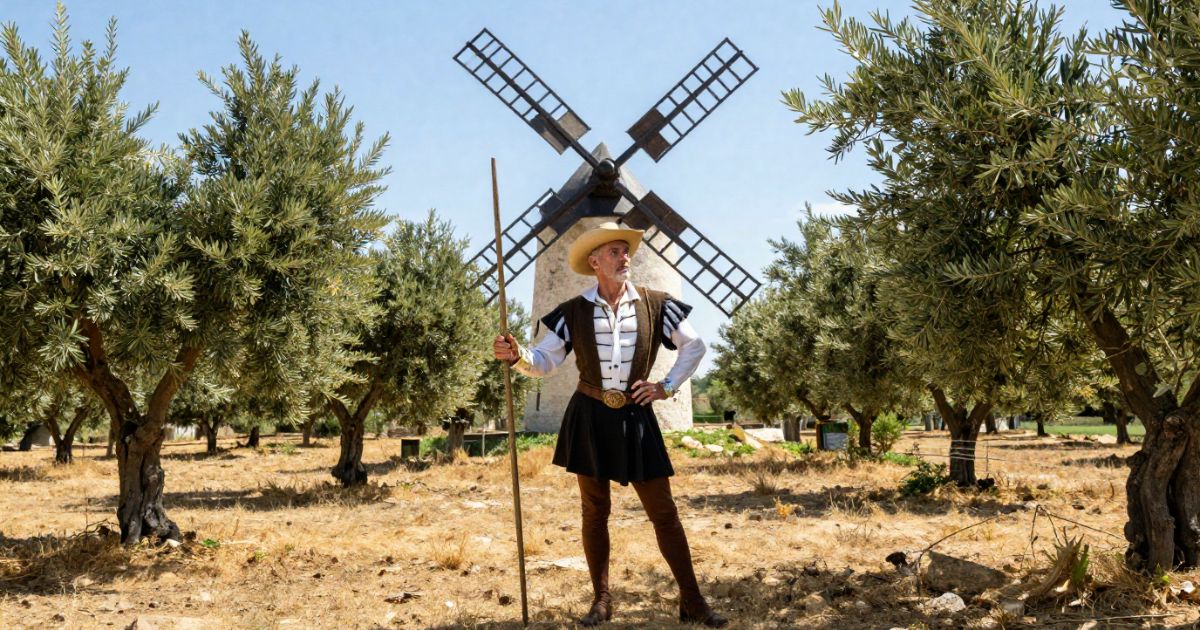
An excerpt from the original text.(complete · 2603 words)
OF WHAT HAPPENED TO OUR KNIGHT WHEN HE LEFT THE INN
Day was dawning when Don Quixote quitted the inn, so happy, so gay, so
exhilarated at finding himself now dubbed a knight, that his joy was
like to burst his horse-girths. However, recalling the advice of his
host as to the requisites he ought to carry with him, especially that
referring to money and shirts, he determined to go home and provide
himself with all, and also with a squire, for he reckoned upon securing
a farm-labourer, a neighbour of his, a poor man with a family, but very
well qualified for the office of squire to a knight. With this object
he turned his horse’s head towards his village, and Rocinante, thus
reminded of his old quarters, stepped out so briskly that he hardly
seemed to tread the earth.
He had not gone far, when out of a thicket on his right there seemed to
come feeble cries as of someone in distress, and the instant he heard
them he exclaimed, “Thanks be to heaven for the favour it accords me,
that it so soon offers me an opportunity of fulfilling the obligation I
have undertaken, and gathering the fruit of my ambition. These cries,
no doubt, come from some man or woman in want of help, and needing my
aid and protection;” and wheeling, he turned Rocinante in the direction
whence the cries seemed to proceed. He had gone but a few paces into
the wood, when he saw a mare tied to an oak, and tied to another, and
stripped from the waist upwards, a youth of about fifteen years of age,
from whom the cries came. Nor were they without cause, for a lusty
farmer was flogging him with a belt and following up every blow with
scoldings and commands, repeating, “Your mouth shut and your eyes
open!” while the youth made answer, “I won’t do it again, master mine;
by God’s passion I won’t do it again, and I’ll take more care of the
flock another time.”
Seeing what was going on, Don Quixote said in an angry voice,
“Discourteous knight, it ill becomes you to assail one who cannot
defend himself; mount your steed and take your lance” (for there was a
lance leaning against the oak to which the mare was tied), “and I will
make you know that you are behaving as a coward.” The farmer, seeing
before him this figure in full armour brandishing a lance over his
head, gave himself up for dead, and made answer meekly, “Sir Knight,
this youth that I am chastising is my servant, employed by me to watch
a flock of sheep that I have hard by, and he is so careless that I lose
one every day, and when I punish him for his carelessness and knavery
he says I do it out of niggardliness, to escape paying him the wages I
owe him, and before God, and on my soul, he lies.”
“Lies before me, base clown!” said Don Quixote. “By the sun that shines
on us I have a mind to run you through with this lance. Pay him at once
without another word; if not, by the God that rules us I will make an
end of you, and annihilate you on the spot; release him instantly.”
The farmer hung his head, and without a word untied his servant, of
whom Don Quixote asked how much his master owed him.
He replied, nine months at seven reals a month. Don Quixote added it
up, found that it came to sixty-three reals, and told the farmer to pay
it down immediately, if he did not want to die for it.
The trembling clown replied that as he lived and by the oath he had
sworn (though he had not sworn any) it was not so much; for there were
to be taken into account and deducted three pairs of shoes he had given
him, and a real for two blood-lettings when he was sick.
“All that is very well,” said Don Quixote; “but let the shoes and the
blood-lettings stand as a setoff against the blows you have given him
without any cause; for if he spoiled the leather of the shoes you paid
for, you have damaged that of his body, and if the barber took blood
from him when he was sick, you have drawn it when he was sound; so on
that score he owes you nothing.”
“The difficulty is, Sir Knight, that I have no money here; let Andres
come home with me, and I will pay him all, real by real.”
“I go with him!” said the youth. “Nay, God forbid! No, señor, not for
the world; for once alone with me, he would flay me like a Saint
Bartholomew.”
“He will do nothing of the kind,” said Don Quixote; “I have only to
command, and he will obey me; and as he has sworn to me by the order of
knighthood which he has received, I leave him free, and I guarantee the
payment.”
“Consider what you are saying, señor,” said the youth; “this master of
mine is not a knight, nor has he received any order of knighthood; for
he is Juan Haldudo the Rich, of Quintanar.”
“That matters little,” replied Don Quixote; “there may be Haldudos
knights; moreover, everyone is the son of his works.”
“That is true,” said Andres; “but this master of mine—of what works is
he the son, when he refuses me the wages of my sweat and labour?”
“I do not refuse, brother Andres,” said the farmer, “be good enough to
come along with me, and I swear by all the orders of knighthood there
are in the world to pay you as I have agreed, real by real, and
perfumed.”
“For the perfumery I excuse you,” said Don Quixote; “give it to him in
reals, and I shall be satisfied; and see that you do as you have sworn;
if not, by the same oath I swear to come back and hunt you out and
punish you; and I shall find you though you should lie closer than a
lizard. And if you desire to know who it is lays this command upon you,
that you be more firmly bound to obey it, know that I am the valorous
Don Quixote of La Mancha, the undoer of wrongs and injustices; and so,
God be with you, and keep in mind what you have promised and sworn
under those penalties that have been already declared to you.”
So saying, he gave Rocinante the spur and was soon out of reach. The
farmer followed him with his eyes, and when he saw that he had cleared
the wood and was no longer in sight, he turned to his boy Andres, and
said, “Come here, my son, I want to pay you what I owe you, as that
undoer of wrongs has commanded me.”
“My oath on it,” said Andres, “your worship will be well advised to
obey the command of that good knight—may he live a thousand years—for,
as he is a valiant and just judge, by Roque, if you do not pay me, he
will come back and do as he said.”
“My oath on it, too,” said the farmer; “but as I have a strong
affection for you, I want to add to the debt in order to add to the
payment;” and seizing him by the arm, he tied him up again, and gave
him such a flogging that he left him for dead.
“Now, Master Andres,” said the farmer, “call on the undoer of wrongs;
you will find he won’t undo that, though I am not sure that I have
quite done with you, for I have a good mind to flay you alive.” But at
last he untied him, and gave him leave to go look for his judge in
order to put the sentence pronounced into execution.
Andres went off rather down in the mouth, swearing he would go to look
for the valiant Don Quixote of La Mancha and tell him exactly what had
happened, and that all would have to be repaid him sevenfold; but for
all that, he went off weeping, while his master stood laughing.
Thus did the valiant Don Quixote right that wrong, and, thoroughly
satisfied with what had taken place, as he considered he had made a
very happy and noble beginning with his knighthood, he took the road
towards his village in perfect self-content, saying in a low voice,
“Well mayest thou this day call thyself fortunate above all on earth, O
Dulcinea del Toboso, fairest of the fair! since it has fallen to thy
lot to hold subject and submissive to thy full will and pleasure a
knight so renowned as is and will be Don Quixote of La Mancha, who, as
all the world knows, yesterday received the order of knighthood, and
hath to-day righted the greatest wrong and grievance that ever
injustice conceived and cruelty perpetrated: who hath to-day plucked
the rod from the hand of yonder ruthless oppressor so wantonly lashing
that tender child.”
He now came to a road branching in four directions, and immediately he
was reminded of those cross-roads where knights-errant used to stop to
consider which road they should take. In imitation of them he halted
for a while, and after having deeply considered it, he gave Rocinante
his head, submitting his own will to that of his hack, who followed out
his first intention, which was to make straight for his own stable.
After he had gone about two miles Don Quixote perceived a large party
of people, who, as afterwards appeared, were some Toledo traders, on
their way to buy silk at Murcia. There were six of them coming along
under their sunshades, with four servants mounted, and three muleteers
on foot. Scarcely had Don Quixote descried them when the fancy
possessed him that this must be some new adventure; and to help him to
imitate as far as he could those passages he had read of in his books,
here seemed to come one made on purpose, which he resolved to attempt.
So with a lofty bearing and determination he fixed himself firmly in
his stirrups, got his lance ready, brought his buckler before his
breast, and planting himself in the middle of the road, stood waiting
the approach of these knights-errant, for such he now considered and
held them to be; and when they had come near enough to see and hear, he
exclaimed with a haughty gesture, “All the world stand, unless all the
world confess that in all the world there is no maiden fairer than the
Empress of La Mancha, the peerless Dulcinea del Toboso.”
The traders halted at the sound of this language and the sight of the
strange figure that uttered it, and from both figure and language at
once guessed the craze of their owner; they wished, however, to learn
quietly what was the object of this confession that was demanded of
them, and one of them, who was rather fond of a joke and was very
sharp-witted, said to him, “Sir Knight, we do not know who this good
lady is that you speak of; show her to us, for, if she be of such
beauty as you suggest, with all our hearts and without any pressure we
will confess the truth that is on your part required of us.”
“If I were to show her to you,” replied Don Quixote, “what merit would
you have in confessing a truth so manifest? The essential point is that
without seeing her you must believe, confess, affirm, swear, and defend
it; else ye have to do with me in battle, ill-conditioned, arrogant
rabble that ye are; and come ye on, one by one as the order of
knighthood requires, or all together as is the custom and vile usage of
your breed, here do I bide and await you relying on the justice of the
cause I maintain.”
“Sir Knight,” replied the trader, “I entreat your worship in the name
of this present company of princes, that, to save us from charging our
consciences with the confession of a thing we have never seen or heard
of, and one moreover so much to the prejudice of the Empresses and
Queens of the Alcarria and Estremadura, your worship will be pleased to
show us some portrait of this lady, though it be no bigger than a grain
of wheat; for by the thread one gets at the ball, and in this way we
shall be satisfied and easy, and you will be content and pleased; nay,
I believe we are already so far agreed with you that even though her
portrait should show her blind of one eye, and distilling vermilion and
sulphur from the other, we would nevertheless, to gratify your worship,
say all in her favour that you desire.”
“She distils nothing of the kind, vile rabble,” said Don Quixote,
burning with rage, “nothing of the kind, I say, only ambergris and
civet in cotton; nor is she one-eyed or humpbacked, but straighter than
a Guadarrama spindle: but ye must pay for the blasphemy ye have uttered
against beauty like that of my lady.”
And so saying, he charged with levelled lance against the one who had
spoken, with such fury and fierceness that, if luck had not contrived
that Rocinante should stumble midway and come down, it would have gone
hard with the rash trader. Down went Rocinante, and over went his
master, rolling along the ground for some distance; and when he tried
to rise he was unable, so encumbered was he with lance, buckler, spurs,
helmet, and the weight of his old armour; and all the while he was
struggling to get up he kept saying, “Fly not, cowards and caitiffs!
stay, for not by my fault, but my horse’s, am I stretched here.”
One of the muleteers in attendance, who could not have had much good
nature in him, hearing the poor prostrate man blustering in this style,
was unable to refrain from giving him an answer on his ribs; and coming
up to him he seized his lance, and having broken it in pieces, with one
of them he began so to belabour our Don Quixote that, notwithstanding
and in spite of his armour, he milled him like a measure of wheat. His
masters called out not to lay on so hard and to leave him alone, but
the muleteer’s blood was up, and he did not care to drop the game until
he had vented the rest of his wrath, and gathering up the remaining
fragments of the lance he finished with a discharge upon the unhappy
victim, who all through the storm of sticks that rained on him never
ceased threatening heaven, and earth, and the brigands, for such they
seemed to him. At last the muleteer was tired, and the traders
continued their journey, taking with them matter for talk about the
poor fellow who had been cudgelled. He when he found himself alone made
another effort to rise; but if he was unable when whole and sound, how
was he to rise after having been thrashed and well-nigh knocked to
pieces? And yet he esteemed himself fortunate, as it seemed to him that
this was a regular knight-errant’s mishap, and entirely, he considered,
the fault of his horse. However, battered in body as he was, to rise
was beyond his power.
e04.jpg (28K)
Master this chapter. Complete your experience
Purchase the complete book to access all chapters and support classic literature
As an Amazon Associate, we earn a small commission from qualifying purchases at no additional cost to you.
Available in paperback, hardcover, and e-book formats
Let's Analyse the Pattern
When our desire to help overrides our need to understand, we often make situations worse while feeling righteous about it.
Why This Matters
Connect literature to life
This chapter teaches how to recognize when your need to be right overrides your ability to actually help.
Practice This Today
This week, notice when you feel the urge to jump into someone else's problem—pause and ask three questions before offering solutions.
Now let's explore the literary elements.
Key Quotes & Analysis
"Thanks be to heaven for the favour it accords me, that it so soon offers me an opportunity of fulfilling the obligation I have undertaken, and gathering the fruit of my ambition."
Context: When he hears Andres crying out in the woods
This shows Don Quixote's self-centered approach to helping others. He's more excited about proving himself as a knight than actually understanding what help is needed. He sees every situation as an opportunity for personal glory.
In Today's Words:
Finally, my chance to be the hero I know I am!
"I charge you not to move from this spot until you have fully paid him what you owe him."
Context: Commanding the farmer to pay Andres his wages
Don Quixote thinks he can solve complex problems with simple commands. He doesn't consider enforcement or consequences - he just assumes his authority as a knight will make everything work out.
In Today's Words:
I'm ordering you to do the right thing, and I expect you'll just do it because I said so.
"Now you see, Andres my lad, how easily I have undone the wrong that was done to you."
Context: After forcing the farmer to agree to his demands
This reveals Don Quixote's dangerous naivety. He thinks the problem is solved because he got the outcome he wanted in the moment, without considering what happens after he leaves.
In Today's Words:
See how easy that was? Problem solved!
Thematic Threads
Class
In This Chapter
Don Quixote assumes the farmer is wrong and the servant is innocent, imposing his aristocratic worldview without understanding working-class realities
Development
Builds on earlier themes of social hierarchy, now showing how class blindness can harm those it claims to help
In Your Life:
You might miss important context when trying to help someone from a different economic background than yours
Identity
In This Chapter
Don Quixote's need to be a knight-errant matters more than Andres's actual welfare—his identity requires him to be the hero
Development
Deepens from earlier chapters where identity was just delusion, now showing how it drives harmful action
In Your Life:
Your self-image might drive you to 'help' in ways that serve your ego more than the person in need
Social Expectations
In This Chapter
Don Quixote expects merchants to praise an unknown woman's beauty simply because a 'knight' demands it
Development
Continues the pattern of expecting others to validate his fantasy world
In Your Life:
You might expect others to support your beliefs or decisions without giving them good reasons to do so
Personal Growth
In This Chapter
Don Quixote learns nothing from his failures—the beating doesn't make him question his approach
Development
Shows how delusion prevents learning, contrasting with potential wisdom from earlier setbacks
In Your Life:
You might resist feedback that challenges your self-concept, missing chances to actually improve
Human Relationships
In This Chapter
Don Quixote treats people as props in his story rather than complex individuals with their own needs and perspectives
Development
Introduced here as a new dimension of his disconnection from reality
In Your Life:
You might project your own narrative onto relationships instead of seeing people as they actually are
You now have the context. Time to form your own thoughts.
Discussion Questions
- 1
What actually happened to Andres after Don Quixote left, and why did the farmer's behavior change?
analysis • surface - 2
Why did Don Quixote's 'rescue' of Andres make the situation worse instead of better?
analysis • medium - 3
Where do you see people today jumping in to 'fix' situations without fully understanding them first?
application • medium - 4
When you encounter someone being treated unfairly, how can you help without making things worse?
application • deep - 5
What does this chapter reveal about the difference between wanting to be a hero and actually being helpful?
reflection • deep
Critical Thinking Exercise
Rewrite the Rescue Scene
Imagine you're Don Quixote approaching the scene with Andres and the farmer. Instead of immediately assuming you understand the situation, rewrite the encounter focusing on gathering information first. What questions would you ask? What would you need to know before taking action? Write out this alternative scene, showing how curiosity and patience might lead to a better outcome than righteous anger.
Consider:
- •What legitimate concerns might the farmer have that Don Quixote ignored?
- •How could asking questions change the power dynamic in the situation?
- •What follow-up actions would actually protect Andres long-term?
Journaling Prompt
Write about a time when you jumped in to help someone without fully understanding their situation. What happened? What would you do differently now, knowing what you learned from that experience?
Coming Up Next...
Chapter 25: Don Quixote's Mad Penance
Beaten and unable to move, Don Quixote lies helpless on the road. His mind turns to the heroic tales that comfort him, but will fantasy be enough to get him home? A familiar face may be his unlikely salvation.