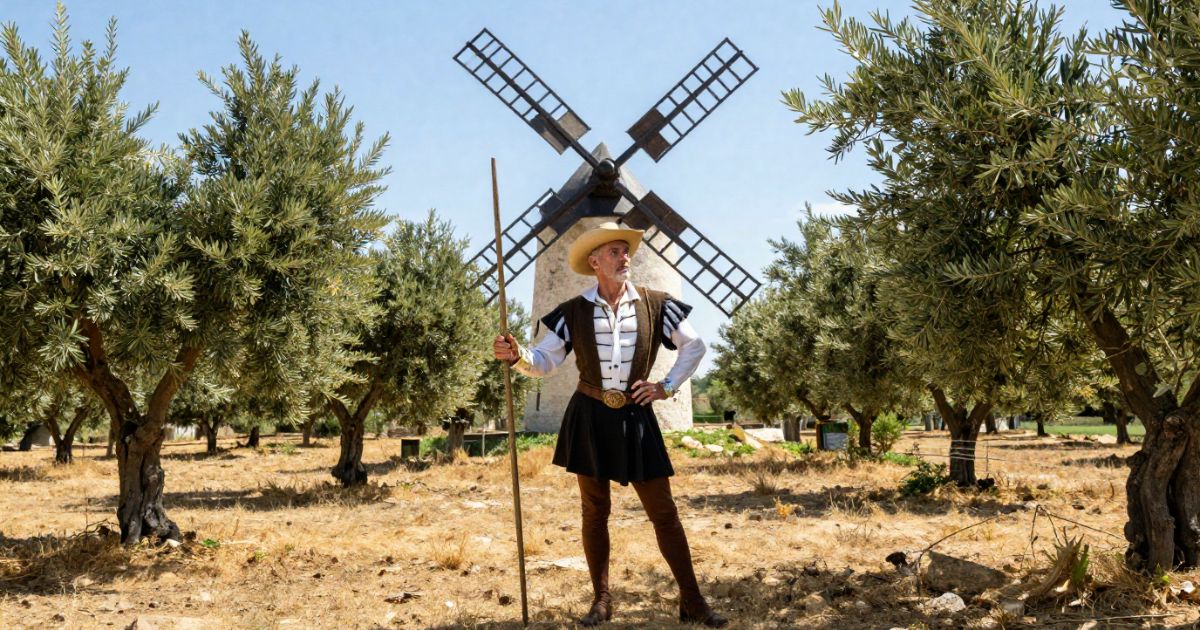
An excerpt from the original text.(complete · 1309 words)
: N WHICH IS ENDED THE STORY OF THE SHEPHERDESS MARCELA, WITH OTHER INCIDENTS
At dawn, five goatherds came to rouse Don Quixote for the burial. They met six shepherds in black sheepskins crowned with cypress and oleander, carrying a bier. Two men of quality on horseback—Vivaldo and companion—with servants joined them. All were heading to the burial.
On the journey, Vivaldo asked why Don Quixote went armed in such peaceful country. Quixote explained his calling as knight-errant. They all immediately recognized his madness. Vivaldo, to pass the time, engaged him in absurd theological debates about knights-errant versus monks, whether knights should commend themselves to ladies or to God before battle. Quixote defended every aspect of knight-errantry with elaborate arguments.
They arrived at the burial site where shepherds were digging a grave by a rock. On the bier lay Chrysostom's body—thirty years old, comely even in death, surrounded by books and papers. Ambrosio confirmed this was the spot where Chrysostom first saw Marcela, first declared his honorable passion, and where she finally rejected him completely. He called her "that mortal enemy of the human race."
Vivaldo asked Ambrosio not to burn Chrysostom's papers—to preserve them as warning about Marcela's cruelty. Ambrosio agreed to save some. Vivaldo read aloud "The Lay of Chrysostom"—a long despairing poem accusing Marcela of cruelty, calling her cruel tyrant, describing his suffering. The poem claimed "thy injustice hath supplied the cause that makes me quit the weary life I loathe."
Just as Vivaldo was about to read another paper, Marcela appeared on the summit of the rock above them—so beautiful that even those accustomed to seeing her were amazed. Ambrosio addressed her with manifest indignation: "Art thou come, cruel basilisk of these mountains, to see if in thy presence blood will flow from wounds thy cruelty has robbed of life?"
Marcela replied she came to defend herself and prove how unreasonable were those who blamed her. She delivered a powerful speech:
"Heaven has made me beautiful, you say, and so much so that despite yourselves my beauty leads you to love me; and for the love you show me you say I am bound to love you. By natural understanding God gave me, I know that everything beautiful attracts love, but I cannot see how, by reason of being loved, that which is loved for its beauty is bound to love that which loves it. Besides, the lover of that which is beautiful may be ugly, and ugliness being detestable, it is absurd to say 'I love thee because thou art beautiful, thou must love me though I be ugly.'
"But supposing the beauty equal on both sides, it does not follow that inclinations must be alike. Not every beauty that excites love wins the heart. If every beauty won the heart, the will would wander unable to choose. True love is indivisible, voluntary, and not compelled. Why do you desire me to bend my will by force, for no other reason but that you say you love me?
"Had Heaven made me ugly as it made me beautiful, could I with justice complain of you for not loving me? The beauty I possess was no choice of mine—Heaven gave it without my asking. As the viper does not deserve blame for the poison it carries, a gift of nature, neither do I deserve reproach for being beautiful. Beauty in a modest woman is like fire at a distance or a sharp sword—they do not burn or cut those who do not come too near.
"If modesty is a virtue that lends grace to mind and body, why should she who is loved for her beauty part with it to gratify one who for his pleasure alone strives to rob her of it?
"I was born free, and that I might live in freedom I chose the solitude of fields. In trees I find society, in clear waters my mirrors. I am a fire afar off, a sword laid aside. Those whom I have inspired with love by letting them see me, I have by words undeceived. If their longings live on hope—and I gave none to Chrysostom—it cannot justly be said that the death of any is my doing. It was his own obstinacy, not my cruelty, that killed him.
"If it be made a charge that his wishes were honourable and therefore I was bound to yield, I answer: when on this very spot he declared his pure purpose, I told him mine was to live in perpetual solitude, and that the earth alone should enjoy the fruits of my retirement and spoils of my beauty. After this open avowal, he chose to persist against hope and steer against the wind. What wonder he should sink in the depths of his infatuation?
"If I had encouraged him, I should be false. If I had gratified him, I should have acted against my own resolution. He was persistent in spite of warning, he despaired without being hated. Bethink you now if it be reasonable that his suffering should be laid to my charge.
"Let him who has been deceived complain, let him whose encouraged hopes proved vain give way to despair, let him whom I shall entice flatter himself, let him whom I receive boast—but let not him call me cruel or homicide to whom I make no promise, whom I neither entice nor receive.
"It has not been the will of Heaven that I should love by fate, and to expect me to love by choice is idle. Let this general declaration serve for each of my suitors: if anyone dies for me it is not of jealousy or misery, for she who loves no one can give no cause for jealousy. Candour is not to be confounded with scorn.
"Let him who calls me wild beast and basilisk leave me alone. Let him who calls me ungrateful withhold his service. Who calls me wayward, seek not my acquaintance. Who calls me cruel, pursue me not. This wild beast has no desire to seek, serve, know, or follow them.
"If Chrysostom's impatience and violent passion killed him, why should my modest behaviour be blamed? If I preserve my purity in society of the trees, why should he who would have me preserve it among men seek to rob me of it? I have wealth of my own and covet not others'. My taste is for freedom and I have no relish for constraint. I neither love nor hate anyone. I do not deceive this one or court that. The modest converse of shepherd girls and care of my goats are my recreations. My desires are bounded by these mountains."
With these words, not waiting for reply, she turned and passed into the thickest part of the wood, leaving all lost in admiration of her good sense and her beauty. Some wounded by her bright eyes made as though to follow her. Don Quixote, laying hand on his sword, exclaimed: "Let no one dare to follow the beautiful Marcela! She has shown by clear arguments that little or no fault is with her for Chrysostom's death. Instead of being followed and persecuted, she should be honoured and esteemed, for she shows she is the only woman in the world that holds to such virtuous resolution."
None of the shepherds moved until they'd finished the grave, burned the papers, and laid Chrysostom's body in it with many tears. They closed the grave with a heavy stone. Ambrosio planned an epitaph: "In life a shepherd swain, In death a victim to disdain."
After condolences, Vivaldo's party invited Don Quixote to Seville where adventures present themselves constantly. Quixote declined—he must first clear these mountains of highwaymen. They left. Don Quixote resolved to find Marcela and offer his services, but things did not fall out as he expected.
Master this chapter. Complete your experience
Purchase the complete book to access all chapters and support classic literature
As an Amazon Associate, we earn a small commission from qualifying purchases at no additional cost to you.
Available in paperback, hardcover, and e-book formats
Let's Analyse the Pattern
When maintaining clear, consistent boundaries gets blamed as cruelty because it disappoints someone who hoped you'd change your stated position.
Why This Matters
Connect literature to life
This chapter teaches you to recognize the difference between being clear (saying no and meaning it) versus being cruel (leading someone on or being unclear). Marcela shows that clarity isn't cruelty even when it disappoints.
Practice This Today
This week, if you need to say no to something, practice being clear and brief without over-explaining or apologizing. Notice if the other person frames your clarity as meanness—that's their pattern, not your problem.
Now let's explore the literary elements.
Key Quotes & Analysis
"I cannot see how, by reason of being loved, that which is loved for its beauty is bound to love that which loves it."
Context: Core argument of her defense
The foundational logic: being desired doesn't create obligation to desire back. This should be obvious, but apparently needed saying in 1605 and still needs saying today. She's dismantling the assumed reciprocity of romantic interest.
In Today's Words:
Just because you love me doesn't mean I have to love you back.
"The beauty I possessed was no choice of mine, for, be it what it may, Heaven of its bounty gave it me without my asking or choosing it."
Context: Defending against being blamed for her beauty
She didn't ask to be beautiful, didn't choose it, and can't turn it off. Blaming her for having it is blaming her for existing. This is the fundamental unfairness attractive people face—punished for something they didn't control.
In Today's Words:
I didn't choose to be beautiful—I was born this way. How is that my fault?
"It was rather his own obstinacy than my cruelty that killed him...He was persistent in spite of warning, he despaired without being hated."
Context: Refuting the accusation of causing his death
Perfect assignment of responsibility. She warned him clearly. He persisted anyway. She never hated him—just didn't love him. His choice to continue despite clear rejection is what hurt him, not anything she did.
In Today's Words:
He kept pursuing me after I said no—that's his choice, not my cruelty. I didn't hate him, I just didn't love him.
"Let no one, whatever his rank or condition, dare to follow the beautiful Marcela...she should in justice be honoured and esteemed by all the good people of the world."
Context: Defending Marcela from pursuit
Don Quixote's first genuinely heroic act—using his delusion to protect someone's actual autonomy. He's right for once: she's shown she's innocent, she should be honored not harassed. Even a madman can see this clearly.
In Today's Words:
Nobody better follow her. She's proven she did nothing wrong and deserves respect, not harassment.
Thematic Threads
Identity
In This Chapter
Marcela has constructed an identity of solitary freedom and defends it against social pressure to conform to the identity of wife/romantic partner that everyone expects
Development
Introducing the right to self-define in opposition to social/romantic expectations
In Your Life:
You might recognize fighting to maintain an identity others want you to abandon for one that fits their needs
Class
In This Chapter
Marcela has wealth, so she can choose solitude—her freedom is economically supported. Most women didn't have this option. Class privilege enables her autonomy in ways unavailable to poorer women.
Development
Showing how class determines whose autonomy is possible—she can refuse marriage because she has money
In Your Life:
You might notice how economic independence determines whose boundaries can be maintained
Social Expectations
In This Chapter
Entire community expected beautiful wealthy woman to marry someone from the many suitors. Her refusal violates the script so severely a man dies and she's blamed. Social expectation treats women's autonomy as violence.
Development
Making explicit: gendered social expectations frame women's choices as harm to men
In Your Life:
You might recognize how violating expected social scripts gets you blamed for others' disappointment
Personal Growth
In This Chapter
Don Quixote shows growth—he understands Marcela's argument, agrees with it, and acts to protect her autonomy. First time his chivalry actually helps someone.
Development
Quixote's delusion accidentally produces genuine heroism when pointed at actual injustice
In Your Life:
You might notice times when you got something right by accident or when your usual patterns surprisingly produced good results
You now have the context. Time to form your own thoughts.
Discussion Questions
- 1
What are Marcela's main arguments for why she's not responsible for Chrysostom's death?
analysis • surface - 2
How does Marcela use the metaphor of fire at a distance to explain her position?
analysis • medium - 3
Why does Don Quixote defend Marcela instead of defending the suffering romantic pursuers?
analysis • deep - 4
Have you ever been accused of being cruel or cold for maintaining clear boundaries that disappointed someone?
reflection • medium - 5
How can you tell the difference between someone genuinely mistreating another person versus someone being blamed for not reciprocating unwanted romantic attention?
application • deep
Critical Thinking Exercise
Clarity Audit
Think of a situation where you set a boundary and someone called you cruel, cold, or mean for it. Write down: 1) What was your boundary? 2) How clearly did you communicate it? 3) Did you give mixed signals or were you consistent? 4) Did you lead them on or were you honest from the start? 5) Are you responsible for their disappointment, or are they responsible for ignoring your clarity? Use Marcela's framework: Did you deceive? Did you encourage false hope? Did you entice then reject? Or were you clear and consistent?
Consider:
- •Notice if you've been carrying guilt for someone else's choice to ignore your clearly stated position
- •Ask whether you'd expect someone else to abandon their boundaries to prevent someone's disappointment
- •Consider whether 'being nice' means being unclear versus being kind while being clear
Journaling Prompt
Write about a time when you finally stopped over-explaining or softening your no, and just stated your boundary clearly. What happened? Did the other person respect it more or less? How did it feel to be clear instead of gentle?
Coming Up Next...
Chapter 14: Chrysostom's Verses and Marcela's Entrance
After Marcela's departure, they'll read more of Chrysostom's verses—poetry that reveals the psychology of romantic obsession. Then Don Quixote and Sancho will encounter violence they didn't see coming.