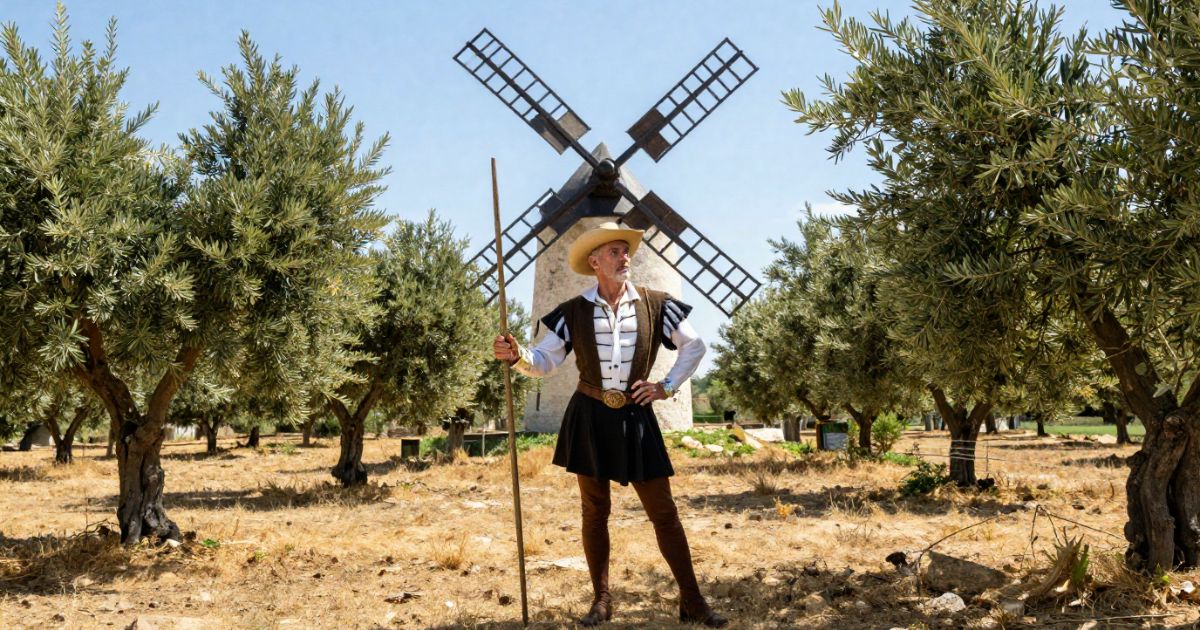
An excerpt from the original text.(complete · 573 words)
: F WHAT A GOATHERD RELATED TO THOSE WITH DON QUIXOTE
A young goatherd arrived from the village with news: "This morning that famous student-shepherd called Chrysostom died, and it is rumoured that he died of love for that devil of a village girl, the daughter of Guillermo the Rich, she that wanders about the wolds here in the dress of a shepherdess."
"You mean Marcela?" said one.
"Her I mean. And the best of it is, he has directed in his will that he is to be buried in the fields like a Moor, at the foot of the rock where the Cork-tree spring is—the place where he first saw her. He's left other directions which the clergy say savour of paganism. His great friend Ambrosio the student says everything must be done according to Chrysostom's directions. The village is in commotion. Tomorrow they're coming to bury him with great ceremony. I'm sure it will be worth seeing."
The goatherds decided to go. Don Quixote asked Pedro to explain who these people were.
Pedro told the story: Chrysostom was a wealthy gentleman who'd been a student at Salamanca for many years. He returned very learned, especially in astronomy—he predicted eclipses ("cris" Pedro called them, which Quixote corrected to "eclipse") and whether years would be abundant or sterile ("estility" Pedro said; Quixote corrected "sterility"). His father grew rich following his agricultural advice. Pedro interrupted himself with mispronunciations until Quixote promised to stop correcting him.
Not many months after returning, Chrysostom appeared dressed as a shepherd with crook and sheepskin, putting off his scholar's gown. His friend Ambrosio joined him in shepherd's dress. The villagers were lost in wonder at this transformation. Chrysostom was a great writer of verses—carols for Christmas Eve, plays for Corpus Christi. About this time his father died, leaving him heir to large property: chattels, land, cattle, sheep, and money. He was deserving of it all—a good comrade, kind-hearted, with a countenance like a benediction.
It came to be known he'd changed his dress only to wander these wastes after the shepherdess Marcela, with whom he'd fallen in love.
Pedro then told Marcela's story: In their village lived Guillermo, even richer than Chrysostom's father. God gave him a daughter, but her mother died in childbirth—the most respected woman in the neighborhood. Guillermo died of grief, leaving his daughter Marcela, a child and rich, to the care of her uncle, a priest. The girl grew up with such beauty it surpassed even her mother's. By fourteen or fifteen, nobody beheld her but blessed God. The greater number were in love with her past redemption.
Her uncle kept her in seclusion, but fame of her beauty and wealth spread. Her uncle was asked, solicited, and importuned to give her in marriage by suitors from many leagues around—persons of highest quality. Being a good Christian, he wanted to give her in marriage (she was old enough), but was unwilling without her consent. Pedro noted the priest was praised for this—in small villages everything is talked about, and a priest must be exceptionally good to make parishioners speak well of him.
The uncle presented many suitors to Marcela, describing their qualities and begging her to choose. She gave only one answer: she had no desire to marry yet, being too young to bear the burden of matrimony. At these reasonable excuses, her uncle ceased urging and waited until she was more advanced in age.
Master this chapter. Complete your experience
Purchase the complete book to access all chapters and support classic literature
As an Amazon Associate, we earn a small commission from qualifying purchases at no additional cost to you.
Available in paperback, hardcover, and e-book formats
Let's Analyse the Pattern
When physical attractiveness gets framed as creating moral debt to reciprocate romantic interest, making rejection seem like cruelty rather than autonomy.
Why This Matters
Connect literature to life
This chapter teaches you to distinguish between causing harm through your actions versus being blamed for harm caused by others' reactions to your boundaries.
Practice This Today
This week, notice when someone frames your boundary (saying no, being unavailable, choosing differently) as you hurting them. Ask: did I create their expectation or did they create it themselves?
Now let's explore the literary elements.
Key Quotes & Analysis
"This morning that famous student-shepherd called Chrysostom died, and it is rumoured that he died of love for that devil of a village girl."
Context: Announcing Chrysostom's death
Note 'devil of a village girl'—she's blamed for his death before anyone even explains what happened. Beautiful women who reject men get demonized automatically. The rumor assigns causation: he died OF love FOR her, making her responsible.
In Today's Words:
That famous rich guy who became a shepherd died this morning, apparently because that terrible beautiful girl wouldn't love him back.
"If, señor, you must go finding fault with words at every step, we shall not make an end of it this twelvemonth."
Context: Responding to Quixote's constant corrections
Pedro pushing back against Quixote's pedantry. This is class resistance—refusing to be educated or corrected by someone who's supposed to be listening to your story. He's saying: my pronunciation isn't the point, stop derailing my narrative with your superior knowledge.
In Today's Words:
Sir, if you're going to correct every word I say, we'll never get through this story.
"Such and so great is the vigilance with which she watches over her honour, that of all those that court and woo her not one has boasted, or can with truth boast, that she has given him any hope however small."
Context: Describing Marcela's behavior
This is crucial: she hasn't led anyone on. She's not playing games. She treats everyone courteously but clearly rejects romantic advances. Yet she's still blamed for men's suffering. The 'vigilance over honour' means she's careful, proper, gives no mixed signals. But it doesn't matter.
In Today's Words:
She's been totally clear—she's not interested in any of them. She hasn't given anyone false hope or led anyone on.
"With this kind of disposition she does more harm in this country than if the plague had got into it."
Context: Explaining Marcela's impact
She's compared to plague—a disease killing people—just for being beautiful and unavailable. Her crime is existing in a way that inspires desire she won't fulfill. The metaphor reveals how women's autonomy gets framed as violence against men.
In Today's Words:
Her refusing to date anyone is destroying this whole area worse than a disease outbreak.
Thematic Threads
Identity
In This Chapter
Chrysostom abandoned his scholar identity to adopt shepherd identity purely for romantic pursuit—showing how love can make people reconstruct their entire self
Development
Introducing romantic obsession as identity transformation, parallel to Quixote's chivalric obsession
In Your Life:
You might recognize times when romantic pursuit made you change who you were, or when you watched someone lose themselves in chasing someone
Class
In This Chapter
Wealthy educated men playing at being shepherds while actual shepherds work—the privilege of choosing poverty versus living it by necessity
Development
Deepening class critique: who gets to romanticize hardship as lifestyle versus who's trapped in it
In Your Life:
You might notice the difference between people experiencing something as aesthetic choice versus economic reality
Social Expectations
In This Chapter
Marcela is expected to marry someone from the many suitors—her refusal to follow this script causes village-wide commotion because beautiful wealthy women are supposed to accept the system
Development
Introducing gendered social expectations about romance and beauty
In Your Life:
You might recognize times when refusing expected social scripts (marriage, career path, etc.) caused others to see you as problematic
Personal Growth
In This Chapter
Quixote shows slight growth—he apologizes when Pedro calls him out for interrupting, and actually stops correcting, letting Pedro finish his story
Development
First example of Quixote adjusting his behavior based on social feedback from someone not Sancho
In Your Life:
You might notice small moments where you learned to stop a habit that was irritating others
You now have the context. Time to form your own thoughts.
Discussion Questions
- 1
What reasons does Pedro give for Chrysostom becoming a shepherd?
analysis • surface - 2
How is Marcela described, and what has she actually done that people are calling her cruel?
analysis • medium - 3
Why does Pedro get irritated with Don Quixote's constant corrections, and what does Quixote's pedantry reveal about class and education?
analysis • deep - 4
Have you ever been blamed for someone's feelings when you were just maintaining your boundaries?
reflection • medium - 5
How can you tell the difference between actually leading someone on versus just being friendly/attractive while they develop their own expectations?
application • deep
Critical Thinking Exercise
Responsibility Chain Analysis
Think of a situation where someone blamed you for their emotional reaction to your boundary or choice. Map the sequence: 1) What boundary did you set or choice did you make? 2) What was their reaction? 3) How did they frame your choice as harm to them? 4) At what point did they make choices that created or amplified their own suffering? 5) Where is the actual responsibility line between your choices (which are yours to make) and their reactions (which are theirs to manage)?
Consider:
- •Notice if you've been carrying responsibility for others' emotional reactions to your legitimate boundaries
- •Consider whether you'd expect someone else to sacrifice their autonomy to protect someone's feelings
- •Ask what would happen if you simply maintained your boundary without managing their disappointment
Journaling Prompt
Write about a time when you said no to something and the other person made you feel responsible for their disappointment. Looking back, where did your responsibility actually end and theirs begin?
Coming Up Next...
Chapter 13: Sancho's Rise to Power
At the funeral, as Chrysostom's body is being lowered into the ground, Marcela appears on the rocks above. She's come to defend herself against accusations of murder by cruelty. Her speech will challenge every assumption about what beautiful people owe to those who desire them.