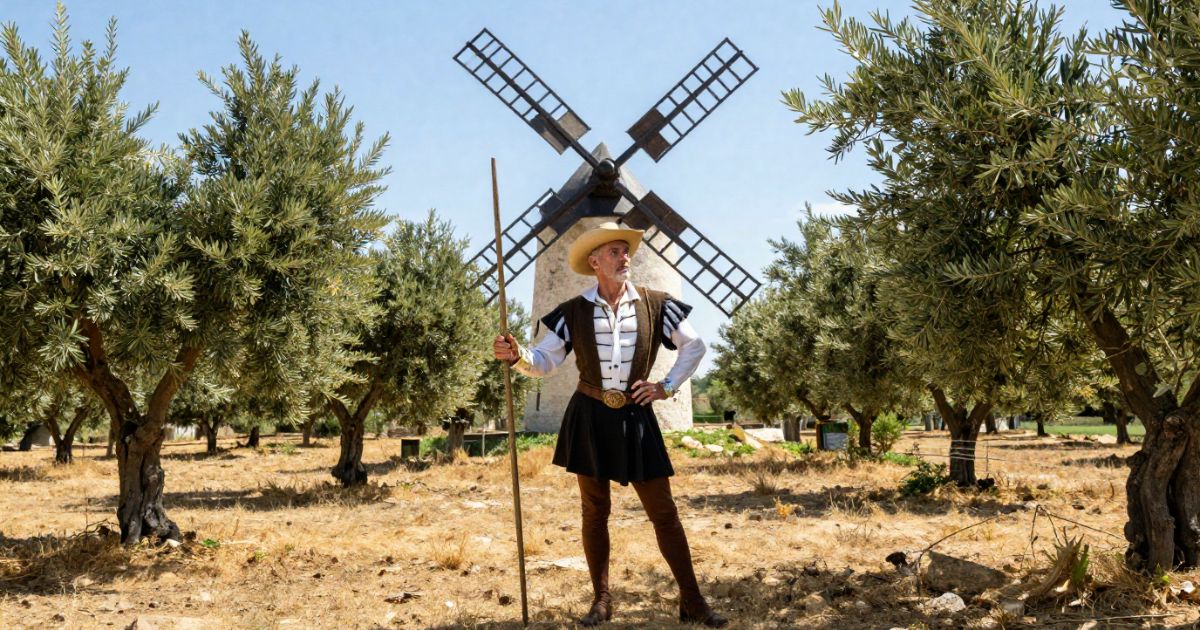
An excerpt from the original text.(complete · 476 words)
: HEREIN ARE INSERTED THE DESPAIRING VERSES OF THE DEAD SHEPHERD, TOGETHER WITH OTHER INCIDENTS NOT LOOKED FOR
This chapter consists primarily of "The Lay of Chrysostom"—a long poem read aloud at the funeral. The verses are elaborate, dramatic, and deeply self-pitying:
"Since thou dost in thy cruelty desire / The ruthless rigour of thy tyranny / From tongue to tongue, from land to land proclaimed..."
The poem calls on Hell to lend him "deep notes of woe" and summons animal cries—lion's roar, wolf's howl, snake's hissing—to express his pain. He claims "Disdain hath power to kill" and that he lives "a prey to absence, jealousy, disdain; / Racked by suspicion as by certainty; / Forgotten, left to feed my flame alone."
The poem's climax blames Marcela directly: "Thou whose injustice hath supplied the cause / That makes me quit the weary life I loathe" and asks her not to shed tears but to let her laughter ring because "my death to be thy festival...Thy glory gains by my untimely end."
He summons mythological figures of eternal torment—Tantalus, Sisyphus, Tityus, Ixion—and the progeny of hell to join in mourning "a lover dead."
When Vivaldo finished reading, listeners approved the verses. But one noted something didn't agree with reports of Marcela's virtue—Chrysostom complained of jealousy, suspicion, and absence, "all to the prejudice of the good name and fame of Marcela."
Ambrosio, who knew his friend's secret thoughts, explained: "When the unhappy man wrote this lay he was away from Marcela, from whom he had voluntarily separated himself, to try if absence would act with him as it is wont. And as everything distresses and every fear haunts the banished lover, so imaginary jealousies and suspicions, dreaded as if they were true, tormented Chrysostom. Thus the truth of what report declares of the virtue of Marcela remains unshaken, and with her envy itself should not and cannot find any fault save that of being cruel, somewhat haughty, and very scornful."
"That is true," said Vivaldo.
As he was about to read another paper of those preserved from the fire, he was stopped by a marvellous vision that unexpectedly presented itself—on the summit of the rock where they were digging the grave, there appeared the shepherdess Marcela, so beautiful that her beauty exceeded its reputation. Those who had never beheld her gazed in wonder and silence. Those accustomed to seeing her were not less amazed.
The instant Ambrosio saw her, he addressed her with manifest indignation: "Art thou come, by chance, cruel basilisk of these mountains, to see if in thy presence blood will flow from the wounds of this wretched being thy cruelty has robbed of life?"
[Note: Marcela's response and defense speech are in Chapter XIII—this chapter focuses on the reading of Chrysostom's poem and sets up her dramatic entrance, which continues into what we've already covered.]
Master this chapter. Complete your experience
Purchase the complete book to access all chapters and support classic literature
As an Amazon Associate, we earn a small commission from qualifying purchases at no additional cost to you.
Available in paperback, hardcover, and e-book formats
Let's Analyse the Pattern
When you intellectually know you are being irrational but emotionally continue the pattern anyway—awareness without the power to change behavior.
Why This Matters
Connect literature to life
This chapter teaches you that knowing you have a problem and actually changing the problem are different things. Self-awareness is necessary but not sufficient for growth.
Practice This Today
This week, notice if you have any patterns where you regularly say I know I should not do this but do it anyway. That is self-aware dysfunction. Ask: what would have to change for knowing to become doing?
Now let's explore the literary elements.
Key Quotes & Analysis
"Thus, self-deluding, and in bondage sore, / And wearing out the wretched shred of life / To which I am reduced by her disdain."
Context: Admitting his self-delusion in the poem
He knows he's 'self-deluding'—consciously aware he's clinging to fantasy. Yet he still frames Marcela's disdain as what reduced him to this state. The awareness doesn't produce accountability; he acknowledges the delusion and continues with the blame.
In Today's Words:
I know I'm fooling myself and destroying myself over your rejection.
"Imaginary jealousies and suspicions, dreaded as if they were true, tormented Chrysostom."
Context: Explaining the poem's accusations
Ambrosio defending Marcela's virtue by explaining his friend was tormented by fantasies, not realities. The jealousies were in Chrysostom's head—Marcela never gave cause. Yet Chrysostom suffered as if they were true and blamed her for them.
In Today's Words:
He was torturing himself with scenarios he made up in his head—she didn't actually do anything to cause them.
"Thou whose injustice hath supplied the cause / That makes me quit the weary life I loathe, / As by this wounded bosom thou canst see / How willingly thy victim I become."
Context: Blaming Marcela for his death
The poem's central accusation—her 'injustice' caused his death. But what was the injustice? Not loving him back. Framing rejection as injustice makes not reciprocating desire into a crime. The logic is: I love you, therefore you must love me, and if you don't, you're committing injustice.
In Today's Words:
Your refusal to love me back is such an injustice that I'm killing myself, and it's your fault.
"On the summit of the rock where they were digging the grave there appeared the shepherdess Marcela, so beautiful that her beauty exceeded its reputation."
Context: Marcela's entrance
Her appearance is described as 'marvellous vision'—almost supernatural. Her beauty stunning even those who knew her. This sets up the irony: all this beauty being blamed for one man's inability to handle desire he generated himself.
In Today's Words:
Marcela appeared at the top of the rock and she was even more beautiful than everyone said.
Thematic Threads
Identity
In This Chapter
Chrysostom's scholar identity abandoned for shepherd-lover identity, maintained through poetry even unto death—showing how romantic obsession can become totalizing identity
Development
Parallel to Quixote: both men reconstructing identity around obsession (chivalry/romance) and maintaining it regardless of reality
In Your Life:
You might notice times when romantic pursuit became your entire identity rather than one aspect of life
Class
In This Chapter
Wealthy educated man can afford to die romantically with elaborate poetry and symbolic burial—working shepherds don't have that luxury of performative death
Development
Class determines whose suffering gets aestheticized versus whose just has to keep working
In Your Life:
You might notice who gets to have dramatic emotional breakdowns versus who has to keep functioning
Social Expectations
In This Chapter
The funeral becomes theater—everyone performing their roles (grieving friend, curious travelers, accused beauty) in a drama with social scripts
Development
How grief and blame become performances with audiences
In Your Life:
You might recognize how social rituals can become more about performance than genuine feeling
Personal Growth
In This Chapter
Chrysostom showed zero growth—aware of his delusion but unwilling to change, dying with blame still intact. Negative example of self-awareness without growth
Development
Demonstrating that knowing better doesn't mean doing better
In Your Life:
You might notice patterns where you're aware you're stuck but haven't found the way to unstick yourself
You now have the context. Time to form your own thoughts.
Discussion Questions
- 1
What does Chrysostom admit about his own delusion in the poem, and what does he still blame Marcela for?
analysis • surface - 2
Why does Ambrosio say Chrysostom's jealousies were imaginary, and what does this reveal about who created the suffering?
analysis • medium - 3
How does Chrysostom's poem set up Marcela to be blamed no matter how she responds to his death?
analysis • deep - 4
Have you ever been aware you were doing something irrational or unhealthy but continued doing it anyway? What was the gap between knowing and changing?
reflection • medium - 5
How can you tell when someone's suffering is genuine processing versus performative manipulation aimed at making you feel responsible?
application • deep
Critical Thinking Exercise
Awareness vs. Action Gap Analysis
Identify a behavior or pattern you have where you know you should change but have not. Write down: 1) What you know intellectually about why this is problematic, 2) What you keep doing anyway, 3) What knowing has not changed, 4) What would have to be different for knowledge to become action, 5) What system or circumstance change would work with your emotional brain instead of just talking to your rational brain.
Consider:
- •Notice if you are stuck in the I know but loop
- •Ask whether awareness makes you feel like you are working on it when you are not actually changing anything
- •Consider what external structure or accountability might bridge the gap between knowing and doing
Journaling Prompt
Write about a time when you finally changed a pattern you had been aware of for a long time. What finally made the difference? Was it more awareness or was it something else entirely?
Coming Up Next...
Chapter 15: The Yanguesan Beating
Leaving the philosophical drama of Marcela and Chrysostom, Don Quixote and Sancho will face pure physical violence when Rocinante's inappropriate behavior toward mares triggers a brutal beating from carriers who have zero patience for knight-errant nonsense.