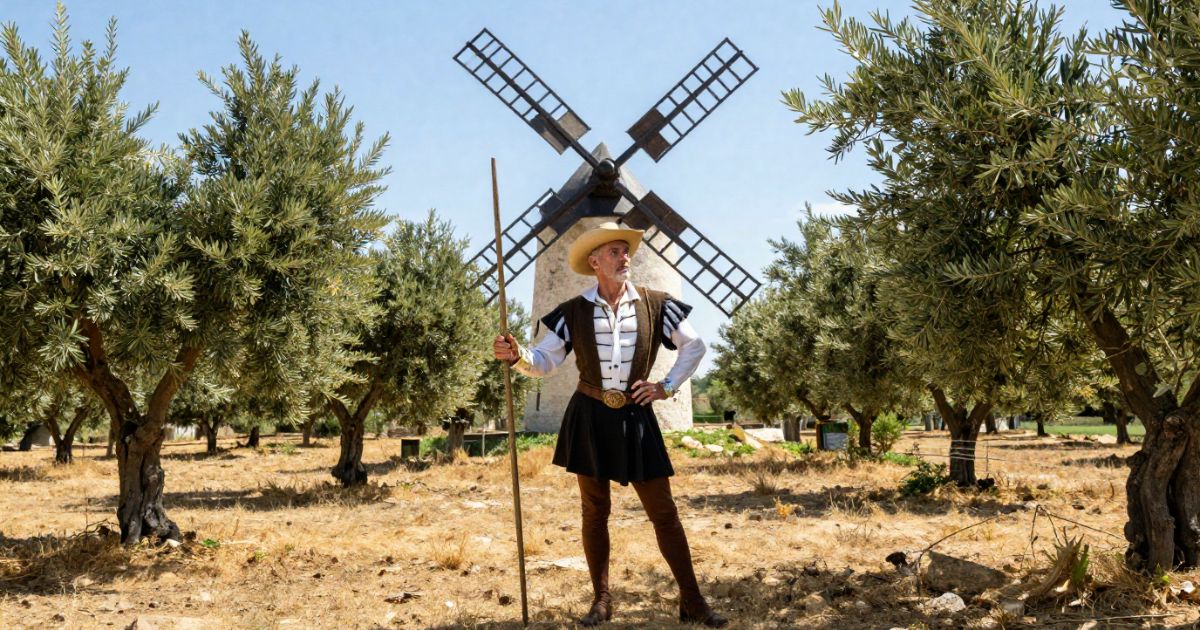
An excerpt from the original text.(complete · 2393 words)
OF THE SECOND SET OF COUNSELS DON QUIXOTE GAVE SANCHO PANZA
Who, hearing the foregoing discourse of Don Quixote, would not have set
him down for a person of great good sense and greater rectitude of
purpose? But, as has been frequently observed in the course of this
great history, he only talked nonsense when he touched on chivalry, and
in discussing all other subjects showed that he had a clear and
unbiassed understanding; so that at every turn his acts gave the lie to
his intellect, and his intellect to his acts; but in the case of these
second counsels that he gave Sancho, he showed himself to have a lively
turn of humour, and displayed conspicuously his wisdom, and also his
folly.
Sancho listened to him with the deepest attention, and endeavoured to
fix his counsels in his memory, like one who meant to follow them and
by their means bring the full promise of his government to a happy
issue. Don Quixote, then, went on to say:
“With regard to the mode in which thou shouldst govern thy person and
thy house, Sancho, the first charge I have to give thee is to be clean,
and to cut thy nails, not letting them grow as some do, whose ignorance
makes them fancy that long nails are an ornament to their hands, as if
those excrescences they neglect to cut were nails, and not the talons
of a lizard-catching kestrel—a filthy and unnatural abuse.
“Go not ungirt and loose, Sancho; for disordered attire is a sign of an
unstable mind, unless indeed the slovenliness and slackness is to be
set down to craft, as was the common opinion in the case of Julius
Cæsar.
“Ascertain cautiously what thy office may be worth; and if it will
allow thee to give liveries to thy servants, give them respectable and
serviceable, rather than showy and gay ones, and divide them between
thy servants and the poor; that is to say, if thou canst clothe six
pages, clothe three and three poor men, and thus thou wilt have pages
for heaven and pages for earth; the vainglorious never think of this
new mode of giving liveries.
“Eat not garlic nor onions, lest they find out thy boorish origin by
the smell; walk slowly and speak deliberately, but not in such a way as
to make it seem thou art listening to thyself, for all affectation is
bad.
“Dine sparingly and sup more sparingly still; for the health of the
whole body is forged in the workshop of the stomach.
“Be temperate in drinking, bearing in mind that wine in excess keeps
neither secrets nor promises.
“Take care, Sancho, not to chew on both sides, and not to eruct in
anybody’s presence.”
“Eruct!” said Sancho; “I don’t know what that means.”
“To eruct, Sancho,” said Don Quixote, “means to belch, and that is one
of the filthiest words in the Spanish language, though a very
expressive one; and therefore nice folk have had recourse to the Latin,
and instead of belch say eruct, and instead of belches say eructations;
and if some do not understand these terms it matters little, for custom
will bring them into use in the course of time, so that they will be
readily understood; this is the way a language is enriched; custom and
the public are all-powerful there.”
“In truth, señor,” said Sancho, “one of the counsels and cautions I
mean to bear in mind shall be this, not to belch, for I’m constantly
doing it.”
“Eruct, Sancho, not belch,” said Don Quixote.
“Eruct, I shall say henceforth, and I swear not to forget it,” said
Sancho.
“Likewise, Sancho,” said Don Quixote, “thou must not mingle such a
quantity of proverbs in thy discourse as thou dost; for though proverbs
are short maxims, thou dost drag them in so often by the head and
shoulders that they savour more of nonsense than of maxims.”
“God alone can cure that,” said Sancho; “for I have more proverbs in me
than a book, and when I speak they come so thick together into my mouth
that they fall to fighting among themselves to get out; that’s why my
tongue lets fly the first that come, though they may not be pat to the
purpose. But I’ll take care henceforward to use such as befit the
dignity of my office; for ‘in a house where there’s plenty, supper is
soon cooked,’ and ‘he who binds does not wrangle,’ and ‘the
bell-ringer’s in a safe berth,’ and ‘giving and keeping require
brains.’”
“That’s it, Sancho!” said Don Quixote; “pack, tack, string proverbs
together; nobody is hindering thee! ‘My mother beats me, and I go on
with my tricks.’ I am bidding thee avoid proverbs, and here in a second
thou hast shot out a whole litany of them, which have as much to do
with what we are talking about as ‘over the hills of Úbeda.’ Mind,
Sancho, I do not say that a proverb aptly brought in is objectionable;
but to pile up and string together proverbs at random makes
conversation dull and vulgar.
“When thou ridest on horseback, do not go lolling with thy body on the
back of the saddle, nor carry thy legs stiff or sticking out from the
horse’s belly, nor yet sit so loosely that one would suppose thou wert
on Dapple; for the seat on a horse makes gentlemen of some and grooms
of others.
“Be moderate in thy sleep; for he who does not rise early does not get
the benefit of the day; and remember, Sancho, diligence is the mother
of good fortune, and indolence, its opposite, never yet attained the
object of an honest ambition.
“The last counsel I will give thee now, though it does not tend to
bodily improvement, I would have thee carry carefully in thy memory,
for I believe it will be no less useful to thee than those I have given
thee already, and it is this—never engage in a dispute about families,
at least in the way of comparing them one with another; for necessarily
one of those compared will be better than the other, and thou wilt be
hated by the one thou hast disparaged, and get nothing in any shape
from the one thou hast exalted.
“Thy attire shall be hose of full length, a long jerkin, and a cloak a
trifle longer; loose breeches by no means, for they are becoming
neither for gentlemen nor for governors.
“For the present, Sancho, this is all that has occurred to me to advise
thee; as time goes by and occasions arise my instructions shall follow,
if thou take care to let me know how thou art circumstanced.”
“Señor,” said Sancho, “I see well enough that all these things your
worship has said to me are good, holy, and profitable; but what use
will they be to me if I don’t remember one of them? To be sure that
about not letting my nails grow, and marrying again if I have the
chance, will not slip out of my head; but all that other hash, muddle,
and jumble—I don’t and can’t recollect any more of it than of last
year’s clouds; so it must be given me in writing; for though I can’t
either read or write, I’ll give it to my confessor, to drive it into me
and remind me of it whenever it is necessary.”
“Ah, sinner that I am!” said Don Quixote, “how bad it looks in
governors not to know how to read or write; for let me tell thee,
Sancho, when a man knows not how to read, or is left-handed, it argues
one of two things; either that he was the son of exceedingly mean and
lowly parents, or that he himself was so incorrigible and
ill-conditioned that neither good company nor good teaching could make
any impression on him. It is a great defect that thou labourest under,
and therefore I would have thee learn at any rate to sign thy name.”
“I can sign my name well enough,” said Sancho, “for when I was steward
of the brotherhood in my village I learned to make certain letters,
like the marks on bales of goods, which they told me made out my name.
Besides I can pretend my right hand is disabled and make someone else
sign for me, for ‘there’s a remedy for everything except death;’ and as
I shall be in command and hold the staff, I can do as I like; moreover,
‘he who has the alcalde for his father—,’ and I’ll be governor, and
that’s higher than alcalde. Only come and see! Let them make light of
me and abuse me; ‘they’ll come for wool and go back shorn;’ ‘whom God
loves, his house is known to Him;’ ‘the silly sayings of the rich pass
for saws in the world;’ and as I’ll be rich, being a governor, and at
the same time generous, as I mean to be, no fault will be seen in me.
‘Only make yourself honey and the flies will suck you;’ ‘as much as
thou hast so much art thou worth,’ as my grandmother used to say; and
‘thou canst have no revenge of a man of substance.’”
“Oh, God’s curse upon thee, Sancho!” here exclaimed Don Quixote; “sixty
thousand devils fly away with thee and thy proverbs! For the last hour
thou hast been stringing them together and inflicting the pangs of
torture on me with every one of them. Those proverbs will bring thee to
the gallows one day, I promise thee; thy subjects will take the
government from thee, or there will be revolts among them. Tell me,
where dost thou pick them up, thou booby? How dost thou apply them,
thou blockhead? For with me, to utter one and make it apply properly, I
have to sweat and labour as if I were digging.”
“By God, master mine,” said Sancho, “your worship is making a fuss
about very little. Why the devil should you be vexed if I make use of
what is my own? And I have got nothing else, nor any other stock in
trade except proverbs and more proverbs; and here are three just this
instant come into my head, pat to the purpose and like pears in a
basket; but I won’t repeat them, for ‘sage silence is called Sancho.’”
“That, Sancho, thou art not,” said Don Quixote; “for not only art thou
not sage silence, but thou art pestilent prate and perversity; still I
would like to know what three proverbs have just now come into thy
memory, for I have been turning over mine own—and it is a good one—and
none occurs to me.”
“What can be better,” said Sancho, “than ‘never put thy thumbs between
two back teeth;’ and ‘to “get out of my house” and “what do you want
with my wife?” there is no answer;’ and ‘whether the pitcher hits the
stone, or the stone the pitcher, it’s a bad business for the pitcher;’
all which fit to a hair? For no one should quarrel with his governor,
or him in authority over him, because he will come off the worst, as he
does who puts his finger between two back and if they are not back
teeth it makes no difference, so long as they are teeth; and to
whatever the governor may say there’s no answer, any more than to ‘get
out of my house’ and ‘what do you want with my wife?’ and then, as for
that about the stone and the pitcher, a blind man could see that. So
that he ‘who sees the mote in another’s eye had need to see the beam in
his own,’ that it be not said of himself, ‘the dead woman was
frightened at the one with her throat cut;’ and your worship knows well
that ‘the fool knows more in his own house than the wise man in
another’s.’”
“Nay, Sancho,” said Don Quixote, “the fool knows nothing, either in his
own house or in anybody else’s, for no wise structure of any sort can
stand on a foundation of folly; but let us say no more about it,
Sancho, for if thou governest badly, thine will be the fault and mine
the shame; but I comfort myself with having done my duty in advising
thee as earnestly and as wisely as I could; and thus I am released from
my obligations and my promise. God guide thee, Sancho, and govern thee
in thy government, and deliver me from the misgiving I have that thou
wilt turn the whole island upside down, a thing I might easily prevent
by explaining to the duke what thou art and telling him that all that
fat little person of thine is nothing else but a sack full of proverbs
and sauciness.”
“Señor,” said Sancho, “if your worship thinks I’m not fit for this
government, I give it up on the spot; for the mere black of the nail of
my soul is dearer to me than my whole body; and I can live just as
well, simple Sancho, on bread and onions, as governor, on partridges
and capons; and what’s more, while we’re asleep we’re all equal, great
and small, rich and poor. But if your worship looks into it, you will
see it was your worship alone that put me on to this business of
governing; for I know no more about the government of islands than a
buzzard; and if there’s any reason to think that because of my being a
governor the devil will get hold of me, I’d rather go Sancho to heaven
than governor to hell.”
“By God, Sancho,” said Don Quixote, “for those last words thou hast
uttered alone, I consider thou deservest to be governor of a thousand
islands. Thou hast good natural instincts, without which no knowledge
is worth anything; commend thyself to God, and try not to swerve in the
pursuit of thy main object; I mean, always make it thy aim and fixed
purpose to do right in all matters that come before thee, for heaven
always helps good intentions; and now let us go to dinner, for I think
my lord and lady are waiting for us.”
p43e.jpg (41K)
Master this chapter. Complete your experience
Purchase the complete book to access all chapters and support classic literature
As an Amazon Associate, we earn a small commission from qualifying purchases at no additional cost to you.
Available in paperback, hardcover, and e-book formats
Let's Analyse the Pattern
The ability to possess profound insight in one area while maintaining complete delusion in another, usually protecting our deepest emotional investments.
Why This Matters
Connect literature to life
This chapter teaches how to spot when someone (including yourself) gives brilliant advice in one area while being completely delusional in another.
Practice This Today
This week, notice when you give others advice you don't follow yourself, or when experts in one field make obvious mistakes in another area they care deeply about.
Now let's explore the literary elements.
Key Quotes & Analysis
"he only talked nonsense when he touched on chivalry, and in discussing all other subjects showed that he had a clear and unbiassed understanding"
Context: The narrator explains Don Quixote's contradictory nature at the chapter's opening
This perfectly captures how people can be brilliant in some areas while completely delusional in others. It shows that wisdom and folly often coexist in the same person, depending on their blind spots and obsessions.
In Today's Words:
He was totally nuts about one thing but made perfect sense about everything else
"Go not ungirt and loose, for slovenly attire is evidence of a careless mind"
Context: Don Quixote advises Sancho on proper dress and appearance for a governor
This shows Don Quixote's understanding that appearance affects how others perceive your competence and authority. He recognizes that leadership requires attention to details that signal respect for the position and those you serve.
In Today's Words:
Dress the part - if you look sloppy, people will think you don't take the job seriously
"I would rather go to heaven as Sancho than to hell as a governor"
Context: Sancho responds to Don Quixote's extensive advice with this humble declaration
This reveals Sancho's fundamental wisdom about knowing his own limitations and values. He understands that power and position mean nothing if they corrupt your character or make you miserable. It's a profound statement about authenticity versus ambition.
In Today's Words:
I'd rather be myself and happy than successful and miserable
Thematic Threads
Identity
In This Chapter
Don Quixote maintains his chivalric identity while dispensing practical wisdom, showing how we protect core self-concepts even when they conflict with reality
Development
Evolved from earlier chapters where identity was purely delusional—now we see it coexisting with genuine wisdom
In Your Life:
You might cling to outdated professional identities or relationship roles even when they no longer serve you
Class
In This Chapter
Don Quixote advises Sancho on appropriate dress and behavior for his new station, revealing deep understanding of social hierarchies
Development
Developed from earlier class tensions into practical navigation of social mobility
In Your Life:
You might struggle with how to present yourself when moving between different social or professional circles
Personal Growth
In This Chapter
Sancho's honest admission that he won't remember the advice shows self-awareness about his limitations
Development
Evolved from earlier blind acceptance to realistic self-assessment
In Your Life:
You might recognize good advice but honestly assess your ability to follow through on changes
Social Expectations
In This Chapter
The detailed advice about appearance, manners, and communication reveals how performance shapes perception of competence
Development
Introduced here as practical wisdom rather than abstract ideals
In Your Life:
You might underestimate how much your presentation affects others' willingness to take you seriously
You now have the context. Time to form your own thoughts.
Discussion Questions
- 1
What's the contradiction between Don Quixote's practical advice to Sancho and his own behavior throughout the story?
analysis • surface - 2
Why can Don Quixote give excellent advice about governance and social conduct while remaining completely delusional about knight-errantry?
analysis • medium - 3
Think about someone you know who gives great advice in one area but makes poor decisions in another. What pattern do you notice?
application • medium - 4
When Sancho says he'd rather be 'Sancho in heaven than governor in hell,' what does this reveal about knowing your own limitations?
reflection • deep - 5
How might you identify and address your own blind spots, especially in areas you care most deeply about?
application • deep
Critical Thinking Exercise
Map Your Compartments
Draw three columns: 'Areas Where I Give Good Advice,' 'Areas Where I Struggle to Follow My Own Advice,' and 'Things I Care Most About.' Fill each column with 3-4 items, then look for patterns. Do your blind spots align with your deepest attachments? Where do you see the Don Quixote pattern in your own life?
Consider:
- •Notice if your struggles involve things you're emotionally invested in
- •Consider whether protecting your identity prevents you from seeing clearly
- •Think about who might give you honest feedback in your blind spot areas
Journaling Prompt
Write about a time when someone pointed out a contradiction between your advice and your actions. What were you protecting by not seeing it yourself?
Coming Up Next...
Chapter 116: Sancho's Departure and Don Quixote's Temptation
Sancho finally departs for his long-awaited governorship of an island, while Don Quixote faces a mysterious new adventure in the castle. The moment of truth arrives—will Sancho's practical wisdom serve him as a ruler?