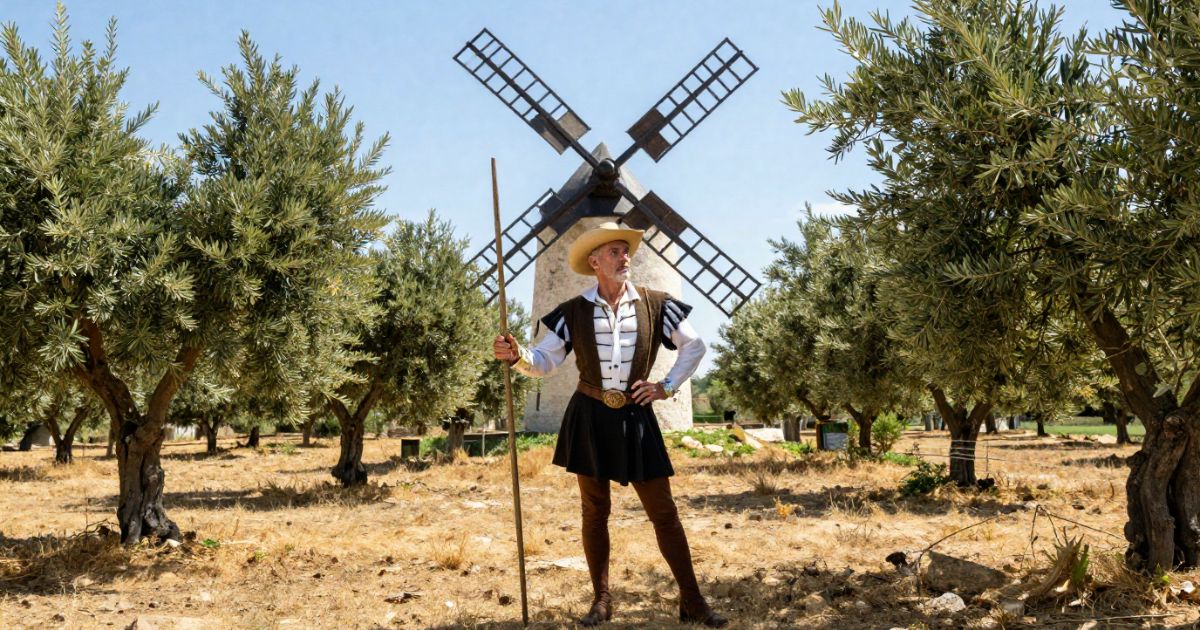
An excerpt from the original text.(complete · 3473 words)
OW SANCHO PANZA WAS CONDUCTED TO HIS GOVERNMENT, AND OF THE STRANGE
ADVENTURE THAT BEFELL DON QUIXOTE IN THE CASTLE
It is stated, they say, in the true original of this history, that when
Cide Hamete came to write this chapter, his interpreter did not
translate it as he wrote it—that is, as a kind of complaint the Moor
made against himself for having taken in hand a story so dry and of so
little variety as this of Don Quixote, for he found himself forced to
speak perpetually of him and Sancho, without venturing to indulge in
digressions and episodes more serious and more interesting. He said,
too, that to go on, mind, hand, pen always restricted to writing upon
one single subject, and speaking through the mouths of a few
characters, was intolerable drudgery, the result of which was never
equal to the author’s labour, and that to avoid this he had in the
First Part availed himself of the device of novels, like “The
Ill-advised Curiosity,” and “The Captive Captain,” which stand, as it
were, apart from the story; the others are given there being incidents
which occurred to Don Quixote himself and could not be omitted. He also
thought, he says, that many, engrossed by the interest attaching to the
exploits of Don Quixote, would take none in the novels, and pass them
over hastily or impatiently without noticing the elegance and art of
their composition, which would be very manifest were they published by
themselves and not as mere adjuncts to the crazes of Don Quixote or the
simplicities of Sancho. Therefore in this Second Part he thought it
best not to insert novels, either separate or interwoven, but only
episodes, something like them, arising out of the circumstances the
facts present; and even these sparingly, and with no more words than
suffice to make them plain; and as he confines and restricts himself to
the narrow limits of the narrative, though he has ability; capacity,
and brains enough to deal with the whole universe, he requests that his
labours may not be despised, and that credit be given him, not alone
for what he writes, but for what he has refrained from writing.
And so he goes on with his story, saying that the day Don Quixote gave
the counsels to Sancho, the same afternoon after dinner he handed them
to him in writing so that he might get someone to read them to him.
They had scarcely, however, been given to him when he let them drop,
and they fell into the hands of the duke, who showed them to the
duchess and they were both amazed afresh at the madness and wit of Don
Quixote. To carry on the joke, then, the same evening they despatched
Sancho with a large following to the village that was to serve him for
an island. It happened that the person who had him in charge was a
majordomo of the duke’s, a man of great discretion and humour—and there
can be no humour without discretion—and the same who played the part of
the Countess Trifaldi in the comical way that has been already
described; and thus qualified, and instructed by his master and
mistress as to how to deal with Sancho, he carried out their scheme
admirably. Now it came to pass that as soon as Sancho saw this
majordomo he seemed in his features to recognise those of the Trifaldi,
and turning to his master, he said to him, “Señor, either the devil
will carry me off, here on this spot, righteous and believing, or your
worship will own to me that the face of this majordomo of the duke’s
here is the very face of the Distressed One.”
Don Quixote regarded the majordomo attentively, and having done so,
said to Sancho, “There is no reason why the devil should carry thee
off, Sancho, either righteous or believing—and what thou meanest by
that I know not; the face of the Distressed One is that of the
majordomo, but for all that the majordomo is not the Distressed One;
for his being so would involve a mighty contradiction; but this is not
the time for going into questions of the sort, which would be involving
ourselves in an inextricable labyrinth. Believe me, my friend, we must
pray earnestly to our Lord that he deliver us both from wicked wizards
and enchanters.”
“It is no joke, señor,” said Sancho, “for before this I heard him
speak, and it seemed exactly as if the voice of the Trifaldi was
sounding in my ears. Well, I’ll hold my peace; but I’ll take care to be
on the look-out henceforth for any sign that may be seen to confirm or
do away with this suspicion.”
“Thou wilt do well, Sancho,” said Don Quixote, “and thou wilt let me
know all thou discoverest, and all that befalls thee in thy
government.”
Sancho at last set out attended by a great number of people. He was
dressed in the garb of a lawyer, with a gaban of tawny watered camlet
over all and a montera cap of the same material, and mounted a la
gineta upon a mule. Behind him, in accordance with the duke’s orders,
followed Dapple with brand new ass-trappings and ornaments of silk, and
from time to time Sancho turned round to look at his ass, so well
pleased to have him with him that he would not have changed places with
the emperor of Germany. On taking leave he kissed the hands of the duke
and duchess and got his master’s blessing, which Don Quixote gave him
with tears, and he received blubbering.
Let worthy Sancho go in peace, and good luck to him, Gentle Reader; and
look out for two bushels of laughter, which the account of how he
behaved himself in office will give thee. In the meantime turn thy
attention to what happened his master the same night, and if thou dost
not laugh thereat, at any rate thou wilt stretch thy mouth with a grin;
for Don Quixote’s adventures must be honoured either with wonder or
with laughter.
It is recorded, then, that as soon as Sancho had gone, Don Quixote felt
his loneliness, and had it been possible for him to revoke the mandate
and take away the government from him he would have done so. The
duchess observed his dejection and asked him why he was melancholy;
because, she said, if it was for the loss of Sancho, there were
squires, duennas, and damsels in her house who would wait upon him to
his full satisfaction.
“The truth is, señora,” replied Don Quixote, “that I do feel the loss
of Sancho; but that is not the main cause of my looking sad; and of all
the offers your excellence makes me, I accept only the good-will with
which they are made, and as to the remainder I entreat of your
excellence to permit and allow me alone to wait upon myself in my
chamber.”
“Indeed, Señor Don Quixote,” said the duchess, “that must not be; four
of my damsels, as beautiful as flowers, shall wait upon you.”
“To me,” said Don Quixote, “they will not be flowers, but thorns to
pierce my heart. They, or anything like them, shall as soon enter my
chamber as fly. If your highness wishes to gratify me still further,
though I deserve it not, permit me to please myself, and wait upon
myself in my own room; for I place a barrier between my inclinations
and my virtue, and I do not wish to break this rule through the
generosity your highness is disposed to display towards me; and, in
short, I will sleep in my clothes, sooner than allow anyone to undress
me.”
“Say no more, Señor Don Quixote, say no more,” said the duchess; “I
assure you I will give orders that not even a fly, not to say a damsel,
shall enter your room. I am not the one to undermine the propriety of
Señor Don Quixote, for it strikes me that among his many virtues the
one that is pre-eminent is that of modesty. Your worship may undress
and dress in private and in your own way, as you please and when you
please, for there will be no one to hinder you; and in your chamber you
will find all the utensils requisite to supply the wants of one who
sleeps with his door locked, to the end that no natural needs compel
you to open it. May the great Dulcinea del Toboso live a thousand
years, and may her fame extend all over the surface of the globe, for
she deserves to be loved by a knight so valiant and so virtuous; and
may kind heaven infuse zeal into the heart of our governor Sancho Panza
to finish off his discipline speedily, so that the world may once more
enjoy the beauty of so grand a lady.”
To which Don Quixote replied, “Your highness has spoken like what you
are; from the mouth of a noble lady nothing bad can come; and Dulcinea
will be more fortunate, and better known to the world by the praise of
your highness than by all the eulogies the greatest orators on earth
could bestow upon her.”
“Well, well, Señor Don Quixote,” said the duchess, it is nearly
supper-time, and the duke is probably waiting; come let us go to
supper, and retire to rest early, for the journey you made yesterday
from Kandy was not such a short one but that it must have caused you
some fatigue.”
“I feel none, señora,” said Don Quixote, “for I would go so far as to
swear to your excellence that in all my life I never mounted a quieter
beast, or a pleasanter paced one, than Clavileño; and I don’t know what
could have induced Malambruno to discard a steed so swift and so
gentle, and burn it so recklessly as he did.”
“Probably,” said the duchess, “repenting of the evil he had done to the
Trifaldi and company, and others, and the crimes he must have committed
as a wizard and enchanter, he resolved to make away with all the
instruments of his craft; and so burned Clavileño as the chief one, and
that which mainly kept him restless, wandering from land to land; and
by its ashes and the trophy of the placard the valour of the great Don
Quixote of La Mancha is established for ever.”
Don Quixote renewed his thanks to the duchess; and having supped,
retired to his chamber alone, refusing to allow anyone to enter with
him to wait on him, such was his fear of encountering temptations that
might lead or drive him to forget his chaste fidelity to his lady
Dulcinea; for he had always present to his mind the virtue of Amadis,
that flower and mirror of knights-errant. He locked the door behind
him, and by the light of two wax candles undressed himself, but as he
was taking off his stockings—O disaster unworthy of such a
personage!—there came a burst, not of sighs, or anything belying his
delicacy or good breeding, but of some two dozen stitches in one of his
stockings, that made it look like a window-lattice. The worthy
gentleman was beyond measure distressed, and at that moment he would
have given an ounce of silver to have had half a drachm of green silk
there; I say green silk, because the stockings were green.
Here Cide Hamete exclaimed as he was writing, “O poverty, poverty! I
know not what could have possessed the great Cordovan poet to call thee
‘holy gift ungratefully received.’ Although a Moor, I know well enough
from the intercourse I have had with Christians that holiness consists
in charity, humility, faith, obedience, and poverty; but for all that,
I say he must have a great deal of godliness who can find any
satisfaction in being poor; unless, indeed, it be the kind of poverty
one of their greatest saints refers to, saying, ‘possess all things as
though ye possessed them not;’ which is what they call poverty in
spirit. But thou, that other poverty—for it is of thee I am speaking
now—why dost thou love to fall out with gentlemen and men of good birth
more than with other people? Why dost thou compel them to smear the
cracks in their shoes, and to have the buttons of their coats, one
silk, another hair, and another glass? Why must their ruffs be always
crinkled like endive leaves, and not crimped with a crimping iron?”
(From this we may perceive the antiquity of starch and crimped ruffs.)
Then he goes on: “Poor gentleman of good family! always cockering up
his honour, dining miserably and in secret, and making a hypocrite of
the toothpick with which he sallies out into the street after eating
nothing to oblige him to use it! Poor fellow, I say, with his nervous
honour, fancying they perceive a league off the patch on his shoe, the
sweat-stains on his hat, the shabbiness of his cloak, and the hunger of
his stomach!”
All this was brought home to Don Quixote by the bursting of his
stitches; however, he comforted himself on perceiving that Sancho had
left behind a pair of travelling boots, which he resolved to wear the
next day. At last he went to bed, out of spirits and heavy at heart, as
much because he missed Sancho as because of the irreparable disaster to
his stockings, the stitches of which he would have even taken up with
silk of another colour, which is one of the greatest signs of poverty a
gentleman can show in the course of his never-failing embarrassments.
He put out the candles; but the night was warm and he could not sleep;
he rose from his bed and opened slightly a grated window that looked
out on a beautiful garden, and as he did so he perceived and heard
people walking and talking in the garden. He set himself to listen
attentively, and those below raised their voices so that he could hear
these words:
“Urge me not to sing, Emerencia, for thou knowest that ever since this
stranger entered the castle and my eyes beheld him, I cannot sing but
only weep; besides my lady is a light rather than a heavy sleeper, and
I would not for all the wealth of the world that she found us here; and
even if she were asleep and did not waken, my singing would be in vain,
if this strange Æneas, who has come into my neighbourhood to flout me,
sleeps on and wakens not to hear it.”
“Heed not that, dear Altisidora,” replied a voice; “the duchess is no
doubt asleep, and everybody in the house save the lord of thy heart and
disturber of thy soul; for just now I perceived him open the grated
window of his chamber, so he must be awake; sing, my poor sufferer, in
a low sweet tone to the accompaniment of thy harp; and even if the
duchess hears us we can lay the blame on the heat of the night.”
“That is not the point, Emerencia,” replied Altisidora, “it is that I
would not that my singing should lay bare my heart, and that I should
be thought a light and wanton maiden by those who know not the mighty
power of love; but come what may; better a blush on the cheeks than a
sore in the heart;” and here a harp softly touched made itself heard.
As he listened to all this Don Quixote was in a state of breathless
amazement, for immediately the countless adventures like this, with
windows, gratings, gardens, serenades, lovemakings, and languishings,
that he had read of in his trashy books of chivalry, came to his mind.
He at once concluded that some damsel of the duchess’s was in love with
him, and that her modesty forced her to keep her passion secret. He
trembled lest he should fall, and made an inward resolution not to
yield; and commending himself with all his might and soul to his lady
Dulcinea he made up his mind to listen to the music; and to let them
know he was there he gave a pretended sneeze, at which the damsels were
not a little delighted, for all they wanted was that Don Quixote should
hear them. So having tuned the harp, Altisidora, running her hand
across the strings, began this ballad:
O thou that art above in bed,
Between the holland sheets,
A-lying there from night till morn,
With outstretched legs asleep;
O thou, most valiant knight of all
The famed Manchegan breed,
Of purity and virtue more
Than gold of Araby;
Give ear unto a suffering maid,
Well-grown but evil-starr’d,
For those two suns of thine have lit
A fire within her heart.
Adventures seeking thou dost rove,
To others bringing woe;
Thou scatterest wounds, but, ah, the balm
To heal them dost withhold!
Say, valiant youth, and so may God
Thy enterprises speed,
Didst thou the light mid Libya’s sands
Or Jaca’s rocks first see?
Did scaly serpents give thee suck?
Who nursed thee when a babe?
Wert cradled in the forest rude,
Or gloomy mountain cave?
O Dulcinea may be proud,
That plump and lusty maid;
For she alone hath had the power
A tiger fierce to tame.
And she for this shall famous be
From Tagus to Jarama,
From Manzanares to Genil,
From Duero to Arlanza.
Fain would I change with her, and give
A petticoat to boot,
The best and bravest that I have,
All trimmed with gold galloon.
O for to be the happy fair
Thy mighty arms enfold,
Or even sit beside thy bed
And scratch thy dusty poll!
I rave,—to favours such as these
Unworthy to aspire;
Thy feet to tickle were enough
For one so mean as I.
What caps, what slippers silver-laced,
Would I on thee bestow!
What damask breeches make for thee;
What fine long holland cloaks!
And I would give thee pearls that should
As big as oak-galls show;
So matchless big that each might well
Be called the great “Alone.”
Manchegan Nero, look not down
From thy Tarpeian Rock
Upon this burning heart, nor add
The fuel of thy wrath.
A virgin soft and young am I,
Not yet fifteen years old;
(I’m only three months past fourteen,
I swear upon my soul).
I hobble not nor do I limp,
All blemish I’m without,
And as I walk my lily locks
Are trailing on the ground.
And though my nose be rather flat,
And though my mouth be wide,
My teeth like topazes exalt
My beauty to the sky.
Thou knowest that my voice is sweet,
That is if thou dost hear;
And I am moulded in a form
Somewhat below the mean.
These charms, and many more, are thine,
Spoils to thy spear and bow all;
A damsel of this house am I,
By name Altisidora.
Here the lay of the heart-stricken Altisidora came to an end, while the
warmly wooed Don Quixote began to feel alarm; and with a deep sigh he
said to himself, “O that I should be such an unlucky knight that no
damsel can set eyes on me but falls in love with me! O that the
peerless Dulcinea should be so unfortunate that they cannot let her
enjoy my incomparable constancy in peace! What would ye with her, ye
queens? Why do ye persecute her, ye empresses? Why ye pursue her, ye
virgins of from fourteen to fifteen? Leave the unhappy being to
triumph, rejoice and glory in the lot love has been pleased to bestow
upon her in surrendering my heart and yielding up my soul to her. Ye
love-smitten host, know that to Dulcinea only I am dough and
sugar-paste, flint to all others; for her I am honey, for you aloes.
For me Dulcinea alone is beautiful, wise, virtuous, graceful, and
high-bred, and all others are ill-favoured, foolish, light, and
low-born. Nature sent me into the world to be hers and no other’s;
Altisidora may weep or sing, the lady for whose sake they belaboured me
in the castle of the enchanted Moor may give way to despair, but I must
be Dulcinea’s, boiled or roast, pure, courteous, and chaste, in spite
of all the magic-working powers on earth.” And with that he shut the
window with a bang, and, as much out of temper and out of sorts as if
some great misfortune had befallen him, stretched himself on his bed,
where we will leave him for the present, as the great Sancho Panza, who
is about to set up his famous government, now demands our attention.
Master this chapter. Complete your experience
Purchase the complete book to access all chapters and support classic literature
As an Amazon Associate, we earn a small commission from qualifying purchases at no additional cost to you.
Available in paperback, hardcover, and e-book formats
Let's Analyse the Pattern
When separated from support systems and accountability, our deepest values face their strongest test through amplified vulnerability and temptation.
Why This Matters
Connect literature to life
This chapter teaches how isolation and stress create predictable moments when our values get tested most severely.
Practice This Today
This week, notice when you feel most tempted to compromise your standards—tired, alone, stressed, or desperate—and identify what anchors keep you steady.
Now let's explore the literary elements.
Key Quotes & Analysis
"I am made of honey for Dulcinea del Toboso alone, and flint for all other women in the world."
Context: Don Quixote declares his unwavering loyalty to Dulcinea when faced with Altisidora's serenade.
This quote reveals Don Quixote's absolute commitment to his idealized love, using the metaphor of honey and flint to show he can be sweet or hard depending on the situation. It demonstrates how his delusions actually protect him from real-world temptations.
In Today's Words:
I'm only soft and sweet for my one true love - everyone else gets the cold shoulder.
"O poverty, poverty! I know not what could have induced that great Cordovan poet to call thee holy gift!"
Context: The narrator reflects on Don Quixote's embarrassment over his torn stockings.
This quote captures the bitter irony of poverty being called a virtue when it causes daily humiliation. It shows how financial struggle affects dignity and self-worth, especially for those trying to maintain appearances.
In Today's Words:
Poverty might build character, but it sure doesn't feel like a blessing when you can't afford decent clothes.
"Many, engrossed by the interest attaching to the exploits of Don Quixote, would take none in the novels, and pass them over hastily."
Context: The fictional author complains about readers skipping the side stories to get back to the main plot.
This meta-commentary reveals Cervantes' awareness of his audience and their preferences. It's both a complaint about readers' attention spans and a clever way to acknowledge the story's structure.
In Today's Words:
People just want to get to the good stuff and skip all the side plots I worked so hard on.
Thematic Threads
Loneliness
In This Chapter
Don Quixote feels deeply alone after Sancho's departure, making him vulnerable to romantic temptation
Development
Evolved from companionship themes—shows how separation tests character
In Your Life:
You might recognize this when working alone, traveling, or going through major life transitions without your usual support network.
Integrity
In This Chapter
Don Quixote maintains fidelity to Dulcinea despite isolation and temptation from Altisidora
Development
Builds on earlier themes of commitment—shows values holding under pressure
In Your Life:
You face this when your principles are tested and nobody would know if you compromised.
Class
In This Chapter
The torn stockings humiliate Don Quixote, highlighting the special burden poverty places on those expected to maintain appearances
Development
Continues exploration of how social expectations clash with economic reality
In Your Life:
You might feel this pressure when trying to maintain professional appearance or social status despite financial constraints.
Temptation
In This Chapter
Altisidora's serenade presents romantic temptation that mirrors the adventures in chivalric novels
Development
Introduced here as test of character under isolation
In Your Life:
You encounter this when isolated circumstances make normally unacceptable choices seem reasonable or justified.
Identity
In This Chapter
Don Quixote's commitment to his knight-errant identity protects him from compromising his values
Development
Shows how constructed identity can provide strength—builds on earlier identity themes
In Your Life:
You might find that strong sense of who you are and what you stand for helps resist pressure to act against your values.
You now have the context. Time to form your own thoughts.
Discussion Questions
- 1
What happens when Sancho leaves for his governorship, and how does Don Quixote respond to being alone at the duke's castle?
analysis • surface - 2
Why does Don Quixote refuse the duchess's offer of servants and insist on privacy, and what does the torn stocking incident reveal about his situation?
analysis • medium - 3
When have you seen people make different choices when they're alone versus when others are watching? What patterns do you notice?
application • medium - 4
Don Quixote uses his devotion to Dulcinea as an anchor against temptation. What anchors could someone create to maintain their values during lonely or vulnerable moments?
application • deep - 5
What does this chapter suggest about the relationship between isolation, vulnerability, and moral choices? How do our values get tested differently when we're alone?
reflection • deep
Critical Thinking Exercise
Build Your Integrity Anchor System
Think about times when you'll be isolated or vulnerable - working alone, traveling, facing stress without support. Write down three specific 'anchors' that could help you maintain your values during these moments. These could be people you'd disappoint, consequences you care about, or core principles that matter to you. Make them concrete and personal, not abstract ideals.
Consider:
- •Your anchors should be specific enough to remember under pressure
- •Consider both positive motivations (people you want to honor) and negative consequences (outcomes you want to avoid)
- •Think about situations where you've already been tested and what helped you stay strong
Journaling Prompt
Write about a time when being alone or isolated made you more tempted to compromise your values. What happened, and what anchor system might have helped you navigate that situation better?
Coming Up Next...
Chapter 117: Sancho's First Day as Governor
Meanwhile, Sancho arrives at his 'island' to begin governing, where his practical wisdom will be put to the test in ways neither he nor Don Quixote could have imagined.