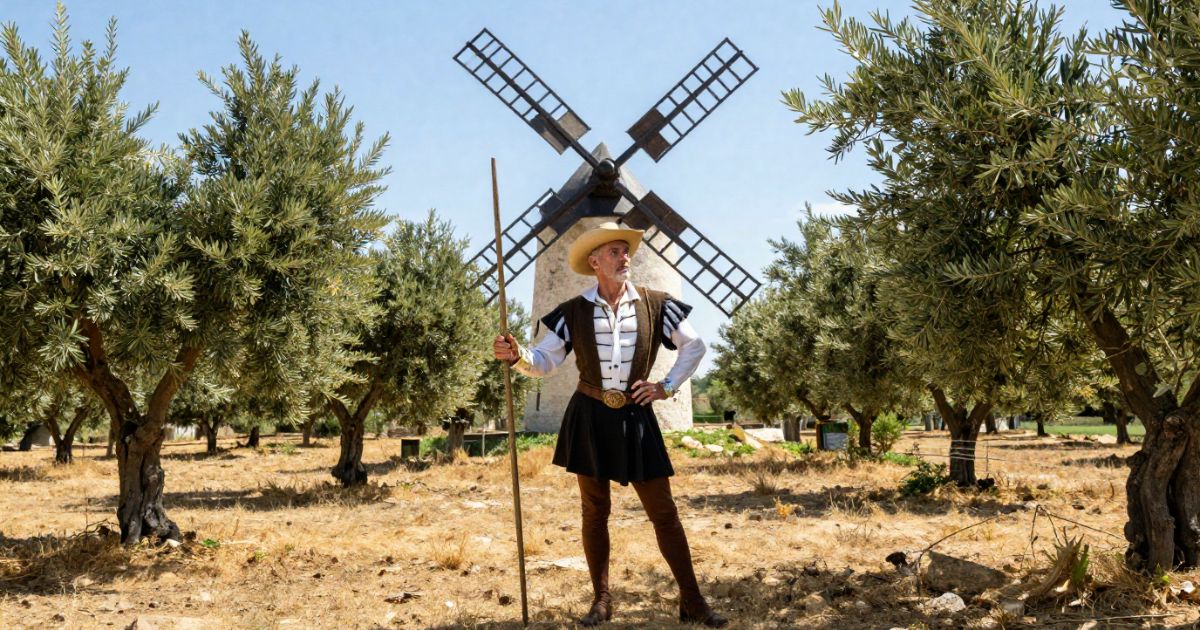
An excerpt from the original text.(complete · 2899 words)
OF THE DELECTABLE DISCOURSE WHICH THE DUCHESS AND HER DAMSELS HELD WITH
SANCHO PANZA, WELL WORTH READING AND NOTING
The history records that Sancho did not sleep that afternoon, but in
order to keep his word came, before he had well done dinner, to visit
the duchess, who, finding enjoyment in listening to him, made him sit
down beside her on a low seat, though Sancho, out of pure good
breeding, wanted not to sit down; the duchess, however, told him he was
to sit down as governor and talk as squire, as in both respects he was
worthy of even the chair of the Cid Ruy Diaz the Campeador. Sancho
shrugged his shoulders, obeyed, and sat down, and all the duchess’s
damsels and duennas gathered round him, waiting in profound silence to
hear what he would say. It was the duchess, however, who spoke first,
saying:
“Now that we are alone, and that there is nobody here to overhear us, I
should be glad if the señor governor would relieve me of certain doubts
I have, rising out of the history of the great Don Quixote that is now
in print. One is: inasmuch as worthy Sancho never saw Dulcinea, I mean
the lady Dulcinea del Toboso, nor took Don Quixote’s letter to her, for
it was left in the memorandum book in the Sierra Morena, how did he
dare to invent the answer and all that about finding her sifting wheat,
the whole story being a deception and falsehood, and so much to the
prejudice of the peerless Dulcinea’s good name, a thing that is not at
all becoming the character and fidelity of a good squire?”
At these words, Sancho, without uttering one in reply, got up from his
chair, and with noiseless steps, with his body bent and his finger on
his lips, went all round the room lifting up the hangings; and this
done, he came back to his seat and said, “Now, señora, that I have seen
that there is no one except the bystanders listening to us on the sly,
I will answer what you have asked me, and all you may ask me, without
fear or dread. And the first thing I have got to say is, that for my
own part I hold my master Don Quixote to be stark mad, though sometimes
he says things that, to my mind, and indeed everybody’s that listens to
him, are so wise, and run in such a straight furrow, that Satan himself
could not have said them better; but for all that, really, and beyond
all question, it’s my firm belief he is cracked. Well, then, as this is
clear to my mind, I can venture to make him believe things that have
neither head nor tail, like that affair of the answer to the letter,
and that other of six or eight days ago, which is not yet in history,
that is to say, the affair of the enchantment of my lady Dulcinea; for
I made him believe she is enchanted, though there’s no more truth in it
than over the hills of Úbeda.”
The duchess begged him to tell her about the enchantment or deception,
so Sancho told the whole story exactly as it had happened, and his
hearers were not a little amused by it; and then resuming, the duchess
said, “In consequence of what worthy Sancho has told me, a doubt starts
up in my mind, and there comes a kind of whisper to my ear that says,
‘If Don Quixote be mad, crazy, and cracked, and Sancho Panza his squire
knows it, and, notwithstanding, serves and follows him, and goes
trusting to his empty promises, there can be no doubt he must be still
madder and sillier than his master; and that being so, it will be cast
in your teeth, señora duchess, if you give the said Sancho an island to
govern; for how will he who does not know how to govern himself know
how to govern others?’”
“By God, señora,” said Sancho, “but that doubt comes timely; but your
grace may say it out, and speak plainly, or as you like; for I know
what you say is true, and if I were wise I should have left my master
long ago; but this was my fate, this was my bad luck; I can’t help it,
I must follow him; we’re from the same village, I’ve eaten his bread,
I’m fond of him, I’m grateful, he gave me his ass-colts, and above all
I’m faithful; so it’s quite impossible for anything to separate us,
except the pickaxe and shovel. And if your highness does not like to
give me the government you promised, God made me without it, and maybe
your not giving it to me will be all the better for my conscience, for
fool as I am I know the proverb ‘to her hurt the ant got wings,’ and it
may be that Sancho the squire will get to heaven sooner than Sancho the
governor. ‘They make as good bread here as in France,’ and ‘by night
all cats are grey,’ and ‘a hard case enough his, who hasn’t broken his
fast at two in the afternoon,’ and ‘there’s no stomach a hand’s breadth
bigger than another,’ and the same can be filled ‘with straw or hay,’
as the saying is, and ‘the little birds of the field have God for their
purveyor and caterer,’ and ‘four yards of Cuenca frieze keep one warmer
than four of Segovia broad-cloth,’ and ‘when we quit this world and are
put underground the prince travels by as narrow a path as the
journeyman,’ and ‘the Pope’s body does not take up more feet of earth
than the sacristan’s,’ for all that the one is higher than the other;
for when we go to our graves we all pack ourselves up and make
ourselves small, or rather they pack us up and make us small in spite
of us, and then—good night to us. And I say once more, if your ladyship
does not like to give me the island because I’m a fool, like a wise man
I will take care to give myself no trouble about it; I have heard say
that ‘behind the cross there’s the devil,’ and that ‘all that glitters
is not gold,’ and that from among the oxen, and the ploughs, and the
yokes, Wamba the husbandman was taken to be made King of Spain, and
from among brocades, and pleasures, and riches, Roderick was taken to
be devoured by adders, if the verses of the old ballads don’t lie.”
“To be sure they don’t lie!” exclaimed Doña Rodriguez, the duenna, who
was one of the listeners. “Why, there’s a ballad that says they put
King Rodrigo alive into a tomb full of toads, and adders, and lizards,
and that two days afterwards the king, in a plaintive, feeble voice,
cried out from within the tomb-
They gnaw me now, they gnaw me now,
There where I most did sin.
And according to that the gentleman has good reason to say he would
rather be a labouring man than a king, if vermin are to eat him.”
The duchess could not help laughing at the simplicity of her duenna, or
wondering at the language and proverbs of Sancho, to whom she said,
“Worthy Sancho knows very well that when once a knight has made a
promise he strives to keep it, though it should cost him his life. My
lord and husband the duke, though not one of the errant sort, is none
the less a knight for that reason, and will keep his word about the
promised island, in spite of the envy and malice of the world. Let
Sancho be of good cheer; for when he least expects it he will find
himself seated on the throne of his island and seat of dignity, and
will take possession of his government that he may discard it for
another of three-bordered brocade. The charge I give him is to be
careful how he governs his vassals, bearing in mind that they are all
loyal and well-born.”
“As to governing them well,” said Sancho, “there’s no need of charging
me to do that, for I’m kind-hearted by nature, and full of compassion
for the poor; there’s no stealing the loaf from him who kneads and
bakes;’ and by my faith it won’t do to throw false dice with me; I am
an old dog, and I know all about ‘tus, tus;’ I can be wide-awake if
need be, and I don’t let clouds come before my eyes, for I know where
the shoe pinches me; I say so, because with me the good will have
support and protection, and the bad neither footing nor access. And it
seems to me that, in governments, to make a beginning is everything;
and maybe, after having been governor a fortnight, I’ll take kindly to
the work and know more about it than the field labour I have been
brought up to.”
“You are right, Sancho,” said the duchess, “for no one is born ready
taught, and the bishops are made out of men and not out of stones. But
to return to the subject we were discussing just now, the enchantment
of the lady Dulcinea, I look upon it as certain, and something more
than evident, that Sancho’s idea of practising a deception upon his
master, making him believe that the peasant girl was Dulcinea and that
if he did not recognise her it must be because she was enchanted, was
all a device of one of the enchanters that persecute Don Quixote. For
in truth and earnest, I know from good authority that the coarse
country wench who jumped up on the ass was and is Dulcinea del Toboso,
and that worthy Sancho, though he fancies himself the deceiver, is the
one that is deceived; and that there is no more reason to doubt the
truth of this, than of anything else we never saw. Señor Sancho Panza
must know that we too have enchanters here that are well disposed to
us, and tell us what goes on in the world, plainly and distinctly,
without subterfuge or deception; and believe me, Sancho, that agile
country lass was and is Dulcinea del Toboso, who is as much enchanted
as the mother that bore her; and when we least expect it, we shall see
her in her own proper form, and then Sancho will be disabused of the
error he is under at present.”
“All that’s very possible,” said Sancho Panza; “and now I’m willing to
believe what my master says about what he saw in the cave of
Montesinos, where he says he saw the lady Dulcinea del Toboso in the
very same dress and apparel that I said I had seen her in when I
enchanted her all to please myself. It must be all exactly the other
way, as your ladyship says; because it is impossible to suppose that
out of my poor wit such a cunning trick could be concocted in a moment,
nor do I think my master is so mad that by my weak and feeble
persuasion he could be made to believe a thing so out of all reason.
But, señora, your excellence must not therefore think me ill-disposed,
for a dolt like me is not bound to see into the thoughts and plots of
those vile enchanters. I invented all that to escape my master’s
scolding, and not with any intention of hurting him; and if it has
turned out differently, there is a God in heaven who judges our
hearts.”
“That is true,” said the duchess; “but tell me, Sancho, what is this
you say about the cave of Montesinos, for I should like to know.”
Sancho upon this related to her, word for word, what has been said
already touching that adventure, and having heard it the duchess said,
“From this occurrence it may be inferred that, as the great Don Quixote
says he saw there the same country wench Sancho saw on the way from El
Toboso, it is, no doubt, Dulcinea, and that there are some very active
and exceedingly busy enchanters about.”
“So I say,” said Sancho, “and if my lady Dulcinea is enchanted, so much
the worse for her, and I’m not going to pick a quarrel with my master’s
enemies, who seem to be many and spiteful. The truth is that the one I
saw was a country wench, and I set her down to be a country wench; and
if that was Dulcinea it must not be laid at my door, nor should I be
called to answer for it or take the consequences. But they must go
nagging at me at every step—‘Sancho said it, Sancho did it, Sancho
here, Sancho there,’ as if Sancho was nobody at all, and not that same
Sancho Panza that’s now going all over the world in books, so Samson
Carrasco told me, and he’s at any rate one that’s a bachelor of
Salamanca; and people of that sort can’t lie, except when the whim
seizes them or they have some very good reason for it. So there’s no
occasion for anybody to quarrel with me; and then I have a good
character, and, as I have heard my master say, ‘a good name is better
than great riches;’ let them only stick me into this government and
they’ll see wonders, for one who has been a good squire will be a good
governor.”
“All worthy Sancho’s observations,” said the duchess, “are Catonian
sentences, or at any rate out of the very heart of Michael Verino
himself, who florentibus occidit annis. In fact, to speak in his own
style, ‘under a bad cloak there’s often a good drinker.’”
“Indeed, señora,” said Sancho, “I never yet drank out of wickedness;
from thirst I have very likely, for I have nothing of the hypocrite in
me; I drink when I’m inclined, or, if I’m not inclined, when they offer
it to me, so as not to look either strait-laced or ill-bred; for when a
friend drinks one’s health what heart can be so hard as not to return
it? But if I put on my shoes I don’t dirty them; besides, squires to
knights-errant mostly drink water, for they are always wandering among
woods, forests and meadows, mountains and crags, without a drop of wine
to be had if they gave their eyes for it.”
“So I believe,” said the duchess; “and now let Sancho go and take his
sleep, and we will talk by-and-by at greater length, and settle how he
may soon go and stick himself into the government, as he says.”
Sancho once more kissed the duchess’s hand, and entreated her to let
good care be taken of his Dapple, for he was the light of his eyes.
“What is Dapple?” said the duchess.
“My ass,” said Sancho, “which, not to mention him by that name, I’m
accustomed to call Dapple; I begged this lady duenna here to take care
of him when I came into the castle, and she got as angry as if I had
said she was ugly or old, though it ought to be more natural and proper
for duennas to feed asses than to ornament chambers. God bless me! what
a spite a gentleman of my village had against these ladies!”
“He must have been some clown,” said Doña Rodriguez the duenna; “for if
he had been a gentleman and well-born he would have exalted them higher
than the horns of the moon.”
“That will do,” said the duchess; “no more of this; hush, Doña
Rodriguez, and let Señor Panza rest easy and leave the treatment of
Dapple in my charge, for as he is a treasure of Sancho’s, I’ll put him
on the apple of my eye.”
“It will be enough for him to be in the stable,” said Sancho, “for
neither he nor I are worthy to rest a moment in the apple of your
highness’s eye, and I’d as soon stab myself as consent to it; for
though my master says that in civilities it is better to lose by a card
too many than a card too few, when it comes to civilities to asses we
must mind what we are about and keep within due bounds.”
“Take him to your government, Sancho,” said the duchess, “and there you
will be able to make as much of him as you like, and even release him
from work and pension him off.”
“Don’t think, señora duchess, that you have said anything absurd,” said
Sancho; “I have seen more than two asses go to governments, and for me
to take mine with me would be nothing new.”
Sancho’s words made the duchess laugh again and gave her fresh
amusement, and dismissing him to sleep she went away to tell the duke
the conversation she had had with him, and between them they plotted
and arranged to play a joke upon Don Quixote that was to be a rare one
and entirely in knight-errantry style, and in that same style they
practised several upon him, so much in keeping and so clever that they
form the best adventures this great history contains.
p33e.jpg (34K)
Master this chapter. Complete your experience
Purchase the complete book to access all chapters and support classic literature
As an Amazon Associate, we earn a small commission from qualifying purchases at no additional cost to you.
Available in paperback, hardcover, and e-book formats
Let's Analyse the Pattern
The ability to see someone's flaws clearly while choosing to remain committed based on deeper values and shared history.
Why This Matters
Connect literature to life
This chapter teaches how to recognize when someone questions you out of care versus when they're trying to undermine your confidence.
Practice This Today
Next time someone challenges your decision, listen for whether they're asking questions to understand or to prove you wrong—then respond accordingly.
Now let's explore the literary elements.
Key Quotes & Analysis
"I know he is stark mad, but for all that, and even worse, I follow and serve him, and keep faith with him"
Context: Sancho admits the truth about Don Quixote's mental state to the Duchess
This shows Sancho's remarkable emotional intelligence - he can see reality clearly while still choosing loyalty based on gratitude and shared history. It's not blind devotion but conscious choice.
In Today's Words:
Yeah, I know my friend is completely nuts, but I'm still going to have their back
"I'd rather be a good man under a fig tree than a bad governor in a palace"
Context: Sancho explains his values when questioned about his fitness to govern
This reveals Sancho's core wisdom - he values integrity over status. He understands that power without character leads to corruption, showing moral clarity that many educated people lack.
In Today's Words:
I'd rather stay broke and honest than get rich by screwing people over
"The whole story being a deception and falsehood, or at least something very like it"
Context: She's questioning Sancho about his made-up stories regarding Dulcinea
The Duchess is testing whether Sancho will continue lying or come clean. Her phrasing shows she already suspects the truth but wants to see if he has the courage to admit it.
In Today's Words:
We both know you're making this up, so are you going to keep lying to my face?
Thematic Threads
Class
In This Chapter
Sancho proves that wisdom doesn't require education or status—his honest self-reflection impresses the educated Duchess
Development
Evolved from early comedy about class differences to serious exploration of where real wisdom comes from
In Your Life:
You might find your practical experience gives you insights that college-educated colleagues miss
Identity
In This Chapter
Sancho shows remarkable self-knowledge, admitting his deceptions while standing firm in his core values
Development
Developed from simple peasant character to someone with complex understanding of his own motivations
In Your Life:
You might discover that knowing your flaws honestly makes you stronger, not weaker
Personal Growth
In This Chapter
Sancho demonstrates emotional maturity by being both loyal and truthful, no longer seeing them as contradictory
Development
Culmination of his journey from simple follower to wise companion who can balance competing values
In Your Life:
You might learn that growing up means holding multiple truths at once—loving someone and seeing their problems clearly
Human Relationships
In This Chapter
The friendship between Sancho and Don Quixote deepens through honesty rather than despite it
Development
Evolved from master-servant dynamic to genuine partnership based on mutual understanding
In Your Life:
You might find that your closest relationships are with people who see your flaws and choose to stay anyway
Social Expectations
In This Chapter
Sancho rejects the idea that he must be corrupt to govern, preferring honest simplicity to dishonest power
Development
Built on earlier themes about how society expects certain behaviors from certain classes
In Your Life:
You might face pressure to compromise your values for advancement and have to choose what matters more
You now have the context. Time to form your own thoughts.
Discussion Questions
- 1
What does Sancho admit to the Duchess about Don Quixote, and why does he stay loyal despite knowing this?
analysis • surface - 2
Why does Sancho confess to lying about Dulcinea's enchantment, and what does this reveal about his character growth?
analysis • medium - 3
Think of someone in your life whose flaws you can see clearly but whom you choose to stay loyal to anyway. What keeps you committed?
application • medium - 4
How do you balance honesty about someone's problems with maintaining a relationship with them? When does loyalty become enabling?
application • deep - 5
What's the difference between blind loyalty and conscious commitment? Which one leads to healthier relationships?
reflection • deep
Critical Thinking Exercise
Map Your Loyalty Choices
Think of three important relationships in your life. For each one, write down one major flaw or frustrating trait you see clearly, then identify what you value about the relationship despite that flaw. Notice the difference between relationships where you've made a conscious choice to stay committed versus those where you're loyal out of habit or guilt.
Consider:
- •Are you staying loyal because you've chosen to, or because you feel you have to?
- •Which flaws can you live with, and which ones cross your boundaries?
- •How do you show loyalty while still being honest about problems?
Journaling Prompt
Write about a time when you had to decide whether to stay loyal to someone despite their flaws. What helped you make that decision, and how did it turn out?
Coming Up Next...
Chapter 106: The Elaborate Hunt and Demon's Message
The Duke and Duchess, delighted by their conversations with both Don Quixote and Sancho, begin plotting an elaborate adventure involving the disenchantment of Dulcinea—one that will test both master and squire in unexpected ways.