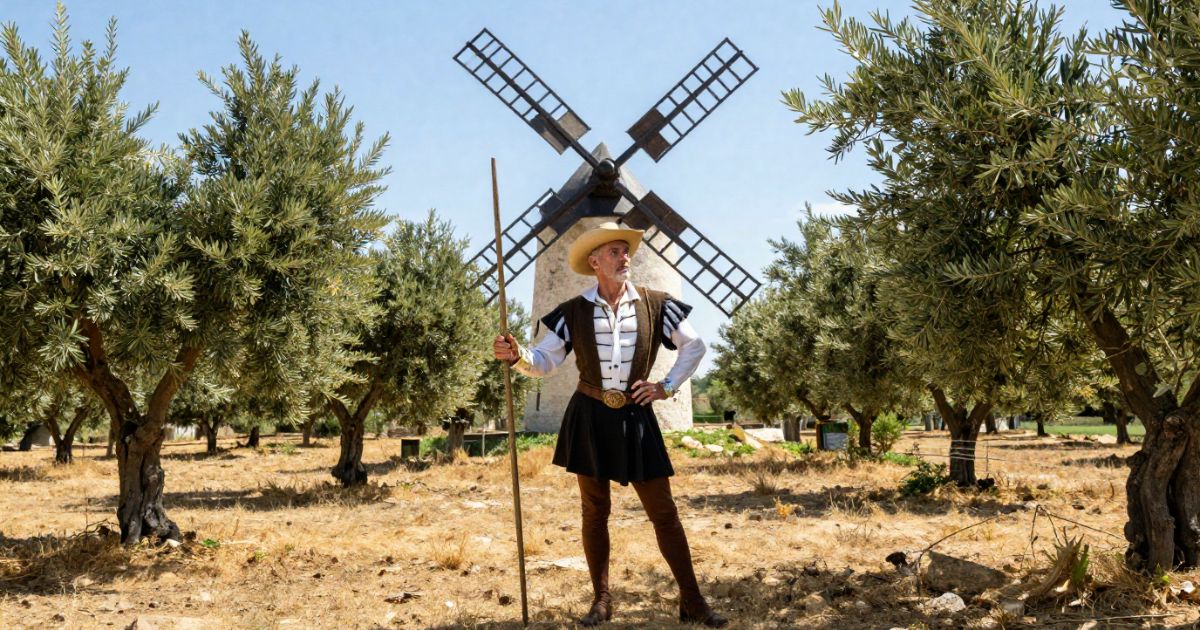
An excerpt from the original text.(complete · 2909 words)
WHICH RELATES HOW THEY LEARNED THE WAY IN WHICH THEY WERE TO DISENCHANT
THE PEERLESS DULCINEA DEL TOBOSO, WHICH IS ONE OF THE RAREST ADVENTURES
IN THIS BOOK
Great was the pleasure the duke and duchess took in the conversation of
Don Quixote and Sancho Panza; and, more bent than ever upon the plan
they had of practising some jokes upon them that should have the look
and appearance of adventures, they took as their basis of action what
Don Quixote had already told them about the cave of Montesinos, in
order to play him a famous one. But what the duchess marvelled at above
all was that Sancho’s simplicity could be so great as to make him
believe as absolute truth that Dulcinea had been enchanted, when it was
he himself who had been the enchanter and trickster in the business.
Having, therefore, instructed their servants in everything they were to
do, six days afterwards they took him out to hunt, with as great a
retinue of huntsmen and beaters as a crowned king.
They presented Don Quixote with a hunting suit, and Sancho with another
of the finest green cloth; but Don Quixote declined to put his on,
saying that he must soon return to the hard pursuit of arms, and could
not carry wardrobes or stores with him. Sancho, however, took what they
gave him, meaning to sell it at the first opportunity.
The appointed day having arrived, Don Quixote armed himself, and Sancho
arrayed himself, and mounted on his Dapple (for he would not give him
up though they offered him a horse), he placed himself in the midst of
the troop of huntsmen. The duchess came out splendidly attired, and Don
Quixote, in pure courtesy and politeness, held the rein of her palfrey,
though the duke wanted not to allow him; and at last they reached a
wood that lay between two high mountains, where, after occupying
various posts, ambushes, and paths, and distributing the party in
different positions, the hunt began with great noise, shouting, and
hallooing, so that, between the baying of the hounds and the blowing of
the horns, they could not hear one another. The duchess dismounted, and
with a sharp boar-spear in her hand posted herself where she knew the
wild boars were in the habit of passing. The duke and Don Quixote
likewise dismounted and placed themselves one at each side of her.
Sancho took up a position in the rear of all without dismounting from
Dapple, whom he dared not desert lest some mischief should befall him.
Scarcely had they taken their stand in a line with several of their
servants, when they saw a huge boar, closely pressed by the hounds and
followed by the huntsmen, making towards them, grinding his teeth and
tusks, and scattering foam from his mouth. As soon as he saw him Don
Quixote, bracing his shield on his arm, and drawing his sword, advanced
to meet him; the duke with boar-spear did the same; but the duchess
would have gone in front of them all had not the duke prevented her.
Sancho alone, deserting Dapple at the sight of the mighty beast, took
to his heels as hard as he could and strove in vain to mount a tall
oak. As he was clinging to a branch, however, half-way up in his
struggle to reach the top, the bough, such was his ill-luck and hard
fate, gave way, and caught in his fall by a broken limb of the oak, he
hung suspended in the air unable to reach the ground. Finding himself
in this position, and that the green coat was beginning to tear, and
reflecting that if the fierce animal came that way he might be able to
get at him, he began to utter such cries, and call for help so
earnestly, that all who heard him and did not see him felt sure he must
be in the teeth of some wild beast. In the end the tusked boar fell
pierced by the blades of the many spears they held in front of him; and
Don Quixote, turning round at the cries of Sancho, for he knew by them
that it was he, saw him hanging from the oak head downwards, with
Dapple, who did not forsake him in his distress, close beside him; and
Cide Hamete observes that he seldom saw Sancho Panza without seeing
Dapple, or Dapple without seeing Sancho Panza; such was their
attachment and loyalty one to the other. Don Quixote went over and
unhooked Sancho, who, as soon as he found himself on the ground, looked
at the rent in his huntingcoat and was grieved to the heart, for he
thought he had got a patrimonial estate in that suit.
Meanwhile they had slung the mighty boar across the back of a mule, and
having covered it with sprigs of rosemary and branches of myrtle, they
bore it away as the spoils of victory to some large field-tents which
had been pitched in the middle of the wood, where they found the tables
laid and dinner served, in such grand and sumptuous style that it was
easy to see the rank and magnificence of those who had provided it.
Sancho, as he showed the rents in his torn suit to the duchess,
observed, “If we had been hunting hares, or after small birds, my coat
would have been safe from being in the plight it’s in; I don’t know
what pleasure one can find in lying in wait for an animal that may take
your life with his tusk if he gets at you. I recollect having heard an
old ballad sung that says,
By bears be thou devoured, as erst
Was famous Favila.”
“That,” said Don Quixote, “was a Gothic king, who, going a-hunting, was
devoured by a bear.”
“Just so,” said Sancho; “and I would not have kings and princes expose
themselves to such dangers for the sake of a pleasure which, to my
mind, ought not to be one, as it consists in killing an animal that has
done no harm whatever.”
“Quite the contrary, Sancho; you are wrong there,” said the duke; “for
hunting is more suitable and requisite for kings and princes than for
anybody else. The chase is the emblem of war; it has stratagems, wiles,
and crafty devices for overcoming the enemy in safety; in it extreme
cold and intolerable heat have to be borne, indolence and sleep are
despised, the bodily powers are invigorated, the limbs of him who
engages in it are made supple, and, in a word, it is a pursuit which
may be followed without injury to anyone and with enjoyment to many;
and the best of it is, it is not for everybody, as field-sports of
other sorts are, except hawking, which also is only for kings and great
lords. Reconsider your opinion therefore, Sancho, and when you are
governor take to hunting, and you will find the good of it.”
“Nay,” said Sancho, “the good governor should have a broken leg and
keep at home;” it would be a nice thing if, after people had been at
the trouble of coming to look for him on business, the governor were to
be away in the forest enjoying himself; the government would go on
badly in that fashion. By my faith, señor, hunting and amusements are
more fit for idlers than for governors; what I intend to amuse myself
with is playing all fours at Eastertime, and bowls on Sundays and
holidays; for these huntings don’t suit my condition or agree with my
conscience.”
“God grant it may turn out so,” said the duke; “because it’s a long
step from saying to doing.”
“Be that as it may,” said Sancho, “‘pledges don’t distress a good
payer,’ and ‘he whom God helps does better than he who gets up early,’
and ‘it’s the tripes that carry the feet and not the feet the tripes;’
I mean to say that if God gives me help and I do my duty honestly, no
doubt I’ll govern better than a gerfalcon. Nay, let them only put a
finger in my mouth, and they’ll see whether I can bite or not.”
“The curse of God and all his saints upon thee, thou accursed Sancho!”
exclaimed Don Quixote; “when will the day come—as I have often said to
thee—when I shall hear thee make one single coherent, rational remark
without proverbs? Pray, your highnesses, leave this fool alone, for he
will grind your souls between, not to say two, but two thousand
proverbs, dragged in as much in season, and as much to the purpose
as—may God grant as much health to him, or to me if I want to listen to
them!”
“Sancho Panza’s proverbs,” said the duchess, “though more in number
than the Greek Commander’s, are not therefore less to be esteemed for
the conciseness of the maxims. For my own part, I can say they give me
more pleasure than others that may be better brought in and more
seasonably introduced.”
In pleasant conversation of this sort they passed out of the tent into
the wood, and the day was spent in visiting some of the posts and
hiding-places, and then night closed in, not, however, as brilliantly
or tranquilly as might have been expected at the season, for it was
then midsummer; but bringing with it a kind of haze that greatly aided
the project of the duke and duchess; and thus, as night began to fall,
and a little after twilight set in, suddenly the whole wood on all four
sides seemed to be on fire, and shortly after, here, there, on all
sides, a vast number of trumpets and other military instruments were
heard, as if several troops of cavalry were passing through the wood.
The blaze of the fire and the noise of the warlike instruments almost
blinded the eyes and deafened the ears of those that stood by, and
indeed of all who were in the wood. Then there were heard repeated
lelilies after the fashion of the Moors when they rush to battle;
trumpets and clarions brayed, drums beat, fifes played, so unceasingly
and so fast that he could not have had any senses who did not lose them
with the confused din of so many instruments. The duke was astounded,
the duchess amazed, Don Quixote wondering, Sancho Panza trembling, and
indeed, even they who were aware of the cause were frightened. In their
fear, silence fell upon them, and a postillion, in the guise of a
demon, passed in front of them, blowing, in lieu of a bugle, a huge
hollow horn that gave out a horrible hoarse note.
“Ho there! brother courier,” cried the duke, “who are you? Where are
you going? What troops are these that seem to be passing through the
wood?”
To which the courier replied in a harsh, discordant voice, “I am the
devil; I am in search of Don Quixote of La Mancha; those who are coming
this way are six troops of enchanters, who are bringing on a triumphal
car the peerless Dulcinea del Toboso; she comes under enchantment,
together with the gallant Frenchman Montesinos, to give instructions to
Don Quixote as to how, she the said lady, may be disenchanted.”
“If you were the devil, as you say and as your appearance indicates,”
said the duke, “you would have known the said knight Don Quixote of La
Mancha, for you have him here before you.”
“By God and upon my conscience,” said the devil, “I never observed it,
for my mind is occupied with so many different things that I was
forgetting the main thing I came about.”
“This demon must be an honest fellow and a good Christian,” said
Sancho; “for if he wasn’t he wouldn’t swear by God and his conscience;
I feel sure now there must be good souls even in hell itself.”
Without dismounting, the demon then turned to Don Quixote and said,
“The unfortunate but valiant knight Montesinos sends me to thee, the
Knight of the Lions (would that I saw thee in their claws), bidding me
tell thee to wait for him wherever I may find thee, as he brings with
him her whom they call Dulcinea del Toboso, that he may show thee what
is needful in order to disenchant her; and as I came for no more I need
stay no longer; demons of my sort be with thee, and good angels with
these gentles;” and so saying he blew his huge horn, turned about and
went off without waiting for a reply from anyone.
They all felt fresh wonder, but particularly Sancho and Don Quixote;
Sancho to see how, in defiance of the truth, they would have it that
Dulcinea was enchanted; Don Quixote because he could not feel sure
whether what had happened to him in the cave of Montesinos was true or
not; and as he was deep in these cogitations the duke said to him, “Do
you mean to wait, Señor Don Quixote?”
“Why not?” replied he; “here will I wait, fearless and firm, though all
hell should come to attack me.”
“Well then, if I see another devil or hear another horn like the last,
I’ll wait here as much as in Flanders,” said Sancho.
Night now closed in more completely, and many lights began to flit
through the wood, just as those fiery exhalations from the earth, that
look like shooting-stars to our eyes, flit through the heavens; a
frightful noise, too, was heard, like that made by the solid wheels the
ox-carts usually have, by the harsh, ceaseless creaking of which, they
say, the bears and wolves are put to flight, if there happen to be any
where they are passing. In addition to all this commotion, there came a
further disturbance to increase the tumult, for now it seemed as if in
truth, on all four sides of the wood, four encounters or battles were
going on at the same time; in one quarter resounded the dull noise of a
terrible cannonade, in another numberless muskets were being
discharged, the shouts of the combatants sounded almost close at hand,
and farther away the Moorish lelilies were raised again and again. In a
word, the bugles, the horns, the clarions, the trumpets, the drums, the
cannon, the musketry, and above all the tremendous noise of the carts,
all made up together a din so confused and terrific that Don Quixote
had need to summon up all his courage to brave it; but Sancho’s gave
way, and he fell fainting on the skirt of the duchess’s robe, who let
him lie there and promptly bade them throw water in his face. This was
done, and he came to himself by the time that one of the carts with the
creaking wheels reached the spot. It was drawn by four plodding oxen
all covered with black housings; on each horn they had fixed a large
lighted wax taper, and on the top of the cart was constructed a raised
seat, on which sat a venerable old man with a beard whiter than the
very snow, and so long that it fell below his waist; he was dressed in
a long robe of black buckram; for as the cart was thickly set with a
multitude of candles it was easy to make out everything that was on it.
Leading it were two hideous demons, also clad in buckram, with
countenances so frightful that Sancho, having once seen them, shut his
eyes so as not to see them again. As soon as the cart came opposite the
spot the old man rose from his lofty seat, and standing up said in a
loud voice, “I am the sage Lirgandeo,” and without another word the
cart then passed on. Behind it came another of the same form, with
another aged man enthroned, who, stopping the cart, said in a voice no
less solemn than that of the first, “I am the sage Alquife, the great
friend of Urganda the Unknown,” and passed on. Then another cart came
by at the same pace, but the occupant of the throne was not old like
the others, but a man stalwart and robust, and of a forbidding
countenance, who as he came up said in a voice far hoarser and more
devilish, “I am the enchanter Archelaus, the mortal enemy of Amadis of
Gaul and all his kindred,” and then passed on. Having gone a short
distance the three carts halted and the monotonous noise of their
wheels ceased, and soon after they heard another, not noise, but sound
of sweet, harmonious music, of which Sancho was very glad, taking it to
be a good sign; and said he to the duchess, from whom he did not stir a
step, or for a single instant, “Señora, where there’s music there can’t
be mischief.”
“Nor where there are lights and it is bright,” said the duchess; to
which Sancho replied, “Fire gives light, and it’s bright where there
are bonfires, as we see by those that are all round us and perhaps may
burn us; but music is a sign of mirth and merrymaking.”
“That remains to be seen,” said Don Quixote, who was listening to all
that passed; and he was right, as is shown in the following chapter.
p34e.jpg (47K)
Master this chapter. Complete your experience
Purchase the complete book to access all chapters and support classic literature
As an Amazon Associate, we earn a small commission from qualifying purchases at no additional cost to you.
Available in paperback, hardcover, and e-book formats
Let's Analyse the Pattern
Using gifts and favors as tools of manipulation to create obligation and control over others.
Why This Matters
Connect literature to life
This chapter teaches how to recognize when someone's help is designed to create obligation rather than genuine support.
Practice This Today
This week, notice when someone's generosity comes with an audience or unspoken expectations—real help doesn't need applause or create debt.
Now let's explore the literary elements.
Key Quotes & Analysis
"he must soon return to the hard pursuit of arms, and could not carry wardrobes or stores with him"
Context: When refusing the expensive hunting outfit the Duke offers him
This shows Don Quixote's genuine commitment to his ideals, even when they conflict with comfort or social expectations. He's willing to reject luxury when it doesn't fit his self-image as a knight.
In Today's Words:
I can't be weighed down with fancy stuff when I've got serious work to do
"Sancho, however, took what they gave him, meaning to sell it at the first opportunity"
Context: Describing Sancho's practical response to receiving expensive hunting clothes
This reveals the class divide perfectly - the nobles give away expensive items casually while Sancho sees them as valuable resources to convert to money he actually needs.
In Today's Words:
Sancho grabbed the free stuff planning to flip it for cash as soon as possible
"Great was the pleasure the duke and duchess took in the conversation of Don Quixote and Sancho Panza"
Context: Opening description of why the nobles continue their elaborate pranks
This shows how the wealthy treat working people as entertainment. Their 'pleasure' comes from observing and manipulating others, not from genuine friendship or respect.
In Today's Words:
The rich couple got their kicks out of messing with Don Quixote and Sancho
Thematic Threads
Class
In This Chapter
The Duke and Duchess use their wealth to orchestrate elaborate entertainment at others' expense, showing how the rich can turn people into objects for amusement
Development
Deepening from earlier chapters—now showing how class privilege enables psychological cruelty disguised as hospitality
In Your Life:
You might see this when wealthy family members or employers use their resources to manipulate rather than genuinely help.
Deception
In This Chapter
The staged supernatural spectacle with demons and fires is designed to manipulate Don Quixote's beliefs about his quest
Development
Evolution from simple lies to elaborate theatrical productions meant to deceive
In Your Life:
You encounter this when people create elaborate scenarios to make you believe something that serves their agenda.
Identity
In This Chapter
Don Quixote struggles between wanting to believe in his heroic identity and growing uncertainty about what's real
Development
Continued erosion of his certainty as external manipulation increases
In Your Life:
You face this when others try to define who you should be instead of letting you discover it yourself.
Social Expectations
In This Chapter
Sancho must participate in dangerous hunting despite his practical concerns because refusing would violate social courtesy
Development
Building on earlier themes of obligation disguised as politeness
In Your Life:
You experience this when social pressure forces you into situations that don't serve your actual interests.
Power
In This Chapter
The Duke and Duchess demonstrate how unlimited resources can be used to manipulate and control others for entertainment
Development
Showing how power corrupts through enabling cruelty disguised as generosity
In Your Life:
You see this when people in authority positions use their advantages to manipulate rather than lead responsibly.
You now have the context. Time to form your own thoughts.
Discussion Questions
- 1
Why do the Duke and Duchess go to such elaborate lengths to stage the hunting trip and supernatural show for Don Quixote and Sancho?
analysis • surface - 2
What does Sancho's concern about his torn hunting coat reveal about the different ways he and the nobles view expensive gifts?
analysis • medium - 3
Where do you see people today using generous gifts or elaborate gestures to control or manipulate others?
application • medium - 4
How can you tell the difference between genuine generosity and gifts that come with hidden strings attached?
application • deep - 5
What does this chapter reveal about how power and wealth can be used to turn other people's lives into entertainment?
reflection • deep
Critical Thinking Exercise
Decode the Gift
Think of a time when someone gave you something generous but it felt uncomfortable or came with expectations. Write down what the gift was, how it made you feel, and what the giver seemed to want in return. Then identify what you would do differently if faced with a similar situation today.
Consider:
- •Notice the difference between how the gift was presented versus how it actually felt to receive it
- •Consider whether the generosity was proportional to what the giver could afford versus what it meant to you
- •Think about whether you felt free to say no or whether refusing would have created conflict
Journaling Prompt
Write about a time when you recognized that someone's generosity was actually a form of control. How did you handle it, and what would you do differently now?
Coming Up Next...
Chapter 107: Merlin's Bargain and Sancho's Price
The supernatural spectacle escalates as a magnificent triumphal car approaches with white-robed figures and mysterious passengers. The Duke and Duchess's most elaborate trick yet is about to unfold, promising to reveal the supposed method for Dulcinea's disenchantment.