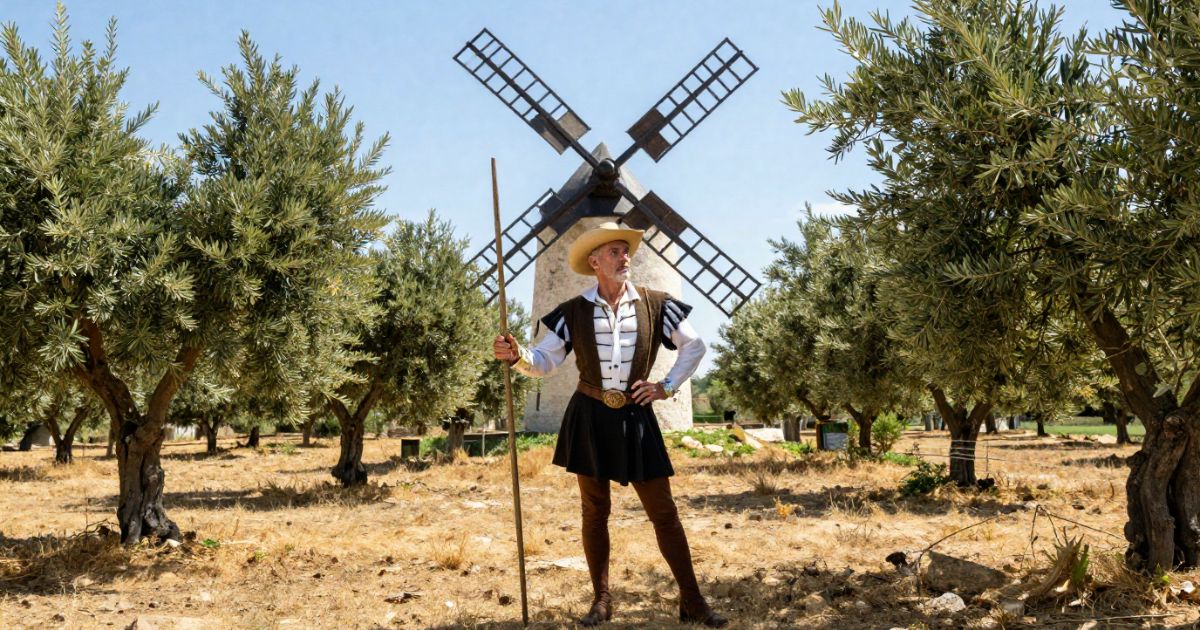
An excerpt from the original text.(complete · 5574 words)
F THE REPLY DON QUIXOTE GAVE HIS CENSURER, WITH OTHER INCIDENTS, GRAVE
AND DROLL
Don Quixote, then, having risen to his feet, trembling from head to
foot like a man dosed with mercury, said in a hurried, agitated voice,
“The place I am in, the presence in which I stand, and the respect I
have and always have had for the profession to which your worship
belongs, hold and bind the hands of my just indignation; and as well
for these reasons as because I know, as everyone knows, that a
gownsman’s weapon is the same as a woman’s, the tongue, I will with
mine engage in equal combat with your worship, from whom one might have
expected good advice instead of foul abuse. Pious, well-meant reproof
requires a different demeanour and arguments of another sort; at any
rate, to have reproved me in public, and so roughly, exceeds the bounds
of proper reproof, for that comes better with gentleness than with
rudeness; and it is not seemly to call the sinner roundly blockhead and
booby, without knowing anything of the sin that is reproved. Come, tell
me, for which of the stupidities you have observed in me do you condemn
and abuse me, and bid me go home and look after my house and wife and
children, without knowing whether I have any? Is nothing more needed
than to get a footing, by hook or by crook, in other people’s houses to
rule over the masters (and that, perhaps, after having been brought up
in all the straitness of some seminary, and without having ever seen
more of the world than may lie within twenty or thirty leagues round),
to fit one to lay down the law rashly for chivalry, and pass judgment
on knights-errant? Is it, haply, an idle occupation, or is the time
ill-spent that is spent in roaming the world in quest, not of its
enjoyments, but of those arduous toils whereby the good mount upwards
to the abodes of everlasting life? If gentlemen, great lords, nobles,
men of high birth, were to rate me as a fool I should take it as an
irreparable insult; but I care not a farthing if clerks who have never
entered upon or trod the paths of chivalry should think me foolish.
Knight I am, and knight I will die, if such be the pleasure of the Most
High. Some take the broad road of overweening ambition; others that of
mean and servile flattery; others that of deceitful hypocrisy, and some
that of true religion; but I, led by my star, follow the narrow path of
knight-errantry, and in pursuit of that calling I despise wealth, but
not honour. I have redressed injuries, righted wrongs, punished
insolences, vanquished giants, and crushed monsters; I am in love, for
no other reason than that it is incumbent on knights-errant to be so;
but though I am, I am no carnal-minded lover, but one of the chaste,
platonic sort. My intentions are always directed to worthy ends, to do
good to all and evil to none; and if he who means this, does this, and
makes this his practice deserves to be called a fool, it is for your
highnesses to say, O most excellent duke and duchess.”
“Good, by God!” cried Sancho; “say no more in your own defence, master
mine, for there’s nothing more in the world to be said, thought, or
insisted on; and besides, when this gentleman denies, as he has, that
there are or ever have been any knights-errant in the world, is it any
wonder if he knows nothing of what he has been talking about?”
“Perhaps, brother,” said the ecclesiastic, “you are that Sancho Panza
that is mentioned, to whom your master has promised an island?”
“Yes, I am,” said Sancho, “and what’s more, I am one who deserves it as
much as anyone; I am one of the sort—‘Attach thyself to the good, and
thou wilt be one of them,’ and of those, ‘Not with whom thou art bred,
but with whom thou art fed,’ and of those, ‘Who leans against a good
tree, a good shade covers him;’ I have leant upon a good master, and I
have been for months going about with him, and please God I shall be
just such another; long life to him and long life to me, for neither
will he be in any want of empires to rule, or I of islands to govern.”
“No, Sancho my friend, certainly not,” said the duke, “for in the name
of Señor Don Quixote I confer upon you the government of one of no
small importance that I have at my disposal.”
“Go down on thy knees, Sancho,” said Don Quixote, “and kiss the feet of
his excellence for the favour he has bestowed upon thee.”
Sancho obeyed, and on seeing this the ecclesiastic stood up from table
completely out of temper, exclaiming, “By the gown I wear, I am almost
inclined to say that your excellence is as great a fool as these
sinners. No wonder they are mad, when people who are in their senses
sanction their madness! I leave your excellence with them, for so long
as they are in the house, I will remain in my own, and spare myself the
trouble of reproving what I cannot remedy;” and without uttering
another word, or eating another morsel, he went off, the entreaties of
the duke and duchess being entirely unavailing to stop him; not that
the duke said much to him, for he could not, because of the laughter
his uncalled-for anger provoked.
When he had done laughing, he said to Don Quixote, “You have replied on
your own behalf so stoutly, Sir Knight of the Lions, that there is no
occasion to seek further satisfaction for this, which, though it may
look like an offence, is not so at all, for, as women can give no
offence, no more can ecclesiastics, as you very well know.”
“That is true,” said Don Quixote, “and the reason is, that he who is
not liable to offence cannot give offence to anyone. Women, children,
and ecclesiastics, as they cannot defend themselves, though they may
receive offence cannot be insulted, because between the offence and the
insult there is, as your excellence very well knows, this difference:
the insult comes from one who is capable of offering it, and does so,
and maintains it; the offence may come from any quarter without
carrying insult. To take an example: a man is standing unsuspectingly
in the street and ten others come up armed and beat him; he draws his
sword and quits himself like a man, but the number of his antagonists
makes it impossible for him to effect his purpose and avenge himself;
this man suffers an offence but not an insult. Another example will
make the same thing plain: a man is standing with his back turned,
another comes up and strikes him, and after striking him takes to
flight, without waiting an instant, and the other pursues him but does
not overtake him; he who received the blow received an offence, but not
an insult, because an insult must be maintained. If he who struck him,
though he did so sneakingly and treacherously, had drawn his sword and
stood and faced him, then he who had been struck would have received
offence and insult at the same time; offence because he was struck
treacherously, insult because he who struck him maintained what he had
done, standing his ground without taking to flight. And so, according
to the laws of the accursed duel, I may have received offence, but not
insult, for neither women nor children can maintain it, nor can they
wound, nor have they any way of standing their ground, and it is just
the same with those connected with religion; for these three sorts of
persons are without arms offensive or defensive, and so, though
naturally they are bound to defend themselves, they have no right to
offend anybody; and though I said just now I might have received
offence, I say now certainly not, for he who cannot receive an insult
can still less give one; for which reasons I ought not to feel, nor do
I feel, aggrieved at what that good man said to me; I only wish he had
stayed a little longer, that I might have shown him the mistake he
makes in supposing and maintaining that there are not and never have
been any knights-errant in the world; had Amadis or any of his
countless descendants heard him say as much, I am sure it would not
have gone well with his worship.”
“I will take my oath of that,” said Sancho; “they would have given him
a slash that would have slit him down from top to toe like a
pomegranate or a ripe melon; they were likely fellows to put up with
jokes of that sort! By my faith, I’m certain if Reinaldos of Montalvan
had heard the little man’s words he would have given him such a spank
on the mouth that he wouldn’t have spoken for the next three years; ay,
let him tackle them, and he’ll see how he’ll get out of their hands!”
The duchess, as she listened to Sancho, was ready to die with laughter,
and in her own mind she set him down as droller and madder than his
master; and there were a good many just then who were of the same
opinion.
Don Quixote finally grew calm, and dinner came to an end, and as the
cloth was removed four damsels came in, one of them with a silver
basin, another with a jug also of silver, a third with two fine white
towels on her shoulder, and the fourth with her arms bared to the
elbows, and in her white hands (for white they certainly were) a round
ball of Naples soap. The one with the basin approached, and with arch
composure and impudence, thrust it under Don Quixote’s chin, who,
wondering at such a ceremony, said never a word, supposing it to be the
custom of that country to wash beards instead of hands; he therefore
stretched his out as far as he could, and at the same instant the jug
began to pour and the damsel with the soap rubbed his beard briskly,
raising snow-flakes, for the soap lather was no less white, not only
over the beard, but all over the face, and over the eyes of the
submissive knight, so that they were perforce obliged to keep shut. The
duke and duchess, who had not known anything about this, waited to see
what came of this strange washing. The barber damsel, when she had him
a hand’s breadth deep in lather, pretended that there was no more
water, and bade the one with the jug go and fetch some, while Señor Don
Quixote waited. She did so, and Don Quixote was left the strangest and
most ludicrous figure that could be imagined. All those present, and
there were a good many, were watching him, and as they saw him there
with half a yard of neck, and that uncommonly brown, his eyes shut, and
his beard full of soap, it was a great wonder, and only by great
discretion, that they were able to restrain their laughter. The
damsels, the concocters of the joke, kept their eyes down, not daring
to look at their master and mistress; and as for them, laughter and
anger struggled within them, and they knew not what to do, whether to
punish the audacity of the girls, or to reward them for the amusement
they had received from seeing Don Quixote in such a plight.
At length the damsel with the jug returned and they made an end of
washing Don Quixote, and the one who carried the towels very
deliberately wiped him and dried him; and all four together making him
a profound obeisance and curtsey, they were about to go, when the duke,
lest Don Quixote should see through the joke, called out to the one
with the basin saying, “Come and wash me, and take care that there is
water enough.” The girl, sharp-witted and prompt, came and placed the
basin for the duke as she had done for Don Quixote, and they soon had
him well soaped and washed, and having wiped him dry they made their
obeisance and retired. It appeared afterwards that the duke had sworn
that if they had not washed him as they had Don Quixote he would have
punished them for their impudence, which they adroitly atoned for by
soaping him as well.
Sancho observed the ceremony of the washing very attentively, and said
to himself, “God bless me, if it were only the custom in this country
to wash squires’ beards too as well as knights’. For by God and upon my
soul I want it badly; and if they gave me a scrape of the razor besides
I’d take it as a still greater kindness.”
“What are you saying to yourself, Sancho?” asked the duchess.
“I was saying, señora,” he replied, “that in the courts of other
princes, when the cloth is taken away, I have always heard say they
give water for the hands, but not lye for the beard; and that shows it
is good to live long that you may see much; to be sure, they say too
that he who lives a long life must undergo much evil, though to undergo
a washing of that sort is pleasure rather than pain.”
“Don’t be uneasy, friend Sancho,” said the duchess; “I will take care
that my damsels wash you, and even put you in the tub if necessary.”
“I’ll be content with the beard,” said Sancho, “at any rate for the
present; and as for the future, God has decreed what is to be.”
“Attend to worthy Sancho’s request, seneschal,” said the duchess, “and
do exactly what he wishes.”
The seneschal replied that Señor Sancho should be obeyed in everything;
and with that he went away to dinner and took Sancho along with him,
while the duke and duchess and Don Quixote remained at table discussing
a great variety of things, but all bearing on the calling of arms and
knight-errantry.
The duchess begged Don Quixote, as he seemed to have a retentive
memory, to describe and portray to her the beauty and features of the
lady Dulcinea del Toboso, for, judging by what fame trumpeted abroad of
her beauty, she felt sure she must be the fairest creature in the
world, nay, in all La Mancha.
Don Quixote sighed on hearing the duchess’s request, and said, “If I
could pluck out my heart, and lay it on a plate on this table here
before your highness’s eyes, it would spare my tongue the pain of
telling what can hardly be thought of, for in it your excellence would
see her portrayed in full. But why should I attempt to depict and
describe in detail, and feature by feature, the beauty of the peerless
Dulcinea, the burden being one worthy of other shoulders than mine, an
enterprise wherein the pencils of Parrhasius, Timantes, and Apelles,
and the graver of Lysippus ought to be employed, to paint it in
pictures and carve it in marble and bronze, and Ciceronian and
Demosthenian eloquence to sound its praises?”
“What does Demosthenian mean, Señor Don Quixote?” said the duchess; “it
is a word I never heard in all my life.”
“Demosthenian eloquence,” said Don Quixote, “means the eloquence of
Demosthenes, as Ciceronian means that of Cicero, who were the two most
eloquent orators in the world.”
“True,” said the duke; “you must have lost your wits to ask such a
question. Nevertheless, Señor Don Quixote would greatly gratify us if
he would depict her to us; for never fear, even in an outline or sketch
she will be something to make the fairest envious.”
“I would do so certainly,” said Don Quixote, “had she not been blurred
to my mind’s eye by the misfortune that fell upon her a short time
since, one of such a nature that I am more ready to weep over it than
to describe it. For your highnesses must know that, going a few days
back to kiss her hands and receive her benediction, approbation, and
permission for this third sally, I found her altogether a different
being from the one I sought; I found her enchanted and changed from a
princess into a peasant, from fair to foul, from an angel into a devil,
from fragrant to pestiferous, from refined to clownish, from a
dignified lady into a jumping tomboy, and, in a word, from Dulcinea del
Toboso into a coarse Sayago wench.”
“God bless me!” said the duke aloud at this, “who can have done the
world such an injury? Who can have robbed it of the beauty that
gladdened it, of the grace and gaiety that charmed it, of the modesty
that shed a lustre upon it?”
“Who?” replied Don Quixote; “who could it be but some malignant
enchanter of the many that persecute me out of envy—that accursed race
born into the world to obscure and bring to naught the achievements of
the good, and glorify and exalt the deeds of the wicked? Enchanters
have persecuted me, enchanters persecute me still, and enchanters will
continue to persecute me until they have sunk me and my lofty chivalry
in the deep abyss of oblivion; and they injure and wound me where they
know I feel it most. For to deprive a knight-errant of his lady is to
deprive him of the eyes he sees with, of the sun that gives him light,
of the food whereby he lives. Many a time before have I said it, and I
say it now once more, a knight-errant without a lady is like a tree
without leaves, a building without a foundation, or a shadow without
the body that causes it.”
“There is no denying it,” said the duchess; “but still, if we are to
believe the history of Don Quixote that has come out here lately with
general applause, it is to be inferred from it, if I mistake not, that
you never saw the lady Dulcinea, and that the said lady is nothing in
the world but an imaginary lady, one that you yourself begot and gave
birth to in your brain, and adorned with whatever charms and
perfections you chose.”
“There is a good deal to be said on that point,” said Don Quixote; “God
knows whether there be any Dulcinea or not in the world, or whether she
is imaginary or not imaginary; these are things the proof of which must
not be pushed to extreme lengths. I have not begotten nor given birth
to my lady, though I behold her as she needs must be, a lady who
contains in herself all the qualities to make her famous throughout the
world, beautiful without blemish, dignified without haughtiness, tender
and yet modest, gracious from courtesy and courteous from good
breeding, and lastly, of exalted lineage, because beauty shines forth
and excels with a higher degree of perfection upon good blood than in
the fair of lowly birth.”
“That is true,” said the duke; “but Señor Don Quixote will give me
leave to say what I am constrained to say by the story of his exploits
that I have read, from which it is to be inferred that, granting there
is a Dulcinea in El Toboso, or out of it, and that she is in the
highest degree beautiful as you have described her to us, as regards
the loftiness of her lineage she is not on a par with the Orianas,
Alastrajareas, Madasimas, or others of that sort, with whom, as you
well know, the histories abound.”
“To that I may reply,” said Don Quixote, “that Dulcinea is the daughter
of her own works, and that virtues rectify blood, and that lowly virtue
is more to be regarded and esteemed than exalted vice. Dulcinea,
besides, has that within her that may raise her to be a crowned and
sceptred queen; for the merit of a fair and virtuous woman is capable
of performing greater miracles; and virtually, though not formally, she
has in herself higher fortunes.”
“I protest, Señor Don Quixote,” said the duchess, “that in all you say,
you go most cautiously and lead in hand, as the saying is; henceforth I
will believe myself, and I will take care that everyone in my house
believes, even my lord the duke if needs be, that there is a Dulcinea
in El Toboso, and that she is living to-day, and that she is beautiful
and nobly born and deserves to have such a knight as Señor Don Quixote
in her service, and that is the highest praise that it is in my power
to give her or that I can think of. But I cannot help entertaining a
doubt, and having a certain grudge against Sancho Panza; the doubt is
this, that the aforesaid history declares that the said Sancho Panza,
when he carried a letter on your worship’s behalf to the said lady
Dulcinea, found her sifting a sack of wheat; and more by token it says
it was red wheat; a thing which makes me doubt the loftiness of her
lineage.”
To this Don Quixote made answer, “Señora, your highness must know that
everything or almost everything that happens me transcends the ordinary
limits of what happens to other knights-errant; whether it be that it
is directed by the inscrutable will of destiny, or by the malice of
some jealous enchanter. Now it is an established fact that all or most
famous knights-errant have some special gift, one that of being proof
against enchantment, another that of being made of such invulnerable
flesh that he cannot be wounded, as was the famous Roland, one of the
twelve peers of France, of whom it is related that he could not be
wounded except in the sole of his left foot, and that it must be with
the point of a stout pin and not with any other sort of weapon
whatever; and so, when Bernardo del Carpio slew him at Roncesvalles,
finding that he could not wound him with steel, he lifted him up from
the ground in his arms and strangled him, calling to mind seasonably
the death which Hercules inflicted on Antæus, the fierce giant that
they say was the son of Terra. I would infer from what I have mentioned
that perhaps I may have some gift of this kind, not that of being
invulnerable, because experience has many times proved to me that I am
of tender flesh and not at all impenetrable; nor that of being proof
against enchantment, for I have already seen myself thrust into a cage,
in which all the world would not have been able to confine me except by
force of enchantments. But as I delivered myself from that one, I am
inclined to believe that there is no other that can hurt me; and so,
these enchanters, seeing that they cannot exert their vile craft
against my person, revenge themselves on what I love most, and seek to
rob me of life by maltreating that of Dulcinea in whom I live; and
therefore I am convinced that when my squire carried my message to her,
they changed her into a common peasant girl, engaged in such a mean
occupation as sifting wheat; I have already said, however, that that
wheat was not red wheat, nor wheat at all, but grains of orient pearl.
And as a proof of all this, I must tell your highnesses that, coming to
El Toboso a short time back, I was altogether unable to discover the
palace of Dulcinea; and that the next day, though Sancho, my squire,
saw her in her own proper shape, which is the fairest in the world, to
me she appeared to be a coarse, ill-favoured farm-wench, and by no
means a well-spoken one, she who is propriety itself. And so, as I am
not and, so far as one can judge, cannot be enchanted, she it is that
is enchanted, that is smitten, that is altered, changed, and
transformed; in her have my enemies revenged themselves upon me, and
for her shall I live in ceaseless tears, until I see her in her
pristine state. I have mentioned this lest anybody should mind what
Sancho said about Dulcinea’s winnowing or sifting; for, as they changed
her to me, it is no wonder if they changed her to him. Dulcinea is
illustrious and well-born, and of one of the gentle families of El
Toboso, which are many, ancient, and good. Therein, most assuredly, not
small is the share of the peerless Dulcinea, through whom her town will
be famous and celebrated in ages to come, as Troy was through Helen,
and Spain through La Cava, though with a better title and tradition.
For another thing; I would have your graces understand that Sancho
Panza is one of the drollest squires that ever served knight-errant;
sometimes there is a simplicity about him so acute that it is an
amusement to try and make out whether he is simple or sharp; he has
mischievous tricks that stamp him rogue, and blundering ways that prove
him a booby; he doubts everything and believes everything; when I fancy
he is on the point of coming down headlong from sheer stupidity, he
comes out with something shrewd that sends him up to the skies. After
all, I would not exchange him for another squire, though I were given a
city to boot, and therefore I am in doubt whether it will be well to
send him to the government your highness has bestowed upon him; though
I perceive in him a certain aptitude for the work of governing, so
that, with a little trimming of his understanding, he would manage any
government as easily as the king does his taxes; and moreover, we know
already ample experience that it does not require much cleverness or
much learning to be a governor, for there are a hundred round about us
that scarcely know how to read, and govern like gerfalcons. The main
point is that they should have good intentions and be desirous of doing
right in all things, for they will never be at a loss for persons to
advise and direct them in what they have to do, like those
knight-governors who, being no lawyers, pronounce sentences with the
aid of an assessor. My advice to him will be to take no bribe and
surrender no right, and I have some other little matters in reserve,
that shall be produced in due season for Sancho’s benefit and the
advantage of the island he is to govern.”
The duke, duchess, and Don Quixote had reached this point in their
conversation, when they heard voices and a great hubbub in the palace,
and Sancho burst abruptly into the room all glowing with anger, with a
straining-cloth by way of a bib, and followed by several servants, or,
more properly speaking, kitchen-boys and other underlings, one of whom
carried a small trough full of water, that from its colour and impurity
was plainly dishwater. The one with the trough pursued him and followed
him everywhere he went, endeavouring with the utmost persistence to
thrust it under his chin, while another kitchen-boy seemed anxious to
wash his beard.
“What is all this, brothers?” asked the duchess. “What is it? What do
you want to do to this good man? Do you forget he is a governor-elect?”
To which the barber kitchen-boy replied, “The gentleman will not let
himself be washed as is customary, and as my lord and the señor his
master have been.”
“Yes, I will,” said Sancho, in a great rage; “but I’d like it to be
with cleaner towels, clearer lye, and not such dirty hands; for there’s
not so much difference between me and my master that he should be
washed with angels’ water and I with devil’s lye. The customs of
countries and princes’ palaces are only good so long as they give no
annoyance; but the way of washing they have here is worse than doing
penance. I have a clean beard, and I don’t require to be refreshed in
that fashion, and whoever comes to wash me or touch a hair of my head,
I mean to say my beard, with all due respect be it said, I’ll give him
a punch that will leave my fist sunk in his skull; for cirimonies and
soapings of this sort are more like jokes than the polite attentions of
one’s host.”
The duchess was ready to die with laughter when she saw Sancho’s rage
and heard his words; but it was no pleasure to Don Quixote to see him
in such a sorry trim, with the dingy towel about him, and the
hangers-on of the kitchen all round him; so making a low bow to the
duke and duchess, as if to ask their permission to speak, he addressed
the rout in a dignified tone: “Holloa, gentlemen! you let that youth
alone, and go back to where you came from, or anywhere else if you
like; my squire is as clean as any other person, and those troughs are
as bad as narrow thin-necked jars to him; take my advice and leave him
alone, for neither he nor I understand joking.”
Sancho took the word out of his mouth and went on, “Nay, let them come
and try their jokes on the country bumpkin, for it’s about as likely
I’ll stand them as that it’s now midnight! Let them bring me a comb
here, or what they please, and curry this beard of mine, and if they
get anything out of it that offends against cleanliness, let them clip
me to the skin.”
Upon this, the duchess, laughing all the while, said, “Sancho Panza is
right, and always will be in all he says; he is clean, and, as he says
himself, he does not require to be washed; and if our ways do not
please him, he is free to choose. Besides, you promoters of cleanliness
have been excessively careless and thoughtless, I don’t know if I ought
not to say audacious, to bring troughs and wooden utensils and kitchen
dishclouts, instead of basins and jugs of pure gold and towels of
holland, to such a person and such a beard; but, after all, you are
ill-conditioned and ill-bred, and spiteful as you are, you cannot help
showing the grudge you have against the squires of knights-errant.”
The impudent servitors, and even the seneschal who came with them, took
the duchess to be speaking in earnest, so they removed the
straining-cloth from Sancho’s neck, and with something like shame and
confusion of face went off all of them and left him; whereupon he,
seeing himself safe out of that extreme danger, as it seemed to him,
ran and fell on his knees before the duchess, saying, “From great
ladies great favours may be looked for; this which your grace has done
me to-day cannot be requited with less than wishing I was dubbed a
knight-errant, to devote myself all the days of my life to the service
of so exalted a lady. I am a labouring man, my name is Sancho Panza, I
am married, I have children, and I am serving as a squire; if in any
one of these ways I can serve your highness, I will not be longer in
obeying than your grace in commanding.”
“It is easy to see, Sancho,” replied the duchess, “that you have
learned to be polite in the school of politeness itself; I mean to say
it is easy to see that you have been nursed in the bosom of Señor Don
Quixote, who is, of course, the cream of good breeding and flower of
ceremony—or cirimony, as you would say yourself. Fair be the fortunes
of such a master and such a servant, the one the cynosure of
knight-errantry, the other the star of squirely fidelity! Rise, Sancho,
my friend; I will repay your courtesy by taking care that my lord the
duke makes good to you the promised gift of the government as soon as
possible.”
With this, the conversation came to an end, and Don Quixote retired to
take his midday sleep; but the duchess begged Sancho, unless he had a
very great desire to go to sleep, to come and spend the afternoon with
her and her damsels in a very cool chamber. Sancho replied that, though
he certainly had the habit of sleeping four or five hours in the heat
of the day in summer, to serve her excellence he would try with all his
might not to sleep even one that day, and that he would come in
obedience to her command, and with that he went off. The duke gave
fresh orders with respect to treating Don Quixote as a knight-errant,
without departing even in smallest particular from the style in which,
as the stories tell us, they used to treat the knights of old.
p32e.jpg (16K)
Master this chapter. Complete your experience
Purchase the complete book to access all chapters and support classic literature
As an Amazon Associate, we earn a small commission from qualifying purchases at no additional cost to you.
Available in paperback, hardcover, and e-book formats
Let's Analyse the Pattern
The ability to distinguish between legitimate criticism from credible sources and attacks from those who lack standing or courage to engage constructively.
Why This Matters
Connect literature to life
This chapter teaches how to distinguish between legitimate feedback from credible sources and attacks from people who lack the standing or courage to truly judge your choices.
Practice This Today
This week, notice when someone criticizes your decisions - ask yourself: does this person have the experience, courage, or standing to offer meaningful feedback on this topic?
Now let's explore the literary elements.
Key Quotes & Analysis
"I know, as everyone knows, that a gownsman's weapon is the same as a woman's, the tongue"
Context: Explaining why he'll respond with words rather than violence to the priest's attack
Don Quixote shows strategic thinking - he recognizes what kind of fight he's in and chooses the appropriate response. He's not backing down, just fighting smart.
In Today's Words:
You want to have a war of words? Fine, I can do that too.
"Pious, well-meant reproof requires a different demeanour and arguments of another sort"
Context: Criticizing how the priest chose to attack him publicly rather than offer private guidance
This distinguishes between helpful criticism and public shaming. Don Quixote shows he understands the difference between someone trying to help and someone trying to humiliate.
In Today's Words:
If you really wanted to help me, you'd talk to me privately, not try to embarrass me in front of everyone.
"Is nothing more needed than to get a footing, by hook or by crook, in other people's houses to rule over the masters?"
Context: Questioning the priest's right to interfere in his life choices
Don Quixote calls out the priest's overreach - just because you have authority in one area doesn't give you the right to control someone's entire life.
In Today's Words:
Who made you the boss of my personal decisions?
Thematic Threads
Dignity
In This Chapter
Don Quixote maintains dignity through philosophical distinction between offense and insult, while Sancho defends dignity through direct refusal of mistreatment
Development
Evolved from earlier physical confrontations to sophisticated emotional and intellectual self-defense
In Your Life:
You might need to defend your dignity when facing criticism at work or personal attacks that feel designed to diminish rather than improve.
Class
In This Chapter
The ecclesiastic uses his position to attack, while servants attempt to humiliate through fake hospitality rituals
Development
Continues pattern of class-based power dynamics and attempts to enforce social hierarchy through humiliation
In Your Life:
You might encounter people using their position or status to make you feel small rather than addressing issues directly.
Respect
In This Chapter
Both Don Quixote and Sancho refuse to accept disrespectful treatment disguised as normal interaction or hospitality
Development
Shows progression from accepting mistreatment to actively setting boundaries around respectful engagement
In Your Life:
You might need to recognize when someone is treating you poorly while pretending it's normal or acceptable behavior.
Courage
In This Chapter
Don Quixote points out that true courage requires standing ready to defend your position, not just attacking others
Development
Develops earlier themes of brave action into intellectual and moral courage
In Your Life:
You might need to evaluate whether critics in your life have the courage to engage constructively or just tear down from safety.
Alliance
In This Chapter
The duchess intervenes to stop the servants' mistreatment, showing how allies can support dignity defense
Development
Introduced here as active support for maintaining boundaries and respect
In Your Life:
You might need allies who will help you maintain standards for how you're treated when others try to normalize disrespect.
You now have the context. Time to form your own thoughts.
Discussion Questions
- 1
What's the difference between being offended and being insulted, according to Don Quixote's explanation to the ecclesiastic?
analysis • surface - 2
Why does Don Quixote argue that the ecclesiastic cannot truly insult him, even though his words were harsh and public?
analysis • medium - 3
Think about social media or workplace conflicts - where do you see people confusing offense with actual insult in today's world?
application • medium - 4
When someone criticizes you unfairly, how do you decide whether to engage or dismiss their words? What criteria would you use?
application • deep - 5
What does this chapter suggest about the relationship between dignity and the courage to stand up for yourself?
reflection • deep
Critical Thinking Exercise
The Credibility Filter
Think of a recent time someone criticized you or said something hurtful. Write down what they said, then evaluate the source using Don Quixote's framework. Do they have the knowledge, standing, and courage to offer legitimate criticism? Are they willing to engage constructively or just tear down? Based on this analysis, decide whether their words deserve your emotional energy.
Consider:
- •Consider the person's expertise in the area they're criticizing
- •Look at whether they're willing to have a real conversation about solutions
- •Ask if they're taking similar risks or responsibilities in their own life
Journaling Prompt
Write about a time when you let someone's criticism affect you deeply, even though they had no real standing to judge. How would you handle that situation differently now?
Coming Up Next...
Chapter 105: Sancho's Honest Confessions to the Duchess
Sancho gets some one-on-one time with the duchess and her ladies, where his earthy wisdom and unfiltered observations about court life promise to provide both entertainment and unexpected insights into the nature of power and social climbing.