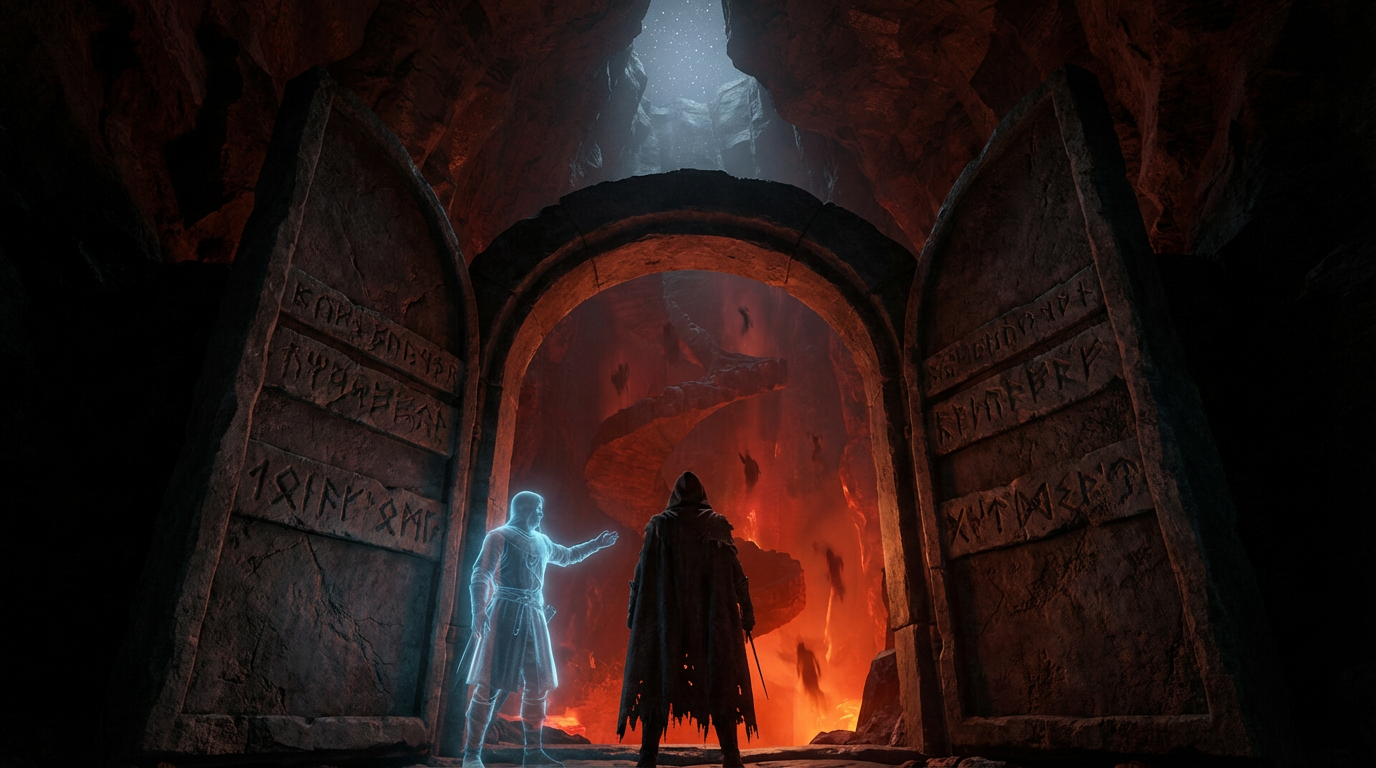
An excerpt from the original text.(complete · 1134 words)
No longer than what time Latona’s twins
Cover’d of Libra and the fleecy star,
Together both, girding the’ horizon hang,
In even balance from the zenith pois’d,
Till from that verge, each, changing hemisphere,
Part the nice level; e’en so brief a space
Did Beatrice’s silence hold. A smile
Bat painted on her cheek; and her fix’d gaze
Bent on the point, at which my vision fail’d:
When thus her words resuming she began:
“I speak, nor what thou wouldst inquire demand;
For I have mark’d it, where all time and place
Are present. Not for increase to himself
Of good, which may not be increas’d, but forth
To manifest his glory by its beams,
Inhabiting his own eternity,
Beyond time’s limit or what bound soe’er
To circumscribe his being, as he will’d,
Into new natures, like unto himself,
Eternal Love unfolded. Nor before,
As if in dull inaction torpid lay.
For not in process of before or aft
Upon these waters mov’d the Spirit of God.
Simple and mix’d, both form and substance, forth
To perfect being started, like three darts
Shot from a bow three-corded. And as ray
In crystal, glass, and amber, shines entire,
E’en at the moment of its issuing; thus
Did, from th’ eternal Sovran, beam entire
His threefold operation, at one act
Produc’d coeval. Yet in order each
Created his due station knew: those highest,
Who pure intelligence were made: mere power
The lowest: in the midst, bound with strict league,
Intelligence and power, unsever’d bond.
Long tract of ages by the angels past,
Ere the creating of another world,
Describ’d on Jerome’s pages thou hast seen.
But that what I disclose to thee is true,
Those penmen, whom the Holy Spirit mov’d
In many a passage of their sacred book
Attest; as thou by diligent search shalt find
And reason in some sort discerns the same,
Who scarce would grant the heav’nly ministers
Of their perfection void, so long a space.
Thus when and where these spirits of love were made,
Thou know’st, and how: and knowing hast allay’d
Thy thirst, which from the triple question rose.
Ere one had reckon’d twenty, e’en so soon
Part of the angels fell: and in their fall
Confusion to your elements ensued.
The others kept their station: and this task,
Whereon thou lookst, began with such delight,
That they surcease not ever, day nor night,
Their circling. Of that fatal lapse the cause
Was the curst pride of him, whom thou hast seen
Pent with the world’s incumbrance. Those, whom here
Thou seest, were lowly to confess themselves
Of his free bounty, who had made them apt
For ministries so high: therefore their views
Were by enlight’ning grace and their own merit
Exalted; so that in their will confirm’d
They stand, nor feel to fall. For do not doubt,
But to receive the grace, which heav’n vouchsafes,
Is meritorious, even as the soul
With prompt affection welcometh the guest.
Now, without further help, if with good heed
My words thy mind have treasur’d, thou henceforth
This consistory round about mayst scan,
And gaze thy fill. But since thou hast on earth
Heard vain disputers, reasoners in the schools,
Canvas the’ angelic nature, and dispute
Its powers of apprehension, memory, choice;
Therefore, ’tis well thou take from me the truth,
Pure and without disguise, which they below,
Equivocating, darken and perplex.

“Know thou, that, from the first, these substances,
Rejoicing in the countenance of God,
Have held unceasingly their view, intent
Upon the glorious vision, from the which
Naught absent is nor hid: where then no change
Of newness with succession interrupts,
Remembrance there needs none to gather up
Divided thought and images remote

“So that men, thus at variance with the truth
Dream, though their eyes be open; reckless some
Of error; others well aware they err,
To whom more guilt and shame are justly due.
Each the known track of sage philosophy
Deserts, and has a byway of his own:
So much the restless eagerness to shine
And love of singularity prevail.
Yet this, offensive as it is, provokes
Heav’n’s anger less, than when the book of God
Is forc’d to yield to man’s authority,
Or from its straightness warp’d: no reck’ning made
What blood the sowing of it in the world
Has cost; what favour for himself he wins,
Who meekly clings to it. The aim of all
Is how to shine: e’en they, whose office is
To preach the Gospel, let the gospel sleep,
And pass their own inventions off instead.
One tells, how at Christ’s suffering the wan moon
Bent back her steps, and shadow’d o’er the sun
With intervenient disk, as she withdrew:
Another, how the light shrouded itself
Within its tabernacle, and left dark
The Spaniard and the Indian, with the Jew.
Such fables Florence in her pulpit hears,
Bandied about more frequent, than the names
Of Bindi and of Lapi in her streets.
The sheep, meanwhile, poor witless ones, return
From pasture, fed with wind: and what avails
For their excuse, they do not see their harm?
Christ said not to his first conventicle,
‘Go forth and preach impostures to the world,’
But gave them truth to build on; and the sound
Was mighty on their lips; nor needed they,
Beside the gospel, other spear or shield,
To aid them in their warfare for the faith.
The preacher now provides himself with store
Of jests and gibes; and, so there be no lack
Of laughter, while he vents them, his big cowl
Distends, and he has won the meed he sought:
Could but the vulgar catch a glimpse the while
Of that dark bird which nestles in his hood,
They scarce would wait to hear the blessing said.
Which now the dotards hold in such esteem,
That every counterfeit, who spreads abroad
The hands of holy promise, finds a throng
Of credulous fools beneath. Saint Anthony
Fattens with this his swine, and others worse
Than swine, who diet at his lazy board,
Paying with unstamp’d metal for their fare.

“But (for we far have wander’d) let us seek
The forward path again; so as the way
Be shorten’d with the time. No mortal tongue
Nor thought of man hath ever reach’d so far,
That of these natures he might count the tribes.
What Daniel of their thousands hath reveal’d
With finite number infinite conceals.
The fountain at whose source these drink their beams,
With light supplies them in as many modes,
As there are splendours, that it shines on: each
According to the virtue it conceives,
Differing in love and sweet affection.
Look then how lofty and how huge in breadth
The’ eternal might, which, broken and dispers’d
Over such countless mirrors, yet remains
Whole in itself and one, as at the first.”
Master this chapter. Complete your experience
Purchase the complete book to access all chapters and support classic literature
As an Amazon Associate, we earn a small commission from qualifying purchases at no additional cost to you.
Available in paperback, hardcover, and e-book formats
Let's Analyse the Pattern
Leaders abandon their true mission to chase applause and validation, gradually replacing authentic service with empty spectacle.
Why This Matters
Connect literature to life
This chapter teaches how to recognize when leaders abandon their core mission to chase personal validation and applause.
Practice This Today
This week, notice when someone in authority seems more focused on looking important than actually helping—then ask yourself if you've fallen into the same trap.
Now let's explore the literary elements.
Key Quotes & Analysis
"Not for increase to himself of good, which may not be increased, but forth to manifest his glory by its beams"
Context: Explaining why God created the universe
This reveals that true power creates abundance for others, not scarcity for personal gain. God doesn't create because He lacks something, but because He wants to share perfection.
In Today's Words:
Real leaders don't hoard power to feel important - they share it because they have more than enough.
"With jokes and gibes to preach the Gospel now"
Context: Condemning preachers who entertain rather than teach truth
This shows how spiritual authority gets corrupted when leaders prioritize popularity over genuine service. Entertainment becomes a substitute for transformation.
In Today's Words:
They turn serious stuff into comedy shows to get likes and applause.
"So much blood to sow the Gospel in the world was spilt"
Context: Contrasting the sacrifice of early Christians with modern corruption
This reminds us that truth often comes at great cost, making its exploitation for personal gain especially offensive. Real change requires real sacrifice.
In Today's Words:
People died for this truth, and now you're using it to make a quick buck.
Thematic Threads
Authority
In This Chapter
Beatrice models authentic authority by teaching clearly and pointing beyond herself, contrasting with corrupt preachers who exploit their platforms for personal gain
Development
Building from earlier examples of false vs. true guidance throughout the journey
In Your Life:
You see this when supervisors take credit for team success or when experts use jargon to sound important rather than help you understand
Class
In This Chapter
Corrupt preachers exploit the spiritual hunger of ordinary people, offering entertainment instead of the genuine nourishment they desperately need
Development
Continues the theme of elites failing to serve those who depend on them
In Your Life:
This appears when professionals in positions of trust—doctors, teachers, managers—prioritize their image over actually helping you
Identity
In This Chapter
Preachers lose their true identity as servants of truth and become performers seeking applause, corrupting their fundamental purpose
Development
Deepens the exploration of how roles can either authentic expression or hollow performance
In Your Life:
You might recognize this when you find yourself changing who you are to get approval at work or in relationships
Social Expectations
In This Chapter
The pressure to entertain and win approval corrupts the sacred duty to teach truth, showing how social expectations can destroy authentic purpose
Development
Expands on how external pressures can corrupt internal mission
In Your Life:
This shows up when you feel pressure to be the 'fun' parent or 'cool' coworker instead of being genuinely helpful
Personal Growth
In This Chapter
Beatrice demonstrates growth through service—she becomes more luminous by helping Dante understand, showing how authentic teaching elevates both teacher and student
Development
Contrasts with earlier examples of growth through suffering, showing growth through generous service
In Your Life:
You experience this when helping others genuinely makes you feel more fulfilled than getting recognition for yourself
You now have the context. Time to form your own thoughts.
Discussion Questions
- 1
What does Beatrice reveal about why God created the universe and angels, and what happened to some of the angels?
analysis • surface - 2
Why does Beatrice become angry with contemporary preachers, and how does their approach differ from Christ's original message?
analysis • medium - 3
Where do you see leaders today who have shifted from serving their mission to performing for applause?
application • medium - 4
How can you tell when you're genuinely helping others versus just trying to look impressive?
application • deep - 5
What does this chapter suggest about the relationship between authentic authority and ego-driven performance?
reflection • deep
Critical Thinking Exercise
Performance Check: Mission vs. Applause
Think of a role where you have influence over others - as a parent, trainer, team leader, or mentor. Write down three specific things you do in that role. For each one, honestly assess: Am I doing this to help them grow, or to make myself look good? Look for signs like whether you explain things clearly or use confusing jargon, whether you share credit or hog it, whether you focus on their success or your reputation.
Consider:
- •Notice when you feel tempted to show off your knowledge instead of helping someone understand
- •Pay attention to whether you're more excited about being seen as helpful than actually being helpful
- •Consider how your motivation affects the quality of your guidance and the other person's growth
Journaling Prompt
Write about a time when you caught yourself performing instead of genuinely serving. What triggered the shift, and how did you recognize it? What would you do differently now?
Coming Up Next...
Chapter 97: The River of Light
As the cosmic vision begins to fade like stars disappearing at dawn, Dante must prepare for the final, most overwhelming revelation of his journey through Paradise.