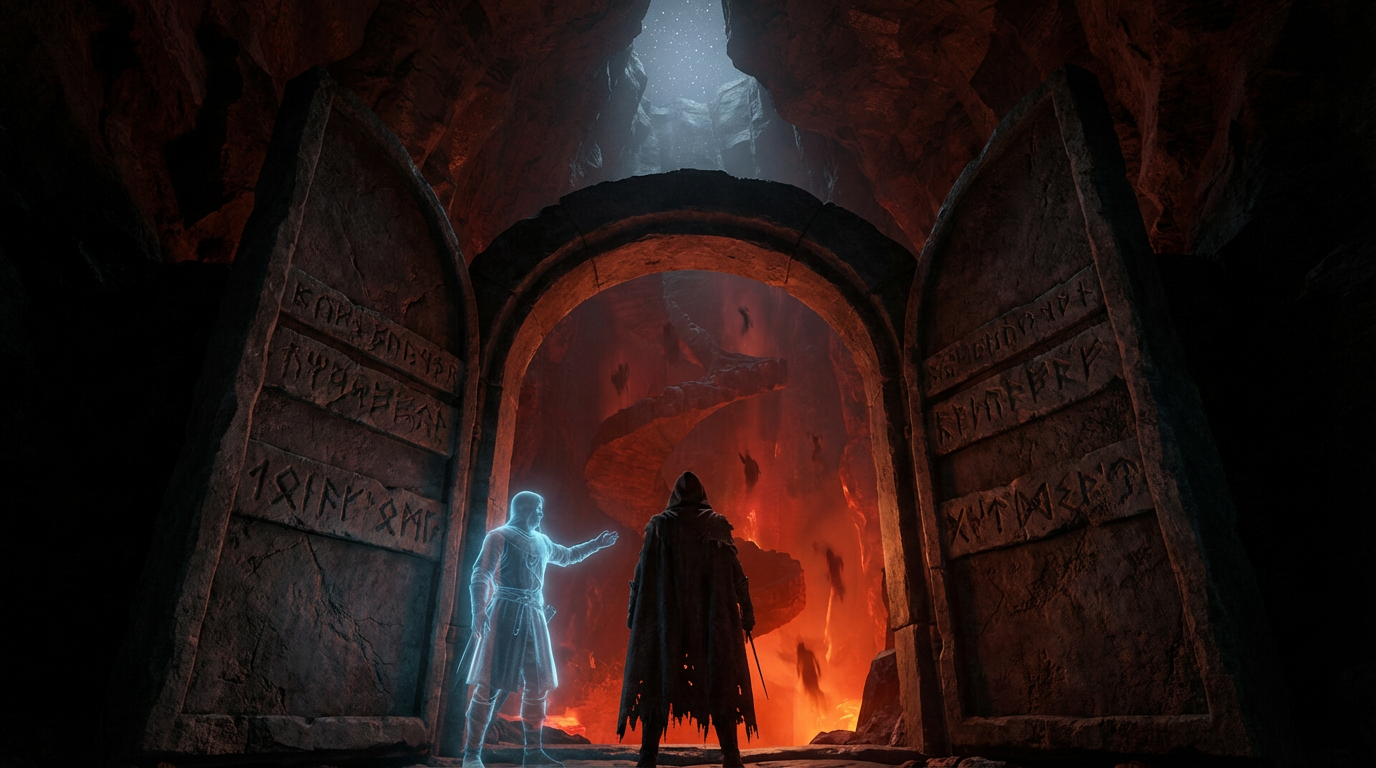
An excerpt from the original text.(complete · 1180 words)
Hell’s dunnest gloom, or night unlustrous, dark,
Of every planes ’reft, and pall’d in clouds,
Did never spread before the sight a veil
In thickness like that fog, nor to the sense
So palpable and gross. Ent’ring its shade,
Mine eye endured not with unclosed lids;
Which marking, near me drew the faithful guide,
Offering me his shoulder for a stay.

As the blind man behind his leader walks,
Lest he should err, or stumble unawares
On what might harm him, or perhaps destroy,
I journey’d through that bitter air and foul,
Still list’ning to my escort’s warning voice,
“Look that from me thou part not.” Straight I heard
Voices, and each one seem’d to pray for peace,
And for compassion, to the Lamb of God
That taketh sins away. Their prelude still
Was “Agnus Dei,” and through all the choir,
One voice, one measure ran, that perfect seem’d
The concord of their song. “Are these I hear
Spirits, O master?” I exclaim’d; and he:
“Thou aim’st aright: these loose the bonds of wrath.”

“Now who art thou, that through our smoke dost cleave?
And speak’st of us, as thou thyself e’en yet
Dividest time by calends?” So one voice
Bespake me; whence my master said: “Reply;
And ask, if upward hence the passage lead.”

“O being! who dost make thee pure, to stand
Beautiful once more in thy Maker’s sight!
Along with me: and thou shalt hear and wonder.”
Thus I, whereto the spirit answering spake:
“Long as ’tis lawful for me, shall my steps
Follow on thine; and since the cloudy smoke
Forbids the seeing, hearing in its stead
Shall keep us join’d.” I then forthwith began
“Yet in my mortal swathing, I ascend
To higher regions, and am hither come
Through the fearful agony of hell.
And, if so largely God hath doled his grace,
That, clean beside all modern precedent,
He wills me to behold his kingly state,
From me conceal not who thou wast, ere death
Had loos’d thee; but instruct me: and instruct
If rightly to the pass I tend; thy words
The way directing as a safe escort.”

“I was of Lombardy, and Marco call’d:
Not inexperienc’d of the world, that worth
I still affected, from which all have turn’d
The nerveless bow aside. Thy course tends right
Unto the summit:” and, replying thus,
He added, “I beseech thee pray for me,
When thou shalt come aloft.” And I to him:
“Accept my faith for pledge I will perform
What thou requirest. Yet one doubt remains,
That wrings me sorely, if I solve it not,
Singly before it urg’d me, doubled now
By thine opinion, when I couple that
With one elsewhere declar’d, each strength’ning other.
The world indeed is even so forlorn
Of all good as thou speak’st it and so swarms
With every evil. Yet, beseech thee, point
The cause out to me, that myself may see,
And unto others show it: for in heaven
One places it, and one on earth below.”

Then heaving forth a deep and audible sigh,
“Brother!” he thus began, “the world is blind;
And thou in truth com’st from it. Ye, who live,
Do so each cause refer to heav’n above,
E’en as its motion of necessity
Drew with it all that moves. If this were so,
Free choice in you were none; nor justice would
There should be joy for virtue, woe for ill.
Your movements have their primal bent from heaven;
Not all; yet said I all; what then ensues?
Light have ye still to follow evil or good,
And of the will free power, which, if it stand
Firm and unwearied in Heav’n’s first assay,
Conquers at last, so it be cherish’d well,
Triumphant over all. To mightier force,
To better nature subject, ye abide
Free, not constrain’d by that, which forms in you
The reasoning mind uninfluenc’d of the stars.
If then the present race of mankind err,
Seek in yourselves the cause, and find it there.
Herein thou shalt confess me no false spy.

“Forth from his plastic hand, who charm’d beholds
Her image ere she yet exist, the soul
Comes like a babe, that wantons sportively
Weeping and laughing in its wayward moods,
As artless and as ignorant of aught,
Save that her Maker being one who dwells
With gladness ever, willingly she turns
To whate’er yields her joy. Of some slight good
The flavour soon she tastes; and, snar’d by that,
With fondness she pursues it, if no guide
Recall, no rein direct her wand’ring course.
Hence it behov’d, the law should be a curb;
A sovereign hence behov’d, whose piercing view
Might mark at least the fortress and main tower
Of the true city. Laws indeed there are:
But who is he observes them? None; not he,
Who goes before, the shepherd of the flock,
Who chews the cud but doth not cleave the hoof.
Therefore the multitude, who see their guide
Strike at the very good they covet most,
Feed there and look no further. Thus the cause
Is not corrupted nature in yourselves,
But ill-conducting, that hath turn’d the world
To evil. Rome, that turn’d it unto good,
Was wont to boast two suns, whose several beams
Cast light on either way, the world’s and God’s.
One since hath quench’d the other; and the sword
Is grafted on the crook; and so conjoin’d
Each must perforce decline to worse, unaw’d
By fear of other. If thou doubt me, mark
The blade: each herb is judg’d of by its seed.
That land, through which Adice and the Po
Their waters roll, was once the residence
Of courtesy and velour, ere the day,
That frown’d on Frederick; now secure may pass
Those limits, whosoe’er hath left, for shame,
To talk with good men, or come near their haunts.
Three aged ones are still found there, in whom
The old time chides the new: these deem it long
Ere God restore them to a better world:
The good Gherardo, of Palazzo he
Conrad, and Guido of Castello, nam’d
In Gallic phrase more fitly the plain Lombard.
On this at last conclude. The church of Rome,
Mixing two governments that ill assort,
Hath miss’d her footing, fall’n into the mire,
And there herself and burden much defil’d.”

“O Marco!” I replied, shine arguments
Convince me: and the cause I now discern
Why of the heritage no portion came
To Levi’s offspring. But resolve me this
Who that Gherardo is, that as thou sayst
Is left a sample of the perish’d race,
And for rebuke to this untoward age?”

“Either thy words,” said he, “deceive; or else
Are meant to try me; that thou, speaking Tuscan,
Appear’st not to have heard of good Gherado;
The sole addition that, by which I know him;
Unless I borrow’d from his daughter Gaia
Another name to grace him. God be with you.
I bear you company no more. Behold
The dawn with white ray glimm’ring through the mist.
I must away—the angel comes—ere he
Appear.” He said, and would not hear me more.
Master this chapter. Complete your experience
Purchase the complete book to access all chapters and support classic literature
As an Amazon Associate, we earn a small commission from qualifying purchases at no additional cost to you.
Available in paperback, hardcover, and e-book formats
Let's Analyse the Pattern
When institutions abandon their core purpose for power or profit, they create moral confusion that blinds everyone in the system.
Why This Matters
Connect literature to life
This chapter teaches how to recognize when organizations abandon their core mission and create moral confusion.
Practice This Today
This week, notice when institutions you interact with seem to contradict their stated purpose—when does your workplace, healthcare system, or local government seem to serve itself rather than its intended mission?
Now let's explore the literary elements.
Key Quotes & Analysis
"Look that from me thou part not"
Context: Virgil warns Dante to stay close as they enter the blinding fog
This shows the importance of trusted guidance when we can't see clearly. Virgil knows that in confusing situations, the temptation is to wander off and get lost. Good mentors keep us anchored.
In Today's Words:
Don't you dare leave my side right now
"The stars, which gave the first impulse, do not excuse you"
Context: Marco explains that while circumstances influence us, we still have free will
This cuts through the medieval tendency to blame everything on fate or astrology. Marco insists that regardless of our influences or background, we're still responsible for our choices.
In Today's Words:
Your circumstances don't give you an excuse to act badly
"Rome, which made the good world, was wont to have two suns"
Context: Marco explains how the separation of church and state once worked
This metaphor shows how power should be divided - spiritual leaders handling souls, political leaders handling earthly matters. When one tries to do both jobs, both get corrupted.
In Today's Words:
Rome used to keep religion and politics separate, and that's when things worked
Thematic Threads
Power
In This Chapter
The Church's grab for political power corrupts both spiritual and temporal authority, creating institutional failure
Development
Evolved from personal power struggles to systemic corruption of entire institutions
In Your Life:
You might see this when your workplace prioritizes profits over the mission that originally drew you there
Leadership
In This Chapter
Marco explains how failed leadership creates moral confusion, with people following bad examples from corrupt authorities
Development
Developed from individual moral choices to understanding how leadership shapes entire societies
In Your Life:
You experience this when supervisors model behavior that contradicts company values, leaving you unsure what's really expected
Personal Agency
In This Chapter
Despite corrupt systems, Marco emphasizes that individuals still possess free will to choose between good and evil
Development
Built from earlier themes of personal responsibility to show agency exists even within failing institutions
In Your Life:
You face this when deciding whether to speak up about problems at work, knowing you can't control the system but can control your response
Social Expectations
In This Chapter
The fog represents how unclear social guidance leaves people unable to distinguish between true good and shallow pleasures
Development
Expanded from individual confusion to societal-level moral blindness caused by institutional failure
In Your Life:
You might feel this when social media and advertising make it hard to tell what actually matters versus what just looks good
Class
In This Chapter
Marco, as a nobleman, provides wisdom about governance that reveals how class structures depend on legitimate authority
Development
Developed from personal class anxiety to understanding how class systems require moral legitimacy to function
In Your Life:
You see this when managers who don't understand the actual work make decisions that hurt both workers and the organization
You now have the context. Time to form your own thoughts.
Discussion Questions
- 1
Marco says the world's corruption comes from failed leadership, not human nature. What specific example does he give about how institutions should work versus how they actually work?
analysis • surface - 2
Why does Marco use the metaphor of 'two suns' for Church and State? What happens when one institution tries to do both jobs?
analysis • medium - 3
Think about your workplace, school, or community. Where do you see institutions abandoning their original purpose to grab more power or money?
application • medium - 4
Marco insists people still have free will even when leaders fail them. How would you maintain your own moral compass when the 'fog' of institutional corruption surrounds you?
application • deep - 5
The chapter suggests that without good guidance, people naturally pursue shallow pleasures instead of true good. What does this reveal about the relationship between leadership and personal responsibility?
reflection • deep
Critical Thinking Exercise
Map Your Institutional Fog
Think of an institution in your life that's supposed to serve one purpose but seems to prioritize something else entirely. Draw a simple diagram showing what they claim to do versus what they actually do. Then identify three specific ways this creates 'moral fog' for the people involved.
Consider:
- •Look for the gap between stated mission and actual priorities
- •Notice how this confusion affects people's daily decisions
- •Consider what the institution would need to change to clear the fog
Journaling Prompt
Write about a time when you had to make a moral choice despite unclear or contradictory guidance from authority figures. How did you decide what was right?
Coming Up Next...
Chapter 51: Understanding Love's Three Forms
As the fog begins to lift and dawn approaches, Dante will encounter an angel and experience a moment of clarity that transforms his understanding. The physical world starts to break through the spiritual darkness.