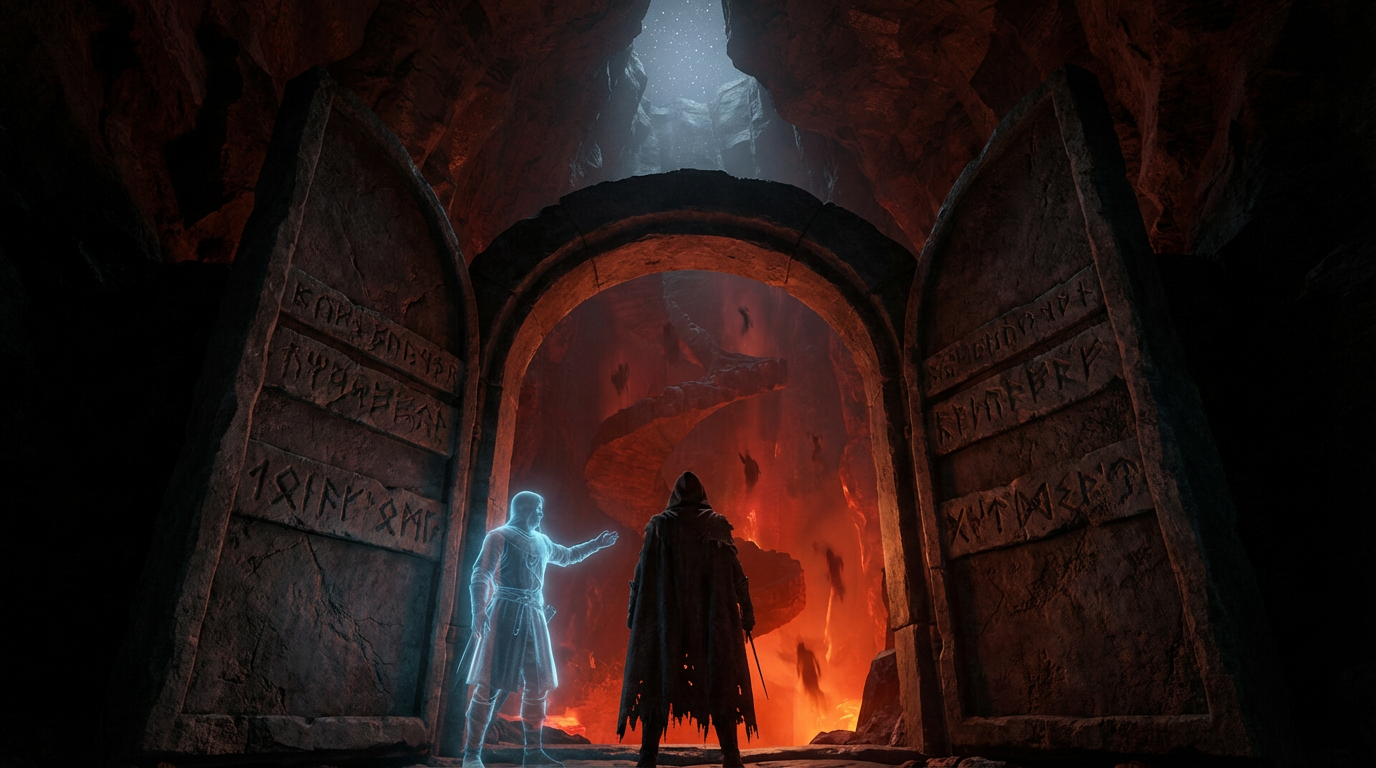
An excerpt from the original text.(complete · 1031 words)
After their courteous greetings joyfully
Sev’n times exchang’d, Sordello backward drew
Exclaiming, “Who are ye?” “Before this mount
By spirits worthy of ascent to God
Was sought, my bones had by Octavius’ care
Been buried. I am Virgil, for no sin
Depriv’d of heav’n, except for lack of faith.”

So answer’d him in few my gentle guide.

As one, who aught before him suddenly
Beholding, whence his wonder riseth, cries
“It is yet is not,” wav’ring in belief;
Such he appear’d; then downward bent his eyes,
And drawing near with reverential step,
Caught him, where of mean estate might clasp
His lord. “Glory of Latium!” he exclaim’d,
“In whom our tongue its utmost power display’d!
Boast of my honor’d birth-place! what desert
Of mine, what favour rather undeserv’d,
Shows thee to me? If I to hear that voice
Am worthy, say if from below thou com’st
And from what cloister’s pale?”—“Through every orb
Of that sad region,” he reply’d, “thus far
Am I arriv’d, by heav’nly influence led
And with such aid I come. There is a place
There underneath, not made by torments sad,
But by dun shades alone; where mourning’s voice
Sounds not of anguish sharp, but breathes in sighs.
There I with little innocents abide,
Who by death’s fangs were bitten, ere exempt
From human taint. There I with those abide,
Who the three holy virtues put not on,
But understood the rest, and without blame
Follow’d them all. But if thou know’st and canst,
Direct us, how we soonest may arrive,
Where Purgatory its true beginning takes.”

He answer’d thus: “We have no certain place
Assign’d us: upwards I may go or round,
Far as I can, I join thee for thy guide.
But thou beholdest now how day declines:
And upwards to proceed by night, our power
Excels: therefore it may be well to choose
A place of pleasant sojourn. To the right
Some spirits sit apart retir’d. If thou
Consentest, I to these will lead thy steps:
And thou wilt know them, not without delight.”

“How chances this?” was answer’d; “who so wish’d
To ascend by night, would he be thence debarr’d
By other, or through his own weakness fail?”

The good Sordello then, along the ground
Trailing his finger, spoke: “Only this line
Thou shalt not overpass, soon as the sun
Hath disappear’d; not that aught else impedes
Thy going upwards, save the shades of night.
These with the wont of power perplex the will.
With them thou haply mightst return beneath,
Or to and fro around the mountain’s side
Wander, while day is in the horizon shut.”

My master straight, as wond’ring at his speech,
Exclaim’d: “Then lead us quickly, where thou sayst,
That, while we stay, we may enjoy delight.”

A little space we were remov’d from thence,
When I perceiv’d the mountain hollow’d out.
Ev’n as large valleys hollow’d out on earth,

“That way,” the’ escorting spirit cried, “we go,
Where in a bosom the high bank recedes:
And thou await renewal of the day.”

Betwixt the steep and plain a crooked path
Led us traverse into the ridge’s side,
Where more than half the sloping edge expires.
Refulgent gold, and silver thrice refin’d,
And scarlet grain and ceruse, Indian wood
Of lucid dye serene, fresh emeralds
But newly broken, by the herbs and flowers
Plac’d in that fair recess, in color all
Had been surpass’d, as great surpasses less.
Nor nature only there lavish’d her hues,
But of the sweetness of a thousand smells
A rare and undistinguish’d fragrance made.

“Salve Regina,” on the grass and flowers
Here chanting I beheld those spirits sit
Who not beyond the valley could be seen.

“Before the west’ring sun sink to his bed,”
Began the Mantuan, who our steps had turn’d,

“’Mid those desires not that I lead ye on.
For from this eminence ye shall discern
Better the acts and visages of all,
Than in the nether vale among them mix’d.
He, who sits high above the rest, and seems
To have neglected that he should have done,
And to the others’ song moves not his lip,
The Emperor Rodolph call, who might have heal’d
The wounds whereof fair Italy hath died,
So that by others she revives but slowly,
He, who with kindly visage comforts him,
Sway’d in that country, where the water springs,
That Moldaw’s river to the Elbe, and Elbe
Rolls to the ocean: Ottocar his name:
Who in his swaddling clothes was of more worth
Than Winceslaus his son, a bearded man,
Pamper’d with rank luxuriousness and ease.
And that one with the nose depress, who close
In counsel seems with him of gentle look,
Flying expir’d, with’ring the lily’s flower.
Look there how he doth knock against his breast!
The other ye behold, who for his cheek
Makes of one hand a couch, with frequent sighs.
They are the father and the father-in-law
Of Gallia’s bane: his vicious life they know
And foul; thence comes the grief that rends them thus.

“He, so robust of limb, who measure keeps
In song, with him of feature prominent,
With ev’ry virtue bore his girdle brac’d.
And if that stripling who behinds him sits,
King after him had liv’d, his virtue then
From vessel to like vessel had been pour’d;
Which may not of the other heirs be said.
By James and Frederick his realms are held;
Neither the better heritage obtains.
Rarely into the branches of the tree
Doth human worth mount up; and so ordains
He who bestows it, that as his free gift
It may be call’d. To Charles my words apply
No less than to his brother in the song;
Which Pouille and Provence now with grief confess.
So much that plant degenerates from its seed,
As more than Beatrice and Margaret
Costanza still boasts of her valorous spouse.

“Behold the king of simple life and plain,
Harry of England, sitting there alone:
He through his branches better issue spreads.

“That one, who on the ground beneath the rest
Sits lowest, yet his gaze directs aloft,
Us William, that brave Marquis, for whose cause
The deed of Alexandria and his war
Makes Conferrat and Canavese weep.”
Master this chapter. Complete your experience
Purchase the complete book to access all chapters and support classic literature
As an Amazon Associate, we earn a small commission from qualifying purchases at no additional cost to you.
Available in paperback, hardcover, and e-book formats
Let's Analyse the Pattern
The tendency for successful people to delay crucial decisions until opportunities are lost and problems become unfixable.
Why This Matters
Connect literature to life
This chapter teaches how to recognize when someone is struggling with new authority and needs guidance rather than judgment.
Practice This Today
This week, notice when someone at work gets promoted or takes on new responsibility - instead of criticizing their mistakes, consider what support they might need.
Now let's explore the literary elements.
Key Quotes & Analysis
"Glory of Latium! In whom our tongue its utmost power display'd!"
Context: Sordello's reaction upon recognizing Virgil as the great poet
This shows genuine respect for artistic achievement and the power of language. Sordello immediately recognizes greatness and honors it without jealousy or competition.
In Today's Words:
You're the one who showed us what our language could really do!
"There is a place there underneath, not made by torments sad, but by dun shades alone"
Context: Explaining Limbo to Sordello - where he comes from
Virgil describes Limbo as a place of sadness without punishment, showing that not all spiritual waiting involves suffering. Some people are stuck not because they're bad, but because of circumstances beyond their control.
In Today's Words:
I come from a place that's not hell, just a sad waiting room for people who never got the chance.
"By heav'nly influence led, and with such aid I come"
Context: Explaining how he's able to guide Dante through this journey
Virgil acknowledges that he's not operating on his own power - he has divine permission and help. This shows humility and recognition that even guides need guidance.
In Today's Words:
I'm here because someone upstairs sent me to help.
Thematic Threads
Leadership
In This Chapter
True leadership requires seizing difficult moments rather than avoiding them
Development
Introduced here
In Your Life:
You might recognize this when you keep postponing a hard conversation at work or home that you know needs to happen.
Timing
In This Chapter
Some actions can only be taken within specific windows of opportunity
Development
Introduced here
In Your Life:
You might see this in relationships where the right moment to address problems passes and they become much harder to fix.
Regret
In This Chapter
The deepest regret comes not from what we did wrong, but from what we failed to do at all
Development
Introduced here
In Your Life:
You might feel this when looking back at opportunities you let slip by because you were waiting for perfect conditions.
Power
In This Chapter
Power creates the illusion that you can always act later, leading to paralysis
Development
Introduced here
In Your Life:
You might experience this when your job security or relationship stability makes you think you can keep avoiding difficult decisions indefinitely.
Responsibility
In This Chapter
Having the ability to act creates the responsibility to act, even when it's uncomfortable
Development
Introduced here
In Your Life:
You might struggle with this when you see problems around you that you could address but would rather someone else handle.
You now have the context. Time to form your own thoughts.
Discussion Questions
- 1
Why can't Dante and Virgil climb Purgatory at night, and what does this reveal about the nature of spiritual growth?
analysis • surface - 2
What pattern do you notice among the rulers in the valley - what kind of failures landed them here rather than in Hell?
analysis • medium - 3
Where do you see this 'paralysis through success' pattern in modern workplaces or families - people who have enough power to delay hard decisions indefinitely?
application • medium - 4
Think of a situation where you've been putting off a difficult but necessary conversation or decision. What would change if you applied the 72-hour rule?
application • deep - 5
What does this chapter suggest about the relationship between power, responsibility, and regret?
reflection • deep
Critical Thinking Exercise
The Opportunity Audit
List three important decisions or conversations you've been postponing. For each one, identify what you're waiting for and what you could do in the next 72 hours to take the first step. Then rank them by potential regret - which would you most regret not addressing six months from now?
Consider:
- •Consider why postponing feels safer than acting
- •Think about what 'the perfect moment' actually looks like versus what's realistic
- •Notice which situations you have more control over than you're admitting
Journaling Prompt
Write about a time when you delayed action and later regretted it. What warning signs did you ignore, and how might you recognize them earlier next time?
Coming Up Next...
Chapter 42: The Valley of the Rulers
As evening falls, something magical happens in the valley. The souls begin a ritual that will reveal the spiritual battles that continue even in this peaceful place, and Dante witnesses a moment that changes how he understands prayer and protection.