An excerpt from the original text.(complete · 1096 words)
“The banners of Hell’s Monarch do come forth
Towards us; therefore look,” so spake my guide,
“If thou discern him.” As, when breathes a cloud
Heavy and dense, or when the shades of night
Fall on our hemisphere, seems view’d from far
A windmill, which the blast stirs briskly round,
Such was the fabric then methought I saw,

To shield me from the wind, forthwith I drew
Behind my guide: no covert else was there.

Now came I (and with fear I bid my strain
Record the marvel) where the souls were all
Whelm’d underneath, transparent, as through glass
Pellucid the frail stem. Some prone were laid,
Others stood upright, this upon the soles,
That on his head, a third with face to feet
Arch’d like a bow. When to the point we came,
Whereat my guide was pleas’d that I should see
The creature eminent in beauty once,
He from before me stepp’d and made me pause.

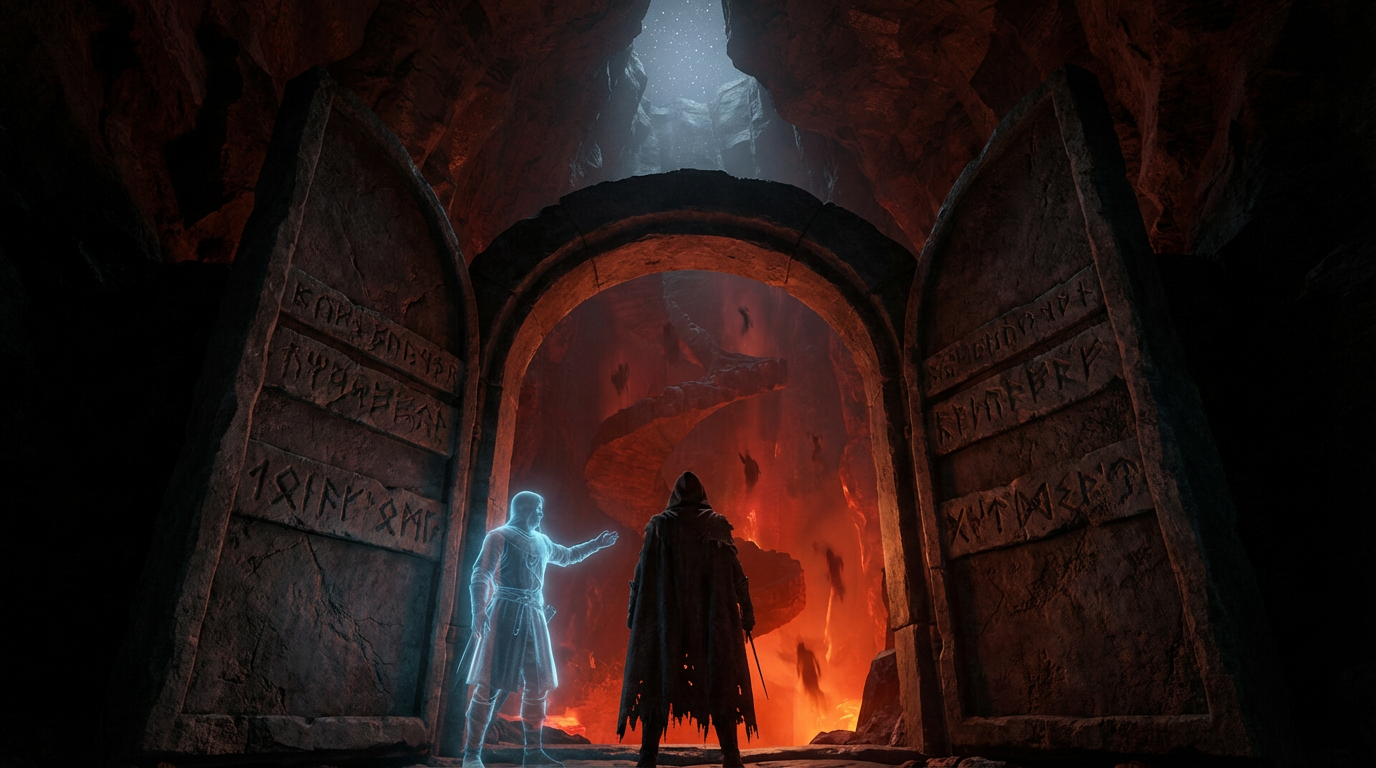
“Lo!” he exclaim’d, “lo Dis! and lo the place,
Where thou hast need to arm thy heart with strength.”

How frozen and how faint I then became,
Ask me not, reader! for I write it not,
Since words would fail to tell thee of my state.
I was not dead nor living. Think thyself
If quick conception work in thee at all,
How I did feel. That emperor, who sways
The realm of sorrow, at mid breast from th’ ice
Stood forth; and I in stature am more like
A giant, than the giants are in his arms.
Mark now how great that whole must be, which suits
With such a part. If he were beautiful
As he is hideous now, and yet did dare
To scowl upon his Maker, well from him
May all our mis’ry flow. Oh what a sight!
How passing strange it seem’d, when I did spy
Upon his head three faces: one in front
Of hue vermilion, th’ other two with this
Midway each shoulder join’d and at the crest;
The right ’twixt wan and yellow seem’d: the left
To look on, such as come from whence old Nile
Stoops to the lowlands. Under each shot forth
Two mighty wings, enormous as became
A bird so vast. Sails never such I saw
Outstretch’d on the wide sea. No plumes had they,
But were in texture like a bat, and these
He flapp’d i’ th’ air, that from him issued still
Three winds, wherewith Cocytus to its depth
Was frozen. At six eyes he wept: the tears
Adown three chins distill’d with bloody foam.
At every mouth his teeth a sinner champ’d
Bruis’d as with pond’rous engine, so that three
Were in this guise tormented. But far more
Than from that gnawing, was the foremost pang’d
By the fierce rending, whence ofttimes the back
Was stript of all its skin. “That upper spirit,
Who hath worse punishment,” so spake my guide,
“Is Judas, he that hath his head within
And plies the feet without. Of th’ other two,
Whose heads are under, from the murky jaw
Who hangs, is Brutus: lo! how he doth writhe
And speaks not! Th’ other Cassius, that appears
So large of limb. But night now re-ascends,
And it is time for parting. All is seen.”

I clipp’d him round the neck, for so he bade;
And noting time and place, he, when the wings
Enough were op’d, caught fast the shaggy sides,
And down from pile to pile descending stepp’d
Between the thick fell and the jagged ice.

Soon as he reach’d the point, whereat the thigh
Upon the swelling of the haunches turns,
My leader there with pain and struggling hard
Turn’d round his head, where his feet stood before,
And grappled at the fell, as one who mounts,
That into hell methought we turn’d again.

“Expect that by such stairs as these,” thus spake
The teacher, panting like a man forespent,
“We must depart from evil so extreme.”
Then at a rocky opening issued forth,
And plac’d me on a brink to sit, next join’d
With wary step my side. I rais’d mine eyes,
Believing that I Lucifer should see
Where he was lately left, but saw him now
With legs held upward. Let the grosser sort,
Who see not what the point was I had pass’d,
Bethink them if sore toil oppress’d me then.

“Arise,” my master cried, “upon thy feet.
“The way is long, and much uncouth the road;
And now within one hour and half of noon
The sun returns.” It was no palace-hall
Lofty and luminous wherein we stood,
But natural dungeon where ill footing was
And scant supply of light. “Ere from th’ abyss
I sep’rate,” thus when risen I began,
“My guide! vouchsafe few words to set me free
From error’s thralldom. Where is now the ice?
How standeth he in posture thus revers’d?
And how from eve to morn in space so brief
Hath the sun made his transit?” He in few
Thus answering spake: “Thou deemest thou art still
On th’ other side the centre, where I grasp’d
Th’ abhorred worm, that boreth through the world.
Thou wast on th’ other side, so long as I
Descended; when I turn’d, thou didst o’erpass
That point, to which from ev’ry part is dragg’d
All heavy substance. Thou art now arriv’d
Under the hemisphere opposed to that,
Which the great continent doth overspread,
And underneath whose canopy expir’d
The Man, that was born sinless, and so liv’d.
Thy feet are planted on the smallest sphere,
Whose other aspect is Judecca. Morn
Here rises, when there evening sets: and he,
Whose shaggy pile was scal’d, yet standeth fix’d,
As at the first. On this part he fell down
From heav’n; and th’ earth, here prominent before,
Through fear of him did veil her with the sea,
And to our hemisphere retir’d. Perchance
To shun him was the vacant space left here
By what of firm land on this side appears,
That sprang aloof.” There is a place beneath,
From Belzebub as distant, as extends
The vaulted tomb, discover’d not by sight,
But by the sound of brooklet, that descends
This way along the hollow of a rock,
Which, as it winds with no precipitous course,
The wave hath eaten. By that hidden way
My guide and I did enter, to return
To the fair world: and heedless of repose
We climbed, he first, I following his steps,
Till on our view the beautiful lights of heav’n
Dawn, through a circular opening in the cave:
Thus issuing we again beheld the stars.


PURGATORY
Master this chapter. Complete your experience
Purchase the complete book to access all chapters and support classic literature
As an Amazon Associate, we earn a small commission from qualifying purchases at no additional cost to you.
Available in paperback, hardcover, and e-book formats
Let's Analyse the Pattern
The Road Through Fear - When the Only Way Out Is Through
Our greatest fears often lose their power when we stop avoiding them and face them directly, revealing they're less powerful than our avoidance made them seem.
Why This Matters
Connect literature to life
This chapter teaches how our worst fears usually lose power the moment we stop running and examine them up close.
Practice This Today
This week, notice when you're avoiding someone or something at work - then take one small step toward it instead of away from it.
Now let's explore the literary elements.
Key Quotes & Analysis
"The banners of Hell's Monarch do come forth Towards us; therefore look, if thou discern him."
Context: Virgil warns Dante as they approach Satan at the bottom of Hell
This moment builds suspense while showing Virgil's role as protector and guide. The formal announcement makes Satan seem like a defeated king rather than a terrifying force, preparing us for the pathetic figure they'll encounter.
In Today's Words:
Here comes the big boss of this whole mess - brace yourself and take a good look.
"How frozen and how faint I then became, Ask me not, reader! for I write it not, Since words would fail to tell thee of my state."
Context: Dante's reaction upon seeing Satan frozen in the ice
Dante admits his complete terror and inability to describe it, making the experience more real and relatable. By saying words fail, he actually makes us feel the overwhelming nature of facing our deepest fears.
In Today's Words:
I can't even begin to tell you how terrified I was - there aren't words for that kind of fear.
"That emperor, who sways The realm of sorrow, at mid breast from th' ice Stood forth"
Context: Dante's first description of seeing Satan trapped in ice
Calling Satan an 'emperor' while showing him trapped and powerless creates irony. The image of being stuck waist-deep in ice makes this ultimate evil figure seem pathetic rather than powerful.
In Today's Words:
There was the so-called king of all this misery, stuck in ice up to his chest like some sad statue.
Thematic Threads
Courage
In This Chapter
Dante must literally climb down Satan's body, embracing his greatest fear to find freedom
Development
Evolved from earlier passive observation to active confrontation of ultimate terror
In Your Life:
You might recognize this when you finally have that difficult conversation you've been avoiding for months.
Transformation
In This Chapter
The moment of gravity reversal symbolizes complete perspective shift - what seemed like descent becomes ascent
Development
Culmination of Dante's journey from lost wanderer to someone who can navigate through ultimate darkness
In Your Life:
You might experience this when a crisis that felt like the end actually becomes your new beginning.
Disillusionment
In This Chapter
Satan appears pathetic rather than powerful - a mindless, trapped creature rather than ultimate evil
Development
Final revelation that apparent powers often mask fundamental weakness
In Your Life:
You might see this when that intimidating boss or authority figure reveals their own insecurities and limitations.
Trust
In This Chapter
Dante must trust Virgil completely during the terrifying climb, even when gravity reverses and nothing makes sense
Development
Ultimate test of the mentor-student relationship established throughout Hell
In Your Life:
You might need this when following advice that seems counterintuitive but comes from someone who's navigated similar challenges.
Hope
In This Chapter
The emergence under stars after the ultimate darkness - visible proof that the worst experiences can lead to renewal
Development
First glimpse of light and possibility after thirty-three chapters of descent and darkness
In Your Life:
You might feel this when you realize you've survived your worst period and can see possibilities ahead again.
You now have the context. Time to form your own thoughts.
Discussion Questions
- 1
Why do you think Dante describes Satan as pathetic and trapped rather than as an all-powerful force of evil?
analysis • surface - 2
What does it mean that Dante has to climb down Satan's body - literally embrace what he fears most - to escape Hell?
analysis • medium - 3
Think about a fear you've been avoiding. How might that fear be getting bigger in your mind the longer you avoid it?
application • medium - 4
When have you discovered that facing something scary head-on made it less powerful than you expected?
application • deep - 5
What does this chapter suggest about the relationship between avoidance and the power our fears hold over us?
reflection • deep
Critical Thinking Exercise
Map Your Fear Journey
Think of something you've been avoiding - a difficult conversation, a medical appointment, asking for what you need at work. Draw or describe the fear as you imagine it from a distance, then imagine what it might actually look like up close. What specific steps would you need to take to move toward it rather than away from it?
Consider:
- •How does the fear change when you examine it closely versus from a distance?
- •What's the worst realistic outcome if you faced this fear directly?
- •What might you learn about yourself by moving through this fear instead of around it?
Journaling Prompt
Write about a time when you avoided something that scared you, only to discover later that facing it wasn't as bad as you imagined. What did that experience teach you about the relationship between avoidance and fear?
Coming Up Next...
Chapter 35: Crossing Into Purgatory
Having escaped Hell's depths, Dante and Virgil begin their ascent up Mount Purgatory, where souls actively work to purge themselves of sin. Unlike Hell's hopeless despair, this new realm pulses with possibility and second chances.