
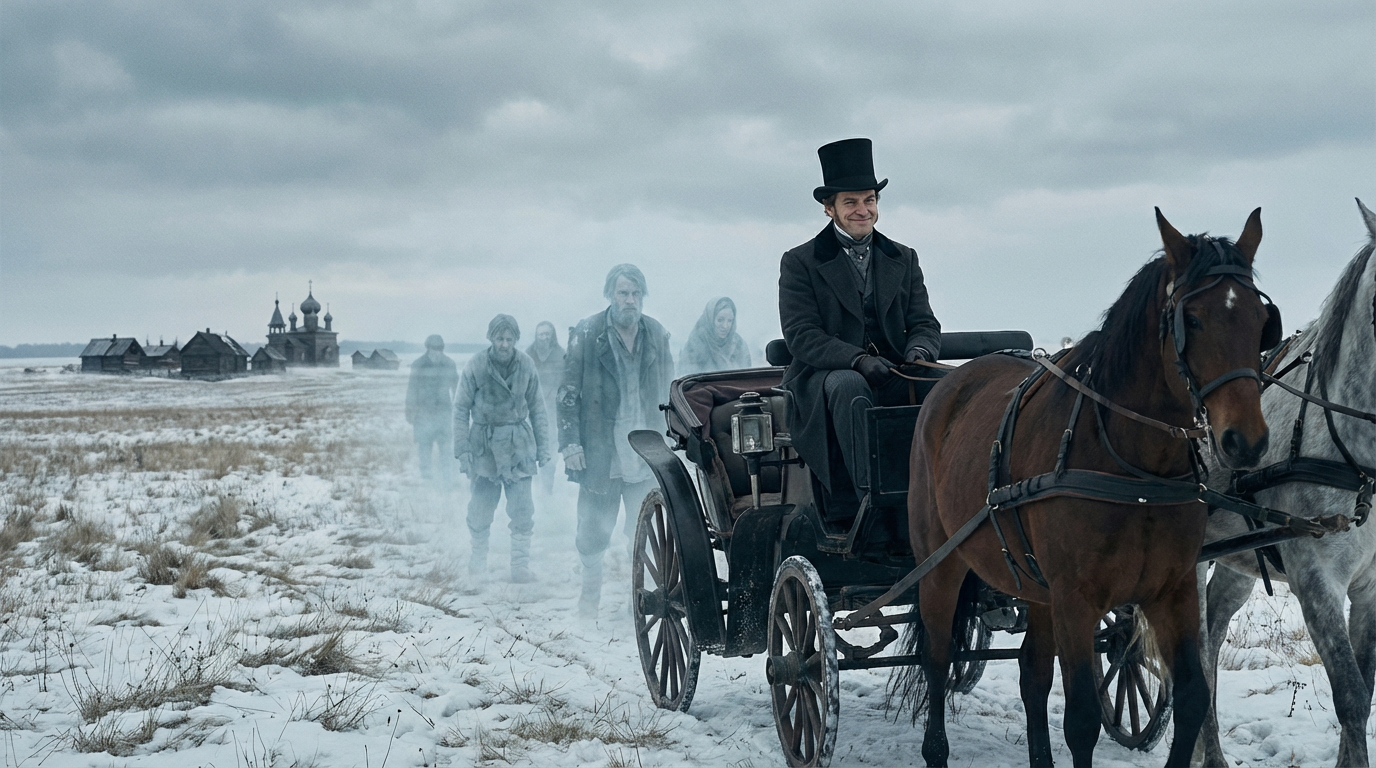
An excerpt from the original text.(complete · 3863 words)
ext morning, before the usual hour for paying calls, there tripped from
the portals of an orange-coloured wooden house with an attic storey and
a row of blue pillars a lady in an elegant plaid cloak. With her came
a footman in a many-caped greatcoat and a polished top hat with a gold
band. Hastily, but gracefully, the lady ascended the steps let down from
a koliaska which was standing before the entrance, and as soon as
she had done so the footman shut her in, put up the steps again, and,
catching hold of the strap behind the vehicle, shouted to the coachman,
“Right away!” The reason of all this was that the lady was the possessor
of a piece of intelligence that she was burning to communicate to a
fellow-creature. Every moment she kept looking out of the carriage
window, and perceiving, with almost speechless vexation, that, as yet,
she was but half-way on her journey. The fronts of the houses appeared
to her longer than usual, and in particular did the front of the white
stone hospital, with its rows of narrow windows, seem interminable to
a degree which at length forced her to ejaculate: “Oh, the cursed
building! Positively there is no end to it!” Also, she twice adjured the
coachman with the words, “Go quicker, Andrusha! You are a horribly long
time over the journey this morning.” But at length the goal was reached,
and the koliaska stopped before a one-storied wooden mansion, dark grey
in colour, and having white carvings over the windows, a tall wooden
fence and narrow garden in front of the latter, and a few meagre trees
looming white with an incongruous coating of road dust. In the windows
of the building were also a few flower pots and a parrot that kept
alternately dancing on the floor of its cage and hanging on to the ring
of the same with its beak. Also, in the sunshine before the door two pet
dogs were sleeping. Here there lived the lady’s bosom friend. As soon as
the bosom friend in question learnt of the newcomer’s arrival, she ran
down into the hall, and the two ladies kissed and embraced one another.
Then they adjourned to the drawing-room.
“How glad I am to see you!” said the bosom friend. “When I heard some
one arriving I wondered who could possibly be calling so early. Parasha
declared that it must be the Vice-Governor’s wife, so, as I did not want
to be bored with her, I gave orders that I was to be reported ‘not at
home.’”
For her part, the guest would have liked to have proceeded to business
by communicating her tidings, but a sudden exclamation from the hostess
imparted (temporarily) a new direction to the conversation.
“What a pretty chintz!” she cried, gazing at the other’s gown.
“Yes, it IS pretty,” agreed the visitor. “On the other hand, Praskovia
Thedorovna thinks that--”
In other words, the ladies proceeded to indulge in a conversation on
the subject of dress; and only after this had lasted for a considerable
while did the visitor let fall a remark which led her entertainer to
inquire:
“And how is the universal charmer?”
“My God!” replied the other. “There has been SUCH a business! In fact,
do you know why I am here at all?” And the visitor’s breathing became
more hurried, and further words seemed to be hovering between her lips
like hawks preparing to stoop upon their prey. Only a person of the
unhumanity of a “true friend” would have had the heart to interrupt her;
but the hostess was just such a friend, and at once interposed with:
“I wonder how any one can see anything in the man to praise or to
admire. For my own part, I think--and I would say the same thing
straight to his face--that he is a perfect rascal.”
“Yes, but do listen to what I have got to tell you.”
“Oh, I know that some people think him handsome,” continued the
hostess, unmoved; “but I say that he is nothing of the kind--that, in
particular, his nose is perfectly odious.”
“Yes, but let me finish what I was saying.” The guest’s tone was almost
piteous in its appeal.
“What is it, then?”
“You cannot imagine my state of mind! You see, this morning I received
a visit from Father Cyril’s wife--the Archpriest’s wife--you know her,
don’t you? Well, whom do you suppose that fine gentleman visitor of ours
has turned out to be?”
“The man who has built the Archpriest a poultry-run?”
“Oh dear no! Had that been all, it would have been nothing. No. Listen
to what Father Cyril’s wife had to tell me. She said that, last night,
a lady landowner named Madame Korobotchka arrived at the Archpriest’s
house--arrived all pale and trembling--and told her, oh, such things!
They sound like a piece out of a book. That is to say, at dead of night,
just when every one had retired to rest, there came the most dreadful
knocking imaginable, and some one screamed out, ‘Open the gates, or we
will break them down!’ Just think! After this, how any one can say that
the man is charming I cannot imagine.”
“Well, what of Madame Korobotchka? Is she a young woman or good
looking?”
“Oh dear no! Quite an old woman.”
“Splendid indeed! So he is actually engaged to a person like that? One
may heartily commend the taste of our ladies for having fallen in love
with him!”
“Nevertheless, it is not as you suppose. Think, now! Armed with weapons
from head to foot, he called upon this old woman, and said: ‘Sell me any
souls of yours which have lately died.’ Of course, Madame Korobotchka
answered, reasonably enough: ‘I cannot sell you those souls, seeing that
they have departed this world;’ but he replied: ‘No, no! They are NOT
dead. ’Tis I who tell you that--I who ought to know the truth of the
matter. I swear that they are still alive.’ In short, he made such a
scene that the whole village came running to the house, and children
screamed, and men shouted, and no one could tell what it was all
about. The affair seemed to me so horrible, so utterly horrible, that I
trembled beyond belief as I listened to the story. ‘My dearest madam,’
said my maid, Mashka, ‘pray look at yourself in the mirror, and see how
white you are.’ ‘But I have no time for that,’ I replied, ‘as I must
be off to tell my friend, Anna Grigorievna, the news.’ Nor did I lose a
moment in ordering the koliaska. Yet when my coachman, Andrusha, asked
me for directions I could not get a word out--I just stood staring
at him like a fool, until I thought he must think me mad. Oh, Anna
Grigorievna, if you but knew how upset I am!”
“What a strange affair!” commented the hostess. “What on earth can
the man have meant by ‘dead souls’? I confess that the words pass my
understanding. Curiously enough, this is the second time I have heard
speak of those souls. True, my husband avers that Nozdrev was lying; yet
in his lies there seems to have been a grain of truth.”
“Well, just think of my state when I heard all this! ‘And now,’
apparently said Korobotchka to the Archpriest’s wife, ‘I am altogether
at a loss what to do, for, throwing me fifteen roubles, the man forced
me to sign a worthless paper--yes, me, an inexperienced, defenceless
widow who knows nothing of business.’ That such things should happen!
TRY and imagine my feelings!”
“In my opinion, there is in this more than the dead souls which meet the
eye.”
“I think so too,” agreed the other. As a matter of fact, her friend’s
remark had struck her with complete surprise, as well as filled her with
curiosity to know what the word “more” might possibly signify. In fact,
she felt driven to inquire: “What do YOU suppose to be hidden beneath it
all?”
“No; tell me what YOU suppose?”
“What I suppose? I am at a loss to conjecture.”
“Yes, but tell me what is in your mind?”
Upon this the visitor had to confess herself nonplussed; for, though
capable of growing hysterical, she was incapable of propounding any
rational theory. Consequently she felt the more that she needed tender
comfort and advice.
“Then THIS is what I think about the dead souls,” said the hostess.
Instantly the guest pricked up her ears (or, rather, they pricked
themselves up) and straightened herself and became, somehow, more
modish, and, despite her not inconsiderable weight, posed herself to
look like a piece of thistledown floating on the breeze.
“The dead souls,” began the hostess.
“Are what, are what?” inquired the guest in great excitement.
“Are, are--”
“Tell me, tell me, for heaven’s sake!”
“They are an invention to conceal something else. The man’s real object
is, is--TO ABDUCT THE GOVERNOR’S DAUGHTER.”
So startling and unexpected was this conclusion that the guest sat
reduced to a state of pale, petrified, genuine amazement.
“My God!” she cried, clapping her hands, “I should NEVER have guessed
it!”
“Well, to tell you the truth, I guessed it as soon as ever you opened
your mouth.”
“So much, then, for educating girls like the Governor’s daughter at
school! Just see what comes of it!”
“Yes, indeed! And they tell me that she says things which I hesitate
even to repeat.”
“Truly it wrings one’s heart to see to what lengths immorality has
come.”
“Some of the men have quite lost their heads about her, but for my part
I think her not worth noticing.”
“Of course. And her manners are unbearable. But what puzzles me most is
how a travelled man like Chichikov could come to let himself in for such
an affair. Surely he must have accomplices?”
“Yes; and I should say that one of those accomplices is Nozdrev.”
“Surely not?”
“CERTAINLY I should say so. Why, I have known him even try to sell his
own father! At all events he staked him at cards.”
“Indeed? You interest me. I should never had thought him capable of such
things.”
“I always guessed him to be so.”
The two ladies were still discussing the matter with acumen and success
when there walked into the room the Public Prosecutor--bushy eyebrows,
motionless features, blinking eyes, and all. At once the ladies hastened
to inform him of the events related, adducing therewith full details
both as to the purchase of dead souls and as to the scheme to abduct the
Governor’s daughter; after which they departed in different directions,
for the purpose of raising the rest of the town. For the execution of
this undertaking not more than half an hour was required. So thoroughly
did they succeed in throwing dust in the public’s eyes that for a while
every one--more especially the army of public officials--was placed in
the position of a schoolboy who, while still asleep, has had a bag of
pepper thrown in his face by a party of more early-rising comrades. The
questions now to be debated resolved themselves into two--namely, the
question of the dead souls and the question of the Governor’s daughter.
To this end two parties were formed--the men’s party and the feminine
section. The men’s party--the more absolutely senseless of the
two--devoted its attention to the dead souls: the women’s party
occupied itself exclusively with the alleged abduction of the Governor’s
daughter. And here it may be said (to the ladies’ credit) that the
women’s party displayed far more method and caution than did its rival
faction, probably because the function in life of its members had always
been that of managing and administering a household. With the ladies,
therefore, matters soon assumed vivid and definite shape; they became
clearly and irrefutably materialised; they stood stripped of all doubt
and other impedimenta. Said some of the ladies in question, Chichikov
had long been in love with the maiden, and the pair had kept tryst by
the light of the moon, while the Governor would have given his consent
(seeing that Chichikov was as rich as a Jew) but for the obstacle that
Chichikov had deserted a wife already (how the worthy dames came to
know that he was married remains a mystery), and the said deserted wife,
pining with love for her faithless husband, had sent the Governor a
letter of the most touching kind, so that Chichikov, on perceiving that
the father and mother would never give their consent, had decided to
abduct the girl. In other circles the matter was stated in a different
way. That is to say, this section averred that Chichikov did NOT possess
a wife, but that, as a man of subtlety and experience, he had bethought
him of obtaining the daughter’s hand through the expedient of first
tackling the mother and carrying on with her an ardent liaison, and
that, thereafter, he had made an application for the desired hand, but
that the mother, fearing to commit a sin against religion, and feeling
in her heart certain gnawings of conscience, had returned a blank
refusal to Chichikov’s request; whereupon Chichikov had decided to carry
out the abduction alleged. To the foregoing, of course, there became
appended various additional proofs and items of evidence, in proportion
as the sensation spread to more remote corners of the town. At length,
with these perfectings, the affair reached the ears of the Governor’s
wife herself. Naturally, as the mother of a family, and as the first
lady in the town, and as a matron who had never before been suspected of
things of the kind, she was highly offended when she heard the stories,
and very justly so: with the result that her poor young daughter, though
innocent, had to endure about as unpleasant a tete-a-tete as ever befell
a maiden of sixteen, while, for his part, the Swiss footman received
orders never at any time to admit Chichikov to the house.
Having done their business with the Governor’s wife, the ladies’ party
descended upon the male section, with a view to influencing it to their
own side by asserting that the dead souls were an invention used solely
for the purpose of diverting suspicion and successfully affecting the
abduction. And, indeed, more than one man was converted, and joined the
feminine camp, in spite of the fact that thereby such seceders incurred
strong names from their late comrades--names such as “old women,”
“petticoats,” and others of a nature peculiarly offensive to the male
sex.
Also, however much they might arm themselves and take the field, the
men could not compass such orderliness within their ranks as could the
women. With the former everything was of the antiquated and rough-hewn
and ill-fitting and unsuitable and badly-adapted and inferior kind;
their heads were full of nothing but discord and triviality and
confusion and slovenliness of thought. In brief, they displayed
everywhere the male bent, the rude, ponderous nature which is incapable
either of managing a household or of jumping to a conclusion, as well
as remains always distrustful and lazy and full of constant doubt and
everlasting timidity. For instance, the men’s party declared that the
whole story was rubbish--that the alleged abduction of the Governor’s
daughter was the work rather of a military than of a civilian culprit;
that the ladies were lying when they accused Chichikov of the deed;
that a woman was like a money-bag--whatsoever you put into her she
thenceforth retained; that the subject which really demanded attention
was the dead souls, of which the devil only knew the meaning, but in
which there certainly lurked something that was contrary to good order
and discipline. One reason why the men’s party was so certain that the
dead souls connoted something contrary to good order and discipline,
was that there had just been appointed to the province a new
Governor-General--an event which, of course, had thrown the whole army
of provincial tchinovniks into a state of great excitement, seeing that
they knew that before long there would ensue transferments and sentences
of censure, as well as the series of official dinners with which a
Governor-General is accustomed to entertain his subordinates. “Alas,”
thought the army of tchinovniks, “it is probable that, should he learn
of the gross reports at present afloat in our town, he will make such a
fuss that we shall never hear the last of them.” In particular did
the Director of the Medical Department turn pale at the thought that
possibly the new Governor-General would surmise the term “dead folk”
to connote patients in the local hospitals who, for want of proper
preventative measures, had died of sporadic fever. Indeed, might it not
be that Chichikov was neither more nor less than an emissary of the said
Governor-General, sent to conduct a secret inquiry? Accordingly he (the
Director of the Medical Department) communicated this last supposition
to the President of the Council, who, though at first inclined to
ejaculate “Rubbish!” suddenly turned pale on propounding to himself the
theory. “What if the souls purchased by Chichikov should REALLY be
dead ones?”--a terrible thought considering that he, the President, had
permitted their transferment to be registered, and had himself acted
as Plushkin’s representative! What if these things should reach the
Governor-General’s ears? He mentioned the matter to one friend and
another, and they, in their turn, went white to the lips, for panic
spreads faster and is even more destructive, than the dreaded black
death. Also, to add to the tchinovniks’ troubles, it so befell that
just at this juncture there came into the local Governor’s hands two
documents of great importance. The first of them contained advices that,
according to received evidence and reports, there was operating in the
province a forger of rouble-notes who had been passing under various
aliases and must therefore be sought for with the utmost diligence;
while the second document was a letter from the Governor of a
neighbouring province with regard to a malefactor who had there evaded
apprehension--a letter conveying also a warning that, if in the province
of the town of N. there should appear any suspicious individual who
could produce neither references nor passports, he was to be arrested
forthwith. These two documents left every one thunderstruck, for they
knocked on the head all previous conceptions and theories. Not for
a moment could it be supposed that the former document referred to
Chichikov; yet, as each man pondered the position from his own point of
view, he remembered that no one REALLY knew who Chichikov was; as also
that his vague references to himself had--yes!--included statements that
his career in the service had suffered much to the cause of Truth, and
that he possessed a number of enemies who were seeking his life. This
gave the tchinovniks further food for thought. Perhaps his life really
DID stand in danger? Perhaps he really WAS being sought for by some one?
Perhaps he really HAD done something of the kind above referred to? As a
matter of fact, who was he?--not that it could actually be supposed that
he was a forger of notes, still less a brigand, seeing that his exterior
was respectable in the highest degree. Yet who was he? At length
the tchinovniks decided to make enquiries among those of whom he had
purchased souls, in order that at least it might be learnt what the
purchases had consisted of, and what exactly underlay them, and whether,
in passing, he had explained to any one his real intentions, or revealed
to any one his identity. In the first instance, therefore, resort was
had to Korobotchka. Yet little was gleaned from that source--merely
a statement that he had bought of her some souls for fifteen roubles
apiece, and also a quantity of feathers, while promising also to buy
some other commodities in the future, seeing that, in particular, he had
entered into a contract with the Treasury for lard, a fact constituting
fairly presumptive proof that the man was a rogue, seeing that just such
another fellow had bought a quantity of feathers, yet had cheated folk
all round, and, in particular, had done the Archpriest out of over a
hundred roubles. Thus the net result of Madame’s cross-examination was
to convince the tchinovniks that she was a garrulous, silly old woman.
With regard to Manilov, he replied that he would answer for Chichikov as
he would for himself, and that he would gladly sacrifice his property in
toto if thereby he could attain even a tithe of the qualities which
Paul Ivanovitch possessed. Finally, he delivered on Chichikov, with
acutely-knitted brows, a eulogy couched in the most charming of terms,
and coupled with sundry sentiments on the subject of friendship and
affection in general. True, these remarks sufficed to indicate the
tender impulses of the speaker’s heart, but also they did nothing to
enlighten his examiners concerning the business that was actually at
hand. As for Sobakevitch, that landowner replied that he considered
Chichikov an excellent fellow, as well as that the souls whom he had
sold to his visitor had been in the truest sense of the word alive, but
that he could not answer for anything which might occur in the future,
seeing that any difficulties which might arise in the course of the
actual transferment of souls would not be HIS fault, in view of the fact
that God was lord of all, and that fevers and other mortal complaints
were so numerous in the world, and that instances of whole villages
perishing through the same could be found on record.
Finally, our friends the tchinovniks found themselves compelled to
resort to an expedient which, though not particularly savoury, is not
infrequently employed--namely, the expedient of getting lacqueys quietly
to approach the servants of the person concerning whom information is
desired, and to ascertain from them (the servants) certain details with
regard to their master’s life and antecedents. Yet even from this source
very little was obtained, since Petrushka provided his interrogators
merely with a taste of the smell of his living-room, and Selifan
confined his replies to a statement that the barin had “been in the
employment of the State, and also had served in the Customs.”
In short, the sum total of the results gathered by the tchinovniks was
that they still stood in ignorance of Chichikov’s identity, but that he
MUST be some one; wherefore it was decided to hold a final debate on the
subject on what ought to be done, and who Chichikov could possibly be,
and whether or not he was a man who ought to be apprehended and detained
as not respectable, or whether he was a man who might himself be able
to apprehend and detain THEM as persons lacking in respectability. The
debate in question, it was proposed, should be held at the residence of
the Chief of Police, who is known to our readers as the father and the
general benefactor of the town.
Master this chapter. Complete your experience
Purchase the complete book to access all chapters and support classic literature
As an Amazon Associate, we earn a small commission from qualifying purchases at no additional cost to you.
Available in paperback, hardcover, and e-book formats
Let's Analyse the Pattern
When people lack clear information, they fill the void with their worst fears and organize around those fears as if they were established facts.
Why This Matters
Connect literature to life
This chapter teaches how to recognize when groups fill missing information with their worst fears and organize around those fears as truth.
Practice This Today
This week, notice when incomplete news at work or in your community gets filled with dramatic theories—pause and ask what's actually known versus what's being assumed.
Now let's explore the literary elements.
Key Quotes & Analysis
"The reason of all this was that the lady was the possessor of a piece of intelligence that she was burning to communicate to a fellow-creature."
Context: Describing why the lady is rushing across town so urgently in the morning
Gogol captures the irresistible human need to share dramatic news. The word 'burning' shows how gossip creates physical urgency - people literally cannot contain themselves when they have juicy information.
In Today's Words:
She had tea that was too hot to handle and she needed to spill it immediately.
"Oh, the cursed building! Positively there is no end to it!"
Context: She's frustrated that her journey to share gossip is taking too long
When you're desperate to share news, every obstacle feels enormous. Her impatience reveals how gossip creates its own sense of emergency - the information feels too important to wait.
In Today's Words:
This traffic is killing me! I need to get there NOW!
"Go quicker, Andrusha! You are a horribly long time over the journey this morning."
Context: Urging her coachman to drive faster so she can deliver her news
She's treating routine travel time as an unreasonable delay because her need to share gossip has created artificial urgency. This shows how rumors make people feel like they're racing against time.
In Today's Words:
Can't you drive any faster? I'm going to burst if I don't tell someone this right now!
Thematic Threads
Social Contagion
In This Chapter
Rumors about Chichikov spread through the town in half an hour, with each retelling adding new dramatic elements
Development
Builds on earlier chapters showing how social influence shapes individual behavior
In Your Life:
You might see this when workplace gossip transforms minor incidents into major scandals within a single day.
Authority Fear
In This Chapter
Officials panic not about Chichikov himself, but about how the Governor-General will react to any scandal
Development
Expands the theme of bureaucratic anxiety introduced in earlier official interactions
In Your Life:
You might recognize this when you're more worried about your boss's reaction to a problem than solving the problem itself.
Gender Dynamics
In This Chapter
Women organize efficiently around the abduction theory while men form chaotic factions around the dead souls mystery
Development
Introduced here as a new lens for understanding social organization
In Your Life:
You might notice this in how different groups at work or in your community respond differently to the same crisis.
Identity Mystery
In This Chapter
Nobody can definitively say who Chichikov is, leading to wild speculation about forgers and criminals
Development
Deepens the ongoing theme of Chichikov's unclear identity and social position
In Your Life:
You might experience this when someone new joins your workplace and people create elaborate backstories based on minimal information.
Information Control
In This Chapter
Official documents arrive at the worst possible moment, turning uncertainty into active suspicion
Development
Builds on earlier themes about how information timing affects social dynamics
In Your Life:
You might see this when bad news arrives just as you're already dealing with other stressful situations.
You now have the context. Time to form your own thoughts.
Discussion Questions
- 1
How did the story about Chichikov transform as it passed from person to person in the town?
analysis • surface - 2
Why did the ladies immediately jump to the conclusion that Chichikov wanted to kidnap the Governor's daughter, rather than considering other explanations?
analysis • medium - 3
Where have you seen rumors or incomplete information spiral into panic in your workplace, family, or community?
application • medium - 4
When you're faced with confusing or incomplete information about someone's intentions, how do you resist the urge to fill in the gaps with worst-case scenarios?
application • deep - 5
What does this chapter reveal about how fear spreads faster than facts, and why people prefer dramatic explanations over simple ones?
reflection • deep
Critical Thinking Exercise
Track Your Information Gap Panic
Think of a recent situation where you had incomplete information about something important—a delayed text response, a workplace rumor, a medical test, or a family member acting strangely. Write down what you actually knew versus what your mind filled in. Then trace how your assumptions affected your emotions and actions.
Consider:
- •Notice how quickly your brain jumped from 'I don't know' to 'I know it's bad'
- •Identify which fears felt most real even without evidence
- •Consider what you could have done differently to stay grounded in facts
Journaling Prompt
Write about a time when your worst-case assumptions about incomplete information turned out to be completely wrong. What did that experience teach you about managing uncertainty?
Coming Up Next...
Chapter 10: When Panic Sets In
The officials gather at the Chief of Police's house for an emergency meeting, but their panic has already taken a visible toll—everyone has grown thinner from stress. As they prepare to debate what to do about the mysterious Chichikov, the weight of their fears threatens to crush them all.



