
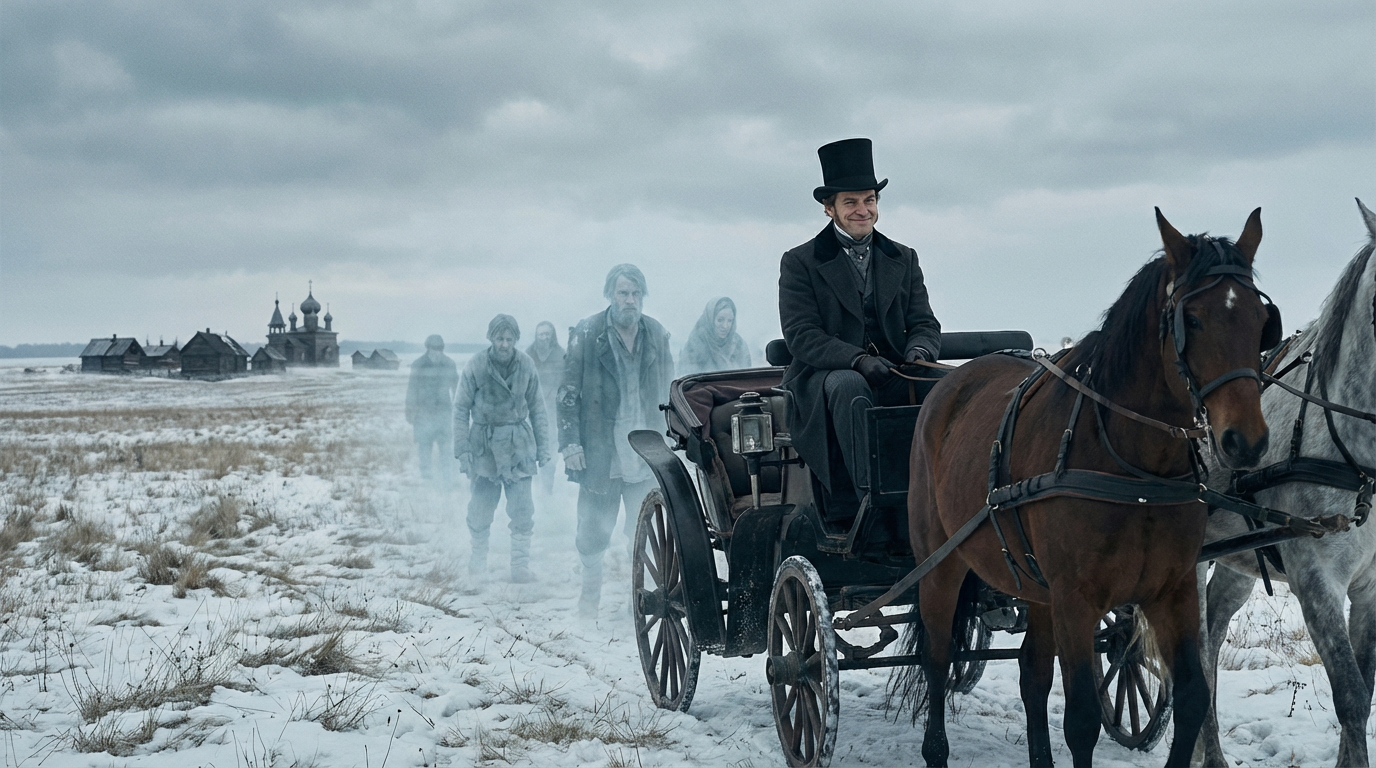
An excerpt from the original text.(complete · 5114 words)
n assembling at the residence indicated, the tchinovniks had occasion
to remark that, owing to all these cares and excitements, every one
of their number had grown thinner. Yes, the appointment of a new
Governor-General, coupled with the rumours described and the reception
of the two serious documents above-mentioned, had left manifest traces
upon the features of every one present. More than one frockcoat had come
to look too large for its wearer, and more than one frame had fallen
away, including the frames of the President of the Council, the Director
of the Medical Department, and the Public Prosecutor. Even a certain
Semen Ivanovitch, who, for some reason or another, was never alluded to
by his family name, but who wore on his index finger a ring with which
he was accustomed to dazzle his lady friends, had diminished in bulk.
Yet, as always happens at such junctures, there were also present
a score of brazen individuals who had succeeded in NOT losing their
presence of mind, even though they constituted a mere sprinkling.
Of them the Postmaster formed one, since he was a man of equable
temperament who could always say: “WE know you, Governor-Generals! We
have seen three or four of you come and go, whereas WE have been sitting
on the same stools these thirty years.” Nevertheless a prominent feature
of the gathering was the total absence of what is vulgarly known as
“common sense.” In general, we Russians do not make a good show at
representative assemblies, for the reason that, unless there be in
authority a leading spirit to control the rest, the affair always
develops into confusion. Why this should be so one could hardly say, but
at all events a success is scored only by such gatherings as have for
their object dining and festivity--to wit, gatherings at clubs or in
German-run restaurants. However, on the present occasion, the meeting
was NOT one of this kind; it was a meeting convoked of necessity, and
likely in view of the threatened calamity to affect every tchinovnik in
the place. Also, in addition to the great divergency of views expressed
thereat, there was visible in all the speakers an invincible tendency to
indecision which led them at one moment to make assertions, and at the
next to contradict the same. But on at least one point all seemed to
agree--namely, that Chichikov’s appearance and conversation were too
respectable for him to be a forger or a disguised brigand. That is to
say, all SEEMED to agree on the point; until a sudden shout arose from
the direction of the Postmaster, who for some time past had been sitting
plunged in thought.
“I can tell you,” he cried, “who Chichikov is!”
“Who, then?” replied the crowd in great excitement.
“He is none other than Captain Kopeikin.”
“And who may Captain Kopeikin be?”
Taking a pinch of snuff (which he did with the lid of his snuff-box
half-open, lest some extraneous person should contrive to insert a not
over-clean finger into the stuff), the Postmaster related the following
story [35].
“After fighting in the campaign of 1812, there was sent home, wounded,
a certain Captain Kopeikin--a headstrong, lively blade who, whether on
duty or under arrest, made things lively for everybody. Now, since at
Krasni or at Leipzig (it matters not which) he had lost an arm and a
leg, and in those days no provision was made for wounded soldiers, and
he could not work with his left arm alone, he set out to see his father.
Unfortunately his father could only just support himself, and was forced
to tell his son so; wherefore the Captain decided to go and apply for
help in St. Petersburg, seeing that he had risked his life for his
country, and had lost much blood in its service. You can imagine him
arriving in the capital on a baggage waggon--in the capital which is
like no other city in the world! Before him there lay spread out the
whole field of life, like a sort of Arabian Nights--a picture made up of
the Nevski Prospect, Gorokhovaia Street, countless tapering spires, and
a number of bridges apparently supported on nothing--in fact, a regular
second Nineveh. Well, he made shift to hire a lodging, but found
everything so wonderfully furnished with blinds and Persian carpets and
so forth that he saw it would mean throwing away a lot of money. True,
as one walks the streets of St. Petersburg one seems to smell money by
the thousand roubles, but our friend Kopeikin’s bank was limited to a
few score coppers and a little silver--not enough to buy a village with!
At length, at the price of a rouble a day, he obtained a lodging in the
sort of tavern where the daily ration is a bowl of cabbage soup and a
crust of bread; and as he felt that he could not manage to live very
long on fare of that kind he asked folk what he had better do. ‘What you
had better do?’ they said. ‘Well the Government is not here--it is in
Paris, and the troops have not yet returned from the war; but there is a
TEMPORARY Commission sitting, and you had better go and see what IT can
do for you.’ ‘All right!’ he said. ‘I will go and tell the Commission
that I have shed my blood, and sacrificed my life, for my country.’
And he got up early one morning, and shaved himself with his left hand
(since the expense of a barber was not worth while), and set out, wooden
leg and all, to see the President of the Commission. But first he
asked where the President lived, and was told that his house was in
Naberezhnaia Street. And you may be sure that it was no peasant’s hut,
with its glazed windows and great mirrors and statues and lacqueys and
brass door handles! Rather, it was the sort of place which you would
enter only after you had bought a cheap cake of soap and indulged in a
two hours’ wash. Also, at the entrance there was posted a grand Swiss
footman with a baton and an embroidered collar--a fellow looking like a
fat, over-fed pug dog. However, friend Kopeikin managed to get himself
and his wooden leg into the reception room, and there squeezed himself
away into a corner, for fear lest he should knock down the gilded china
with his elbow. And he stood waiting in great satisfaction at having
arrived before the President had so much as left his bed and been served
with his silver wash-basin. Nevertheless, it was only when Kopeikin had
been waiting four hours that a breakfast waiter entered to say, ‘The
President will soon be here.’ By now the room was as full of people as
a plate is of beans, and when the President left the breakfast-room he
brought with him, oh, such dignity and refinement, and such an air
of the metropolis! First he walked up to one person, and then up to
another, saying: ‘What do YOU want? And what do YOU want? What can I
do for YOU? What is YOUR business?’ And at length he stopped before
Kopeikin, and Kopeikin said to him: ‘I have shed my blood, and lost
both an arm and a leg, for my country, and am unable to work. Might I
therefore dare to ask you for a little help, if the regulations should
permit of it, or for a gratuity, or for a pension, or something of the
kind?’ Then the President looked at him, and saw that one of his legs
was indeed a wooden one, and that an empty right sleeve was pinned to
his uniform. ‘Very well,’ he said. ‘Come to me again in a few days’
time.’ Upon this friend Kopeikin felt delighted. ‘NOW I have done my
job!’ he thought to himself; and you may imagine how gaily he trotted
along the pavement, and how he dropped into a tavern for a glass of
vodka, and how he ordered a cutlet and some caper sauce and some other
things for luncheon, and how he called for a bottle of wine, and how he
went to the theatre in the evening! In short, he did himself thoroughly
well. Next, he saw in the street a young English lady, as graceful as a
swan, and set off after her on his wooden leg. ‘But no,’ he thought to
himself. ‘To the devil with that sort of thing just now! I will wait
until I have drawn my pension. For the present I have spent enough.’
(And I may tell you that by now he had got through fully half his
money.) Two or three days later he went to see the President of the
Commission again. ‘I should be glad to know,’ he said, ‘whether by now
you can do anything for me in return for my having shed my blood and
suffered sickness and wounds on military service.’ ‘First of all,’ said
the President, ‘I must tell you that nothing can be decided in your case
without the authority of the Supreme Government. Without that sanction
we cannot move in the matter. Surely you see how things stand until the
army shall have returned from the war? All that I can advise you to
do is wait for the Minister to return, and, in the meanwhile, to have
patience. Rest assured that then you will not be overlooked. And if for
the moment you have nothing to live upon, this is the best that I can
do for you.’ With that he handed Kopeikin a trifle until his case should
have been decided. However, that was not what Kopeikin wanted. He
had supposed that he would be given a gratuity of a thousand roubles
straight away; whereas, instead of ‘Drink and be merry,’ it was ‘Wait,
for the time is not yet.’ Thus, though his head had been full of soup
plates and cutlets and English girls, he now descended the steps with
his ears and his tail down--looking, in fact, like a poodle over which
the cook has poured a bucketful of water. You see, St. Petersburg life
had changed him not a little since first he had got a taste of it, and,
now that the devil only knew how he was going to live, it came all the
harder to him that he should have no more sweets to look forward to.
Remember that a man in the prime of years has an appetite like a
wolf; and as he passed a restaurant he could see a round-faced,
holland-shirted, snow-white aproned fellow of a French chef preparing a
dish delicious enough to make it turn to and eat itself; while, again,
as he passed a fruit shop he could see delicacies looking out of a
window for fools to come and buy them at a hundred roubles apiece.
Imagine, therefore, his position! On the one hand, so to speak, were
salmon and water-melons, while on the other hand was the bitter fare
which passed at a tavern for luncheon. ‘Well,’ he thought to himself,
‘let them do what they like with me at the Commission, but I intend
to go and raise the whole place, and to tell every blessed functionary
there that I have a mind to do as I choose.’ And in truth this
bold impertinence of a man did have the hardihood to return to the
Commission. ‘What do you want?’ said the President. ‘Why are you here
for the third time? You have had your orders given you.’ ‘I daresay I
have,’ he retorted, ‘but I am not going to be put off with THEM. I want
some cutlets to eat, and a bottle of French wine, and a chance to go and
amuse myself at the theatre.’ ‘Pardon me,’ said the President. ‘What you
really need (if I may venture to mention it) is a little patience. You
have been given something for food until the Military Committee shall
have met, and then, doubtless, you will receive your proper reward,
seeing that it would not be seemly that a man who has served his country
should be left destitute. On the other hand, if, in the meanwhile, you
desire to indulge in cutlets and theatre-going, please understand that
we cannot help you, but you must make your own resources, and try as
best you can to help yourself.’ You can imagine that this went in at one
of Kopeikin’s ears, and out at the other; that it was like shooting peas
at a stone wall. Accordingly he raised a turmoil which sent the staff
flying. One by one, he gave the mob of secretaries and clerks a real
good hammering. ‘You, and you, and you,’ he said, ‘do not even know
your duties. You are law-breakers.’ Yes, he trod every man of them under
foot. At length the General himself arrived from another office, and
sounded the alarm. What was to be done with a fellow like Kopeikin?
The President saw that strong measures were imperative. ‘Very well,’ he
said. ‘Since you decline to rest satisfied with what has been given you,
and quietly to await the decision of your case in St. Petersburg, I must
find you a lodging. Here, constable, remove the man to gaol.’ Then a
constable who had been called to the door--a constable three ells
in height, and armed with a carbine--a man well fitted to guard a
bank--placed our friend in a police waggon. ‘Well,’ reflected Kopeikin,
‘at least I shan’t have to pay my fare for THIS ride. That’s one
comfort.’ Again, after he had ridden a little way, he said to himself:
‘they told me at the Commission to go and make my own means of enjoying
myself. Very good. I’ll do so.’ However, what became of Kopeikin,
and whither he went, is known to no one. He sank, to use the poet’s
expression, into the waters of Lethe, and his doings now lie buried in
oblivion. But allow me, gentlemen, to piece together the further threads
of the story. Not two months later there appeared in the forests of
Riazan a band of robbers: and of that band the chieftain was none other
than--”
“Allow me,” put in the Head of the Police Department. “You have said
that Kopeikin had lost an arm and a leg; whereas Chichikov--”
To say anything more was unnecessary. The Postmaster clapped his hand
to his forehead, and publicly called himself a fool, though, later, he
tried to excuse his mistake by saying that in England the science of
mechanics had reached such a pitch that wooden legs were manufactured
which would enable the wearer, on touching a spring, to vanish
instantaneously from sight.
Various other theories were then propounded, among them a theory that
Chichikov was Napoleon, escaped from St. Helena and travelling about
the world in disguise. And if it should be supposed that no such notion
could possibly have been broached, let the reader remember that these
events took place not many years after the French had been driven out of
Russia, and that various prophets had since declared that Napoleon was
Antichrist, and would one day escape from his island prison to exercise
universal sway on earth. Nay, some good folk had even declared the
letters of Napoleon’s name to constitute the Apocalyptic cipher!
As a last resort, the tchinovniks decided to question Nozdrev, since not
only had the latter been the first to mention the dead souls, but
also he was supposed to stand on terms of intimacy with Chichikov.
Accordingly the Chief of Police dispatched a note by the hand of a
commissionaire. At the time Nozdrev was engaged on some very important
business--so much so that he had not left his room for four days, and
was receiving his meals through the window, and no visitors at all. The
business referred to consisted of the marking of several dozen selected
cards in such a way as to permit of his relying upon them as upon his
bosom friend. Naturally he did not like having his retirement invaded,
and at first consigned the commissionaire to the devil; but as soon
as he learnt from the note that, since a novice at cards was to be the
guest of the Chief of Police that evening, a call at the latter’s house
might prove not wholly unprofitable he relented, unlocked the door of
his room, threw on the first garments that came to hand, and set forth.
To every question put to him by the tchinovniks he answered firmly and
with assurance. Chichikov, he averred, had indeed purchased dead souls,
and to the tune of several thousand roubles. In fact, he (Nozdrev) had
himself sold him some, and still saw no reason why he should not have
done so. Next, to the question of whether or not he considered Chichikov
to be a spy, he replied in the affirmative, and added that, as long ago
as his and Chichikov’s joint schooldays, the said Chichikov had been
known as “The Informer,” and repeatedly been thrashed by his companions
on that account. Again, to the question of whether or not Chichikov was
a forger of currency notes the deponent, as before, responded in
the affirmative, and appended thereto an anecdote illustrative of
Chichikov’s extraordinary dexterity of hand--namely, an anecdote to
that effect that, once upon a time, on learning that two million
roubles worth of counterfeit notes were lying in Chichikov’s house, the
authorities had placed seals upon the building, and had surrounded it
on every side with an armed guard; whereupon Chichikov had, during the
night, changed each of these seals for a new one, and also so arranged
matters that, when the house was searched, the forged notes were found
to be genuine ones!
Again, to the question of whether or not Chichikov had schemed to abduct
the Governor’s daughter, and also whether it was true that he, Nozdrev,
had undertaken to aid and abet him in the act, the witness replied that,
had he not undertaken to do so, the affair would never have come off. At
this point the witness pulled himself up, on realising that he had told
a lie which might get him into trouble; but his tongue was not to be
denied--the details trembling on its tip were too alluring, and he
even went on to cite the name of the village church where the pair
had arranged to be married, that of the priest who had performed
the ceremony, the amount of the fees paid for the same (seventy-five
roubles), and statements (1) that the priest had refused to solemnise
the wedding until Chichikov had frightened him by threatening to expose
the fact that he (the priest) had married Mikhail, a local corn dealer,
to his paramour, and (2) that Chichikov had ordered both a koliaska for
the couple’s conveyance and relays of horses from the post-houses on the
road. Nay, the narrative, as detailed by Nozdrev, even reached the
point of his mentioning certain of the postillions by name! Next, the
tchinovniks sounded him on the question of Chichikov’s possible identity
with Napoleon; but before long they had reason to regret the step, for
Nozdrev responded with a rambling rigmarole such as bore no resemblance
to anything possibly conceivable. Finally, the majority of the audience
left the room, and only the Chief of Police remained to listen (in the
hope of gathering something more); but at last even he found himself
forced to disclaim the speaker with a gesture which said: “The devil
only knows what the fellow is talking about!” and so voiced the general
opinion that it was no use trying to gather figs of thistles.
Meanwhile Chichikov knew nothing of these events; for, having contracted
a slight chill, coupled with a sore throat, he had decided to keep his
room for three days; during which time he gargled his throat with
milk and fig juice, consumed the fruit from which the juice had been
extracted, and wore around his neck a poultice of camomile and camphor.
Also, to while away the hours, he made new and more detailed lists of
the souls which he had bought, perused a work by the Duchesse de la
Valliere [36], rummaged in his portmanteau, looked through various
articles and papers which he discovered in his dispatch-box, and found
every one of these occupations tedious. Nor could he understand why
none of his official friends had come to see him and inquire after his
health, seeing that, not long since, there had been standing in front of
the inn the drozhkis both of the Postmaster, the Public Prosecutor, and
the President of the Council. He wondered and wondered, and then, with
a shrug of his shoulders, fell to pacing the room. At length he felt
better, and his spirits rose at the prospect of once more going out into
the fresh air; wherefore, having shaved a plentiful growth of hair from
his face, he dressed with such alacrity as almost to cause a split
in his trousers, sprinkled himself with eau-de-Cologne, and wrapping
himself in warm clothes, and turning up the collar of his coat, sallied
forth into the street. His first destination was intended to be the
Governor’s mansion, and, as he walked along, certain thoughts concerning
the Governor’s daughter would keep whirling through his head, so that
almost he forgot where he was, and took to smiling and cracking jokes to
himself.
Arrived at the Governor’s entrance, he was about to divest himself
of his scarf when a Swiss footman greeted him with the words, “I am
forbidden to admit you.”
“What?” he exclaimed. “You do not know me? Look at me again, and see if
you do not recognise me.”
“Of course I recognise you,” the footman replied. “I have seen you
before, but have been ordered to admit any one else rather than Monsieur
Chichikov.”
“Indeed? And why so?”
“Those are my orders, and they must be obeyed,” said the footman,
confronting Chichikov with none of that politeness with which, on
former occasions, he had hastened to divest our hero of his wrappings.
Evidently he was of opinion that, since the gentry declined to receive
the visitor, the latter must certainly be a rogue.
“I cannot understand it,” said Chichikov to himself. Then he departed,
and made his way to the house of the President of the Council. But so
put about was that official by Chichikov’s entry that he could not utter
two consecutive words--he could only murmur some rubbish which left both
his visitor and himself out of countenance. Chichikov wondered, as he
left the house, what the President’s muttered words could have meant,
but failed to make head or tail of them. Next, he visited, in turn, the
Chief of Police, the Vice-Governor, the Postmaster, and others; but in
each case he either failed to be accorded admittance or was received
so strangely, and with such a measure of constraint and conversational
awkwardness and absence of mind and embarrassment, that he began to fear
for the sanity of his hosts. Again and again did he strive to divine
the cause, but could not do so; so he went wandering aimlessly about
the town, without succeeding in making up his mind whether he or
the officials had gone crazy. At length, in a state bordering upon
bewilderment, he returned to the inn--to the establishment whence, that
every afternoon, he had set forth in such exuberance of spirits. Feeling
the need of something to do, he ordered tea, and, still marvelling at
the strangeness of his position, was about to pour out the beverage when
the door opened and Nozdrev made his appearance.
“What says the proverb?” he began. “‘To see a friend, seven versts is
not too long a round to make.’ I happened to be passing the house, saw a
light in your window, and thought to myself: ‘Now, suppose I were to run
up and pay him a visit? It is unlikely that he will be asleep.’ Ah, ha!
I see tea on your table! Good! Then I will drink a cup with you, for I
had wretched stuff for dinner, and it is beginning to lie heavy on my
stomach. Also, tell your man to fill me a pipe. Where is your own pipe?”
“I never smoke,” rejoined Chichikov drily.
“Rubbish! As if I did not know what a chimney-pot you are! What is your
man’s name? Hi, Vakhramei! Come here!”
“Petrushka is his name, not Vakhramei.”
“Indeed? But you USED to have a man called Vakhramei, didn’t you?”
“No, never.”
“Oh, well. Then it must be Derebin’s man I am thinking of. What a lucky
fellow that Derebin is! An aunt of his has gone and quarrelled with her
son for marrying a serf woman, and has left all her property to HIM,
to Derebin. Would that I had an aunt of that kind to provide against
future contingencies! But why have you been hiding yourself away? I
suppose the reason has been that you go in for abstruse subjects and are
fond of reading” (why Nozdrev should have drawn these conclusions no one
could possibly have said--least of all Chichikov himself). “By the way,
I can tell you of something that would have found you scope for your
satirical vein” (the conclusion as to Chichikov’s “satirical vein” was,
as before, altogether unwarranted on Nozdrev’s part). “That is to say,
you would have seen merchant Likhachev losing a pile of money at play.
My word, you would have laughed! A fellow with me named Perependev said:
‘Would that Chichikov had been here! It would have been the very thing
for him!’” (As a matter of fact, never since the day of his birth had
Nozdrev met any one of the name of Perependev.) “However, my friend, you
must admit that you treated me rather badly the day that we played that
game of chess; but, as I won the game, I bear you no malice. A propos,
I am just from the President’s, and ought to tell you that the feeling
against you in the town is very strong, for every one believes you to be
a forger of currency notes. I myself was sent for and questioned
about you, but I stuck up for you through thick and thin, and told
the tchinovniks that I had been at school with you, and had known your
father. In fact, I gave the fellows a knock or two for themselves.”
“You say that I am believed to be a forger?” said Chichikov, starting
from his seat.
“Yes,” said Nozdrev. “Why have you gone and frightened everybody as you
have done? Some of our folk are almost out of their minds about it, and
declare you to be either a brigand in disguise or a spy. Yesterday the
Public Prosecutor even died of it, and is to be buried to-morrow”
(this was true in so far as that, on the previous day, the official in
question had had a fatal stroke--probably induced by the excitement of
the public meeting). “Of course, I don’t suppose you to be anything of
the kind, but, you see, these fellows are in a blue funk about the new
Governor-General, for they think he will make trouble for them over your
affair. A propos, he is believed to be a man who puts on airs, and turns
up his nose at everything; and if so, he will get on badly with the
dvoriane, seeing that fellows of that sort need to be humoured a bit.
Yes, my word! Should the new Governor-General shut himself up in his
study, and give no balls, there will be the very devil to pay! By the
way, Chichikov, that is a risky scheme of yours.”
“What scheme to you mean?” Chichikov asked uneasily.
“Why, that scheme of carrying off the Governor’s daughter. However, to
tell the truth, I was expecting something of the kind. No sooner did
I see you and her together at the ball than I said to myself: ‘Ah, ha!
Chichikov is not here for nothing!’ For my own part, I think you have
made a poor choice, for I can see nothing in her at all. On the other
hand, the niece of a friend of mine named Bikusov--she IS a girl, and no
mistake! A regular what you might call ‘miracle in muslin!’”
“What on earth are you talking about?” asked Chichikov with his eyes
distended. “HOW could I carry off the Governor’s daughter? What on earth
do you mean?”
“Come, come! What a secretive fellow you are! My only object in having
come to see you is to lend you a helping hand in the matter. Look here.
On condition that you will lend me three thousand roubles, I will stand
you the cost of the wedding, the koliaska, and the relays of horses. I
must have the money even if I die for it.”
Throughout Nozdrev’s maunderings Chichikov had been rubbing his eyes to
ascertain whether or not he was dreaming. What with the charge of being
a forger, the accusation of having schemed an abduction, the death of
the Public Prosecutor (whatever might have been its cause), and the
advent of a new Governor-General, he felt utterly dismayed.
“Things having come to their present pass,” he reflected, “I had better
not linger here--I had better be off at once.”
Getting rid of Nozdrev as soon as he could, he sent for Selifan, and
ordered him to be up at daybreak, in order to clean the britchka and to
have everything ready for a start at six o’clock. Yet, though Selifan
replied, “Very well, Paul Ivanovitch,” he hesitated awhile by the door.
Next, Chichikov bid Petrushka get out the dusty portmanteau from under
the bed, and then set to work to cram into it, pell-mell, socks, shirts,
collars (both clean and dirty), boot trees, a calendar, and a variety of
other articles. Everything went into the receptacle just as it came
to hand, since his one object was to obviate any possible delay in
the morning’s departure. Meanwhile the reluctant Selifan slowly, very
slowly, left the room, as slowly descended the staircase (on each
separate step of which he left a muddy foot-print), and, finally, halted
to scratch his head. What that scratching may have meant no one could
say; for, with the Russian populace, such a scratching may mean any one
of a hundred things.
Master this chapter. Complete your experience
Purchase the complete book to access all chapters and support classic literature
As an Amazon Associate, we earn a small commission from qualifying purchases at no additional cost to you.
Available in paperback, hardcover, and e-book formats
Let's Analyse the Pattern
When fear and uncertainty drive people to create elaborate explanations that feel more satisfying than admitting they don't know.
Why This Matters
Connect literature to life
This chapter teaches how to recognize when fear transforms speculation into accepted fact through collective storytelling.
Practice This Today
This week, notice when workplace conversations shift from 'What happened?' to 'Here's what must have happened'—that's panic logic forming.
Now let's explore the literary elements.
Key Quotes & Analysis
"Nevertheless a prominent feature of the gathering was the total absence of what is vulgarly known as 'common sense.'"
Context: Describing the officials' meeting to discuss Chichikov
Gogol directly points out that fear has made these educated men abandon rational thinking. They're so panicked about the new Governor-General and mysterious documents that they can't think clearly about anything.
In Today's Words:
Nobody in that room was thinking straight anymore.
"WE know you, Governor-Generals! We have seen three or four of you come and go, whereas WE have been sitting on the same stools these thirty years."
Context: Trying to calm the other officials about the new appointment
This shows the mindset of career bureaucrats who think they can outlast any boss. The Postmaster believes his experience makes him immune to change, but he's still caught up in the same panic as everyone else.
In Today's Words:
I've seen plenty of new bosses come and go - we'll still be here when they're gone.
"In general, we Russians do not make a good show at constituting a gathering."
Context: Commenting on the officials' inability to have a productive meeting
Gogol is critiquing how his countrymen handle group decision-making, suggesting they're prone to chaos and poor judgment when they come together. This sets up the disaster that follows.
In Today's Words:
Russians aren't great at running meetings or making group decisions.
Thematic Threads
Identity
In This Chapter
Chichikov's identity becomes whatever the town's fears project onto him—spy, criminal, Napoleon
Development
Evolved from his carefully crafted gentleman persona to complete loss of control over how others see him
In Your Life:
You might find your reputation at work or in your community suddenly shifts based on rumors rather than your actual actions.
Class
In This Chapter
Officials' panic reveals their insecurity about their own positions and authority when challenged by mystery
Development
Continued exploration of how social position depends on others' recognition and approval
In Your Life:
You might notice how quickly people in authority positions become defensive when they feel their status is questioned.
Social Expectations
In This Chapter
The town expected Chichikov to be who he appeared to be; when that breaks down, they can't process the contradiction
Development
Shows the fragility of social roles when underlying assumptions are challenged
In Your Life:
You might experience this when someone you trusted turns out to be different than you thought, and everyone struggles to readjust their expectations.
Human Relationships
In This Chapter
Former social connections instantly evaporate as doors literally close in Chichikov's face
Development
Reveals how quickly social relationships can disappear when based on superficial foundations
In Your Life:
You might see how some friendships or professional relationships only exist as long as your reputation remains intact.
You now have the context. Time to form your own thoughts.
Discussion Questions
- 1
What happens when the town officials try to figure out who Chichikov really is, and why do their theories get more and more ridiculous?
analysis • surface - 2
Why do the officials prefer wild conspiracy theories over simply admitting they don't know who Chichikov is?
analysis • medium - 3
Where have you seen this same pattern of people creating elaborate explanations when they're scared and don't have real information?
application • medium - 4
If you were Chichikov and suddenly found yourself shut out by everyone who used to welcome you, how would you handle the situation?
application • deep - 5
What does this chapter reveal about how fear affects our ability to think clearly and seek the truth?
reflection • deep
Critical Thinking Exercise
Track the Rumor Mill
Think of a time when rumors or theories spread through your workplace, family, or community. Map out how the story changed as it passed from person to person. What details got added? What facts got lost? Who believed it and who questioned it? Compare this to how the officials' theories about Chichikov evolved.
Consider:
- •Notice who added the most dramatic details and why they might have done so
- •Identify the moment when people stopped checking facts and started believing the story
- •Consider how fear or stress influenced what people were willing to believe
Journaling Prompt
Write about a time when you were either the target of rumors or participated in spreading them. What would you do differently now that you understand this pattern?
Coming Up Next...
Chapter 11: The Origin of a Scheme
Chichikov plans to escape at dawn, but his careful exit strategy hits immediate snags. Sometimes the simplest plans go wrong in the most frustrating ways, and our hero discovers that leaving town might be harder than arriving.



