
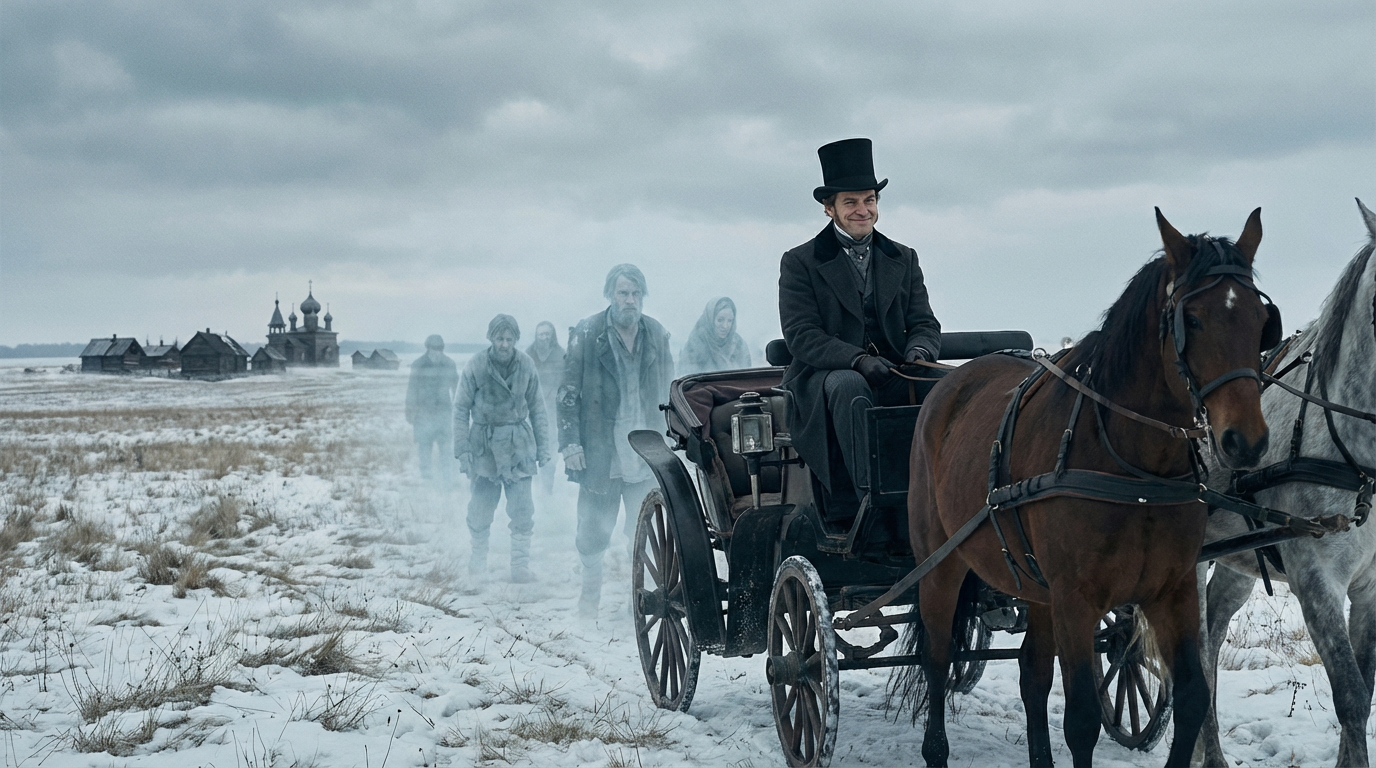
An excerpt from the original text.(complete · 14469 words)
evertheless events did not turn out as Chichikov had intended they
should. In the first place, he overslept himself. That was check number
one. In the second place, on his rising and inquiring whether the
britchka had been harnessed and everything got ready, he was informed
that neither of those two things had been done. That was check number
two. Beside himself with rage, he prepared to give Selifan the wigging
of his life, and, meanwhile, waited impatiently to hear what the
delinquent had got to say in his defence. It goes without saying that
when Selifan made his appearance in the doorway he had only the usual
excuses to offer--the sort of excuses usually offered by servants when a
hasty departure has become imperatively necessary.
“Paul Ivanovitch,” he said, “the horses require shoeing.”
“Blockhead!” exclaimed Chichikov. “Why did you not tell me of that
before, you damned fool? Was there not time enough for them to be shod?”
“Yes, I suppose there was,” agreed Selifan. “Also one of the wheels is
in want of a new tyre, for the roads are so rough that the old tyre is
worn through. Also, the body of the britchka is so rickety that probably
it will not last more than a couple of stages.”
“Rascal!” shouted Chichikov, clenching his fists and approaching Selifan
in such a manner that, fearing to receive a blow, the man backed and
dodged aside. “Do you mean to ruin me, and to break all our bones on the
road, you cursed idiot? For these three weeks past you have been doing
nothing at all; yet now, at the last moment, you come here stammering
and playing the fool! Do you think I keep you just to eat and to drive
yourself about? You must have known of this before? Did you, or did you
not, know it? Answer me at once.”
“Yes, I did know it,” replied Selifan, hanging his head.
“Then why didn’t you tell me about it?”
Selifan had no reply immediately ready, so continued to hang his head
while quietly saying to himself: “See how well I have managed things! I
knew what was the matter, yet I did not say.”
“And now,” continued Chichikov, “go you at once and fetch a blacksmith.
Tell him that everything must be put right within two hours at the most.
Do you hear? If that should not be done, I, I--I will give you the best
flogging that ever you had in your life.” Truly Chichikov was almost
beside himself with fury.
Turning towards the door, as though for the purpose of going and
carrying out his orders, Selifan halted and added:
“That skewbald, barin--you might think it well to sell him, seeing that
he is nothing but a rascal? A horse like that is more of a hindrance
than a help.”
“What? Do you expect me to go NOW to the market-place and sell him?”
“Well, Paul Ivanovitch, he is good for nothing but show, since by nature
he is a most cunning beast. Never in my life have I seen such a horse.”
“Fool! Whenever I may wish to sell him I SHALL sell him. Meanwhile,
don’t you trouble your head about what doesn’t concern you, but go and
fetch a blacksmith, and see that everything is put right within two
hours. Otherwise I will take the very hair off your head, and beat you
till you haven’t a face left. Be off! Hurry!”
Selifan departed, and Chichikov, his ill-humour vented, threw down
upon the floor the poignard which he always took with him as a means of
instilling respect into whomsoever it might concern, and spent the next
quarter of an hour in disputing with a couple of blacksmiths--men who,
as usual, were rascals of the type which, on perceiving that something
is wanted in a hurry, at once multiplies its terms for providing the
same. Indeed, for all Chichikov’s storming and raging as he dubbed
the fellows robbers and extortioners and thieves, he could make no
impression upon the pair, since, true to their character, they declined
to abate their prices, and, even when they had begun their work, spent
upon it, not two hours, but five and a half. Meanwhile he had the
satisfaction of experiencing that delightful time with which all
travellers are familiar--namely, the time during which one sits in a
room where, except for a litter of string, waste paper, and so forth,
everything else has been packed. But to all things there comes an end,
and there arrived also the long-awaited moment when the britchka had
received the luggage, the faulty wheel had been fitted with a new tyre,
the horses had been re-shod, and the predatory blacksmiths had departed
with their gains. “Thank God!” thought Chichikov as the britchka rolled
out of the gates of the inn, and the vehicle began to jolt over the
cobblestones. Yet a feeling which he could not altogether have defined
filled his breast as he gazed upon the houses and the streets and the
garden walls which he might never see again. Presently, on turning a
corner, the britchka was brought to a halt through the fact that along
the street there was filing a seemingly endless funeral procession.
Leaning forward in his britchka, Chichikov asked Petrushka whose
obsequies the procession represented, and was told that they represented
those of the Public Prosecutor. Disagreeably shocked, our hero hastened
to raise the hood of the vehicle, to draw the curtains across the
windows, and to lean back into a corner. While the britchka remained
thus halted Selifan and Petrushka, their caps doffed, sat watching the
progress of the cortege, after they had received strict instructions not
to greet any fellow-servant whom they might recognise. Behind the hearse
walked the whole body of tchinovniks, bare-headed; and though, for a
moment or two, Chichikov feared that some of their number might discern
him in his britchka, he need not have disturbed himself, since their
attention was otherwise engaged. In fact, they were not even exchanging
the small talk customary among members of such processions, but
thinking exclusively of their own affairs, of the advent of the new
Governor-General, and of the probable manner in which he would take up
the reins of administration. Next came a number of carriages, from
the windows of which peered the ladies in mourning toilets. Yet the
movements of their hands and lips made it evident that they were
indulging in animated conversation--probably about the Governor-General,
the balls which he might be expected to give, and their own eternal
fripperies and gewgaws. Lastly came a few empty drozhkis. As soon as the
latter had passed, our hero was able to continue on his way. Throwing
back the hood of the britchka, he said to himself:
“Ah, good friend, you have lived your life, and now it is over! In the
newspapers they will say of you that you died regretted not only by
your subordinates, but also by humanity at large, as well as that, a
respected citizen, a kind father, and a husband beyond reproach, you
went to your grave amid the tears of your widow and orphans. Yet, should
those journals be put to it to name any particular circumstance which
justified this eulogy of you, they would be forced to fall back upon the
fact that you grew a pair of exceptionally thick eyebrows!”
With that Chichikov bid Selifan quicken his pace, and concluded: “After
all, it is as well that I encountered the procession, for they say that
to meet a funeral is lucky.”
Presently the britchka turned into some less frequented streets, lines
of wooden fencing of the kind which mark the outskirts of a town began
to file by, the cobblestones came to an end, the macadam of the highroad
succeeded to them, and once more there began on either side of the
turnpike a procession of verst stones, road menders, and grey villages;
inns with samovars and peasant women and landlords who came running out
of yards with seivefuls of oats; pedestrians in worn shoes which, it
might be, had covered eight hundred versts; little towns, bright with
booths for the sale of flour in barrels, boots, small loaves, and other
trifles; heaps of slag; much repaired bridges; expanses of field to
right and to left; stout landowners; a mounted soldier bearing a green,
iron-clamped box inscribed: “The --th Battery of Artillery”; long strips
of freshly-tilled earth which gleamed green, yellow, and black on the
face of the countryside. With it mingled long-drawn singing, glimpses of
elm-tops amid mist, the far-off notes of bells, endless clouds of rocks,
and the illimitable line of the horizon.
Ah, Russia, Russia, from my beautiful home in a strange land I can still
see you! In you everything is poor and disordered and unhomely; in you
the eye is neither cheered nor dismayed by temerities of nature which
a yet more temerarious art has conquered; in you one beholds no cities
with lofty, many-windowed mansions, lofty as crags, no picturesque
trees, no ivy-clad ruins, no waterfalls with their everlasting spray and
roar, no beetling precipices which confuse the brain with their stony
immensity, no vistas of vines and ivy and millions of wild roses and
ageless lines of blue hills which look almost unreal against the clear,
silvery background of the sky. In you everything is flat and open; your
towns project like points or signals from smooth levels of plain, and
nothing whatsoever enchants or deludes the eye. Yet what secret, what
invincible force draws me to you? Why does there ceaselessly echo and
re-echo in my ears the sad song which hovers throughout the length and
the breadth of your borders? What is the burden of that song? Why does
it wail and sob and catch at my heart? What say the notes which
thus painfully caress and embrace my soul, and flit, uttering their
lamentations, around me? What is it you seek of me, O Russia? What is
the hidden bond which subsists between us? Why do you regard me as you
do? Why does everything within you turn upon me eyes full of
yearning? Even at this moment, as I stand dumbly, fixedly, perplexedly
contemplating your vastness, a menacing cloud, charged with gathering
rain, seems to overshadow my head. What is it that your boundless
expanses presage? Do they not presage that one day there will arise in
you ideas as boundless as yourself? Do they not presage that one day you
too will know no limits? Do they not presage that one day, when again
you shall have room for their exploits, there will spring to life
the heroes of old? How the power of your immensity enfolds me, and
reverberates through all my being with a wild, strange spell, and
flashes in my eyes with an almost supernatural radiance! Yes, a strange,
brilliant, unearthly vista indeed do you disclose, O Russia, country of
mine!
“Stop, stop, you fool!” shouted Chichikov to Selifan; and even as he
spoke a troika, bound on Government business, came chattering by, and
disappeared in a cloud of dust. To Chichikov’s curses at Selifan for not
having drawn out of the way with more alacrity a rural constable with
moustaches of the length of an arshin added his quota.
What a curious and attractive, yet also what an unreal, fascination
the term “highway” connotes! And how interesting for its own sake is
a highway! Should the day be a fine one (though chilly) in mellowing
autumn, press closer your travelling cloak, and draw down your cap over
your ears, and snuggle cosily, comfortably into a corner of the britchka
before a last shiver shall course through your limbs, and the ensuing
warmth shall put to flight the autumnal cold and damp. As the horses
gallop on their way, how delightfully will drowsiness come stealing upon
you, and make your eyelids droop! For a while, through your somnolence,
you will continue to hear the hard breathing of the team and the
rumbling of the wheels; but at length, sinking back into your corner,
you will relapse into the stage of snoring. And when you awake--behold!
you will find that five stages have slipped away, and that the moon is
shining, and that you have reached a strange town of churches and old
wooden cupolas and blackened spires and white, half-timbered houses! And
as the moonlight glints hither and thither, almost you will believe that
the walls and the streets and the pavements of the place are spread with
sheets--sheets shot with coal-black shadows which make the wooden roofs
look all the brighter under the slanting beams of the pale luminary.
Nowhere is a soul to be seen, for every one is plunged in slumber. Yet
no. In a solitary window a light is flickering where some good burgher
is mending his boots, or a baker drawing a batch of dough. O night
and powers of heaven, how perfect is the blackness of your infinite
vault--how lofty, how remote its inaccessible depths where it lies
spread in an intangible, yet audible, silence! Freshly does the lulling
breath of night blow in your face, until once more you relapse into
snoring oblivion, and your poor neighbour turns angrily in his corner as
he begins to be conscious of your weight. Then again you awake, but
this time to find yourself confronted with only fields and steppes.
Everywhere in the ascendant is the desolation of space. But suddenly the
ciphers on a verst stone leap to the eye! Morning is rising, and on the
chill, gradually paling line of the horizon you can see gleaming a faint
gold streak. The wind freshens and grows keener, and you snuggle closer
in your cloak; yet how glorious is that freshness, and how marvellous
the sleep in which once again you become enfolded! A jolt!--and for the
last time you return to consciousness. By now the sun is high in the
heavens, and you hear a voice cry “gently, gently!” as a farm waggon
issues from a by-road. Below, enclosed within an ample dike, stretches
a sheet of water which glistens like copper in the sunlight. Beyond, on
the side of a slope, lie some scattered peasants’ huts, a manor house,
and, flanking the latter, a village church with its cross flashing
like a star. There also comes wafted to your ear the sound of peasants’
laughter, while in your inner man you are becoming conscious of an
appetite which is not to be withstood.
Oh long-drawn highway, how excellent you are! How often have I in
weariness and despondency set forth upon your length, and found in you
salvation and rest! How often, as I followed your leading, have I been
visited with wonderful thoughts and poetic dreams and curious, wild
impressions!
At this moment our friend Chichikov also was experiencing visions of a
not wholly prosaic nature. Let us peep into his soul and share them.
At first he remained unconscious of anything whatsoever, for he was too
much engaged in making sure that he was really clear of the town; but
as soon as he saw that it had completely disappeared, with its mills and
factories and other urban appurtenances, and that even the steeples
of the white stone churches had sunk below the horizon, he turned his
attention to the road, and the town of N. vanished from his thoughts as
completely as though he had not seen it since childhood. Again, in its
turn, the road ceased to interest him, and he began to close his eyes
and to loll his head against the cushions. Of this let the author
take advantage, in order to speak at length concerning his hero; since
hitherto he (the author) has been prevented from so doing by Nozdrev and
balls and ladies and local intrigues--by those thousand trifles which
seem trifles only when they are introduced into a book, but which, in
life, figure as affairs of importance. Let us lay them aside, and betake
ourselves to business.
Whether the character whom I have selected for my hero has pleased my
readers is, of course, exceedingly doubtful. At all events the ladies
will have failed to approve him for the fair sex demands in a hero
perfection, and, should there be the least mental or physical stain
on him--well, woe betide! Yes, no matter how profoundly the author may
probe that hero’s soul, no matter how clearly he may portray his figure
as in a mirror, he will be given no credit for the achievement. Indeed,
Chichikov’s very stoutness and plenitude of years may have militated
against him, for never is a hero pardoned for the former, and the
majority of ladies will, in such case, turn away, and mutter to
themselves: “Phew! What a beast!” Yes, the author is well aware of this.
Yet, though he could not, to save his life, take a person of virtue for
his principal character, it may be that this story contains themes
never before selected, and that in it there projects the whole boundless
wealth of Russian psychology; that it portrays, as well as Chichikov,
the peasant who is gifted with the virtues which God has sent him, and
the marvellous maiden of Russia who has not her like in all the world
for her beautiful feminine spirituality, the roots of which lie buried
in noble aspirations and boundless self-denial. In fact, compared with
these types, the virtuous of other races seem lifeless, as does an
inanimate volume when compared with the living word. Yes, each time that
there arises in Russia a movement of thought, it becomes clear that the
movement sinks deep into the Slavonic nature where it would but have
skimmed the surface of other nations.--But why am I talking like this?
Whither am I tending? It is indeed shameful that an author who long
ago reached man’s estate, and was brought up to a course of severe
introspection and sober, solitary self-enlightenment, should give way to
such jejune wandering from the point. To everything its proper time
and place and turn. As I was saying, it does not lie in me to take a
virtuous character for my hero: and I will tell you why. It is because
it is high time that a rest were given to the “poor, but virtuous”
individual; it is because the phrase “a man of worth” has grown into a
by-word; it is because the “man of worth” has become converted into a
horse, and there is not a writer but rides him and flogs him, in and out
of season; it is because the “man of worth” has been starved until he
has not a shred of his virtue left, and all that remains of his body is
but the ribs and the hide; it is because the “man of worth” is for ever
being smuggled upon the scene; it is because the “man of worth” has at
length forfeited every one’s respect. For these reasons do I reaffirm
that it is high time to yoke a rascal to the shafts. Let us yoke that
rascal.
Our hero’s beginnings were both modest and obscure. True, his parents
were dvoriane, but he in no way resembled them. At all events, a short,
squab female relative who was present at his birth exclaimed as she
lifted up the baby: “He is altogether different from what I had expected
him to be. He ought to have taken after his maternal grandmother,
whereas he has been born, as the proverb has it, ‘like not father nor
mother, but like a chance passer-by.’” Thus from the first life
regarded the little Chichikov with sour distaste, and as through a dim,
frost-encrusted window. A tiny room with diminutive casements which were
never opened, summer or winter; an invalid father in a dressing-gown
lined with lambskin, and with an ailing foot swathed in bandages--a man
who was continually drawing deep breaths, and walking up and down the
room, and spitting into a sandbox; a period of perpetually sitting on
a bench with pen in hand and ink on lips and fingers; a period of being
eternally confronted with the copy-book maxim, “Never tell a lie, but
obey your superiors, and cherish virtue in your heart;” an everlasting
scraping and shuffling of slippers up and down the room; a period of
continually hearing a well-known, strident voice exclaim: “So you have
been playing the fool again!” at times when the child, weary of the
mortal monotony of his task, had added a superfluous embellishment
to his copy; a period of experiencing the ever-familiar, but
ever-unpleasant, sensation which ensued upon those words as the boy’s
ear was painfully twisted between two long fingers bent backwards at
the tips--such is the miserable picture of that youth of which, in later
life, Chichikov preserved but the faintest of memories! But in this
world everything is liable to swift and sudden change; and, one day in
early spring, when the rivers had melted, the father set forth with
his little son in a teliezshka [37] drawn by a sorrel steed of the kind
known to horsy folk as a soroka, and having as coachman the diminutive
hunchback who, father of the only serf family belonging to the elder
Chichikov, served as general factotum in the Chichikov establishment.
For a day and a half the soroka conveyed them on their way; during which
time they spent the night at a roadside inn, crossed a river, dined off
cold pie and roast mutton, and eventually arrived at the county town. To
the lad the streets presented a spectacle of unwonted brilliancy, and
he gaped with amazement. Turning into a side alley wherein the mire
necessitated both the most strenuous exertions on the soroka’s part and
the most vigorous castigation on the part of the driver and the barin,
the conveyance eventually reached the gates of a courtyard which,
combined with a small fruit garden containing various bushes, a couple
of apple-trees in blossom, and a mean, dirty little shed, constituted
the premises attached to an antiquated-looking villa. Here there lived
a relative of the Chichikovs, a wizened old lady who went to market in
person and dried her stockings at the samovar. On seeing the boy, she
patted his cheek and expressed satisfaction at his physique; whereupon
the fact became disclosed that here he was to abide for a while, for
the purpose of attending a local school. After a night’s rest his father
prepared to betake himself homeward again; but no tears marked the
parting between him and his son, he merely gave the lad a copper or two
and (a far more important thing) the following injunctions. “See here,
my boy. Do your lessons well, do not idle or play the fool, and above
all things, see that you please your teachers. So long as you observe
these rules you will make progress, and surpass your fellows, even if
God shall have denied you brains, and you should fail in your studies.
Also, do not consort overmuch with your comrades, for they will do you
no good; but, should you do so, then make friends with the richer of
them, since one day they may be useful to you. Also, never entertain or
treat any one, but see that every one entertains and treats YOU. Lastly,
and above all else, keep and save your every kopeck. To save money is
the most important thing in life. Always a friend or a comrade may fail
you, and be the first to desert you in a time of adversity; but never
will a KOPECK fail you, whatever may be your plight. Nothing in the
world cannot be done, cannot be attained, with the aid of money.” These
injunctions given, the father embraced his son, and set forth on his
return; and though the son never again beheld his parent, the latter’s
words and precepts sank deep into the little Chichikov’s soul.
The next day young Pavlushka made his first attendance at school. But no
special aptitude in any branch of learning did he display. Rather, his
distinguishing characteristics were diligence and neatness. On the other
hand, he developed great intelligence as regards the PRACTICAL aspect
of life. In a trice he divined and comprehended how things ought to
be worked, and, from that time forth, bore himself towards his
school-fellows in such a way that, though they frequently gave him
presents, he not only never returned the compliment, but even on
occasions pocketed the gifts for the mere purpose of selling them again.
Also, boy though he was, he acquired the art of self-denial. Of the
trifle which his father had given him on parting he spent not a kopeck,
but, the same year, actually added to his little store by fashioning
a bullfinch of wax, painting it, and selling the same at a handsome
profit. Next, as time went on, he engaged in other speculations--in
particular, in the scheme of buying up eatables, taking his seat in
class beside boys who had plenty of pocket-money, and, as soon as such
opulent individuals showed signs of failing attention (and, therefore,
of growing appetite), tendering them, from beneath the desk, a roll of
pudding or a piece of gingerbread, and charging according to degree
of appetite and size of portion. He also spent a couple of months in
training a mouse, which he kept confined in a little wooden cage in his
bedroom. At length, when the training had reached the point that, at the
several words of command, the mouse would stand upon its hind legs,
lie down, and get up again, he sold the creature for a respectable sum.
Thus, in time, his gains attained the amount of five roubles; whereupon
he made himself a purse and then started to fill a second receptacle of
the kind. Still more studied was his attitude towards the authorities.
No one could sit more quietly in his place on the bench than he. In the
same connection it may be remarked that his teacher was a man who, above
all things, loved peace and good behaviour, and simply could not
abide clever, witty boys, since he suspected them of laughing at him.
Consequently any lad who had once attracted the master’s attention with
a manifestation of intelligence needed but to shuffle in his place, or
unintentionally to twitch an eyebrow, for the said master at once to
burst into a rage, to turn the supposed offender out of the room, and
to visit him with unmerciful punishment. “Ah, my fine fellow,” he would
say, “I’LL cure you of your impudence and want of respect! I know you
through and through far better than you know yourself, and will take
good care that you have to go down upon your knees and curb your
appetite.” Whereupon the wretched lad would, for no cause of which he
was aware, be forced to wear out his breeches on the floor and go hungry
for days. “Talents and gifts,” the schoolmaster would declare, “are so
much rubbish. I respect only good behaviour, and shall award full marks
to those who conduct themselves properly, even if they fail to learn a
single letter of their alphabet: whereas to those in whom I may perceive
a tendency to jocularity I shall award nothing, even though they should
outdo Solon himself.” For the same reason he had no great love of the
author Krylov, in that the latter says in one of his Fables: “In my
opinion, the more one sings, the better one works;” and often the
pedagogue would relate how, in a former school of his, the silence had
been such that a fly could be heard buzzing on the wing, and for the
space of a whole year not a single pupil sneezed or coughed in class,
and so complete was the absence of all sound that no one could have
told that there was a soul in the place. Of this mentor young Chichikov
speedily appraised the mentality; wherefore he fashioned his behaviour
to correspond with it. Not an eyelid, not an eyebrow, would he stir
during school hours, howsoever many pinches he might receive from
behind; and only when the bell rang would he run to anticipate his
fellows in handing the master the three-cornered cap which that
dignitary customarily sported, and then to be the first to leave the
class-room, and contrive to meet the master not less than two or three
times as the latter walked homeward, in order that, on each occasion,
he might doff his cap. And the scheme proved entirely successful.
Throughout the period of his attendance at school he was held in high
favour, and, on leaving the establishment, received full marks for every
subject, as well as a diploma and a book inscribed (in gilt letters)
“For Exemplary Diligence and the Perfection of Good Conduct.” By this
time he had grown into a fairly good-looking youth of the age when the
chin first calls for a razor; and at about the same period his father
died, leaving behind him, as his estate, four waistcoats completely worn
out, two ancient frockcoats, and a small sum of money. Apparently he had
been skilled only in RECOMMENDING the saving of kopecks--not in ACTUALLY
PRACTISING the art. Upon that Chichikov sold the old house and its
little parcel of land for a thousand roubles, and removed, with his
one serf and the serf’s family, to the capital, where he set about
organising a new establishment and entering the Civil Service.
Simultaneously with his doing so, his old schoolmaster lost (through
stupidity or otherwise) the establishment over which he had hitherto
presided, and in which he had set so much store by silence and good
behaviour. Grief drove him to drink, and when nothing was left, even
for that purpose, he retired--ill, helpless, and starving--into a
broken-down, cheerless hovel. But certain of his former pupils--the same
clever, witty lads whom he had once been wont to accuse of impertinence
and evil conduct generally--heard of his pitiable plight, and collected
for him what money they could, even to the point of selling their own
necessaries. Only Chichikov, when appealed to, pleaded inability, and
compromised with a contribution of a single piatak [38]: which his
old schoolfellows straightway returned him--full in the face, and
accompanied with a shout of “Oh, you skinflint!” As for the poor
schoolmaster, when he heard what his former pupils had done, he buried
his face in his hands, and the tears gushed from his failing eyes as
from those of a helpless infant. “God has brought you but to weep over
my death-bed,” he murmured feebly; and added with a profound sigh, on
hearing of Chichikov’s conduct: “Ah, Pavlushka, how a human being may
become changed! Once you were a good lad, and gave me no trouble; but
now you are become proud indeed!”
Yet let it not be inferred from this that our hero’s character had grown
so blase and hard, or his conscience so blunted, as to preclude his
experiencing a particle of sympathy or compassion. As a matter of fact,
he was capable both of the one and the other, and would have been glad
to assist his old teacher had no great sum been required, or had he not
been called upon to touch the fund which he had decided should remain
intact. In other words, the father’s injunction, “Guard and save every
kopeck,” had become a hard and fast rule of the son’s. Yet the youth had
no particular attachment to money for money’s sake; he was not possessed
with the true instinct for hoarding and niggardliness. Rather, before
his eyes there floated ever a vision of life and its amenities and
advantages--a vision of carriages and an elegantly furnished house and
recherche dinners; and it was in the hope that some day he might attain
these things that he saved every kopeck and, meanwhile, stinted both
himself and others. Whenever a rich man passed him by in a splendid
drozhki drawn by swift and handsomely-caparisoned horses, he would halt
as though deep in thought, and say to himself, like a man awakening
from a long sleep: “That gentleman must have been a financier, he has so
little hair on his brow.” In short, everything connected with wealth and
plenty produced upon him an ineffaceable impression. Even when he left
school he took no holiday, so strong in him was the desire to get to
work and enter the Civil Service. Yet, for all the encomiums contained
in his diploma, he had much ado to procure a nomination to a Government
Department; and only after a long time was a minor post found for him,
at a salary of thirty or forty roubles a year. Nevertheless, wretched
though this appointment was, he determined, by strict attention to
business, to overcome all obstacles, and to win success. And, indeed,
the self-denial, the patience, and the economy which he displayed
were remarkable. From early morn until late at night he would, with
indefatigable zeal of body and mind, remain immersed in his sordid task
of copying official documents--never going home, snatching what sleep he
could on tables in the building, and dining with the watchman on duty.
Yet all the while he contrived to remain clean and neat, to preserve
a cheerful expression of countenance, and even to cultivate a certain
elegance of movement. In passing, it may be remarked that his fellow
tchinovniks were a peculiarly plain, unsightly lot, some of them having
faces like badly baked bread, swollen cheeks, receding chins, and
cracked and blistered upper lips. Indeed, not a man of them was
handsome. Also, their tone of voice always contained a note of
sullenness, as though they had a mind to knock some one on the head; and
by their frequent sacrifices to Bacchus they showed that even yet there
remains in the Slavonic nature a certain element of paganism. Nay, the
Director’s room itself they would invade while still licking their lips,
and since their breath was not over-aromatic, the atmosphere of the room
grew not over-pleasant. Naturally, among such an official staff a man
like Chichikov could not fail to attract attention and remark, since in
everything--in cheerfulness of demeanour, in suavity of voice, and
in complete neglect of the use of strong potions--he was the absolute
antithesis of his companions. Yet his path was not an easy one to tread,
for over him he had the misfortune to have placed in authority a Chief
Clerk who was a graven image of elderly insensibility and inertia.
Always the same, always unapproachable, this functionary could never in
his life have smiled or asked civilly after an acquaintance’s health.
Nor had any one ever seen him a whit different in the street or at his
own home from what he was in the office, or showing the least interest
in anything whatever, or getting drunk and relapsing into jollity in
his cups, or indulging in that species of wild gaiety which, when
intoxicated, even a burglar affects. No, not a particle of this was
there in him. Nor, for that matter, was there in him a particle of
anything at all, whether good or bad: which complete negativeness
of character produced rather a strange effect. In the same way, his
wizened, marble-like features reminded one of nothing in particular, so
primly proportioned were they. Only the numerous pockmarks and dimples
with which they were pitted placed him among the number of those over
whose faces, to quote the popular saying, “The Devil has walked by night
to grind peas.” In short, it would seem that no human agency could have
approached such a man and gained his goodwill. Yet Chichikov made the
effort. As a first step, he took to consulting the other’s convenience
in all manner of insignificant trifles--to cleaning his pens carefully,
and, when they had been prepared exactly to the Chief Clerk’s liking,
laying them ready at his elbow; to dusting and sweeping from his table
all superfluous sand and tobacco ash; to procuring a new mat for his
inkstand; to looking for his hat--the meanest-looking hat that ever
the world beheld--and having it ready for him at the exact moment when
business came to an end; to brushing his back if it happened to become
smeared with whitewash from a wall. Yet all this passed as unnoticed
as though it had never been done. Finally, Chichikov sniffed into his
superior’s family and domestic life, and learnt that he possessed a
grown-up daughter on whose face also there had taken place a nocturnal,
diabolical grinding of peas. HERE was a quarter whence a fresh attack
might be delivered! After ascertaining what church the daughter attended
on Sundays, our hero took to contriving to meet her in a neat suit and a
well-starched dickey: and soon the scheme began to work. The surly Chief
Clerk wavered for a while; then ended by inviting Chichikov to tea. Nor
could any man in the office have told you how it came about that before
long Chichikov had removed to the Chief Clerk’s house, and become a
person necessary--indeed indispensable--to the household, seeing that he
bought the flour and the sugar, treated the daughter as his betrothed,
called the Chief Clerk “Papenka,” and occasionally kissed “Papenka’s”
hand. In fact, every one at the office supposed that, at the end of
February (i.e. before the beginning of Lent) there would take place
a wedding. Nay, the surly father even began to agitate with the
authorities on Chichikov’s behalf, and so enabled our hero, on a vacancy
occurring, to attain the stool of a Chief Clerk. Apparently this marked
the consummation of Chichikov’s relations with his host, for he hastened
stealthily to pack his trunk and, the next day, figured in a fresh
lodging. Also, he ceased to call the Chief Clerk “Papenka,” or to kiss
his hand; and the matter of the wedding came to as abrupt a termination
as though it had never been mooted. Yet also he never failed to press
his late host’s hand, whenever he met him, and to invite him to tea;
while, on the other hand, for all his immobility and dry indifference,
the Chief Clerk never failed to shake his head with a muttered, “Ah, my
fine fellow, you have grown too proud, you have grown too proud.”
The foregoing constituted the most difficult step that our hero had to
negotiate. Thereafter things came with greater ease and swifter
success. Everywhere he attracted notice, for he developed within
himself everything necessary for this world--namely, charm of manner
and bearing, and great diligence in business matters. Armed with these
resources, he next obtained promotion to what is known as “a fat post,”
and used it to the best advantage; and even though, at that period,
strict inquiry had begun to be made into the whole subject of bribes,
such inquiry failed to alarm him--nay, he actually turned it to account
and thereby manifested the Russian resourcefulness which never fails to
attain its zenith where extortion is concerned. His method of working
was the following. As soon as a petitioner or a suitor put his hand into
his pocket, to extract thence the necessary letters of recommendation
for signature, Chichikov would smilingly exclaim as he detained his
interlocutor’s hand: “No, no! Surely you do not think that I--? But no,
no! It is our duty, it is our obligation, and we do not require rewards
for doing our work properly. So far as YOUR matter is concerned, you may
rest easy. Everything shall be carried through to-morrow. But may I
have your address? There is no need to trouble yourself, seeing that the
documents can easily be brought to you at your residence.” Upon which
the delighted suitor would return home in raptures, thinking: “Here, at
long last, is the sort of man so badly needed. A man of that kind is
a jewel beyond price.” Yet for a day, for two days--nay, even for
three--the suitor would wait in vain so far as any messengers with
documents were concerned. Then he would repair to the office--to find
that his business had not so much as been entered upon! Lastly, he would
confront the “jewel beyond price.” “Oh, pardon me, pardon me!” Chichikov
would exclaim in the politest of tones as he seized and grasped the
visitor’s hands. “The truth is that we have SUCH a quantity of business
on hand! But the matter shall be put through to-morrow, and in the
meanwhile I am most sorry about it.” And with this would go the most
fascinating of gestures. Yet neither on the morrow, nor on the day
following, nor on the third would documents arrive at the suitor’s
abode. Upon that he would take thought as to whether something more
ought not to have been done; and, sure enough, on his making inquiry,
he would be informed that “something will have to be given to the
copyists.” “Well, there can be no harm in that,” he would reply. “As a
matter of fact, I have ready a tchetvertak [39] or two.” “Oh, no, no,”
the answer would come. “Not a tchetvertak per copyist, but a rouble,
is the fee.” “What? A rouble per copyist?” “Certainly. What is there to
grumble at in that? Of the money the copyists will receive a tchetvertak
apiece, and the rest will go to the Government.” Upon that the
disillusioned suitor would fly out upon the new order of things brought
about by the inquiry into illicit fees, and curse both the tchinovniks
and their uppish, insolent behaviour. “Once upon a time,” would the
suitor lament, “one DID know what to do. Once one had tipped the
Director a bank-note, one’s affair was, so to speak, in the hat. But
now one has to pay a rouble per copyist after waiting a week because
otherwise it was impossible to guess how the wind might set! The devil
fly away with all ‘disinterested’ and ‘trustworthy’ tchinovniks!” And
certainly the aggrieved suitor had reason to grumble, seeing that,
now that bribe-takers had ceased to exist, and Directors had uniformly
become men of honour and integrity, secretaries and clerks ought not
with impunity to have continued their thievish ways. In time there
opened out to Chichikov a still wider field, for a Commission was
appointed to supervise the erection of a Government building, and, on
his being nominated to that body, he proved himself one of its most
active members. The Commission got to work without delay, but for a
space of six years had some trouble with the building in question.
Either the climate hindered operations or the materials used were of the
kind which prevents official edifices from ever rising higher than the
basement. But, meanwhile, OTHER quarters of the town saw arise, for each
member of the Commission, a handsome house of the NON-official style of
architecture. Clearly the foundation afforded by the soil of those parts
was better than that where the Government building was still engaged
in hanging fire! Likewise the members of the Commission began to look
exceedingly prosperous, and to blossom out into family life; and, for
the first time in his existence, even Chichikov also departed from the
iron laws of his self-imposed restraint and inexorable self-denial, and
so far mitigated his heretofore asceticism as to show himself a man not
averse to those amenities which, during his youth, he had been capable
of renouncing. That is to say, certain superfluities began to make their
appearance in his establishment. He engaged a good cook, took to wearing
linen shirts, bought for himself cloth of a pattern worn by no one else
in the province, figured in checks shot with the brightest of reds and
browns, fitted himself out with two splendid horses (which he drove with
a single pair of reins, added to a ring attachment for the trace horse),
developed a habit of washing with a sponge dipped in eau-de-Cologne, and
invested in soaps of the most expensive quality, in order to communicate
to his skin a more elegant polish.
But suddenly there appeared upon the scene a new Director--a military
man, and a martinet as regarded his hostility to bribe-takers and
anything which might be called irregular. On the very day after his
arrival he struck fear into every breast by calling for accounts,
discovering hosts of deficits and missing sums, and directing his
attention to the aforesaid fine houses of civilian architecture. Upon
that there ensued a complete reshuffling. Tchinovniks were retired
wholesale, and the houses were sequestrated to the Government, or else
converted into various pious institutions and schools for soldiers’
children. Thus the whole fabric, and especially Chichikov, came crashing
to the ground. Particularly did our hero’s agreeable face displease the
new Director. Why that was so it is impossible to say, but frequently,
in cases of the kind, no reason exists. However, the Director conceived
a mortal dislike to him, and also extended that enmity to the whole of
Chichikov’s colleagues. But inasmuch as the said Director was a military
man, he was not fully acquainted with the myriad subtleties of the
civilian mind; wherefore it was not long before, by dint of maintaining
a discreet exterior, added to a faculty for humouring all and sundry,
a fresh gang of tchinovniks succeeded in restoring him to mildness, and
the General found himself in the hands of greater thieves than before,
but thieves whom he did not even suspect, seeing that he believed
himself to have selected men fit and proper, and even ventured to
boast of possessing a keen eye for talent. In a trice the tchinovniks
concerned appraised his spirit and character; with the result that the
entire sphere over which he ruled became an agency for the detection of
irregularities. Everywhere, and in every case, were those irregularities
pursued as a fisherman pursues a fat sturgeon with a gaff; and to such
an extent did the sport prove successful that almost in no time each
participator in the hunt was seen to be in possession of several
thousand roubles of capital. Upon that a large number of the former band
of tchinovniks also became converted to paths of rectitude, and were
allowed to re-enter the Service; but not by hook or by crook could
Chichikov worm his way back, even though, incited thereto by sundry
items of paper currency, the General’s first secretary and principal
bear leader did all he could on our hero’s behalf. It seemed that the
General was the kind of man who, though easily led by the nose (provided
it was done without his knowledge) no sooner got an idea into his head
than it stuck there like a nail, and could not possibly be extracted;
and all that the wily secretary succeeded in procuring was the tearing
up of a certain dirty fragment of paper--even that being effected only
by an appeal to the General’s compassion, on the score of the unhappy
fate which, otherwise, would befall Chichikov’s wife and children (who,
luckily, had no existence in fact).
“Well,” said Chichikov to himself, “I have done my best, and now
everything has failed. Lamenting my misfortune won’t help me, but only
action.” And with that he decided to begin his career anew, and once
more to arm himself with the weapons of patience and self-denial. The
better to effect this, he had, of course to remove to another town. Yet
somehow, for a while, things miscarried. More than once he found himself
forced to exchange one post for another, and at the briefest of notice;
and all of them were posts of the meanest, the most wretched, order.
Yet, being a man of the utmost nicety of feeling, the fact that he found
himself rubbing shoulders with anything but nice companions did not
prevent him from preserving intact his innate love of what was decent
and seemly, or from cherishing the instinct which led him to hanker
after office fittings of lacquered wood, with neatness and orderliness
everywhere. Nor did he at any time permit a foul word to creep into
his speech, and would feel hurt even if in the speech of others there
occurred a scornful reference to anything which pertained to rank and
dignity. Also, the reader will be pleased to know that our hero changed
his linen every other day, and in summer, when the weather was very
hot, EVERY day, seeing that the very faintest suspicion of an unpleasant
odour offended his fastidiousness. For the same reason it was his
custom, before being valeted by Petrushka, always to plug his nostrils
with a couple of cloves. In short, there were many occasions when his
nerves suffered rackings as cruel as a young girl’s, and so helped to
increase his disgust at having once more to associate with men who set
no store by the decencies of life. Yet, though he braced himself to the
task, this period of adversity told upon his health, and he even grew a
trifle shabby. More than once, on happening to catch sight of himself
in the mirror, he could not forbear exclaiming: “Holy Mother of God,
but what a nasty-looking brute I have become!” and for a long while
afterwards could not with anything like sang-froid contemplate his
reflection. Yet throughout he bore up stoutly and patiently--and ended
by being transferred to the Customs Department. It may be said that the
department had long constituted the secret goal of his ambition, for
he had noted the foreign elegancies with which its officials always
contrived to provide themselves, and had also observed that invariably
they were able to send presents of china and cambric to their sisters
and aunts--well, to their lady friends generally. Yes, more than once
he had said to himself with a sigh: “THAT is the department to which I
ought to belong, for, given a town near the frontier, and a sensible set
of colleagues, I might be able to fit myself out with excellent linen
shirts.” Also, it may be said that most frequently of all had his
thoughts turned towards a certain quality of French soap which imparted
a peculiar whiteness to the skin and a peerless freshness to the cheeks.
Its name is known to God alone, but at least it was to be procured only
in the immediate neighbourhood of the frontier. So, as I say, Chichikov
had long felt a leaning towards the Customs, but for a time had been
restrained from applying for the same by the various current advantages
of the Building Commission; since rightly he had adjudged the latter to
constitute a bird in the hand, and the former to constitute only a bird
in the bush. But now he decided that, come what might, into the Customs
he must make his way. And that way he made, and then applied himself
to his new duties with a zeal born of the fact that he realised that
fortune had specially marked him out for a Customs officer. Indeed,
such activity, perspicuity, and ubiquity as his had never been seen or
thought of. Within four weeks at the most he had so thoroughly got his
hand in that he was conversant with Customs procedure in every detail.
Not only could he weigh and measure, but also he could divine from
an invoice how many arshins of cloth or other material a given piece
contained, and then, taking a roll of the latter in his hand, could
specify at once the number of pounds at which it would tip the scale. As
for searchings, well, even his colleagues had to admit that he possessed
the nose of a veritable bloodhound, and that it was impossible not
to marvel at the patience wherewith he would try every button of the
suspected person, yet preserve, throughout, a deadly politeness and an
icy sang-froid which surpass belief. And while the searched were raging,
and foaming at the mouth, and feeling that they would give worlds to
alter his smiling exterior with a good, resounding slap, he would
move not a muscle of his face, nor abate by a jot the urbanity of his
demeanour, as he murmured, “Do you mind so far incommoding yourself as
to stand up?” or “Pray step into the next room, madam, where the wife
of one of our staff will attend you,” or “Pray allow me to slip this
penknife of mine into the lining of your coat” (after which he would
extract thence shawls and towels with as much nonchalance as he
would have done from his own travelling-trunk). Even his superiors
acknowledged him to be a devil at the job, rather than a human being, so
perfect was his instinct for looking into cart-wheels, carriage-poles,
horses’ ears, and places whither an author ought not to penetrate even
in thought--places whither only a Customs official is permitted to go.
The result was that the wretched traveller who had just crossed the
frontier would, within a few minutes, become wholly at sea, and, wiping
away the perspiration, and breaking out into body flushes, would be
reduced to crossing himself and muttering, “Well, well, well!” In fact,
such a traveller would feel in the position of a schoolboy who, having
been summoned to the presence of the headmaster for the ostensible
purpose of being given an order, has found that he receives, instead, a
sound flogging. In short, for some time Chichikov made it impossible
for smugglers to earn a living. In particular, he reduced Polish
Jewry almost to despair, so invincible, so almost unnatural, was the
rectitude, the incorruptibility which led him to refrain from converting
himself into a small capitalist with the aid of confiscated goods and
articles which, “to save excessive clerical labour,” had failed to be
handed over to the Government. Also, without saying it goes that
such phenomenally zealous and disinterested service attracted general
astonishment, and, eventually, the notice of the authorities; whereupon
he received promotion, and followed that up by mooting a scheme for
the infallible detection of contrabandists, provided that he could be
furnished with the necessary authority for carrying out the same. At
once such authority was accorded him, as also unlimited power to conduct
every species of search and investigation. And that was all he
wanted. It happened that previously there had been formed a well-found
association for smuggling on regular, carefully prepared lines, and
that this daring scheme seemed to promise profit to the extent of
some millions of money: yet, though he had long had knowledge of it,
Chichikov had said to the association’s emissaries, when sent to buy him
over, “The time is not yet.” But now that he had got all the reins into
his hands, he sent word of the fact to the gang, and with it the remark,
“The time is NOW.” Nor was he wrong in his calculations, for, within
the space of a year, he had acquired what he could not have made during
twenty years of non-fraudulent service. With similar sagacity he had,
during his early days in the department, declined altogether to enter
into relations with the association, for the reason that he had then
been a mere cipher, and would have come in for nothing large in the way
of takings; but now--well, now it was another matter altogether, and
he could dictate what terms he liked. Moreover, that the affair might
progress the more smoothly, he suborned a fellow tchinovnik of the type
which, in spite of grey hairs, stands powerless against temptation;
and, the contract concluded, the association duly proceeded to business.
Certainly business began brilliantly. But probably most of my readers
are familiar with the oft-repeated story of the passage of Spanish sheep
across the frontier in double fleeces which carried between their outer
layers and their inner enough lace of Brabant to sell to the tune of
millions of roubles; wherefore I will not recount the story again beyond
saying that those journeys took place just when Chichikov had become
head of the Customs, and that, had he not a hand in the enterprise, not
all the Jews in the world could have brought it to success. By the time
that three or four of these ovine invasions had taken place, Chichikov
and his accomplice had come to be the possessors of four hundred
thousand roubles apiece; while some even aver that the former’s gains
totalled half a million, owing to the greater industry which he had
displayed in the matter. Nor can any one but God say to what a figure
the fortunes of the pair might not eventually have attained, had not an
awkward contretemps cut right across their arrangements. That is to
say, for some reason or another the devil so far deprived these
tchinovnik-conspirators of sense as to make them come to words with
one another, and then to engage in a quarrel. Beginning with a heated
argument, this quarrel reached the point of Chichikov--who was,
possibly, a trifle tipsy--calling his colleague a priest’s son; and
though that description of the person so addressed was perfectly
accurate, he chose to take offence, and to answer Chichikov with the
words (loudly and incisively uttered), “It is YOU who have a priest for
your father,” and to add to that (the more to incense his companion),
“Yes, mark you! THAT is how it is.” Yet, though he had thus turned the
tables upon Chichikov with a tu quoque, and then capped that exploit
with the words last quoted, the offended tchinovnik could not remain
satisfied, but went on to send in an anonymous document to the
authorities. On the other hand, some aver that it was over a woman that
the pair fell out--over a woman who, to quote the phrase then current
among the staff of the Customs Department, was “as fresh and as strong
as the pulp of a turnip,” and that night-birds were hired to assault our
hero in a dark alley, and that the scheme miscarried, and that in any
case both Chichikov and his friend had been deceived, seeing that the
person to whom the lady had really accorded her favours was a certain
staff-captain named Shamsharev. However, only God knows the truth of the
matter. Let the inquisitive reader ferret it out for himself. The fact
remains that a complete exposure of the dealings with the contrabandists
followed, and that the two tchinovniks were put to the question,
deprived of their property, and made to formulate in writing all that
they had done. Against this thunderbolt of fortune the State Councillor
could make no headway, and in some retired spot or another sank into
oblivion; but Chichikov put a brave face upon the matter, for, in
spite of the authorities’ best efforts to smell out his gains, he had
contrived to conceal a portion of them, and also resorted to every
subtle trick of intellect which could possibly be employed by an
experienced man of the world who has a wide knowledge of his fellows.
Nothing which could be effected by pleasantness of demeanour, by moving
oratory, by clouds of flattery, and by the occasional insertion of
a coin into a palm did he leave undone; with the result that he was
retired with less ignominy than was his companion, and escaped actual
trial on a criminal charge. Yet he issued stripped of all his capital,
stripped of his imported effects, stripped of everything. That is to
say, all that remained to him consisted of ten thousand roubles which he
had stored against a rainy day, two dozen linen shirts, a small britchka
of the type used by bachelors, and two serving-men named Selifan and
Petrushka. Yes, and an impulse of kindness moved the tchinovniks of the
Customs also to set aside for him a few cakes of the soap which he had
found so excellent for the freshness of the cheeks. Thus once more our
hero found himself stranded. And what an accumulation of misfortunes had
descended upon his head!--though, true, he termed them “suffering in the
Service in the cause of Truth.” Certainly one would have thought that,
after these buffetings and trials and changes of fortune--after this
taste of the sorrows of life--he and his precious ten thousand roubles
would have withdrawn to some peaceful corner in a provincial town,
where, clad in a stuff dressing-gown, he could have sat and listened to
the peasants quarrelling on festival days, or (for the sake of a breath
of fresh air) have gone in person to the poulterer’s to finger chickens
for soup, and so have spent a quiet, but not wholly useless, existence;
but nothing of the kind took place, and therein we must do justice to
the strength of his character. In other words, although he had undergone
what, to the majority of men, would have meant ruin and discouragement
and a shattering of ideals, he still preserved his energy. True,
downcast and angry, and full of resentment against the world in general,
he felt furious with the injustice of fate, and dissatisfied with
the dealings of men; yet he could not forbear courting additional
experiences. In short, the patience which he displayed was such as to
make the wooden persistency of the German--a persistency merely due to
the slow, lethargic circulation of the Teuton’s blood--seem nothing at
all, seeing that by nature Chichikov’s blood flowed strongly, and
that he had to employ much force of will to curb within himself those
elements which longed to burst forth and revel in freedom. He thought
things over, and, as he did so, a certain spice of reason appeared in
his reflections.
“How have I come to be what I am?” he said to himself. “Why has
misfortune overtaken me in this way? Never have I wronged a poor person,
or robbed a widow, or turned any one out of doors: I have always been
careful only to take advantage of those who possess more than their
share. Moreover, I have never gleaned anywhere but where every one else
was gleaning; and, had I not done so, others would have gleaned in my
place. Why, then, should those others be prospering, and I be sunk as
low as a worm? What am I? What am I good for? How can I, in future, hope
to look any honest father of a family in the face? How shall I escape
being tortured with the thought that I am cumbering the ground? What,
in the years to come, will my children say, save that ‘our father was a
brute, for he left us nothing to live upon?’”
Here I may remark that we have seen how much thought Chichikov devoted
to his future descendants. Indeed, had not there been constantly
recurring to his mind the insistent question, “What will my children
say?” he might not have plunged into the affair so deeply. Nevertheless,
like a wary cat which glances hither and thither to see whether its
mistress be not coming before it can make off with whatsoever first
falls to its paw (butter, fat, lard, a duck, or anything else), so our
future founder of a family continued, though weeping and bewailing
his lot, to let not a single detail escape his eye. That is to say,
he retained his wits ever in a state of activity, and kept his brain
constantly working. All that he required was a plan. Once more he pulled
himself together, once more he embarked upon a life of toil, once more
he stinted himself in everything, once more he left clean and decent
surroundings for a dirty, mean existence. In other words, until
something better should turn up, he embraced the calling of an ordinary
attorney--a calling which, not then possessed of a civic status, was
jostled on very side, enjoyed little respect at the hands of the minor
legal fry (or, indeed, at its own), and perforce met with universal
slights and rudeness. But sheer necessity compelled Chichikov to face
these things. Among commissions entrusted to him was that of placing in
the hands of the Public Trustee several hundred peasants who belonged
to a ruined estate. The estate had reached its parlous condition through
cattle disease, through rascally bailiffs, through failures of the
harvest, through such epidemic diseases that had killed off the best
workmen, and, last, but not least, through the senseless conduct of the
owner himself, who had furnished a house in Moscow in the latest style,
and then squandered his every kopeck, so that nothing was left for
his further maintenance, and it became necessary to mortgage the
remains--including the peasants--of the estate. In those days mortgage
to the Treasury was an innovation looked upon with reserve, and, as
attorney in the matter, Chichikov had first of all to “entertain” every
official concerned (we know that, unless that be previously done, unless
a whole bottle of madeira first be emptied down each clerical throat,
not the smallest legal affair can be carried through), and to explain,
for the barring of future attachments, that half of the peasants were
dead.
“And are they entered on the revision lists?” asked the secretary.
“Yes,” replied Chichikov. “Then what are you boggling at?” continued the
Secretary. “Should one soul die, another will be born, and in time grow
up to take the first one’s place.” Upon that there dawned on our hero
one of the most inspired ideas which ever entered the human brain. “What
a simpleton I am!” he thought to himself. “Here am I looking about for
my mittens when all the time I have got them tucked into my belt. Why,
were I myself to buy up a few souls which are dead--to buy them before
a new revision list shall have been made, the Council of Public Trust
might pay me two hundred roubles apiece for them, and I might find
myself with, say, a capital of two hundred thousand roubles! The present
moment is particularly propitious, since in various parts of the country
there has been an epidemic, and, glory be to God, a large number of
souls have died of it. Nowadays landowners have taken to card-playing
and junketting and wasting their money, or to joining the Civil Service
in St. Petersburg; consequently their estates are going to rack and
ruin, and being managed in any sort of fashion, and succeeding in paying
their dues with greater difficulty each year. That being so, not a man
of the lot but would gladly surrender to me his dead souls rather than
continue paying the poll-tax; and in this fashion I might make--well,
not a few kopecks. Of course there are difficulties, and, to avoid
creating a scandal, I should need to employ plenty of finesse; but man
was given his brain to USE, not to neglect. One good point about the
scheme is that it will seem so improbable that in case of an accident,
no one in the world will believe in it. True, it is illegal to buy or
mortgage peasants without land, but I can easily pretend to be buying
them only for transferment elsewhere. Land is to be acquired in the
provinces of Taurida and Kherson almost for nothing, provided that one
undertakes subsequently to colonise it; so to Kherson I will ‘transfer’
them, and long may they live there! And the removal of my dead souls
shall be carried out in the strictest legal form; and if the authorities
should want confirmation by testimony, I shall produce a letter signed
by my own superintendent of the Khersonian rural police--that is to
say, by myself. Lastly, the supposed village in Kherson shall be called
Chichikovoe--better still Pavlovskoe, according to my Christian name.”
In this fashion there germinated in our hero’s brain that strange scheme
for which the reader may or may not be grateful, but for which the
author certainly is so, seeing that, had it never occurred to Chichikov,
this story would never have seen the light.
After crossing himself, according to the Russian custom, Chichikov set
about carrying out his enterprise. On pretence of selecting a place
wherein to settle, he started forth to inspect various corners of the
Russian Empire, but more especially those which had suffered from
such unfortunate accidents as failures of the harvest, a high rate of
mortality, or whatsoever else might enable him to purchase souls at the
lowest possible rate. But he did not tackle his landowners haphazard: he
rather selected such of them as seemed more particularly suited to his
taste, or with whom he might with the least possible trouble conclude
identical agreements; though, in the first instance, he always tried, by
getting on terms of acquaintanceship--better still, of friendship--with
them, to acquire the souls for nothing, and so to avoid purchase at all.
In passing, my readers must not blame me if the characters whom they
have encountered in these pages have not been altogether to their
liking. The fault is Chichikov’s rather than mine, for he is the master,
and where he leads we must follow. Also, should my readers gird at me
for a certain dimness and want of clarity in my principal characters
and actors, that will be tantamount to saying that never do the broad
tendency and the general scope of a work become immediately apparent.
Similarly does the entry to every town--the entry even to the Capital
itself--convey to the traveller such an impression of vagueness that
at first everything looks grey and monotonous, and the lines of smoky
factories and workshops seem never to be coming to an end; but in time
there will begin also to stand out the outlines of six-storied mansions,
and of shops and balconies, and wide perspectives of streets, and a
medley of steeples, columns, statues, and turrets--the whole framed in
rattle and roar and the infinite wonders which the hand and the brain of
men have conceived. Of the manner in which Chichikov’s first purchases
were made the reader is aware. Subsequently he will see also how the
affair progressed, and with what success or failure our hero met,
and how Chichikov was called upon to decide and to overcome even more
difficult problems than the foregoing, and by what colossal forces the
levers of his far-flung tale are moved, and how eventually the horizon
will become extended until everything assumes a grandiose and a lyrical
tendency. Yes, many a verst of road remains to be travelled by a party
made up of an elderly gentleman, a britchka of the kind affected by
bachelors, a valet named Petrushka, a coachman named Selifan, and
three horses which, from the Assessor to the skewbald, are known to us
individually by name. Again, although I have given a full description of
our hero’s exterior (such as it is), I may yet be asked for an inclusive
definition also of his moral personality. That he is no hero compounded
of virtues and perfections must be already clear. Then WHAT is he? A
villain? Why should we call him a villain? Why should we be so hard upon
a fellow man? In these days our villains have ceased to exist. Rather
it would be fairer to call him an ACQUIRER. The love of acquisition, the
love of gain, is a fault common to many, and gives rise to many and many
a transaction of the kind generally known as “not strictly honourable.”
True, such a character contains an element of ugliness, and the same
reader who, on his journey through life, would sit at the board of a
character of this kind, and spend a most agreeable time with him, would
be the first to look at him askance if he should appear in the guise of
the hero of a novel or a play. But wise is the reader who, on meeting
such a character, scans him carefully, and, instead of shrinking from
him with distaste, probes him to the springs of his being. The human
personality contains nothing which may not, in the twinkling of an eye,
become altogether changed--nothing in which, before you can look round,
there may not spring to birth some cankerous worm which is destined to
suck thence the essential juice. Yes, it is a common thing to see not
only an overmastering passion, but also a passion of the most petty
order, arise in a man who was born to better things, and lead him both
to forget his greatest and most sacred obligations, and to see only in
the veriest trifles the Great and the Holy. For human passions are as
numberless as is the sand of the seashore, and go on to become his most
insistent of masters. Happy, therefore, the man who may choose from
among the gamut of human passions one which is noble! Hour by hour will
that instinct grow and multiply in its measureless beneficence; hour by
hour will it sink deeper and deeper into the infinite paradise of his
soul. But there are passions of which a man cannot rid himself, seeing
that they are born with him at his birth, and he has no power to abjure
them. Higher powers govern those passions, and in them is something
which will call to him, and refuse to be silenced, to the end of his
life. Yes, whether in a guise of darkness, or whether in a guise which
will become converted into a light to lighten the world, they will and
must attain their consummation on life’s field: and in either case they
have been evoked for man’s good. In the same way may the passion
which drew our Chichikov onwards have been one that was independent of
himself; in the same way may there have lurked even in his cold essence
something which will one day cause men to humble themselves in the dust
before the infinite wisdom of God.
Yet that folk should be dissatisfied with my hero matters nothing. What
matters is the fact that, under different circumstances, their approval
could have been taken as a foregone conclusion. That is to say, had not
the author pried over-deeply into Chichikov’s soul, nor stirred up in
its depths what shunned and lay hidden from the light, nor disclosed
those of his hero’s thoughts which that hero would have not have
disclosed even to his most intimate friend; had the author, indeed,
exhibited Chichikov just as he exhibited himself to the townsmen of
N. and Manilov and the rest; well, then we may rest assured that every
reader would have been delighted with him, and have voted him a most
interesting person. For it is not nearly so necessary that Chichikov
should figure before the reader as though his form and person were
actually present to the eye as that, on concluding a perusal of this
work, the reader should be able to return, unharrowed in soul, to that
cult of the card-table which is the solace and delight of all good
Russians. Yes, readers of this book, none of you really care to see
humanity revealed in its nakedness. “Why should we do so?” you say.
“What would be the use of it? Do we not know for ourselves that human
life contains much that is gross and contemptible? Do we not with our
own eyes have to look upon much that is anything but comforting?
Far better would it be if you would put before us what is comely and
attractive, so that we might forget ourselves a little.” In the same
fashion does a landowner say to his bailiff: “Why do you come and tell
me that the affairs of my estate are in a bad way? I know that without
YOUR help. Have you nothing else to tell me? Kindly allow me to forget
the fact, or else to remain in ignorance of it, and I shall be much
obliged to you.” Whereafter the said landowner probably proceeds to
spend on his diversion the money which ought to have gone towards the
rehabilitation of his affairs.
Possibly the author may also incur censure at the hands of those
so-called “patriots” who sit quietly in corners, and become capitalists
through making fortunes at the expense of others. Yes, let but something
which they conceive to be derogatory to their country occur--for
instance, let there be published some book which voices the bitter
truth--and out they will come from their hiding-places like a spider
which perceives a fly to be caught in its web. “Is it well to proclaim
this to the world, and to set folk talking about it?” they will cry.
“What you have described touches US, is OUR affair. Is conduct of that
kind right? What will foreigners say? Does any one care calmly to sit
by and hear himself traduced? Why should you lead foreigners to suppose
that all is not well with us, and that we are not patriotic?” Well, to
these sage remarks no answer can really be returned, especially to such
of the above as refer to foreign opinion. But see here. There once lived
in a remote corner of Russia two natives of the region indicated. One of
those natives was a good man named Kifa Mokievitch, and a man of kindly
disposition; a man who went through life in a dressing-gown, and paid no
heed to his household, for the reason that his whole being was centred
upon the province of speculation, and that, in particular, he was
preoccupied with a philosophical problem usually stated by him thus:
“A beast,” he would say, “is born naked. Now, why should that be? Why
should not a beast be born as a bird is born--that is to say, through
the process of being hatched from an egg? Nature is beyond the
understanding, however much one may probe her.” This was the substance
of Kifa Mokievitch’s reflections. But herein is not the chief point.
The other of the pair was a fellow named Mofi Kifovitch, and son to the
first named. He was what we Russians call a “hero,” and while his
father was pondering the parturition of beasts, his, the son’s, lusty,
twenty-year-old temperament was violently struggling for development.
Yet that son could tackle nothing without some accident occurring. At
one moment would he crack some one’s fingers in half, and at another
would he raise a bump on somebody’s nose; so that both at home
and abroad every one and everything--from the serving-maid to the
yard-dog--fled on his approach, and even the bed in his bedroom became
shattered to splinters. Such was Mofi Kifovitch; and with it all he had
a kindly soul. But herein is not the chief point. “Good sir, good Kifa
Mokievitch,” servants and neighbours would come and say to the father,
“what are you going to do about your Moki Kifovitch? We get no rest from
him, he is so above himself.” “That is only his play, that is only his
play,” the father would reply. “What else can you expect? It is too late
now to start a quarrel with him, and, moreover, every one would accuse
me of harshness. True, he is a little conceited; but, were I to reprove
him in public, the whole thing would become common talk, and folk would
begin giving him a dog’s name. And if they did that, would not their
opinion touch me also, seeing that I am his father? Also, I am busy with
philosophy, and have no time for such things. Lastly, Moki Kifovitch
is my son, and very dear to my heart.” And, beating his breast, Kifa
Mokievitch again asserted that, even though his son should elect
to continue his pranks, it would not be for HIM, for the father,
to proclaim the fact, or to fall out with his offspring. And, this
expression of paternal feeling uttered, Kifa Mokievitch left Moki
Kifovitch to his heroic exploits, and himself returned to his beloved
subject of speculation, which now included also the problem, “Suppose
elephants were to take to being hatched from eggs, would not the
shell of such eggs be of a thickness proof against cannonballs, and
necessitate the invention of some new type of firearm?” Thus at the end
of this little story we have these two denizens of a peaceful corner of
Russia looking thence, as from a window, in less terror of doing what
was scandalous than of having it SAID of them that they were acting
scandalously. Yes, the feeling animating our so-called “patriots” is not
true patriotism at all. Something else lies beneath it. Who, if not an
author, is to speak aloud the truth? Men like you, my pseudo-patriots,
stand in dread of the eye which is able to discern, yet shrink from
using your own, and prefer, rather, to glance at everything unheedingly.
Yes, after laughing heartily over Chichikov’s misadventures, and perhaps
even commending the author for his dexterity of observation and pretty
turn of wit, you will look at yourselves with redoubled pride and a
self-satisfied smile, and add: “Well, we agree that in certain parts of
the provinces there exists strange and ridiculous individuals, as well
as unconscionable rascals.”
Yet which of you, when quiet, and alone, and engaged in solitary
self-communion, would not do well to probe YOUR OWN souls, and to put
to YOURSELVES the solemn question, “Is there not in ME an element of
Chichikov?” For how should there not be? Which of you is not liable at
any moment to be passed in the street by an acquaintance who, nudging
his neighbour, may say of you, with a barely suppressed sneer: “Look!
there goes Chichikov! That is Chichikov who has just gone by!”
But here are we talking at the top of our voices whilst all the time our
hero lies slumbering in his britchka! Indeed, his name has been repeated
so often during the recital of his life’s history that he must almost
have heard us! And at any time he is an irritable, irascible fellow when
spoken of with disrespect. True, to the reader Chichikov’s displeasure
cannot matter a jot; but for the author it would mean ruin to quarrel
with his hero, seeing that, arm in arm, Chichikov and he have yet far to
go.
“Tut, tut, tut!” came in a shout from Chichikov. “Hi, Selifan!”
“What is it?” came the reply, uttered with a drawl.
“What is it? Why, how dare you drive like that? Come! Bestir yourself a
little!”
And indeed, Selifan had long been sitting with half-closed eyes, and
hands which bestowed no encouragement upon his somnolent steeds save an
occasional flicking of the reins against their flanks; whilst Petrushka
had lost his cap, and was leaning backwards until his head had come to
rest against Chichikov’s knees--a position which necessitated his being
awakened with a cuff. Selifan also roused himself, and apportioned to
the skewbald a few cuts across the back of a kind which at least had the
effect of inciting that animal to trot; and when, presently, the other
two horses followed their companion’s example, the light britchka moved
forwards like a piece of thistledown. Selifan flourished his whip and
shouted, “Hi, hi!” as the inequalities of the road jerked him vertically
on his seat; and meanwhile, reclining against the leather cushions
of the vehicle’s interior, Chichikov smiled with gratification at the
sensation of driving fast. For what Russian does not love to drive fast?
Which of us does not at times yearn to give his horses their head, and
to let them go, and to cry, “To the devil with the world!”? At such
moments a great force seems to uplift one as on wings; and one flies,
and everything else flies, but contrariwise--both the verst stones, and
traders riding on the shafts of their waggons, and the forest with
dark lines of spruce and fir amid which may be heard the axe of the
woodcutter and the croaking of the raven. Yes, out of a dim, remote
distance the road comes towards one, and while nothing save the sky and
the light clouds through which the moon is cleaving her way seem halted,
the brief glimpses wherein one can discern nothing clearly have in them
a pervading touch of mystery. Ah, troika, troika, swift as a bird, who
was it first invented you? Only among a hardy race of folk can you have
come to birth--only in a land which, though poor and rough, lies spread
over half the world, and spans versts the counting whereof would leave
one with aching eyes. Nor are you a modishly-fashioned vehicle of the
road--a thing of clamps and iron. Rather, you are a vehicle but shapen
and fitted with the axe or chisel of some handy peasant of Yaroslav.
Nor are you driven by a coachman clothed in German livery, but by a man
bearded and mittened. See him as he mounts, and flourishes his whip, and
breaks into a long-drawn song! Away like the wind go the horses, and
the wheels, with their spokes, become transparent circles, and the
road seems to quiver beneath them, and a pedestrian, with a cry of
astonishment, halts to watch the vehicle as it flies, flies, flies on
its way until it becomes lost on the ultimate horizon--a speck amid a
cloud of dust!
And you, Russia of mine--are not you also speeding like a troika which
nought can overtake? Is not the road smoking beneath your wheels, and
the bridges thundering as you cross them, and everything being left in
the rear, and the spectators, struck with the portent, halting to wonder
whether you be not a thunderbolt launched from heaven? What does that
awe-inspiring progress of yours foretell? What is the unknown force
which lies within your mysterious steeds? Surely the winds themselves
must abide in their manes, and every vein in their bodies be an
ear stretched to catch the celestial message which bids them, with
iron-girded breasts, and hooves which barely touch the earth as
they gallop, fly forward on a mission of God? Whither, then, are
you speeding, O Russia of mine? Whither? Answer me! But no answer
comes--only the weird sound of your collar-bells. Rent into a thousand
shreds, the air roars past you, for you are overtaking the whole world,
and shall one day force all nations, all empires to stand aside, to give
you way!
1841.
PART II
Master this chapter. Complete your experience
Purchase the complete book to access all chapters and support classic literature
As an Amazon Associate, we earn a small commission from qualifying purchases at no additional cost to you.
Available in paperback, hardcover, and e-book formats
Let's Analyse the Pattern
How ordinary people gradually compromise their values through incremental betrayals, each rationalized as necessary for survival or success.
Why This Matters
Connect literature to life
This chapter teaches how to distinguish between legitimate problem-solving and self-serving justification by tracking the escalation of compromises.
Practice This Today
This week, notice when you start a sentence with 'I had to...' or 'Everyone else does...'—these phrases often signal rationalization rather than genuine necessity.
Now let's explore the literary elements.
Key Quotes & Analysis
"Save every kopeck, and befriend only those who can be of use to you"
Context: Advice given to young Chichikov that shaped his entire worldview
This quote reveals the root of Chichikov's calculating nature. His father's survival wisdom in a harsh class system created a man who sees all relationships as transactions and measures everything by profit.
In Today's Words:
Don't waste money on anyone who can't help you get ahead
"What is there to regret about him? The duties of a Public Prosecutor he never fulfilled"
Context: His dismissive reaction to learning of the Public Prosecutor's death
Shows Chichikov's complete lack of empathy and his reduction of human worth to professional usefulness. He can't even pretend to care about a man's death, revealing his fundamental disconnection from normal human emotion.
In Today's Words:
Why should I care? He was useless at his job anyway
"Blockhead! Why did you not tell me of that before, you damned fool?"
Context: His rage at Selifan for not preparing the carriage properly
Despite his smooth social facade, Chichikov's true nature emerges under pressure. His verbal abuse of servants shows the class contempt and explosive anger beneath his polished exterior.
In Today's Words:
Are you kidding me? Why didn't you tell me this earlier, you idiot?
Thematic Threads
Class
In This Chapter
Chichikov's father teaches him to befriend only the wealthy, setting him on a path of calculating social climbing that shapes his entire worldview
Development
Evolved from earlier observations of class dynamics to reveal the psychological programming that creates class-obsessed behavior
In Your Life:
You might catch yourself treating people differently based on their perceived status or usefulness to your goals
Identity
In This Chapter
Chichikov's true identity is revealed as a product of systematic corruption rather than inherent evil—he became what the system rewarded
Development
Transforms from mysterious stranger to fully explained character, showing how identity forms through environmental pressures
In Your Life:
You might recognize how your own identity has been shaped by adapting to systems that reward certain behaviors over others
Social Expectations
In This Chapter
The corrupt system creates expectations that honest people are naive while clever manipulators are admired as 'smart'
Development
Deepens from earlier chapters to show how social expectations actively shape individual moral choices
In Your Life:
You might feel pressure to compromise your values because 'everyone else is doing it' or 'that's just how things work'
Personal Growth
In This Chapter
Chichikov's 'growth' is actually moral regression disguised as learning to navigate the world more effectively
Development
Reveals the dark side of adaptation—sometimes we grow in directions that diminish rather than expand our humanity
In Your Life:
You might need to examine whether your own 'street smarts' or 'professional development' has come at the cost of your core values
Human Relationships
In This Chapter
Every relationship in Chichikov's life becomes transactional—from romantic manipulation to servant loyalty bought with shared complicity
Development
Shows the ultimate cost of corruption: the inability to form authentic connections when everyone becomes a means to an end
In Your Life:
You might notice when you're calculating the usefulness of relationships rather than valuing people for themselves
You now have the context. Time to form your own thoughts.
Discussion Questions
- 1
What specific events from Chichikov's past led him to create the dead souls scheme?
analysis • surface - 2
How did Chichikov's father's advice about money and relationships shape his entire approach to life?
analysis • medium - 3
Where do you see people today justifying small compromises that lead to bigger ethical violations?
application • medium - 4
What boundaries could someone set early in their career to avoid Chichikov's path of escalating corruption?
application • deep - 5
What does Chichikov's story reveal about how systems can gradually corrupt even well-intentioned people?
reflection • deep
Critical Thinking Exercise
Track Your Own Compromise Points
Think about a situation where you bent a rule or compromised a value for what seemed like a good reason. Write down the initial compromise, what led to it, and any larger compromises that followed. Then identify what early warning signs you could watch for in similar future situations.
Consider:
- •Focus on the reasoning you used to justify the first small step
- •Notice how each compromise made the next one easier to rationalize
- •Consider what external pressures or rewards influenced your choices
Journaling Prompt
Write about a time when you had to choose between following rules and achieving something you wanted. What factors influenced your decision, and how do you feel about that choice now?
Coming Up Next...
Chapter 12: The Dreamer's Retreat
With Chichikov's master plan finally revealed, we return to find him continuing his journey across the Russian countryside, but his next encounter will test his scheme in ways he never anticipated.



