
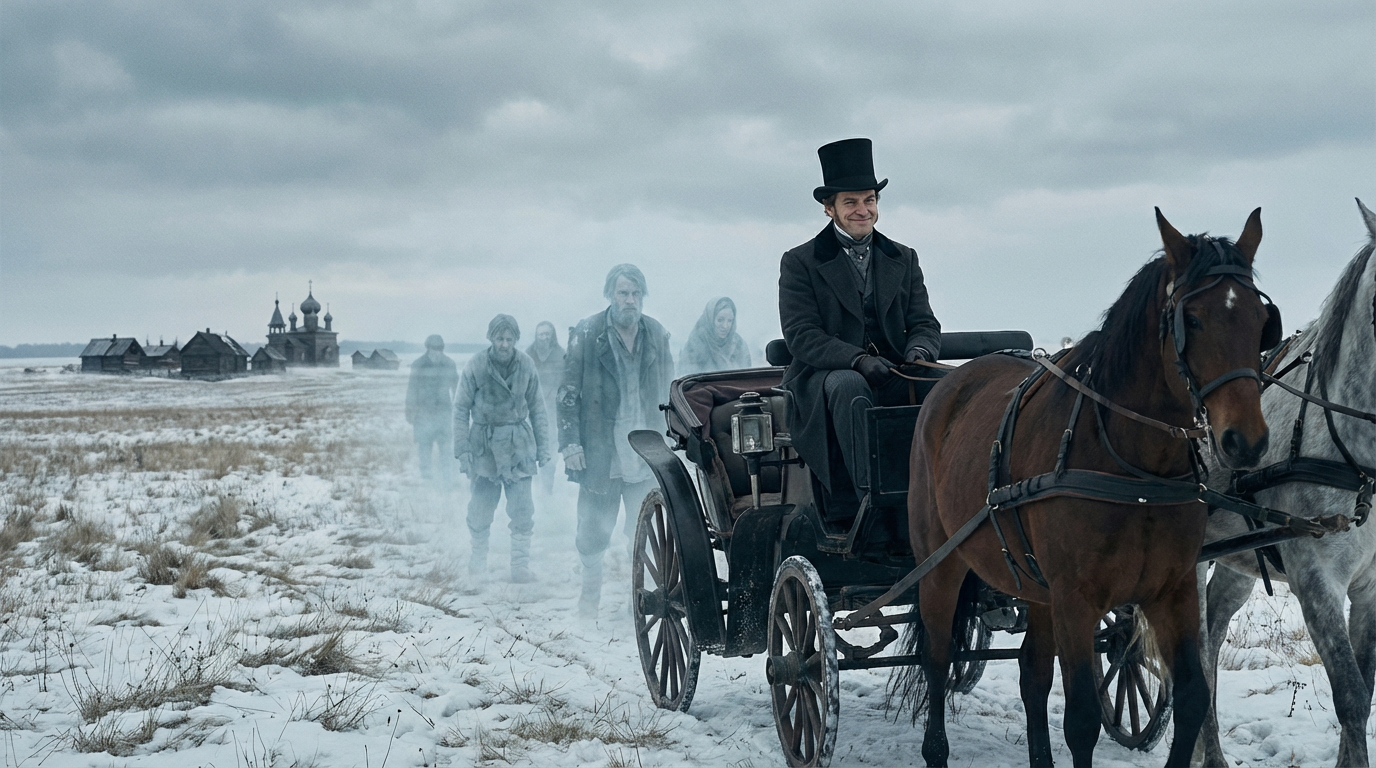
An excerpt from the original text.(complete · 7603 words)
hen Chichikov awoke he stretched himself and realised that he had slept
well. For a moment or two he lay on his back, and then suddenly clapped
his hands at the recollection that he was now owner of nearly four
hundred souls. At once he leapt out of bed without so much as glancing
at his face in the mirror, though, as a rule, he had much solicitude for
his features, and especially for his chin, of which he would make the
most when in company with friends, and more particularly should any one
happen to enter while he was engaged in the process of shaving. “Look
how round my chin is!” was his usual formula. On the present occasion,
however, he looked neither at chin nor at any other feature, but at once
donned his flower-embroidered slippers of morroco leather (the kind
of slippers in which, thanks to the Russian love for a dressing-gowned
existence, the town of Torzhok does such a huge trade), and, clad only
in a meagre shirt, so far forgot his elderliness and dignity as to cut
a couple of capers after the fashion of a Scottish highlander--alighting
neatly, each time, on the flat of his heels. Only when he had done that
did he proceed to business. Planting himself before his dispatch-box,
he rubbed his hands with a satisfaction worthy of an incorruptible rural
magistrate when adjourning for luncheon; after which he extracted from
the receptacle a bundle of papers. These he had decided not to deposit
with a lawyer, for the reason that he would hasten matters, as well as
save expense, by himself framing and fair-copying the necessary deeds
of indenture; and since he was thoroughly acquainted with the necessary
terminology, he proceeded to inscribe in large characters the date, and
then in smaller ones, his name and rank. By two o’clock the whole was
finished, and as he looked at the sheets of names representing bygone
peasants who had ploughed, worked at handicrafts, cheated their masters,
fetched, carried, and got drunk (though SOME of them may have behaved
well), there came over him a strange, unaccountable sensation. To his
eye each list of names seemed to possess a character of its own;
and even individual peasants therein seemed to have taken on certain
qualities peculiar to themselves. For instance, to the majority of
Madame Korobotchka’s serfs there were appended nicknames and other
additions; Plushkin’s list was distinguished by a conciseness of
exposition which had led to certain of the items being represented
merely by Christian name, patronymic, and a couple of dots;
and Sobakevitch’s list was remarkable for its amplitude and
circumstantiality, in that not a single peasant had such of his peculiar
characteristics omitted as that the deceased had been “excellent at
joinery,” or “sober and ready to pay attention to his work.” Also, in
Sobakevitch’s list there was recorded who had been the father and
the mother of each of the deceased, and how those parents had behaved
themselves. Only against the name of a certain Thedotov was there
inscribed: “Father unknown, Mother the maidservant Kapitolina, Morals
and Honesty good.” These details communicated to the document a certain
air of freshness, they seemed to connote that the peasants in question
had lived but yesterday. As Chichikov scanned the list he felt softened
in spirit, and said with a sigh:
“My friends, what a concourse of you is here! How did you all pass your
lives, my brethren? And how did you all come to depart hence?”
As he spoke his eyes halted at one name in particular--that of the same
Peter Saveliev Neuvazhai Korito who had once been the property of the
window Korobotchka. Once more he could not help exclaiming:
“What a series of titles! They occupy a whole line! Peter Saveliev, I
wonder whether you were an artisan or a plain muzhik. Also, I wonder how
you came to meet your end; whether in a tavern, or whether through going
to sleep in the middle of the road and being run over by a train of
waggons. Again, I see the name, ‘Probka Stepan, carpenter, very sober.’
That must be the hero of whom the Guards would have been so glad to get
hold. How well I can imagine him tramping the country with an axe in his
belt and his boots on his shoulder, and living on a few groats’-worth
of bread and dried fish per day, and taking home a couple of half-rouble
pieces in his purse, and sewing the notes into his breeches, or stuffing
them into his boots! In what manner came you by your end, Probka Stepan?
Did you, for good wages, mount a scaffold around the cupola of the
village church, and, climbing thence to the cross above, miss your
footing on a beam, and fall headlong with none at hand but Uncle
Michai--the good uncle who, scratching the back of his neck, and
muttering, ‘Ah, Vania, for once you have been too clever!’ straightway
lashed himself to a rope, and took your place? ‘Maksim Teliatnikov,
shoemaker.’ A shoemaker, indeed? ‘As drunk as a shoemaker,’ says the
proverb. I know what you were like, my friend. If you wish, I will
tell you your whole history. You were apprenticed to a German, who fed
you and your fellows at a common table, thrashed you with a strap,
kept you indoors whenever you had made a mistake, and spoke of you in
uncomplimentary terms to his wife and friends. At length, when your
apprenticeship was over, you said to yourself, ‘I am going to set up
on my own account, and not just to scrape together a kopeck here and a
kopeck there, as the Germans do, but to grow rich quick.’ Hence you took
a shop at a high rent, bespoke a few orders, and set to work to buy up
some rotten leather out of which you could make, on each pair of boots,
a double profit. But those boots split within a fortnight, and brought
down upon your head dire showers of maledictions; with the result that
gradually your shop grew empty of customers, and you fell to roaming
the streets and exclaiming, ‘The world is a very poor place indeed!
A Russian cannot make a living for German competition.’ Well, well!
‘Elizabeta Vorobei!’ But that is a WOMAN’S name! How comes SHE to be on
the list? That villain Sobakevitch must have sneaked her in without my
knowing it.”
“‘Grigori Goiezhai-ne-Doiedesh,’” he went on. “What sort of a man were
YOU, I wonder? Were you a carrier who, having set up a team of three
horses and a tilt waggon, left your home, your native hovel, for ever,
and departed to cart merchandise to market? Was it on the highway that
you surrendered your soul to God, or did your friends first marry you
to some fat, red-faced soldier’s daughter; after which your harness and
team of rough, but sturdy, horses caught a highwayman’s fancy, and you,
lying on your pallet, thought things over until, willy-nilly, you felt
that you must get up and make for the tavern, thereafter blundering into
an icehole? Ah, our peasant of Russia! Never do you welcome death when
it comes!”
“And you, my friends?” continued Chichikov, turning to the sheet whereon
were inscribed the names of Plushkin’s absconded serfs. “Although you
are still alive, what is the good of you? You are practically dead.
Whither, I wonder, have your fugitive feet carried you? Did you fare
hardly at Plushkin’s, or was it that your natural inclinations led you
to prefer roaming the wilds and plundering travellers? Are you, by this
time, in gaol, or have you taken service with other masters for the
tillage of their lands? ‘Eremei Kariakin, Nikita Volokita and Anton
Volokita (son of the foregoing).’ To judge from your surnames, you would
seem to have been born gadabouts [29]. ‘Popov, household serf.’ Probably
you are an educated man, good Popov, and go in for polite thieving, as
distinguished from the more vulgar cut-throat sort. In my mind’s eye I
seem to see a Captain of Rural Police challenging you for being without
a passport; whereupon you stake your all upon a single throw. ‘To whom
do you belong?’ asks the Captain, probably adding to his question a
forcible expletive. ‘To such and such a landowner,’ stoutly you reply.
‘And what are you doing here?’ continues the Captain. ‘I have
just received permission to go and earn my obrok,’ is your fluent
explanation. ‘Then where is your passport?’ ‘At Miestchanin [30]
Pimenov’s.’ ‘Pimenov’s? Then are you Pimenov himself?’ ‘Yes, I am
Pimenov himself.’ ‘He has given you his passport?’ ‘No, he has not given
me his passport.’ ‘Come, come!’ shouts the Captain with another forcible
expletive. ‘You are lying!’ ‘No, I am not,’ is your dogged reply. ‘It is
only that last night I could not return him his passport, because I came
home late; so I handed it to Antip Prochorov, the bell-ringer, for him
to take care of.’ ‘Bell-ringer, indeed! Then HE gave you a passport?’
‘No; I did not receive a passport from him either.’ ‘What?’--and here
the Captain shouts another expletive--‘How dare you keep on lying? Where
is YOUR OWN passport?’ ‘I had one all right,’ you reply cunningly, ‘but
must have dropped it somewhere on the road as I came along.’ ‘And what
about that soldier’s coat?’ asks the Captain with an impolite addition.
‘Whence did you get it? And what of the priest’s cashbox and copper
money?’’ ‘About them I know nothing,’ you reply doggedly. ‘Never at any
time have I committed a theft.’ ‘Then how is it that the coat was found
at your place?’ ‘I do not know. Probably some one else put it there.’
‘You rascal, you rascal!’ shouts the Captain, shaking his head, and
closing in upon you. ‘Put the leg-irons upon him, and off with him to
prison!’ ‘With pleasure,’ you reply as, taking a snuff-box from your
pocket, you offer a pinch to each of the two gendarmes who are manacling
you, while also inquiring how long they have been discharged from the
army, and in what wars they may have served. And in prison you remain
until your case comes on, when the justice orders you to be removed from
Tsarev-Kokshaika to such and such another prison, and a second justice
orders you to be transferred thence to Vesiegonsk or somewhere else, and
you go flitting from gaol to gaol, and saying each time, as you eye your
new habitation, ‘The last place was a good deal cleaner than this one
is, and one could play babki [31] there, and stretch one’s legs, and see
a little society.’”
“‘Abakum Thirov,’” Chichikov went on after a pause. “What of YOU,
brother? Where, and in what capacity, are YOU disporting yourself?
Have you gone to the Volga country, and become bitten with the life of
freedom, and joined the fishermen of the river?”
Here, breaking off, Chichikov relapsed into silent meditation. Of what
was he thinking as he sat there? Was he thinking of the fortunes of
Abakum Thirov, or was he meditating as meditates every Russian when his
thoughts once turn to the joys of an emancipated existence?
“Ah, well!” he sighed, looking at his watch. “It has now gone twelve
o’clock. Why have I so forgotten myself? There is still much to be done,
yet I go shutting myself up and letting my thoughts wander! What a fool
I am!”
So saying, he exchanged his Scottish costume (of a shirt and nothing
else) for attire of a more European nature; after which he pulled
tight the waistcoat over his ample stomach, sprinkled himself with
eau-de-Cologne, tucked his papers under his arm, took his fur cap, and
set out for the municipal offices, for the purpose of completing the
transfer of souls. The fact that he hurried along was not due to a fear
of being late (seeing that the President of the Local Council was an
intimate acquaintance of his, as well as a functionary who could shorten
or prolong an interview at will, even as Homer’s Zeus was able to
shorten or to prolong a night or a day, whenever it became necessary to
put an end to the fighting of his favourite heroes, or to enable them
to join battle), but rather to a feeling that he would like to have the
affair concluded as quickly as possible, seeing that, throughout, it had
been an anxious and difficult business. Also, he could not get rid of
the idea that his souls were unsubstantial things, and that therefore,
under the circumstances, his shoulders had better be relieved of their
load with the least possible delay. Pulling on his cinnamon-coloured,
bear-lined overcoat as he went, he had just stepped thoughtfully into
the street when he collided with a gentleman dressed in a similar
coat and an ear-lappeted fur cap. Upon that the gentleman uttered an
exclamation. Behold, it was Manilov! At once the friends became folded
in a strenuous embrace, and remained so locked for fully five minutes.
Indeed, the kisses exchanged were so vigorous that both suffered from
toothache for the greater portion of the day. Also, Manilov’s delight
was such that only his nose and lips remained visible--the eyes
completely disappeared. Afterwards he spent about a quarter of an hour
in holding Chichikov’s hand and chafing it vigorously. Lastly, he, in
the most pleasant and exquisite terms possible, intimated to his friend
that he had just been on his way to embrace Paul Ivanovitch; and upon
this followed a compliment of the kind which would more fittingly have
been addressed to a lady who was being asked to accord a partner the
favour of a dance. Chichikov had opened his mouth to reply--though
even HE felt at a loss how to acknowledge what had just been said--when
Manilov cut him short by producing from under his coat a roll of paper
tied with red riband.
“What have you there?” asked Chichikov.
“The list of my souls.”
“Ah!” And as Chichikov unrolled the document and ran his eye over it
he could not but marvel at the elegant neatness with which it had been
inscribed.
“It is a beautiful piece of writing,” he said. “In fact, there will be
no need to make a copy of it. Also, it has a border around its edge! Who
worked that exquisite border?”
“Do not ask me,” said Manilov.
“Did YOU do it?”
“No; my wife.”
“Dear, dear!” Chichikov cried. “To think that I should have put her to
so much trouble!”
“NOTHING could be too much trouble where Paul Ivanovitch is concerned.”
Chichikov bowed his acknowledgements. Next, on learning that he was
on his way to the municipal offices for the purpose of completing the
transfer, Manilov expressed his readiness to accompany him; wherefore
the pair linked arm in arm and proceeded together. Whenever they
encountered a slight rise in the ground--even the smallest unevenness
or difference of level--Manilov supported Chichikov with such energy as
almost to lift him off his feet, while accompanying the service with a
smiling implication that not if HE could help it should Paul Ivanovitch
slip or fall. Nevertheless this conduct appeared to embarrass Chichikov,
either because he could not find any fitting words of gratitude or
because he considered the proceeding tiresome; and it was with a
sense of relief that he debouched upon the square where the municipal
offices--a large, three-storied building of a chalky whiteness which
probably symbolised the purity of the souls engaged within--were
situated. No other building in the square could vie with them in size,
seeing that the remaining edifices consisted only of a sentry-box, a
shelter for two or three cabmen, and a long hoarding--the latter adorned
with the usual bills, posters, and scrawls in chalk and charcoal. At
intervals, from the windows of the second and third stories of the
municipal offices, the incorruptible heads of certain of the attendant
priests of Themis would peer quickly forth, and as quickly disappear
again--probably for the reason that a superior official had just entered
the room. Meanwhile the two friends ascended the staircase--nay, almost
flew up it, since, longing to get rid of Manilov’s ever-supporting
arm, Chichikov hastened his steps, and Manilov kept darting forward to
anticipate any possible failure on the part of his companion’s legs.
Consequently the pair were breathless when they reached the first
corridor. In passing it may be remarked that neither corridors nor rooms
evinced any of that cleanliness and purity which marked the exterior of
the building, for such attributes were not troubled about within, and
anything that was dirty remained so, and donned no meritricious, purely
external, disguise. It was as though Themis received her visitors in
neglige and a dressing-gown. The author would also give a description of
the various offices through which our hero passed, were it not that he
(the author) stands in awe of such legal haunts.
Approaching the first desk which he happened to encounter, Chichikov
inquired of the two young officials who were seated at it whether they
would kindly tell him where business relating to serf-indenture was
transacted.
“Of what nature, precisely, IS your business?” countered one of the
youthful officials as he turned himself round.
“I desire to make an application.”
“In connection with a purchase?”
“Yes. But, as I say, I should like first to know where I can find the
desk devoted to such business. Is it here or elsewhere?”
“You must state what it is you have bought, and for how much. THEN we
shall be happy to give you the information.”
Chichikov perceived that the officials’ motive was merely one of
curiosity, as often happens when young tchinovniks desire to cut a more
important and imposing figure than is rightfully theirs.
“Look here, young sirs,” he said. “I know for a fact that all serf
business, no matter to what value, is transacted at one desk alone.
Consequently I again request you to direct me to that desk. Of course,
if you do not know your business I can easily ask some one else.”
To this the tchinovniks made no reply beyond pointing towards a corner
of the room where an elderly man appeared to be engaged in sorting some
papers. Accordingly Chichikov and Manilov threaded their way in his
direction through the desks; whereupon the elderly man became violently
busy.
“Would you mind telling me,” said Chichikov, bowing, “whether this is
the desk for serf affairs?”
The elderly man raised his eyes, and said stiffly:
“This is NOT the desk for serf affairs.”
“Where is it, then?”
“In the Serf Department.”
“And where might the Serf Department be?”
“In charge of Ivan Antonovitch.”
“And where is Ivan Antonovitch?”
The elderly man pointed to another corner of the room; whither
Chichikov and Manilov next directed their steps. As they advanced, Ivan
Antonovitch cast an eye backwards and viewed them askance. Then, with
renewed ardour, he resumed his work of writing.
“Would you mind telling me,” said Chichikov, bowing, “whether this is
the desk for serf affairs?”
It appeared as though Ivan Antonovitch had not heard, so completely did
he bury himself in his papers and return no reply. Instantly it became
plain that HE at least was of an age of discretion, and not one of your
jejune chatterboxes and harum-scarums; for, although his hair was still
thick and black, he had long ago passed his fortieth year. His whole
face tended towards the nose--it was what, in common parlance, is known
as a “pitcher-mug.”
“Would you mind telling me,” repeated Chichikov, “whether this is the
desk for serf affairs?”
“It is that,” said Ivan Antonovitch, again lowering his jug-shaped jowl,
and resuming his writing.
“Then I should like to transact the following business. From various
landowners in this canton I have purchased a number of peasants for
transfer. Here is the purchase list, and it needs but to be registered.”
“Have you also the vendors here?”
“Some of them, and from the rest I have obtained powers of attorney.”
“And have you your statement of application?”
“Yes. I desire--indeed, it is necessary for me so to do--to hasten
matters a little. Could the affair, therefore, be carried through
to-day?”
“To-day? Oh, dear no!” said Ivan Antonovitch. “Before that can be done
you must furnish me with further proofs that no impediments exist.”
“Then, to expedite matters, let me say that Ivan Grigorievitch, the
President of the Council, is a very intimate friend of mine.”
“Possibly,” said Ivan Antonovitch without enthusiasm. “But Ivan
Grigorievitch alone will not do--it is customary to have others as
well.”
“Yes, but the absence of others will not altogether invalidate the
transaction. I too have been in the service, and know how things can be
done.”
“You had better go and see Ivan Grigorievitch,” said Ivan Antonovitch
more mildly. “Should he give you an order addressed to whom it may
concern, we shall soon be able to settle the matter.”
Upon that Chichikov pulled from his pocket a paper, and laid it before
Ivan Antonovitch. At once the latter covered it with a book. Chichikov
again attempted to show it to him, but, with a movement of his head,
Ivan Antonovitch signified that that was unnecessary.
“A clerk,” he added, “will now conduct you to Ivan Grigorievitch’s
room.”
Upon that one of the toilers in the service of Themis--a zealot who
had offered her such heartfelt sacrifice that his coat had burst at the
elbows and lacked a lining--escorted our friends (even as Virgil had
once escorted Dante) to the apartment of the Presence. In this sanctum
were some massive armchairs, a table laden with two or three fat books,
and a large looking-glass. Lastly, in (apparently) sunlike isolation,
there was seated at the table the President. On arriving at the door of
the apartment, our modern Virgil seemed to have become so overwhelmed
with awe that, without daring even to intrude a foot, he turned back,
and, in so doing, once more exhibited a back as shiny as a mat, and
having adhering to it, in one spot, a chicken’s feather. As soon as the
two friends had entered the hall of the Presence they perceived that the
President was NOT alone, but, on the contrary, had seated by his side
Sobakevitch, whose form had hitherto been concealed by the intervening
mirror. The newcomers’ entry evoked sundry exclamations and the
pushing back of a pair of Government chairs as the voluminous-sleeved
Sobakevitch rose into view from behind the looking-glass. Chichikov
the President received with an embrace, and for a while the hall of
the Presence resounded with osculatory salutations as mutually the pair
inquired after one another’s health. It seemed that both had lately
had a touch of that pain under the waistband which comes of a sedentary
life. Also, it seemed that the President had just been conversing with
Sobakevitch on the subject of sales of souls, since he now proceeded
to congratulate Chichikov on the same--a proceeding which rather
embarrassed our hero, seeing that Manilov and Sobakevitch, two of
the vendors, and persons with whom he had bargained in the strictest
privacy, were now confronting one another direct. However, Chichikov
duly thanked the President, and then, turning to Sobakevitch, inquired
after HIS health.
“Thank God, I have nothing to complain of,” replied Sobakevitch: which
was true enough, seeing that a piece of iron would have caught cold and
taken to sneezing sooner than would that uncouthly fashioned landowner.
“Ah, yes; you have always had good health, have you not?” put in the
President. “Your late father was equally strong.”
“Yes, he even went out bear hunting alone,” replied Sobakevitch.
“I should think that you too could worst a bear if you were to try a
tussle with him,” rejoined the President.
“Oh no,” said Sobakevitch. “My father was a stronger man than I am.”
Then with a sigh the speaker added: “But nowadays there are no such men
as he. What is even a life like mine worth?”
“Then you do not have a comfortable time of it?” exclaimed the
President.
“No; far from it,” rejoined Sobakevitch, shaking his head. “Judge for
yourself, Ivan Grigorievitch. I am fifty years old, yet never in my life
had been ill, except for an occasional carbuncle or boil. That is not a
good sign. Sooner or later I shall have to pay for it.” And he relapsed
into melancholy.
“Just listen to the fellow!” was Chichikov’s and the President’s joint
inward comment. “What on earth has HE to complain of?”
“I have a letter for you, Ivan Grigorievitch,” went on Chichikov aloud
as he produced from his pocket Plushkin’s epistle.
“From whom?” inquired the President. Having broken the seal, he
exclaimed: “Why, it is from Plushkin! To think that HE is still alive!
What a strange world it is! He used to be such a nice fellow, and now--”
“And now he is a cur,” concluded Sobakevitch, “as well as a miser who
starves his serfs to death.”
“Allow me a moment,” said the President. Then he read the letter
through. When he had finished he added: “Yes, I am quite ready to act
as Plushkin’s attorney. When do you wish the purchase deeds to be
registered, Monsieur Chichikov--now or later?”
“Now, if you please,” replied Chichikov. “Indeed, I beg that, if
possible, the affair may be concluded to-day, since to-morrow I wish to
leave the town. I have brought with me both the forms of indenture and
my statement of application.”
“Very well. Nevertheless we cannot let you depart so soon. The
indentures shall be completed to-day, but you must continue your sojourn
in our midst. I will issue the necessary orders at once.”
So saying, he opened the door into the general office, where the clerks
looked like a swarm of bees around a honeycomb (if I may liken affairs
of Government to such an article?).
“Is Ivan Antonovitch here?” asked the President.
“Yes,” replied a voice from within.
“Then send him here.”
Upon that the pitcher-faced Ivan Antonovitch made his appearance in the
doorway, and bowed.
“Take these indentures, Ivan Antonovitch,” said the President, “and see
that they--”
“But first I would ask you to remember,” put in Sobakevitch, “that
witnesses ought to be in attendance--not less than two on behalf of
either party. Let us, therefore, send for the Public Prosecutor, who has
little to do, and has even that little done for him by his chief clerk,
Zolotucha. The Inspector of the Medical Department is also a man of
leisure, and likely to be at home--if he has not gone out to a card
party. Others also there are--all men who cumber the ground for
nothing.”
“Quite so, quite so,” agreed the President, and at once dispatched a
clerk to fetch the persons named.
“Also,” requested Chichikov, “I should be glad if you would send for the
accredited representative of a certain lady landowner with whom I have
done business. He is the son of a Father Cyril, and a clerk in your
offices.”
“Certainly we shall call him here,” replied the President. “Everything
shall be done to meet your convenience, and I forbid you to present any
of our officials with a gratuity. That is a special request on my part.
No friend of mine ever pays a copper.”
With that he gave Ivan Antonovitch the necessary instructions; and
though they scarcely seemed to meet with that functionary’s approval,
upon the President the purchase deeds had evidently produced an
excellent impression, more especially since the moment when he had
perceived the sum total to amount to nearly a hundred thousand roubles.
For a moment or two he gazed into Chichikov’s eyes with an expression of
profound satisfaction. Then he said:
“Well done, Paul Ivanovitch! You have indeed made a nice haul!”
“That is so,” replied Chichikov.
“Excellent business! Yes, excellent business!”
“I, too, conceive that I could not well have done better. The truth is
that never until a man has driven home the piles of his life’s structure
upon a lasting bottom, instead of upon the wayward chimeras of youth,
will his aims in life assume a definite end.” And, that said, Chichikov
went on to deliver himself of a very telling indictment of Liberalism
and our modern young men. Yet in his words there seemed to lurk a
certain lack of conviction. Somehow he seemed secretly to be saying to
himself, “My good sir, you are talking the most absolute rubbish, and
nothing but rubbish.” Nor did he even throw a glance at Sobakevitch and
Manilov. It was as though he were uncertain what he might not encounter
in their expression. Yet he need not have been afraid. Never once did
Sobakevitch’s face move a muscle, and, as for Manilov, he was too much
under the spell of Chichikov’s eloquence to do aught beyond nod his
approval at intervals, and strike the kind of attitude which is assumed
by lovers of music when a lady singer has, in rivalry of an accompanying
violin, produced a note whereof the shrillness would exceed even the
capacity of a bird’s throstle.
“But why not tell Ivan Grigorievitch precisely what you have bought?”
inquired Sobakevitch of Chichikov. “And why, Ivan Grigorievitch, do YOU
not ask Monsieur Chichikov precisely what his purchases have consisted
of? What a splendid lot of serfs, to be sure! I myself have sold him my
wheelwright, Michiev.”
“What? You have sold him Michiev?” exclaimed the President. “I know the
man well. He is a splendid craftsman, and, on one occasion, made me a
drozhki [32]. Only, only--well, lately didn’t you tell me that he is
dead?”
“That Michiev is dead?” re-echoed Sobakevitch, coming perilously near
to laughing. “Oh dear no! That was his brother. Michiev himself is very
much alive, and in even better health than he used to be. Any day he
could knock you up a britchka such as you could not procure even in
Moscow. However, he is now bound to work for only one master.”
“Indeed a splendid craftsman!” repeated the President. “My only wonder
is that you can have brought yourself to part with him.”
“Then think you that Michiev is the ONLY serf with whom I have parted?
Nay, for I have parted also with Probka Stepan, my carpenter, with
Milushkin, my bricklayer, and with Teliatnikov, my bootmaker. Yes, the
whole lot I have sold.”
And to the President’s inquiry why he had so acted, seeing that the
serfs named were all skilled workers and indispensable to a household,
Sobakevitch replied that a mere whim had led him to do so, and thus the
sale had owed its origin to a piece of folly. Then he hung his head as
though already repenting of his rash act, and added:
“Although a man of grey hairs, I have not yet learned wisdom.”
“But,” inquired the President further, “how comes it about, Paul
Ivanovitch, that you have purchased peasants apart from land? Is it for
transferment elsewhere that you need them?”
“Yes.”
“Very well, then. That is quite another matter. To what province of the
country?”
“To the province of Kherson.”
“Indeed? That region contains some splendid land,” said the President;
whereupon he proceeded to expatiate on the fertility of the Kherson
pastures.
“And have you MUCH land there?” he continued.
“Yes; quite sufficient to accommodate the serfs whom I have purchased.”
“And is there a river on the estate or a lake?”
“Both.”
After this reply Chichikov involuntarily threw a glance at Sobakevitch;
and though that landowner’s face was as motionless as every other, the
other seemed to detect in it: “You liar! Don’t tell ME that you own both
a river and a lake, as well as the land which you say you do.”
Whilst the foregoing conversation had been in progress, various
witnesses had been arriving on the scene. They consisted of the
constantly blinking Public Prosecutor, the Inspector of the Medical
Department, and others--all, to quote Sobakevitch, “men who cumbered
the ground for nothing.” With some of them, however, Chichikov was
altogether unacquainted, since certain substitutes and supernumeraries
had to be pressed into the service from among the ranks of the
subordinate staff. There also arrived, in answer to the summons, not
only the son of Father Cyril before mentioned, but also Father Cyril
himself. Each such witness appended to his signature a full list of his
dignities and qualifications: one man in printed characters, another in
a flowing hand, a third in topsy-turvy characters of a kind never before
seen in the Russian alphabet, and so forth. Meanwhile our friend Ivan
Antonovitch comported himself with not a little address; and after the
indentures had been signed, docketed, and registered, Chichikov
found himself called upon to pay only the merest trifle in the way of
Government percentage and fees for publishing the transaction in the
Official Gazette. The reason of this was that the President had given
orders that only half the usual charges were to be exacted from the
present purchaser--the remaining half being somehow debited to the
account of another applicant for serf registration.
“And now,” said Ivan Grigorievitch when all was completed, “we need only
to wet the bargain.”
“For that too I am ready,” said Chichikov. “Do you but name the hour.
If, in return for your most agreeable company, I were not to set a few
champagne corks flying, I should be indeed in default.”
“But we are not going to let you charge yourself with anything
whatsoever. WE must provide the champagne, for you are our guest, and
it is for us--it is our duty, it is our bounden obligation--to entertain
you. Look here, gentlemen. Let us adjourn to the house of the Chief
of Police. He is the magician who needs but to wink when passing a
fishmonger’s or a wine merchant’s. Not only shall we fare well at his
place, but also we shall get a game of whist.”
To this proposal no one had any objection to offer, for the mere mention
of the fish shop aroused the witnesses’ appetite. Consequently, the
ceremony being over, there was a general reaching for hats and caps.
As the party were passing through the general office, Ivan Antonovitch
whispered in Chichikov’s ear, with a courteous inclination of his
jug-shaped physiognomy:
“You have given a hundred thousand roubles for the serfs, but have paid
ME only a trifle for my trouble.”
“Yes,” replied Chichikov with a similar whisper, “but what sort of serfs
do you suppose them to be? They are a poor, useless lot, and not worth
even half the purchase money.”
This gave Ivan Antonovitch to understand that the visitor was a man of
strong character--a man from whom nothing more was to be expected.
“Why have you gone and purchased souls from Plushkin?” whispered
Sobakevitch in Chichikov’s other ear.
“Why did YOU go and add the woman Vorobei to your list?” retorted
Chichikov.
“Vorobei? Who is Vorobei?”
“The woman ‘Elizabet’ Vorobei--‘Elizabet,’ not ‘Elizabeta?’”
“I added no such name,” replied Sobakevitch, and straightway joined the
other guests.
At length the party arrived at the residence of the Chief of Police. The
latter proved indeed a man of spells, for no sooner had he learnt what
was afoot than he summoned a brisk young constable, whispered in his
ear, adding laconically, “You understand, do you not?” and brought it
about that, during the time that the guests were cutting for partners at
whist in an adjoining room, the dining-table became laden with sturgeon,
caviare, salmon, herrings, cheese, smoked tongue, fresh roe, and a
potted variety of the same--all procured from the local fish market, and
reinforced with additions from the host’s own kitchen. The fact was that
the worthy Chief of Police filled the office of a sort of father and
general benefactor to the town, and that he moved among the citizens as
though they constituted part and parcel of his own family, and watched
over their shops and markets as though those establishments were
merely his own private larder. Indeed, it would be difficult to say--so
thoroughly did he perform his duties in this respect--whether the post
most fitted him, or he the post. Matters were also so arranged that
though his income more than doubled that of his predecessors, he had
never lost the affection of his fellow townsmen. In particular did the
tradesmen love him, since he was never above standing godfather to their
children or dining at their tables. True, he had differences of opinion
with them, and serious differences at that; but always these were
skilfully adjusted by his slapping the offended ones jovially on the
shoulder, drinking a glass of tea with them, promising to call at their
houses and play a game of chess, asking after their belongings, and,
should he learn that a child of theirs was ill, prescribing the proper
medicine. In short, he bore the reputation of being a very good fellow.
On perceiving the feast to be ready, the host proposed that his guests
should finish their whist after luncheon; whereupon all proceeded to the
room whence for some time past an agreeable odour had been tickling the
nostrils of those present, and towards the door of which Sobakevitch in
particular had been glancing since the moment when he had caught sight
of a huge sturgeon reposing on the sideboard. After a glassful of warm,
olive-coloured vodka apiece--vodka of the tint to be seen only in the
species of Siberian stone whereof seals are cut--the company applied
themselves to knife-and-fork work, and, in so doing, evinced their
several characteristics and tastes. For instance, Sobakevitch,
disdaining lesser trifles, tackled the large sturgeon, and, during the
time that his fellow guests were eating minor comestibles, and drinking
and talking, contrived to consume more than a quarter of the whole fish;
so that, on the host remembering the creature, and, with fork in hand,
leading the way in its direction and saying, “What, gentlemen, think you
of this striking product of nature?” there ensued the discovery that of
the said product of nature there remained little beyond the tail, while
Sobakevitch, with an air as though at least HE had not eaten it, was
engaged in plunging his fork into a much more diminutive piece of fish
which happened to be resting on an adjacent platter. After his divorce
from the sturgeon, Sobakevitch ate and drank no more, but sat frowning
and blinking in an armchair.
Apparently the host was not a man who believed in sparing the wine, for
the toasts drunk were innumerable. The first toast (as the reader may
guess) was quaffed to the health of the new landowner of Kherson; the
second to the prosperity of his peasants and their safe transferment;
and the third to the beauty of his future wife--a compliment which
brought to our hero’s lips a flickering smile. Lastly, he received from
the company a pressing, as well as an unanimous, invitation to extend
his stay in town for at least another fortnight, and, in the meanwhile,
to allow a wife to be found for him.
“Quite so,” agreed the President. “Fight us tooth and nail though you
may, we intend to have you married. You have happened upon us by chance,
and you shall have no reason to repent of it. We are in earnest on this
subject.”
“But why should I fight you tooth and nail?” said Chichikov, smiling.
“Marriage would not come amiss to me, were I but provided with a
betrothed.”
“Then a betrothed you shall have. Why not? We will do as you wish.”
“Very well,” assented Chichikov.
“Bravo, bravo!” the company shouted. “Long live Paul Ivanovitch! Hurrah!
Hurrah!” And with that every one approached to clink glasses with him,
and he readily accepted the compliment, and accepted it many times in
succession. Indeed, as the hours passed on, the hilarity of the company
increased yet further, and more than once the President (a man of great
urbanity when thoroughly in his cups) embraced the chief guest of the
day with the heartfelt words, “My dearest fellow! My own most precious
of friends!” Nay, he even started to crack his fingers, to dance around
Chichikov’s chair, and to sing snatches of a popular song. To the
champagne succeeded Hungarian wine, which had the effect of still
further heartening and enlivening the company. By this time every
one had forgotten about whist, and given himself up to shouting and
disputing. Every conceivable subject was discussed, including politics
and military affairs; and in this connection guests voiced jejune
opinions for the expression of which they would, at any other time, have
soundly spanked their offspring. Chichikov, like the rest, had never
before felt so gay, and, imagining himself really and truly to be a
landowner of Kherson, spoke of various improvements in agriculture, of
the three-field system of tillage [33], and of the beatific felicity of
a union between two kindred souls. Also, he started to recite poetry to
Sobakevitch, who blinked as he listened, for he greatly desired to go to
sleep. At length the guest of the evening realised that matters had gone
far enough, so begged to be given a lift home, and was accommodated with
the Public Prosecutor’s drozhki. Luckily the driver of the vehicle was
a practised man at his work, for, while driving with one hand, he
succeeded in leaning backwards and, with the other, holding Chichikov
securely in his place. Arrived at the inn, our hero continued babbling
awhile about a flaxen-haired damsel with rosy lips and a dimple in her
right cheek, about villages of his in Kherson, and about the amount of
his capital. Nay, he even issued seignorial instructions that Selifan
should go and muster the peasants about to be transferred, and make a
complete and detailed inventory of them. For a while Selifan listened
in silence; then he left the room, and instructed Petrushka to help the
barin to undress. As it happened, Chichikov’s boots had no sooner
been removed than he managed to perform the rest of his toilet without
assistance, to roll on to the bed (which creaked terribly as he did so),
and to sink into a sleep in every way worthy of a landowner of Kherson.
Meanwhile Petrushka had taken his master’s coat and trousers of
bilberry-coloured check into the corridor; where, spreading them over a
clothes’ horse, he started to flick and to brush them, and to fill the
whole corridor with dust. Just as he was about to replace them in his
master’s room he happened to glance over the railing of the gallery, and
saw Selifan returning from the stable. Glances were exchanged, and in
an instant the pair had arrived at an instinctive understanding--an
understanding to the effect that the barin was sound asleep, and that
therefore one might consider one’s own pleasure a little. Accordingly
Petrushka proceeded to restore the coat and trousers to their appointed
places, and then descended the stairs; whereafter he and Selifan left
the house together. Not a word passed between them as to the object
of their expedition. On the contrary, they talked solely of extraneous
subjects. Yet their walk did not take them far; it took them only to
the other side of the street, and thence into an establishment which
immediately confronted the inn. Entering a mean, dirty courtyard covered
with glass, they passed thence into a cellar where a number of customers
were seated around small wooden tables. What thereafter was done by
Selifan and Petrushka God alone knows. At all events, within an hour’s
time they issued, arm in arm, and in profound silence, yet remaining
markedly assiduous to one another, and ever ready to help one another
around an awkward corner. Still linked together--never once releasing
their mutual hold--they spent the next quarter of an hour in attempting
to negotiate the stairs of the inn; but at length even that ascent had
been mastered, and they proceeded further on their way. Halting
before his mean little pallet, Petrushka stood awhile in thought. His
difficulty was how best to assume a recumbent position. Eventually he
lay down on his face, with his legs trailing over the floor; after which
Selifan also stretched himself upon the pallet, with his head resting
upon Petrushka’s stomach, and his mind wholly oblivious of the fact that
he ought not to have been sleeping there at all, but in the servant’s
quarters, or in the stable beside his horses. Scarcely a moment had
passed before the pair were plunged in slumber and emitting the most
raucous snores; to which their master (next door) responded with snores
of a whistling and nasal order. Indeed, before long every one in the
inn had followed their soothing example, and the hostelry lay plunged
in complete restfulness. Only in the window of the room of the
newly-arrived lieutenant from Riazan did a light remain burning.
Evidently he was a devotee of boots, for he had purchased four pairs,
and was now trying on a fifth. Several times he approached the bed with
a view to taking off the boots and retiring to rest; but each time he
failed, for the reason that the boots were so alluring in their make
that he had no choice but to lift up first one foot, and then the other,
for the purpose of scanning their elegant welts.
Master this chapter. Complete your experience
Purchase the complete book to access all chapters and support classic literature
As an Amazon Associate, we earn a small commission from qualifying purchases at no additional cost to you.
Available in paperback, hardcover, and e-book formats
Let's Analyse the Pattern
Success built on lies gradually corrupts the liar as external validation makes the deception feel increasingly real.
Why This Matters
Connect literature to life
This chapter teaches how to recognize when you're getting high off validation for things that aren't real achievements.
Practice This Today
This week, notice when praise feels too easy or when you find yourself believing your own exaggerations—that's your warning signal to reality-check with someone who'll tell you the truth.
Now let's explore the literary elements.
Key Quotes & Analysis
"Look how round my chin is!"
Context: His usual vanity routine, which he skips today because he's too excited about his scheme
Shows how success (even fake success) changes people's priorities. Chichikov is usually obsessed with his appearance, but now he's focused on his business triumph.
In Today's Words:
Check out how good I look today!
"These he had decided not to transfer until he had satisfied himself as to their genuineness"
Context: Chichikov examining the paperwork for his purchased dead souls
Ironic that he's checking the 'genuineness' of a completely fraudulent transaction. Shows how people can convince themselves their dishonest schemes have legitimate aspects.
In Today's Words:
He wanted to make sure his fake deal looked real
"What deaths they had died! What lives they had lived!"
Context: His brief moment of genuine emotion while reading the names of deceased serfs
A rare glimpse of Chichikov's humanity as he imagines the real people behind his paperwork. Shows that even con artists can have moments of genuine feeling.
In Today's Words:
These were real people with real stories
Thematic Threads
Deception
In This Chapter
Chichikov's scheme succeeds so well he starts believing his own lies about being a landowner
Development
Evolved from simple fraud to self-deception—he's now fooling himself as much as others
In Your Life:
You might catch yourself starting to believe the version of yourself you present to get ahead
Social Validation
In This Chapter
The officials eagerly celebrate Chichikov's 'success' and offer to find him a wife
Development
Shows how society rewards what it wants to believe, regardless of truth
In Your Life:
You might notice how people around you validate stories they want to be true
Bureaucracy
In This Chapter
The legal transfer proceeds smoothly through bribes and connections despite being fraudulent
Development
Demonstrates how systems can be corrupted when everyone benefits from looking the other way
In Your Life:
You might see how institutional processes can be bent when the right people are motivated
Class Performance
In This Chapter
Chichikov performs the role of successful landowner so convincingly that society accepts him
Development
Shows how class identity can be performed and purchased rather than earned
In Your Life:
You might recognize how you perform a certain social status that doesn't match your reality
Moral Corruption
In This Chapter
Chichikov's brief moment of humanity (feeling for the dead serfs) is quickly overwhelmed by greed
Development
His capacity for genuine feeling is being eroded by his pursuit of false success
In Your Life:
You might notice how pursuing the wrong kind of success can numb your better instincts
You now have the context. Time to form your own thoughts.
Discussion Questions
- 1
Why does Chichikov dance around his room after buying dead souls, and what does this reveal about his mental state?
analysis • surface - 2
How do the government officials react to Chichikov's transaction, and what does this tell us about the system they work in?
analysis • medium - 3
Where do you see people today getting caught up in believing their own lies or exaggerations?
application • medium - 4
What warning signs should someone watch for when they start believing their own performance or hype?
application • deep - 5
Why do people sometimes choose to believe profitable lies rather than inconvenient truths?
reflection • deep
Critical Thinking Exercise
Map Your Own Reality Checks
Think about an area of your life where you might be tempted to exaggerate or where others give you praise that feels too easy. Write down three people who would tell you the honest truth about this situation, and one specific question you could ask them to get real feedback. Then consider: what would you do if their answer wasn't what you wanted to hear?
Consider:
- •Look for areas where you get praise that feels unearned or too easy
- •Consider who in your life has both the knowledge and courage to give you honest feedback
- •Think about whether you're ready to hear difficult truths or if you're just looking for validation
Journaling Prompt
Write about a time when you realized you had been believing your own hype or when someone helped you see a blind spot. How did it feel, and what did you learn about staying grounded?
Coming Up Next...
Chapter 8: The Millionaire's Downfall at the Ball
Word of Chichikov's unusual purchases begins to spread through town, sparking curiosity and speculation. Some citizens grow concerned enough to suggest he needs an armed escort for his 'peasants,' but bigger revelations about his scheme may be brewing as the community starts asking harder questions.



