
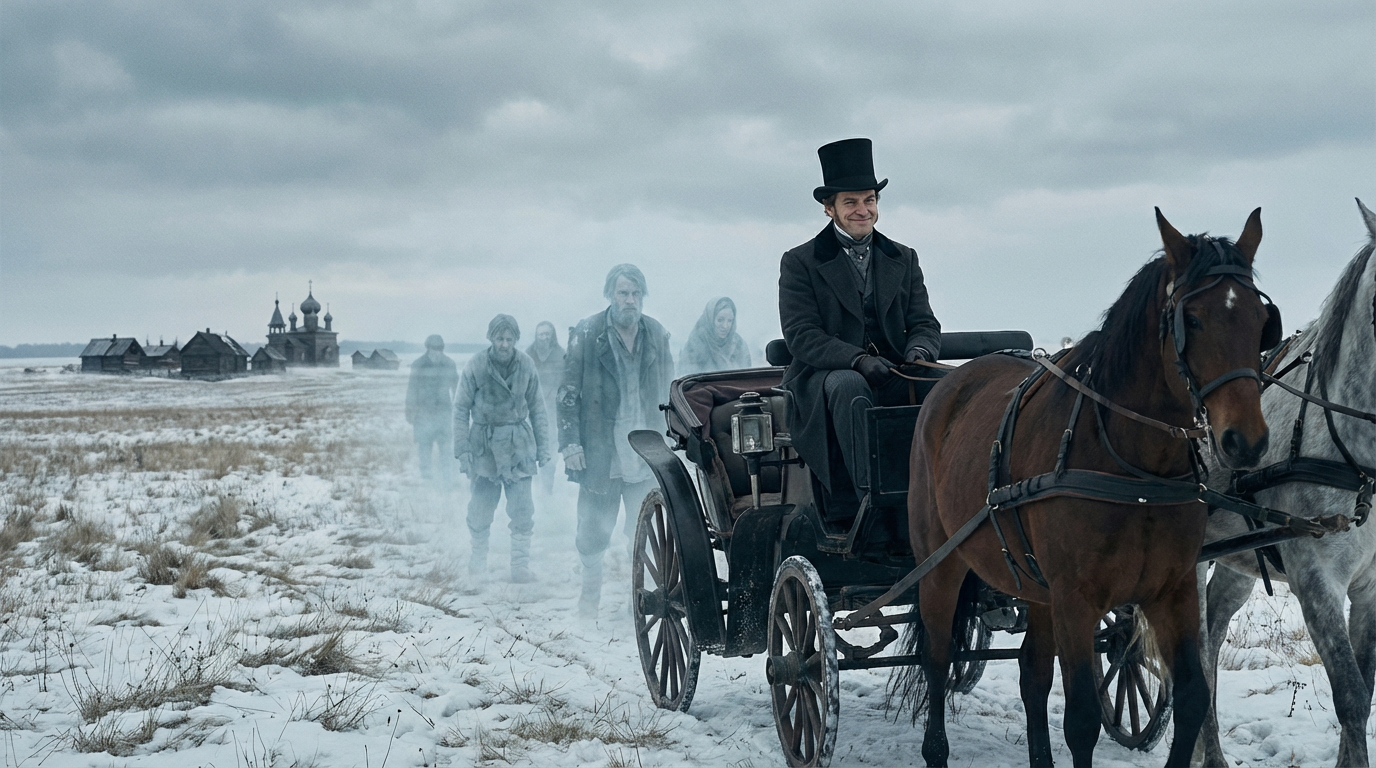
An excerpt from the original text.(complete · 5609 words)
hichikov’s amusement at the peasant’s outburst prevented him from
noticing that he had reached the centre of a large and populous village;
but, presently, a violent jolt aroused him to the fact that he was
driving over wooden pavements of a kind compared with which the
cobblestones of the town had been as nothing. Like the keys of a piano,
the planks kept rising and falling, and unguarded passage over them
entailed either a bump on the back of the neck or a bruise on the
forehead or a bite on the tip of one’s tongue. At the same time
Chichikov noticed a look of decay about the buildings of the village.
The beams of the huts had grown dark with age, many of their roofs were
riddled with holes, others had but a tile of the roof remaining, and yet
others were reduced to the rib-like framework of the same. It would
seem as though the inhabitants themselves had removed the laths and
traverses, on the very natural plea that the huts were no protection
against the rain, and therefore, since the latter entered in bucketfuls,
there was no particular object to be gained by sitting in such huts when
all the time there was the tavern and the highroad and other places to
resort to.
Suddenly a woman appeared from an outbuilding--apparently the
housekeeper of the mansion, but so roughly and dirtily dressed as almost
to seem indistinguishable from a man. Chichikov inquired for the master
of the place.
“He is not at home,” she replied, almost before her interlocutor had had
time to finish. Then she added: “What do you want with him?”
“I have some business to do,” said Chichikov.
“Then pray walk into the house,” the woman advised. Then she turned upon
him a back that was smeared with flour and had a long slit in the lower
portion of its covering. Entering a large, dark hall which reeked like
a tomb, he passed into an equally dark parlour that was lighted only by
such rays as contrived to filter through a crack under the door. When
Chichikov opened the door in question, the spectacle of the untidiness
within struck him almost with amazement. It would seem that the floor
was never washed, and that the room was used as a receptacle for every
conceivable kind of furniture. On a table stood a ragged chair, with,
beside it, a clock minus a pendulum and covered all over with cobwebs.
Against a wall leant a cupboard, full of old silver, glassware, and
china. On a writing table, inlaid with mother-of-pearl which, in places,
had broken away and left behind it a number of yellow grooves (stuffed
with putty), lay a pile of finely written manuscript, an overturned
marble press (turning green), an ancient book in a leather cover with
red edges, a lemon dried and shrunken to the dimensions of a hazelnut,
the broken arm of a chair, a tumbler containing the dregs of some liquid
and three flies (the whole covered over with a sheet of notepaper), a
pile of rags, two ink-encrusted pens, and a yellow toothpick with which
the master of the house had picked his teeth (apparently) at least
before the coming of the French to Moscow. As for the walls, they were
hung with a medley of pictures. Among the latter was a long engraving of
a battle scene, wherein soldiers in three-cornered hats were brandishing
huge drums and slender lances. It lacked a glass, and was set in a frame
ornamented with bronze fretwork and bronze corner rings. Beside it hung
a huge, grimy oil painting representative of some flowers and fruit,
half a water melon, a boar’s head, and the pendent form of a dead
wild duck. Attached to the ceiling there was a chandelier in a holland
covering--the covering so dusty as closely to resemble a huge cocoon
enclosing a caterpillar. Lastly, in one corner of the room lay a pile
of articles which had evidently been adjudged unworthy of a place on the
table. Yet what the pile consisted of it would have been difficult to
say, seeing that the dust on the same was so thick that any hand which
touched it would have at once resembled a glove. Prominently protruding
from the pile was the shaft of a wooden spade and the antiquated sole
of a shoe. Never would one have supposed that a living creature had
tenanted the room, were it not that the presence of such a creature was
betrayed by the spectacle of an old nightcap resting on the table.
Whilst Chichikov was gazing at this extraordinary mess, a side door
opened and there entered the housekeeper who had met him near the
outbuildings. But now Chichikov perceived this person to be a man rather
than a woman, since a female housekeeper would have had no beard to
shave, whereas the chin of the newcomer, with the lower portion of his
cheeks, strongly resembled the curry-comb which is used for grooming
horses. Chichikov assumed a questioning air, and waited to hear what the
housekeeper might have to say. The housekeeper did the same. At length,
surprised at the misunderstanding, Chichikov decided to ask the first
question.
“Is the master at home?” he inquired.
“Yes,” replied the person addressed.
“Then where is he?” continued Chichikov.
“Are you blind, my good sir?” retorted the other. “I am the master.”
Involuntarily our hero started and stared. During his travels it had
befallen him to meet various types of men--some of them, it may be,
types which you and I have never encountered; but even to Chichikov this
particular species was new. In the old man’s face there was nothing very
special--it was much like the wizened face of many another dotard, save
that the chin was so greatly projected that whenever he spoke he was
forced to wipe it with a handkerchief to avoid dribbling, and that his
small eyes were not yet grown dull, but twinkled under their overhanging
brows like the eyes of mice when, with attentive ears and sensitive
whiskers, they snuff the air and peer forth from their holes to
see whether a cat or a boy may not be in the vicinity. No, the most
noticeable feature about the man was his clothes. In no way could it
have been guessed of what his coat was made, for both its sleeves and
its skirts were so ragged and filthy as to defy description, while
instead of two posterior tails, there dangled four of those appendages,
with, projecting from them, a torn newspaper. Also, around his neck
there was wrapped something which might have been a stocking, a garter,
or a stomacher, but was certainly not a tie. In short, had Chichikov
chanced to encounter him at a church door, he would have bestowed upon
him a copper or two (for, to do our hero justice, he had a sympathetic
heart and never refrained from presenting a beggar with alms), but in
the present case there was standing before him, not a mendicant, but
a landowner--and a landowner possessed of fully a thousand serfs, the
superior of all his neighbours in wealth of flour and grain, and the
owner of storehouses, and so forth, that were crammed with homespun
cloth and linen, tanned and undressed sheepskins, dried fish, and every
conceivable species of produce. Nevertheless, such a phenomenon is
rare in Russia, where the tendency is rather to prodigality than to
parsimony.
For several minutes Plushkin stood mute, while Chichikov remained so
dazed with the appearance of the host and everything else in the room,
that he too, could not begin a conversation, but stood wondering how
best to find words in which to explain the object of his visit. For a
while he thought of expressing himself to the effect that, having heard
so much of his host’s benevolence and other rare qualities of spirit,
he had considered it his duty to come and pay a tribute of respect; but
presently even HE came to the conclusion that this would be overdoing
the thing, and, after another glance round the room, decided that
the phrase “benevolence and other rare qualities of spirit” might to
advantage give place to “economy and genius for method.” Accordingly,
the speech mentally composed, he said aloud that, having heard of
Plushkin’s talents for thrifty and systematic management, he had
considered himself bound to make the acquaintance of his host, and
to present him with his personal compliments (I need hardly say that
Chichikov could easily have alleged a better reason, had any better one
happened, at the moment, to have come into his head).
With toothless gums Plushkin murmured something in reply, but nothing is
known as to its precise terms beyond that it included a statement
that the devil was at liberty to fly away with Chichikov’s sentiments.
However, the laws of Russian hospitality do not permit even of a miser
infringing their rules; wherefore Plushkin added to the foregoing a more
civil invitation to be seated.
“It is long since I last received a visitor,” he went on. “Also, I feel
bound to say that I can see little good in their coming. Once introduce
the abominable custom of folk paying calls, and forthwith there will
ensue such ruin to the management of estates that landowners will be
forced to feed their horses on hay. Not for a long, long time have I
eaten a meal away from home--although my own kitchen is a poor one, and
has its chimney in such a state that, were it to become overheated, it
would instantly catch fire.”
“What a brute!” thought Chichikov. “I am lucky to have got through so
much pastry and stuffed shoulder of mutton at Sobakevitch’s!”
“Also,” went on Plushkin, “I am ashamed to say that hardly a wisp of
fodder does the place contain. But how can I get fodder? My lands are
small, and the peasantry lazy fellows who hate work and think of nothing
but the tavern. In the end, therefore, I shall be forced to go and spend
my old age in roaming about the world.”
“But I have been told that you possess over a thousand serfs?” said
Chichikov.
“Who told you that? No matter who it was, you would have been justified
in giving him the lie. He must have been a jester who wanted to make
a fool of you. A thousand souls, indeed! Why, just reckon the taxes
on them, and see what there would be left! For these three years that
accursed fever has been killing off my serfs wholesale.”
“Wholesale, you say?” echoed Chichikov, greatly interested.
“Yes, wholesale,” replied the old man.
“Then might I ask you the exact number?”
“Fully eighty.”
“Surely not?”
“But it is so.”
“Then might I also ask whether it is from the date of the last census
revision that you are reckoning these souls?”
“Yes, damn it! And since that date I have been bled for taxes upon a
hundred and twenty souls in all.”
“Indeed? Upon a hundred and twenty souls in all!” And Chichikov’s
surprise and elation were such that, this said, he remained sitting
open-mouthed.
“Yes, good sir,” replied Plushkin. “I am too old to tell you lies, for I
have passed my seventieth year.”
Somehow he seemed to have taken offence at Chichikov’s almost joyous
exclamation; wherefore the guest hastened to heave a profound sigh, and
to observe that he sympathised to the full with his host’s misfortunes.
“But sympathy does not put anything into one’s pocket,” retorted
Plushkin. “For instance, I have a kinsman who is constantly plaguing me.
He is a captain in the army, damn him, and all day he does nothing but
call me ‘dear uncle,’ and kiss my hand, and express sympathy until I am
forced to stop my ears. You see, he has squandered all his money upon
his brother-officers, as well as made a fool of himself with an actress;
so now he spends his time in telling me that he has a sympathetic
heart!”
Chichikov hastened to explain that HIS sympathy had nothing in common
with the captain’s, since he dealt, not in empty words alone, but in
actual deeds; in proof of which he was ready then and there (for
the purpose of cutting the matter short, and of dispensing with
circumlocution) to transfer to himself the obligation of paying the
taxes due upon such serfs as Plushkin’s as had, in the unfortunate
manner just described, departed this world. The proposal seemed to
astonish Plushkin, for he sat staring open-eyed. At length he inquired:
“My dear sir, have you seen military service?”
“No,” replied the other warily, “but I have been a member of the CIVIL
Service.”
“Oh! Of the CIVIL Service?” And Plushkin sat moving his lips as though
he were chewing something. “Well, what of your proposal?” he added
presently. “Are you prepared to lose by it?”
“Yes, certainly, if thereby I can please you.”
“My dear sir! My good benefactor!” In his delight Plushkin lost sight of
the fact that his nose was caked with snuff of the consistency of thick
coffee, and that his coat had parted in front and was disclosing some
very unseemly underclothing. “What comfort you have brought to an old
man! Yes, as God is my witness!”
For the moment he could say no more. Yet barely a minute had elapsed
before this instantaneously aroused emotion had, as instantaneously,
disappeared from his wooden features. Once more they assumed a careworn
expression, and he even wiped his face with his handkerchief, then
rolled it into a ball, and rubbed it to and fro against his upper lip.
“If it will not annoy you again to state the proposal,” he went on,
“what you undertake to do is to pay the annual tax upon these souls, and
to remit the money either to me or to the Treasury?”
“Yes, that is how it shall be done. We will draw up a deed of purchase
as though the souls were still alive and you had sold them to myself.”
“Quite so--a deed of purchase,” echoed Plushkin, once more relapsing
into thought and the chewing motion of the lips. “But a deed of such
a kind will entail certain expenses, and lawyers are so devoid of
conscience! In fact, so extortionate is their avarice that they will
charge one half a rouble, and then a sack of flour, and then a whole
waggon-load of meal. I wonder that no one has yet called attention to
the system.”
Upon that Chichikov intimated that, out of respect for his host, he
himself would bear the cost of the transfer of souls. This led Plushkin
to conclude that his guest must be the kind of unconscionable fool who,
while pretending to have been a member of the Civil Service, has in
reality served in the army and run after actresses; wherefore the old
man no longer disguised his delight, but called down blessings alike
upon Chichikov’s head and upon those of his children (he had never even
inquired whether Chichikov possessed a family). Next, he shuffled to the
window, and, tapping one of its panes, shouted the name of “Proshka.”
Immediately some one ran quickly into the hall, and, after much stamping
of feet, burst into the room. This was Proshka--a thirteen-year-old
youngster who was shod with boots of such dimensions as almost to engulf
his legs as he walked. The reason why he had entered thus shod was
that Plushkin only kept one pair of boots for the whole of his domestic
staff. This universal pair was stationed in the hall of the mansion, so
that any servant who was summoned to the house might don the said boots
after wading barefooted through the mud of the courtyard, and enter
the parlour dry-shod--subsequently leaving the boots where he had found
them, and departing in his former barefooted condition. Indeed, had any
one, on a slushy winter’s morning, glanced from a window into the said
courtyard, he would have seen Plushkin’s servitors performing saltatory
feats worthy of the most vigorous of stage-dancers.
“Look at that boy’s face!” said Plushkin to Chichikov as he pointed to
Proshka. “It is stupid enough, yet, lay anything aside, and in a trice
he will have stolen it. Well, my lad, what do you want?”
He paused a moment or two, but Proshka made no reply.
“Come, come!” went on the old man. “Set out the samovar, and then give
Mavra the key of the store-room--here it is--and tell her to get out
some loaf sugar for tea. Here! Wait another moment, fool! Is the devil
in your legs that they itch so to be off? Listen to what more I have to
tell you. Tell Mavra that the sugar on the outside of the loaf has gone
bad, so that she must scrape it off with a knife, and NOT throw away
the scrapings, but give them to the poultry. Also, see that you yourself
don’t go into the storeroom, or I will give you a birching that you
won’t care for. Your appetite is good enough already, but a better one
won’t hurt you. Don’t even TRY to go into the storeroom, for I shall be
watching you from this window.”
“You see,” the old man added to Chichikov, “one can never trust these
fellows.” Presently, when Proshka and the boots had departed, he fell
to gazing at his guest with an equally distrustful air, since certain
features in Chichikov’s benevolence now struck him as a little open to
question, and he had begin to think to himself: “After all, the
devil only knows who he is--whether a braggart, like most of these
spendthrifts, or a fellow who is lying merely in order to get some tea
out of me.” Finally, his circumspection, combined with a desire to
test his guest, led him to remark that it might be well to complete
the transaction IMMEDIATELY, since he had not overmuch confidence in
humanity, seeing that a man might be alive to-day and dead to-morrow.
To this Chichikov assented readily enough--merely adding that he should
like first of all to be furnished with a list of the dead souls. This
reassured Plushkin as to his guest’s intention of doing business, so
he got out his keys, approached a cupboard, and, having pulled back the
door, rummaged among the cups and glasses with which it was filled. At
length he said:
“I cannot find it now, but I used to possess a splendid bottle of
liquor. Probably the servants have drunk it all, for they are such
thieves. Oh no: perhaps this is it!”
Looking up, Chichikov saw that Plushkin had extracted a decanter coated
with dust.
“My late wife made the stuff,” went on the old man, “but that rascal of
a housekeeper went and threw away a lot of it, and never even replaced
the stopper. Consequently bugs and other nasty creatures got into the
decanter, but I cleaned it out, and now beg to offer you a glassful.”
The idea of a drink from such a receptacle was too much for Chichikov,
so he excused himself on the ground that he had just had luncheon.
“You have just had luncheon?” re-echoed Plushkin. “Now, THAT shows how
invariably one can tell a man of good society, wheresoever one may be.
A man of that kind never eats anything--he always says that he has had
enough. Very different that from the ways of a rogue, whom one can never
satisfy, however much one may give him. For instance, that captain of
mine is constantly begging me to let him have a meal--though he is about
as much my nephew as I am his grandfather. As it happens, there is never
a bite of anything in the house, so he has to go away empty. But about
the list of those good-for-nothing souls--I happen to possess such a
list, since I have drawn one up in readiness for the next revision.”
With that Plushkin donned his spectacles, and once more started to
rummage in the cupboard, and to smother his guest with dust as he untied
successive packages of papers--so much so that his victim burst out
sneezing. Finally he extracted a much-scribbled document in which the
names of the deceased peasants lay as close-packed as a cloud of midges,
for there were a hundred and twenty of them in all. Chichikov grinned
with joy at the sight of the multitude. Stuffing the list into his
pocket, he remarked that, to complete the transaction, it would be
necessary to return to the town.
“To the town?” repeated Plushkin. “But why? Moreover, how could I leave
the house, seeing that every one of my servants is either a thief or
a rogue? Day by day they pilfer things, until soon I shall have not a
single coat to hang on my back.”
“Then you possess acquaintances in the town?”
“Acquaintances? No. Every acquaintance whom I ever possessed has either
left me or is dead. But stop a moment. I DO know the President of the
Council. Even in my old age he has once or twice come to visit me, for
he and I used to be schoolfellows, and to go climbing walls together.
Yes, him I do know. Shall I write him a letter?”
“By all means.”
“Yes, him I know well, for we were friends together at school.”
Over Plushkin’s wooden features there had gleamed a ray of warmth--a
ray which expressed, if not feeling, at all events feeling’s pale
reflection. Just such a phenomenon may be witnessed when, for a brief
moment, a drowning man makes a last re-appearance on the surface of a
river, and there rises from the crowd lining the banks a cry of hope
that even yet the exhausted hands may clutch the rope which has been
thrown him--may clutch it before the surface of the unstable element
shall have resumed for ever its calm, dread vacuity. But the hope is
short-lived, and the hands disappear. Even so did Plushkin’s face,
after its momentary manifestation of feeling, become meaner and more
insensible than ever.
“There used to be a sheet of clean writing paper lying on the table,” he
went on. “But where it is now I cannot think. That comes of my servants
being such rascals.”
With that he fell to looking also under the table, as well as to
hurrying about with cries of “Mavra, Mavra!” At length the call was
answered by a woman with a plateful of the sugar of which mention has
been made; whereupon there ensued the following conversation.
“What have you done with my piece of writing paper, you pilferer?”
“I swear that I have seen no paper except the bit with which you covered
the glass.”
“Your very face tells me that you have made off with it.”
“Why should I make off with it? ‘Twould be of no use to me, for I can
neither read nor write.”
“You lie! You have taken it away for the sexton to scribble upon.”
“Well, if the sexton wanted paper he could get some for himself. Neither
he nor I have set eyes upon your piece.”
“Ah! Wait a bit, for on the Judgment Day you will be roasted by devils
on iron spits. Just see if you are not!”
“But why should I be roasted when I have never even TOUCHED the paper?
You might accuse me of any other fault than theft.”
“Nay, devils shall roast you, sure enough. They will say to you, ‘Bad
woman, we are doing this because you robbed your master,’ and then stoke
up the fire still hotter.”
“Nevertheless I shall continue to say, ‘You are roasting me for
nothing, for I never stole anything at all.’ Why, THERE it is, lying on
the table! You have been accusing me for no reason whatever!”
And, sure enough, the sheet of paper was lying before Plushkin’s very
eyes. For a moment or two he chewed silently. Then he went on:
“Well, and what are you making such a noise about? If one says a single
word to you, you answer back with ten. Go and fetch me a candle to seal
a letter with. And mind you bring a TALLOW candle, for it will not cost
so much as the other sort. And bring me a match too.”
Mavra departed, and Plushkin, seating himself, and taking up a pen, sat
turning the sheet of paper over and over, as though in doubt whether
to tear from it yet another morsel. At length he came to the conclusion
that it was impossible to do so, and therefore, dipping the pen into the
mixture of mouldy fluid and dead flies which the ink bottle contained,
started to indite the letter in characters as bold as the notes of a
music score, while momentarily checking the speed of his hand, lest it
should meander too much over the paper, and crawling from line to line
as though he regretted that there was so little vacant space left on the
sheet.
“And do you happen to know any one to whom a few runaway serfs would be
of use?” he asked as subsequently he folded the letter.
“What? You have some runaways as well?” exclaimed Chichikov, again
greatly interested.
“Certainly I have. My son-in-law has laid the necessary information
against them, but says that their tracks have grown cold. However, he is
only a military man--that is to say, good at clinking a pair of spurs,
but of no use for laying a plea before a court.”
“And how many runaways have you?”
“About seventy.”
“Surely not?”
“Alas, yes. Never does a year pass without a certain number of them
making off. Yet so gluttonous and idle are my serfs that they are simply
bursting with food, whereas I scarcely get enough to eat. I will take
any price for them that you may care to offer. Tell your friends about
it, and, should they find even a score of the runaways, it will repay
them handsomely, seeing that a living serf on the census list is at
present worth five hundred roubles.”
“Perhaps so, but I am not going to let any one but myself have a finger
in this,” thought Chichikov to himself; after which he explained to
Plushkin that a friend of the kind mentioned would be impossible to
discover, since the legal expenses of the enterprise would lead to the
said friend having to cut the very tail from his coat before he would
get clear of the lawyers.
“Nevertheless,” added Chichikov, “seeing that you are so hard pressed
for money, and that I am so interested in the matter, I feel moved to
advance you--well, to advance you such a trifle as would scarcely be
worth mentioning.”
“But how much is it?” asked Plushkin eagerly, and with his hands
trembling like quicksilver.
“Twenty-five kopecks per soul.”
“What? In ready money?”
“Yes--in money down.”
“Nevertheless, consider my poverty, dear friend, and make it FORTY
kopecks per soul.”
“Venerable sir, would that I could pay you not merely forty kopecks,
but five hundred roubles. I should be only too delighted if that were
possible, since I perceive that you, an aged and respected gentleman,
are suffering for your own goodness of heart.”
“By God, that is true, that is true.” Plushkin hung his head, and wagged
it feebly from side to side. “Yes, all that I have done I have done
purely out of kindness.”
“See how instantaneously I have divined your nature! By now it will have
become clear to you why it is impossible for me to pay you five hundred
roubles per runaway soul: for by now you will have gathered the fact
that I am not sufficiently rich. Nevertheless, I am ready to add another
five kopecks, and so to make it that each runaway serf shall cost me, in
all, thirty kopecks.”
“As you please, dear sir. Yet stretch another point, and throw in
another two kopecks.”
“Pardon me, but I cannot. How many runaway serfs did you say that you
possess? Seventy?”
“No; seventy-eight.”
“Seventy-eight souls at thirty kopecks each will amount to--to--” only
for a moment did our hero halt, since he was strong in his arithmetic,
“--will amount to twenty-four roubles, ninety-six kopecks.” [28]
With that he requested Plushkin to make out the receipt, and then handed
him the money. Plushkin took it in both hands, bore it to a bureau with
as much caution as though he were carrying a liquid which might at any
moment splash him in the face, and, arrived at the bureau, and glancing
round once more, carefully packed the cash in one of his money bags,
where, doubtless, it was destined to lie buried until, to the intense
joy of his daughters and his son-in-law (and, perhaps, of the captain
who claimed kinship with him), he should himself receive burial at the
hands of Fathers Carp and Polycarp, the two priests attached to his
village. Lastly, the money concealed, Plushkin re-seated himself in the
armchair, and seemed at a loss for further material for conversation.
“Are you thinking of starting?” at length he inquired, on seeing
Chichikov making a trifling movement, though the movement was only
to extract from his pocket a handkerchief. Nevertheless the question
reminded Chichikov that there was no further excuse for lingering.
“Yes, I must be going,” he said as he took his hat.
“Then what about the tea?”
“Thank you, I will have some on my next visit.”
“What? Even though I have just ordered the samovar to be got ready?
Well, well! I myself do not greatly care for tea, for I think it an
expensive beverage. Moreover, the price of sugar has risen terribly.”
“Proshka!” he then shouted. “The samovar will not be needed. Return the
sugar to Mavra, and tell her to put it back again. But no. Bring the
sugar here, and I will put it back.”
“Good-bye, dear sir,” finally he added to Chichikov. “May the Lord bless
you! Hand that letter to the President of the Council, and let him
read it. Yes, he is an old friend of mine. We knew one another as
schoolfellows.”
With that this strange phenomenon, this withered old man, escorted his
guest to the gates of the courtyard, and, after the guest had departed,
ordered the gates to be closed, made the round of the outbuildings for
the purpose of ascertaining whether the numerous watchmen were at their
posts, peered into the kitchen (where, under the pretence of seeing
whether his servants were being properly fed, he made a light meal
of cabbage soup and gruel), rated the said servants soundly for their
thievishness and general bad behaviour, and then returned to his room.
Meditating in solitude, he fell to thinking how best he could contrive
to recompense his guest for the latter’s measureless benevolence. “I
will present him,” he thought to himself, “with a watch. It is a good
silver article--not one of those cheap metal affairs; and though it
has suffered some damage, he can easily get that put right. A young man
always needs to give a watch to his betrothed.”
“No,” he added after further thought. “I will leave him the watch in my
will, as a keepsake.”
Meanwhile our hero was bowling along in high spirit. Such an unexpected
acquisition both of dead souls and of runaway serfs had come as
a windfall. Even before reaching Plushkin’s village he had had a
presentiment that he would do successful business there, but not
business of such pre-eminent profitableness as had actually resulted.
As he proceeded he whistled, hummed with hand placed trumpetwise to his
mouth, and ended by bursting into a burst of melody so striking that
Selifan, after listening for a while, nodded his head and exclaimed, “My
word, but the master CAN sing!”
By the time they reached the town darkness had fallen, and changed the
character of the scene. The britchka bounded over the cobblestones, and
at length turned into the hostelry’s courtyard, where the travellers
were met by Petrushka. With one hand holding back the tails of his coat
(which he never liked to see fly apart), the valet assisted his
master to alight. The waiter ran out with candle in hand and napkin on
shoulder. Whether or not Petrushka was glad to see the barin return
it is impossible to say, but at all events he exchanged a wink with
Selifan, and his ordinarily morose exterior seemed momentarily to
brighten.
“Then you have been travelling far, sir?” said the waiter, as he lit the
way upstarts.
“Yes,” said Chichikov. “What has happened here in the meanwhile?”
“Nothing, sir,” replied the waiter, bowing, “except that last night
there arrived a military lieutenant. He has got room number sixteen.”
“A lieutenant?”
“Yes. He came from Riazan, driving three grey horses.”
On entering his room, Chichikov clapped his hand to his nose, and asked
his valet why he had never had the windows opened.
“But I did have them opened,” replied Petrushka. Nevertheless this was
a lie, as Chichikov well knew, though he was too tired to contest the
point. After ordering and consuming a light supper of sucking pig, he
undressed, plunged beneath the bedclothes, and sank into the profound
slumber which comes only to such fortunate folk as are troubled neither
with mosquitoes nor fleas nor excessive activity of brain.
Master this chapter. Complete your experience
Purchase the complete book to access all chapters and support classic literature
As an Amazon Associate, we earn a small commission from qualifying purchases at no additional cost to you.
Available in paperback, hardcover, and e-book formats
Let's Analyse the Pattern
When fear of losing what you have prevents you from enjoying or benefiting from it, creating misery despite abundance.
Why This Matters
Connect literature to life
This chapter teaches how to identify when someone's fear of spending has become more destructive than helpful.
Practice This Today
This week, notice when you or others avoid spending money that should be spent—on car maintenance, work clothes, or basic comfort—and ask what fear is really driving that choice.
Now let's explore the literary elements.
Key Quotes & Analysis
"It would seem as though the inhabitants themselves had removed the laths and traverses, on the very natural plea that the huts were no protection against the rain"
Context: Describing the decay of Plushkin's village where people have given up maintaining their homes
This shows how neglect from leadership trickles down to create a culture of giving up. When the boss doesn't care, why should the workers? The logical response to a hopeless situation is to stop trying.
In Today's Words:
When management doesn't maintain the workplace, employees stop caring too - 'Why should I fix this if they won't?'
"And you say that some of my peasants have died? Oh, the worthless fellows! And whereabouts are they lying? In the cemetery, I suppose?"
Context: When Chichikov mentions dead serfs, Plushkin's only concern is whether they're still costing him money
Reveals Plushkin's complete dehumanization of the people who work for him. He sees them only as financial assets, not as human beings with families and lives.
In Today's Words:
'My employees died? What a waste of my investment! I hope they're not still on the payroll!'
"Never in his life had Chichikov seen such a curious mixture of parsimony and filth"
Context: Chichikov's first impression of Plushkin's living conditions despite his wealth
Shows how extreme penny-pinching can become self-destructive. Plushkin has money but won't spend it on basic cleanliness or comfort, making his wealth meaningless.
In Today's Words:
'I've never seen someone so rich live in such disgusting conditions because they're too cheap to spend money on themselves'
Thematic Threads
Wealth
In This Chapter
Plushkin's vast riches become meaningless because his miserliness prevents him from using or enjoying them
Development
Contrasts with earlier landowners who at least lived comfortably—Plushkin shows wealth's ultimate corruption
In Your Life:
You might recognize this in yourself when you have money saved but feel guilty spending it on anything beyond necessities.
Isolation
In This Chapter
Plushkin's penny-pinching has driven away his children and friends, leaving him completely alone
Development
Builds on the theme of social disconnection seen in previous landowners
In Your Life:
You see this when someone's extreme frugality or controlling behavior pushes away the people they care about.
Decay
In This Chapter
Despite his wealth, Plushkin's estate is crumbling because he won't spend money on maintenance
Development
Physical decay mirrors the moral decay of previous characters
In Your Life:
This appears when you defer maintenance on your car, home, or health to save money, only to face bigger costs later.
Deception
In This Chapter
Plushkin appears to be a beggar but is actually one of the wealthiest landowners in the region
Development
Continues the theme of appearances versus reality throughout the novel
In Your Life:
You encounter this when someone's lifestyle doesn't match their actual financial situation—either direction.
Paranoia
In This Chapter
Plushkin suspects everyone of theft and can't trust his own servants or family
Development
Introduced here as the extreme endpoint of self-protective behavior
In Your Life:
You might see this in yourself when financial anxiety makes you suspicious of everyone's motives around money.
You now have the context. Time to form your own thoughts.
Discussion Questions
- 1
How does Plushkin's appearance and living conditions contrast with his actual wealth, and what does this reveal about his priorities?
analysis • surface - 2
What specific behaviors and thought patterns keep Plushkin trapped in his miserable lifestyle despite having the resources to live well?
analysis • medium - 3
Where do you see Plushkin's scarcity mindset showing up in modern life - people who have resources but won't use them?
application • medium - 4
If you had to help someone break out of Plushkin's pattern of hoarding and fear-based thinking, what practical steps would you recommend?
application • deep - 5
What does Plushkin's isolation from family and friends teach us about the true cost of extreme penny-pinching and mistrust?
reflection • deep
Critical Thinking Exercise
Audit Your Own Scarcity Patterns
Make three lists: things you're hoarding 'for later' (money, clothes, opportunities), things you won't spend on because they feel 'wasteful,' and relationships you've neglected while focusing on security. Look for patterns where fear of loss is actually preventing you from living well.
Consider:
- •Notice the difference between smart saving and fear-based hoarding
- •Consider what you're sacrificing today for a 'someday' that might never come
- •Think about whether your money fears match your actual financial reality
Journaling Prompt
Write about a time when being too careful with money or resources actually cost you something more valuable - an experience, relationship, or opportunity. What would you do differently now?
Coming Up Next...
Chapter 7: The Bureaucratic Dance
Back in town, Chichikov celebrates his unexpected windfall of nearly 400 souls acquired at bargain prices. But his success may have attracted unwanted attention, and a mysterious military lieutenant has arrived at his hotel.



