
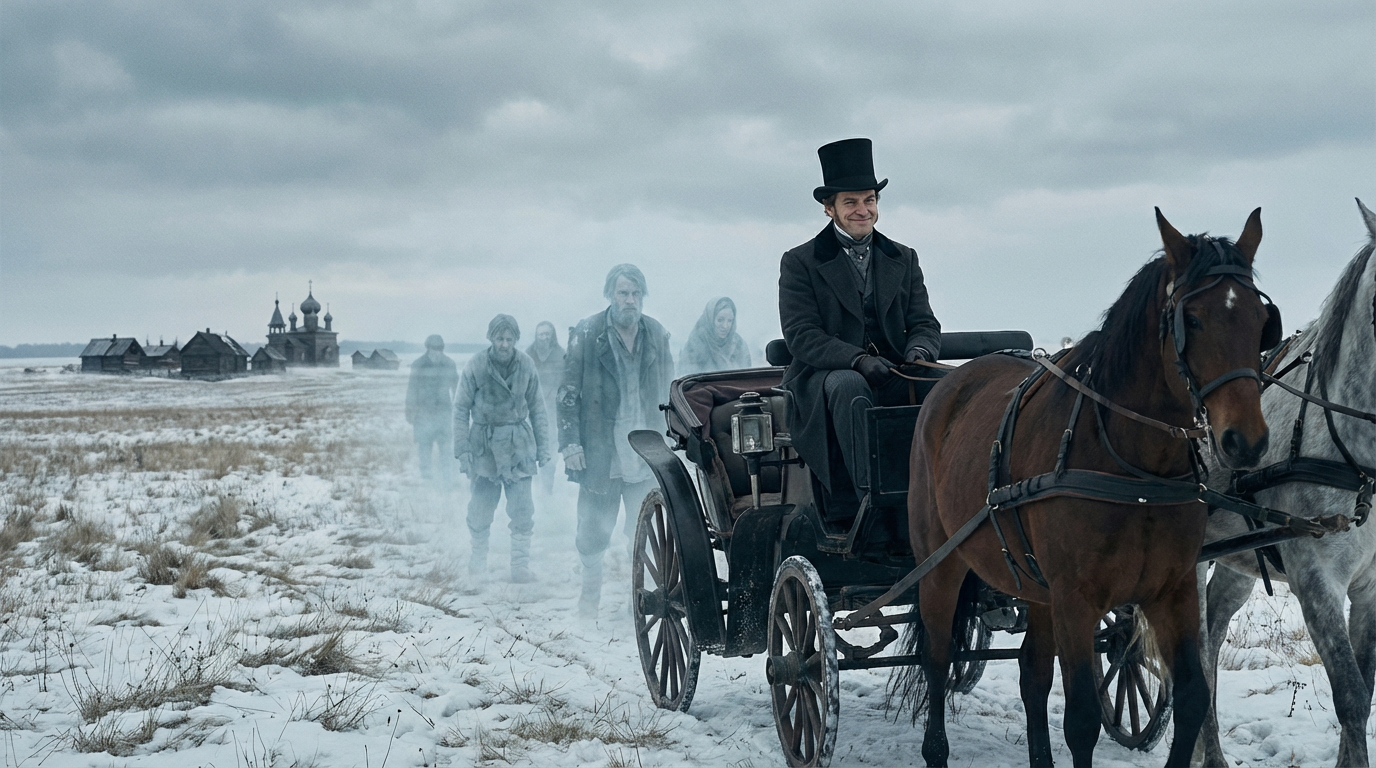
An excerpt from the original text.(complete · 8033 words)
ertainly Chichikov was a thorough coward, for, although the britchka
pursued its headlong course until Nozdrev’s establishment had
disappeared behind hillocks and hedgerows, our hero continued to glance
nervously behind him, as though every moment expecting to see a stern
chase begin. His breath came with difficulty, and when he tried his
heart with his hands he could feel it fluttering like a quail caught in
a net.
“What a sweat the fellow has thrown me into!” he thought to himself,
while many a dire and forceful aspiration passed through his mind.
Indeed, the expressions to which he gave vent were most inelegant
in their nature. But what was to be done next? He was a Russian
and thoroughly aroused. The affair had been no joke. “But for the
Superintendent,” he reflected, “I might never again have looked upon
God’s daylight--I might have vanished like a bubble on a pool, and left
neither trace nor posterity nor property nor an honourable name for my
future offspring to inherit!” (it seemed that our hero was particularly
anxious with regard to his possible issue).
“What a scurvy barin!” mused Selifan as he drove along. “Never have I
seen such a barin. I should like to spit in his face. ’Tis better to
allow a man nothing to eat than to refuse to feed a horse properly. A
horse needs his oats--they are his proper fare. Even if you make a man
procure a meal at his own expense, don’t deny a horse his oats, for he
ought always to have them.”
An equally poor opinion of Nozdrev seemed to be cherished also by
the steeds, for not only were the bay and the Assessor clearly out of
spirits, but even the skewbald was wearing a dejected air. True, at home
the skewbald got none but the poorer sorts of oats to eat, and Selifan
never filled his trough without having first called him a villain; but
at least they WERE oats, and not hay--they were stuff which could be
chewed with a certain amount of relish. Also, there was the fact that
at intervals he could intrude his long nose into his companions’ troughs
(especially when Selifan happened to be absent from the stable) and
ascertain what THEIR provender was like. But at Nozdrev’s there had
been nothing but hay! That was not right. All three horses felt greatly
discontented.
But presently the malcontents had their reflections cut short in a very
rude and unexpected manner. That is to say, they were brought back
to practicalities by coming into violent collision with a six-horsed
vehicle, while upon their heads descended both a babel of cries from the
ladies inside and a storm of curses and abuse from the coachman. “Ah,
you damned fool!” he vociferated. “I shouted to you loud enough! Draw
out, you old raven, and keep to the right! Are you drunk?” Selifan
himself felt conscious that he had been careless, but since a Russian
does not care to admit a fault in the presence of strangers, he retorted
with dignity: “Why have you run into US? Did you leave your eyes behind
you at the last tavern that you stopped at?” With that he started to
back the britchka, in the hope that it might get clear of the other’s
harness; but this would not do, for the pair were too hopelessly
intertwined. Meanwhile the skewbald snuffed curiously at his new
acquaintances as they stood planted on either side of him; while the
ladies in the vehicle regarded the scene with an expression of terror.
One of them was an old woman, and the other a damsel of about sixteen. A
mass of golden hair fell daintily from a small head, and the oval of
her comely face was as shapely as an egg, and white with the transparent
whiteness seen when the hands of a housewife hold a new-laid egg to
the light to let the sun’s rays filter through its shell. The same tint
marked the maiden’s ears where they glowed in the sunshine, and,
in short, what with the tears in her wide-open, arresting eyes, she
presented so attractive a picture that our hero bestowed upon it more
than a passing glance before he turned his attention to the hubbub which
was being raised among the horses and the coachmen.
“Back out, you rook of Nizhni Novgorod!” the strangers’ coachman
shouted. Selifan tightened his reins, and the other driver did the same.
The horses stepped back a little, and then came together again--this
time getting a leg or two over the traces. In fact, so pleased did the
skewbald seem with his new friends that he refused to stir from the
melee into which an unforeseen chance had plunged him. Laying his muzzle
lovingly upon the neck of one of his recently-acquired acquaintances,
he seemed to be whispering something in that acquaintance’s ear--and
whispering pretty nonsense, too, to judge from the way in which that
confidant kept shaking his ears.
At length peasants from a village which happened to be near the scene of
the accident tackled the mess; and since a spectacle of that kind is to
the Russian muzhik what a newspaper or a club-meeting is to the German,
the vehicles soon became the centre of a crowd, and the village denuded
even of its old women and children. The traces were disentangled, and a
few slaps on the nose forced the skewbald to draw back a little; after
which the teams were straightened out and separated. Nevertheless,
either sheer obstinacy or vexation at being parted from their new
friends caused the strange team absolutely to refuse to move a leg.
Their driver laid the whip about them, but still they stood as though
rooted to the spot. At length the participatory efforts of the peasants
rose to an unprecedented degree of enthusiasm, and they shouted in an
intermittent chorus the advice, “Do you, Andrusha, take the head of the
trace horse on the right, while Uncle Mitai mounts the shaft horse. Get
up, Uncle Mitai.” Upon that the lean, long, and red-bearded Uncle Mitai
mounted the shaft horse; in which position he looked like a village
steeple or the winder which is used to raise water from wells. The
coachman whipped up his steeds afresh, but nothing came of it, and
Uncle Mitai had proved useless. “Hold on, hold on!” shouted the peasants
again. “Do you, Uncle Mitai, mount the trace horse, while Uncle Minai
mounts the shaft horse.” Whereupon Uncle Minai--a peasant with a pair of
broad shoulders, a beard as black as charcoal, and a belly like the
huge samovar in which sbiten is brewed for all attending a local
market--hastened to seat himself upon the shaft horse, which almost
sank to the ground beneath his weight. “NOW they will go all right!” the
muzhiks exclaimed. “Lay it on hot, lay it on hot! Give that sorrel horse
the whip, and make him squirm like a koramora [22].” Nevertheless, the
affair in no way progressed; wherefore, seeing that flogging was of
no use, Uncles Mitai and Minai BOTH mounted the sorrel, while Andrusha
seated himself upon the trace horse. Then the coachman himself lost
patience, and sent the two Uncles about their business--and not before
it was time, seeing that the horses were steaming in a way that made it
clear that, unless they were first winded, they would never reach the
next posthouse. So they were given a moment’s rest. That done, they
moved off of their own accord!
Throughout, Chichikov had been gazing at the young unknown with
great attention, and had even made one or two attempts to enter into
conversation with her: but without success. Indeed, when the ladies
departed, it was as in a dream that he saw the girl’s comely presence,
the delicate features of her face, and the slender outline of her form
vanish from his sight; it was as in a dream that once more he saw only
the road, the britchka, the three horses, Selifan, and the bare, empty
fields. Everywhere in life--yes, even in the plainest, the dingiest
ranks of society, as much as in those which are uniformly bright and
presentable--a man may happen upon some phenomenon which is so entirely
different from those which have hitherto fallen to his lot. Everywhere
through the web of sorrow of which our lives are woven there may
suddenly break a clear, radiant thread of joy; even as suddenly along
the street of some poor, poverty-stricken village which, ordinarily,
sees nought but a farm waggon there may came bowling a gorgeous coach
with plated harness, picturesque horses, and a glitter of glass, so that
the peasants stand gaping, and do not resume their caps until long after
the strange equipage has become lost to sight. Thus the golden-haired
maiden makes a sudden, unexpected appearance in our story, and as
suddenly, as unexpectedly, disappears. Indeed, had it not been that the
person concerned was Chichikov, and not some youth of twenty summers--a
hussar or a student or, in general, a man standing on the threshold
of life--what thoughts would not have sprung to birth, and stirred and
spoken, within him; for what a length of time would he not have stood
entranced as he stared into the distance and forgot alike his journey,
the business still to be done, the possibility of incurring loss through
lingering--himself, his vocation, the world, and everything else that
the world contains!
But in the present case the hero was a man of middle-age, and of
cautious and frigid temperament. True, he pondered over the incident,
but in more deliberate fashion than a younger man would have done. That
is to say, his reflections were not so irresponsible and unsteady. “She
was a comely damsel,” he said to himself as he opened his snuff-box and
took a pinch. “But the important point is: Is she also a NICE DAMSEL?
One thing she has in her favour--and that is that she appears only just
to have left school, and not to have had time to become womanly in the
worser sense. At present, therefore, she is like a child. Everything in
her is simple, and she says just what she thinks, and laughs merely when
she feels inclined. Such a damsel might be made into anything--or she
might be turned into worthless rubbish. The latter, I surmise, for
trudging after her she will have a fond mother and a bevy of aunts,
and so forth--persons who, within a year, will have filled her with
womanishness to the point where her own father wouldn’t know her. And
to that there will be added pride and affectation, and she will begin
to observe established rules, and to rack her brains as to how, and how
much, she ought to talk, and to whom, and where, and so forth. Every
moment will see her growing timorous and confused lest she be saying too
much. Finally, she will develop into a confirmed prevaricator, and end
by marrying the devil knows whom!” Chichikov paused awhile. Then he went
on: “Yet I should like to know who she is, and who her father is, and
whether he is a rich landowner of good standing, or merely a respectable
man who has acquired a fortune in the service of the Government.
Should he allow her, on marriage, a dowry of, say, two hundred thousand
roubles, she will be a very nice catch indeed. She might even, so to
speak, make a man of good breeding happy.”
Indeed, so attractively did the idea of the two hundred thousand
roubles begin to dance before his imagination that he felt a twinge of
self-reproach because, during the hubbub, he had not inquired of the
postillion or the coachman who the travellers might be. But soon the
sight of Sobakevitch’s country house dissipated his thoughts, and forced
him to return to his stock subject of reflection.
Sobakevitch’s country house and estate were of very fair size, and on
each side of the mansion were expanses of birch and pine forest in two
shades of green. The wooden edifice itself had dark-grey walls and a
red-gabled roof, for it was a mansion of the kind which Russia builds
for her military settlers and for German colonists. A noticeable
circumstance was the fact that the taste of the architect had differed
from that of the proprietor--the former having manifestly been a pedant
and desirous of symmetry, and the latter having wished only for comfort.
Consequently he (the proprietor) had dispensed with all windows on one
side of the mansion, and had caused to be inserted, in their place, only
a small aperture which, doubtless, was intended to light an otherwise
dark lumber-room. Likewise, the architect’s best efforts had failed to
cause the pediment to stand in the centre of the building, since the
proprietor had had one of its four original columns removed. Evidently
durability had been considered throughout, for the courtyard was
enclosed by a strong and very high wooden fence, and both the stables,
the coach-house, and the culinary premises were partially constructed of
beams warranted to last for centuries. Nay, even the wooden huts of the
peasantry were wonderful in the solidity of their construction, and
not a clay wall or a carved pattern or other device was to be seen.
Everything fitted exactly into its right place, and even the draw-well
of the mansion was fashioned of the oakwood usually thought suitable
only for mills or ships. In short, wherever Chichikov’s eye turned he
saw nothing that was not free from shoddy make and well and skilfully
arranged. As he approached the entrance steps he caught sight of two
faces peering from a window. One of them was that of a woman in a mobcap
with features as long and as narrow as a cucumber, and the other that
of a man with features as broad and as short as the Moldavian pumpkins
(known as gorlianki) whereof balallaiki--the species of light,
two-stringed instrument which constitutes the pride and the joy of
the gay young fellow of twenty as he sits winking and smiling at the
white-necked, white-bosomed maidens who have gathered to listen to his
low-pitched tinkling--are fashioned. This scrutiny made, both faces
withdrew, and there came out on to the entrance steps a lacquey clad
in a grey jacket and a stiff blue collar. This functionary conducted
Chichikov into the hall, where he was met by the master of the house
himself, who requested his guest to enter, and then led him into the
inner part of the mansion.
A covert glance at Sobakevitch showed our hero that his host exactly
resembled a moderate-sized bear. To complete the resemblance,
Sobakevitch’s long frockcoat and baggy trousers were of the precise
colour of a bear’s hide, while, when shuffling across the floor, he made
a criss-cross motion of the legs, and had, in addition, a constant habit
of treading upon his companion’s toes. As for his face, it was of the
warm, ardent tint of a piatok [23]. Persons of this kind--persons
to whose designing nature has devoted not much thought, and in the
fashioning of whose frames she has used no instruments so delicate as a
file or a gimlet and so forth--are not uncommon. Such persons she merely
roughhews. One cut with a hatchet, and there results a nose; another
such cut with a hatchet, and there materialises a pair of lips; two
thrusts with a drill, and there issues a pair of eyes. Lastly, scorning
to plane down the roughness, she sends out that person into the world,
saying: “There is another live creature.” Sobakevitch was just such a
ragged, curiously put together figure--though the above model would seem
to have been followed more in his upper portion than in his lower. One
result was that he seldom turned his head to look at the person with
whom he was speaking, but, rather, directed his eyes towards, say, the
stove corner or the doorway. As host and guest crossed the dining-room
Chichikov directed a second glance at his companion. “He is a bear, and
nothing but a bear,” he thought to himself. And, indeed, the strange
comparison was inevitable. Incidentally, Sobakevitch’s Christian name
and patronymic were Michael Semenovitch. Of his habit of treading upon
other people’s toes Chichikov had become fully aware; wherefore he
stepped cautiously, and, throughout, allowed his host to take the
lead. As a matter of fact, Sobakevitch himself seemed conscious of his
failing, for at intervals he would inquire: “I hope I have not hurt
you?” and Chichikov, with a word of thanks, would reply that as yet he
had sustained no injury.
At length they reached the drawing-room, where Sobakevitch pointed to
an armchair, and invited his guest to be seated. Chichikov gazed with
interest at the walls and the pictures. In every such picture there were
portrayed either young men or Greek generals of the type of Movrogordato
(clad in a red uniform and breaches), Kanaris, and others; and all these
heroes were depicted with a solidity of thigh and a wealth of moustache
which made the beholder simply shudder with awe. Among them there were
placed also, according to some unknown system, and for some unknown
reason, firstly, Bagration [24]--tall and thin, and with a cluster of
small flags and cannon beneath him, and the whole set in the narrowest
of frames--and, secondly, the Greek heroine, Bobelina, whose legs looked
larger than do the whole bodies of the drawing-room dandies of the
present day. Apparently the master of the house was himself a man of
health and strength, and therefore liked to have his apartments adorned
with none but folk of equal vigour and robustness. Lastly, in the
window, and suspended cheek by jowl with Bobelina, there hung a cage
whence at intervals there peered forth a white-spotted blackbird.
Like everything else in the apartment, it bore a strong resemblance to
Sobakevitch. When host and guest had been conversing for two minutes or
so the door opened, and there entered the hostess--a tall lady in a cap
adorned with ribands of domestic colouring and manufacture. She entered
deliberately, and held her head as erect as a palm.
“This is my wife, Theodulia Ivanovna,” said Sobakevitch.
Chichikov approached and took her hand. The fact that she raised it
nearly to the level of his lips apprised him of the circumstance that it
had just been rinsed in cucumber oil.
“My dear, allow me to introduce Paul Ivanovitch Chichikov,” added
Sobakevitch. “He has the honour of being acquainted both with our
Governor and with our Postmaster.”
Upon this Theodulia Ivanovna requested her guest to be seated, and
accompanied the invitation with the kind of bow usually employed only by
actresses who are playing the role of queens. Next, she took a seat upon
the sofa, drew around her her merino gown, and sat thereafter without
moving an eyelid or an eyebrow. As for Chichikov, he glanced upwards,
and once more caught sight of Kanaris with his fat thighs and
interminable moustache, and of Bobelina and the blackbird. For fully
five minutes all present preserved a complete silence--the only sound
audible being that of the blackbird’s beak against the wooden floor of
the cage as the creature fished for grains of corn. Meanwhile Chichikov
again surveyed the room, and saw that everything in it was massive and
clumsy in the highest degree; as also that everything was curiously in
keeping with the master of the house. For example, in one corner of the
apartment there stood a hazelwood bureau with a bulging body on four
grotesque legs--the perfect image of a bear. Also, the tables and the
chairs were of the same ponderous, unrestful order, and every single
article in the room appeared to be saying either, “I, too, am a
Sobakevitch,” or “I am exactly like Sobakevitch.”
“I heard speak of you one day when I was visiting the President of the
Council,” said Chichikov, on perceiving that no one else had a mind to
begin a conversation. “That was on Thursday last. We had a very pleasant
evening.”
“Yes, on that occasion I was not there,” replied Sobakevitch.
“What a nice man he is!”
“Who is?” inquired Sobakevitch, gazing into the corner by the stove.
“The President of the Local Council.”
“Did he seem so to you? True, he is a mason, but he is also the greatest
fool that the world ever saw.”
Chichikov started a little at this mordant criticism, but soon pulled
himself together again, and continued:
“Of course, every man has his weakness. Yet the President seems to be an
excellent fellow.”
“And do you think the same of the Governor?”
“Yes. Why not?”
“Because there exists no greater rogue than he.”
“What? The Governor a rogue?” ejaculated Chichikov, at a loss to
understand how the official in question could come to be numbered with
thieves. “Let me say that I should never have guessed it. Permit me
also to remark that his conduct would hardly seem to bear out your
opinion--he seems so gentle a man.” And in proof of this Chichikov
cited the purses which the Governor knitted, and also expatiated on the
mildness of his features.
“He has the face of a robber,” said Sobakevitch. “Were you to give him a
knife, and to turn him loose on a turnpike, he would cut your throat for
two kopecks. And the same with the Vice-Governor. The pair are just Gog
and Magog.”
“Evidently he is not on good terms with them,” thought Chichikov to
himself. “I had better pass to the Chief of Police, which whom he DOES
seem to be friendly.” Accordingly he added aloud: “For my own part, I
should give the preference to the Head of the Gendarmery. What a frank,
outspoken nature he has! And what an element of simplicity does his
expression contain!”
“He is mean to the core,” remarked Sobakevitch coldly. “He will sell you
and cheat you, and then dine at your table. Yes, I know them all, and
every one of them is a swindler, and the town a nest of rascals engaged
in robbing one another. Not a man of the lot is there but would sell
Christ. Yet stay: ONE decent fellow there is--the Public Prosecutor;
though even HE, if the truth be told, is little better than a pig.”
After these eulogia Chichikov saw that it would be useless to continue
running through the list of officials--more especially since suddenly he
had remembered that Sobakevitch was not at any time given to commending
his fellow man.
“Let us go to luncheon, my dear,” put in Theodulia Ivanovna to her
spouse.
“Yes; pray come to table,” said Sobakevitch to his guest; whereupon they
consumed the customary glass of vodka (accompanied by sundry snacks of
salted cucumber and other dainties) with which Russians, both in town
and country, preface a meal. Then they filed into the dining-room in the
wake of the hostess, who sailed on ahead like a goose swimming across a
pond. The small dining-table was found to be laid for four persons--the
fourth place being occupied by a lady or a young girl (it would have
been difficult to say which exactly) who might have been either a
relative, the housekeeper, or a casual visitor. Certain persons in the
world exist, not as personalities in themselves, but as spots or specks
on the personalities of others. Always they are to be seen sitting in
the same place, and holding their heads at exactly the same angle, so
that one comes within an ace of mistaking them for furniture, and thinks
to oneself that never since the day of their birth can they have spoken
a single word.
“My dear,” said Sobakevitch, “the cabbage soup is excellent.” With that
he finished his portion, and helped himself to a generous measure of
niania [25]--the dish which follows shtchi and consists of a sheep’s
stomach stuffed with black porridge, brains, and other things. “What
niania this is!” he added to Chichikov. “Never would you get such stuff
in a town, where one is given the devil knows what.”
“Nevertheless the Governor keeps a fair table,” said Chichikov.
“Yes, but do you know what all the stuff is MADE OF?” retorted
Sobakevitch. “If you DID know you would never touch it.”
“Of course I am not in a position to say how it is prepared, but at
least the pork cutlets and the boiled fish seemed excellent.”
“Ah, it might have been thought so; yet I know the way in which such
things are bought in the market-place. They are bought by some rascal of
a cook whom a Frenchman has taught how to skin a tomcat and then serve
it up as hare.”
“Ugh! What horrible things you say!” put in Madame.
“Well, my dear, that is how things are done, and it is no fault of mine
that it is so. Moreover, everything that is left over--everything that
WE (pardon me for mentioning it) cast into the slop-pail--is used by
such folk for making soup.”
“Always at table you begin talking like this!” objected his helpmeet.
“And why not?” said Sobakevitch. “I tell you straight that I would not
eat such nastiness, even had I made it myself. Sugar a frog as much
as you like, but never shall it pass MY lips. Nor would I swallow an
oyster, for I know only too well what an oyster may resemble. But
have some mutton, friend Chichikov. It is shoulder of mutton, and
very different stuff from the mutton which they cook in noble
kitchens--mutton which has been kicking about the market-place four days
or more. All that sort of cookery has been invented by French and German
doctors, and I should like to hang them for having done so. They go and
prescribe diets and a hunger cure as though what suits their flaccid
German systems will agree with a Russian stomach! Such devices are no
good at all.” Sobakevitch shook his head wrathfully. “Fellows like
those are for ever talking of civilisation. As if THAT sort of thing was
civilisation! Phew!” (Perhaps the speaker’s concluding exclamation would
have been even stronger had he not been seated at table.) “For myself, I
will have none of it. When I eat pork at a meal, give me the WHOLE pig;
when mutton, the WHOLE sheep; when goose, the WHOLE of the bird. Two
dishes are better than a thousand, provided that one can eat of them as
much as one wants.”
And he proceeded to put precept into practice by taking half the
shoulder of mutton on to his plate, and then devouring it down to the
last morsel of gristle and bone.
“My word!” reflected Chichikov. “The fellow has a pretty good holding
capacity!”
“None of it for me,” repeated Sobakevitch as he wiped his hands on his
napkin. “I don’t intend to be like a fellow named Plushkin, who owns
eight hundred souls, yet dines worse than does my shepherd.”
“Who is Plushkin?” asked Chichikov.
“A miser,” replied Sobakevitch. “Such a miser as never you could
imagine. Even convicts in prison live better than he does. And he
starves his servants as well.”
“Really?” ejaculated Chichikov, greatly interested. “Should you, then,
say that he has lost many peasants by death?”
“Certainly. They keep dying like flies.”
“Then how far from here does he reside?”
“About five versts.”
“Only five versts?” exclaimed Chichikov, feeling his heart beating
joyously. “Ought one, when leaving your gates, to turn to the right or
to the left?”
“I should be sorry to tell you the way to the house of such a cur,” said
Sobakevitch. “A man had far better go to hell than to Plushkin’s.”
“Quite so,” responded Chichikov. “My only reason for asking you is
that it interests me to become acquainted with any and every sort of
locality.”
To the shoulder of mutton there succeeded, in turn, cutlets (each one
larger than a plate), a turkey of about the size of a calf, eggs, rice,
pastry, and every conceivable thing which could possibly be put into a
stomach. There the meal ended. When he rose from table Chichikov felt as
though a pood’s weight were inside him. In the drawing-room the company
found dessert awaiting them in the shape of pears, plums, and apples;
but since neither host nor guest could tackle these particular dainties
the hostess removed them to another room. Taking advantage of her
absence, Chichikov turned to Sobakevitch (who, prone in an armchair,
seemed, after his ponderous meal, to be capable of doing little
beyond belching and grunting--each such grunt or belch necessitating a
subsequent signing of the cross over the mouth), and intimated to him
a desire to have a little private conversation concerning a certain
matter. At this moment the hostess returned.
“Here is more dessert,” she said. “Pray have a few radishes stewed in
honey.”
“Later, later,” replied Sobakevitch. “Do you go to your room, and Paul
Ivanovitch and I will take off our coats and have a nap.”
Upon this the good lady expressed her readiness to send for feather beds
and cushions, but her husband expressed a preference for slumbering in
an armchair, and she therefore departed. When she had gone Sobakevitch
inclined his head in an attitude of willingness to listen to Chichikov’s
business. Our hero began in a sort of detached manner--touching lightly
upon the subject of the Russian Empire, and expatiating upon the
immensity of the same, and saying that even the Empire of Ancient Rome
had been of considerably smaller dimensions. Meanwhile Sobakevitch sat
with his head drooping.
From that Chichikov went on to remark that, according to the statutes of
the said Russian Empire (which yielded to none in glory--so much so that
foreigners marvelled at it), peasants on the census lists who had ended
their earthly careers were nevertheless, on the rendering of new lists,
returned equally with the living, to the end that the courts might be
relieved of a multitude of trifling, useless emendations which might
complicate the already sufficiently complex mechanism of the State.
Nevertheless, said Chichikov, the general equity of this measure did
not obviate a certain amount of annoyance to landowners, since it forced
them to pay upon a non-living article the tax due upon a living. Hence
(our hero concluded) he (Chichikov) was prepared, owing to the personal
respect which he felt for Sobakevitch, to relieve him, in part, of
the irksome obligation referred to (in passing, it may be said that
Chichikov referred to his principal point only guardedly, for he called
the souls which he was seeking not “dead,” but “non-existent”).
Meanwhile Sobakevitch listened with bent head; though something like a
trace of expression dawned in his face as he did so. Ordinarily his
body lacked a soul--or, if he did possess a soul, he seemed to keep it
elsewhere than where it ought to have been; so that, buried beneath
mountains (as it were) or enclosed within a massive shell, its movements
produced no sort of agitation on the surface.
“Well?” said Chichikov--though not without a certain tremor of
diffidence as to the possible response.
“You are after dead souls?” were Sobakevitch’s perfectly simple words.
He spoke without the least surprise in his tone, and much as though the
conversation had been turning on grain.
“Yes,” replied Chichikov, and then, as before, softened down the
expression “dead souls.”
“They are to be found,” said Sobakevitch. “Why should they not be?”
“Then of course you will be glad to get rid of any that you may chance
to have?”
“Yes, I shall have no objection to SELLING them.” At this point the
speaker raised his head a little, for it had struck him that surely the
would-be buyer must have some advantage in view.
“The devil!” thought Chichikov to himself. “Here is he selling the goods
before I have even had time to utter a word!”
“And what about the price?” he added aloud. “Of course, the articles are
not of a kind very easy to appraise.”
“I should be sorry to ask too much,” said Sobakevitch. “How would a
hundred roubles per head suit you?”
“What, a hundred roubles per head?” Chichikov stared open-mouthed at
his host--doubting whether he had heard aright, or whether his host’s
slow-moving tongue might not have inadvertently substituted one word for
another.
“Yes. Is that too much for you?” said Sobakevitch. Then he added: “What
is your own price?”
“My own price? I think that we cannot properly have understood one
another--that you must have forgotten of what the goods consist. With
my hand on my heart do I submit that eight grivni per soul would be a
handsome, a VERY handsome, offer.”
“What? Eight grivni?”
“In my opinion, a higher offer would be impossible.”
“But I am not a seller of boots.”
“No; yet you, for your part, will agree that these souls are not live
human beings?”
“I suppose you hope to find fools ready to sell you souls on the census
list for a couple of groats apiece?”
“Pardon me, but why do you use the term ‘on the census list’? The souls
themselves have long since passed away, and have left behind them only
their names. Not to trouble you with any further discussion of the
subject, I can offer you a rouble and a half per head, but no more.”
“You should be ashamed even to mention such a sum! Since you deal in
articles of this kind, quote me a genuine price.”
“I cannot, Michael Semenovitch. Believe me, I cannot. What a man
cannot do, that he cannot do.” The speaker ended by advancing another
half-rouble per head.
“But why hang back with your money?” said Sobakevitch. “Of a truth I am
not asking much of you. Any other rascal than myself would have cheated
you by selling you old rubbish instead of good, genuine souls, whereas
I should be ready to give you of my best, even were you buying only
nut-kernels. For instance, look at wheelwright Michiev. Never was there
such a one to build spring carts! And his handiwork was not like your
Moscow handiwork--good only for an hour. No, he did it all himself, even
down to the varnishing.”
Chichikov opened his mouth to remark that, nevertheless, the said
Michiev had long since departed this world; but Sobakevitch’s eloquence
had got too thoroughly into its stride to admit of any interruption.
“And look, too, at Probka Stepan, the carpenter,” his host went on. “I
will wager my head that nowhere else would you find such a workman. What
a strong fellow he was! He had served in the Guards, and the Lord only
knows what they had given for him, seeing that he was over three arshins
in height.”
Again Chichikov tried to remark that Probka was dead, but Sobakevitch’s
tongue was borne on the torrent of its own verbiage, and the only thing
to be done was to listen.
“And Milushkin, the bricklayer! He could build a stove in any house you
liked! And Maksim Teliatnikov, the bootmaker! Anything that he drove
his awl into became a pair of boots--and boots for which you would
be thankful, although he WAS a bit foul of the mouth. And Eremi
Sorokoplechin, too! He was the best of the lot, and used to work at
his trade in Moscow, where he paid a tax of five hundred roubles. Well,
THERE’S an assortment of serfs for you!--a very different assortment
from what Plushkin would sell you!”
“But permit me,” at length put in Chichikov, astounded at this flood of
eloquence to which there appeared to be no end. “Permit me, I say, to
inquire why you enumerate the talents of the deceased, seeing that they
are all of them dead, and that therefore there can be no sense in doing
so. ‘A dead body is only good to prop a fence with,’ says the proverb.”
“Of course they are dead,” replied Sobakevitch, but rather as though the
idea had only just occurred to him, and was giving him food for thought.
“But tell me, now: what is the use of listing them as still alive? And
what is the use of them themselves? They are flies, not human beings.”
“Well,” said Chichikov, “they exist, though only in idea.”
“But no--NOT only in idea. I tell you that nowhere else would you
find such a fellow for working heavy tools as was Michiev. He had the
strength of a horse in his shoulders.” And, with the words, Sobakevitch
turned, as though for corroboration, to the portrait of Bagration, as is
frequently done by one of the parties in a dispute when he purports to
appeal to an extraneous individual who is not only unknown to him, but
wholly unconnected with the subject in hand; with the result that the
individual is left in doubt whether to make a reply, or whether to
betake himself elsewhere.
“Nevertheless, I CANNOT give you more than two roubles per head,” said
Chichikov.
“Well, as I don’t want you to swear that I have asked too much of you
and won’t meet you halfway, suppose, for friendship’s sake, that you pay
me seventy-five roubles in assignats?”
“Good heavens!” thought Chichikov to himself. “Does the man take me for
a fool?” Then he added aloud: “The situation seems to me a strange
one, for it is as though we were performing a stage comedy. No other
explanation would meet the case. Yet you appear to be a man of sense,
and possessed of some education. The matter is a very simple one. The
question is: what is a dead soul worth, and is it of any use to any
one?”
“It is of use to YOU, or you would not be buying such articles.”
Chichikov bit his lip, and stood at a loss for a retort. He tried
to saying something about “family and domestic circumstances,” but
Sobakevitch cut him short with:
“I don’t want to know your private affairs, for I never poke my nose
into such things. You need the souls, and I am ready to sell them.
Should you not buy them, I think you will repent it.”
“Two roubles is my price,” repeated Chichikov.
“Come, come! As you have named that sum, I can understand your not
liking to go back upon it; but quote me a bona fide figure.”
“The devil fly away with him!” mused Chichikov. “However, I will add
another half-rouble.” And he did so.
“Indeed?” said Sobakevitch. “Well, my last word upon it is--fifty
roubles in assignats. That will mean a sheer loss to me, for nowhere
else in the world could you buy better souls than mine.”
“The old skinflint!” muttered Chichikov. Then he added aloud, with
irritation in his tone: “See here. This is a serious matter. Any one but
you would be thankful to get rid of the souls. Only a fool would stick
to them, and continue to pay the tax.”
“Yes, but remember (and I say it wholly in a friendly way) that
transactions of this kind are not generally allowed, and that any one
would say that a man who engages in them must have some rather doubtful
advantage in view.”
“Have it your own away,” said Chichikov, with assumed indifference. “As
a matter of fact, I am not purchasing for profit, as you suppose, but to
humour a certain whim of mine. Two and a half roubles is the most that I
can offer.”
“Bless your heart!” retorted the host. “At least give me thirty roubles
in assignats, and take the lot.”
“No, for I see that you are unwilling to sell. I must say good-day to
you.”
“Hold on, hold on!” exclaimed Sobakevitch, retaining his guest’s hand,
and at the same moment treading heavily upon his toes--so heavily,
indeed, that Chichikov gasped and danced with the pain.
“I BEG your pardon!” said Sobakevitch hastily. “Evidently I have hurt
you. Pray sit down again.”
“No,” retorted Chichikov. “I am merely wasting my time, and must be
off.”
“Oh, sit down just for a moment. I have something more agreeable to
say.” And, drawing closer to his guest, Sobakevitch whispered in his
ear, as though communicating to him a secret: “How about twenty-five
roubles?”
“No, no, no!” exclaimed Chichikov. “I won’t give you even a QUARTER of
that. I won’t advance another kopeck.”
For a while Sobakevitch remained silent, and Chichikov did the same.
This lasted for a couple of minutes, and, meanwhile, the aquiline-nosed
Bagration gazed from the wall as though much interested in the
bargaining.
“What is your outside price?” at length said Sobakevitch.
“Two and a half roubles.”
“Then you seem to rate a human soul at about the same value as a boiled
turnip. At least give me THREE roubles.”
“No, I cannot.”
“Pardon me, but you are an impossible man to deal with. However, even
though it will mean a dead loss to me, and you have not shown a very
nice spirit about it, I cannot well refuse to please a friend. I suppose
a purchase deed had better be made out in order to have everything in
order?”
“Of course.”
“Then for that purpose let us repair to the town.”
The affair ended in their deciding to do this on the morrow, and to
arrange for the signing of a deed of purchase. Next, Chichikov requested
a list of the peasants; to which Sobakevitch readily agreed. Indeed, he
went to his writing-desk then and there, and started to indite a
list which gave not only the peasants’ names, but also their late
qualifications.
Meanwhile Chichikov, having nothing else to do, stood looking at the
spacious form of his host; and as he gazed at his back as broad as that
of a cart horse, and at the legs as massive as the iron standards which
adorn a street, he could not help inwardly ejaculating:
“Truly God has endowed you with much! Though not adjusted with nicety,
at least you are strongly built. I wonder whether you were born a
bear or whether you have come to it through your rustic life, with its
tilling of crops and its trading with peasants? Yet no; I believe that,
even if you had received a fashionable education, and had mixed with
society, and had lived in St. Petersburg, you would still have been just
the kulak [26] that you are. The only difference is that circumstances,
as they stand, permit of your polishing off a stuffed shoulder of mutton
at a meal; whereas in St. Petersburg you would have been unable to
do so. Also, as circumstances stand, you have under you a number
of peasants, whom you treat well for the reason that they are your
property; whereas, otherwise, you would have had under you tchinovniks
[27]: whom you would have bullied because they were NOT your property.
Also, you would have robbed the Treasury, since a kulak always remains a
money-grubber.”
“The list is ready,” said Sobakevitch, turning round.
“Indeed? Then please let me look at it.” Chichikov ran his eye over the
document, and could not but marvel at its neatness and accuracy. Not
only were there set forth in it the trade, the age, and the pedigree
of every serf, but on the margin of the sheet were jotted remarks
concerning each serf’s conduct and sobriety. Truly it was a pleasure to
look at it.
“And do you mind handing me the earnest money?” said Sobakevitch.
“Yes, I do. Why need that be done? You can receive the money in a lump
sum as soon as we visit the town.”
“But it is always the custom, you know,” asserted Sobakevitch.
“Then I cannot follow it, for I have no money with me. However, here are
ten roubles.”
“Ten roubles, indeed? You might as well hand me fifty while you are
about it.”
Once more Chichikov started to deny that he had any money upon him, but
Sobakevitch insisted so strongly that this was not so that at length
the guest pulled out another fifteen roubles, and added them to the ten
already produced.
“Kindly give me a receipt for the money,” he added.
“A receipt? Why should I give you a receipt?”
“Because it is better to do so, in order to guard against mistakes.”
“Very well; but first hand me over the money.”
“The money? I have it here. Do you write out the receipt, and then the
money shall be yours.”
“Pardon me, but how am I to write out the receipt before I have seen the
cash?”
Chichikov placed the notes in Sobakevitch’s hand; whereupon the host
moved nearer to the table, and added to the list of serfs a note that
he had received for the peasants, therewith sold, the sum of twenty-five
roubles, as earnest money. This done, he counted the notes once more.
“This is a very OLD note,” he remarked, holding one up to the light.
“Also, it is a trifle torn. However, in a friendly transaction one must
not be too particular.”
“What a kulak!” thought Chichikov to himself. “And what a brute beast!”
“Then you do not want any WOMEN souls?” queried Sobakevitch.
“I thank you, no.”
“I could let you have some cheap--say, as between friends, at a rouble a
head?”
“No, I should have no use for them.”
“Then, that being so, there is no more to be said. There is no
accounting for tastes. ‘One man loves the priest, and another the
priest’s wife,’ says the proverb.”
Chichikov rose to take his leave. “Once more I would request of you,” he
said, “that the bargain be left as it is.”
“Of course, of course. What is done between friends holds good because
of their mutual friendship. Good-bye, and thank you for your visit. In
advance I would beg that, whenever you should have an hour or two to
spare, you will come and lunch with us again. Perhaps we might be able
to do one another further service?”
“Not if I know it!” reflected Chichikov as he mounted his britchka. “Not
I, seeing that I have had two and a half roubles per soul squeezed out
of me by a brute of a kulak!”
Altogether he felt dissatisfied with Sobakevitch’s behaviour. In spite
of the man being a friend of the Governor and the Chief of Police,
he had acted like an outsider in taking money for what was worthless
rubbish. As the britchka left the courtyard Chichikov glanced back
and saw Sobakevitch still standing on the verandah--apparently for the
purpose of watching to see which way the guest’s carriage would turn.
“The old villain, to be still standing there!” muttered Chichikov
through his teeth; after which he ordered Selifan to proceed so that the
vehicle’s progress should be invisible from the mansion--the truth
being that he had a mind next to visit Plushkin (whose serfs, to quote
Sobakevitch, had a habit of dying like flies), but not to let his late
host learn of his intention. Accordingly, on reaching the further end of
the village, he hailed the first peasant whom he saw--a man who was in
the act of hoisting a ponderous beam on to his shoulder before setting
off with it, ant-like, to his hut.
“Hi!” shouted Chichikov. “How can I reach landowner Plushkin’s place
without first going past the mansion here?”
The peasant seemed nonplussed by the question.
“Don’t you know?” queried Chichikov.
“No, barin,” replied the peasant.
“What? You don’t know skinflint Plushkin who feeds his people so badly?”
“Of course I do!” exclaimed the fellow, and added thereto an
uncomplimentary expression of a species not ordinarily employed in
polite society. We may guess that it was a pretty apt expression, since
long after the man had become lost to view Chichikov was still laughing
in his britchka. And, indeed, the language of the Russian populace is
always forcible in its phraseology.
Master this chapter. Complete your experience
Purchase the complete book to access all chapters and support classic literature
As an Amazon Associate, we earn a small commission from qualifying purchases at no additional cost to you.
Available in paperback, hardcover, and e-book formats
Let's Analyse the Pattern
When people openly admit their self-interest and corruption, they become paradoxically more trustworthy and harder to negotiate with than those who hide their motives.
Why This Matters
Connect literature to life
This chapter teaches how to identify people who openly admit their motivations versus those who hide behind false nobility.
Practice This Today
This week, notice when someone admits 'I'm doing this because it benefits me' - they're often more reliable than those claiming pure altruism.
Now let's explore the literary elements.
Key Quotes & Analysis
"What a sweat the fellow has thrown me into!"
Context: Thinking about his narrow escape from Nozdrev's violent threats
Shows how Nozdrev's chaos affects even a seasoned schemer like Chichikov. The colloquial expression reveals Chichikov's genuine fear beneath his usual composure. It demonstrates how unpredictable people can derail even the best-laid plans.
In Today's Words:
That guy really stressed me out!
"Never have I seen such a barin. I should like to spit in his face."
Context: Reflecting on Nozdrev's character while driving away
Reveals how servants judge their social superiors by different standards than wealth or title. Selifan's disgust stems from Nozdrev's poor treatment of horses, showing how working people value practical competence over social position.
In Today's Words:
What a terrible boss - I'd love to tell him what I really think.
"They are all scoundrels! The whole town is full of scoundrels!"
Context: Systematically destroying the reputation of every local official
Demonstrates Sobakevitch's brutal honesty about local corruption while simultaneously participating in it himself. His cynical worldview makes him oddly refreshing in a world of polite lies, even as he proves himself equally corrupt.
In Today's Words:
Everyone in this place is crooked!
"Mikhey was a carpenter, and such a carpenter! He could make a carriage that would last you a lifetime."
Context: Describing his dead serfs as if they were still alive and valuable
Shows the absurdity of treating dead people as commodities while revealing Sobakevitch's genuine appreciation for skilled work. His passionate descriptions make the grotesque transaction almost touching, highlighting the human cost of the serf system.
In Today's Words:
Mike was an amazing carpenter - he could build you something that would last forever.
Thematic Threads
Corruption
In This Chapter
Sobakevitch openly participates in Chichikov's illegal scheme while calling everyone else thieves, showing how corruption becomes normalized when acknowledged openly
Development
Evolved from Manilov's naive participation and Nozdrev's chaotic dishonesty to calculated, transparent corruption
In Your Life:
You might recognize this when someone at work openly admits they're cutting corners while criticizing others for the same behavior.
Class
In This Chapter
Sobakevitch's wealth and status allow him to be brutally honest about others' failings while engaging in the same corrupt practices
Development
Continues the pattern of each landowner's class position shaping how they approach corruption
In Your Life:
You see this when wealthy people criticize welfare recipients while openly using tax loopholes and subsidies.
Negotiation
In This Chapter
Sobakevitch immediately understands Chichikov's scheme and negotiates aggressively, treating dead souls as valuable commodities
Development
Introduced here as a contrast to previous landowners' approaches to the deal
In Your Life:
You encounter this when dealing with contractors, lawyers, or salespeople who are completely upfront about maximizing their profit.
Identity
In This Chapter
Sobakevitch's bear-like appearance matches his blunt personality, showing alignment between physical presence and character
Development
Continues Gogol's pattern of matching character to physical description, but more directly than with previous landowners
In Your Life:
You might notice how people's appearance often reflects their approach to life—the overly groomed person who's controlling, the deliberately casual person who's rejecting formality.
Pragmatism
In This Chapter
Chichikov abandons romantic fantasies about the beautiful woman to focus on his business with Sobakevitch, showing his practical nature reasserting itself
Development
Reinforces Chichikov's character established in earlier chapters—opportunistic but ultimately focused on his scheme
In Your Life:
You see this in yourself when you get distracted by attractive possibilities but ultimately return to your practical goals and responsibilities.
You now have the context. Time to form your own thoughts.
Discussion Questions
- 1
Why does Sobakevitch call everyone else thieves while openly trying to cheat Chichikov himself?
analysis • surface - 2
What makes Sobakevitch's brutal honesty about corruption both refreshing and frustrating to deal with?
analysis • medium - 3
When have you encountered someone who was completely upfront about their self-interest? How did that change how you dealt with them?
application • medium - 4
Between someone who lies to make you feel better and someone who tells harsh truths for their own benefit, which would you rather negotiate with and why?
application • deep - 5
What does Sobakevitch's approach reveal about the relationship between honesty and trustworthiness?
reflection • deep
Critical Thinking Exercise
Map Your Own Honest Thieves
Think of three people in your life who are brutally honest about what they want from you - whether it's your time, money, favors, or attention. Write down their names and what they typically want. Then rate each one: Are they easier or harder to deal with than people who hide their motives? What strategies work best with each person?
Consider:
- •Consider why their honesty might actually make relationships clearer
- •Think about whether you trust their word more because they admit their self-interest
- •Notice if you respect their directness even when you don't like what they're asking for
Journaling Prompt
Write about a time when someone's brutal honesty about wanting something from you actually made you more willing to help them than if they had made up a noble excuse.
Coming Up Next...
Chapter 6: The Miser's Mansion of Decay
Armed with directions from a colorfully profane peasant, Chichikov sets off to find the legendary miser Plushkin, whose estate promises to be a goldmine of dead souls. But what he discovers there will surpass even his wildest expectations of human degradation.



