
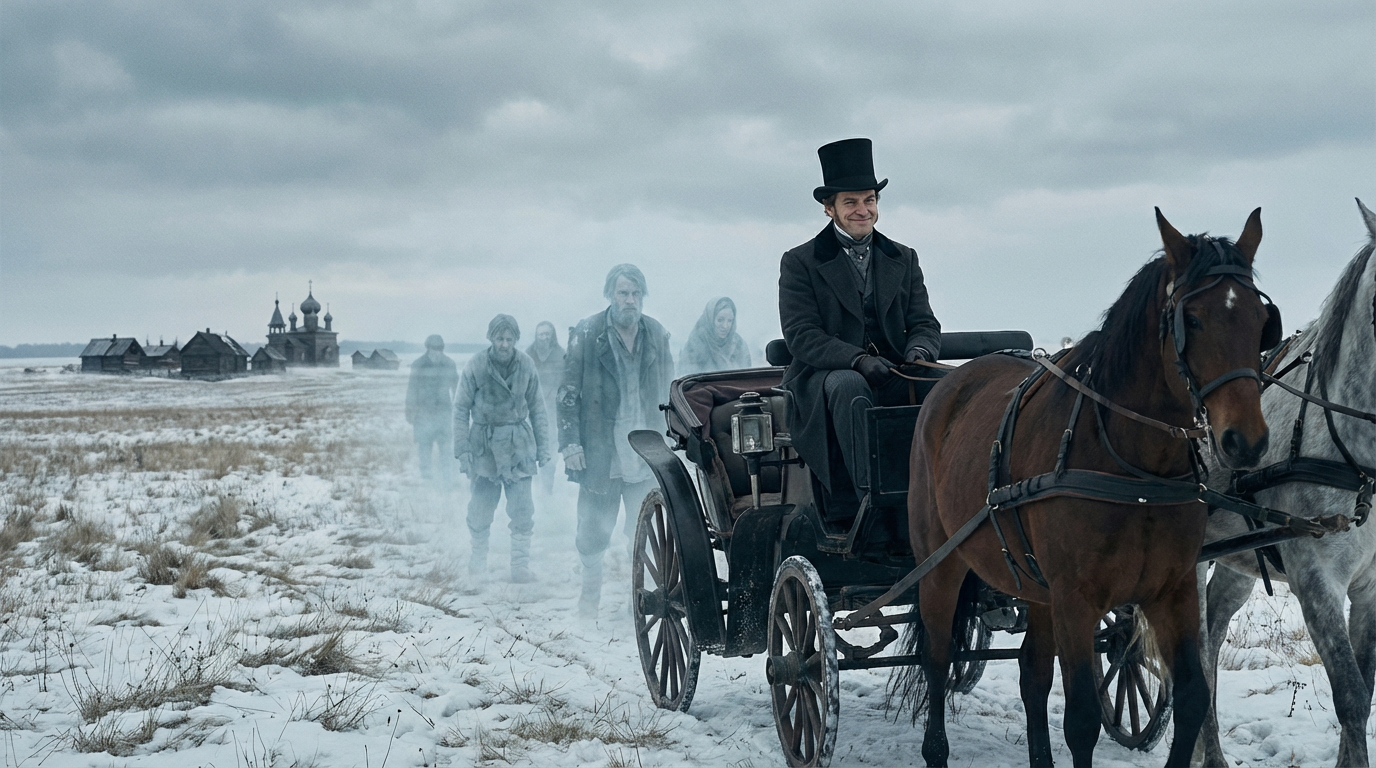
An excerpt from the original text.(complete · 11556 words)
n reaching the tavern, Chichikov called a halt. His reasons for this
were twofold--namely, that he wanted to rest the horses, and that he
himself desired some refreshment. In this connection the author feels
bound to confess that the appetite and the capacity of such men are
greatly to be envied. Of those well-to-do folk of St. Petersburg and
Moscow who spend their time in considering what they shall eat on the
morrow, and in composing a dinner for the day following, and who never
sit down to a meal without first of all injecting a pill and then
swallowing oysters and crabs and a quantity of other monsters, while
eternally departing for Karlsbad or the Caucasus, the author has but a
small opinion. Yes, THEY are not the persons to inspire envy. Rather,
it is the folk of the middle classes--folk who at one posthouse call for
bacon, and at another for a sucking pig, and at a third for a steak of
sturgeon or a baked pudding with onions, and who can sit down to table
at any hour, as though they had never had a meal in their lives, and
can devour fish of all sorts, and guzzle and chew it with a view
to provoking further appetite--these, I say, are the folk who enjoy
heaven’s most favoured gift. To attain such a celestial condition the
great folk of whom I have spoken would sacrifice half their serfs and
half their mortgaged and non-mortgaged property, with the foreign and
domestic improvements thereon, if thereby they could compass such
a stomach as is possessed by the folk of the middle class. But,
unfortunately, neither money nor real estate, whether improved or
non-improved, can purchase such a stomach.
The little wooden tavern, with its narrow, but hospitable, curtain
suspended from a pair of rough-hewn doorposts like old church
candlesticks, seemed to invite Chichikov to enter. True, the
establishment was only a Russian hut of the ordinary type, but it was
a hut of larger dimensions than usual, and had around its windows and
gables carved and patterned cornices of bright-coloured wood which threw
into relief the darker hue of the walls, and consorted well with the
flowered pitchers painted on the shutters.
Ascending the narrow wooden staircase to the upper floor, and arriving
upon a broad landing, Chichikov found himself confronted with a creaking
door and a stout old woman in a striped print gown. “This way, if you
please,” she said. Within the apartment designated Chichikov
encountered the old friends which one invariably finds in such roadside
hostelries--to wit, a heavy samovar, four smooth, bescratched walls of
white pine, a three-cornered press with cups and teapots, egg-cups
of gilded china standing in front of ikons suspended by blue and red
ribands, a cat lately delivered of a family, a mirror which gives one
four eyes instead of two and a pancake for a face, and, beside the
ikons, some bunches of herbs and carnations of such faded dustiness
that, should one attempt to smell them, one is bound to burst out
sneezing.
“Have you a sucking-pig?” Chichikov inquired of the landlady as she
stood expectantly before him.
“Yes.”
“And some horse-radish and sour cream?”
“Yes.”
“Then serve them.”
The landlady departed for the purpose, and returned with a plate, a
napkin (the latter starched to the consistency of dried bark), a knife
with a bone handle beginning to turn yellow, a two-pronged fork as thin
as a wafer, and a salt-cellar incapable of being made to stand upright.
Following the accepted custom, our hero entered into conversation with
the woman, and inquired whether she herself or a landlord kept the
tavern; how much income the tavern brought in; whether her sons lived
with her; whether the oldest was a bachelor or married; whom the
eldest had taken to wife; whether the dowry had been large; whether the
father-in-law had been satisfied, and whether the said father-in-law
had not complained of receiving too small a present at the wedding.
In short, Chichikov touched on every conceivable point. Likewise
(of course) he displayed some curiosity as to the landowners of the
neighbourhood. Their names, he ascertained, were Blochin, Potchitaev,
Minoi, Cheprakov, and Sobakevitch.
“Then you are acquainted with Sobakevitch?” he said; whereupon the old
woman informed him that she knew not only Sobakevitch, but also Manilov,
and that the latter was the more delicate eater of the two, since,
whereas Manilov always ordered a roast fowl and some veal and mutton,
and then tasted merely a morsel of each, Sobakevitch would order one
dish only, but consume the whole of it, and then demand more at the same
price.
Whilst Chichikov was thus conversing and partaking of the sucking pig
until only a fragment of it seemed likely to remain, the sound of an
approaching vehicle made itself heard. Peering through the window, he
saw draw up to the tavern door a light britchka drawn by three fine
horses. From it there descended two men--one flaxen-haired and tall, and
the other dark-haired and of slighter build. While the flaxen-haired
man was clad in a dark-blue coat, the other one was wrapped in a coat
of striped pattern. Behind the britchka stood a second, but an empty,
turn-out, drawn by four long-coated steeds in ragged collars and
rope harnesses. The flaxen-haired man lost no time in ascending the
staircase, while his darker friend remained below to fumble at something
in the britchka, talking, as he did so, to the driver of the vehicle
which stood hitched behind. Somehow, the dark-haired man’s voice struck
Chichikov as familiar; and as he was taking another look at him the
flaxen-haired gentleman entered the room. The newcomer was a man of
lofty stature, with a small red moustache and a lean, hard-bitten face
whose redness made it evident that its acquaintance, if not with the
smoke of gunpowder, at all events with that of tobacco, was intimate
and extensive. Nevertheless he greeted Chichikov civilly, and the latter
returned his bow. Indeed, the pair would have entered into conversation,
and have made one another’s acquaintance (since a beginning was made
with their simultaneously expressing satisfaction at the circumstance
that the previous night’s rain had laid the dust on the roads,
and thereby made driving cool and pleasant) when the gentleman’s
darker-favoured friend also entered the room, and, throwing his cap upon
the table, pushed back a mass of dishevelled black locks from his brow.
The latest arrival was a man of medium height, but well put together,
and possessed of a pair of full red cheeks, a set of teeth as white as
snow, and coal-black whiskers. Indeed, so fresh was his complexion that
it seemed to have been compounded of blood and milk, while health danced
in his every feature.
“Ha, ha, ha!” he cried with a gesture of astonishment at the sight of
Chichikov. “What chance brings YOU here?”
Upon that Chichikov recognised Nozdrev--the man whom he had met at
dinner at the Public Prosecutor’s, and who, within a minute or two of
the introduction, had become so intimate with his fellow guest as to
address him in the second person singular, in spite of the fact that
Chichikov had given him no opportunity for doing so.
“Where have you been to-day?” Nozdrev inquired, and, without waiting for
an answer, went on: “For myself, I am just from the fair, and completely
cleaned out. Actually, I have had to do the journey back with stage
horses! Look out of the window, and see them for yourself.” And he
turned Chichikov’s head so sharply in the desired direction that he came
very near to bumping it against the window frame. “Did you ever see such
a bag of tricks? The cursed things have only just managed to get here.
In fact, on the way I had to transfer myself to this fellow’s britchka.”
He indicated his companion with a finger. “By the way, don’t you know
one another? He is Mizhuev, my brother-in-law. He and I were talking of
you only this morning. ‘Just you see,’ said I to him, ‘if we do not fall
in with Chichikov before we have done.’ Heavens, how completely cleaned
out I am! Not only have I lost four good horses, but also my watch and
chain.” Chichikov perceived that in very truth his interlocutor was
minus the articles named, as well as that one of Nozdrev’s whiskers was
less bushy in appearance than the other one. “Had I had another twenty
roubles in my pocket,” went on Nozdrev, “I should have won back all that
I have lost, as well as have pouched a further thirty thousand. Yes, I
give you my word of honour on that.”
“But you were saying the same thing when last I met you,” put in the
flaxen-haired man. “Yet, even though I lent you fifty roubles, you lost
them all.”
“But I should not have lost them THIS time. Don’t try to make me out
a fool. I should NOT have lost them, I tell you. Had I only played the
right card, I should have broken the bank.”
“But you did NOT break the bank,” remarked the flaxen-haired man.
“No. That was because I did not play my cards right. But what about your
precious major’s play? Is THAT good?”
“Good or not, at least he beat you.”
“Splendid of him! Nevertheless I will get my own back. Let him play me
at doubles, and we shall soon see what sort of a player he is!
Friend Chichikov, at first we had a glorious time, for the fair was a
tremendous success. Indeed, the tradesmen said that never yet had there
been such a gathering. I myself managed to sell everything from my
estate at a good price. In fact, we had a magnificent time. I can’t help
thinking of it, devil take me! But what a pity YOU were not there! Three
versts from the town there is quartered a regiment of dragoons, and you
would scarcely believe what a lot of officers it has. Forty at least
there are, and they do a fine lot of knocking about the town and
drinking. In particular, Staff-Captain Potsieluev is a SPLENDID fellow!
You should just see his moustache! Why, he calls good claret ‘trash’!
‘Bring me some of the usual trash,’ is his way of ordering it. And
Lieutenant Kuvshinnikov, too! He is as delightful as the other man. In
fact, I may say that every one of the lot is a rake. I spent my whole
time with them, and you can imagine that Ponomarev, the wine merchant,
did a fine trade indeed! All the same, he is a rascal, you know, and
ought not to be dealt with, for he puts all sorts of rubbish into his
liquor--Indian wood and burnt cork and elderberry juice, the villain!
Nevertheless, get him to produce a bottle from what he calls his
‘special cellar,’ and you will fancy yourself in the seventh heaven of
delight. And what quantities of champagne we drank! Compared with it,
provincial stuff is kvass [18]. Try to imagine not merely Clicquot, but
a sort of blend of Clicquot and Matradura--Clicquot of double strength.
Also Ponomarev produced a bottle of French stuff which he calls
‘Bonbon.’ Had it a bouquet, ask you? Why, it had the bouquet of a rose
garden, of anything else you like. What times we had, to be sure! Just
after we had left Pnomarev’s place, some prince or another arrived in
the town, and sent out for some champagne; but not a bottle was there
left, for the officers had drunk every one! Why, I myself got through
seventeen bottles at a sitting.”
“Come, come! You CAN’T have got through seventeen,” remarked the
flaxen-haired man.
“But I did, I give my word of honour,” retorted Nozdrev.
“Imagine what you like, but you didn’t drink even TEN bottles at a
sitting.”
“Will you bet that I did not?”
“No; for what would be the use of betting about it?”
“Then at least wager the gun which you have bought.”
“No, I am not going to do anything of the kind.”
“Just as an experiment?”
“No.”
“It is as well for you that you don’t, since, otherwise, you would have
found yourself minus both gun and cap. However, friend Chichikov, it
is a pity you were not there. Had you been there, I feel sure you would
have found yourself unable to part with Lieutenant Kuvshinnikov. You and
he would have hit it off splendidly. You know, he is quite a
different sort from the Public Prosecutor and our other provincial
skinflints--fellows who shiver in their shoes before they will spend a
single kopeck. HE will play faro, or anything else, and at any time.
Why did you not come with us, instead of wasting your time on cattle
breeding or something of the sort? But never mind. Embrace me. I like
you immensely. Mizhuev, see how curiously things have turned out.
Chichikov has nothing to do with me, or I with him, yet here is he come
from God knows where, and landed in the very spot where I happen to be
living! I may tell you that, no matter how many carriages I possessed, I
should gamble the lot away. Recently I went in for a turn at billiards,
and lost two jars of pomade, a china teapot, and a guitar. Then I staked
some more things, and, like a fool, lost them all, and six roubles in
addition. What a dog is that Kuvshinnikov! He and I attended nearly
every ball in the place. In particular, there was a woman--decolletee,
and such a swell! I merely thought to myself, ‘The devil take her!’ but
Kuvshinnikov is such a wag that he sat down beside her, and began paying
her strings of compliments in French. However, I did not neglect the
damsels altogether--although HE calls that sort of thing ‘going in for
strawberries.’ By the way, I have a splendid piece of fish and some
caviare with me. ’Tis all I HAVE brought back! In fact it is a lucky
chance that I happened to buy the stuff before my money was gone. Where
are you for?”
“I am about to call on a friend.”
“On what friend? Let him go to the devil, and come to my place instead.”
“I cannot, I cannot. I have business to do.”
“Oh, business again! I thought so!”
“But I HAVE business to do--and pressing business at that.”
“I wager that you’re lying. If not, tell me whom you’re going to call
upon.”
“Upon Sobakevitch.”
Instantly Nozdrev burst into a laugh compassable only by a healthy man
in whose head every tooth still remains as white as sugar. By this I
mean the laugh of quivering cheeks, the laugh which causes a neighbour
who is sleeping behind double doors three rooms away to leap from his
bed and exclaim with distended eyes, “Hullo! Something HAS upset him!”
“What is there to laugh at?” asked Chichikov, a trifle nettled; but
Nozdrev laughed more unrestrainedly than ever, ejaculating: “Oh, spare
us all! The thing is so amusing that I shall die of it!”
“I say that there is nothing to laugh at,” repeated Chichikov. “It is in
fulfilment of a promise that I am on my way to Sobakevitch’s.”
“Then you will scarcely be glad to be alive when you’ve got there, for
he is the veriest miser in the countryside. Oh, I know you. However,
if you think to find there either faro or a bottle of ‘Bonbon’ you are
mistaken. Look here, my good friend. Let Sobakevitch go to the devil,
and come to MY place, where at least I shall have a piece of sturgeon
to offer you for dinner. Ponomarev said to me on parting: ‘This piece is
just the thing for you. Even if you were to search the whole market, you
would never find a better one.’ But of course he is a terrible rogue.
I said to him outright: ‘You and the Collector of Taxes are the two
greatest skinflints in the town.’ But he only stroked his beard
and smiled. Every day I used to breakfast with Kuvshinnikov in his
restaurant. Well, what I was nearly forgetting is this: that, though I
am aware that you can’t forgo your engagement, I am not going to give
you up--no, not for ten thousand roubles of money. I tell you that in
advance.”
Here he broke off to run to the window and shout to his servant (who was
holding a knife in one hand and a crust of bread and a piece of sturgeon
in the other--he had contrived to filch the latter while fumbling in the
britchka for something else):
“Hi, Porphyri! Bring here that puppy, you rascal! What a puppy it is!
Unfortunately that thief of a landlord has given it nothing to eat, even
though I have promised him the roan filly which, as you may remember, I
swopped from Khvostirev.” As a matter of fact, Chichikov had never in
his life seen either Khvostirev or the roan filly.
“Barin, do you wish for anything to eat?” inquired the landlady as she
entered.
“No, nothing at all. Ah, friend Chichikov, what times we had! Yes, give
me a glass of vodka, old woman. What sort do you keep?”
“Aniseed.”
“Then bring me a glass of it,” repeated Nozdrev.
“And one for me as well,” added the flaxen-haired man.
“At the theatre,” went on Nozdrev, “there was an actress who sang like a
canary. Kuvshinnikov, who happened to be sitting with me, said: ‘My boy,
you had better go and gather that strawberry.’ As for the booths at the
fair, they numbered, I should say, fifty.” At this point he broke off
to take the glass of vodka from the landlady, who bowed low in
acknowledgement of his doing so. At the same moment Porphyri--a
fellow dressed like his master (that is to say, in a greasy, wadded
overcoat)--entered with the puppy.
“Put the brute down here,” commanded Nozdrev, “and then fasten it up.”
Porphyri deposited the animal upon the floor; whereupon it proceeded to
act after the manner of dogs.
“THERE’S a puppy for you!” cried Nozdrev, catching hold of it by the
back, and lifting it up. The puppy uttered a piteous yelp.
“I can see that you haven’t done what I told you to do,” he continued
to Porphyri after an inspection of the animal’s belly. “You have quite
forgotten to brush him.”
“I DID brush him,” protested Porphyri.
“Then where did these fleas come from?”
“I cannot think. Perhaps they have leapt into his coat out of the
britchka.”
“You liar! As a matter of fact, you have forgotten to brush him.
Nevertheless, look at these ears, Chichikov. Just feel them.”
“Why should I? Without doing that, I can see that he is well-bred.”
“Nevertheless, catch hold of his ears and feel them.”
To humour the fellow Chichikov did as he had requested, remarking: “Yes,
he seems likely to turn out well.”
“And feel the coldness of his nose! Just take it in your hand.”
Not wishing to offend his interlocutor, Chichikov felt the puppy’s nose,
saying: “Some day he will have an excellent scent.”
“Yes, will he not? ’Tis the right sort of muzzle for that. I must say
that I have long been wanting such a puppy. Porphyri, take him away
again.”
Porphyri lifted up the puppy, and bore it downstairs.
“Look here, Chichikov,” resumed Nozdrev. “You MUST come to my place. It
lies only five versts away, and we can go there like the wind, and you
can visit Sobakevitch afterwards.”
“Shall I, or shall I not, go to Nozdrev’s?” reflected Chichikov. “Is he
likely to prove any more useful than the rest? Well, at least he is as
promising, even though he has lost so much at play. But he has a head on
his shoulders, and therefore I must go carefully if I am to tackle him
concerning my scheme.”
With that he added aloud: “Very well, I WILL come with you, but do not
let us be long, for my time is very precious.”
“That’s right, that’s right!” cried Nozdrev. “Splendid, splendid! Let me
embrace you!” And he fell upon Chichikov’s neck. “All three of us will
go.”
“No, no,” put in the flaxen-haired man. “You must excuse me, for I must
be off home.”
“Rubbish, rubbish! I am NOT going to excuse you.”
“But my wife will be furious with me. You and Monsieur Chichikov must
change into the other britchka.”
“Come, come! The thing is not to be thought of.”
The flaxen-haired man was one of those people in whose character, at
first sight, there seems to lurk a certain grain of stubbornness--so
much so that, almost before one has begun to speak, they are ready to
dispute one’s words, and to disagree with anything that may be opposed
to their peculiar form of opinion. For instance, they will decline to
have folly called wisdom, or any tune danced to but their own. Always,
however, will there become manifest in their character a soft spot, and
in the end they will accept what hitherto they have denied, and call
what is foolish sensible, and even dance--yes, better than any one else
will do--to a tune set by some one else. In short, they generally begin
well, but always end badly.
“Rubbish!” said Nozdrev in answer to a further objection on his
brother-in-law’s part. And, sure enough, no sooner had Nozdrev clapped
his cap upon his head than the flaxen-haired man started to follow him
and his companion.
“But the gentleman has not paid for the vodka?” put in the old woman.
“All right, all right, good mother. Look here, brother-in-law. Pay her,
will you, for I have not a kopeck left.”
“How much?” inquired the brother-in-law.
“What, sir? Eighty kopecks, if you please,” replied the old woman.
“A lie! Give her half a rouble. That will be quite enough.”
“No, it will NOT, barin,” protested the old woman. However, she took the
money gratefully, and even ran to the door to open it for the gentlemen.
As a matter of fact, she had lost nothing by the transaction, since she
had demanded fully a quarter more than the vodka was worth.
The travellers then took their seats, and since Chichikov’s britchka
kept alongside the britchka wherein Nozdrev and his brother-in-law were
seated, it was possible for all three men to converse together as they
proceeded. Behind them came Nozdrev’s smaller buggy, with its team
of lean stage horses and Porphyri and the puppy. But inasmuch as the
conversation which the travellers maintained was not of a kind likely
to interest the reader, I might do worse than say something concerning
Nozdrev himself, seeing that he is destined to play no small role in our
story.
Nozdrev’s face will be familiar to the reader, seeing that every one
must have encountered many such. Fellows of the kind are known as
“gay young sparks,” and, even in their boyhood and school days, earn a
reputation for being bons camarades (though with it all they come in for
some hard knocks) for the reason that their faces evince an element of
frankness, directness, and enterprise which enables them soon to make
friends, and, almost before you have had time to look around, to start
addressing you in the second person singular. Yet, while cementing such
friendships for all eternity, almost always they begin quarrelling the
same evening, since, throughout, they are a loquacious, dissipated,
high-spirited, over-showy tribe. Indeed, at thirty-five Nozdrev was just
what he had been an eighteen and twenty--he was just such a lover of
fast living. Nor had his marriage in any way changed him, and the less
so since his wife had soon departed to another world, and left behind
her two children, whom he did not want, and who were therefore placed
in the charge of a good-looking nursemaid. Never at any time could he
remain at home for more than a single day, for his keen scent could
range over scores and scores of versts, and detect any fair which
promised balls and crowds. Consequently in a trice he would be
there--quarrelling, and creating disturbances over the gaming-table
(like all men of his type, he had a perfect passion for cards) yet
playing neither a faultless nor an over-clean game, since he was both
a blunderer and able to indulge in a large number of illicit cuts and
other devices. The result was that the game often ended in another kind
of sport altogether. That is to say, either he received a good kicking,
or he had his thick and very handsome whiskers pulled; with the result
that on certain occasions he returned home with one of those appendages
looking decidedly ragged. Yet his plump, healthy-looking cheeks were
so robustly constituted, and contained such an abundance of recreative
vigour, that a new whisker soon sprouted in place of the old one, and
even surpassed its predecessor. Again (and the following is a phenomenon
peculiar to Russia) a very short time would have elapsed before once
more he would be consorting with the very cronies who had recently
cuffed him--and consorting with them as though nothing whatsoever had
happened--no reference to the subject being made by him, and they too
holding their tongues.
In short, Nozdrev was, as it were, a man of incident. Never was he
present at any gathering without some sort of a fracas occurring
thereat. Either he would require to be expelled from the room by
gendarmes, or his friends would have to kick him out into the street. At
all events, should neither of those occurrences take place, at least he
did something of a nature which would not otherwise have been witnessed.
That is to say, should he not play the fool in a buffet to such an
extent as to make every one smile, you may be sure that he was engaged
in lying to a degree which at times abashed even himself. Moreover, the
man lied without reason. For instance, he would begin telling a story to
the effect that he possessed a blue-coated or a red-coated horse; until,
in the end, his listeners would be forced to leave him with the remark,
“You are giving us some fine stuff, old fellow!” Also, men like Nozdrev
have a passion for insulting their neighbours without the least excuse
afforded. (For that matter, even a man of good standing and of
respectable exterior--a man with a star on his breast--may unexpectedly
press your hand one day, and begin talking to you on subjects of a
nature to give food for serious thought. Yet just as unexpectedly may
that man start abusing you to your face--and do so in a manner worthy of
a collegiate registrar rather than of a man who wears a star on his
breast and aspires to converse on subjects which merit reflection. All
that one can do in such a case is to stand shrugging one’s shoulders in
amazement.) Well, Nozdrev had just such a weakness. The more he became
friendly with a man, the sooner would he insult him, and be ready to
spread calumnies as to his reputation. Yet all the while he would
consider himself the insulted one’s friend, and, should he meet him
again, would greet him in the most amicable style possible, and say,
“You rascal, why have you given up coming to see me.” Thus, taken all
round, Nozdrev was a person of many aspects and numerous potentialities.
In one and the same breath would he propose to go with you whithersoever
you might choose (even to the very ends of the world should you so
require) or to enter upon any sort of an enterprise with you, or to
exchange any commodity for any other commodity which you might care to
name. Guns, horses, dogs, all were subjects for barter--though not for
profit so far as YOU were concerned. Such traits are mostly the outcome
of a boisterous temperament, as is additionally exemplified by the fact
that if at a fair he chanced to fall in with a simpleton and to fleece
him, he would then proceed to buy a quantity of the very first articles
which came to hand--horse-collars, cigar-lighters, dresses for his
nursemaid, foals, raisins, silver ewers, lengths of holland, wheatmeal,
tobacco, revolvers, dried herrings, pictures, whetstones, crockery,
boots, and so forth, until every atom of his money was exhausted. Yet
seldom were these articles conveyed home, since, as a rule, the same day
saw them lost to some more skilful gambler, in addition to his pipe, his
tobacco-pouch, his mouthpiece, his four-horsed turn-out, and his
coachman: with the result that, stripped to his very shirt, he would be
forced to beg the loan of a vehicle from a friend.
Such was Nozdrev. Some may say that characters of his type have become
extinct, that Nozdrevs no longer exist. Alas! such as say this will
be wrong; for many a day must pass before the Nozdrevs will have
disappeared from our ken. Everywhere they are to be seen in our
midst--the only difference between the new and the old being a
difference of garments. Persons of superficial observation are apt to
consider that a man clad in a different coat is quite a different person
from what he used to be.
To continue. The three vehicles bowled up to the steps of Nozdrev’s
house, and their occupants alighted. But no preparations whatsoever had
been made for the guest’s reception, for on some wooden trestles in
the centre of the dining-room a couple of peasants were engaged in
whitewashing the ceiling and drawling out an endless song as they
splashed their stuff about the floor. Hastily bidding peasants and
trestles to be gone, Nozdrev departed to another room with further
instructions. Indeed, so audible was the sound of his voice as he
ordered dinner that Chichikov--who was beginning to feel hungry once
more--was enabled to gather that it would be at least five o’clock
before a meal of any kind would be available. On his return, Nozdrev
invited his companions to inspect his establishment--even though as
early as two o’clock he had to announce that nothing more was to be
seen.
The tour began with a view of the stables, where the party saw two mares
(the one a grey, and the other a roan) and a colt; which latter animal,
though far from showy, Nozdrev declared to have cost him ten thousand
roubles.
“You NEVER paid ten thousand roubles for the brute!” exclaimed the
brother-in-law. “He isn’t worth even a thousand.”
“By God, I DID pay ten thousand!” asserted Nozdrev.
“You can swear that as much as you like,” retorted the other.
“Will you bet that I did not?” asked Nozdrev, but the brother-in-law
declined the offer.
Next, Nozdrev showed his guests some empty stalls where a number of
equally fine animals (so he alleged) had lately stood. Also there was on
view the goat which an old belief still considers to be an indispensable
adjunct to such places, even though its apparent use is to pace up and
down beneath the noses of the horses as though the place belonged to it.
Thereafter the host took his guests to look at a young wolf which he had
got tied to a chain. “He is fed on nothing but raw meat,” he explained,
“for I want him to grow up as fierce as possible.” Then the party
inspected a pond in which there were “fish of such a size that it would
take two men all their time to lift one of them out.”
This piece of information was received with renewed incredulity on the
part of the brother-in-law.
“Now, Chichikov,” went on Nozdrev, “let me show you a truly magnificent
brace of dogs. The hardness of their muscles will surprise you, and they
have jowls as sharp as needles.”
So saying, he led the way to a small, but neatly-built, shed surrounded
on every side with a fenced-in run. Entering this run, the visitors
beheld a number of dogs of all sorts and sizes and colours. In their
midst Nozdrev looked like a father lording it over his family circle.
Erecting their tails--their “stems,” as dog fanciers call those
members--the animals came bounding to greet the party, and fully a score
of them laid their paws upon Chichikov’s shoulders. Indeed, one dog was
moved with such friendliness that, standing on its hind legs, it licked
him on the lips, and so forced him to spit. That done, the visitors duly
inspected the couple already mentioned, and expressed astonishment at
their muscles. True enough, they were fine animals. Next, the party
looked at a Crimean bitch which, though blind and fast nearing her end,
had, two years ago, been a truly magnificent dog. At all events, so said
Nozdrev. Next came another bitch--also blind; then an inspection of
the water-mill, which lacked the spindle-socket wherein the upper stone
ought to have been revolving--“fluttering,” to use the Russian peasant’s
quaint expression. “But never mind,” said Nozdrev. “Let us proceed to
the blacksmith’s shop.” So to the blacksmith’s shop the party proceeded,
and when the said shop had been viewed, Nozdrev said as he pointed to a
field:
“In this field I have seen such numbers of hares as to render the ground
quite invisible. Indeed, on one occasion I, with my own hands, caught a
hare by the hind legs.”
“You never caught a hare by the hind legs with your hands!” remarked the
brother-in-law.
“But I DID” reiterated Nozdrev. “However, let me show you the boundary
where my lands come to an end.”
So saying, he started to conduct his guests across a field which
consisted mostly of moleheaps, and in which the party had to pick their
way between strips of ploughed land and of harrowed. Soon Chichikov
began to feel weary, for the terrain was so low-lying that in many spots
water could be heard squelching underfoot, and though for a while the
visitors watched their feet, and stepped carefully, they soon perceived
that such a course availed them nothing, and took to following their
noses, without either selecting or avoiding the spots where the mire
happened to be deeper or the reverse. At length, when a considerable
distance had been covered, they caught sight of a boundary-post and a
narrow ditch.
“That is the boundary,” said Nozdrev. “Everything that you see on this
side of the post is mine, as well as the forest on the other side of it,
and what lies beyond the forest.”
“WHEN did that forest become yours?” asked the brother-in-law. “It
cannot be long since you purchased it, for it never USED to be yours.”
“Yes, it isn’t long since I purchased it,” said Nozdrev.
“How long?”
“How long? Why, I purchased it three days ago, and gave a pretty sum for
it, as the devil knows!”
“Indeed? Why, three days ago you were at the fair?”
“Wiseacre! Cannot one be at a fair and buy land at the same time? Yes, I
WAS at the fair, and my steward bought the land in my absence.”
“Oh, your STEWARD bought it.” The brother-in-law seemed doubtful, and
shook his head.
The guests returned by the same route as that by which they had come;
whereafter, on reaching the house, Nozdrev conducted them to his study,
which contained not a trace of the things usually to be found in such
apartments--such things as books and papers. On the contrary, the only
articles to be seen were a sword and a brace of guns--the one “of them
worth three hundred roubles,” and the other “about eight hundred.” The
brother-in-law inspected the articles in question, and then shook
his head as before. Next, the visitors were shown some “real Turkish”
daggers, of which one bore the inadvertent inscription, “Saveli
Sibiriakov [19], Master Cutler.” Then came a barrel-organ, on which
Nozdrev started to play some tune or another. For a while the sounds
were not wholly unpleasing, but suddenly something seemed to go wrong,
for a mazurka started, to be followed by “Marlborough has gone to the
war,” and to this, again, there succeeded an antiquated waltz. Also,
long after Nozdrev had ceased to turn the handle, one particularly
shrill-pitched pipe which had, throughout, refused to harmonise with the
rest kept up a protracted whistling on its own account. Then followed
an exhibition of tobacco pipes--pipes of clay, of wood, of meerschaum,
pipes smoked and non-smoked; pipes wrapped in chamois leather and not
so wrapped; an amber-mounted hookah (a stake won at cards) and a tobacco
pouch (worked, it was alleged, by some countess who had fallen in love
with Nozdrev at a posthouse, and whose handiwork Nozdrev averred
to constitute the “sublimity of superfluity”--a term which, in the
Nozdrevian vocabulary, purported to signify the acme of perfection).
Finally, after some hors-d’oeuvres of sturgeon’s back, they sat down
to table--the time being then nearly five o’clock. But the meal did not
constitute by any means the best of which Chichikov had ever partaken,
seeing that some of the dishes were overcooked, and others were scarcely
cooked at all. Evidently their compounder had trusted chiefly to
inspiration--she had laid hold of the first thing which had happened to
come to hand. For instance, had pepper represented the nearest article
within reach, she had added pepper wholesale. Had a cabbage chanced to
be so encountered, she had pressed it also into the service. And the
same with milk, bacon, and peas. In short, her rule seemed to have been
“Make a hot dish of some sort, and some sort of taste will result.” For
the rest, Nozdrev drew heavily upon the wine. Even before the soup
had been served, he had poured out for each guest a bumper of port and
another of “haut” sauterne. (Never in provincial towns is ordinary,
vulgar sauterne even procurable.) Next, he called for a bottle of
madeira--“as fine a tipple as ever a field-marshall drank”; but the
madeira only burnt the mouth, since the dealers, familiar with the taste
of our landed gentry (who love “good” madeira) invariably doctor the
stuff with copious dashes of rum and Imperial vodka, in the hope that
Russian stomachs will thus be enabled to carry off the lot. After this
bottle Nozdrev called for another and “a very special” brand--a brand
which he declared to consist of a blend of burgundy and champagne, and
of which he poured generous measures into the glasses of Chichikov
and the brother-in-law as they sat to right and left of him. But since
Chichikov noticed that, after doing so, he added only a scanty modicum
of the mixture to his own tumbler, our hero determined to be cautious,
and therefore took advantage of a moment when Nozdrev had again plunged
into conversation and was yet a third time engaged in refilling his
brother-in-law’s glass, to contrive to upset his (Chichikov’s)
glass over his plate. In time there came also to table a tart of
mountain-ashberries--berries which the host declared to equal, in taste,
ripe plums, but which, curiously enough, smacked more of corn brandy.
Next, the company consumed a sort of pasty of which the precise name has
escaped me, but which the host rendered differently even on the second
occasion of its being mentioned. The meal over, and the whole tale of
wines tried, the guests still retained their seats--a circumstance which
embarrassed Chichikov, seeing that he had no mind to propound his pet
scheme in the presence of Nozdrev’s brother-in-law, who was a complete
stranger to him. No, that subject called for amicable and PRIVATE
conversation. Nevertheless, the brother-in-law appeared to bode little
danger, seeing that he had taken on board a full cargo, and was now
engaged in doing nothing of a more menacing nature than picking his
nose. At length he himself noticed that he was not altogether in a
responsible condition; wherefore he rose and began to make excuses for
departing homewards, though in a tone so drowsy and lethargic that, to
quote the Russian proverb, he might almost have been “pulling a collar
on to a horse by the clasps.”
“No, no!” cried Nozdrev. “I am NOT going to let you go.”
“But I MUST go,” replied the brother-in-law. “Don’t try to hinder me.
You are annoying me greatly.”
“Rubbish! We are going to play a game of banker.”
“No, no. You must play it without me, my friend. My wife is expecting me
at home, and I must go and tell her all about the fair. Yes, I MUST go
if I am to please her. Do not try to detain me.”
“Your wife be--! But have you REALLY an important piece of business with
her?”
“No, no, my friend. The real reason is that she is a good and trustful
woman, and that she does a great deal for me. The tears spring to my
eyes as I think of it. Do not detain me. As an honourable man I say that
I must go. Of that I do assure you in all sincerity.”
“Oh, let him go,” put in Chichikov under his breath. “What use will he
be here?”
“Very well,” said Nozdrev, “though, damn it, I do not like fellows who
lose their heads.” Then he added to his brother-in-law: “All right,
Thetuk [20]. Off you go to your wife and your woman’s talk and may the
devil go with you!”
“Do not insult me with the term Thetuk,” retorted the brother-in-law.
“To her I owe my life, and she is a dear, good woman, and has shown me
much affection. At the very thought of it I could weep. You see, she
will be asking me what I have seen at the fair, and tell her about it I
must, for she is such a dear, good woman.”
“Then off you go to her with your pack of lies. Here is your cap.”
“No, good friend, you are not to speak of her like that. By so doing you
offend me greatly--I say that she is a dear, good woman.”
“Then run along home to her.”
“Yes, I am just going. Excuse me for having been unable to stay. Gladly
would I have stayed, but really I cannot.”
The brother-in-law repeated his excuses again and again without noticing
that he had entered the britchka, that it had passed through the gates,
and that he was now in the open country. Permissibly we may suppose that
his wife succeeded in gleaning from him few details of the fair.
“What a fool!” said Nozdrev as, standing by the window, he watched the
departing vehicle. “Yet his off-horse is not such a bad one. For a long
time past I have been wanting to get hold of it. A man like that is
simply impossible. Yes, he is a Thetuk, a regular Thetuk.”
With that they repaired to the parlour, where, on Porphyri bringing
candles, Chichikov perceived that his host had produced a pack of cards.
“I tell you what,” said Nozdrev, pressing the sides of the pack
together, and then slightly bending them, so that the pack cracked and
a card flew out. “How would it be if, to pass the time, I were to make a
bank of three hundred?”
Chichikov pretended not to have heard him, but remarked with an air of
having just recollected a forgotten point:
“By the way, I had omitted to say that I have a request to make of you.”
“What request?”
“First give me your word that you will grant it.”
“What is the request, I say?”
“Then you give me your word, do you?”
“Certainly.”
“Your word of honour?”
“My word of honour.”
“This, then, is my request. I presume that you have a large number
of dead serfs whose names have not yet been removed from the revision
list?”
“I have. But why do you ask?”
“Because I want you to make them over to me.”
“Of what use would they be to you?”
“Never mind. I have a purpose in wanting them.”
“What purpose?”
“A purpose which is strictly my own affair. In short, I need them.”
“You seem to have hatched a very fine scheme. Out with it, now! What is
in the wind?”
“How could I have hatched such a scheme as you say? One could not very
well hatch a scheme out of such a trifle as this.”
“Then for what purpose do you want the serfs?”
“Oh, the curiosity of the man! He wants to poke his fingers into and
smell over every detail!”
“Why do you decline to say what is in your mind? At all events, until
you DO say I shall not move in the matter.”
“But how would it benefit you to know what my plans are? A whim has
seized me. That is all. Nor are you playing fair. You have given me your
word of honour, yet now you are trying to back out of it.”
“No matter what you desire me to do, I decline to do it until you have
told me your purpose.”
“What am I to say to the fellow?” thought Chichikov. He reflected for
a moment, and then explained that he wanted the dead souls in order
to acquire a better standing in society, since at present he possessed
little landed property, and only a handful of serfs.
“You are lying,” said Nozdrev without even letting him finish. “Yes, you
are lying my good friend.”
Chichikov himself perceived that his device had been a clumsy one, and
his pretext weak. “I must tell him straight out,” he said to himself as
he pulled his wits together.
“Should I tell you the truth,” he added aloud, “I must beg of you not
to repeat it. The truth is that I am thinking of getting married. But,
unfortunately, my betrothed’s father and mother are very ambitious
people, and do not want me to marry her, since they desire the
bridegroom to own not less than three hundred souls, whereas I own but a
hundred and fifty, and that number is not sufficient.”
“Again you are lying,” said Nozdrev.
“Then look here; I have been lying only to this extent.” And Chichikov
marked off upon his little finger a minute portion.
“Nevertheless I will bet my head that you have been lying throughout.”
“Come, come! That is not very civil of you. Why should I have been
lying?”
“Because I know you, and know that you are a regular skinflint. I say
that in all friendship. If I possessed any power over you I should hang
you to the nearest tree.”
This remark hurt Chichikov, for at any time he disliked expressions
gross or offensive to decency, and never allowed any one--no, not even
persons of the highest rank--to behave towards him with an undue
measure of familiarity. Consequently his sense of umbrage on the present
occasion was unbounded.
“By God, I WOULD hang you!” repeated Nozdrev. “I say this frankly, and
not for the purpose of offending you, but simply to communicate to you
my friendly opinion.”
“To everything there are limits,” retorted Chichikov stiffly. “If you
want to indulge in speeches of that sort you had better return to the
barracks.”
However, after a pause he added:
“If you do not care to give me the serfs, why not SELL them?”
“SELL them? I know you, you rascal! You wouldn’t give me very much for
them, WOULD you?”
“A nice fellow! Look here. What are they to you? So many diamonds, eh?”
“I thought so! I know you!”
“Pardon me, but I could wish that you were a member of the Jewish
persuasion. You would give them to me fast enough then.”
“On the contrary, to show you that I am not a usurer, I will decline to
ask of you a single kopeck for the serfs. All that you need do is to buy
that colt of mine, and then I will throw in the serfs in addition.”
“But what should I want with your colt?” said Chichikov, genuinely
astonished at the proposal.
“What should YOU want with him? Why, I have bought him for ten thousand
roubles, and am ready to let you have him for four.”
“I ask you again: of what use could the colt possibly be to me? I am not
the keeper of a breeding establishment.”
“Ah! I see that you fail to understand me. Let me suggest that you pay
down at once three thousand roubles of the purchase money, and leave the
other thousand until later.”
“But I do not mean to buy the colt, damn him!”
“Then buy the roan mare.”
“No, nor the roan mare.”
“Then you shall have both the mare and the grey horse which you have
seen in my stables for two thousand roubles.”
“I require no horses at all.”
“But you would be able to sell them again. You would be able to get
thrice their purchase price at the very first fair that was held.”
“Then sell them at that fair yourself, seeing that you are so certain of
making a triple profit.”
“Oh, I should make it fast enough, only I want YOU to benefit by the
transaction.”
Chichikov duly thanked his interlocutor, but continued to decline either
the grey horse or the roan mare.
“Then buy a few dogs,” said Nozdrev. “I can sell you a couple of hides
a-quiver, ears well pricked, coats like quills, ribs barrel-shaped, and
paws so tucked up as scarcely to graze the ground when they run.”
“Of what use would those dogs be to me? I am not a sportsman.”
“But I WANT you to have the dogs. Listen. If you won’t have the dogs,
then buy my barrel-organ. ’Tis a splendid instrument. As a man of honour
I can tell you that, when new, it cost me fifteen hundred roubles. Well,
you shall have it for nine hundred.”
“Come, come! What should I want with a barrel-organ? I am not a German,
to go hauling it about the roads and begging for coppers.”
“But this is quite a different kind of organ from the one which Germans
take about with them. You see, it is a REAL organ. Look at it for
yourself. It is made of the best wood. I will take you to have another
view of it.”
And seizing Chichikov by the hand, Nozdrev drew him towards the other
room, where, in spite of the fact that Chichikov, with his feet planted
firmly on the floor, assured his host, again and again, that he knew
exactly what the organ was like, he was forced once more to hear how
Marlborough went to the war.
“Then, since you don’t care to give me any money for it,” persisted
Nozdrev, “listen to the following proposal. I will give you the
barrel-organ and all the dead souls which I possess, and in return you
shall give me your britchka, and another three hundred roubles into the
bargain.”
“Listen to the man! In that case, what should I have left to drive in?”
“Oh, I would stand you another britchka. Come to the coach-house, and
I will show you the one I mean. It only needs repainting to look a
perfectly splendid britchka.”
“The ramping, incorrigible devil!” thought Chichikov to himself as at
all hazards he resolved to escape from britchkas, organs, and every
species of dog, however marvellously barrel-ribbed and tucked up of paw.
“And in exchange, you shall have the britchka, the barrel-organ, and the
dead souls,” repeated Nozdrev.
“I must decline the offer,” said Chichikov.
“And why?”
“Because I don’t WANT the things--I am full up already.”
“I can see that you don’t know how things should be done between good
friends and comrades. Plainly you are a man of two faces.”
“What do you mean, you fool? Think for yourself. Why should I acquire
articles which I don’t want?”
“Say no more about it, if you please. I have quite taken your measure.
But see here. Should you care to play a game of banker? I am ready to
stake both the dead souls and the barrel-organ at cards.”
“No; to leave an issue to cards means to submit oneself to the unknown,”
said Chichikov, covertly glancing at the pack which Nozdrev had got
in his hands. Somehow the way in which his companion had cut that pack
seemed to him suspicious.
“Why ‘to the unknown’?” asked Nozdrev. “There is no such thing as ‘the
unknown.’ Should luck be on your side, you may win the devil knows what
a haul. Oh, luck, luck!” he went on, beginning to deal, in the hope of
raising a quarrel. “Here is the cursed nine upon which, the other night,
I lost everything. All along I knew that I should lose my money. Said I
to myself: ‘The devil take you, you false, accursed card!’”
Just as Nozdrev uttered the words Porphyri entered with a fresh bottle
of liquor; but Chichikov declined either to play or to drink.
“Why do you refuse to play?” asked Nozdrev.
“Because I feel indisposed to do so. Moreover, I must confess that I am
no great hand at cards.”
“WHY are you no great hand at them?”
Chichikov shrugged his shoulders. “Because I am not,” he replied.
“You are no great hand at ANYTHING, I think.”
“What does that matter? God has made me so.”
“The truth is that you are a Thetuk, and nothing else. Once upon a
time I believed you to be a good fellow, but now I see that you
don’t understand civility. One cannot speak to you as one would to an
intimate, for there is no frankness or sincerity about you. You are a
regular Sobakevitch--just such another as he.”
“For what reason are you abusing me? Am I in any way at fault for
declining to play cards? Sell me those souls if you are the man to
hesitate over such rubbish.”
“The foul fiend take you! I was about to have given them to you for
nothing, but now you shan’t have them at all--not if you offer me three
kingdoms in exchange. Henceforth I will have nothing to do with you, you
cobbler, you dirty blacksmith! Porphyri, go and tell the ostler to give
the gentleman’s horses no oats, but only hay.”
This development Chichikov had hardly expected.
“And do you,” added Nozdrev to his guest, “get out of my sight.”
Yet in spite of this, host and guest took supper together--even though
on this occasion the table was adorned with no wines of fictitious
nomenclature, but only with a bottle which reared its solitary head
beside a jug of what is usually known as vin ordinaire. When supper was
over Nozdrev said to Chichikov as he conducted him to a side room where
a bed had been made up:
“This is where you are to sleep. I cannot very well wish you
good-night.”
Left to himself on Nozdrev’s departure, Chichikov felt in a most
unenviable frame of mind. Full of inward vexation, he blamed himself
bitterly for having come to see this man and so wasted valuable
time; but even more did he blame himself for having told him of his
scheme--for having acted as carelessly as a child or a madman. Of a
surety the scheme was not one which ought to have been confided to a man
like Nozdrev, for he was a worthless fellow who might lie about it, and
append additions to it, and spread such stories as would give rise
to God knows what scandals. “This is indeed bad!” Chichikov said to
himself. “I have been an absolute fool.” Consequently he spent an uneasy
night--this uneasiness being increased by the fact that a number of
small, but vigorous, insects so feasted upon him that he could do
nothing but scratch the spots and exclaim, “The devil take you and
Nozdrev alike!” Only when morning was approaching did he fall asleep. On
rising, he made it his first business (after donning dressing-gown
and slippers) to cross the courtyard to the stable, for the purpose of
ordering Selifan to harness the britchka. Just as he was returning from
his errand he encountered Nozdrev, clad in a dressing-gown, and holding
a pipe between his teeth.
Host and guest greeted one another in friendly fashion, and Nozdrev
inquired how Chichikov had slept.
“Fairly well,” replied Chichikov, but with a touch of dryness in his
tone.
“The same with myself,” said Nozdrev. “The truth is that such a lot of
nasty brutes kept crawling over me that even to speak of it gives me
the shudders. Likewise, as the effect of last night’s doings, a whole
squadron of soldiers seemed to be camping on my chest, and giving me a
flogging. Ugh! And whom also do you think I saw in a dream? You would
never guess. Why, it was Staff-Captain Potsieluev and Lieutenant
Kuvshinnikov!”
“Yes,” though Chichikov to himself, “and I wish that they too would give
you a public thrashing!”
“I felt so ill!” went on Nozdrev. “And just after I had fallen asleep
something DID come and sting me. Probably it was a party of hag fleas.
Now, dress yourself, and I will be with you presently. First of all I
must give that scoundrel of a bailiff a wigging.”
Chichikov departed to his own room to wash and dress; which process
completed, he entered the dining-room to find the table laid with
tea-things and a bottle of rum. Clearly no broom had yet touched the
place, for there remained traces of the previous night’s dinner and
supper in the shape of crumbs thrown over the floor and tobacco ash on
the tablecloth. The host himself, when he entered, was still clad in a
dressing-gown exposing a hairy chest; and as he sat holding his pipe in
his hand, and drinking tea from a cup, he would have made a model for
the sort of painter who prefers to portray gentlemen of the less curled
and scented order.
“What think you?” he asked of Chichikov after a short silence. “Are you
willing NOW to play me for those souls?”
“I have told you that I never play cards. If the souls are for sale, I
will buy them.”
“I decline to sell them. Such would not be the course proper between
friends. But a game of banker would be quite another matter. Let us deal
the cards.”
“I have told you that I decline to play.”
“And you will not agree to an exchange?”
“No.”
“Then look here. Suppose we play a game of chess. If you win, the souls
shall be yours. There are lots which I should like to see crossed off
the revision list. Hi, Porphyri! Bring me the chessboard.”
“You are wasting your time. I will play neither chess nor cards.”
“But chess is different from playing with a bank. In chess there can be
neither luck nor cheating, for everything depends upon skill. In fact, I
warn you that I cannot possibly play with you unless you allow me a move
or two in advance.”
“The same with me,” thought Chichikov. “Shall I, or shall I not, play
this fellow? I used not to be a bad chess-player, and it is a sport in
which he would find it more difficult to be up to his tricks.”
“Very well,” he added aloud. “I WILL play you at chess.”
“And stake the souls for a hundred roubles?” asked Nozdrev.
“No. Why for a hundred? Would it not be sufficient to stake them for
fifty?”
“No. What would be the use of fifty? Nevertheless, for the hundred
roubles I will throw in a moderately old puppy, or else a gold seal and
watch-chain.”
“Very well,” assented Chichikov.
“Then how many moves are you going to allow me?”
“Is THAT to be part of the bargain? Why, none, of course.”
“At least allow me two.”
“No, none. I myself am only a poor player.”
“I know you and your poor play,” said Nozdrev, moving a chessman.
“In fact, it is a long time since last I had a chessman in my hand,”
replied Chichikov, also moving a piece.
“Ah! I know you and your poor play,” repeated Nozdrev, moving a second
chessman.
“I say again that it is a long time since last I had a chessman in my
hand.” And Chichikov, in his turn, moved.
“Ah! I know you and your poor play,” repeated Nozdrev, for the third
time as he made a third move. At the same moment the cuff of one of his
sleeves happened to dislodge another chessman from its position.
“Again, I say,” said Chichikov, “that ’tis a long time since last--But
hi! look here! Put that piece back in its place!”
“What piece?”
“This one.” And almost as Chichikov spoke he saw a third chessman coming
into view between the queens. God only knows whence that chessman had
materialised.
“No, no!” shouted Chichikov as he rose from the table. “It is impossible
to play with a man like you. People don’t move three pieces at once.”
“How ‘three pieces’? All that I have done is to make a mistake--to move
one of my pieces by accident. If you like, I will forfeit it to you.”
“And whence has the third piece come?”
“What third piece?”
“The one now standing between the queens?”
“’Tis one of your own pieces. Surely you are forgetting?”
“No, no, my friend. I have counted every move, and can remember each
one. That piece has only just become added to the board. Put it back in
its place, I say.”
“Its place? Which IS its place?” But Nozdrev had reddened a good deal.
“I perceive you to be a strategist at the game.”
“No, no, good friend. YOU are the strategist--though an unsuccessful
one, as it happens.”
“Then of what are you supposing me capable? Of cheating you?”
“I am not supposing you capable of anything. All that I say is that I
will not play with you any more.”
“But you can’t refuse to,” said Nozdrev, growing heated. “You see, the
game has begun.”
“Nevertheless, I have a right not to continue it, seeing that you are
not playing as an honest man should do.”
“You are lying--you cannot truthfully say that.”
“’Tis you who are lying.”
“But I have NOT cheated. Consequently you cannot refuse to play, but
must continue the game to a finish.”
“You cannot force me to play,” retorted Chichikov coldly as, turning to
the chessboard, he swept the pieces into confusion.
Nozdrev approached Chichikov with a manner so threatening that the other
fell back a couple of paces.
“I WILL force you to play,” said Nozdrev. “It is no use you making a
mess of the chessboard, for I can remember every move. We will replace
the chessmen exactly as they were.”
“No, no, my friend. The game is over, and I play you no more.”
“You say that you will not?”
“Yes. Surely you can see for yourself that such a thing is impossible?”
“That cock won’t fight. Say at once that you refuse to play with me.”
And Nozdrev approached a step nearer.
“Very well; I DO say that,” replied Chichikov, and at the same moment
raised his hands towards his face, for the dispute was growing heated.
Nor was the act of caution altogether unwarranted, for Nozdrev
also raised his fist, and it may be that one of our hero’s plump,
pleasant-looking cheeks would have sustained an indelible insult had
not he (Chichikov) parried the blow and, seizing Nozdrev by his whirling
arms, held them fast.
“Porphyri! Pavlushka!” shouted Nozdrev as madly he strove to free
himself.
On hearing the words, Chichikov, both because he wished to avoid
rendering the servants witnesses of the unedifying scene and because he
felt that it would be of no avail to hold Nozdrev any longer, let go of
the latter’s arms; but at the same moment Porphyri and Pavlushka entered
the room--a pair of stout rascals with whom it would be unwise to
meddle.
“Do you, or do you not, intend to finish the game?” said Nozdrev. “Give
me a direct answer.”
“No; it will not be possible to finish the game,” replied Chichikov,
glancing out of the window. He could see his britchka standing ready for
him, and Selifan evidently awaiting orders to draw up to the entrance
steps. But from the room there was no escape, since in the doorway was
posted the couple of well-built serving-men.
“Then it is as I say? You refuse to finish the game?” repeated Nozdrev,
his face as red as fire.
“I would have finished it had you played like a man of honour. But, as
it is, I cannot.”
“You cannot, eh, you villain? You find that you cannot as soon as you
find that you are not winning? Thrash him, you fellows!” And as he spoke
Nozdrev grasped the cherrywood shank of his pipe. Chichikov turned as
white as a sheet. He tried to say something, but his quivering lips
emitted no sound. “Thrash him!” again shouted Nozdrev as he rushed
forward in a state of heat and perspiration more proper to a warrior who
is attacking an impregnable fortress. “Thrash him!” again he shouted
in a voice like that of some half-demented lieutenant whose desperate
bravery has acquired such a reputation that orders have had to be issued
that his hands shall be held lest he attempt deeds of over-presumptuous
daring. Seized with the military spirit, however, the lieutenant’s head
begins to whirl, and before his eye there flits the image of Suvorov
[21]. He advances to the great encounter, and impulsively cries,
“Forward, my sons!”--cries it without reflecting that he may be
spoiling the plan of the general attack, that millions of rifles may
be protruding their muzzles through the embrasures of the impregnable,
towering walls of the fortress, that his own impotent assault may be
destined to be dissipated like dust before the wind, and that already
there may have been launched on its whistling career the bullet which is
to close for ever his vociferous throat. However, if Nozdrev resembled
the headstrong, desperate lieutenant whom we have just pictured as
advancing upon a fortress, at least the fortress itself in no way
resembled the impregnable stronghold which I have described. As a matter
of fact, the fortress became seized with a panic which drove its spirit
into its boots. First of all, the chair with which Chichikov (the
fortress in question) sought to defend himself was wrested from his
grasp by the serfs, and then--blinking and neither alive nor dead--he
turned to parry the Circassian pipe-stem of his host. In fact, God
only knows what would have happened had not the fates been pleased by
a miracle to deliver Chichikov’s elegant back and shoulders from the
onslaught. Suddenly, and as unexpectedly as though the sound had
come from the clouds, there made itself heard the tinkling notes of
a collar-bell, and then the rumble of wheels approaching the entrance
steps, and, lastly, the snorting and hard breathing of a team of horses
as a vehicle came to a standstill. Involuntarily all present glanced
through the window, and saw a man clad in a semi-military greatcoat leap
from a buggy. After making an inquiry or two in the hall, he entered the
dining-room just at the juncture when Chichikov, almost swooning with
terror, had found himself placed in about as awkward a situation as
could well befall a mortal man.
“Kindly tell me which of you is Monsieur Nozdrev?” said the unknown with
a glance of perplexity both at the person named (who was still standing
with pipe-shank upraised) and at Chichikov (who was just beginning to
recover from his unpleasant predicament).
“Kindly tell ME whom I have the honour of addressing?” retorted Nozdrev
as he approached the official.
“I am the Superintendent of Rural Police.”
“And what do you want?”
“I have come to fulfil a commission imposed upon me. That is to say,
I have come to place you under arrest until your case shall have been
decided.”
“Rubbish! What case, pray?”
“The case in which you involved yourself when, in a drunken condition,
and through the instrumentality of a walking-stick, you offered grave
offence to the person of Landowner Maksimov.”
“You lie! To your face I tell you that never in my life have I set eyes
upon Landowner Maksimov.”
“Good sir, allow me to represent to you that I am a Government officer.
Speeches like that you may address to your servants, but not to me.”
At this point Chichikov, without waiting for Nozdrev’s reply, seized
his cap, slipped behind the Superintendent’s back, rushed out on to the
verandah, sprang into his britchka, and ordered Selifan to drive like
the wind.
Master this chapter. Complete your experience
Purchase the complete book to access all chapters and support classic literature
As an Amazon Associate, we earn a small commission from qualifying purchases at no additional cost to you.
Available in paperback, hardcover, and e-book formats
Let's Analyse the Pattern
Desperation for something makes you ignore obvious red flags and rationalize dangerous behavior from others.
Why This Matters
Connect literature to life
This chapter teaches how predators identify and exploit people who need something badly.
Practice This Today
This week, notice when someone complicates a simple transaction or pushes for immediate decisions—that's your signal to slow down and ask why.
Now let's explore the literary elements.
Key Quotes & Analysis
"Rather, it is the folk of the middle classes who can sit down to table at any hour, as though they had never had a meal in their lives, and can devour fish of all sorts"
Context: Gogol contrasts the pretentious eating habits of the wealthy with the hearty appetites of middle-class people
This reveals Gogol's preference for authentic, unpretentious people over those who make everything complicated and artificial. It's also ironic since Chichikov himself is trying to climb social classes.
In Today's Words:
Give me someone who actually enjoys their food over someone who Instagram's their fancy dinner but barely eats it
"You must come to my place! It's only fifteen versts away"
Context: Nozdrev insists Chichikov visit his estate despite having just met him again after years
This immediate, overwhelming hospitality is a red flag that Chichikov ignores. Nozdrev's pushiness reveals his need to control situations and people.
In Today's Words:
You have to come to my place right now! It's totally not far and you can't say no!
"What do you want dead souls for?"
Context: When Chichikov finally reveals his request, Nozdrev immediately becomes suspicious
Unlike the previous landowners, Nozdrev's suspicious nature makes him dangerous. He smells opportunity or blackmail material rather than seeing a simple business transaction.
In Today's Words:
Why would you want something that worthless? What's the real scam here?
"No, I won't give them to you for nothing. You must play me for them"
Context: Nozdrev refuses to sell the souls outright and demands Chichikov gamble for them
This shows Nozdrev's compulsive need to turn everything into a game he can manipulate. He can't do straightforward business because he's fundamentally dishonest.
In Today's Words:
I'm not just selling them to you. We're going to play cards for them whether you like it or not.
Thematic Threads
Desperation
In This Chapter
Chichikov's need for dead souls makes him trust the obviously untrustworthy Nozdrev
Development
Building from earlier calculated moves to this moment of poor judgment
In Your Life:
When you need something badly, you might ignore warning signs about people offering to help.
Deception
In This Chapter
Nozdrev lies constantly about his possessions and wealth, but his lies are transparent
Development
Contrasts with earlier subtle deceptions—this is blatant, almost performative lying
In Your Life:
Some people lie so obviously it seems harmless, but it reveals deep character flaws.
Social Expectations
In This Chapter
Hospitality becomes a trap—Chichikov can't easily leave once he accepts Nozdrev's invitation
Development
Shows how social norms can be weaponized against decent people
In Your Life:
Politeness and social obligations can be used to manipulate you into uncomfortable situations.
Class
In This Chapter
Nozdrev's aristocratic status gives him power to threaten violence without immediate consequences
Development
Reveals how class privilege protects destructive behavior
In Your Life:
People with status or connections often get away with behavior that would destroy others.
Control
In This Chapter
Nozdrev tries to control every aspect of the interaction, from dinner to the deal terms
Development
Introduced here as aggressive, overt control versus earlier subtle manipulations
In Your Life:
Some people can't handle simple, straightforward interactions—they must complicate and control everything.
You now have the context. Time to form your own thoughts.
Discussion Questions
- 1
What red flags about Nozdrev did Chichikov ignore, and why do you think he overlooked them?
analysis • surface - 2
Why did Nozdrev immediately complicate what should have been a simple business transaction?
analysis • medium - 3
Where have you seen people make bad decisions because they desperately needed something - a job, relationship, or opportunity?
application • medium - 4
What strategies could help someone maintain good judgment when they're under pressure to make a quick decision?
application • deep - 5
What does this chapter reveal about how predatory people identify and exploit vulnerability?
reflection • deep
Critical Thinking Exercise
Create Your Red Flag Checklist
Think about a situation where you need something important - a job, housing, medical care, or financial help. Create a personal checklist of warning signs that should make you pause, even when you're desperate. Consider both obvious red flags (like Nozdrev's lies) and subtle ones (like unnecessary complications or pressure tactics).
Consider:
- •What behaviors would make you uncomfortable in a normal situation that you might excuse when desperate?
- •How can you tell the difference between someone who's genuinely trying to help and someone who's exploiting your need?
- •What questions could you ask to test whether someone is trustworthy before making important decisions?
Journaling Prompt
Write about a time when desperation led you to ignore your better judgment. What were the warning signs you dismissed, and what would you do differently now?
Coming Up Next...
Chapter 5: The Bear-Like Landowner's Hard Bargain
Chichikov flees Nozdrev's estate in terror, but his troubles are just beginning. His secret is now in the hands of the most unreliable man in the province, and paranoia begins to consume him as he realizes the full scope of his mistake.



