
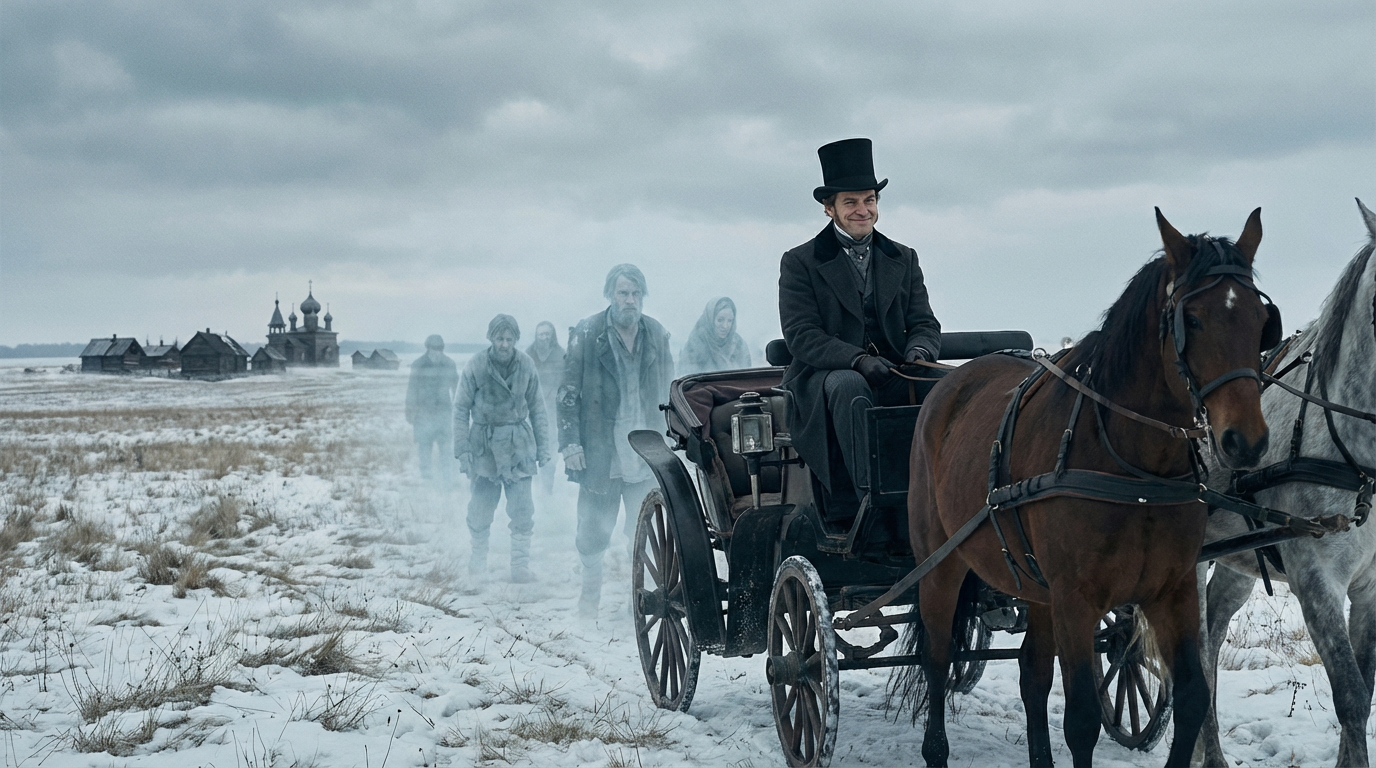
An excerpt from the original text.(complete · 9067 words)
eanwhile, Chichikov, seated in his britchka and bowling along the
turnpike, was feeling greatly pleased with himself. From the preceding
chapter the reader will have gathered the principal subject of his bent
and inclinations: wherefore it is no matter for wonder that his body
and his soul had ended by becoming wholly immersed therein. To all
appearances the thoughts, the calculations, and the projects which
were now reflected in his face partook of a pleasant nature, since
momentarily they kept leaving behind them a satisfied smile. Indeed, so
engrossed was he that he never noticed that his coachman, elated with
the hospitality of Manilov’s domestics, was making remarks of a didactic
nature to the off horse of the troika [11], a skewbald. This skewbald
was a knowing animal, and made only a show of pulling; whereas its
comrades, the middle horse (a bay, and known as the Assessor, owing to
his having been acquired from a gentleman of that rank) and the near
horse (a roan), would do their work gallantly, and even evince in their
eyes the pleasure which they derived from their exertions.
“Ah, you rascal, you rascal! I’ll get the better of you!” ejaculated
Selifan as he sat up and gave the lazy one a cut with his whip. “YOU
know your business all right, you German pantaloon! The bay is a good
fellow, and does his duty, and I will give him a bit over his feed, for
he is a horse to be respected; and the Assessor too is a good horse. But
what are YOU shaking your ears for? You are a fool, so just mind when
you’re spoken to. ’Tis good advice I’m giving you, you blockhead. Ah!
You CAN travel when you like.” And he gave the animal another cut,
and then shouted to the trio, “Gee up, my beauties!” and drew his whip
gently across the backs of the skewbald’s comrades--not as a punishment,
but as a sign of his approval. That done, he addressed himself to the
skewbald again.
“Do you think,” he cried, “that I don’t see what you are doing? You can
behave quite decently when you like, and make a man respect you.”
With that he fell to recalling certain reminiscences.
“They were NICE folk, those folk at the gentleman’s yonder,” he mused.
“I DO love a chat with a man when he is a good sort. With a man of that
kind I am always hail-fellow-well-met, and glad to drink a glass of
tea with him, or to eat a biscuit. One CAN’T help respecting a decent
fellow. For instance, this gentleman of mine--why, every one looks up
to him, for he has been in the Government’s service, and is a Collegiate
Councillor.”
Thus soliloquising, he passed to more remote abstractions; until, had
Chichikov been listening, he would have learnt a number of interesting
details concerning himself. However, his thoughts were wholly occupied
with his own subject, so much so that not until a loud clap of thunder
awoke him from his reverie did he glance around him. The sky was
completely covered with clouds, and the dusty turnpike beginning to
be sprinkled with drops of rain. At length a second and a nearer and a
louder peal resounded, and the rain descended as from a bucket. Falling
slantwise, it beat upon one side of the basketwork of the tilt until the
splashings began to spurt into his face, and he found himself forced to
draw the curtains (fitted with circular openings through which to obtain
a glimpse of the wayside view), and to shout to Selifan to quicken his
pace. Upon that the coachman, interrupted in the middle of his harangue,
bethought him that no time was to be lost; wherefore, extracting from
under the box-seat a piece of old blanket, he covered over his sleeves,
resumed the reins, and cheered on his threefold team (which, it may
be said, had so completely succumbed to the influence of the pleasant
lassitude induced by Selifan’s discourse that it had taken to scarcely
placing one leg before the other). Unfortunately, Selifan could not
clearly remember whether two turnings had been passed or three. Indeed,
on collecting his faculties, and dimly recalling the lie of the road,
he became filled with a shrewd suspicion that A VERY LARGE NUMBER of
turnings had been passed. But since, at moments which call for a hasty
decision, a Russian is quick to discover what may conceivably be
the best course to take, our coachman put away from him all ulterior
reasoning, and, turning to the right at the next cross-road, shouted,
“Hi, my beauties!” and set off at a gallop. Never for a moment did he
stop to think whither the road might lead him!
It was long before the clouds had discharged their burden, and,
meanwhile, the dust on the road became kneaded into mire, and the
horses’ task of pulling the britchka heavier and heavier. Also,
Chichikov had taken alarm at his continued failure to catch sight of
Sobakevitch’s country house. According to his calculations, it ought to
have been reached long ago. He gazed about him on every side, but the
darkness was too dense for the eye to pierce.
“Selifan!” he exclaimed, leaning forward in the britchka.
“What is it, barin?” replied the coachman.
“Can you see the country house anywhere?”
“No, barin.” After which, with a flourish of the whip, the man broke
into a sort of endless, drawling song. In that song everything had
a place. By “everything” I mean both the various encouraging and
stimulating cries with which Russian folk urge on their horses, and a
random, unpremeditated selection of adjectives.
Meanwhile Chichikov began to notice that the britchka was swaying
violently, and dealing him occasional bumps. Consequently he suspected
that it had left the road and was being dragged over a ploughed field.
Upon Selifan’s mind there appeared to have dawned a similar inkling, for
he had ceased to hold forth.
“You rascal, what road are you following?” inquired Chichikov.
“I don’t know,” retorted the coachman. “What can a man do at a time of
night when the darkness won’t let him even see his whip?” And as Selifan
spoke the vehicle tilted to an angle which left Chichikov no choice but
to hang on with hands and teeth. At length he realised the fact that
Selifan was drunk.
“Stop, stop, or you will upset us!” he shouted to the fellow.
“No, no, barin,” replied Selifan. “HOW could I upset you? To upset
people is wrong. I know that very well, and should never dream of such
conduct.”
Here he started to turn the vehicle round a little--and kept on doing so
until the britchka capsized on to its side, and Chichikov landed in the
mud on his hands and knees. Fortunately Selifan succeeded in stopping
the horses, although they would have stopped of themselves, seeing
that they were utterly worn out. This unforeseen catastrophe evidently
astonished their driver. Slipping from the box, he stood resting his
hands against the side of the britchka, while Chichikov tumbled and
floundered about in the mud, in a vain endeavour to wriggle clear of the
stuff.
“Ah, you!” said Selifan meditatively to the britchka. “To think of
upsetting us like this!”
“You are as drunk as a lord!” exclaimed Chichikov.
“No, no, barin. Drunk, indeed? Why, I know my manners too well. A word
or two with a friend--that is all that I have taken. Any one may talk
with a decent man when he meets him. There is nothing wrong in
that. Also, we had a snack together. There is nothing wrong in a
snack--especially a snack with a decent man.”
“What did I say to you when last you got drunk?” asked Chichikov. “Have
you forgotten what I said then?”
“No, no, barin. HOW could I forget it? I know what is what, and know
that it is not right to get drunk. All that I have been having is a word
or two with a decent man, for the reason that--”
“Well, if I lay the whip about you, you’ll know then how to talk to a
decent fellow, I’ll warrant!”
“As you please, barin,” replied the complacent Selifan. “Should you
whip me, you will whip me, and I shall have nothing to complain of. Why
should you not whip me if I deserve it? ’Tis for you to do as you like.
Whippings are necessary sometimes, for a peasant often plays the fool,
and discipline ought to be maintained. If I have deserved it, beat me.
Why should you not?”
This reasoning seemed, at the moment, irrefutable, and Chichikov said
nothing more. Fortunately fate had decided to take pity on the pair, for
from afar their ears caught the barking of a dog. Plucking up courage,
Chichikov gave orders for the britchka to be righted, and the horses to
be urged forward; and since a Russian driver has at least this merit,
that, owing to a keen sense of smell being able to take the place
of eyesight, he can, if necessary, drive at random and yet reach a
destination of some sort, Selifan succeeded, though powerless to discern
a single object, in directing his steeds to a country house near by, and
that with such a certainty of instinct that it was not until the shafts
had collided with a garden wall, and thereby made it clear that to
proceed another pace was impossible, that he stopped. All that Chichikov
could discern through the thick veil of pouring rain was something
which resembled a verandah. So he dispatched Selifan to search for the
entrance gates, and that process would have lasted indefinitely had it
not been shortened by the circumstance that, in Russia, the place of
a Swiss footman is frequently taken by watchdogs; of which animals a
number now proclaimed the travellers’ presence so loudly that Chichikov
found himself forced to stop his ears. Next, a light gleamed in one
of the windows, and filtered in a thin stream to the garden wall--thus
revealing the whereabouts of the entrance gates; whereupon Selifan
fell to knocking at the gates until the bolts of the house door were
withdrawn and there issued therefrom a figure clad in a rough cloak.
“Who is that knocking? What have you come for?” shouted the hoarse voice
of an elderly woman.
“We are travellers, good mother,” said Chichikov. “Pray allow us to
spend the night here.”
“Out upon you for a pair of gadabouts!” retorted the old woman. “A fine
time of night to be arriving! We don’t keep an hotel, mind you. This is
a lady’s residence.”
“But what are we to do, mother? We have lost our way, and cannot spend
the night out of doors in such weather.”
“No, we cannot. The night is dark and cold,” added Selifan.
“Hold your tongue, you fool!” exclaimed Chichikov.
“Who ARE you, then?” inquired the old woman.
“A dvorianin [12], good mother.”
Somehow the word dvorianin seemed to give the old woman food for
thought.
“Wait a moment,” she said, “and I will tell the mistress.”
Two minutes later she returned with a lantern in her hand, the gates
were opened, and a light glimmered in a second window. Entering the
courtyard, the britchka halted before a moderate-sized mansion. The
darkness did not permit of very accurate observation being made,
but, apparently, the windows only of one-half of the building were
illuminated, while a quagmire in front of the door reflected the beams
from the same. Meanwhile the rain continued to beat sonorously down upon
the wooden roof, and could be heard trickling into a water butt; nor
for a single moment did the dogs cease to bark with all the strength of
their lungs. One of them, throwing up its head, kept venting a howl
of such energy and duration that the animal seemed to be howling for a
handsome wager; while another, cutting in between the yelpings of the
first animal, kept restlessly reiterating, like a postman’s bell, the
notes of a very young puppy. Finally, an old hound which appeared to be
gifted with a peculiarly robust temperament kept supplying the part of
contrabasso, so that his growls resembled the rumbling of a bass singer
when a chorus is in full cry, and the tenors are rising on tiptoe in
their efforts to compass a particularly high note, and the whole body of
choristers are wagging their heads before approaching a climax, and
this contrabasso alone is tucking his bearded chin into his collar, and
sinking almost to a squatting posture on the floor, in order to produce
a note which shall cause the windows to shiver and their panes to crack.
Naturally, from a canine chorus of such executants it might reasonably
be inferred that the establishment was one of the utmost respectability.
To that, however, our damp, cold hero gave not a thought, for all his
mind was fixed upon bed. Indeed, the britchka had hardly come to a
standstill before he leapt out upon the doorstep, missed his footing,
and came within an ace of falling. To meet him there issued a female
younger than the first, but very closely resembling her; and on his
being conducted to the parlour, a couple of glances showed him that the
room was hung with old striped curtains, and ornamented with pictures
of birds and small, antique mirrors--the latter set in dark frames which
were carved to resemble scrolls of foliage. Behind each mirror was stuck
either a letter or an old pack of cards or a stocking, while on the wall
hung a clock with a flowered dial. More, however, Chichikov could not
discern, for his eyelids were as heavy as though smeared with treacle.
Presently the lady of the house herself entered--an elderly woman in a
sort of nightcap (hastily put on) and a flannel neck wrap. She belonged
to that class of lady landowners who are for ever lamenting failures of
the harvest and their losses thereby; to the class who, drooping their
heads despondently, are all the while stuffing money into striped
purses, which they keep hoarded in the drawers of cupboards. Into one
purse they will stuff rouble pieces, into another half roubles, and into
a third tchetvertachki [13], although from their mien you would suppose
that the cupboard contained only linen and nightshirts and skeins of
wool and the piece of shabby material which is destined--should the
old gown become scorched during the baking of holiday cakes and other
dainties, or should it fall into pieces of itself--to become converted
into a new dress. But the gown never does get burnt or wear out, for
the reason that the lady is too careful; wherefore the piece of shabby
material reposes in its unmade-up condition until the priest advises
that it be given to the niece of some widowed sister, together with a
quantity of other such rubbish.
Chichikov apologised for having disturbed the household with his
unexpected arrival.
“Not at all, not at all,” replied the lady. “But in what dreadful
weather God has brought you hither! What wind and what rain! You could
not help losing your way. Pray excuse us for being unable to make better
preparations for you at this time of night.”
Suddenly there broke in upon the hostess’ words the sound of a strange
hissing, a sound so loud that the guest started in alarm, and the more
so seeing that it increased until the room seemed filled with adders. On
glancing upwards, however, he recovered his composure, for he perceived
the sound to be emanating from the clock, which appeared to be in a mind
to strike. To the hissing sound there succeeded a wheezing one, until,
putting forth its best efforts, the thing struck two with as much
clatter as though some one had been hitting an iron pot with a
cudgel. That done, the pendulum returned to its right-left, right-left
oscillation.
Chichikov thanked his hostess kindly, and said that he needed nothing,
and she must not put herself about: only for rest was he longing--though
also he should like to know whither he had arrived, and whether the
distance to the country house of land-owner Sobakevitch was anything
very great. To this the lady replied that she had never so much as heard
the name, since no gentleman of the name resided in the locality.
“But at least you are acquainted with landowner Manilov?” continued
Chichikov.
“No. Who is he?”
“Another landed proprietor, madam.”
“Well, neither have I heard of him. No such landowner lives hereabouts.”
“Then who ARE your local landowners?”
“Bobrov, Svinin, Kanapatiev, Khapakin, Trepakin, and Plieshakov.”
“Are they rich men?”
“No, none of them. One of them may own twenty souls, and another thirty,
but of gentry who own a hundred there are none.”
Chichikov reflected that he had indeed fallen into an aristocratic
wilderness!
“At all events, is the town far away?” he inquired.
“About sixty versts. How sorry I am that I have nothing for you to eat!
Should you care to drink some tea?”
“I thank you, good mother, but I require nothing beyond a bed.”
“Well, after such a journey you must indeed be needing rest, so you
shall lie upon this sofa. Fetinia, bring a quilt and some pillows and
sheets. What weather God has sent us! And what dreadful thunder! Ever
since sunset I have had a candle burning before the ikon in my bedroom.
My God! Why, your back and sides are as muddy as a boar’s! However have
you managed to get into such a state?”
“That I am nothing worse than muddy is indeed fortunate, since, but for
the Almighty, I should have had my ribs broken.”
“Dear, dear! To think of all that you must have been through. Had I not
better wipe your back?”
“I thank you, I thank you, but you need not trouble. Merely be so good
as to tell your maid to dry my clothes.”
“Do you hear that, Fetinia?” said the hostess, turning to a woman who
was engaged in dragging in a feather bed and deluging the room with
feathers. “Take this coat and this vest, and, after drying them before
the fire--just as we used to do for your late master--give them a good
rub, and fold them up neatly.”
“Very well, mistress,” said Fetinia, spreading some sheets over the bed,
and arranging the pillows.
“Now your bed is ready for you,” said the hostess to Chichikov.
“Good-night, dear sir. I wish you good-night. Is there anything else
that you require? Perhaps you would like to have your heels tickled
before retiring to rest? Never could my late husband get to sleep
without that having been done.”
But the guest declined the proffered heel-tickling, and, on his hostess
taking her departure, hastened to divest himself of his clothing, both
upper and under, and to hand the garments to Fetinia. She wished him
good-night, and removed the wet trappings; after which he found himself
alone. Not without satisfaction did he eye his bed, which reached
almost to the ceiling. Clearly Fetinia was a past mistress in the art of
beating up such a couch, and, as the result, he had no sooner mounted
it with the aid of a chair than it sank well-nigh to the floor, and the
feathers, squeezed out of their proper confines, flew hither and thither
into every corner of the apartment. Nevertheless he extinguished the
candle, covered himself over with the chintz quilt, snuggled down
beneath it, and instantly fell asleep. Next day it was late in the
morning before he awoke. Through the window the sun was shining into his
eyes, and the flies which, overnight, had been roosting quietly on the
walls and ceiling now turned their attention to the visitor. One settled
on his lip, another on his ear, a third hovered as though intending
to lodge in his very eye, and a fourth had the temerity to alight
just under his nostrils. In his drowsy condition he inhaled the latter
insect, sneezed violently, and so returned to consciousness. He
glanced around the room, and perceived that not all the pictures were
representative of birds, since among them hung also a portrait of
Kutuzov [14] and an oil painting of an old man in a uniform with red
facings such as were worn in the days of the Emperor Paul [15]. At this
moment the clock uttered its usual hissing sound, and struck ten, while
a woman’s face peered in at the door, but at once withdrew, for the
reason that, with the object of sleeping as well as possible, Chichikov
had removed every stitch of his clothing. Somehow the face seemed to him
familiar, and he set himself to recall whose it could be. At length he
recollected that it was the face of his hostess. His clothes he found
lying, clean and dry, beside him; so he dressed and approached the
mirror, meanwhile sneezing again with such vehemence that a cock which
happened at the moment to be near the window (which was situated at no
great distance from the ground) chuckled a short, sharp phrase. Probably
it meant, in the bird’s alien tongue, “Good morning to you!” Chichikov
retorted by calling the bird a fool, and then himself approached the
window to look at the view. It appeared to comprise a poulterer’s
premises. At all events, the narrow yard in front of the window was full
of poultry and other domestic creatures--of game fowls and barn door
fowls, with, among them, a cock which strutted with measured gait, and
kept shaking its comb, and tilting its head as though it were trying to
listen to something. Also, a sow and her family were helping to grace
the scene. First, she rooted among a heap of litter; then, in passing,
she ate up a young pullet; lastly, she proceeded carelessly to munch
some pieces of melon rind. To this small yard or poultry-run a length
of planking served as a fence, while beyond it lay a kitchen garden
containing cabbages, onions, potatoes, beetroots, and other household
vegetables. Also, the garden contained a few stray fruit trees that
were covered with netting to protect them from the magpies and sparrows;
flocks of which were even then wheeling and darting from one spot to
another. For the same reason a number of scarecrows with outstretched
arms stood reared on long poles, with, surmounting one of the figures,
a cast-off cap of the hostess’s. Beyond the garden again there stood a
number of peasants’ huts. Though scattered, instead of being arranged in
regular rows, these appeared to Chichikov’s eye to comprise well-to-do
inhabitants, since all rotten planks in their roofing had been replaced
with new ones, and none of their doors were askew, and such of their
tiltsheds as faced him evinced evidence of a presence of a spare
waggon--in some cases almost a new one.
“This lady owns by no means a poor village,” said Chichikov to himself;
wherefore he decided then and there to have a talk with his hostess, and
to cultivate her closer acquaintance. Accordingly he peeped through the
chink of the door whence her head had recently protruded, and, on seeing
her seated at a tea table, entered and greeted her with a cheerful,
kindly smile.
“Good morning, dear sir,” she responded as she rose. “How have you
slept?” She was dressed in better style than she had been on the
previous evening. That is to say, she was now wearing a gown of some
dark colour, and lacked her nightcap, and had swathed her neck in
something stiff.
“I have slept exceedingly well,” replied Chichikov, seating himself upon
a chair. “And how are YOU, good madam?”
“But poorly, my dear sir.”
“And why so?”
“Because I cannot sleep. A pain has taken me in my middle, and my legs,
from the ankles upwards, are aching as though they were broken.”
“That will pass, that will pass, good mother. You must pay no attention
to it.”
“God grant that it MAY pass. However, I have been rubbing myself with
lard and turpentine. What sort of tea will you take? In this jar I have
some of the scented kind.”
“Excellent, good mother! Then I will take that.”
Probably the reader will have noticed that, for all his expressions of
solicitude, Chichikov’s tone towards his hostess partook of a freer, a
more unceremonious, nature than that which he had adopted towards Madam
Manilov. And here I should like to assert that, howsoever much, in
certain respects, we Russians may be surpassed by foreigners, at least
we surpass them in adroitness of manner. In fact the various shades and
subtleties of our social intercourse defy enumeration. A Frenchman or
a German would be incapable of envisaging and understanding all its
peculiarities and differences, for his tone in speaking to a millionaire
differs but little from that which he employs towards a small
tobacconist--and that in spite of the circumstance that he is accustomed
to cringe before the former. With us, however, things are different. In
Russian society there exist clever folk who can speak in one manner to
a landowner possessed of two hundred peasant souls, and in another to
a landowner possessed of three hundred, and in another to a landowner
possessed of five hundred. In short, up to the number of a million
souls the Russian will have ready for each landowner a suitable mode of
address. For example, suppose that somewhere there exists a government
office, and that in that office there exists a director. I would beg of
you to contemplate him as he sits among his myrmidons. Sheer nervousness
will prevent you from uttering a word in his presence, so great are the
pride and superiority depicted on his countenance. Also, were you to
sketch him, you would be sketching a veritable Prometheus, for his
glance is as that of an eagle, and he walks with measured, stately
stride. Yet no sooner will the eagle have left the room to seek the
study of his superior officer than he will go scurrying along (papers
held close to his nose) like any partridge. But in society, and at the
evening party (should the rest of those present be of lesser rank than
himself) the Prometheus will once more become Prometheus, and the man
who stands a step below him will treat him in a way never dreamt of by
Ovid, seeing that each fly is of lesser account than its superior fly,
and becomes, in the presence of the latter, even as a grain of sand.
“Surely that is not Ivan Petrovitch?” you will say of such and such a
man as you regard him. “Ivan Petrovitch is tall, whereas this man is
small and spare. Ivan Petrovitch has a loud, deep voice, and never
smiles, whereas this man (whoever he may be) is twittering like a
sparrow, and smiling all the time.” Yet approach and take a good look at
the fellow and you will see that is IS Ivan Petrovitch. “Alack, alack!”
will be the only remark you can make.
Let us return to our characters in real life. We have seen that, on this
occasion, Chichikov decided to dispense with ceremony; wherefore, taking
up the teapot, he went on as follows:
“You have a nice little village here, madam. How many souls does it
contain?”
“A little less than eighty, dear sir. But the times are hard, and I have
lost a great deal through last year’s harvest having proved a failure.”
“But your peasants look fine, strong fellows. May I enquire your name?
Through arriving so late at night I have quite lost my wits.”
“Korobotchka, the widow of a Collegiate Secretary.”
“I humbly thank you. And your Christian name and patronymic?”
“Nastasia Petrovna.”
“Nastasia Petrovna! Those are excellent names. I have a maternal aunt
named like yourself.”
“And YOUR name?” queried the lady. “May I take it that you are a
Government Assessor?”
“No, madam,” replied Chichikov with a smile. “I am not an Assessor, but
a traveller on private business.”
“Then you must be a buyer of produce? How I regret that I have sold my
honey so cheaply to other buyers! Otherwise YOU might have bought it,
dear sir.”
“I never buy honey.”
“Then WHAT do you buy, pray? Hemp? I have a little of that by me, but
not more than half a pood [16] or so.”
“No, madam. It is in other wares that I deal. Tell me, have you, of late
years, lost many of your peasants by death?”
“Yes; no fewer than eighteen,” responded the old lady with a sigh. “Such
a fine lot, too--all good workers! True, others have since grown up,
but of what use are THEY? Mere striplings. When the Assessor last called
upon me I could have wept; for, though those workmen of mine are dead,
I have to keep on paying for them as though they were still alive! And
only last week my blacksmith got burnt to death! Such a clever hand at
his trade he was!”
“What? A fire occurred at your place?”
“No, no, God preserve us all! It was not so bad as that. You must
understand that the blacksmith SET HIMSELF on fire--he got set on fire
in his bowels through overdrinking. Yes, all of a sudden there burst
from him a blue flame, and he smouldered and smouldered until he had
turned as black as a piece of charcoal! Yet what a clever blacksmith he
was! And now I have no horses to drive out with, for there is no one to
shoe them.”
“In everything the will of God, madam,” said Chichikov with a sigh.
“Against the divine wisdom it is not for us to rebel. Pray hand them
over to me, Nastasia Petrovna.”
“Hand over whom?”
“The dead peasants.”
“But how could I do that?”
“Quite simply. Sell them to me, and I will give you some money in
exchange.”
“But how am I to sell them to you? I scarcely understand what you mean.
Am I to dig them up again from the ground?”
Chichikov perceived that the old lady was altogether at sea, and that he
must explain the matter; wherefore in a few words he informed her that
the transfer or purchase of the souls in question would take place
merely on paper--that the said souls would be listed as still alive.
“And what good would they be to you?” asked his hostess, staring at him
with her eyes distended.
“That is MY affair.”
“But they are DEAD souls.”
“Who said they were not? The mere fact of their being dead entails upon
you a loss as dead as the souls, for you have to continue paying tax
upon them, whereas MY plan is to relieve you both of the tax and of the
resultant trouble. NOW do you understand? And I will not only do as
I say, but also hand you over fifteen roubles per soul. Is that clear
enough?”
“Yes--but I do not know,” said his hostess diffidently. “You see, never
before have I sold dead souls.”
“Quite so. It would be a surprising thing if you had. But surely you do
not think that these dead souls are in the least worth keeping?”
“Oh, no, indeed! Why should they be worth keeping? I am sure they are
not so. The only thing which troubles me is the fact that they are
DEAD.”
“She seems a truly obstinate old woman!” was Chichikov’s inward comment.
“Look here, madam,” he added aloud. “You reason well, but you are simply
ruining yourself by continuing to pay the tax upon dead souls as though
they were still alive.”
“Oh, good sir, do not speak of it!” the lady exclaimed. “Three weeks ago
I took a hundred and fifty roubles to that Assessor, and buttered him
up, and--”
“Then you see how it is, do you not? Remember that, according to my
plan, you will never again have to butter up the Assessor, seeing that
it will be I who will be paying for those peasants--I, not YOU, for I
shall have taken over the dues upon them, and have transferred them to
myself as so many bona fide serfs. Do you understand AT LAST?”
However, the old lady still communed with herself. She could see that
the transaction would be to her advantage, yet it was one of such a
novel and unprecedented nature that she was beginning to fear lest this
purchaser of souls intended to cheat her. Certainly he had come from God
only knew where, and at the dead of night, too!
“But, sir, I have never in my life sold dead folk--only living ones.
Three years ago I transferred two wenches to Protopopov for a hundred
roubles apiece, and he thanked me kindly, for they turned out splendid
workers--able to make napkins or anything else.
“Yes, but with the living we have nothing to do, damn it! I am asking
you only about DEAD folk.”
“Yes, yes, of course. But at first sight I felt afraid lest I should be
incurring a loss--lest you should be wishing to outwit me, good sir.
You see, the dead souls are worth rather more than you have offered for
them.”
“See here, madam. (What a woman it is!) HOW could they be worth more?
Think for yourself. They are so much loss to you--so much loss, do you
understand? Take any worthless, rubbishy article you like--a piece of
old rag, for example. That rag will yet fetch its price, for it can be
bought for paper-making. But these dead souls are good for NOTHING AT
ALL. Can you name anything that they ARE good for?”
“True, true--they ARE good for nothing. But what troubles me is the fact
that they are dead.”
“What a blockhead of a creature!” said Chichikov to himself, for he was
beginning to lose patience. “Bless her heart, I may as well be going.
She has thrown me into a perfect sweat, the cursed old shrew!”
He took a handkerchief from his pocket, and wiped the perspiration from
his brow. Yet he need not have flown into such a passion. More than one
respected statesman reveals himself, when confronted with a business
matter, to be just such another as Madam Korobotchka, in that, once he
has got an idea into his head, there is no getting it out of him--you
may ply him with daylight-clear arguments, yet they will rebound
from his brain as an india-rubber ball rebounds from a flagstone.
Nevertheless, wiping away the perspiration, Chichikov resolved to try
whether he could not bring her back to the road by another path.
“Madam,” he said, “either you are declining to understand what I say or
you are talking for the mere sake of talking. If I hand you over some
money--fifteen roubles for each soul, do you understand?--it is MONEY,
not something which can be picked up haphazard on the street. For
instance, tell me how much you sold your honey for?”
“For twelve roubles per pood.”
“Ah! Then by those words, madam, you have laid a trifling sin upon your
soul; for you did NOT sell the honey for twelve roubles.”
“By the Lord God I did!”
“Well, well! Never mind. Honey is only honey. Now, you had collected
that stuff, it may be, for a year, and with infinite care and labour.
You had fussed after it, you had trotted to and fro, you had duly frozen
out the bees, and you had fed them in the cellar throughout the winter.
But these dead souls of which I speak are quite another matter, for in
this case you have put forth no exertions--it was merely God’s will that
they should leave the world, and thus decrease the personnel of your
establishment. In the former case you received (so you allege) twelve
roubles per pood for your labour; but in this case you will receive
money for having done nothing at all. Nor will you receive twelve
roubles per item, but FIFTEEN--and roubles not in silver, but roubles in
good paper currency.”
That these powerful inducements would certainly cause the old woman to
yield Chichikov had not a doubt.
“True,” his hostess replied. “But how strangely business comes to me as
a widow! Perhaps I had better wait a little longer, seeing that other
buyers might come along, and I might be able to compare prices.”
“For shame, madam! For shame! Think what you are saying. Who else, I
would ask, would care to buy those souls? What use could they be to any
one?”
“If that is so, they might come in useful to ME,” mused the old woman
aloud; after which she sat staring at Chichikov with her mouth open and
a face of nervous expectancy as to his possible rejoinder.
“Dead folk useful in a household!” he exclaimed. “Why, what could you do
with them? Set them up on poles to frighten away the sparrows from your
garden?”
“The Lord save us, but what things you say!” she ejaculated, crossing
herself.
“Well, WHAT could you do with them? By this time they are so much bones
and earth. That is all there is left of them. Their transfer to myself
would be ON PAPER only. Come, come! At least give me an answer.”
Again the old woman communed with herself.
“What are you thinking of, Nastasia Petrovna?” inquired Chichikov.
“I am thinking that I scarcely know what to do. Perhaps I had better
sell you some hemp?”
“What do I want with hemp? Pardon me, but just when I have made to you
a different proposal altogether you begin fussing about hemp! Hemp is
hemp, and though I may want some when I NEXT visit you, I should like to
know what you have to say to the suggestion under discussion.”
“Well, I think it a very queer bargain. Never have I heard of such a
thing.”
Upon this Chichikov lost all patience, upset his chair, and bid her go
to the devil; of which personage even the mere mention terrified her
extremely.
“Do not speak of him, I beg of you!” she cried, turning pale. “May God,
rather, bless him! Last night was the third night that he has appeared
to me in a dream. You see, after saying my prayers, I bethought me
of telling my fortune by the cards; and God must have sent him as a
punishment. He looked so horrible, and had horns longer than a bull’s!”
“I wonder you don’t see SCORES of devils in your dreams! Merely out of
Christian charity he had come to you to say, ‘I perceive a poor widow
going to rack and ruin, and likely soon to stand in danger of want.’
Well, go to rack and ruin--yes, you and all your village together!”
“The insults!” exclaimed the old woman, glancing at her visitor in
terror.
“I should think so!” continued Chichikov. “Indeed, I cannot find words
to describe you. To say no more about it, you are like a dog in a
manger. You don’t want to eat the hay yourself, yet you won’t let
anyone else touch it. All that I am seeking to do is to purchase
certain domestic products of yours, for the reason that I have certain
Government contracts to fulfil.” This last he added in passing, and
without any ulterior motive, save that it came to him as a happy
thought. Nevertheless the mention of Government contracts exercised a
powerful influence upon Nastasia Petrovna, and she hastened to say in a
tone that was almost supplicatory:
“Why should you be so angry with me? Had I known that you were going to
lose your temper in this way, I should never have discussed the matter.”
“No wonder that I lose my temper! An egg too many is no great matter,
yet it may prove exceedingly annoying.”
“Well, well, I will let you have the souls for fifteen roubles each.
Also, with regard to those contracts, do not forget me if at any time
you should find yourself in need of rye-meal or buckwheat or groats or
dead meat.”
“No, I shall NEVER forget you, madam!” he said, wiping his forehead,
where three separate streams of perspiration were trickling down his
face. Then he asked her whether in the town she had any acquaintance or
agent whom she could empower to complete the transference of the serfs,
and to carry out whatsoever else might be necessary.
“Certainly,” replied Madame Korobotchka. “The son of our archpriest,
Father Cyril, himself is a lawyer.”
Upon that Chichikov begged her to accord the gentleman in question a
power of attorney, while, to save extra trouble, he himself would then
and there compose the requisite letter.
“It would be a fine thing if he were to buy up all my meal and stock
for the Government,” thought Madame to herself. “I must encourage him a
little. There has been some dough standing ready since last night, so I
will go and tell Fetinia to try a few pancakes. Also, it might be well
to try him with an egg pie. We make then nicely here, and they do not
take long in the making.”
So she departed to translate her thoughts into action, as well as to
supplement the pie with other products of the domestic cuisine; while,
for his part, Chichikov returned to the drawing-room where he had spent
the night, in order to procure from his dispatch-box the necessary
writing-paper. The room had now been set in order, the sumptuous
feather bed removed, and a table set before the sofa. Depositing his
dispatch-box upon the table, he heaved a gentle sigh on becoming aware
that he was so soaked with perspiration that he might almost have
been dipped in a river. Everything, from his shirt to his socks,
was dripping. “May she starve to death, the cursed old harridan!” he
ejaculated after a moment’s rest. Then he opened his dispatch-box. In
passing, I may say that I feel certain that at least SOME of my readers
will be curious to know the contents and the internal arrangements of
that receptacle. Why should I not gratify their curiosity? To begin
with, the centre of the box contained a soap-dish, with, disposed around
it, six or seven compartments for razors. Next came square partitions
for a sand-box [17] and an inkstand, as well as (scooped out in their
midst) a hollow of pens, sealing-wax, and anything else that required
more room. Lastly there were all sorts of little divisions, both with
and without lids, for articles of a smaller nature, such as visiting
cards, memorial cards, theatre tickets, and things which Chichikov had
laid by as souvenirs. This portion of the box could be taken out, and
below it were both a space for manuscripts and a secret money-box--the
latter made to draw out from the side of the receptacle.
Chichikov set to work to clean a pen, and then to write. Presently his
hostess entered the room.
“What a beautiful box you have got, my dear sir!” she exclaimed as she
took a seat beside him. “Probably you bought it in Moscow?”
“Yes--in Moscow,” replied Chichikov without interrupting his writing.
“I thought so. One CAN get good things there. Three years ago my sister
brought me a few pairs of warm shoes for my sons, and they were such
excellent articles! To this day my boys wear them. And what nice stamped
paper you have!” (she had peered into the dispatch-box, where, sure
enough, there lay a further store of the paper in question). “Would you
mind letting me have a sheet of it? I am without any at all, although I
shall soon have to be presenting a plea to the land court, and possess
not a morsel of paper to write it on.”
Upon this Chichikov explained that the paper was not the sort proper
for the purpose--that it was meant for serf-indenturing, and not for
the framing of pleas. Nevertheless, to quiet her, he gave her a sheet
stamped to the value of a rouble. Next, he handed her the letter to
sign, and requested, in return, a list of her peasants. Unfortunately,
such a list had never been compiled, let alone any copies of it, and the
only way in which she knew the peasants’ names was by heart. However, he
told her to dictate them. Some of the names greatly astonished our hero,
so, still more, did the surnames. Indeed, frequently, on hearing the
latter, he had to pause before writing them down. Especially did he halt
before a certain “Peter Saveliev Neuvazhai Korito.” “What a string of
titles!” involuntarily he ejaculated. To the Christian name of another
serf was appended “Korovi Kirpitch,” and to that of a third “Koleso
Ivan.” However, at length the list was compiled, and he caught a deep
breath; which latter proceeding caused him to catch also the attractive
odour of something fried in fat.
“I beseech you to have a morsel,” murmured his hostess. Chichikov looked
up, and saw that the table was spread with mushrooms, pies, and other
viands.
“Try this freshly-made pie and an egg,” continued Madame.
Chichikov did so, and having eaten more than half of what she offered
him, praised the pie highly. Indeed, it was a toothsome dish, and, after
his difficulties and exertions with his hostess, it tasted even better
than it might otherwise have done.
“And also a few pancakes?” suggested Madame.
For answer Chichikov folded three together, and, having dipped them in
melted butter, consigned the lot to his mouth, and then wiped his
mouth with a napkin. Twice more was the process repeated, and then
he requested his hostess to order the britchka to be got ready. In
dispatching Fetinia with the necessary instructions, she ordered her to
return with a second batch of hot pancakes.
“Your pancakes are indeed splendid,” said Chichikov, applying himself to
the second consignment of fried dainties when they had arrived.
“Yes, we make them well here,” replied Madame. “Yet how unfortunate it
is that the harvest should have proved so poor as to have prevented me
from earning anything on my--But why should you be in such a hurry to
depart, good sir?” She broke off on seeing Chichikov reach for his cap.
“The britchka is not yet ready.”
“Then it is being got so, madam, it is being got so, and I shall need a
moment or two to pack my things.”
“As you please, dear sir; but do not forget me in connection with those
Government contracts.”
“No, I have said that NEVER shall I forget you,” replied Chichikov as he
hurried into the hall.
“And would you like to buy some lard?” continued his hostess, pursuing
him.
“Lard? Oh certainly. Why not? Only, only--I will do so ANOTHER time.”
“I shall have some ready at about Christmas.”
“Quite so, madam. THEN I will buy anything and everything--the lard
included.”
“And perhaps you will be wanting also some feathers? I shall be having
some for sale about St. Philip’s Day.”
“Very well, very well, madam.”
“There you see!” she remarked as they stepped out on to the verandah.
“The britchka is NOT yet ready.”
“But it soon will be, it soon will be. Only direct me to the main road.”
“How am I to do that?” said Madame. “‘Twould puzzle a wise man to do so,
for in these parts there are so many turnings. However, I will send a
girl to guide you. You could find room for her on the box-seat, could
you not?”
“Yes, of course.”
“Then I will send her. She knows the way thoroughly. Only do not carry
her off for good. Already some traders have deprived me of one of my
girls.”
Chichikov reassured his hostess on the point, and Madame plucked up
courage enough to scan, first of all, the housekeeper, who happened to
be issuing from the storehouse with a bowl of honey, and, next, a
young peasant who happened to be standing at the gates; and, while thus
engaged, she became wholly absorbed in her domestic pursuits. But
why pay her so much attention? The Widow Korobotchka, Madame Manilov,
domestic life, non-domestic life--away with them all! How strangely are
things compounded! In a trice may joy turn to sorrow, should one halt
long enough over it: in a trice only God can say what ideas may strike
one. You may fall even to thinking: “After all, did Madame Korobotchka
stand so very low in the scale of human perfection? Was there really
such a very great gulf between her and Madame Manilov--between her and
the Madame Manilov whom we have seen entrenched behind the walls of a
genteel mansion in which there were a fine staircase of wrought metal
and a number of rich carpets; the Madame Manilov who spent most of her
time in yawning behind half-read books, and in hoping for a visit from
some socially distinguished person in order that she might display her
wit and carefully rehearsed thoughts--thoughts which had been de rigueur
in town for a week past, yet which referred, not to what was going on
in her household or on her estate--both of which properties were at odds
and ends, owing to her ignorance of the art of managing them--but to
the coming political revolution in France and the direction in which
fashionable Catholicism was supposed to be moving? But away with such
things! Why need we speak of them? Yet how comes it that suddenly into
the midst of our careless, frivolous, unthinking moments there may enter
another, and a very different, tendency?--that the smile may not have
left a human face before its owner will have radically changed his or
her nature (though not his or her environment) with the result that
the face will suddenly become lit with a radiance never before seen
there?...
“Here is the britchka, here is the britchka!” exclaimed Chichikov on
perceiving that vehicle slowly advancing. “Ah, you blockhead!” he
went on to Selifan. “Why have you been loitering about? I suppose last
night’s fumes have not yet left your brain?”
To this Selifan returned no reply.
“Good-bye, madam,” added the speaker. “But where is the girl whom you
promised me?”
“Here, Pelagea!” called the hostess to a wench of about eleven who was
dressed in home-dyed garments and could boast of a pair of bare feet
which, from a distance, might almost have been mistaken for boots, so
encrusted were they with fresh mire. “Here, Pelagea! Come and show this
gentleman the way.”
Selifan helped the girl to ascend to the box-seat. Placing one foot upon
the step by which the gentry mounted, she covered the said step with
mud, and then, ascending higher, attained the desired position beside
the coachman. Chichikov followed in her wake (causing the britchka to
heel over with his weight as he did so), and then settled himself back
into his place with an “All right! Good-bye, madam!” as the horses moved
away at a trot.
Selifan looked gloomy as he drove, but also very attentive to his
business. This was invariably his custom when he had committed the fault
of getting drunk. Also, the horses looked unusually well-groomed. In
particular, the collar on one of them had been neatly mended, although
hitherto its state of dilapidation had been such as perennially to allow
the stuffing to protrude through the leather. The silence preserved was
well-nigh complete. Merely flourishing his whip, Selifan spoke to the
team no word of instruction, although the skewbald was as ready as usual
to listen to conversation of a didactic nature, seeing that at such
times the reins hung loosely in the hands of the loquacious driver,
and the whip wandered merely as a matter of form over the backs of the
troika. This time, however, there could be heard issuing from Selifan’s
sullen lips only the uniformly unpleasant exclamation, “Now then, you
brutes! Get on with you, get on with you!” The bay and the Assessor too
felt put out at not hearing themselves called “my pets” or “good lads”;
while, in addition, the skewbald came in for some nasty cuts across his
sleek and ample quarters. “What has put master out like this?” thought
the animal as it shook its head. “Heaven knows where he does not keep
beating me--across the back, and even where I am tenderer still. Yes, he
keeps catching the whip in my ears, and lashing me under the belly.”
“To the right, eh?” snapped Selifan to the girl beside him as he pointed
to a rain-soaked road which trended away through fresh green fields.
“No, no,” she replied. “I will show you the road when the time comes.”
“Which way, then?” he asked again when they had proceeded a little
further.
“This way.” And she pointed to the road just mentioned.
“Get along with you!” retorted the coachman. “That DOES go to the right.
You don’t know your right hand from your left.”
The weather was fine, but the ground so excessively sodden that the
wheels of the britchka collected mire until they had become caked as
with a layer of felt, a circumstance which greatly increased the weight
of the vehicle, and prevented it from clearing the neighbouring parishes
before the afternoon was arrived. Also, without the girl’s help the
finding of the way would have been impossible, since roads wiggled away
in every direction, like crabs released from a net, and, but for the
assistance mentioned, Selifan would have found himself left to his own
devices. Presently she pointed to a building ahead, with the words,
“THERE is the main road.”
“And what is the building?” asked Selifan.
“A tavern,” she said.
“Then we can get along by ourselves,” he observed. “Do you get down, and
be off home.”
With that he stopped, and helped her to alight--muttering as he did so:
“Ah, you blackfooted creature!”
Chichikov added a copper groat, and she departed well pleased with her
ride in the gentleman’s carriage.
Master this chapter. Complete your experience
Purchase the complete book to access all chapters and support classic literature
As an Amazon Associate, we earn a small commission from qualifying purchases at no additional cost to you.
Available in paperback, hardcover, and e-book formats
Let's Analyse the Pattern
Using deliberate misunderstanding as a negotiating tactic to extract more value or avoid responsibility.
Why This Matters
Connect literature to life
This chapter teaches how to distinguish genuine confusion from calculated stalling tactics disguised as ignorance.
Practice This Today
This week, notice when someone's 'confusion' always leads back to the same concern - they're probably not confused, they're negotiating.
Now let's explore the literary elements.
Key Quotes & Analysis
"YOU know your business all right, you German pantaloon!"
Context: Selifan scolds the lazy horse while Chichikov is inside negotiating
Shows how everyone has someone they can boss around and blame for problems. Even the lowly coachman needs to feel superior to something - in this case, a horse he calls foreign and lazy.
In Today's Words:
You think you're so smart, but I know you're just being lazy!
"But they are dead souls!"
Context: Her repeated confusion about why anyone would buy dead serfs
Represents the gap between legal technicalities and common sense. She can't understand why worthless paper has value, which actually shows she's smarter than she seems - the deal really doesn't make logical sense.
In Today's Words:
But why would you pay for something that doesn't exist anymore?
"I have never sold dead folk before - only live ones"
Context: When trying to understand Chichikov's unusual request
Highlights the absurdity of the whole serf system where humans are treated as property to be bought and sold. Her practical confusion exposes how bizarre the legal system really is.
In Today's Words:
I've never dealt with paperwork for people who aren't around anymore - I only know how to sell actual workers
Thematic Threads
Class
In This Chapter
Chichikov treats the widow more casually and directly than he did the refined Manilovs, adapting his approach to her social level
Development
Building from Chapter 2's class performance with Manilov—now showing how Chichikov code-switches between social levels
In Your Life:
You probably speak differently to your boss than to the grocery clerk, adjusting your communication style based on perceived social position
Deception
In This Chapter
Korobotchka's 'confusion' masks shrewd calculation—she's not as simple as she pretends to be
Development
Evolved from Chichikov's mysterious business—now showing deception from the other side of the transaction
In Your Life:
Someone in your life might be playing dumb to avoid responsibilities or get better treatment
Persistence
In This Chapter
Chichikov's growing frustration as he explains the same concept repeatedly, testing his patience and resolve
Development
New theme—showing how determination can be both strength and weakness depending on the situation
In Your Life:
You've probably had to explain something obvious multiple times to someone who benefits from not understanding
Power
In This Chapter
The widow uses her apparent weakness (confusion, being a woman, lower class) as actual strength in negotiations
Development
New angle on power—sometimes the person who seems to have less control actually controls the entire interaction
In Your Life:
The 'helpless' family member who always gets others to solve their problems might be more powerful than they appear
You now have the context. Time to form your own thoughts.
Discussion Questions
- 1
What tactics does Korobotchka use to drag out the negotiation with Chichikov, and how does he respond differently than he did with Manilov?
analysis • surface - 2
Why does Korobotchka keep saying 'but they're dead' when she clearly understands the business concept? What is she really trying to accomplish?
analysis • medium - 3
Where have you seen people use 'I don't understand' as a way to avoid responsibility, get out of commitments, or extract better deals?
application • medium - 4
When someone uses strategic confusion against you, what specific steps would you take to move the conversation forward without getting trapped in endless explanations?
application • deep - 5
What does this chapter reveal about how people adapt their negotiating style based on who they're dealing with, and when might this flexibility cross the line into manipulation?
reflection • deep
Critical Thinking Exercise
Decode the Real Message
Think of a recent situation where someone claimed they 'didn't understand' something that seemed pretty clear to you. Write down what they kept saying versus what you think they were really trying to communicate. Then identify what they actually wanted and whether their confusion strategy worked.
Consider:
- •Look for patterns in what they claimed to be confused about versus what they understood perfectly
- •Notice if their 'confusion' always led back to the same outcome they wanted
- •Consider whether you kept over-explaining instead of setting boundaries
Journaling Prompt
Write about a time when you used strategic confusion yourself - maybe to avoid a difficult conversation or get out of something you didn't want to do. How did it work, and how did you feel about using this strategy?
Coming Up Next...
Chapter 4: When Hospitality Turns Dangerous
At a roadside tavern, Chichikov encounters other travelers and begins to hear gossip about the local landowners—information that could prove invaluable for his mysterious scheme. But he also risks exposure as questions arise about his true business in the region.



