
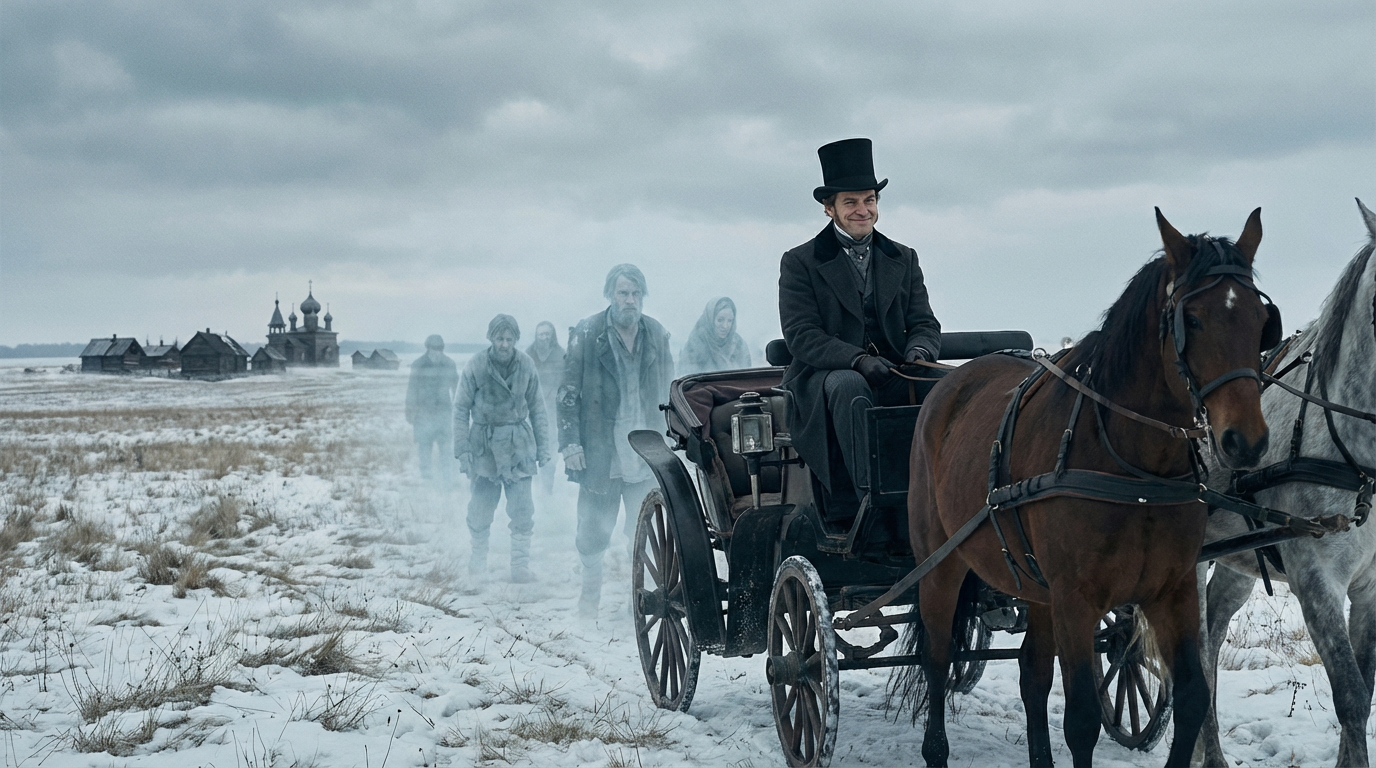
An excerpt from the original text.(complete · 8746 words)
or more than two weeks the visitor lived amid a round of evening
parties and dinners; wherefore he spent (as the saying goes) a very
pleasant time. Finally he decided to extend his visits beyond the urban
boundaries by going and calling upon landowners Manilov and Sobakevitch,
seeing that he had promised on his honour to do so. Yet what really
incited him to this may have been a more essential cause, a matter of
greater gravity, a purpose which stood nearer to his heart, than the
motive which I have just given; and of that purpose the reader will
learn if only he will have the patience to read this prefatory narrative
(which, lengthy though it be, may yet develop and expand in proportion
as we approach the denouement with which the present work is destined to
be crowned).
One evening, therefore, Selifan the coachman received orders to have
the horses harnessed in good time next morning; while Petrushka
received orders to remain behind, for the purpose of looking after the
portmanteau and the room. In passing, the reader may care to become
more fully acquainted with the two serving-men of whom I have spoken.
Naturally, they were not persons of much note, but merely what folk call
characters of secondary, or even of tertiary, importance. Yet, despite
the fact that the springs and the thread of this romance will not DEPEND
upon them, but only touch upon them, and occasionally include them,
the author has a passion for circumstantiality, and, like the average
Russian, such a desire for accuracy as even a German could not rival.
To what the reader already knows concerning the personages in hand it is
therefore necessary to add that Petrushka usually wore a cast-off brown
jacket of a size too large for him, as also that he had (according to
the custom of individuals of his calling) a pair of thick lips and
a very prominent nose. In temperament he was taciturn rather than
loquacious, and he cherished a yearning for self-education. That is to
say, he loved to read books, even though their contents came alike to
him whether they were books of heroic adventure or mere grammars or
liturgical compendia. As I say, he perused every book with an equal
amount of attention, and, had he been offered a work on chemistry,
would have accepted that also. Not the words which he read, but the mere
solace derived from the act of reading, was what especially pleased his
mind; even though at any moment there might launch itself from the page
some devil-sent word whereof he could make neither head nor tail. For
the most part, his task of reading was performed in a recumbent position
in the anteroom; which circumstance ended by causing his mattress to
become as ragged and as thin as a wafer. In addition to his love of
poring over books, he could boast of two habits which constituted two
other essential features of his character--namely, a habit of
retiring to rest in his clothes (that is to say, in the brown jacket
above-mentioned) and a habit of everywhere bearing with him his own
peculiar atmosphere, his own peculiar smell--a smell which filled
any lodging with such subtlety that he needed but to make up his bed
anywhere, even in a room hitherto untenanted, and to drag thither his
greatcoat and other impedimenta, for that room at once to assume an air
of having been lived in during the past ten years. Nevertheless, though
a fastidious, and even an irritable, man, Chichikov would merely frown
when his nose caught this smell amid the freshness of the morning, and
exclaim with a toss of his head: “The devil only knows what is up with
you! Surely you sweat a good deal, do you not? The best thing you can do
is to go and take a bath.” To this Petrushka would make no reply, but,
approaching, brush in hand, the spot where his master’s coat would be
pendent, or starting to arrange one and another article in order, would
strive to seem wholly immersed in his work. Yet of what was he thinking
as he remained thus silent? Perhaps he was saying to himself: “My master
is a good fellow, but for him to keep on saying the same thing forty
times over is a little wearisome.” Only God knows and sees all things;
wherefore for a mere human being to know what is in the mind of a
servant while his master is scolding him is wholly impossible. However,
no more need be said about Petrushka. On the other hand, Coachman
Selifan--
But here let me remark that I do not like engaging the reader’s
attention in connection with persons of a lower class than himself; for
experience has taught me that we do not willingly familiarise ourselves
with the lower orders--that it is the custom of the average Russian to
yearn exclusively for information concerning persons on the higher rungs
of the social ladder. In fact, even a bowing acquaintance with a prince
or a lord counts, in his eyes, for more than do the most intimate of
relations with ordinary folk. For the same reason the author feels
apprehensive on his hero’s account, seeing that he has made that hero
a mere Collegiate Councillor--a mere person with whom Aulic Councillors
might consort, but upon whom persons of the grade of full General
[8] would probably bestow one of those glances proper to a man who is
cringing at their august feet. Worse still, such persons of the grade of
General are likely to treat Chichikov with studied negligence--and to an
author studied negligence spells death.
However, in spite of the distressfulness of the foregoing possibilities,
it is time that I returned to my hero. After issuing, overnight, the
necessary orders, he awoke early, washed himself, rubbed himself
from head to foot with a wet sponge (a performance executed only on
Sundays--and the day in question happened to be a Sunday), shaved his
face with such care that his cheeks issued of absolutely satin-like
smoothness and polish, donned first his bilberry-coloured, spotted
frockcoat, and then his bearskin overcoat, descended the staircase
(attended, throughout, by the waiter) and entered his britchka. With a
loud rattle the vehicle left the inn-yard, and issued into the street.
A passing priest doffed his cap, and a few urchins in grimy shirts
shouted, “Gentleman, please give a poor orphan a trifle!” Presently the
driver noticed that a sturdy young rascal was on the point of climbing
onto the splashboard; wherefore he cracked his whip and the britchka
leapt forward with increased speed over the cobblestones. At last, with
a feeling of relief, the travellers caught sight of macadam ahead, which
promised an end both to the cobblestones and to sundry other annoyances.
And, sure enough, after his head had been bumped a few more times
against the boot of the conveyance, Chichikov found himself bowling over
softer ground. On the town receding into the distance, the sides of the
road began to be varied with the usual hillocks, fir trees, clumps of
young pine, trees with old, scarred trunks, bushes of wild juniper, and
so forth. Presently there came into view also strings of country villas
which, with their carved supports and grey roofs (the latter looking
like pendent, embroidered tablecloths), resembled, rather, bundles
of old faggots. Likewise the customary peasants, dressed in sheepskin
jackets, could be seen yawning on benches before their huts, while
their womenfolk, fat of feature and swathed of bosom, gazed out of upper
windows, and the windows below displayed, here a peering calf, and there
the unsightly jaws of a pig. In short, the view was one of the familiar
type. After passing the fifteenth verst-stone Chichikov suddenly
recollected that, according to Manilov, fifteen versts was the exact
distance between his country house and the town; but the sixteenth verst
stone flew by, and the said country house was still nowhere to be
seen. In fact, but for the circumstance that the travellers happened to
encounter a couple of peasants, they would have come on their errand in
vain. To a query as to whether the country house known as Zamanilovka
was anywhere in the neighbourhood the peasants replied by doffing their
caps; after which one of them who seemed to boast of a little more
intelligence than his companion, and who wore a wedge-shaped beard, made
answer:
“Perhaps you mean Manilovka--not ZAmanilovka?”
“Yes, yes--Manilovka.”
“Manilovka, eh? Well, you must continue for another verst, and then you
will see it straight before you, on the right.”
“On the right?” re-echoed the coachman.
“Yes, on the right,” affirmed the peasant. “You are on the proper road
for Manilovka, but ZAmanilovka--well, there is no such place. The house
you mean is called Manilovka because Manilovka is its name; but no house
at all is called ZAmanilovka. The house you mean stands there, on that
hill, and is a stone house in which a gentleman lives, and its name
is Manilovka; but ZAmanilovka does not stand hereabouts, nor ever has
stood.”
So the travellers proceeded in search of Manilovka, and, after driving
an additional two versts, arrived at a spot whence there branched off a
by-road. Yet two, three, or four versts of the by-road had been covered
before they saw the least sign of a two-storied stone mansion. Then it
was that Chichikov suddenly recollected that, when a friend has invited
one to visit his country house, and has said that the distance thereto
is fifteen versts, the distance is sure to turn out to be at least
thirty.
Not many people would have admired the situation of Manilov’s abode, for
it stood on an isolated rise and was open to every wind that blew. On
the slope of the rise lay closely-mown turf, while, disposed here and
there, after the English fashion, were flower-beds containing clumps of
lilac and yellow acacia. Also, there were a few insignificant groups
of slender-leaved, pointed-tipped birch trees, with, under two of the
latter, an arbour having a shabby green cupola, some blue-painted wooden
supports, and the inscription “This is the Temple of Solitary Thought.”
Lower down the slope lay a green-coated pond--green-coated ponds
constitute a frequent spectacle in the gardens of Russian landowners;
and, lastly, from the foot of the declivity there stretched a line of
mouldy, log-built huts which, for some obscure reason or another, our
hero set himself to count. Up to two hundred or more did he count, but
nowhere could he perceive a single leaf of vegetation or a single stick
of timber. The only thing to greet the eye was the logs of which the
huts were constructed. Nevertheless the scene was to a certain extent
enlivened by the spectacle of two peasant women who, with clothes
picturesquely tucked up, were wading knee-deep in the pond and dragging
behind them, with wooden handles, a ragged fishing-net, in the meshes
of which two crawfish and a roach with glistening scales were entangled.
The women appeared to have cause of dispute between themselves--to be
rating one another about something. In the background, and to one side
of the house, showed a faint, dusky blur of pinewood, and even the
weather was in keeping with the surroundings, since the day was neither
clear nor dull, but of the grey tint which may be noted in uniforms of
garrison soldiers which have seen long service. To complete the picture,
a cock, the recognised harbinger of atmospheric mutations, was present;
and, in spite of the fact that a certain connection with affairs of
gallantry had led to his having had his head pecked bare by other
cocks, he flapped a pair of wings--appendages as bare as two pieces of
bast--and crowed loudly.
As Chichikov approached the courtyard of the mansion he caught sight
of his host (clad in a green frock coat) standing on the verandah and
pressing one hand to his eyes to shield them from the sun and so get a
better view of the approaching carriage. In proportion as the britchka
drew nearer and nearer to the verandah, the host’s eyes assumed a more
and more delighted expression, and his smile a broader and broader
sweep.
“Paul Ivanovitch!” he exclaimed when at length Chichikov leapt from the
vehicle. “Never should I have believed that you would have remembered
us!”
The two friends exchanged hearty embraces, and Manilov then conducted
his guest to the drawing-room. During the brief time that they are
traversing the hall, the anteroom, and the dining-room, let me try
to say something concerning the master of the house. But such an
undertaking bristles with difficulties--it promises to be a far less
easy task than the depicting of some outstanding personality which calls
but for a wholesale dashing of colours upon the canvas--the colours of
a pair of dark, burning eyes, a pair of dark, beetling brows, a forehead
seamed with wrinkles, a black, or a fiery-red, cloak thrown backwards
over the shoulder, and so forth, and so forth. Yet, so numerous are
Russian serf owners that, though careful scrutiny reveals to one’s sight
a quantity of outre peculiarities, they are, as a class, exceedingly
difficult to portray, and one needs to strain one’s faculties to the
utmost before it becomes possible to pick out their variously subtle,
their almost invisible, features. In short, one needs, before doing
this, to carry out a prolonged probing with the aid of an insight
sharpened in the acute school of research.
Only God can say what Manilov’s real character was. A class of men
exists whom the proverb has described as “men unto themselves, neither
this nor that--neither Bogdan of the city nor Selifan of the village.”
And to that class we had better assign also Manilov. Outwardly he was
presentable enough, for his features were not wanting in amiability, but
that amiability was a quality into which there entered too much of the
sugary element, so that his every gesture, his every attitude, seemed
to connote an excess of eagerness to curry favour and cultivate a closer
acquaintance. On first speaking to the man, his ingratiating smile, his
flaxen hair, and his blue eyes would lead one to say, “What a pleasant,
good-tempered fellow he seems!” yet during the next moment or two one
would feel inclined to say nothing at all, and, during the third moment,
only to say, “The devil alone knows what he is!” And should, thereafter,
one not hasten to depart, one would inevitably become overpowered with
the deadly sense of ennui which comes of the intuition that nothing
in the least interesting is to be looked for, but only a series of
wearisome utterances of the kind which are apt to fall from the lips
of a man whose hobby has once been touched upon. For every man HAS his
hobby. One man’s may be sporting dogs; another man’s may be that of
believing himself to be a lover of music, and able to sound the art to
its inmost depths; another’s may be that of posing as a connoisseur of
recherche cookery; another’s may be that of aspiring to play roles of
a kind higher than nature has assigned him; another’s (though this is
a more limited ambition) may be that of getting drunk, and of dreaming
that he is edifying both his friends, his acquaintances, and people with
whom he has no connection at all by walking arm-in-arm with an Imperial
aide-de-camp; another’s may be that of possessing a hand able to chip
corners off aces and deuces of diamonds; another’s may be that of
yearning to set things straight--in other words, to approximate his
personality to that of a stationmaster or a director of posts. In short,
almost every man has his hobby or his leaning; yet Manilov had none
such, for at home he spoke little, and spent the greater part of
his time in meditation--though God only knows what that meditation
comprised! Nor can it be said that he took much interest in the
management of his estate, for he never rode into the country, and the
estate practically managed itself. Whenever the bailiff said to him, “It
might be well to have such-and-such a thing done,” he would reply, “Yes,
that is not a bad idea,” and then go on smoking his pipe--a habit which
he had acquired during his service in the army, where he had been looked
upon as an officer of modesty, delicacy, and refinement. “Yes, it is NOT
a bad idea,” he would repeat. Again, whenever a peasant approached him
and, rubbing the back of his neck, said “Barin, may I have leave to go
and work for myself, in order that I may earn my obrok [9]?” he would
snap out, with pipe in mouth as usual, “Yes, go!” and never trouble his
head as to whether the peasant’s real object might not be to go and get
drunk. True, at intervals he would say, while gazing from the verandah
to the courtyard, and from the courtyard to the pond, that it would be
indeed splendid if a carriage drive could suddenly materialise, and the
pond as suddenly become spanned with a stone bridge, and little shops
as suddenly arise whence pedlars could dispense the petty merchandise of
the kind which peasantry most need. And at such moments his eyes
would grow winning, and his features assume an expression of intense
satisfaction. Yet never did these projects pass beyond the stage of
debate. Likewise there lay in his study a book with the fourteenth page
permanently turned down. It was a book which he had been reading for
the past two years! In general, something seemed to be wanting in the
establishment. For instance, although the drawing-room was filled with
beautiful furniture, and upholstered in some fine silken material which
clearly had cost no inconsiderable sum, two of the chairs lacked
any covering but bast, and for some years past the master had been
accustomed to warn his guests with the words, “Do not sit upon these
chairs; they are not yet ready for use.” Another room contained no
furniture at all, although, a few days after the marriage, it had been
said: “My dear, to-morrow let us set about procuring at least some
TEMPORARY furniture for this room.” Also, every evening would see placed
upon the drawing-room table a fine bronze candelabrum, a statuette
representative of the Three Graces, a tray inlaid with mother-of-pearl,
and a rickety, lop-sided copper invalide. Yet of the fact that all four
articles were thickly coated with grease neither the master of the
house nor the mistress nor the servants seemed to entertain the least
suspicion. At the same time, Manilov and his wife were quite satisfied
with each other. More than eight years had elapsed since their marriage,
yet one of them was for ever offering his or her partner a piece of
apple or a bonbon or a nut, while murmuring some tender something which
voiced a whole-hearted affection. “Open your mouth, dearest”--thus ran
the formula--“and let me pop into it this titbit.” You may be sure that
on such occasions the “dearest mouth” parted its lips most graciously!
For their mutual birthdays the pair always contrived some “surprise
present” in the shape of a glass receptacle for tooth-powder, or what
not; and as they sat together on the sofa he would suddenly, and for
some unknown reason, lay aside his pipe, and she her work (if at the
moment she happened to be holding it in her hands) and husband and wife
would imprint upon one another’s cheeks such a prolonged and languishing
kiss that during its continuance you could have smoked a small cigar. In
short, they were what is known as “a very happy couple.” Yet it may be
remarked that a household requires other pursuits to be engaged in than
lengthy embracings and the preparing of cunning “surprises.” Yes, many
a function calls for fulfilment. For instance, why should it be thought
foolish or low to superintend the kitchen? Why should care not be taken
that the storeroom never lacks supplies? Why should a housekeeper be
allowed to thieve? Why should slovenly and drunken servants exist?
Why should a domestic staff be suffered in indulge in bouts of
unconscionable debauchery during its leisure time? Yet none of these
things were thought worthy of consideration by Manilov’s wife, for she
had been gently brought up, and gentle nurture, as we all know, is to
be acquired only in boarding schools, and boarding schools, as we know,
hold the three principal subjects which constitute the basis of human
virtue to be the French language (a thing indispensable to the happiness
of married life), piano-playing (a thing wherewith to beguile
a husband’s leisure moments), and that particular department of
housewifery which is comprised in the knitting of purses and other
“surprises.” Nevertheless changes and improvements have begun to take
place, since things now are governed more by the personal inclinations
and idiosyncracies of the keepers of such establishments. For instance,
in some seminaries the regimen places piano-playing first, and the
French language second, and then the above department of housewifery;
while in other seminaries the knitting of “surprises” heads the list,
and then the French language, and then the playing of pianos--so diverse
are the systems in force! None the less, I may remark that Madame
Manilov--
But let me confess that I always shrink from saying too much about
ladies. Moreover, it is time that we returned to our heroes, who, during
the past few minutes, have been standing in front of the drawing-room
door, and engaged in urging one another to enter first.
“Pray be so good as not to inconvenience yourself on my account,” said
Chichikov. “I will follow YOU.”
“No, Paul Ivanovitch--no! You are my guest.” And Manilov pointed towards
the doorway.
“Make no difficulty about it, I pray,” urged Chichikov. “I beg of you to
make no difficulty about it, but to pass into the room.”
“Pardon me, I will not. Never could I allow so distinguished and so
welcome a guest as yourself to take second place.”
“Why call me ‘distinguished,’ my dear sir? I beg of you to proceed.”
“Nay; be YOU pleased to do so.”
“And why?”
“For the reason which I have stated.” And Manilov smiled his very
pleasantest smile.
Finally the pair entered simultaneously and sideways; with the result
that they jostled one another not a little in the process.
“Allow me to present to you my wife,” continued Manilov. “My dear--Paul
Ivanovitch.”
Upon that Chichikov caught sight of a lady whom hitherto he had
overlooked, but who, with Manilov, was now bowing to him in the doorway.
Not wholly of unpleasing exterior, she was dressed in a well-fitting,
high-necked morning dress of pale-coloured silk; and as the visitor
entered the room her small white hands threw something upon the table
and clutched her embroidered skirt before rising from the sofa where she
had been seated. Not without a sense of pleasure did Chichikov take her
hand as, lisping a little, she declared that she and her husband were
equally gratified by his coming, and that, of late, not a day had passed
without her husband recalling him to mind.
“Yes,” affirmed Manilov; “and every day SHE has said to ME: ‘Why does
not your friend put in an appearance?’ ‘Wait a little dearest,’ I have
always replied. ‘’Twill not be long now before he comes.’ And you HAVE
come, you HAVE honoured us with a visit, you HAVE bestowed upon us a
treat--a treat destined to convert this day into a gala day, a true
birthday of the heart.”
The intimation that matters had reached the point of the occasion being
destined to constitute a “true birthday of the heart” caused Chichikov
to become a little confused; wherefore he made modest reply that, as a
matter of fact, he was neither of distinguished origin nor distinguished
rank.
“Ah, you ARE so,” interrupted Manilov with his fixed and engaging smile.
“You are all that, and more.”
“How like you our town?” queried Madame. “Have you spent an agreeable
time in it?”
“Very,” replied Chichikov. “The town is an exceedingly nice one, and I
have greatly enjoyed its hospitable society.”
“And what do you think of our Governor?”
“Yes; IS he not a most engaging and dignified personage?” added Manilov.
“He is all that,” assented Chichikov. “Indeed, he is a man worthy of the
greatest respect. And how thoroughly he performs his duty according to
his lights! Would that we had more like him!”
“And the tactfulness with which he greets every one!” added Manilov,
smiling, and half-closing his eyes, like a cat which is being tickled
behind the ears.
“Quite so,” assented Chichikov. “He is a man of the most eminent
civility and approachableness. And what an artist! Never should I have
thought he could have worked the marvellous household samplers which he
has done! Some specimens of his needlework which he showed me could not
well have been surpassed by any lady in the land!”
“And the Vice-Governor, too--he is a nice man, is he not?” inquired
Manilov with renewed blinkings of the eyes.
“Who? The Vice-Governor? Yes, a most worthy fellow!” replied Chichikov.
“And what of the Chief of Police? Is it not a fact that he too is in the
highest degree agreeable?”
“Very agreeable indeed. And what a clever, well-read individual! With
him and the Public Prosecutor and the President of the Local Council I
played whist until the cocks uttered their last morning crow. He is a
most excellent fellow.”
“And what of his wife?” queried Madame Manilov. “Is she not a most
gracious personality?”
“One of the best among my limited acquaintance,” agreed Chichikov.
Nor were the President of the Local Council and the Postmaster
overlooked; until the company had run through the whole list of urban
officials. And in every case those officials appeared to be persons of
the highest possible merit.
“Do you devote your time entirely to your estate?” asked Chichikov, in
his turn.
“Well, most of it,” replied Manilov; “though also we pay occasional
visits to the town, in order that we may mingle with a little well-bred
society. One grows a trifle rusty if one lives for ever in retirement.”
“Quite so,” agreed Chichikov.
“Yes, quite so,” capped Manilov. “At the same time, it would be a
different matter if the neighbourhood were a GOOD one--if, for example,
one had a friend with whom one could discuss manners and polite
deportment, or engage in some branch of science, and so stimulate one’s
wits. For that sort of thing gives one’s intellect an airing. It, it--”
At a loss for further words, he ended by remarking that his feelings
were apt to carry him away; after which he continued with a gesture:
“What I mean is that, were that sort of thing possible, I, for
one, could find the country and an isolated life possessed of great
attractions. But, as matters stand, such a thing is NOT possible. All
that I can manage to do is, occasionally, to read a little of A Son of
the Fatherland.”
With these sentiments Chichikov expressed entire agreement: adding that
nothing could be more delightful than to lead a solitary life in which
there should be comprised only the sweet contemplation of nature and the
intermittent perusal of a book.
“Nay, but even THAT were worth nothing had not one a friend with whom to
share one’s life,” remarked Manilov.
“True, true,” agreed Chichikov. “Without a friend, what are all the
treasures in the world? ‘Possess not money,’ a wise man has said, ‘but
rather good friends to whom to turn in case of need.’”
“Yes, Paul Ivanovitch,” said Manilov with a glance not merely sweet,
but positively luscious--a glance akin to the mixture which even clever
physicians have to render palatable before they can induce a hesitant
patient to take it. “Consequently you may imagine what happiness--what
PERFECT happiness, so to speak--the present occasion has brought me,
seeing that I am permitted to converse with you and to enjoy your
conversation.”
“But WHAT of my conversation?” replied Chichikov. “I am an insignificant
individual, and, beyond that, nothing.”
“Oh, Paul Ivanovitch!” cried the other. “Permit me to be frank, and to
say that I would give half my property to possess even a PORTION of the
talents which you possess.”
“On the contrary, I should consider it the highest honour in the world
if--”
The lengths to which this mutual outpouring of soul would have proceeded
had not a servant entered to announce luncheon must remain a mystery.
“I humbly invite you to join us at table,” said Manilov. “Also, you will
pardon us for the fact that we cannot provide a banquet such as is to
be obtained in our metropolitan cities? We partake of simple fare,
according to Russian custom--we confine ourselves to shtchi [10], but we
do so with a single heart. Come, I humbly beg of you.”
After another contest for the honour of yielding precedence, Chichikov
succeeded in making his way (in zigzag fashion) to the dining-room,
where they found awaiting them a couple of youngsters. These were
Manilov’s sons, and boys of the age which admits of their presence at
table, but necessitates the continued use of high chairs. Beside them
was their tutor, who bowed politely and smiled; after which the hostess
took her seat before her soup plate, and the guest of honour found
himself esconsed between her and the master of the house, while the
servant tied up the boys’ necks in bibs.
“What charming children!” said Chichikov as he gazed at the pair. “And
how old are they?”
“The eldest is eight,” replied Manilov, “and the younger one attained
the age of six yesterday.”
“Themistocleus,” went on the father, turning to his first-born, who was
engaged in striving to free his chin from the bib with which the footman
had encircled it. On hearing this distinctly Greek name (to which, for
some unknown reason, Manilov always appended the termination “eus”),
Chichikov raised his eyebrows a little, but hastened, the next moment,
to restore his face to a more befitting expression.
“Themistocleus,” repeated the father, “tell me which is the finest city
in France.”
Upon this the tutor concentrated his attention upon Themistocleus, and
appeared to be trying hard to catch his eye. Only when Themistocleus had
muttered “Paris” did the preceptor grow calmer, and nod his head.
“And which is the finest city in Russia?” continued Manilov.
Again the tutor’s attitude became wholly one of concentration.
“St. Petersburg,” replied Themistocleus.
“And what other city?”
“Moscow,” responded the boy.
“Clever little dear!” burst out Chichikov, turning with an air of
surprise to the father. “Indeed, I feel bound to say that the child
evinces the greatest possible potentialities.”
“You do not know him fully,” replied the delighted Manilov. “The amount
of sharpness which he possesses is extraordinary. Our younger one,
Alkid, is not so quick; whereas his brother--well, no matter what he
may happen upon (whether upon a cowbug or upon a water-beetle or upon
anything else), his little eyes begin jumping out of his head, and he
runs to catch the thing, and to inspect it. For HIM I am reserving a
diplomatic post. Themistocleus,” added the father, again turning to his
son, “do you wish to become an ambassador?”
“Yes, I do,” replied Themistocleus, chewing a piece of bread and wagging
his head from side to side.
At this moment the lacquey who had been standing behind the future
ambassador wiped the latter’s nose; and well it was that he did so,
since otherwise an inelegant and superfluous drop would have been added
to the soup. After that the conversation turned upon the joys of a quiet
life--though occasionally it was interrupted by remarks from the hostess
on the subject of acting and actors. Meanwhile the tutor kept his eyes
fixed upon the speakers’ faces; and whenever he noticed that they were
on the point of laughing he at once opened his mouth, and laughed with
enthusiasm. Probably he was a man of grateful heart who wished to
repay his employers for the good treatment which he had received. Once,
however, his features assumed a look of grimness as, fixing his eyes
upon his vis-a-vis, the boys, he tapped sternly upon the table. This
happened at a juncture when Themistocleus had bitten Alkid on the ear,
and the said Alkid, with frowning eyes and open mouth, was preparing
himself to sob in piteous fashion; until, recognising that for such a
proceeding he might possibly be deprived of his plate, he hastened to
restore his mouth to its original expression, and fell tearfully to
gnawing a mutton bone--the grease from which had soon covered his
cheeks.
Every now and again the hostess would turn to Chichikov with the words,
“You are eating nothing--you have indeed taken little;” but invariably
her guest replied: “Thank you, I have had more than enough. A pleasant
conversation is worth all the dishes in the world.”
At length the company rose from table. Manilov was in high spirits,
and, laying his hand upon his guest’s shoulder, was on the point of
conducting him to the drawing-room, when suddenly Chichikov intimated
to him, with a meaning look, that he wished to speak to him on a very
important matter.
“That being so,” said Manilov, “allow me to invite you into my study.”
And he led the way to a small room which faced the blue of the forest.
“This is my sanctum,” he added.
“What a pleasant apartment!” remarked Chichikov as he eyed it carefully.
And, indeed, the room did not lack a certain attractiveness. The walls
were painted a sort of blueish-grey colour, and the furniture consisted
of four chairs, a settee, and a table--the latter of which bore a few
sheets of writing-paper and the book of which I have before had occasion
to speak. But the most prominent feature of the room was tobacco, which
appeared in many different guises--in packets, in a tobacco jar, and in
a loose heap strewn about the table. Likewise, both window sills were
studded with little heaps of ash, arranged, not without artifice, in
rows of more or less tidiness. Clearly smoking afforded the master of
the house a frequent means of passing the time.
“Permit me to offer you a seat on this settee,” said Manilov. “Here you
will be quieter than you would be in the drawing-room.”
“But I should prefer to sit upon this chair.”
“I cannot allow that,” objected the smiling Manilov. “The settee is
specially reserved for my guests. Whether you choose or no, upon it you
MUST sit.”
Accordingly Chichikov obeyed.
“And also let me hand you a pipe.”
“No, I never smoke,” answered Chichikov civilly, and with an assumed air
of regret.
“And why?” inquired Manilov--equally civilly, but with a regret that was
wholly genuine.
“Because I fear that I have never quite formed the habit, owing to
my having heard that a pipe exercises a desiccating effect upon the
system.”
“Then allow me to tell you that that is mere prejudice. Nay, I would
even go so far as to say that to smoke a pipe is a healthier practice
than to take snuff. Among its members our regiment numbered a
lieutenant--a most excellent, well-educated fellow--who was simply
INCAPABLE of removing his pipe from his mouth, whether at table or
(pardon me) in other places. He is now forty, yet no man could enjoy
better health than he has always done.”
Chichikov replied that such cases were common, since nature comprised
many things which even the finest intellect could not compass.
“But allow me to put to you a question,” he went on in a tone in which
there was a strange--or, at all events, RATHER a strange--note. For some
unknown reason, also, he glanced over his shoulder. For some equally
unknown reason, Manilov glanced over HIS.
“How long is it,” inquired the guest, “since you last rendered a census
return?”
“Oh, a long, long time. In fact, I cannot remember when it was.”
“And since then have many of your serfs died?”
“I do not know. To ascertain that I should need to ask my bailiff.
Footman, go and call the bailiff. I think he will be at home to-day.”
Before long the bailiff made his appearance. He was a man of under
forty, clean-shaven, clad in a smock, and evidently used to a quiet
life, seeing that his face was of that puffy fullness, and the skin
encircling his slit-like eyes was of that sallow tint, which shows that
the owner of those features is well acquainted with a feather bed. In a
trice it could be seen that he had played his part in life as all such
bailiffs do--that, originally a young serf of elementary education, he
had married some Agashka of a housekeeper or a mistress’s favourite, and
then himself become housekeeper, and, subsequently, bailiff; after which
he had proceeded according to the rules of his tribe--that is to say,
he had consorted with and stood in with the more well-to-do serfs on the
estate, and added the poorer ones to the list of forced payers of obrok,
while himself leaving his bed at nine o’clock in the morning, and, when
the samovar had been brought, drinking his tea at leisure.
“Look here, my good man,” said Manilov. “How many of our serfs have died
since the last census revision?”
“How many of them have died? Why, a great many.” The bailiff hiccoughed,
and slapped his mouth lightly after doing so.
“Yes, I imagined that to be the case,” corroborated Manilov. “In fact,
a VERY great many serfs have died.” He turned to Chichikov and repeated
the words.
“How many, for instance?” asked Chichikov.
“Yes; how many?” re-echoed Manilov.
“HOW many?” re-echoed the bailiff. “Well, no one knows the exact number,
for no one has kept any account.”
“Quite so,” remarked Manilov. “I supposed the death-rate to have been
high, but was ignorant of its precise extent.”
“Then would you be so good as to have it computed for me?” said
Chichikov. “And also to have a detailed list of the deaths made out?”
“Yes, I will--a detailed list,” agreed Manilov.
“Very well.”
The bailiff departed.
“For what purpose do you want it?” inquired Manilov when the bailiff had
gone.
The question seemed to embarrass the guest, for in Chichikov’s face
there dawned a sort of tense expression, and it reddened as though its
owner were striving to express something not easy to put into words.
True enough, Manilov was now destined to hear such strange and
unexpected things as never before had greeted human ears.
“You ask me,” said Chichikov, “for what purpose I want the list. Well,
my purpose in wanting it is this--that I desire to purchase a few
peasants.” And he broke off in a gulp.
“But may I ask HOW you desire to purchase those peasants?” asked
Manilov. “With land, or merely as souls for transferment--that is to
say, by themselves, and without any land?”
“I want the peasants themselves only,” replied Chichikov. “And I want
dead ones at that.”
“What?--Excuse me, but I am a trifle deaf. Really, your words sound most
strange!”
“All that I am proposing to do,” replied Chichikov, “is to purchase the
dead peasants who, at the last census, were returned by you as alive.”
Manilov dropped his pipe on the floor, and sat gaping. Yes, the two
friends who had just been discussing the joys of camaraderie sat
staring at one another like the portraits which, of old, used to hang on
opposite sides of a mirror. At length Manilov picked up his pipe, and,
while doing so, glanced covertly at Chichikov to see whether there was
any trace of a smile to be detected on his lips--whether, in short, he
was joking. But nothing of the sort could be discerned. On the contrary,
Chichikov’s face looked graver than usual. Next, Manilov wondered
whether, for some unknown reason, his guest had lost his wits; wherefore
he spent some time in gazing at him with anxious intentness. But the
guest’s eyes seemed clear--they contained no spark of the wild, restless
fire which is apt to wander in the eyes of madmen. All was as it should
be. Consequently, in spite of Manilov’s cogitations, he could think
of nothing better to do than to sit letting a stream of tobacco smoke
escape from his mouth.
“So,” continued Chichikov, “what I desire to know is whether you are
willing to hand over to me--to resign--these actually non-living, but
legally living, peasants; or whether you have any better proposal to
make?”
Manilov felt too confused and confounded to do aught but continue
staring at his interlocutor.
“I think that you are disturbing yourself unnecessarily,” was
Chichikov’s next remark.
“I? Oh no! Not at all!” stammered Manilov. “Only--pardon me--I do not
quite comprehend you. You see, never has it fallen to my lot to acquire
the brilliant polish which is, so to speak, manifest in your every
movement. Nor have I ever been able to attain the art of expressing
myself well. Consequently, although there is a possibility that in
the--er--utterances which have just fallen from your lips there may
lie something else concealed, it may equally be that--er--you have been
pleased so to express yourself for the sake of the beauty of the terms
wherein that expression found shape?”
“Oh, no,” asserted Chichikov. “I mean what I say and no more. My
reference to such of your pleasant souls as are dead was intended to be
taken literally.”
Manilov still felt at a loss--though he was conscious that he MUST do
something, he MUST propound some question. But what question? The devil
alone knew! In the end he merely expelled some more tobacco smoke--this
time from his nostrils as well as from his mouth.
“So,” went on Chichikov, “if no obstacle stands in the way, we might as
well proceed to the completion of the purchase.”
“What? Of the purchase of the dead souls?”
“Of the ‘dead’ souls? Oh dear no! Let us write them down as LIVING ones,
seeing that that is how they figure in the census returns. Never do I
permit myself to step outside the civil law, great though has been
the harm which that rule has wrought me in my career. In my eyes an
obligation is a sacred thing. In the presence of the law I am dumb.”
These last words reassured Manilov not a little: yet still the meaning
of the affair remained to him a mystery. By way of answer, he fell to
sucking at his pipe with such vehemence that at length the pipe began
to gurgle like a bassoon. It was as though he had been seeking of
it inspiration in the present unheard-of juncture. But the pipe only
gurgled, et praeterea nihil.
“Perhaps you feel doubtful about the proposal?” said Chichikov.
“Not at all,” replied Manilov. “But you will, I know, excuse me if I
say (and I say it out of no spirit of prejudice, nor yet as criticising
yourself in any way)--you will, I know, excuse me if I say that possibly
this--er--this, er, SCHEME of yours, this--er--TRANSACTION of yours, may
fail altogether to accord with the Civil Statutes and Provisions of the
Realm?”
And Manilov, with a slight gesture of the head, looked meaningly into
Chichikov’s face, while displaying in his every feature, including
his closely-compressed lips, such an expression of profundity as
never before was seen on any human countenance--unless on that of some
particularly sapient Minister of State who is debating some particularly
abstruse problem.
Nevertheless Chichikov rejoined that the kind of scheme or transaction
which he had adumbrated in no way clashed with the Civil Statutes and
Provisions of Russia; to which he added that the Treasury would even
BENEFIT by the enterprise, seeing it would draw therefrom the usual
legal percentage.
“What, then, do you propose?” asked Manilov.
“I propose only what is above-board, and nothing else.”
“Then, that being so, it is another matter, and I have nothing to urge
against it,” said Manilov, apparently reassured to the full.
“Very well,” remarked Chichikov. “Then we need only to agree as to the
price.”
“As to the price?” began Manilov, and then stopped. Presently he went
on: “Surely you cannot suppose me capable of taking money for souls
which, in one sense at least, have completed their existence? Seeing
that this fantastic whim of yours (if I may so call it?) has seized
upon you to the extent that it has, I, on my side, shall be ready to
surrender to you those souls UNCONDITIONALLY, and to charge myself with
the whole expenses of the sale.”
I should be greatly to blame if I were to omit that, as soon as Manilov
had pronounced these words, the face of his guest became replete with
satisfaction. Indeed, grave and prudent a man though Chichikov was,
he had much ado to refrain from executing a leap that would have done
credit to a goat (an animal which, as we all know, finds itself moved
to such exertions only during moments of the most ecstatic joy).
Nevertheless the guest did at least execute such a convulsive shuffle
that the material with which the cushions of the chair were covered came
apart, and Manilov gazed at him with some misgiving. Finally Chichikov’s
gratitude led him to plunge into a stream of acknowledgement of a
vehemence which caused his host to grow confused, to blush, to shake
his head in deprecation, and to end by declaring that the concession was
nothing, and that, his one desire being to manifest the dictates of
his heart and the psychic magnetism which his friend exercised, he, in
short, looked upon the dead souls as so much worthless rubbish.
“Not at all,” replied Chichikov, pressing his hand; after which
he heaved a profound sigh. Indeed, he seemed in the right mood for
outpourings of the heart, for he continued--not without a ring of
emotion in his tone: “If you but knew the service which you have
rendered to an apparently insignificant individual who is devoid both
of family and kindred! For what have I not suffered in my time--I, a
drifting barque amid the tempestuous billows of life? What harryings,
what persecutions, have I not known? Of what grief have I not tasted?
And why? Simply because I have ever kept the truth in view, because ever
I have preserved inviolate an unsullied conscience, because ever I have
stretched out a helping hand to the defenceless widow and the hapless
orphan!” After which outpouring Chichikov pulled out his handkerchief,
and wiped away a brimming tear.
Manilov’s heart was moved to the core. Again and again did the two
friends press one another’s hands in silence as they gazed into one
another’s tear-filled eyes. Indeed, Manilov COULD not let go our hero’s
hand, but clasped it with such warmth that the hero in question began
to feel himself at a loss how best to wrench it free: until, quietly
withdrawing it, he observed that to have the purchase completed as
speedily as possible would not be a bad thing; wherefore he himself
would at once return to the town to arrange matters. Taking up his hat,
therefore, he rose to make his adieus.
“What? Are you departing already?” said Manilov, suddenly recovering
himself, and experiencing a sense of misgiving. At that moment his wife
sailed into the room.
“Is Paul Ivanovitch leaving us so soon, dearest Lizanka?” she said with
an air of regret.
“Yes. Surely it must be that we have wearied him?” her spouse replied.
“By no means,” asserted Chichikov, pressing his hand to his heart. “In
this breast, madam, will abide for ever the pleasant memory of the time
which I have spent with you. Believe me, I could conceive of no greater
blessing than to reside, if not under the same roof as yourselves, at
all events in your immediate neighbourhood.”
“Indeed?” exclaimed Manilov, greatly pleased with the idea. “How
splendid it would be if you DID come to reside under our roof, so that
we could recline under an elm tree together, and talk philosophy, and
delve to the very root of things!”
“Yes, it WOULD be a paradisaical existence!” agreed Chichikov with a
sigh. Nevertheless he shook hands with Madame. “Farewell, sudarina,” he
said. “And farewell to YOU, my esteemed host. Do not forget what I have
requested you to do.”
“Rest assured that I will not,” responded Manilov. “Only for a couple of
days will you and I be parted from one another.”
With that the party moved into the drawing-room.
“Farewell, dearest children,” Chichikov went on as he caught sight of
Alkid and Themistocleus, who were playing with a wooden hussar which
lacked both a nose and one arm. “Farewell, dearest pets. Pardon me for
having brought you no presents, but, to tell you the truth, I was not,
until my visit, aware of your existence. However, now that I shall be
coming again, I will not fail to bring you gifts. Themistocleus, to you
I will bring a sword. You would like that, would you not?”
“I should,” replied Themistocleus.
“And to you, Alkid, I will bring a drum. That would suit you, would it
not?” And he bowed in Alkid’s direction.
“Zeth--a drum,” lisped the boy, hanging his head.
“Good! Then a drum it shall be--SUCH a beautiful drum! What a
tur-r-r-ru-ing and a tra-ta-ta-ta-ing you will be able to kick up!
Farewell, my darling.” And, kissing the boy’s head, he turned to Manilov
and Madame with the slight smile which one assumes before assuring
parents of the guileless merits of their offspring.
“But you had better stay, Paul Ivanovitch,” said the father as the trio
stepped out on to the verandah. “See how the clouds are gathering!”
“They are only small ones,” replied Chichikov.
“And you know your way to Sobakevitch’s?”
“No, I do not, and should be glad if you would direct me.”
“If you like I will tell your coachman.” And in very civil fashion
Manilov did so, even going so far as to address the man in the second
person plural. On hearing that he was to pass two turnings, and then to
take a third, Selifan remarked, “We shall get there all right, sir,” and
Chichikov departed amid a profound salvo of salutations and wavings of
handkerchiefs on the part of his host and hostess, who raised themselves
on tiptoe in their enthusiasm.
For a long while Manilov stood following the departing britchka with his
eyes. In fact, he continued to smoke his pipe and gaze after the
vehicle even when it had become lost to view. Then he re-entered the
drawing-room, seated himself upon a chair, and surrendered his mind to
the thought that he had shown his guest most excellent entertainment.
Next, his mind passed imperceptibly to other matters, until at last it
lost itself God only knows where. He thought of the amenities of a life,
of friendship, and of how nice it would be to live with a comrade on,
say, the bank of some river, and to span the river with a bridge of his
own, and to build an enormous mansion with a facade lofty enough even to
afford a view to Moscow. On that facade he and his wife and friend would
drink afternoon tea in the open air, and discuss interesting subjects;
after which, in a fine carriage, they would drive to some reunion or
other, where with their pleasant manners they would so charm the company
that the Imperial Government, on learning of their merits, would raise
the pair to the grade of General or God knows what--that is to say, to
heights whereof even Manilov himself could form no idea. Then suddenly
Chichikov’s extraordinary request interrupted the dreamer’s reflections,
and he found his brain powerless to digest it, seeing that, turn and
turn the matter about as he might, he could not properly explain its
bearing. Smoking his pipe, he sat where he was until supper time.
Master this chapter. Complete your experience
Purchase the complete book to access all chapters and support classic literature
As an Amazon Associate, we earn a small commission from qualifying purchases at no additional cost to you.
Available in paperback, hardcover, and e-book formats
Let's Analyse the Pattern
The tendency to fill life with elaborate but meaningless activities and rituals to avoid confronting a lack of genuine purpose or direction.
Why This Matters
Connect literature to life
This chapter teaches you to recognize when people substitute meaningless activity for genuine purpose, making them vulnerable to manipulation.
Practice This Today
This week, notice when someone talks a lot about their plans but never follows through, or when they agree to things they clearly don't understand—you're seeing Empty Performance in action.
Now let's explore the literary elements.
Key Quotes & Analysis
"What exactly are dead souls?"
Context: When Chichikov first explains his bizarre request to buy dead serfs
This question reveals how completely unprepared Manilov is for any real business discussion. He's so used to empty social pleasantries that he can't process an actual transaction, even a corrupt one.
In Today's Words:
Wait, what are you actually asking me to do here?
"I should be delighted to do you such a service"
Context: His response after agreeing to sell dead souls without understanding why
Shows how people-pleasers will agree to anything to avoid conflict or appear helpful, even when they don't understand what they're agreeing to. His need to be liked overrides his common sense.
In Today's Words:
Sure, whatever you need - I'm happy to help!
"The room was furnished with a certain pretension to elegance, but it had a cold, unfinished look"
Context: Describing Manilov's house when Chichikov arrives
This perfectly captures how Manilov approaches everything - he starts projects with grand intentions but never follows through. His whole life is half-finished gestures toward sophistication.
In Today's Words:
The place looked like someone tried to make it fancy but gave up halfway through
Thematic Threads
Social Performance
In This Chapter
Manilov and his wife perform elaborate displays of affection with pet names and theatrical gestures that ring hollow
Development
Builds on Chapter 1's introduction of social facades, now showing how performance can become a complete substitute for authentic living
In Your Life:
You might recognize this in your own tendency to say what people want to hear rather than what you actually think.
People-Pleasing
In This Chapter
Manilov agrees to Chichikov's incomprehensible request simply to avoid disappointing his guest
Development
Introduced here as a dangerous form of social compliance
In Your Life:
This appears when you agree to things you don't understand or want because saying no feels too uncomfortable.
Class Anxiety
In This Chapter
Manilov's desperate attempts to appear refined and important through his elaborate but incomplete projects and affected mannerisms
Development
Continues from Chapter 1's exploration of social positioning, now showing the exhausting effort required to maintain false status
In Your Life:
You see this when you spend money or time on things meant to impress others rather than satisfy yourself.
Avoidance
In This Chapter
Manilov's half-finished house and abandoned projects reveal someone who starts things but never faces the difficulty of completion
Development
Introduced here as a pattern of avoiding the hard work that real achievement requires
In Your Life:
This shows up in your life as the projects you start with enthusiasm but abandon when they require sustained effort.
Manipulation
In This Chapter
Chichikov easily exploits Manilov's people-pleasing nature to get what he wants without Manilov even understanding the transaction
Development
Builds on Chapter 1's hints at Chichikov's calculating nature, now showing how he reads and exploits character weaknesses
In Your Life:
You might recognize this pattern when someone asks favors of you in ways that make it hard to say no, even when something feels off.
You now have the context. Time to form your own thoughts.
Discussion Questions
- 1
What specific behaviors show that Manilov is all performance and no substance?
analysis • surface - 2
Why does Manilov agree to Chichikov's bizarre request without really understanding it?
analysis • medium - 3
Where do you see people today performing busyness or politeness to avoid dealing with real issues?
application • medium - 4
How can you tell the difference between someone genuinely trying to help versus someone just performing helpfulness?
application • deep - 5
What drives people to choose elaborate performances over authentic but potentially uncomfortable truth?
reflection • deep
Critical Thinking Exercise
Performance Audit
Think about your typical day and identify three activities you do regularly. For each one, write down whether you do it because it genuinely matters to you or because it looks good to others. Be brutally honest - no judgment, just observation. Then pick one 'performance' activity and brainstorm what you'd do instead if you only had to please yourself.
Consider:
- •Consider both work and personal activities - committee meetings, social media posting, volunteering, even how you talk to neighbors
- •Notice the difference between things that energize you versus things that drain you but look impressive
- •Pay attention to activities where you find yourself using buzzwords or phrases that don't sound like how you normally talk
Journaling Prompt
Write about a time when you caught yourself performing a role instead of being authentic. What were you afraid would happen if you dropped the performance? What actually happened when you tried being more genuine?
Coming Up Next...
Chapter 3: The Art of the Deal
Chichikov departs Manilov's estate with his first success, but his journey to the next landowner promises a very different challenge. Where Manilov was all sweetness and compliance, his next target may prove far more difficult to charm.



