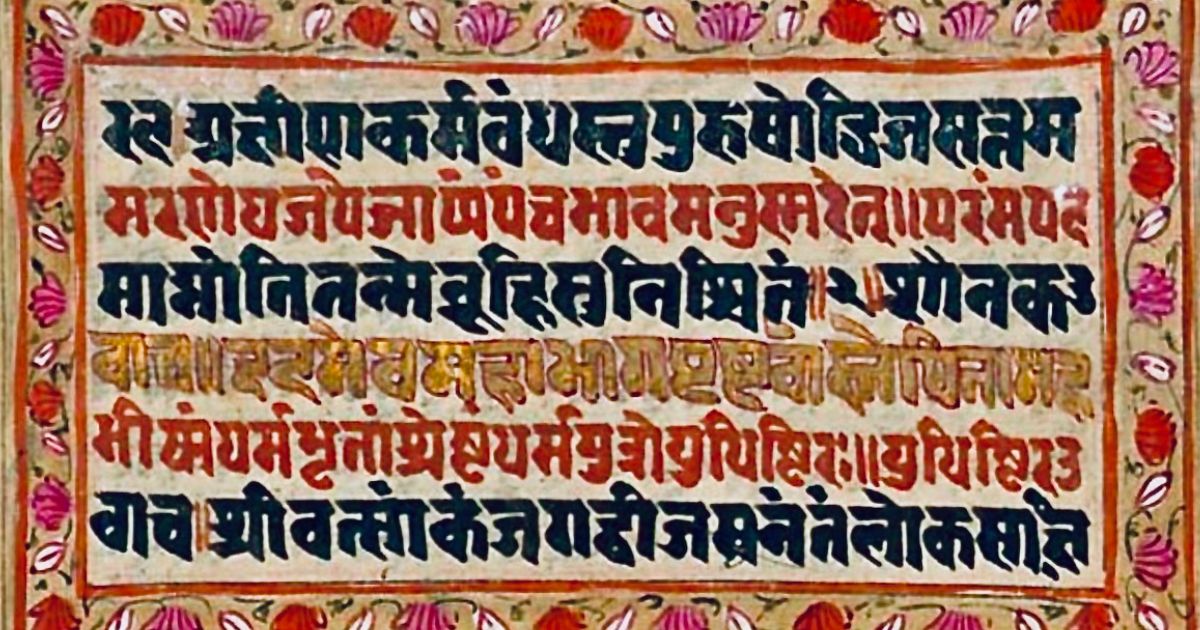
An excerpt from the original text.(complete · 1082 words)
rjuna.
Thou whom all mortals praise, Janardana!
If meditation be a nobler thing
Than action, wherefore, then, great Kesava!
Dost thou impel me to this dreadful fight?
Now am I by thy doubtful speech disturbed!
Tell me one thing, and tell me certainly;
By what road shall I find the better end?
Krishna.
I told thee, blameless Lord! there be two paths
Shown to this world; two schools of wisdom.
First
The Sankhya's, which doth save in way of works
Prescribed[FN#4] by reason; next, the Yog, which bids
Attain by meditation, spiritually:
Yet these are one! No man shall 'scape from act
By shunning action; nay, and none shall come
By mere renouncements unto perfectness.
Nay, and no jot of time, at any time,
Rests any actionless; his nature's law
Compels him, even unwilling, into act;
[For thought is act in fancy]. He who sits
Suppressing all the instruments of flesh,
Yet in his idle heart thinking on them,
Plays the inept and guilty hypocrite:
But he who, with strong body serving mind,
Gives up his mortal powers to worthy work,
Not seeking gain, Arjuna! such an one
Is honourable. Do thine allotted task!
Work is more excellent than idleness;
The body's life proceeds not, lacking work.
There is a task of holiness to do,
Unlike world-binding toil, which bindeth not
The faithful soul; such earthly duty do
Free from desire, and thou shalt well perform
Thy heavenly purpose. Spake Prajapati--
In the beginning, when all men were made,
And, with mankind, the sacrifice-- "Do this!
Work! sacrifice! Increase and multiply
With sacrifice! This shall be Kamaduk,
Your 'Cow of Plenty,' giving back her milk
Of all abundance. Worship the gods thereby;
The gods shall yield thee grace. Those meats ye crave
The gods will grant to Labour, when it pays
Tithes in the altar-flame. But if one eats
Fruits of the earth, rendering to kindly Heaven
No gift of toil, that thief steals from his world."
Who eat of food after their sacrifice
Are quit of fault, but they that spread a feast
All for themselves, eat sin and drink of sin.
By food the living live; food comes of rain,
And rain comes by the pious sacrifice,
And sacrifice is paid with tithes of toil;
Thus action is of Brahma, who is One,
The Only, All-pervading; at all times
Present in sacrifice. He that abstains
To help the rolling wheels of this great world,
Glutting his idle sense, lives a lost life,
Shameful and vain. Existing for himself,
Self-concentrated, serving self alone,
No part hath he in aught; nothing achieved,
Nought wrought or unwrought toucheth him; no hope
Of help for all the living things of earth
Depends from him.[FN#5] Therefore, thy task prescribed
With spirit unattached gladly perform,
Since in performance of plain duty man
Mounts to his highest bliss. By works alone
Janak and ancient saints reached blessedness!
Moreover, for the upholding of thy kind,
Action thou should'st embrace. What the wise choose
The unwise people take; what best men do
The multitude will follow. Look on me,
Thou Son of Pritha! in the three wide worlds
I am not bound to any toil, no height
Awaits to scale, no gift remains to gain,
Yet I act here! and, if I acted not--
Earnest and watchful--those that look to me
For guidance, sinking back to sloth again
Because I slumbered, would decline from good,
And I should break earth's order and commit
Her offspring unto ruin, Bharata!
Even as the unknowing toil, wedded to sense,
So let the enlightened toil, sense-freed, but set
To bring the world deliverance, and its bliss;
Not sowing in those simple, busy hearts
Seed of despair. Yea! let each play his part
In all he finds to do, with unyoked soul.
All things are everywhere by Nature wrought
In interaction of the qualities.
The fool, cheated by self, thinks, "This I did"
And "That I wrought; "but--ah, thou strong-armed Prince!--
A better-lessoned mind, knowing the play
Of visible things within the world of sense,
And how the qualities must qualify,
Standeth aloof even from his acts. Th' untaught
Live mixed with them, knowing not Nature's way,
Of highest aims unwitting, slow and dull.
Those make thou not to stumble, having the light;
But all thy dues discharging, for My sake,
With meditation centred inwardly,
Seeking no profit, satisfied, serene,
Heedless of issue--fight! They who shall keep
My ordinance thus, the wise and willing hearts,
Have quittance from all issue of their acts;
But those who disregard My ordinance,
Thinking they know, know nought, and fall to loss,
Confused and foolish. 'Sooth, the instructed one
Doth of his kind, following what fits him most:
And lower creatures of their kind; in vain
Contending 'gainst the law. Needs must it be
The objects of the sense will stir the sense
To like and dislike, yet th' enlightened man
Yields not to these, knowing them enemies.
Finally, this is better, that one do
His own task as he may, even though he fail,
Than take tasks not his own, though they seem good.
To die performing duty is no ill;
But who seeks other roads shall wander still.
Arjuna.
Yet tell me, Teacher! by what force doth man
Go to his ill, unwilling; as if one
Pushed him that evil path?
Krishna.
Kama it is!
Passion it is! born of the Darknesses,
Which pusheth him. Mighty of appetite,
Sinful, and strong is this!--man's enemy!
As smoke blots the white fire, as clinging rust
Mars the bright mirror, as the womb surrounds
The babe unborn, so is the world of things
Foiled, soiled, enclosed in this desire of flesh.
The wise fall, caught in it; the unresting foe
It is of wisdom, wearing countless forms,
Fair but deceitful, subtle as a flame.
Sense, mind, and reason--these, O Kunti's Son!
Are booty for it; in its play with these
It maddens man, beguiling, blinding him.
Therefore, thou noblest child of Bharata!
Govern thy heart! Constrain th' entangled sense!
Resist the false, soft sinfulness which saps
Knowledge and judgment! Yea, the world is strong,
But what discerns it stronger, and the mind
Strongest; and high o'er all the ruling Soul.
Wherefore, perceiving Him who reigns supreme,
Put forth full force of Soul in thy own soul!
Fight! vanquish foes and doubts, dear Hero! slay
What haunts thee in fond shapes, and would betray!
HERE ENDETH CHAPTER III. OF THE BHAGAVAD-GITA,
Entitled "Karma-Yog,"
Or "The Book of Virtue in Work."
Master this chapter. Complete your experience
Purchase the complete book to access all chapters and support classic literature
As an Amazon Associate, we earn a small commission from qualifying purchases at no additional cost to you.
Available in paperback, hardcover, and e-book formats
Let's Analyse the Pattern
Using noble-sounding reasons to avoid necessary but difficult responsibilities.
Why This Matters
Connect literature to life
This chapter teaches how to recognize when you're using noble-sounding reasons to avoid difficult responsibilities.
Practice This Today
This week, notice when you avoid hard conversations or tasks by claiming higher motives—then ask what the situation actually requires.
Now let's explore the literary elements.
Key Quotes & Analysis
"No man shall 'scape from act by shunning action; nay, and none shall come by mere renouncements unto perfectness."
Context: Explaining why Arjuna can't just walk away from his responsibilities
This is Krishna's core message - you can't grow spiritually by avoiding life's challenges. Even choosing to do nothing is still a choice with consequences. True wisdom comes from engaging with the world skillfully, not hiding from it.
In Today's Words:
You can't solve your problems by running away from them, and you won't become a better person just by quitting everything.
"He who sits suppressing all the instruments of flesh, yet in his idle heart thinking on them, plays the inept and guilty hypocrite."
Context: Warning against false spirituality that pretends to renounce while secretly craving
Krishna calls out the person who acts holy on the outside but is still obsessed with worldly things inside. It's better to be honest about your desires and work with them than to pretend they don't exist.
In Today's Words:
Don't be the person who acts like they're above it all while secretly wanting what everyone else has - that's just being fake.
"Work is more excellent than idleness; the body's life proceeds not, lacking work."
Context: Explaining why action is necessary for life itself
This isn't about being a workaholic - it's about recognizing that life requires participation. Even basic survival needs action, and meaningful work gives life purpose and keeps the world functioning.
In Today's Words:
Staying busy with meaningful work is better than sitting around doing nothing - you need purpose to really live.
"Do thine allotted task! Work is more excellent than idleness."
Context: Encouraging Arjuna to fulfill his duty as a warrior
Krishna emphasizes that everyone has a role to play, and avoiding your responsibilities doesn't lead to peace - it leads to stagnation. Your particular talents and situation give you specific duties to fulfill.
In Today's Words:
Do your job and do it well - having purpose is better than having nothing to do.
Thematic Threads
Duty
In This Chapter
Krishna teaches that everyone has dharma - righteous duty that cannot be escaped through spiritual avoidance
Development
Introduced here as core concept
In Your Life:
You might recognize this when you avoid difficult conversations by claiming you're 'keeping the peace.'
Action
In This Chapter
All of existence operates through interconnected action - even gods must act to maintain cosmic order
Development
Builds on earlier themes of necessary engagement with the world
In Your Life:
You see this when you realize that even 'doing nothing' is a choice that affects others.
Desire
In This Chapter
Craving and passion cloud judgment like smoke obscures fire, leading people to destructive choices despite knowing better
Development
Introduced here as the root of human confusion
In Your Life:
You experience this when you know what's right but want something else more.
Leadership
In This Chapter
Krishna explains that leaders must act responsibly because others follow their example
Development
Introduced here through divine modeling
In Your Life:
You see this when your behavior as a parent, supervisor, or team member influences how others act.
Interconnection
In This Chapter
The cosmic cycle of giving and receiving - rain, crops, people, offerings - shows how all action is connected
Development
Introduced here as fundamental principle
In Your Life:
You recognize this when you realize that taking without giving back makes you 'a thief of life itself.'
You now have the context. Time to form your own thoughts.
Discussion Questions
- 1
Why does Arjuna want to avoid fighting and meditate instead? What does Krishna say is wrong with this reasoning?
analysis • surface - 2
Krishna says 'you cannot escape action by avoiding action.' What does he mean, and why is the person who pretends to renounce while secretly craving called a hypocrite?
analysis • medium - 3
Where do you see people using 'spiritual' or moral reasons to avoid difficult responsibilities in your workplace, family, or community?
application • medium - 4
Think of a situation where you avoided doing something difficult by telling yourself it was for noble reasons. How would Krishna's teaching about duty without attachment change your approach?
application • deep - 5
Krishna says desire and craving cloud judgment 'like smoke obscures fire.' What does this reveal about why smart people sometimes make obviously bad choices?
reflection • deep
Critical Thinking Exercise
Spot Your Spiritual Bypassing
Think of a responsibility or difficult situation you've been avoiding. Write down the 'noble' reasons you've given yourself for not dealing with it. Then ask: What does this situation actually require, regardless of how I feel about it? What would 'duty without attachment' look like here?
Consider:
- •Notice the difference between what sounds virtuous and what's actually needed
- •Consider how your avoidance might be affecting others who depend on you
- •Ask yourself what you're really afraid will happen if you take action
Journaling Prompt
Write about a time when you did something difficult simply because it needed doing, without expecting praise or reward. How did that feel different from times when you acted for recognition or to avoid consequences?
Coming Up Next...
Chapter 4: When to Act, When to Rest
Krishna is about to reveal something extraordinary about his own nature and the ancient origins of this wisdom. He'll explain how this teaching has been passed down through generations of enlightened rulers, and why Arjuna has been chosen to receive it now.