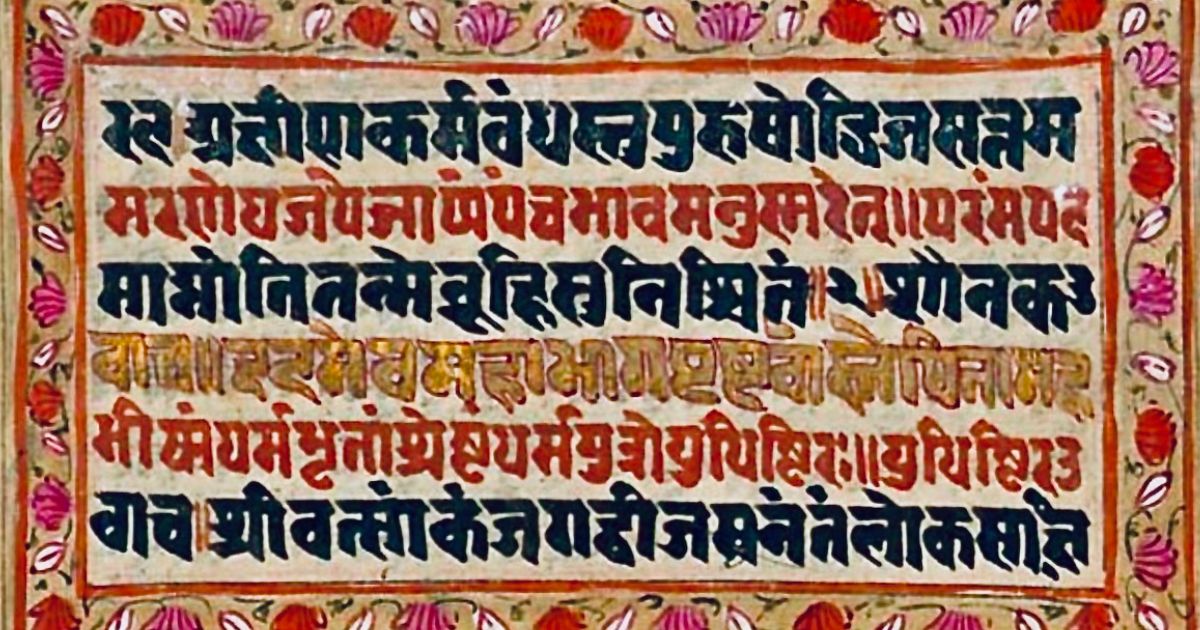
An excerpt from the original text.(complete · 1163 words)
rishna.
This deathless Yoga, this deep union,
I taught Vivaswata,[FN#6] the Lord of Light;
Vivaswata to Manu gave it; he
To Ikshwaku; so passed it down the line
Of all my royal Rishis. Then, with years,
The truth grew dim and perished, noble Prince!
Now once again to thee it is declared--
This ancient lore, this mystery supreme--
Seeing I find thee votary and friend.
Arjuna.
Thy birth, dear Lord, was in these later days,
And bright Vivaswata's preceded time!
How shall I comprehend this thing thou sayest,
"From the beginning it was I who taught?"
Krishna.
Manifold the renewals of my birth
Have been, Arjuna! and of thy births, too!
But mine I know, and thine thou knowest not,
O Slayer of thy Foes! Albeit I be
Unborn, undying, indestructible,
The Lord of all things living; not the less--
By Maya, by my magic which I stamp
On floating Nature-forms, the primal vast--
I come, and go, and come. When Righteousness
Declines, O Bharata! when Wickedness
Is strong, I rise, from age to age, and take
Visible shape, and move a man with men,
Succouring the good, thrusting the evil back,
And setting Virtue on her seat again.
Who knows the truth touching my births on earth
And my divine work, when he quits the flesh
Puts on its load no more, falls no more down
To earthly birth: to Me he comes, dear Prince!
Many there be who come! from fear set free,
From anger, from desire; keeping their hearts
Fixed upon me--my Faithful--purified
By sacred flame of Knowledge. Such as these
Mix with my being. Whoso worship me,
Them I exalt; but all men everywhere
Shall fall into my path; albeit, those souls
Which seek reward for works, make sacrifice
Now, to the lower gods. I say to thee
Here have they their reward. But I am He
Made the Four Castes, and portioned them a place
After their qualities and gifts. Yea, I
Created, the Reposeful; I that live
Immortally, made all those mortal births:
For works soil not my essence, being works
Wrought uninvolved.[FN#7] Who knows me acting thus
Unchained by action, action binds not him;
And, so perceiving, all those saints of old
Worked, seeking for deliverance. Work thou
As, in the days gone by, thy fathers did.
Thou sayst, perplexed, It hath been asked before
By singers and by sages, "What is act,
And what inaction? "I will teach thee this,
And, knowing, thou shalt learn which work doth save
Needs must one rightly meditate those three--
Doing,--not doing,--and undoing. Here
Thorny and dark the path is! He who sees
How action may be rest, rest action--he
Is wisest 'mid his kind; he hath the truth!
He doeth well, acting or resting. Freed
In all his works from prickings of desire,
Burned clean in act by the white fire of truth,
The wise call that man wise; and such an one,
Renouncing fruit of deeds, always content.
Always self-satisfying, if he works,
Doth nothing that shall stain his separate soul,
Which--quit of fear and hope--subduing self--
Rejecting outward impulse--yielding up
To body's need nothing save body, dwells
Sinless amid all sin, with equal calm
Taking what may befall, by grief unmoved,
Unmoved by joy, unenvyingly; the same
In good and evil fortunes; nowise bound
By bond of deeds. Nay, but of such an one,
Whose crave is gone, whose soul is liberate,
Whose heart is set on truth--of such an one
What work he does is work of sacrifice,
Which passeth purely into ash and smoke
Consumed upon the altar! All's then God!
The sacrifice is Brahm, the ghee and grain
Are Brahm, the fire is Brahm, the flesh it eats
Is Brahm, and unto Brahm attaineth he
Who, in such office, meditates on Brahm.
Some votaries there be who serve the gods
With flesh and altar-smoke; but other some
Who, lighting subtler fires, make purer rite
With will of worship. Of the which be they
Who, in white flame of continence, consume
Joys of the sense, delights of eye and ear,
Forgoing tender speech and sound of song:
And they who, kindling fires with torch of Truth,
Burn on a hidden altar-stone the bliss
Of youth and love, renouncing happiness:
And they who lay for offering there their wealth,
Their penance, meditation, piety,
Their steadfast reading of the scrolls, their lore
Painfully gained with long austerities:
And they who, making silent sacrifice,
Draw in their breath to feed the flame of thought,
And breathe it forth to waft the heart on high,
Governing the ventage of each entering air
Lest one sigh pass which helpeth not the soul:
And they who, day by day denying needs,
Lay life itself upon the altar-flame,
Burning the body wan. Lo! all these keep
The rite of offering, as if they slew
Victims; and all thereby efface much sin.
Yea! and who feed on the immortal food
Left of such sacrifice, to Brahma pass,
To The Unending. But for him that makes
No sacrifice, he hath nor part nor lot
Even in the present world. How should he share
Another, O thou Glory of thy Line?
In sight of Brahma all these offerings
Are spread and are accepted! Comprehend
That all proceed by act; for knowing this,
Thou shalt be quit of doubt. The sacrifice
Which Knowledge pays is better than great gifts
Offered by wealth, since gifts' worth--O my Prince!
Lies in the mind which gives, the will that serves:
And these are gained by reverence, by strong search,
By humble heed of those who see the Truth
And teach it. Knowing Truth, thy heart no more
Will ache with error, for the Truth shall show
All things subdued to thee, as thou to Me.
Moreover, Son of Pandu! wert thou worst
Of all wrong-doers, this fair ship of Truth
Should bear thee safe and dry across the sea
Of thy transgressions. As the kindled flame
Feeds on the fuel till it sinks to ash,
So unto ash, Arjuna! unto nought
The flame of Knowledge wastes works' dross away!
There is no purifier like thereto
In all this world, and he who seeketh it
Shall find it--being grown perfect--in himself.
Believing, he receives it when the soul
Masters itself, and cleaves to Truth, and comes--
Possessing knowledge--to the higher peace,
The uttermost repose. But those untaught,
And those without full faith, and those who fear
Are shent; no peace is here or other where,
No hope, nor happiness for whoso doubts.
He that, being self-contained, hath vanquished doubt,
Disparting self from service, soul from works,
Enlightened and emancipate, my Prince!
Works fetter him no more! Cut then atwain
With sword of wisdom, Son of Bharata!
This doubt that binds thy heart-beats! cleave the bond
Born of thy ignorance! Be bold and wise!
Give thyself to the field with me! Arise!
HERE ENDETH CHAPTER IV. OF THE BHAGAVAD-GITA,
Entitled "Jnana Yog,"
Or "The Book of the Religion of Knowledge,"
Master this chapter. Complete your experience
Purchase the complete book to access all chapters and support classic literature
As an Amazon Associate, we earn a small commission from qualifying purchases at no additional cost to you.
Available in paperback, hardcover, and e-book formats
Let's Analyse the Pattern
Peak performance emerges when you engage fully with work while remaining emotionally detached from specific outcomes.
Why This Matters
Connect literature to life
This chapter teaches how to maintain peak performance while emotionally detaching from results you can't control.
Practice This Today
This week, notice when anxiety about outcomes starts affecting your work quality—then redirect focus to what you can actually control in the moment.
Now let's explore the literary elements.
Key Quotes & Analysis
"When Righteousness Declines, O Bharata! when Wickedness Is strong, I rise, from age to age, and take Visible shape, and move a man with men"
Context: Krishna explains why divine consciousness manifests in human form throughout history
This reveals the cyclical nature of moral leadership and suggests that guidance appears exactly when society needs it most. It's both comforting and empowering - help comes when things get bad enough.
In Today's Words:
When things get really messed up and good people are getting trampled, that's when real leaders step up and show themselves.
"Who knows the truth touching my births on earth And my divine work, when he quits the flesh Puts on its load no more, falls no more down To earthly birth: to Me he comes"
Context: Krishna explains the liberation that comes from understanding divine action
This suggests that understanding the true nature of selfless action frees you from the cycle of anxiety and attachment that keeps you trapped in suffering.
In Today's Words:
When you really get how to work without being attached to the outcome, you stop being a slave to stress and worry.
"Many there be who come! from fear set free, From anger, from desire; keeping their hearts Fixed upon me"
Context: Krishna describes those who achieve liberation through understanding
This shows that freedom comes not from avoiding emotions but from maintaining focus on something larger than immediate reactions. It's about emotional regulation through perspective.
In Today's Words:
Plenty of people have learned to stay calm and focused by keeping their eyes on what really matters instead of getting caught up in every little drama.
Thematic Threads
Identity
In This Chapter
Krishna reveals his divine identity while teaching that true identity transcends any single role or incarnation
Development
Building on earlier questions of warrior identity—now exploring identity as something larger than circumstances
In Your Life:
You might struggle with defining yourself by your job title, relationship status, or current circumstances rather than deeper values.
Class
In This Chapter
Different types of 'sacrifice' reflect different social positions—some give wealth, others labor, others knowledge
Development
Expanding from warrior class duties to recognition that all social positions offer paths to wisdom
In Your Life:
You might feel your working-class background limits your spiritual or intellectual growth compared to those with more resources.
Personal Growth
In This Chapter
Growth comes through cutting doubt with knowledge and learning from those who truly understand life
Development
Moving beyond paralysis toward active development through wisdom and mentorship
In Your Life:
You might recognize that real growth requires finding mentors and being willing to challenge your own assumptions.
Social Expectations
In This Chapter
The expectation to act is balanced with the wisdom of how to act without being consumed by results
Development
Refining the duty concept—it's not just about meeting expectations but transforming how you meet them
In Your Life:
You might feel pressure to achieve specific outcomes at work or home rather than focusing on doing your best.
You now have the context. Time to form your own thoughts.
Discussion Questions
- 1
What does Krishna mean when he says he returns to earth whenever righteousness declines? How is this different from claiming to be immortal?
analysis • surface - 2
Why does Krishna say the key isn't whether you act, but how you act? What's the difference between working with attachment versus working without attachment to results?
analysis • medium - 3
Where do you see people in your life who work hard but seem peaceful inside, versus those who are constantly stressed about outcomes? What patterns do you notice?
application • medium - 4
Think about a situation where you're anxious about results - at work, in relationships, or with family. How would applying the '100% effort, 0% guarantee' principle change your approach?
application • deep - 5
Krishna suggests that wisdom emerges when it's most needed. What does this teach us about how good leadership and guidance appear in communities during difficult times?
reflection • deep
Critical Thinking Exercise
Practice Detached Excellence
Choose something you're currently worried about - a work project, family situation, or personal goal. Write down what you can control versus what you can't control. Then rewrite your approach focusing only on the 'can control' list, giving your best effort without demanding specific outcomes.
Consider:
- •Notice how much mental energy you spend on things outside your control
- •Identify the difference between caring deeply and being anxiously attached
- •Consider how outcome-anxiety might actually hurt your performance
Journaling Prompt
Write about a time when you performed your best. Were you focused on the work itself or constantly worried about results? What does this tell you about your own patterns of excellence?
Coming Up Next...
Chapter 5: Working Without Attachment
Arjuna remains puzzled by what seems like contradictory advice—sometimes Krishna praises giving up action entirely, other times he advocates for engaged service. Which path is actually better? Krishna will need to clarify this apparent contradiction once and for all.