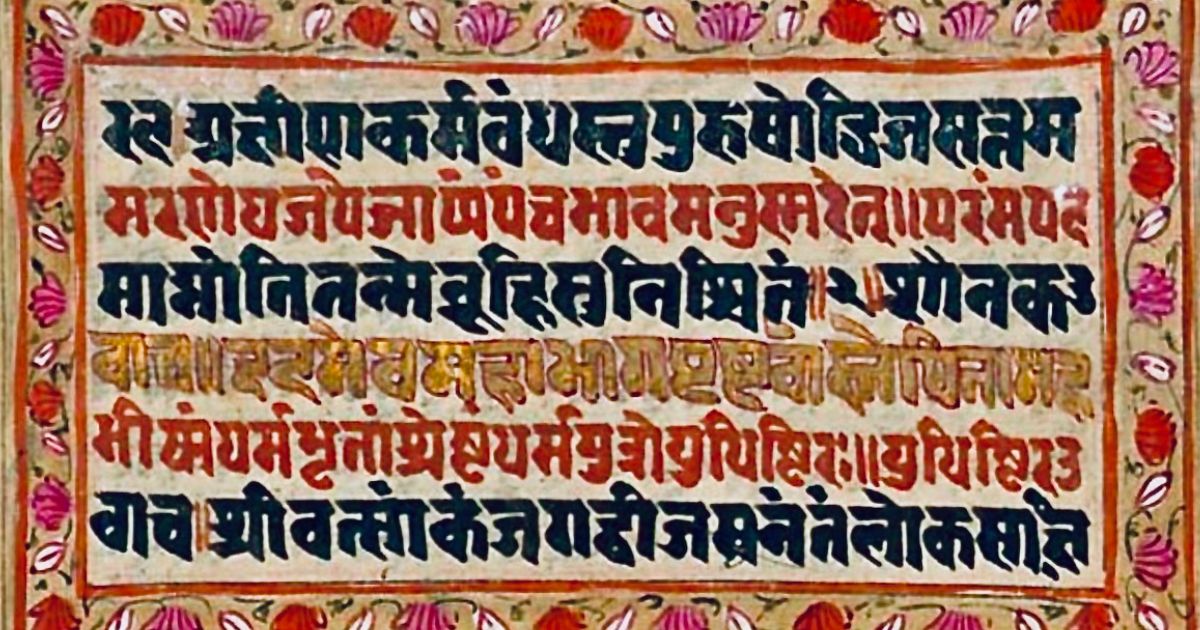
An excerpt from the original text.(complete · 1948 words)
anjaya.
Him, filled with such compassion and such grief,
With eyes tear-dimmed, despondent, in stern words
The Driver, Madhusudan, thus addressed:
Krishna.
How hath this weakness taken thee? Whence springs
The inglorious trouble, shameful to the brave,
Barring the path of virtue? Nay, Arjun!
Forbid thyself to feebleness! it mars
Thy warrior-name! cast off the coward-fit!
Wake! Be thyself! Arise, Scourge of thy Foes!
Arjuna.
How can I, in the battle, shoot with shafts
On Bhishma, or on Drona-O thou Chief!--
Both worshipful, both honourable men?
Better to live on beggar's bread
With those we love alive,
Than taste their blood in rich feasts spread,
And guiltily survive!
Ah! were it worse-who knows?--to be
Victor or vanquished here,
When those confront us angrily
Whose death leaves living drear?
In pity lost, by doubtings tossed,
My thoughts-distracted-turn
To Thee, the Guide I reverence most,
That I may counsel learn:
I know not what would heal the grief
Burned into soul and sense,
If I were earth's unchallenged chief--
A god--and these gone thence!
Sanjaya.
So spake Arjuna to the Lord of Hearts,
And sighing,"I will not fight!" held silence then.
To whom, with tender smile, (O Bharata! )
While the Prince wept despairing 'twixt those hosts,
Krishna made answer in divinest verse:
Krishna.
Thou grievest where no grief should be! thou speak'st
Words lacking wisdom! for the wise in heart
Mourn not for those that live, nor those that die.
Nor I, nor thou, nor any one of these,
Ever was not, nor ever will not be,
For ever and for ever afterwards.
All, that doth live, lives always! To man's frame
As there come infancy and youth and age,
So come there raisings-up and layings-down
Of other and of other life-abodes,
Which the wise know, and fear not. This that irks--
Thy sense-life, thrilling to the elements--
Bringing thee heat and cold, sorrows and joys,
'Tis brief and mutable! Bear with it, Prince!
As the wise bear. The soul which is not moved,
The soul that with a strong and constant calm
Takes sorrow and takes joy indifferently,
Lives in the life undying! That which is
Can never cease to be; that which is not
Will not exist. To see this truth of both
Is theirs who part essence from accident,
Substance from shadow. Indestructible,
Learn thou! the Life is, spreading life through all;
It cannot anywhere, by any means,
Be anywise diminished, stayed, or changed.
But for these fleeting frames which it informs
With spirit deathless, endless, infinite,
They perish. Let them perish, Prince! and fight!
He who shall say, "Lo! I have slain a man!"
He who shall think, "Lo! I am slain!" those both
Know naught! Life cannot slay. Life is not slain!
Never the spirit was born; the spirit shall cease to be never;
Never was time it was not; End and Beginning are dreams!
Birthless and deathless and changeless remaineth the spirit for ever;
Death hath not touched it at all, dead though the house of it seems!
Who knoweth it exhaustless, self-sustained,
Immortal, indestructible,--shall such
Say, "I have killed a man, or caused to kill?"
Nay, but as when one layeth
His worn-out robes away,
And taking new ones, sayeth,
"These will I wear to-day!"
So putteth by the spirit
Lightly its garb of flesh,
And passeth to inherit
A residence afresh.
I say to thee weapons reach not the Life;
Flame burns it not, waters cannot o'erwhelm,
Nor dry winds wither it. Impenetrable,
Unentered, unassailed, unharmed, untouched,
Immortal, all-arriving, stable, sure,
Invisible, ineffable, by word
And thought uncompassed, ever all itself,
Thus is the Soul declared! How wilt thou, then,--
Knowing it so,--grieve when thou shouldst not grieve?
How, if thou hearest that the man new-dead
Is, like the man new-born, still living man--
One same, existent Spirit--wilt thou weep?
The end of birth is death; the end of death
Is birth: this is ordained! and mournest thou,
Chief of the stalwart arm! for what befalls
Which could not otherwise befall? The birth
Of living things comes unperceived; the death
Comes unperceived; between them, beings perceive:
What is there sorrowful herein, dear Prince?
Wonderful, wistful, to contemplate!
Difficult, doubtful, to speak upon!
Strange and great for tongue to relate,
Mystical hearing for every one!
Nor wotteth man this, what a marvel it is,
When seeing, and saying, and hearing are done!
This Life within all living things, my Prince!
Hides beyond harm; scorn thou to suffer, then,
For that which cannot suffer. Do thy part!
Be mindful of thy name, and tremble not!
Nought better can betide a martial soul
Than lawful war; happy the warrior
To whom comes joy of battle--comes, as now,
Glorious and fair, unsought; opening for him
A gateway unto Heav'n. But, if thou shunn'st
This honourable field--a Kshattriya--
If, knowing thy duty and thy task, thou bidd'st
Duty and task go by--that shall be sin!
And those to come shall speak thee infamy
From age to age; but infamy is worse
For men of noble blood to bear than death!
The chiefs upon their battle-chariots
Will deem 'twas fear that drove thee from the fray.
Of those who held thee mighty-souled the scorn
Thou must abide, while all thine enemies
Will scatter bitter speech of thee, to mock
The valour which thou hadst; what fate could fall
More grievously than this? Either--being killed--
Thou wilt win Swarga's safety, or--alive
And victor--thou wilt reign an earthly king.
Therefore, arise, thou Son of Kunti! brace
Thine arm for conflict, nerve thy heart to meet--
As things alike to thee--pleasure or pain,
Profit or ruin, victory or defeat:
So minded, gird thee to the fight, for so
Thou shalt not sin!
Thus far I speak to thee
As from the "Sankhya"--unspiritually--
Hear now the deeper teaching of the Yog,
Which holding, understanding, thou shalt burst
Thy Karmabandh, the bondage of wrought deeds.
Here shall no end be hindered, no hope marred,
No loss be feared: faith--yea, a little faith--
Shall save thee from the anguish of thy dread.
Here, Glory of the Kurus! shines one rule--
One steadfast rule--while shifting souls have laws
Many and hard. Specious, but wrongful deem
The speech of those ill-taught ones who extol
The letter of their Vedas, saying, "This
Is all we have, or need;" being weak at heart
With wants, seekers of Heaven: which comes--they say--
As "fruit of good deeds done;" promising men
Much profit in new births for works of faith;
In various rites abounding; following whereon
Large merit shall accrue towards wealth and power;
Albeit, who wealth and power do most desire
Least fixity of soul have such, least hold
On heavenly meditation. Much these teach,
From Veds, concerning the "three qualities;"
But thou, be free of the "three qualities,"
Free of the "pairs of opposites,"[FN#2] and free
From that sad righteousness which calculates;
Self-ruled, Arjuna! simple, satisfied![FN#3]
Look! like as when a tank pours water forth
To suit all needs, so do these Brahmans draw
Text for all wants from tank of Holy Writ.
But thou, want not! ask not! Find full reward
Of doing right in right! Let right deeds be
Thy motive, not the fruit which comes from them.
And live in action! Labour! Make thine acts
Thy piety, casting all self aside,
Contemning gain and merit; equable
In good or evil: equability
Is Yog, is piety!
Yet, the right act
Is less, far less, than the right-thinking mind.
Seek refuge in thy soul; have there thy heaven!
Scorn them that follow virtue for her gifts!
The mind of pure devotion--even here--
Casts equally aside good deeds and bad,
Passing above them. Unto pure devotion
Devote thyself: with perfect meditation
Comes perfect act, and the right-hearted rise--
More certainly because they seek no gain--
Forth from the bands of body, step by step,
To highest seats of bliss. When thy firm soul
Hath shaken off those tangled oracles
Which ignorantly guide, then shall it soar
To high neglect of what's denied or said,
This way or that way, in doctrinal writ.
Troubled no longer by the priestly lore,
Safe shall it live, and sure; steadfastly bent
On meditation. This is Yog--and Peace!
Arjuna.
What is his mark who hath that steadfast heart,
Confirmed in holy meditation? How
Know we his speech, Kesava? Sits he, moves he
Like other men?
Krishna.
When one, O Pritha's Son!
Abandoning desires which shake the mind--
Finds in his soul full comfort for his soul,
He hath attained the Yog--that man is such!
In sorrows not dejected, and in joys
Not overjoyed; dwelling outside the stress
Of passion, fear, and anger; fixed in calms
Of lofty contemplation;--such an one
Is Muni, is the Sage, the true Recluse!
He who to none and nowhere overbound
By ties of flesh, takes evil things and good
Neither desponding nor exulting, such
Bears wisdom's plainest mark! He who shall draw
As the wise tortoise draws its four feet safe
Under its shield, his five frail senses back
Under the spirit's buckler from the world
Which else assails them, such an one, my Prince!
Hath wisdom's mark! Things that solicit sense
Hold off from the self-governed; nay, it comes,
The appetites of him who lives beyond
Depart,--aroused no more. Yet may it chance,
O Son of Kunti! that a governed mind
Shall some time feel the sense-storms sweep, and wrest
Strong self-control by the roots. Let him regain
His kingdom! let him conquer this, and sit
On Me intent. That man alone is wise
Who keeps the mastery of himself! If one
Ponders on objects of the sense, there springs
Attraction; from attraction grows desire,
Desire flames to fierce passion, passion breeds
Recklessness; then the memory--all betrayed--
Lets noble purpose go, and saps the mind,
Till purpose, mind, and man are all undone.
But, if one deals with objects of the sense
Not loving and not hating, making them
Serve his free soul, which rests serenely lord,
Lo! such a man comes to tranquillity;
And out of that tranquillity shall rise
The end and healing of his earthly pains,
Since the will governed sets the soul at peace.
The soul of the ungoverned is not his,
Nor hath he knowledge of himself; which lacked,
How grows serenity? and, wanting that,
Whence shall he hope for happiness?
The mind
That gives itself to follow shows of sense
Seeth its helm of wisdom rent away,
And, like a ship in waves of whirlwind, drives
To wreck and death. Only with him, great Prince!
Whose senses are not swayed by things of sense--
Only with him who holds his mastery,
Shows wisdom perfect. What is midnight-gloom
To unenlightened souls shines wakeful day
To his clear gaze; what seems as wakeful day
Is known for night, thick night of ignorance,
To his true-seeing eyes. Such is the Saint!
And like the ocean, day by day receiving
Floods from all lands, which never overflows
Its boundary-line not leaping, and not leaving,
Fed by the rivers, but unswelled by those;--
So is the perfect one! to his soul's ocean
The world of sense pours streams of witchery;
They leave him as they find, without commotion,
Taking their tribute, but remaining sea.
Yea! whoso, shaking off the yoke of flesh
Lives lord, not servant, of his lusts; set free
From pride, from passion, from the sin of "Self,"
Toucheth tranquillity! O Pritha's Son!
That is the state of Brahm! There rests no dread
When that last step is reached! Live where he will,
Die when he may, such passeth from all 'plaining,
To blest Nirvana, with the Gods, attaining.
HERE ENDETH CHAPTER II. OF THE BHAGAVAD-GITA,
Entitled "Sankhya-Yog,"
Or "The Book of Doctrines."
Master this chapter. Complete your experience
Purchase the complete book to access all chapters and support classic literature
As an Amazon Associate, we earn a small commission from qualifying purchases at no additional cost to you.
Available in paperback, hardcover, and e-book formats
Let's Analyse the Pattern
When love for specific people conflicts with broader moral duty, we freeze rather than choose, avoiding responsibility while calling it compassion.
Why This Matters
Connect literature to life
This chapter teaches how to distinguish between genuine care and emotional manipulation disguised as loyalty.
Practice This Today
This week, notice when someone asks you to compromise your principles 'because you care about them'—that's the moment to apply detached action.
Now let's explore the literary elements.
Key Quotes & Analysis
"Thou grievest where no grief should be! thou speak'st Words lacking wisdom! for the wise in heart Mourn not for those that live, nor those that die."
Context: Krishna's first response to Arjuna's breakdown about having to kill his loved ones
This cuts to the heart of human suffering - we often grieve over things that aren't actually losses. Krishna is saying that focusing on physical death misses the bigger picture of what's truly permanent.
In Today's Words:
You're crying over the wrong things. Smart people don't waste energy mourning what was never really lost in the first place.
"Better to live on beggar's bread With those we love alive, Than taste their blood in rich feasts spread, And guiltily survive!"
Context: Arjuna explaining why he'd rather give up his kingdom than fight his family
This shows how our emotions can make even the wrong choice seem noble. Arjuna is letting his personal attachments override his duty to protect justice and innocent people.
In Today's Words:
I'd rather be poor with the people I love than rich knowing I hurt them to get there.
"How can I, in the battle, shoot with shafts On Bhishma, or on Drona-O thou Chief!-- Both worshipful, both honourable men?"
Context: Arjuna expressing his anguish about having to fight his respected teachers
This captures the real-world complexity of moral decisions. Sometimes doing what's right means opposing good people who happen to be on the wrong side.
In Today's Words:
How am I supposed to go against people I respect and who taught me everything I know?
"I will not fight!"
Context: Arjuna's final declaration before Krishna begins teaching him
Sometimes we reach a point where we're so overwhelmed that we just shut down completely. This moment of total surrender actually opens the door for real wisdom to enter.
In Today's Words:
I'm done. I can't do this anymore.
Thematic Threads
Duty
In This Chapter
Arjuna's warrior duty to fight for justice conflicts with his personal feelings about killing family members
Development
Introduced here as central tension
In Your Life:
Every time you must choose between what's right and what feels comfortable for people you care about
Identity
In This Chapter
Arjuna questions his role as warrior when it demands actions that feel wrong to his heart
Development
Introduced here through role conflict
In Your Life:
When your job, family role, or social position demands behavior that conflicts with your personal values
Attachment
In This Chapter
Arjuna's attachment to specific outcomes and people prevents him from acting clearly
Development
Introduced here as source of suffering
In Your Life:
When fear of losing someone or something keeps you from doing what you know is necessary
Wisdom
In This Chapter
Krishna distinguishes between emotional reaction and clear understanding of what's permanent versus temporary
Development
Introduced here as detached perspective
In Your Life:
Learning to separate immediate feelings from long-term consequences when making difficult decisions
Action
In This Chapter
The revolutionary idea that right action can be performed without attachment to results
Development
Introduced here as core teaching
In Your Life:
Doing what's right while releasing control over how others respond or what happens next
You now have the context. Time to form your own thoughts.
Discussion Questions
- 1
Why does Arjuna throw down his weapons and refuse to fight? What specific fears overwhelm him?
analysis • surface - 2
How does Krishna's teaching about the eternal soul versus the temporary body challenge Arjuna's understanding of what he's really fighting for?
analysis • medium - 3
Where do you see people today facing the same conflict between personal loyalty and larger responsibility that paralyzes Arjuna?
application • medium - 4
How would Krishna's concept of 'detached action' apply to a modern situation where you know what's right but fear the personal cost of doing it?
application • deep - 5
What does this chapter reveal about why good people sometimes fail to act when action is needed most?
reflection • deep
Critical Thinking Exercise
Map Your Own Moral Paralysis
Think of a situation where you felt torn between loyalty to someone you care about and doing what you believed was right. Write down the conflict in one sentence, then list what you feared would happen if you chose duty over loyalty, and what you feared would happen if you chose loyalty over duty. Finally, apply Krishna's framework: what would detached action look like in this situation?
Consider:
- •Notice how emotion makes the personal consequences feel more real than the principled ones
- •Consider whether your 'loyalty' was actually avoiding difficult conversations or accountability
- •Ask yourself what you would do if you loved everyone involved equally
Journaling Prompt
Write about a time when you chose emotional comfort over doing what you knew was right. What pattern do you notice in how you handle these conflicts? How might you prepare differently for the next one?
Coming Up Next...
Chapter 3: The Path of Righteous Action
Arjuna is confused by Krishna's advice. If meditation and wisdom are so important, why is Krishna pushing him toward violent action? He demands a clearer answer about the right path forward.