
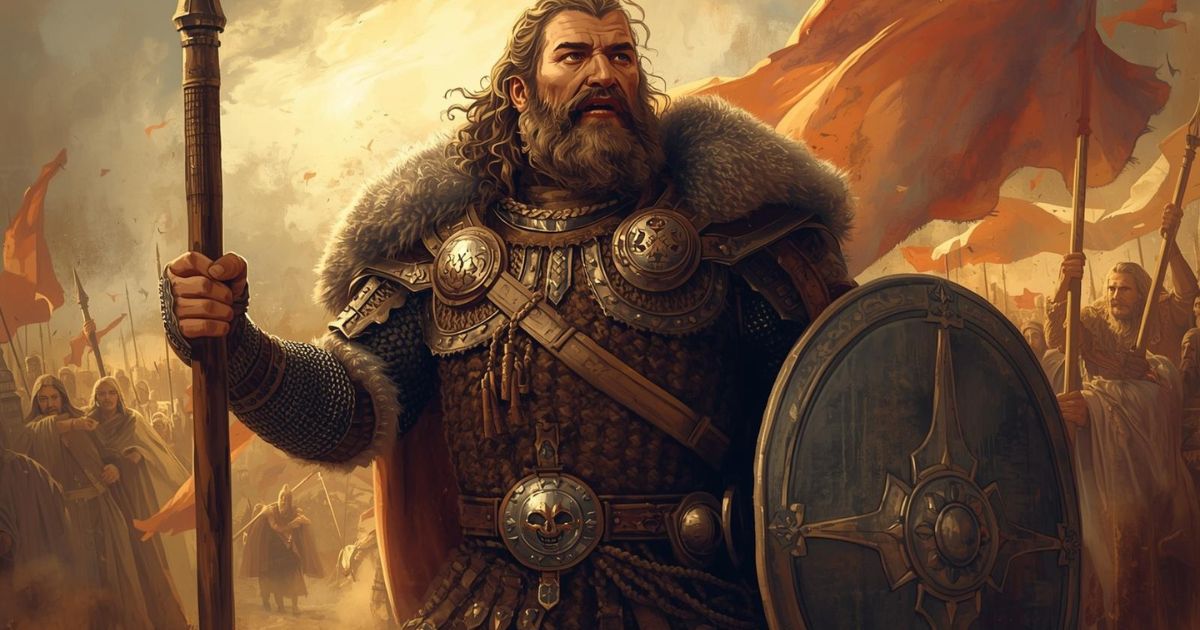
An excerpt from the original text.(complete · 780 words)
GIFT-GIVING IS MUTUAL.


          "So the belovèd land-prince lived in decorum;
          I had missed no rewards, no meeds of my prowess,
          But he gave me jewels, regarding my wishes,
          Healfdene his bairn; I'll bring them to thee, then,

{All my gifts I lay at thy feet.}

        5 Atheling of earlmen, offer them gladly.
          And still unto thee is all my affection:[1]
          But few of my folk-kin find I surviving
          But thee, dear Higelac!" Bade he in then to carry[2]
          The boar-image, banner, battle-high helmet,
       10 Iron-gray armor, the excellent weapon,

{This armor I have belonged of yore to Heregar.}

          In song-measures said: "This suit-for-the-battle
          Hrothgar presented me, bade me expressly,
          Wise-mooded atheling, thereafter to tell thee[3]
          The whole of its history, said King Heregar owned it,
       15 Dane-prince for long: yet he wished not to give then
[74]      The mail to his son, though dearly he loved him,
          Hereward the hardy. Hold all in joyance!"
          I heard that there followed hard on the jewels
          Two braces of stallions of striking resemblance,
       20 Dappled and yellow; he granted him usance
          Of horses and treasures. So a kinsman should bear him,
          No web of treachery weave for another,
          Nor by cunning craftiness cause the destruction

{Higelac loves his nephew Beowulf.}

          Of trusty companion. Most precious to Higelac,
       25 The bold one in battle, was the bairn of his sister,
          And each unto other mindful of favors.

{Beowulf gives Hygd the necklace that Wealhtheow had given him.}

          I am told that to Hygd he proffered the necklace,
          Wonder-gem rare that Wealhtheow gave him,
          The troop-leader's daughter, a trio of horses
       30 Slender and saddle-bright; soon did the jewel
          Embellish her bosom, when the beer-feast was over.
          So Ecgtheow's bairn brave did prove him,

{Beowulf is famous.}

          War-famous man, by deeds that were valiant,
          He lived in honor, belovèd companions
       35 Slew not carousing; his mood was not cruel,
          But by hand-strength hugest of heroes then living
          The brave one retained the bountiful gift that
          The Lord had allowed him. Long was he wretched,
          So that sons of the Geatmen accounted him worthless,
       40 And the lord of the liegemen loth was to do him
          Mickle of honor, when mead-cups were passing;
          They fully believed him idle and sluggish,

{He is requited for the slights suffered in earlier days.}

          An indolent atheling: to the honor-blest man there
          Came requital for the cuts he had suffered.
       45 The folk-troop's defender bade fetch to the building
          The heirloom of Hrethel, embellished with gold,

{Higelac overwhelms the conqueror with gifts.}

          So the brave one enjoined it; there was jewel no richer
          In the form of a weapon 'mong Geats of that era;
          In Beowulf's keeping he placed it and gave him
       50 Seven of thousands, manor and lordship.
          Common to both was land 'mong the people,
[75]      Estate and inherited rights and possessions,
          To the second one specially spacious dominions,
          To the one who was better. It afterward happened
       55 In days that followed, befell the battle-thanes,

{After Heardred's death, Beowulf becomes king.}

          After Higelac's death, and when Heardred was murdered
          With weapons of warfare 'neath well-covered targets,
          When valiant battlemen in victor-band sought him,
          War-Scylfing heroes harassed the nephew
       60 Of Hereric in battle. To Beowulf's keeping
          Turned there in time extensive dominions:

{He rules the Geats fifty years.}

          He fittingly ruled them a fifty of winters
          (He a man-ruler wise was, manor-ward old) till
          A certain one 'gan, on gloom-darkening nights, a

{The fire-drake.}

       65 Dragon, to govern, who guarded a treasure,
          A high-rising stone-cliff, on heath that was grayish:
          A path 'neath it lay, unknown unto mortals.
          Some one of earthmen entered the mountain,
          The heathenish hoard laid hold of with ardor;
       70 *       *       *       *       *       *       *
          *       *       *       *       *       *       *
          *       *       *       *       *       *       *
          *       *       *       *       *       *       *
          *       *       *       *       *       *       *

    [1] This verse B. renders, '_Now serve I again thee alone as my
    gracious king_.'

    [2] For 'eafor' (2153), Kl. suggests 'ealdor.' Translate then: _Bade
    the prince then to bear in the banner, battle-high helmet, etc_. On
    the other hand, W. takes 'eaforhéafodsegn' as a compound, meaning
    'helmet': _He bade them bear in the helmet, battle-high helm, gray
    armor, etc_.

    [3] The H.-So. rendering (ærest = _history, origin_; 'eft' for 'est'),
    though liable to objection, is perhaps the best offered. 'That I
    should very early tell thee of his favor, kindness' sounds well; but
    'his' is badly placed to limit 'ést.'--Perhaps, 'eft' with verbs of
    saying may have the force of Lat. prefix 're,' and the H.-So. reading
    mean, 'that I should its origin rehearse to thee.'
Master this chapter. Complete your experience
Purchase the complete book to access all chapters and support classic literature
As an Amazon Associate, we earn a small commission from qualifying purchases at no additional cost to you.
Available in paperback, hardcover, and e-book formats
Let's Analyse the Pattern
Sharing credit and resources strategically builds networks that multiply future opportunities and support.
Why This Matters
Connect literature to life
This chapter teaches how to recognize when giving actually creates more receiving than hoarding ever could.
Practice This Today
This week, notice when someone shares credit publicly versus someone who claims all the glory—track how others respond to each approach over time.
Now let's explore the literary elements.
Key Quotes & Analysis
"So a kinsman should bear him, No web of treachery weave for another"
Context: Describing the proper relationship between Beowulf and Higelac as uncle and nephew
This emphasizes that family relationships should be based on mutual support and trust, not manipulation or competition. It shows the ideal of how relatives should treat each other.
In Today's Words:
Family should have each other's backs, not scheme against each other
"I had missed no rewards, no meeds of my prowess, But he gave me jewels, regarding my wishes"
Context: Beowulf explaining to Higelac how well Hrothgar treated him in Denmark
Beowulf acknowledges that he was properly rewarded for his service, showing his understanding of fair exchange and his gratitude for good treatment.
In Today's Words:
My boss took good care of me and gave me everything I earned and more
"And still unto thee is all my affection"
Context: Beowulf expressing his continued loyalty to Higelac despite his success abroad
This shows that Beowulf's achievements haven't made him arrogant or disloyal. Success hasn't changed his commitment to the relationships that matter most.
In Today's Words:
No matter how well I do out there, you're still my family and my loyalty is with you
Thematic Threads
Class
In This Chapter
Beowulf transforms from dismissed 'lazy' youth to honored warrior through persistent action
Development
Evolved from earlier focus on proving worth to established social mobility through merit
In Your Life:
Early judgments about your potential don't define your ultimate trajectory if you keep working.
Relationships
In This Chapter
Strategic sharing of treasure strengthens bonds between Beowulf and Higelac
Development
Builds on earlier themes of loyalty by showing how reciprocity deepens connections
In Your Life:
Your willingness to share success determines how much others invest in your future.
Identity
In This Chapter
Beowulf's identity evolves from young hero-seeker to mature king responsible for others
Development
Natural progression from individual achievement to community leadership
In Your Life:
True growth means shifting from proving yourself to protecting and developing others.
Social Expectations
In This Chapter
Society's early dismissal of Beowulf as worthless proves completely wrong
Development
Continues theme of challenging surface judgments with deeper character assessment
In Your Life:
People who write you off early often become your biggest supporters when you prove them wrong.
Personal Growth
In This Chapter
Fifty-year time jump shows sustained character development and wisdom
Development
Demonstrates that heroic moments must be followed by consistent daily choices
In Your Life:
Real success is measured in decades of consistent choices, not individual achievements.
You now have the context. Time to form your own thoughts.
Discussion Questions
- 1
Why does Beowulf immediately give away all his treasures from Denmark instead of keeping them for himself?
analysis • surface - 2
How does Beowulf's strategy of sharing credit and wealth actually increase his power and status?
analysis • medium - 3
Where do you see this pattern of 'strategic generosity' working in modern workplaces, families, or communities?
application • medium - 4
Think about someone you know who was initially underestimated but later proved themselves. What does Beowulf's early reputation as 'lazy and worthless' teach us about first impressions?
reflection • deep - 5
If you achieved something significant at work or in your community, how would you share that success to build stronger relationships rather than create resentment?
application • deep
Critical Thinking Exercise
Map Your Reciprocity Network
Draw a simple diagram of people who have helped you in the last year - supervisors, colleagues, family members, neighbors. Next to each name, write one specific way you could publicly acknowledge their help or share credit for something you've accomplished. Then identify one person you could help or mentor, creating a new reciprocal relationship.
Consider:
- •Focus on specific, genuine contributions rather than generic thank-yous
- •Consider how acknowledging others publicly benefits both of you
- •Think about building long-term relationships, not just immediate exchanges
Journaling Prompt
Write about a time when someone gave you credit publicly or shared an opportunity with you. How did it make you feel about that person, and how did it affect your willingness to help them in the future?
Coming Up Next...
Chapter 32: The Dragon Awakens to Theft
A dragon awakens from centuries of slumber, and its fury threatens to destroy everything Beowulf has spent fifty years building. The final test of his heroism is about to begin.



