
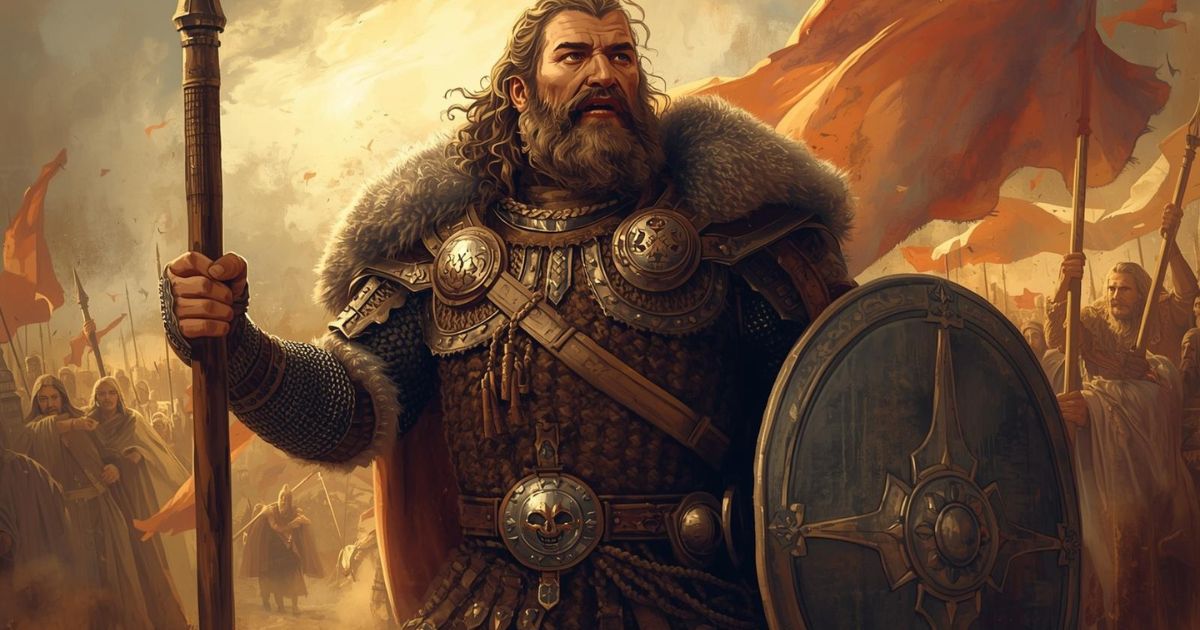
An excerpt from the original text.(complete · 974 words)
THE HOARD AND THE DRAGON.


          *       *       *       *       *       *       *
          He sought of himself who sorely did harm him,
          But, for need very pressing, the servant of one of
          The sons of the heroes hate-blows evaded,
        5 Seeking for shelter and the sin-driven warrior
          Took refuge within there. He early looked in it,
          *       *       *       *       *       *       *
          *       *       *       *       *       *       *
[76]      *  *  *  *  *  * when the onset surprised him,

{The hoard.}

       10 He a gem-vessel saw there: many of suchlike
          Ancient ornaments in the earth-cave were lying,
          As in days of yore some one of men of
          Illustrious lineage, as a legacy monstrous,
          There had secreted them, careful and thoughtful,
       15 Dear-valued jewels. Death had offsnatched them,
          In the days of the past, and the one man moreover
          Of the flower of the folk who fared there the longest,
          Was fain to defer it, friend-mourning warder,
          A little longer to be left in enjoyment
       20 Of long-lasting treasure.[1] A barrow all-ready
          Stood on the plain the stream-currents nigh to,
          New by the ness-edge, unnethe of approaching:
          The keeper of rings carried within a
          [2]Ponderous deal of the treasure of nobles,
       25 Of gold that was beaten, briefly he spake then:[3]

{The ring-giver bewails the loss of retainers.}

          "Hold thou, O Earth, now heroes no more may,
          The earnings of earlmen. Lo! erst in thy bosom
          Worthy men won them; war-death hath ravished,
          Perilous life-bale, all my warriors,
       30 Liegemen belovèd, who this life have forsaken,
          Who hall-pleasures saw. No sword-bearer have I,
          And no one to burnish the gold-plated vessel,
          The high-valued beaker: my heroes are vanished.
          The hardy helmet behung with gilding
       35 Shall be reaved of its riches: the ring-cleansers slumber
          Who were charged to have ready visors-for-battle,
          And the burnie that bided in battle-encounter
[77]      O'er breaking of war-shields the bite of the edges
          Moulds with the hero. The ring-twisted armor,
       40 Its lord being lifeless, no longer may journey
          Hanging by heroes; harp-joy is vanished,
          The rapture of glee-wood, no excellent falcon
          Swoops through the building, no swift-footed charger
          Grindeth the gravel. A grievous destruction
       45 No few of the world-folk widely hath scattered!"
          So, woful of spirit one after all
          Lamented mournfully, moaning in sadness
          By day and by night, till death with its billows

{The fire-dragon}

          Dashed on his spirit. Then the ancient dusk-scather
       50 Found the great treasure standing all open,
          He who flaming and fiery flies to the barrows,
          Naked war-dragon, nightly escapeth
          Encompassed with fire; men under heaven
          Widely beheld him. 'Tis said that he looks for[4]
       55 The hoard in the earth, where old he is guarding
          The heathenish treasure; he'll be nowise the better.

{The dragon meets his match.}

          So three-hundred winters the waster of peoples
          Held upon earth that excellent hoard-hall,
          Till the forementioned earlman angered him bitterly:
       60 The beat-plated beaker he bare to his chieftain
          And fullest remission for all his remissness
          Begged of his liegelord. Then the hoard[5] was discovered,
          The treasure was taken, his petition was granted

{The hero plunders the dragon's den}

          The lorn-mooded liegeman. His lord regarded
       65 The old-work of earth-folk--'twas the earliest occasion.
          When the dragon awoke, the strife was renewed there;
          He snuffed 'long the stone then, stout-hearted found he
[78]      The footprint of foeman; too far had he gone
          With cunning craftiness close to the head of
       70 The fire-spewing dragon. So undoomed he may 'scape from
          Anguish and exile with ease who possesseth
          The favor of Heaven. The hoard-warden eagerly
          Searched o'er the ground then, would meet with the person
          That caused him sorrow while in slumber reclining:
       75 Gleaming and wild he oft went round the cavern,
          All of it outward; not any of earthmen
          Was seen in that desert.[6] Yet he joyed in the battle,
          Rejoiced in the conflict: oft he turned to the barrow,
          Sought for the gem-cup;[7] this he soon perceived then

{The dragon perceives that some one has disturbed his treasure.}

       80 That some man or other had discovered the gold,
          The famous folk-treasure. Not fain did the hoard-ward
          Wait until evening; then the ward of the barrow
          Was angry in spirit, the loathèd one wished to
          Pay for the dear-valued drink-cup with fire.
       85 Then the day was done as the dragon would have it,
          He no longer would wait on the wall, but departed

{The dragon is infuriated.}

          Fire-impelled, flaming. Fearful the start was
          To earls in the land, as it early thereafter
          To their giver-of-gold was grievously ended.

    [1] For 'long-gestréona,' B. suggests 'láengestréona,' and renders,
    _Of fleeting treasures_. S. accepts H.'s 'long-gestréona,' but
    renders, _The treasure long in accumulating_.

    [2] For 'hard-fyrdne' (2246), B. first suggested 'hard-fyndne,'
    rendering: _A heap of treasures ... so great that its equal would be
    hard to find_. The same scholar suggests later 'hord-wynne dæl' = _A
    deal of treasure-joy_.

    [3] Some read 'fec-word' (2247), and render: _Banning words uttered_.

    [4] An earlier reading of H.'s gave the following meaning to this
    passage: _He is said to inhabit a mound under the earth, where he,
    etc._ The translation in the text is more authentic.

    [5] The repetition of 'hord' in this passage has led some scholars to
    suggest new readings to avoid the second 'hord.' This, however, is not
    under the main stress, and, it seems to me, might easily be accepted.

    [6] The reading of H.-So. is well defended in the notes to that
    volume. B. emends and renders: _Nor was there any man in that desert
    who rejoiced in conflict, in battle-work._ That is, the hoard-ward
    could not find any one who had disturbed his slumbers, for no warrior
    was there, t.B.'s emendation would give substantially the same
    translation.

    [7] 'Sinc-fæt' (2301): this word both here and in v. 2232, t.B.
    renders 'treasure.'
Master this chapter. Complete your experience
Purchase the complete book to access all chapters and support classic literature
As an Amazon Associate, we earn a small commission from qualifying purchases at no additional cost to you.
Available in paperback, hardcover, and e-book formats
Let's Analyse the Pattern
When survival pressure forces small desperate acts that awaken disproportionate consequences from those guarding power or wealth.
Why This Matters
Connect literature to life
This chapter teaches how to spot when small actions might trigger disproportionately large consequences from those in power.
Practice This Today
This week, notice when you're making decisions from panic versus planning—ask yourself 'what dragon might this wake up?' before acting on desperation.
Now let's explore the literary elements.
Key Quotes & Analysis
"Hold thou, O Earth, now heroes no more may, The earnings of earlmen."
Context: The dying man speaks to the earth as he buries his people's treasure, knowing no one will ever claim it.
This reveals the tragic futility of accumulating wealth when there's no community to share it with. The earth becomes the only heir to a dead civilization.
In Today's Words:
Take this treasure, Earth - there's nobody left who deserves it or can use it.
"War-death hath ravished, Perilous life-bale, all my warriors."
Context: He explains how his entire people were destroyed in battle, leaving him completely alone.
Shows how violence doesn't just kill individuals but can destroy entire ways of life. The survivor bears the weight of being the final witness to his culture.
In Today's Words:
War took everyone I ever knew - all my friends, all my family, everyone who shared my world.
"He a gem-vessel saw there: many of suchlike Ancient ornaments in the earth-cave were lying."
Context: The servant discovers the vast treasure hoard hidden in the burial mound.
This moment of discovery changes everything. One desperate person stumbling onto centuries of hidden wealth triggers a chain of events that will destroy kingdoms.
In Today's Words:
He saw a golden cup sitting there, and realized the whole place was packed with ancient treasure.
Thematic Threads
Class
In This Chapter
The powerless servant must steal to survive while the dragon hoards meaningless wealth in isolation
Development
Deepened from earlier themes of warriors and kings to show how class desperation creates cascading destruction
In Your Life:
You might see this in how financial pressure forces choices that risk your job or family stability.
Isolation
In This Chapter
Both the last survivor who buried the treasure and the dragon who guards it live in complete solitude
Development
Introduced here as a new theme showing how isolation corrupts purpose
In Your Life:
You might recognize this when hoarding resources or opportunities instead of sharing them with your community.
Consequences
In This Chapter
One stolen cup triggers a dragon's rage that will devastate kingdoms
Development
Evolved from personal consequences in earlier chapters to societal destruction
In Your Life:
You might experience this when small survival choices at work or home spiral into much larger problems.
Legacy
In This Chapter
The last survivor's treasure becomes meaningless because there's no one left to inherit it
Development
Introduced here as a meditation on what we leave behind
In Your Life:
You might see this in how achievements or savings mean nothing if you have no relationships to share them with.
Power
In This Chapter
The dragon's three centuries of unchallenged control over the treasure creates the conditions for its violation
Development
Developed from earlier themes of leadership to show how hoarding power creates its own destruction
In Your Life:
You might notice this when people in authority create the problems they later rage against.
You now have the context. Time to form your own thoughts.
Discussion Questions
- 1
Why did the servant steal from the dragon's hoard, and what does this tell us about his situation?
analysis • surface - 2
How does the dragon's centuries of hoarding create the very conditions that lead to his treasure being violated?
analysis • medium - 3
Where do you see this pattern today - desperate people making survival choices that awaken forces beyond what they intended?
application • medium - 4
When you're facing a desperate situation, how can you pause to see the 'sleeping dragons' your choices might awaken?
application • deep - 5
What does this chapter reveal about how power structures create their own threats through the desperation they cause?
reflection • deep
Critical Thinking Exercise
Map Your Own Dragons
Think of a current financial or work pressure you're facing. Draw a simple map showing: your immediate need, the 'quick fix' solution you're tempted by, and the powerful forces (bosses, systems, institutions) that might 'wake up' if you take that action. Then brainstorm three alternative approaches that address the need without awakening the dragon.
Consider:
- •Dragons aren't always evil - they're just protective of what they guard
- •Sometimes you have to wake the dragon anyway, but it's better to do it intentionally
- •The most dangerous dragons are the ones you don't see coming
Journaling Prompt
Write about a time when a small desperate choice led to bigger consequences than you expected. What would you do differently now, knowing what you know?
Coming Up Next...
Chapter 33: When Crisis Calls Your Name
The dragon's fury will not be contained within his cave. His fire-breathing vengeance is about to rain down on innocent people, and an aging king will face the greatest test of his legendary courage.



