
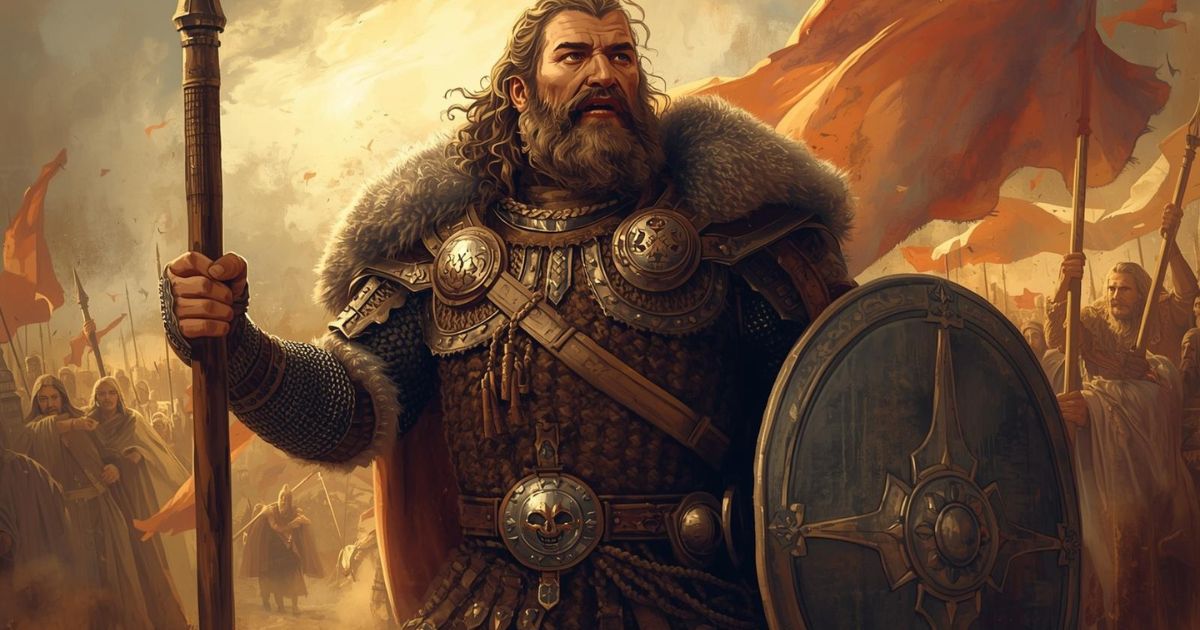
An excerpt from the original text.(complete · 1044 words)
BEOWULF NARRATES HIS ADVENTURES TO HIGELAC.


          "It well may discomfit the prince of the Heathobards
          And each of the thanemen of earls that attend him,
[70]      When he goes to the building escorting the woman,
          That a noble-born Daneman the knights should be feasting:
        5 There gleam on his person the leavings of elders
          Hard and ring-bright, Heathobards' treasure,
          While they wielded their arms, till they misled to the battle
          Their own dear lives and belovèd companions.
          He saith at the banquet who the collar beholdeth,
       10 An ancient ash-warrior who earlmen's destruction
          Clearly recalleth (cruel his spirit),
          Sadly beginneth sounding the youthful
          Thane-champion's spirit through the thoughts of his bosom,
          War-grief to waken, and this word-answer speaketh:

{Ingeld is stirred up to break the truce.}

       15 'Art thou able, my friend, to know when thou seest it
          The brand which thy father bare to the conflict
          In his latest adventure, 'neath visor of helmet,
          The dearly-loved iron, where Danemen did slay him,
          And brave-mooded Scyldings, on the fall of the heroes,
       20 (When vengeance was sleeping) the slaughter-place wielded?
          E'en now some man of the murderer's progeny
          Exulting in ornaments enters the building,
          Boasts of his blood-shedding, offbeareth the jewel
          Which thou shouldst wholly hold in possession!'
       25 So he urgeth and mindeth on every occasion
          With woe-bringing words, till waxeth the season
          When the woman's thane for the works of his father,
          The bill having bitten, blood-gory sleepeth,
          Fated to perish; the other one thenceward
       30 'Scapeth alive, the land knoweth thoroughly.[1]
          Then the oaths of the earlmen on each side are broken,
          When rancors unresting are raging in Ingeld
          And his wife-love waxeth less warm after sorrow.
          So the Heathobards' favor not faithful I reckon,
       35 Their part in the treaty not true to the Danemen,
          Their friendship not fast. I further shall tell thee

[71]

{Having made these preliminary statements, I will now tell thee of
Grendel, the monster.}

          More about Grendel, that thou fully mayst hear,
          Ornament-giver, what afterward came from
          The hand-rush of heroes. When heaven's bright jewel
       40 O'er earthfields had glided, the stranger came raging,
          The horrible night-fiend, us for to visit,
          Where wholly unharmed the hall we were guarding.

{Hondscio fell first}

          To Hondscio happened a hopeless contention,
          Death to the doomed one, dead he fell foremost,
       45 Girded war-champion; to him Grendel became then,
          To the vassal distinguished, a tooth-weaponed murderer,
          The well-beloved henchman's body all swallowed.
          Not the earlier off empty of hand did
          The bloody-toothed murderer, mindful of evils,
       50 Wish to escape from the gold-giver's palace,
          But sturdy of strength he strove to outdo me,
          Hand-ready grappled. A glove was suspended
          Spacious and wondrous, in art-fetters fastened,
          Which was fashioned entirely by touch of the craftman
       55 From the dragon's skin by the devil's devices:
          He down in its depths would do me unsadly
          One among many, deed-doer raging,
          Though sinless he saw me; not so could it happen
          When I in my anger upright did stand.
       60 'Tis too long to recount how requital I furnished
          For every evil to the earlmen's destroyer;

{I reflected honor upon my people.}

          'Twas there, my prince, that I proudly distinguished
          Thy land with my labors. He left and retreated,
          He lived his life a little while longer:
       65 Yet his right-hand guarded his footstep in Heorot,
          And sad-mooded thence to the sea-bottom fell he,
          Mournful in mind. For the might-rush of battle

{King Hrothgar lavished gifts upon me.}

          The friend of the Scyldings, with gold that was plated,
          With ornaments many, much requited me,
       70 When daylight had dawned, and down to the banquet
          We had sat us together. There was chanting and joyance:
          The age-stricken Scylding asked many questions
[72]      And of old-times related; oft light-ringing harp-strings,
          Joy-telling wood, were touched by the brave one;
       75 Now he uttered measures, mourning and truthful,
          Then the large-hearted land-king a legend of wonder
          Truthfully told us. Now troubled with years

{The old king is sad over the loss of his youthful vigor.}

          The age-hoary warrior afterward began to
          Mourn for the might that marked him in youth-days;
       80 His breast within boiled, when burdened with winters
          Much he remembered. From morning till night then
          We joyed us therein as etiquette suffered,
          Till the second night season came unto earth-folk.
          Then early thereafter, the mother of Grendel

{Grendel's mother.}

       85 Was ready for vengeance, wretched she journeyed;
          Her son had death ravished, the wrath of the Geatmen.
          The horrible woman avengèd her offspring,
          And with mighty mainstrength murdered a hero.

{Æschere falls a prey to her vengeance.}

          There the spirit of Æschere, agèd adviser,
       90 Was ready to vanish; nor when morn had lightened
          Were they anywise suffered to consume him with fire,
          Folk of the Danemen, the death-weakened hero,
          Nor the belovèd liegeman to lay on the pyre;

{She suffered not his body to be burned, but ate it.}

          She the corpse had offcarried in the clutch of the foeman[2]
       95 'Neath mountain-brook's flood. To Hrothgar 'twas saddest
          Of pains that ever had preyed on the chieftain;
          By the life of thee the land-prince then me[3]
          Besought very sadly, in sea-currents' eddies
          To display my prowess, to peril my safety,
      100 Might-deeds accomplish; much did he promise.

{I sought the creature in her den,}

          I found then the famous flood-current's cruel,
          Horrible depth-warder. A while unto us two
[73]      Hand was in common; the currents were seething
          With gore that was clotted, and Grendel's fierce mother's

{and hewed her head off.}

      105 Head I offhacked in the hall at the bottom
          With huge-reaching sword-edge, hardly I wrested
          My life from her clutches; not doomed was I then,

{Jewels were freely bestowed upon me.}

          But the warden of earlmen afterward gave me
          Jewels in quantity, kinsman of Healfdene.

    [1] For 'lifigende' (2063), a mere conjecture, 'wígende' has been
    suggested. The line would then read: _Escapeth by fighting, knows the
    land thoroughly_.

    [2] For 'fæðmum,' Gr.'s conjecture, B. proposes 'færunga.' These three
    half-verses would then read: _She bore off the corpse of her foe
    suddenly under the mountain-torrent_.

    [3] The phrase 'þíne lýfe' (2132) was long rendered '_with thy
    (presupposed) permission_.' The verse would read: _The land-prince
    then sadly besought me, with thy (presupposed) permission, etc_.
Master this chapter. Complete your experience
Purchase the complete book to access all chapters and support classic literature
As an Amazon Associate, we earn a small commission from qualifying purchases at no additional cost to you.
Available in paperback, hardcover, and e-book formats
Let's Analyse the Pattern
People who provide strategic insight alongside task completion become indispensable advisors rather than replaceable workers.
Why This Matters
Connect literature to life
This chapter teaches how to transform routine updates into valuable intelligence by analyzing human dynamics and predicting future patterns.
Practice This Today
This week, notice when you complete any task or attend any meeting—ask yourself what deeper patterns you observed and how you can report insights, not just outcomes.
Now let's explore the literary elements.
Key Quotes & Analysis
"Art thou able, my friend, to know when thou seest it the brand which thy father bare to the conflict"
Context: Beowulf imagines how an old Heathobard warrior will provoke revenge by pointing out Danish weapons taken from dead fathers
This shows how physical objects can trigger deep emotional wounds. The sight of a dead father's sword in enemy hands makes peace impossible because it makes the loss personal and immediate again.
In Today's Words:
Do you see that? That's your dad's gun the guy who killed him is carrying around like a trophy.
"So he urgeth and mindeth on every occasion with woe-bringing words"
Context: Describing how the old warrior will constantly remind young men of past grievances
Beowulf understands that some people specialize in keeping wounds fresh. They use guilt and shame to manipulate others into continuing cycles of violence.
In Today's Words:
He keeps bringing up old hurt to make people angry all over again.
"When the woman's thane for the works of his father, the bill having bitten, blood-gory sleepeth"
Context: Beowulf predicts that the peace-weaving marriage will end in murder
This shows Beowulf's grim realism about human nature. He knows that political solutions can't fix emotional wounds, and that violence often erupts despite everyone's best intentions.
In Today's Words:
The husband will end up dead because someone couldn't let go of what happened to their family.
Thematic Threads
Class
In This Chapter
Beowulf demonstrates how to elevate status through strategic intelligence rather than just physical prowess
Development
Evolved from warrior-focused to advisor-warrior hybrid
In Your Life:
You can increase your value at work by providing insights, not just completing tasks
Identity
In This Chapter
Beowulf shapes his identity as both warrior and political strategist through how he reports his experiences
Development
Developed from simple hero to complex leader who understands multiple roles
In Your Life:
How you talk about your experiences shapes how others see your capabilities
Human Relationships
In This Chapter
Beowulf predicts relationship failure based on understanding deep emotional wounds and generational trauma
Development
Expanded from personal loyalty to understanding broader social dynamics
In Your Life:
Old hurts in families and workplaces often sabotage new attempts at peace
Social Expectations
In This Chapter
Beowulf balances pride in accomplishments with proper respect for his king's authority
Development
Refined understanding of how to navigate hierarchical relationships
In Your Life:
You can showcase achievements while still showing respect for supervisors and authority figures
Personal Growth
In This Chapter
Beowulf shows growth by adapting tactics and learning from each encounter rather than relying on brute force alone
Development
Evolved from single-strategy warrior to adaptive problem-solver
In Your Life:
Real growth means developing multiple approaches to challenges rather than relying on one strength
You now have the context. Time to form your own thoughts.
Discussion Questions
- 1
What two types of information does Beowulf share with King Hygelac, and why does he include both?
analysis • surface - 2
Why does Beowulf predict the Danish-Heathobard peace treaty will fail, and what does this show about his understanding of human nature?
analysis • medium - 3
Think about your workplace or family - when have you seen someone give a basic report versus strategic insight? What was the difference in how they were received?
application • medium - 4
If you were reporting back from a difficult assignment at work or handling a family crisis, how would you apply Beowulf's approach to make yourself more valuable?
application • deep - 5
What does Beowulf's reporting style reveal about the relationship between information, respect, and future opportunities?
reflection • deep
Critical Thinking Exercise
Practice Strategic Reporting
Think of a recent situation where you completed a task or handled a problem - at work, home, or in your community. Write two versions of how you could report back: first, a basic 'mission accomplished' update, then a strategic report that includes what you observed, patterns you noticed, and potential future implications.
Consider:
- •What information would be most valuable to the person receiving your report?
- •What patterns or warning signs did you notice that others might miss?
- •How can you frame your observations to show your strategic thinking?
Journaling Prompt
Write about a time when you wish you had reported more strategically. What additional insights could you have shared? How might it have changed how others viewed your capabilities?
Coming Up Next...
Chapter 31: The Honor of Gift-Giving
Beowulf's report continues as he describes the treasures he won and the lessons learned from his time among the Danes. But his greatest challenges still lie ahead in his homeland.



