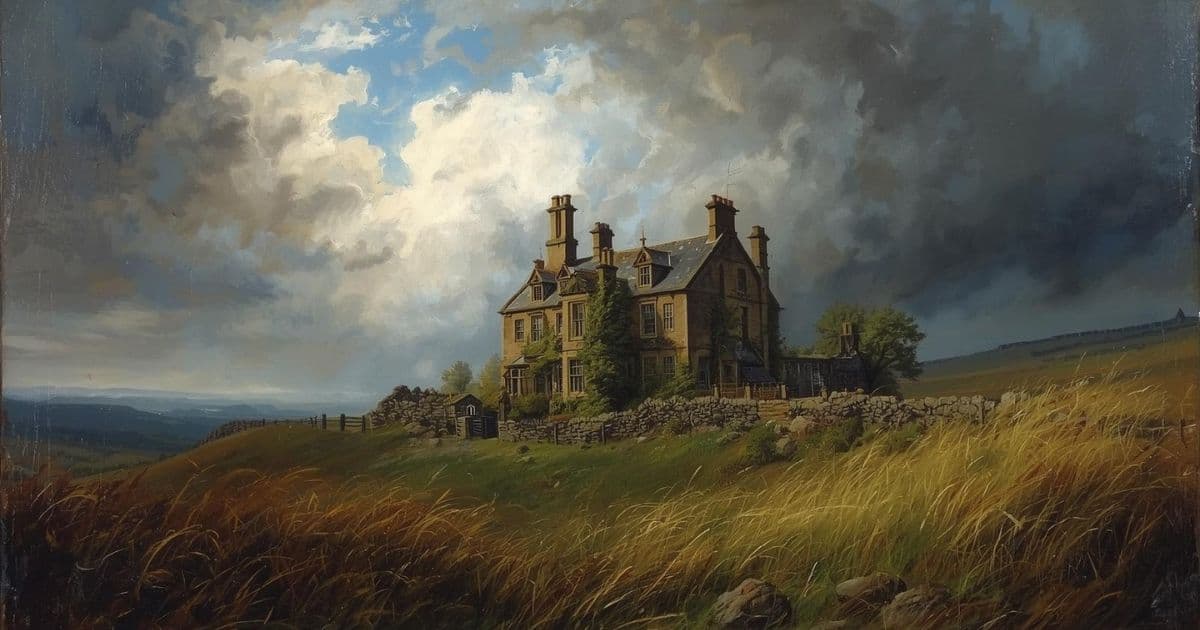
An excerpt from the original text.(complete · 1674 words)
aking up at earliest dawn, Levin tried to wake his companions.
Vassenka, lying on his stomach, with one leg in a stocking thrust out,
was sleeping so soundly that he could elicit no response. Oblonsky,
half asleep, declined to get up so early. Even Laska, who was asleep,
curled up in the hay, got up unwillingly, and lazily stretched out and
straightened her hind legs one after the other. Getting on his boots
and stockings, taking his gun, and carefully opening the creaking door
of the barn, Levin went out into the road. The coachmen were sleeping
in their carriages, the horses were dozing. Only one was lazily eating
oats, dipping its nose into the manger. It was still gray out-of-doors.
“Why are you up so early, my dear?” the old woman, their hostess, said,
coming out of the hut and addressing him affectionately as an old
friend.
“Going shooting, granny. Do I go this way to the marsh?”
“Straight out at the back; by our threshing floor, my dear, and hemp
patches; there’s a little footpath.” Stepping carefully with her
sunburnt, bare feet, the old woman conducted Levin, and moved back the
fence for him by the threshing floor.
“Straight on and you’ll come to the marsh. Our lads drove the cattle
there yesterday evening.”
Laska ran eagerly forward along the little path. Levin followed her
with a light, rapid step, continually looking at the sky. He hoped the
sun would not be up before he reached the marsh. But the sun did not
delay. The moon, which had been bright when he went out, by now shone
only like a crescent of quicksilver. The pink flush of dawn, which one
could not help seeing before, now had to be sought to be discerned at
all. What were before undefined, vague blurs in the distant countryside
could now be distinctly seen. They were sheaves of rye. The dew, not
visible till the sun was up, wetted Levin’s legs and his blouse above
his belt in the high growing, fragrant hemp patch, from which the
pollen had already fallen out. In the transparent stillness of morning
the smallest sounds were audible. A bee flew by Levin’s ear with the
whizzing sound of a bullet. He looked carefully, and saw a second and a
third. They were all flying from the beehives behind the hedge, and
they disappeared over the hemp patch in the direction of the marsh. The
path led straight to the marsh. The marsh could be recognized by the
mist which rose from it, thicker in one place and thinner in another,
so that the reeds and willow bushes swayed like islands in this mist.
At the edge of the marsh and the road, peasant boys and men, who had
been herding for the night, were lying, and in the dawn all were asleep
under their coats. Not far from them were three hobbled horses. One of
them clanked a chain. Laska walked beside her master, pressing a little
forward and looking round. Passing the sleeping peasants and reaching
the first reeds, Levin examined his pistols and let his dog off. One of
the horses, a sleek, dark-brown three-year-old, seeing the dog, started
away, switched its tail and snorted. The other horses too were
frightened, and splashing through the water with their hobbled legs,
and drawing their hoofs out of the thick mud with a squelching sound,
they bounded out of the marsh. Laska stopped, looking ironically at the
horses and inquiringly at Levin. Levin patted Laska, and whistled as a
sign that she might begin.
Laska ran joyfully and anxiously through the slush that swayed under
her.
Running into the marsh among the familiar scents of roots, marsh
plants, and slime, and the extraneous smell of horse dung, Laska
detected at once a smell that pervaded the whole marsh, the scent of
that strong-smelling bird that always excited her more than any other.
Here and there among the moss and marsh plants this scent was very
strong, but it was impossible to determine in which direction it grew
stronger or fainter. To find the direction, she had to go farther away
from the wind. Not feeling the motion of her legs, Laska bounded with a
stiff gallop, so that at each bound she could stop short, to the right,
away from the wind that blew from the east before sunrise, and turned
facing the wind. Sniffing in the air with dilated nostrils, she felt at
once that not their tracks only but they themselves were here before
her, and not one, but many. Laska slackened her speed. They were here,
but where precisely she could not yet determine. To find the very spot,
she began to make a circle, when suddenly her master’s voice drew her
off. “Laska! here?” he asked, pointing her to a different direction.
She stopped, asking him if she had better not go on doing as she had
begun. But he repeated his command in an angry voice, pointing to a
spot covered with water, where there could not be anything. She obeyed
him, pretending she was looking, so as to please him, went round it,
and went back to her former position, and was at once aware of the
scent again. Now when he was not hindering her, she knew what to do,
and without looking at what was under her feet, and to her vexation
stumbling over a high stump into the water, but righting herself with
her strong, supple legs, she began making the circle which was to make
all clear to her. The scent of them reached her, stronger and stronger,
and more and more defined, and all at once it became perfectly clear to
her that one of them was here, behind this tuft of reeds, five paces in
front of her; she stopped, and her whole body was still and rigid. On
her short legs she could see nothing in front of her, but by the scent
she knew it was sitting not more than five paces off. She stood still,
feeling more and more conscious of it, and enjoying it in anticipation.
Her tail was stretched straight and tense, and only wagging at the
extreme end. Her mouth was slightly open, her ears raised. One ear had
been turned wrong side out as she ran up, and she breathed heavily but
warily, and still more warily looked round, but more with her eyes than
her head, to her master. He was coming along with the face she knew so
well, though the eyes were always terrible to her. He stumbled over the
stump as he came, and moved, as she thought, extraordinarily slowly.
She thought he came slowly, but he was running.
Noticing Laska’s special attitude as she crouched on the ground, as it
were, scratching big prints with her hind paws, and with her mouth
slightly open, Levin knew she was pointing at grouse, and with an
inward prayer for luck, especially with the first bird, he ran up to
her. Coming quite close up to her, he could from his height look beyond
her, and he saw with his eyes what she was seeing with her nose. In a
space between two little thickets, at a couple of yards’ distance, he
could see a grouse. Turning its head, it was listening. Then lightly
preening and folding its wings, it disappeared round a corner with a
clumsy wag of its tail.
“Fetch it, fetch it!” shouted Levin, giving Laska a shove from behind.
“But I can’t go,” thought Laska. “Where am I to go? From here I feel
them, but if I move forward I shall know nothing of where they are or
who they are.” But then he shoved her with his knee, and in an excited
whisper said, “Fetch it, Laska.”
“Well, if that’s what he wishes, I’ll do it, but I can’t answer for
myself now,” she thought, and darted forward as fast as her legs would
carry her between the thick bushes. She scented nothing now; she could
only see and hear, without understanding anything.
Ten paces from her former place a grouse rose with a guttural cry and
the peculiar round sound of its wings. And immediately after the shot
it splashed heavily with its white breast on the wet mire. Another bird
did not linger, but rose behind Levin without the dog. When Levin
turned towards it, it was already some way off. But his shot caught it.
Flying twenty paces further, the second grouse rose upwards, and
whirling round like a ball, dropped heavily on a dry place.
“Come, this is going to be some good!” thought Levin, packing the warm
and fat grouse into his game bag. “Eh, Laska, will it be good?”
When Levin, after loading his gun, moved on, the sun had fully risen,
though unseen behind the storm-clouds. The moon had lost all of its
luster, and was like a white cloud in the sky. Not a single star could
be seen. The sedge, silvery with dew before, now shone like gold. The
stagnant pools were all like amber. The blue of the grass had changed
to yellow-green. The marsh birds twittered and swarmed about the brook
and upon the bushes that glittered with dew and cast long shadows. A
hawk woke up and settled on a haycock, turning its head from side to
side and looking discontentedly at the marsh. Crows were flying about
the field, and a bare-legged boy was driving the horses to an old man,
who had got up from under his long coat and was combing his hair. The
smoke from the gun was white as milk over the green of the grass.
One of the boys ran up to Levin.
“Uncle, there were ducks here yesterday!” he shouted to him, and he
walked a little way off behind him.
And Levin was doubly pleased, in sight of the boy, who expressed his
approval, at killing three snipe, one after another, straight off.
Master this chapter. Complete your experience
Purchase the complete book to access all chapters and support classic literature
As an Amazon Associate, we earn a small commission from qualifying purchases at no additional cost to you.
Available in paperback, hardcover, and e-book formats
Let's Analyse the Pattern
Overthinking our way past the wisdom we already carry, seeking external validation for truths our conscience already knows.
Why This Matters
Connect literature to life
This chapter teaches how to recognize when we're overthinking our way past truths we already know.
Practice This Today
This week, notice when you're endlessly researching decisions your gut has already made—then ask yourself what you knew before you started analyzing.
Now let's explore the literary elements.
Key Quotes & Analysis
"I have discovered nothing. I have simply recognized what I already knew."
Context: When he realizes his spiritual understanding was always within him
This shows that wisdom isn't about learning new information but recognizing truths we already carry inside. Levin's journey wasn't about finding answers but trusting what he already knew in his heart.
In Today's Words:
I didn't learn something new - I just finally listened to what I already knew deep down.
"I shall go on in the same way, losing my temper with Ivan the coachman, falling into angry discussions, expressing my opinions tactlessly; there will be still the same wall between the holy of holies of my soul and other people."
Context: When he realizes his revelation won't make him perfect
Levin understands that spiritual growth doesn't instantly fix personality flaws or make life easy. He'll still be human, still make mistakes, but now he has a foundation of meaning to build on.
In Today's Words:
I'm still going to lose my temper and say the wrong things sometimes, but now I know what really matters underneath it all.
"The meaning of my life and of all existence is not concealed from me, and is not far away, but is always accessible to me."
Context: During his moment of spiritual clarity
This represents the shift from seeking meaning in external sources to recognizing it's always been available through conscience and love. It's about accessibility rather than complexity.
In Today's Words:
The point of life isn't some big mystery I need to solve - it's right here in how I treat people every day.
Thematic Threads
Faith
In This Chapter
Levin discovers that meaning comes through trusting inner moral compass rather than intellectual proof
Development
Evolved from his earlier religious doubts and philosophical searching into acceptance of unknowing
In Your Life:
You might recognize this when you keep researching decisions you already know the answer to in your gut
Personal Growth
In This Chapter
Levin's final transformation from anxious seeker to peaceful acceptance of his moral foundation
Development
Culmination of his entire character arc from restless questioner to settled believer in simple goodness
In Your Life:
You see this in moments when you stop trying to fix yourself and start accepting who you fundamentally are
Class
In This Chapter
Wisdom comes from peasant Fyodor's simple truth rather than educated philosophical debates
Development
Reinforces ongoing theme that authentic wisdom often comes from working people, not intellectuals
In Your Life:
You might notice this when the most helpful advice comes from unexpected sources rather than experts
Identity
In This Chapter
Levin stops trying to construct an identity through beliefs and accepts his natural inclination toward love
Development
Resolution of his identity crisis through embracing rather than analyzing his core nature
In Your Life:
You experience this when you stop trying to become someone else and start being more fully yourself
Human Relationships
In This Chapter
His revelation centers on love for family and care for others as the foundation of meaningful life
Development
Brings full circle his struggles with marriage, fatherhood, and community connection
In Your Life:
You see this when relationships become easier once you focus on loving rather than being loved
You now have the context. Time to form your own thoughts.
Discussion Questions
- 1
What specific realization does Levin have in his study, and how does it differ from all his previous searching?
analysis • surface - 2
Why does Levin's breakthrough come from a peasant's simple words rather than from all the philosophy books he's read?
analysis • medium - 3
When have you seen someone (maybe yourself) overthink their way past something they already knew in their gut was right?
application • medium - 4
How do you tell the difference between genuine inner knowing and just wanting something to be true?
application • deep - 5
What does Levin's journey suggest about the relationship between intellectual understanding and living a meaningful life?
reflection • deep
Critical Thinking Exercise
Map Your Inner Knowing
Think of a current situation where you keep researching, asking for advice, or analyzing, but still feel uncertain. Write down what your gut instinct tells you about this situation before your brain jumps in with 'but what if' scenarios. Then list three times you trusted your inner knowing and it led you in the right direction.
Consider:
- •Notice the difference between fear-based hesitation and genuine uncertainty
- •Consider whether you're seeking more information or seeking permission to act on what you already know
- •Pay attention to how your body feels when you think about each possible choice
Journaling Prompt
Write about a time when you ignored your inner knowing because you couldn't logically explain it, and what happened as a result. What would you do differently now?
Coming Up Next...
Chapter 170
As Levin emerges from his study with this new understanding, he must face the practical reality of living according to his revelation. The question becomes whether this spiritual awakening will truly change how he navigates his daily life and relationships.