
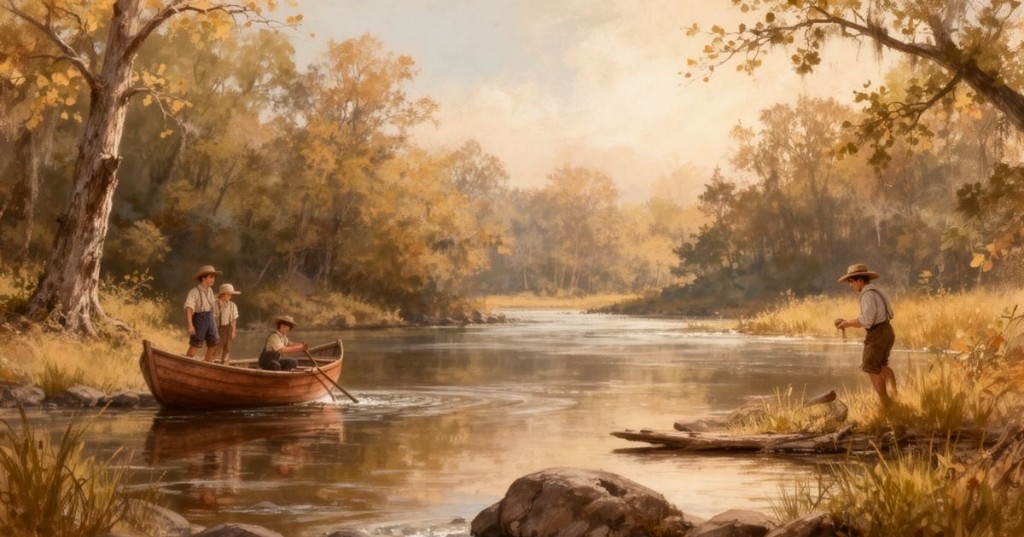
An excerpt from the original text.(complete · 2675 words)
pened my eyes and looked around, trying to make out where I was. It
was after sun-up, and I had been sound asleep. Pap was standing over me
looking sour and sick, too. He says:
“What you doin’ with this gun?”
I judged he didn’t know nothing about what he had been doing, so I
says:
“Somebody tried to get in, so I was laying for him.”
“Why didn’t you roust me out?”
“Well, I tried to, but I couldn’t; I couldn’t budge you.”
“Well, all right. Don’t stand there palavering all day, but out with
you and see if there’s a fish on the lines for breakfast. I’ll be along
in a minute.”
He unlocked the door, and I cleared out up the river-bank. I noticed
some pieces of limbs and such things floating down, and a sprinkling of
bark; so I knowed the river had begun to rise. I reckoned I would have
great times now if I was over at the town. The June rise used to be
always luck for me; because as soon as that rise begins here comes
cordwood floating down, and pieces of log rafts—sometimes a dozen logs
together; so all you have to do is to catch them and sell them to the
wood-yards and the sawmill.
I went along up the bank with one eye out for pap and t’other one out
for what the rise might fetch along. Well, all at once here comes a
canoe; just a beauty, too, about thirteen or fourteen foot long, riding
high like a duck. I shot head-first off of the bank like a frog,
clothes and all on, and struck out for the canoe. I just expected
there’d be somebody laying down in it, because people often done that
to fool folks, and when a chap had pulled a skiff out most to it they’d
raise up and laugh at him. But it warn’t so this time. It was a
drift-canoe sure enough, and I clumb in and paddled her ashore. Thinks
I, the old man will be glad when he sees this—she’s worth ten dollars.
But when I got to shore pap wasn’t in sight yet, and as I was running
her into a little creek like a gully, all hung over with vines and
willows, I struck another idea: I judged I’d hide her good, and then,
’stead of taking to the woods when I run off, I’d go down the river
about fifty mile and camp in one place for good, and not have such a
rough time tramping on foot.
It was pretty close to the shanty, and I thought I heard the old man
coming all the time; but I got her hid; and then I out and looked
around a bunch of willows, and there was the old man down the path a
piece just drawing a bead on a bird with his gun. So he hadn’t seen
anything.
When he got along I was hard at it taking up a “trot” line. He abused
me a little for being so slow; but I told him I fell in the river, and
that was what made me so long. I knowed he would see I was wet, and
then he would be asking questions. We got five catfish off the lines
and went home.
While we laid off after breakfast to sleep up, both of us being about
wore out, I got to thinking that if I could fix up some way to keep pap
and the widow from trying to follow me, it would be a certainer thing
than trusting to luck to get far enough off before they missed me; you
see, all kinds of things might happen. Well, I didn’t see no way for a
while, but by-and-by pap raised up a minute to drink another barrel of
water, and he says:
“Another time a man comes a-prowling round here you roust me out, you
hear? That man warn’t here for no good. I’d a shot him. Next time you
roust me out, you hear?”
Then he dropped down and went to sleep again; but what he had been
saying give me the very idea I wanted. I says to myself, I can fix it
now so nobody won’t think of following me.
About twelve o’clock we turned out and went along up the bank. The
river was coming up pretty fast, and lots of driftwood going by on the
rise. By-and-by along comes part of a log raft—nine logs fast together.
We went out with the skiff and towed it ashore. Then we had dinner.
Anybody but pap would a waited and seen the day through, so as to catch
more stuff; but that warn’t pap’s style. Nine logs was enough for one
time; he must shove right over to town and sell. So he locked me in and
took the skiff, and started off towing the raft about half-past three.
I judged he wouldn’t come back that night. I waited till I reckoned he
had got a good start; then I out with my saw, and went to work on that
log again. Before he was t’other side of the river I was out of the
hole; him and his raft was just a speck on the water away off yonder.
I took the sack of corn meal and took it to where the canoe was hid,
and shoved the vines and branches apart and put it in; then I done the
same with the side of bacon; then the whisky-jug. I took all the coffee
and sugar there was, and all the ammunition; I took the wadding; I took
the bucket and gourd; I took a dipper and a tin cup, and my old saw and
two blankets, and the skillet and the coffee-pot. I took fish-lines and
matches and other things—everything that was worth a cent. I cleaned
out the place. I wanted an axe, but there wasn’t any, only the one out
at the woodpile, and I knowed why I was going to leave that. I fetched
out the gun, and now I was done.
I had wore the ground a good deal crawling out of the hole and dragging
out so many things. So I fixed that as good as I could from the outside
by scattering dust on the place, which covered up the smoothness and
the sawdust. Then I fixed the piece of log back into its place, and put
two rocks under it and one against it to hold it there, for it was bent
up at that place and didn’t quite touch ground. If you stood four or
five foot away and didn’t know it was sawed, you wouldn’t never notice
it; and besides, this was the back of the cabin, and it warn’t likely
anybody would go fooling around there.
It was all grass clear to the canoe, so I hadn’t left a track. I
followed around to see. I stood on the bank and looked out over the
river. All safe. So I took the gun and went up a piece into the woods,
and was hunting around for some birds when I see a wild pig; hogs soon
went wild in them bottoms after they had got away from the prairie
farms. I shot this fellow and took him into camp.
I took the axe and smashed in the door. I beat it and hacked it
considerable a-doing it. I fetched the pig in, and took him back nearly
to the table and hacked into his throat with the axe, and laid him down
on the ground to bleed; I say ground because it was ground—hard
packed, and no boards. Well, next I took an old sack and put a lot of
big rocks in it—all I could drag—and I started it from the pig, and
dragged it to the door and through the woods down to the river and
dumped it in, and down it sunk, out of sight. You could easy see that
something had been dragged over the ground. I did wish Tom Sawyer was
there; I knowed he would take an interest in this kind of business, and
throw in the fancy touches. Nobody could spread himself like Tom Sawyer
in such a thing as that.
Well, last I pulled out some of my hair, and blooded the axe good, and
stuck it on the back side, and slung the axe in the corner. Then I took
up the pig and held him to my breast with my jacket (so he couldn’t
drip) till I got a good piece below the house and then dumped him into
the river. Now I thought of something else. So I went and got the bag
of meal and my old saw out of the canoe, and fetched them to the house.
I took the bag to where it used to stand, and ripped a hole in the
bottom of it with the saw, for there warn’t no knives and forks on the
place—pap done everything with his clasp-knife about the cooking. Then
I carried the sack about a hundred yards across the grass and through
the willows east of the house, to a shallow lake that was five mile
wide and full of rushes—and ducks too, you might say, in the season.
There was a slough or a creek leading out of it on the other side that
went miles away, I don’t know where, but it didn’t go to the river. The
meal sifted out and made a little track all the way to the lake. I
dropped pap’s whetstone there too, so as to look like it had been done
by accident. Then I tied up the rip in the meal sack with a string, so
it wouldn’t leak no more, and took it and my saw to the canoe again.
It was about dark now; so I dropped the canoe down the river under some
willows that hung over the bank, and waited for the moon to rise. I
made fast to a willow; then I took a bite to eat, and by-and-by laid
down in the canoe to smoke a pipe and lay out a plan. I says to myself,
they’ll follow the track of that sackful of rocks to the shore and then
drag the river for me. And they’ll follow that meal track to the lake
and go browsing down the creek that leads out of it to find the robbers
that killed me and took the things. They won’t ever hunt the river for
anything but my dead carcass. They’ll soon get tired of that, and won’t
bother no more about me. All right; I can stop anywhere I want to.
Jackson’s Island is good enough for me; I know that island pretty well,
and nobody ever comes there. And then I can paddle over to town nights,
and slink around and pick up things I want. Jackson’s Island’s the
place.
I was pretty tired, and the first thing I knowed I was asleep. When I
woke up I didn’t know where I was for a minute. I set up and looked
around, a little scared. Then I remembered. The river looked miles and
miles across. The moon was so bright I could a counted the drift logs
that went a-slipping along, black and still, hundreds of yards out from
shore. Everything was dead quiet, and it looked late, and smelt late.
You know what I mean—I don’t know the words to put it in.
I took a good gap and a stretch, and was just going to unhitch and
start when I heard a sound away over the water. I listened. Pretty soon
I made it out. It was that dull kind of a regular sound that comes from
oars working in rowlocks when it’s a still night. I peeped out through
the willow branches, and there it was—a skiff, away across the water. I
couldn’t tell how many was in it. It kept a-coming, and when it was
abreast of me I see there warn’t but one man in it. Think’s I, maybe
it’s pap, though I warn’t expecting him. He dropped below me with the
current, and by-and-by he came a-swinging up shore in the easy water,
and he went by so close I could a reached out the gun and touched him.
Well, it was pap, sure enough—and sober, too, by the way he laid his
oars.
I didn’t lose no time. The next minute I was a-spinning down stream
soft but quick in the shade of the bank. I made two mile and a half,
and then struck out a quarter of a mile or more towards the middle of
the river, because pretty soon I would be passing the ferry landing,
and people might see me and hail me. I got out amongst the driftwood,
and then laid down in the bottom of the canoe and let her float.
I laid there, and had a good rest and a smoke out of my pipe, looking
away into the sky; not a cloud in it. The sky looks ever so deep when
you lay down on your back in the moonshine; I never knowed it before.
And how far a body can hear on the water such nights! I heard people
talking at the ferry landing. I heard what they said, too—every word of
it. One man said it was getting towards the long days and the short
nights now. T’other one said this warn’t one of the short ones, he
reckoned—and then they laughed, and he said it over again, and they
laughed again; then they waked up another fellow and told him, and
laughed, but he didn’t laugh; he ripped out something brisk, and said
let him alone. The first fellow said he ’lowed to tell it to his old
woman—she would think it was pretty good; but he said that warn’t
nothing to some things he had said in his time. I heard one man say it
was nearly three o’clock, and he hoped daylight wouldn’t wait more than
about a week longer. After that the talk got further and further away,
and I couldn’t make out the words any more; but I could hear the
mumble, and now and then a laugh, too, but it seemed a long ways off.
I was away below the ferry now. I rose up, and there was Jackson’s
Island, about two mile and a half down stream, heavy timbered and
standing up out of the middle of the river, big and dark and solid,
like a steamboat without any lights. There warn’t any signs of the bar
at the head—it was all under water now.
It didn’t take me long to get there. I shot past the head at a ripping
rate, the current was so swift, and then I got into the dead water and
landed on the side towards the Illinois shore. I run the canoe into a
deep dent in the bank that I knowed about; I had to part the willow
branches to get in; and when I made fast nobody could a seen the canoe
from the outside.
I went up and set down on a log at the head of the island, and looked
out on the big river and the black driftwood and away over to the town,
three mile away, where there was three or four lights twinkling. A
monstrous big lumber-raft was about a mile up stream, coming along
down, with a lantern in the middle of it. I watched it come creeping
down, and when it was most abreast of where I stood I heard a man say,
“Stern oars, there! heave her head to stabboard!” I heard that just as
plain as if the man was by my side.
There was a little gray in the sky now; so I stepped into the woods,
and laid down for a nap before breakfast.
Master this chapter. Complete your experience
Purchase the complete book to access all chapters and support classic literature
As an Amazon Associate, we earn a small commission from qualifying purchases at no additional cost to you.
Available in paperback, hardcover, and e-book formats
Let's Analyse the Pattern
When someone controls you completely, the only escape is to become unreachable by making them believe you're no longer available to control.
Why This Matters
Connect literature to life
This chapter teaches how to identify when someone is using official systems (legal, medical, educational, workplace) as weapons to control you rather than for their stated purpose.
Practice This Today
This week, notice when someone threatens to 'report' you to an authority figure—ask yourself if they're solving a real problem or trying to control your behavior through fear.
Now let's explore the literary elements.
Key Quotes & Analysis
"I took the bag of corn meal and took it to where the canoe was hid, and shoved the vines and branches apart and put it in; then I done the same with the side of bacon; then the whisky-jug."
Context: Huck is methodically loading supplies into his hidden canoe before escaping
Shows Huck isn't just running away impulsively - he's planning for survival. The careful preparation reveals his intelligence and determination to succeed in his escape.
In Today's Words:
I loaded up my getaway car with everything I'd need to survive on my own.
"I did wish Tom Sawyer was there; I knowed he would take an interest in this kind of business, and throw in the fancy touches."
Context: While staging the fake murder scene
Even in this serious moment, Huck thinks about how Tom would make it more elaborate. Shows the difference between Tom's love of adventure for fun and Huck's real-life survival needs.
In Today's Words:
I wished my friend was here - he'd love this dramatic stuff and probably have even better ideas.
"Jackson's Island is good enough for me; I know that island pretty well, and nobody ever comes there."
Context: Huck choosing his destination for hiding
Reveals Huck has thought this through - he's not just running randomly but going somewhere he knows he'll be safe. Shows his practical intelligence.
In Today's Words:
That place is perfect for hiding out - I know it well and no one ever goes there.
Thematic Threads
Control
In This Chapter
Huck realizes Pap will never voluntarily release control, so he must break free through deception
Development
Evolved from passive resistance to active liberation strategy
In Your Life:
You might recognize this when someone uses guilt, threats, or manipulation to keep you from making your own choices.
Intelligence
In This Chapter
Huck's elaborate staging shows strategic thinking—he's not just reacting emotionally but planning systematically
Development
Building from earlier survival instincts to sophisticated problem-solving
In Your Life:
You demonstrate this when you think several steps ahead instead of just responding to immediate pressure.
Identity
In This Chapter
By 'killing' his old self, Huck creates space to discover who he really is away from others' expectations
Development
Moving from defined by others (Pap's son, Widow's project) toward self-determination
In Your Life:
You might feel this when you realize you've been living someone else's version of your life instead of your own.
Freedom
In This Chapter
True freedom requires cutting all ties that bind—Huck can't be partially free from Pap
Development
Introduced here as complete liberation rather than temporary escape
In Your Life:
You experience this when half-measures keep failing and you realize you need a clean break.
Resourcefulness
In This Chapter
Huck uses limited materials and time to create a convincing crime scene that will fool adults
Development
Building on earlier survival skills but now applied to long-term planning
In Your Life:
You show this when you make the most of what you have available rather than waiting for perfect conditions.
You now have the context. Time to form your own thoughts.
Discussion Questions
- 1
What specific steps did Huck take to make his fake death believable, and why was each detail important?
analysis • surface - 2
Why did Huck choose to fake his death instead of just running away or asking adults for help?
analysis • medium - 3
Where do you see people today using 'strategic invisibility' - becoming unreachable to escape someone's control?
application • medium - 4
If you were advising someone trapped in a controlling situation, how would you help them recognize when explanation won't work and planning must happen in secret?
application • deep - 5
What does Huck's willingness to let everyone think he's dead reveal about how trapped he felt, and what does this teach us about recognizing when someone is truly desperate?
reflection • deep
Critical Thinking Exercise
Map the Power Dynamic
Draw a simple diagram showing who had power over Huck and how. Then identify someone in your life (past or present) who held similar control over you. Map out what your 'strategic invisibility' plan might look like - what would you need to do quietly before making your move?
Consider:
- •Consider both obvious power (money, authority) and hidden power (guilt, manipulation)
- •Think about what this person would do if they knew you were planning to leave their control
- •Identify what resources or support you'd need to build before making your move visible
Journaling Prompt
Write about a time when you tried to negotiate with someone who fundamentally didn't respect your right to choose. What happened, and what would you do differently now?
Coming Up Next...
Chapter 8
On Jackson's Island, Huck discovers he's not as alone as he thought. Someone else is hiding on the island, and their unexpected reunion will change everything about Huck's plans for his new life of freedom.



