
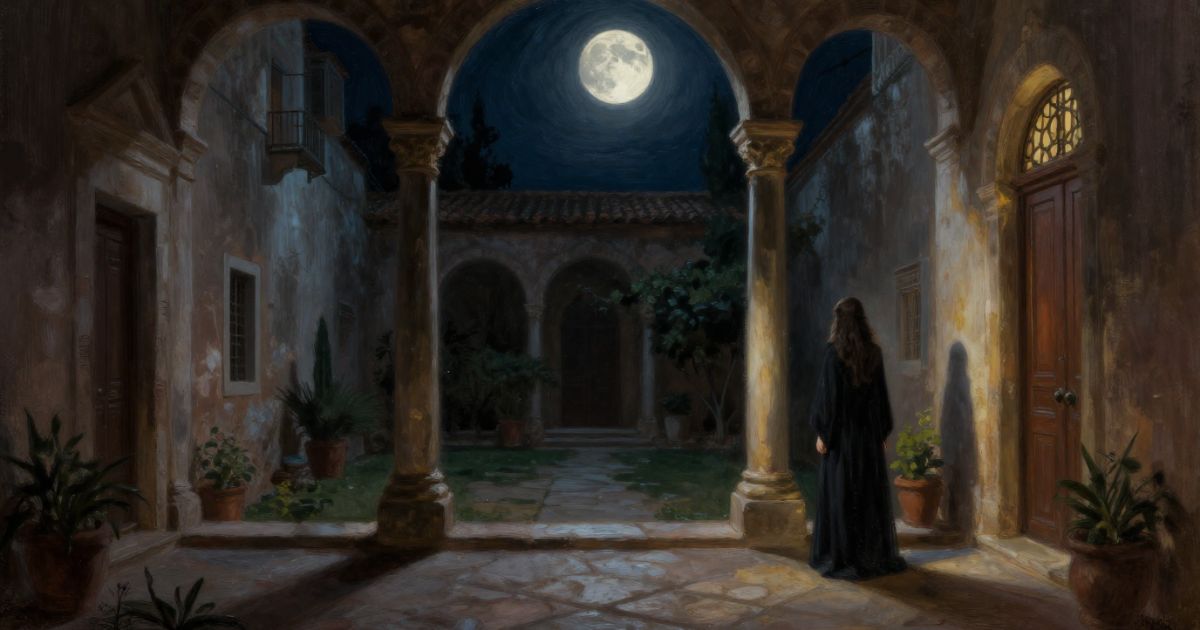
An excerpt from the original text.(complete · 2820 words)
eanwhile Julia, sheltered in the obscure recesses of St Augustin,
endeavoured to attain a degree of that tranquillity which so
strikingly characterized the scenes around her. The abbey of St
Augustin was a large magnificent mass of Gothic architecture, whose
gloomy battlements, and majestic towers arose in proud sublimity from
amid the darkness of the surrounding shades. It was founded in the
twelfth century, and stood a proud monument of monkish superstition
and princely magnificence. In the times when Italy was agitated by
internal commotions, and persecuted by foreign invaders, this edifice
afforded an asylum to many noble Italian emigrants, who here
consecrated the rest of their days to religion. At their death they
enriched the monastery with the treasures which it had enabled them to
secure.
The view of this building revived in the mind of the beholder the
memory of past ages. The manners and characters which distinguished
them arose to his fancy, and through the long lapse of years he
discriminated those customs and manners which formed so striking a
contrast to the modes of his own times. The rude manners, the
boisterous passions, the daring ambition, and the gross indulgences
which formerly characterized the priest, the nobleman, and the
sovereign, had now begun to yield to learning--the charms of refined
conversation--political intrigue and private artifices. Thus do the
scenes of life vary with the predominant passions of mankind, and with
the progress of civilization. The dark clouds of prejudice break away
before the sun of science, and gradually dissolving, leave the
brightening hemisphere to the influence of his beams. But through the
present scene appeared only a few scattered rays, which served to shew
more forcibly the vast and heavy masses that concealed the form of
truth. Here prejudice, not reason, suspended the influence of the
passions; and scholastic learning, mysterious philosophy, and crafty
sanctity supplied the place of wisdom, simplicity, and pure devotion.
At the abbey, solitude and stillness conspired with the solemn aspect
of the pile to impress the mind with religious awe. The dim glass of
the high-arched windows, stained with the colouring of monkish
fictions, and shaded by the thick trees that environed the edifice,
spread around a sacred gloom, which inspired the beholder with
congenial feelings.
As Julia mused through the walks, and surveyed this vast monument of
barbarous superstition, it brought to her recollection an ode which
she often repeated with melancholy pleasure, as the composition of
Hippolitus.
SUPERSTITION
AN ODE
High mid Alverna's awful steeps,
Eternal shades, and silence dwell.
Save, when the gale resounding sweeps,
Sad strains are faintly heard to swell:
Enthron'd amid the wild impending rocks,
Involved in clouds, and brooding future woe,
The demon Superstition Nature shocks,
And waves her sceptre o'er the world below.
Around her throne, amid the mingling glooms,
Wild--hideous forms are slowly seen to glide,
She bids them fly to shade earth's brightest blooms,
And spread the blast of Desolation wide.
See! in the darkened air their fiery course!
The sweeping ruin settles o'er the land,
Terror leads on their steps with madd'ning force,
And Death and Vengeance close the ghastly band!
Mark the purple streams that flow!
Mark the deep empassioned woe!
Frantic Fury's dying groan!
Virtue's sigh, and Sorrow's moan!
Wide--wide the phantoms swell the loaded air
With shrieks of anguish--madness and despair!
Cease your ruin! spectres dire!
Cease your wild terrific sway!
Turn your steps--and check your ire,
Yield to peace the mourning day!
She wept to the memory of times past, and there was a romantic sadness
in her feelings, luxurious and indefinable. Madame behaved to Julia
with the tenderest attention, and endeavoured to withdraw her thoughts
from their mournful subject by promoting that taste for literature and
music, which was so suitable to the powers of her mind.
But an object seriously interesting now obtained that regard, which
those of mere amusement failed to attract. Her favorite nun, for whom
her love and esteem daily increased, seemed declining under the
pressure of a secret grief. Julia was deeply affected with her
situation, and though she was not empowered to administer consolation
to her sorrows, she endeavoured to mitigate the sufferings of illness.
She nursed her with unremitting care, and seemed to seize with avidity
the temporary opportunity of escaping from herself. The nun appeared
perfectly reconciled to her fate, and exhibited during her illness so
much sweetness, patience, and resignation as affected all around her
with pity and love. Her angelic mildness, and steady fortitude
characterized the beatification of a saint, rather than the death of a
mortal. Julia watched every turn of her disorder with the utmost
solicitude, and her care was at length rewarded by the amendment of
Cornelia. Her health gradually improved, and she attributed this
circumstance to the assiduity and tenderness of her young friend, to
whom her heart now expanded in warm and unreserved affection. At
length Julia ventured to solicit what she had so long and so earnestly
wished for, and Cornelia unfolded the history of her sorrows.
'Of the life which your care has prolonged,' said she, 'it is but just
that you should know the events; though those events are neither new,
or striking, and possess little power of interesting persons
unconnected with them. To me they have, however, been unexpectedly
dreadful in effect, and my heart assures me, that to you they will not
be indifferent.
'I am the unfortunate descendant of an ancient and illustrious Italian
family. In early childhood I was deprived of a mother's care, but the
tenderness of my surviving parent made her loss, as to my welfare,
almost unfelt. Suffer me here to do justice to the character of my
noble father. He united in an eminent degree the mild virtues of
social life, with the firm unbending qualities of the noble Romans,
his ancestors, from whom he was proud to trace his descent. Their
merit, indeed, continually dwelt on his tongue, and their actions he
was always endeavouring to imitate, as far as was consistent with the
character of his times, and with the limited sphere in which he moved.
The recollection of his virtue elevates my mind, and fills my heart
with a noble pride, which even the cold walls of a monastery have not
been able to subdue.
'My father's fortune was unsuitable to his rank. That his son might
hereafter be enabled to support the dignity of his family, it was
necessary for me to assume the veil. Alas! that heart was unfit to be
offered at an heavenly shrine, which was already devoted to an earthly
object. My affections had long been engaged by the younger son of a
neighbouring nobleman, whose character and accomplishments attracted
my early love, and confirmed my latest esteem. Our families were
intimate, and our youthful intercourse occasioned an attachment which
strengthened and expanded with our years. He solicited me of my
father, but there appeared an insuperable barrier to our union. The
family of my lover laboured under a circumstance of similar distress
with that of my own--it was noble--but poor! My father, who was
ignorant of the strength of my affection, and who considered a
marriage formed in poverty as destructive to happiness, prohibited his
suit.
'Touched with chagrin and disappointment, he immediately entered into
the service of his Neapolitan majesty, and sought in the tumultuous
scenes of glory, a refuge from the pangs of disappointed passion.
'To me, whose hours moved in one round of full uniformity--who had no
pursuit to interest--no variety to animate my drooping spirits--to me
the effort of forgetfulness was ineffectual. The loved idea of Angelo
still rose upon my fancy, and its powers of captivation, heightened by
absence, and, perhaps even by despair, pursued me with incessant
grief. I concealed in silence the anguish that preyed upon my heart,
and resigned myself a willing victim to monastic austerity. But I was
now threatened with a new evil, terrible and unexpected. I was so
unfortunate as to attract the admiration of the Marquis Marinelli, and
he applied to my father. He was illustrious at once in birth and
fortune, and his visits could only be unwelcome to me. Dreadful was
the moment in which my father disclosed to me the proposal. My
distress, which I vainly endeavoured to command, discovered the exact
situation of my heart, and my father was affected.
'After along and awful pause, he generously released me from my
sufferings by leaving it to my choice to accept the marquis, or to
assume the veil. I fell at his feet, overcome by the noble
disinterestedness of his conduct, and instantly accepted the latter.
'This affair removed entirely the disguise with which I had hitherto
guarded my heart;--my brother--my generous brother! learned the true
state of its affections. He saw the grief which prayed upon my health;
he observed it to my father, and he nobly--oh how nobly! to restore my
happiness, desired to resign apart of the estate which had already
descended to him in right of his mother. Alas! Hippolitus,' continued
Cornelia, deeply sighing, 'thy virtues deserved a better fate.'
'Hippolitus!' said Julia, in a tremulous accent, 'Hippolitus, Count de
Vereza!'--'The same,' replied the nun, in a tone of surprize. Julia
was speechless; tears, however, came to her relief. The astonishment
of Cornelia for some moment surpassed expression; at length a gleam of
recollection crossed her mind, and she too well understood the scene
before her. Julia, after some time revived, when Cornelia tenderly
approaching her, 'Do I then embrace my sister!' said she. 'United in
sentiment, are we also united in misfortune?' Julia answered with her
sighs, and their tears flowed in mournful sympathy together. At length
Cornelia resumed her narrative.
'My father, struck with the conduct of Hippolitus, paused upon the
offer. The alteration in my health was too obvious to escape his
notice; the conflict between pride and parental tenderness, held him
for some time in indecision, but the latter finally subdued every
opposing feeling, and he yielded his consent to my marriage with
Angelo. The sudden transition from grief to joy was almost too much
for my feeble frame; judge then what must have been the effect of the
dreadful reverse, when the news arrived that Angelo had fallen in a
foreign engagement! Let me obliterate, if possible, the impression of
sensations so dreadful. The sufferings of my brother, whose generous
heart could so finely feel for another's woe, were on this occasion
inferior only to my own.
'After the first excess of my grief was subsided, I desired to retire
from a world which had tempted me only with illusive visions of
happiness, and to remove from those scenes which prompted
recollection, and perpetuated my distress. My father applauded my
resolution, and I immediately was admited a noviciate into this
monastery, with the Superior of which my father had in his youth been
acquainted.
'At the expiration of the year I received the veil. Oh! I well
remember with what perfect resignation, with what comfortable
complacency I took those vows which bound me to a life of retirement,
and religious rest.
'The high importance of the moment, the solemnity of the ceremony, the
sacred glooms which surrounded me, and the chilling silence that
prevailed when I uttered the irrevocable vow--all conspired to impress
my imagination, and to raise my views to heaven. When I knelt at the
altar, the sacred flame of pure devotion glowed in my heart, and
elevated my soul to sublimity. The world and all its recollections
faded from my mind, and left it to the influence of a serene and, holy
enthusiasm which no words can describe.
'Soon after my noviciation, I had the misfortune to lose my dear
father. In the tranquillity of this monastery, however, in the
soothing kindness of my companions, and in devotional exercises, my
sorrows found relief, and the sting of grief was blunted. My repose
was of short continuance. A circumstance occurred that renewed the
misery, which, can now never quit me but in the grave, to which I look
with no fearful apprehension, but as a refuge from calamity, trusting
that the power who has seen good to afflict me, will pardon the
imperfectness of my devotion, and the too frequent wandering of my
thoughts to the object once so dear to me.'
As she spoke she raised her eyes, which beamed with truth and meek
assurance to heaven; and the fine devotional suffusion of her
countenance seemed to characterize the beauty of an inspired saint.
'One day, Oh! never shall I forget it, I went as usual to the
confessional to acknowledge my sins. I knelt before the father with
eyes bent towards the earth, and in a low voice proceeded to confess.
I had but one crime to deplore, and that was the too tender
remembrance of him for whom I mourned, and whose idea, impressed upon
my heart, made it a blemished offering to God.
'I was interrupted in my confession by a sound of deep sobs, and
rising my eyes, Oh God, what were my sensations, when in the features
of the holy father I discovered Angelo! His image faded like a vision
from my sight, and I sunk at his feet. On recovering I found myself on
my matrass, attended by a sister, who I discovered by her conversation
had no suspicion of the occasion of my disorder. Indisposition
confined me to my bed for several days; when I recovered, I saw Angelo
no more, and could almost have doubted my senses, and believed that an
illusion had crossed my sight, till one day I found in my cell a
written paper. I distinguished at the first glance the handwriting of
Angelo, that well-known hand which had so often awakened me to other
emotions. I trembled at the sight; my beating heart acknowledged the
beloved characters; a cold tremor shook my frame, and half breathless
I seized the paper. But recollecting myself, I paused--I hesitated:
duty at length yielded to the strong temptation, and I read the lines!
Oh! those lines prompted by despair, and bathed in my tears! every
word they offered gave a new pang to my heart, and swelled its anguish
almost beyond endurance. I learned that Angelo, severely wounded in a
foreign engagement, had been left for dead upon the field; that his
life was saved by the humanity of a common soldier of the enemy, who
perceiving signs of existence, conveyed him to a house. Assistance was
soon procured, but his wounds exhibited the most alarming symptoms.
During several months he languished between life and death, till at
length his youth and constitution surmounted the conflict, and he
returned to Naples. Here he saw my brother, whose distress and
astonishment at beholding him occasioned a relation of past
circumstances, and of the vows I had taken in consequence of the
report of his death. It is unnecessary to mention the immediate effect
of this narration; the final one exhibited a very singular proof of
his attachment and despair;--he devoted himself to a monastic life,
and chose this abbey for the place of his residence, because it
contained the object most dear to his affections. His letter informed
me that he had purposely avoided discovering himself, endeavouring to
be contented with the opportunities which occurred of silently
observing me, till chance had occasioned the foregoing interview.--But
that since its effects had been so mutually painful, he would relieve
me from the apprehension of a similar distress, by assuring me, that I
should see him no more. He was faithful to his promise; from that day
I have never seen him, and am even ignorant whether he yet inhabits
this asylum; the efforts of religious fortitude, and the just fear of
exciting curiosity, having withheld me from enquiry. But the moment of
our last interview has been equally fatal to my peace and to my
health, and I trust I shall, ere very long, be released from the
agonizing ineffectual struggles occasioned by the consciousness of
sacred vows imperfectly performed, and by earthly affections not
wholly subdued.'
Cornelia ceased, and Julia, who had listened to the narrative in deep
attention, at once admired, loved, and pitied her. As the sister of
Hippolitus, her heart expanded towards her, and it was now inviolably
attached by the fine ties of sympathetic sorrow. Similarity of
sentiment and suffering united them in the firmest bonds of
friendship; and thus, from reciprocation of thought and feeling,
flowed a pure and sweet consolation.
Julia loved to indulge in the mournful pleasure of conversing of
Hippolitus, and when thus engaged, the hours crept unheeded by. A
thousand questions she repeated concerning him, but to those most
interesting to her, she received no consolatory answer. Cornelia, who
had heard of the fatal transaction at the castle of Mazzini, deplored
with her its too certain consequence.
Master this chapter. Complete your experience
Purchase the complete book to access all chapters and support classic literature
As an Amazon Associate, we earn a small commission from qualifying purchases at no additional cost to you.
Available in paperback, hardcover, and e-book formats
Let's Analyse the Pattern
Pain becomes manageable when we channel our struggle into helping others face similar challenges.
Why This Matters
Connect literature to life
This chapter teaches how caring for others strategically breaks cycles of self-focused anxiety and depression.
Practice This Today
This week, notice when you're stuck in mental loops about your problems, then find one concrete way to help someone else - the shift in focus will provide immediate psychological relief.
Now let's explore the literary elements.
Key Quotes & Analysis
"The abbey of St Augustin was a large magnificent mass of Gothic architecture, whose gloomy battlements, and majestic towers arose in proud sublimity from amid the darkness of the surrounding shades."
Context: Describing the monastery where Julia seeks refuge
This description establishes the abbey as both protective and imposing - it offers shelter but also represents the weight of religious authority. The contrast between 'proud sublimity' and 'darkness' suggests safety comes with a price.
In Today's Words:
The monastery was this massive, impressive building that made you feel both safe and small at the same time, rising up out of the shadows like a fortress.
"Thus do the scenes of life vary with the predominant passions of mankind, and with the progress of civilization."
Context: Reflecting on how human nature and society change over time
This philosophical observation suggests that while the forms of human drama evolve, the underlying passions remain constant. It's both hopeful about progress and realistic about human nature.
In Today's Words:
People's problems change with the times, but the basic emotions and desires driving them stay pretty much the same.
"I am the sister of Hippolitus."
Context: Revealing her identity to Julia after recovering from illness
This simple revelation transforms both women's understanding of their connection. It shows how caring for someone can lead to discovering unexpected bonds that change everything.
In Today's Words:
I'm Hippolitus's sister - the guy you're in love with is my brother.
Thematic Threads
Sanctuary
In This Chapter
The monastery provides both physical refuge and spiritual healing through community service
Development
Introduced here as alternative to isolation
In Your Life:
You might find unexpected peace in volunteer work when your own life feels chaotic.
Connection
In This Chapter
Julia and Cornelia's instant bond forms through shared experience of lost love and family tragedy
Development
Evolution from Julia's earlier isolation toward meaningful relationships
In Your Life:
Your deepest friendships often form with people who've survived similar struggles.
Class
In This Chapter
Both women, despite noble birth, find themselves powerless against family expectations and social constraints
Development
Continues theme of nobility offering no real protection from suffering
In Your Life:
Your background or education doesn't shield you from life's fundamental challenges.
Identity
In This Chapter
Julia discovers her capacity for healing and nurturing through caring for Cornelia
Development
Shift from victim identity toward active helper role
In Your Life:
You might discover hidden strengths when circumstances force you to care for others.
Sacrifice
In This Chapter
Cornelia chose the veil over unwanted marriage, only to discover her love survived and made the same choice
Development
Introduced as theme of noble choices leading to unexpected consequences
In Your Life:
Your principled decisions sometimes create new problems you couldn't have foreseen.
You now have the context. Time to form your own thoughts.
Discussion Questions
- 1
What changes in Julia when she starts caring for the sick nun Cornelia, and how does this affect her own emotional state?
analysis • surface - 2
Why does focusing on someone else's needs help Julia manage her own pain and worry about Hippolitus?
analysis • medium - 3
Where have you seen this pattern in your own life or community - someone finding relief from their problems by helping others?
application • medium - 4
When you're overwhelmed by your own struggles, how could you use this 'helper's high' strategy to break out of mental loops?
application • deep - 5
What does the instant bond between Julia and Cornelia reveal about how shared suffering can create unexpected connections?
reflection • deep
Critical Thinking Exercise
Map Your Service Strategy
Think of a current problem that's been cycling through your mind repeatedly. Now identify three specific ways you could help someone else facing a similar or related challenge. Focus on concrete actions, not just emotional support - what could you actually do?
Consider:
- •Choose help that requires action, not just listening or advice-giving
- •Look for people whose situation is similar to yours but more immediate
- •Consider how this service might shift your perspective on your own problem
Journaling Prompt
Write about a time when helping someone else unexpectedly helped you process your own difficulties. What did you learn about yourself through that experience?
Coming Up Next...
Chapter 10: The Abate's Pride and Julia's Peril
With Cornelia's story revealed, the two women find solace in their shared connection to Hippolitus. But their newfound friendship may soon be tested as the outside world intrudes upon their peaceful sanctuary.



