
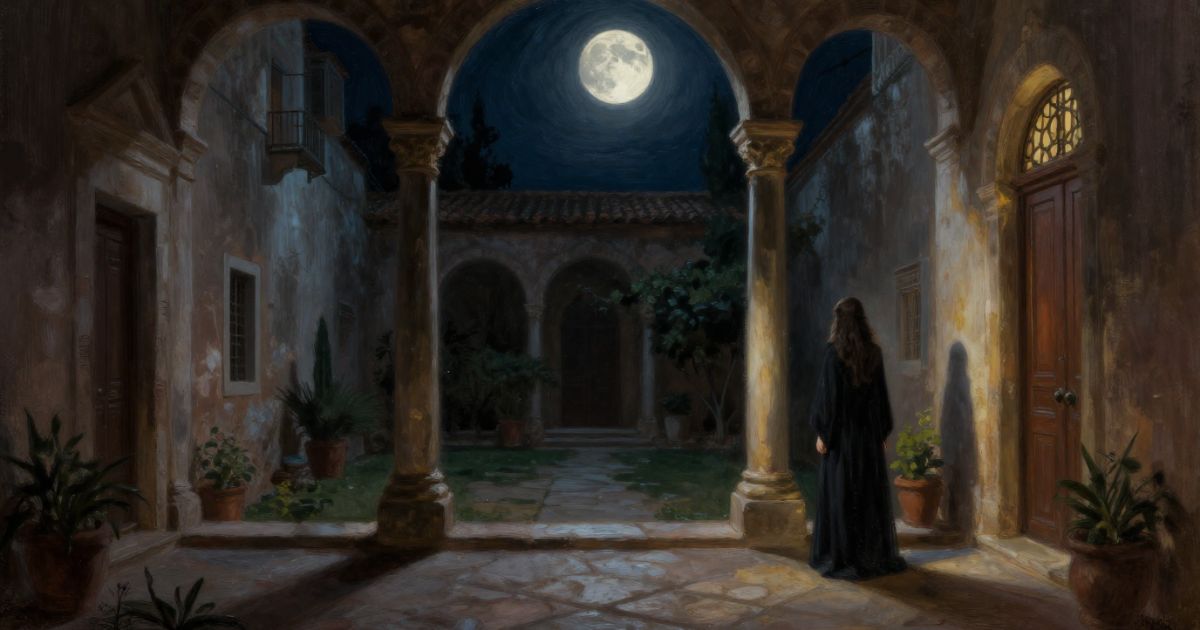
An excerpt from the original text.(complete · 3221 words)
ulia accustomed herself to walk in the fine evenings under the shade
of the high trees that environed the abbey. The dewy coolness of the
air refreshed her. The innumerable roseate tints which the parting
sun-beams reflected on the rocks above, and the fine vermil glow
diffused over the romantic scene beneath, softly fading from the eye,
as the nightshades fell, excited sensations of a sweet and tranquil
nature, and soothed her into a temporary forgetfulness of her sorrows.
The deep solitude of the place subdued her apprehension, and one
evening she ventured with Madame de Menon to lengthen her walk. They
returned to the abbey without having seen a human being, except a
friar of the monastery, who had been to a neighbouring town to order
provision. On the following evening they repeated their walk; and,
engaged in conversation, rambled to a considerable distance from the
abbey. The distant bell of the monastery sounding for vespers,
reminded them of the hour, and looking round, they perceived the
extremity of the wood. They were returning towards the abbey, when
struck by the appearance of some majestic columns which were
distinguishable between the trees, they paused. Curiosity tempted them
to examine to what edifice pillars of such magnificent architecture
could belong, in a scene so rude, and they went on.
There appeared on a point of rock impending over the valley the
reliques of a palace, whose beauty time had impaired only to heighten
its sublimity. An arch of singular magnificence remained almost
entire, beyond which appeared wild cliffs retiring in grand
perspective. The sun, which was now setting, threw a trembling lustre
upon the ruins, and gave a finishing effect to the scene. They gazed
in mute wonder upon the view; but the fast fading light, and the dewy
chillness of the air, warned them to return. As Julia gave a last
look to the scene, she perceived two men leaning upon a part of the
ruin at some distance, in earnest conversation. As they spoke, their
looks were so attentively bent on her, that she could have no doubt
she was the subject of their discourse. Alarmed at this circumstance,
madame and Julia immediately retreated towards the abbey. They walked
swiftly through the woods, whose shades, deepened by the gloom of
evening, prevented their distinguishing whether they were pursued.
They were surprized to observe the distance to which they had strayed
from the monastery, whose dark towers were now obscurely seen rising
among the trees that closed the perspective. They had almost reached
the gates, when on looking back, they perceived the same men slowly
advancing, without any appearance of pursuit, but clearly as if
observing the place of their retreat.
This incident occasioned Julia much alarm. She could not but believe
that the men whom she had seen were spies of the marquis;--if so, her
asylum was discovered, and she had every thing to apprehend. Madame
now judged it necessary to the safety of Julia, that the Abate
should be informed of her story, and of the sanctuary she had sought
in his monastery, and also that he should be solicited to protect her
from parental tyranny. This was a hazardous, but a necessary step, to
provide against the certain danger which must ensue, should the
marquis, if he demanded his daughter of the Abate, be the first to
acquaint him with her story. If she acted otherwise, she feared that
the Abate, in whose generosity she had not confided, and whose pity
she had not solicited, would, in the pride of his resentment, deliver
her up, and thus would she become a certain victim to the Duke de
Luovo.
Julia approved of this communication, though she trembled for the
event; and requested madame to plead her cause with the Abate. On
the following morning, therefore, madame solicited a private audience
of the Abate; she obtained permission to see him, and Julia, in
trembling anxiety, watched her to the door of his apartment. This
conference was long, and every moment seemed an hour to Julia, who, in
fearful expectation, awaited with Cornelia the sentence which would
decide her destiny. She was now the constant companion of Cornelia,
whose declining health interested her pity, and strengthened her
attachment.
Meanwhile madame developed to the Abate the distressful story of
Julia. She praised her virtues, commended her accomplishments, and
deplored her situation. She described the characters of the marquis
and the duke, and concluded with pathetically representing, that Julia
had sought in this monastery, a last asylum from injustice and misery,
and with entreating that the Abate would grant her his pity and
protection.
The Abate during this discourse preserved a sullen silence; his eyes
were bent to the ground, and his aspect was thoughful and solemn. When
madame ceased to speak, a pause of profound silence ensued, and she
sat in anxious expectation. She endeavoured to anticipate in his
countenance the answer preparing, but she derived no comfort from
thence. At length raising his head, and awakening from his deep
reverie, he told her that her request required deliberation, and that
the protection she solicited for Julia, might involve him in serious
consequences, since, from a character so determined as the marquis's,
much violence might reasonably be expected. 'Should his daughter be
refused him,' concluded the Abate, 'he may even dare to violate the
sanctuary.'
Madame, shocked by the stern indifference of this reply, was a moment
silent. The Abate went on. 'Whatever I shall determine upon, the
young lady has reason to rejoice that she is admitted into this holy
house; for I will even now venture to assure her, that if the marquis
fails to demand her, she shall be permitted to remain in this
sanctuary unmolested. You, Madam, will be sensible of this indulgence,
and of the value of the sacrifice I make in granting it; for, in thus
concealing a child from her parent, I encourage her in disobedience,
and consequently sacrifice my sense of duty, to what may be justly
called a weak humanity.'
Madame listened to pompous declamation in silent sorrow and
indignation. She made another effort to interest the Abate in favor
of Julia, but he preserved his stern inflexibility, and repeating that
he would deliberate upon the matter, and acquaint her with the result,
he arose with great solemnity, and quitted the room.
She now half repented of the confidence she had reposed in him, and of
the pity she had solicited, since he discovered a mind incapable of
understanding the first, and a temper inaccessible to the influence of
the latter. With an heavy heart she returned to Julia, who read in her
countenance, at the moment she entered the room, news of no happy
import. When madame related the particulars of the conference, Julia
presaged from it only misery, and giving herself up for lost--she
burst into tears. She severely deplored the confidence she had been
induced to yield; for she now saw herself in the power of a man, stern
and unfeeling in his nature: and from whom, if he thought it fit to
betray her, she had no means of escaping. But she concealed the
anguish of her heart; and to console madame, affected to hope where
she could only despair.
Several days elapsed, and no answer was returned from the Abate.
Julia too well understood this silence.
One morning Cornelia entering her room with a disturbed and impatient
air, informed her that some emissaries from the marquis were then in
the monastery, having enquired at the gate for the Abate, with whom,
they said, they had business of importance to transact. The Abate
had granted them immediate audience, and they were now in close
conference.
At this intelligence the spirits of Julia forsook her; she trembled,
grew pale, and stood fixed in mute despair. Madame, though scarcely
less distressed, retained a presence of mind. She understood too
justly the character of the Superior to doubt that he would hesitate
in delivering Julia to the hands of the marquis. On this moment,
therefore, turned the crisis of her fate!--this moment she might
escape--the next she was a prisoner. She therefore advised Julia to
seize the instant, and fly from the monastery before the conference
was concluded, when the gates would most probably be closed upon her,
assuring her, at the same time, she would accompany her in flight.
The generous conduct of madame called tears of gratitude into the eyes
of Julia, who now awoke from the state of stupefaction which distress
had caused. But before she could thank her faithful friend, a nun
entered the room with a summons for madame to attend the Abate
immediately. The distress which this message occasioned can not easily
be conceived. Madame advised Julia to escape while she detained the
Abate in conversation, as it was not probable that he had yet issued
orders for her detention. Leaving her to this attempt, with an
assurance of following her from the abbey as soon as possible, madame
obeyed the summons. The coolness of her fortitude forsook her as she
approached the Abate's apartment, and she became less certain as to
the occasion of this summons.
The Abate was alone. His countenance was pale with anger, and he was
pacing the room with slow but agitated steps. The stern authority of
his look startled her. 'Read this letter,' said he, stretching forth
his hand which held a letter, 'and tell me what that mortal deserves,
who dares insult our holy order, and set our sacred prerogative at
defiance.' Madame distinguished the handwriting of the marquis, and
the words of the Superior threw her into the utmost astonishment. She
took the letter. It was dictated by that spirit of proud vindictive
rage, which so strongly marked the character of the marquis. Having
discovered the retreat of Julia, and believing the monastery afforded
her a willing sanctuary from his pursuit, he accused the Abate of
encouraging his child in open rebellion to his will. He loaded him and
his sacred order with opprobrium, and threatened, if she was not
immediately resigned to the emissaries in waiting, he would in person
lead on a force which should compel the church to yield to the
superior authority of the father.
The spirit of the Abate was roused by this menace; and Julia
obtained from his pride, that protection which neither his principle
or his humanity would have granted. 'The man shall tremble,' cried he,
'who dares defy our power, or question our sacred authority. The lady
Julia is safe. I will protect her from this proud invader of our
rights, and teach him at least to venerate the power he cannot
conquer. I have dispatched his emissaries with my answer.'
These words struck sudden joy upon the heart of Madame de Menon, but
she instantly recollected, that ere this time Julia had quitted the
abbey, and thus the very precaution which was meant to ensure her
safety, had probably precipitated her into the hand of her enemy. This
thought changed her joy to anguish; and she was hurrying from the
apartment in a sort of wild hope, that Julia might not yet be gone,
when the stern voice of the Abate arrested her. 'Is it thus,' cried
he, 'that you receive the knowledge of our generous resolution to
protect your friend? Does such condescending kindness merit no
thanks--demand no gratitude?' Madame returned in an agony of fear,
lest one moment of delay might prove fatal to Julia, if haply she had
not yet quitted the monastery. She was conscious of her deficiency in
apparent gratitude, and of the strange appearance of her abrupt
departure from the Abate, for which it was impossible to apologize,
without betraying the secret, which would kindle all his resentment.
Yet some atonement his present anger demanded, and these circumstances
caused her a very painful embarrassment. She formed a hasty excuse;
and expressing her sense of his goodness, again attempted to retire,
when the Abate frowning in deep resentment, his features inflamed
with pride, arose from his seat. 'Stay,' said he; 'whence this
impatience to fly from the presence of a benefactor?--If my generosity
fails to excite gratitude, my resentment shall not fail to inspire
awe.--Since the lady Julia is insensible of my condescension, she is
unworthy of my protection, and I will resign her to the tyrant who
demands her.'
To this speech, in which the offended pride of the Abate overcoming
all sense of justice, accused and threatened to punish Julia for the
fault of her friend, madame listened in dreadful impatience. Every
word that detained her struck torture to her heart, but the concluding
sentence occasioned new terror, and she started at its purpose. She
fell at the feet of the Abate in an agony of grief. 'Holy father,'
said she, 'punish not Julia for the offence which I only have
committed; her heart will bless her generous protector, and for
myself, suffer me to assure you that I am fully sensible of your
goodness.'
'If this is true,' said the Abate, 'arise, and bid the lady Julia
attend me.' This command increased the confusion of madame, who had no
doubt that her detention had proved fatal to Julia. At length she was
suffered to depart, and to her infinite joy found Julia in her own
room. Her intention of escaping had yielded, immediately after the
departure of madame, to the fear of being discovered by the marquis's
people. This fear had been confirmed by the report of Cornelia, who
informed her, that at that time several horsemen were waiting at the
gates for the return of their companions. This was a dreadful
circumstance to Julia, who perceived it was utterly impossible to quit
the monastery, without rushing upon certain destruction. She was
lamenting her destiny, when madame recited the particulars of the late
interview, and delivered the summons of the Abate.
They had now to dread the effect of that tender anxiety, which had
excited his resentment; and Julia, suddenly elated to joy by his first
determination, was as suddenly sunk to despair by his last. She
trembled with apprehension of the coming interview, though each moment
of delay which her fear solicited, would, by heightening the
resentment of the Abate, only increase the danger she dreaded.
At length, by a strong effort, she reanimated her spirits, and went to
the Abate's closet to receive her sentence. He was seated in his
chair, and his frowning aspect chilled her heart. 'Daughter,' said he,
'you have been guilty of heinous crimes. You have dared to
dispute--nay openly to rebel, against the lawful authority of your
father. You have disobeyed the will of him whose prerogative yields
only to ours. You have questioned his right upon a point of all others
the most decided--the right of a father to dispose of his child in
marriage. You have even fled from his protection--and you have
dared--insidiously, and meanly have dared, to screen your disobedience
beneath this sacred roof. You have prophaned our sanctuary with your
crime. You have brought insult upon our sacred order, and have caused
bold and impious defiance of our high prerogative. What punishment is
adequate to guilt like this?'
The father paused--his eyes sternly fixed on Julia, who, pale and
trembling, could scarcely support herself, and who had no power to
reply. 'I will be merciful, and not just,' resumed he,--'I will soften
the punishment you deserve, and will only deliver you to your father.'
At these dreadful words, Julia bursting into tears, sunk at the feet
of the Abate, to whom she raised her eyes in supplicating
expression, but was unable to speak. He suffered her to remain in this
posture. 'Your duplicity,' he resumed, 'is not the least of your
offences.--Had you relied upon our generosity for forgiveness and
protection, an indulgence might have been granted;--but under the
disguise of virtue you concealed your crimes, and your necessities
were hid beneath the mask of devotion.'
These false aspersions roused in Julia the spirit of indignant virtue;
she arose from her knees with an air of dignity, that struck even the
Abate. 'Holy father,' said she, 'my heart abhors the crime you
mention, and disclaims all union with it. Whatever are my offences,
from the sin of hypocrisy I am at least free; and you will pardon me
if I remind you, that my confidence has already been such, as fully
justifies my claim to the protection I solicit. When I sheltered
myself within these walls, it was to be presumed that they would
protect me from injustice; and with what other term than injustice
would you, Sir, distinguish the conduct of the marquis, if the fear of
his power did not overcome the dictates of truth?'
The Abate felt the full force of this reproof; but disdaining to
appear sensible to it, restrained his resentment. His wounded pride
thus exasperated, and all the malignant passions of his nature thus
called into action, he was prompted to that cruel surrender which he
had never before seriously intended. The offence which Madame de
Menon had unintentionally given his haughty spirit urged him to
retaliate in punishment. He had, therefore, pleased himself with
exciting a terror which he never meant to confirm, and he resolved to
be further solicited for that protection which he had already
determined to grant. But this reproof of Julia touched him where he
was most conscious of defect; and the temporary triumph which he
imagined it afforded her, kindled his resentment into flame. He mused
in his chair, in a fixed attitude.--She saw in his countenance the
deep workings of his mind--she revolved the fate preparing for her,
and stood in trembling anxiety to receive her sentence. The Abate
considered each aggravating circumstance of the marquis's menace, and
each sentence of Julia's speech; and his mind experienced that vice is
not only inconsistent with virtue, but with itself--for to gratify his
malignity, he now discovered that it would be necessary to sacrifice
his pride--since it would be impossible to punish the object of the
first without denying himself the gratification of the latter. This
reflection suspended his mind in a state of torture, and he sat wrapt
in gloomy silence.
The spirit which lately animated Julia had vanished with her
words--each moment of silence increased her apprehension; the deep
brooding of his thoughts confirmed her in the apprehension of evil,
and with all the artless eloquence of sorrow she endeavoured to soften
him to pity. He listened to her pleadings in sullen stillness. But
each instant now cooled the fervour of his resentment to her, and
increased his desire of opposing the marquis. At length the
predominant feature of his character resumed its original influence,
and overcame the workings of subordinate passion. Proud of his
religious authority, he determined never to yield the prerogative of
the church to that of the father, and resolved to oppose the violence
of the marquis with equal force.
He therefore condescended to relieve Julia from her terrors, by
assuring her of his protection; but he did this in a manner so
ungracious, as almost to destroy the gratitude which the promise
demanded. She hastened with the joyful intelligence to Madame de
Menon, who wept over her tears of thankfulness.
Master this chapter. Complete your experience
Purchase the complete book to access all chapters and support classic literature
As an Amazon Associate, we earn a small commission from qualifying purchases at no additional cost to you.
Available in paperback, hardcover, and e-book formats
Let's Analyse the Pattern
Your personal crisis becomes a strategic move in someone else's power struggle, and your outcome depends on how useful you are to their agenda.
Why This Matters
Connect literature to life
This chapter teaches how institutions make decisions based on their own power struggles, not just the merits of your case.
Practice This Today
This week, notice when organizations suddenly care about your problem after someone challenges their authority—that's the pattern revealing itself.
Now let's explore the literary elements.
Key Quotes & Analysis
"The deep solitude of the place subdued her apprehension"
Context: Julia feels safe during her evening walks around the abbey
This shows how Julia has found temporary peace in isolation, but also hints at false security. The word 'subdued' suggests her fears are only temporarily quieted, not eliminated.
In Today's Words:
Being alone in this peaceful place made her feel like maybe she was actually safe.
"Curiosity tempted them to examine to what edifice pillars of such magnificent architecture could belong"
Context: Julia and Madame de Menon discover the ancient ruins
This moment of innocent curiosity leads directly to danger. The beautiful ruins hide watchers, showing how attraction to beauty can lead us into peril.
In Today's Words:
They couldn't resist checking out what looked like an amazing old building.
"Protection is a sacred duty which we owe to the unfortunate"
Context: The Abate explains his decision to shelter Julia
The Abate frames his decision in religious terms, but we know he's really motivated by wounded pride. This shows how people justify self-interested actions with noble language.
In Today's Words:
It's our moral obligation to help people in trouble.
Thematic Threads
Power
In This Chapter
The Abate's protection of Julia shifts from reluctant duty to aggressive assertion when his authority is challenged
Development
Evolved from earlier themes of patriarchal control to institutional power dynamics
In Your Life:
You might see this when your boss suddenly supports your project after a rival department criticizes it
Pride
In This Chapter
The Marquis's arrogant letter backfires by triggering the Abate's wounded pride
Development
Continues the pattern of male pride creating unintended consequences
In Your Life:
You might recognize this when someone's condescending tone makes you want to prove them wrong, regardless of logic
Survival
In This Chapter
Julia learns to navigate institutional politics while maintaining her dignity
Development
Her survival skills evolve from passive endurance to strategic thinking
In Your Life:
You might apply this when dealing with bureaucracy, knowing when to push back and when to play along
Identity
In This Chapter
Julia's moment of defiance nearly costs her protection, showing the price of authentic self-expression
Development
Her identity continues to conflict with social expectations and survival needs
In Your Life:
You might face this tension when standing up for yourself at work could jeopardize your job security
Class
In This Chapter
The power struggle between Marquis and Abate reveals how class conflicts affect those caught between them
Development
Shows how class tensions play out through institutional channels
In Your Life:
You might see this when wealthy donors influence decisions at your workplace or community organization
You now have the context. Time to form your own thoughts.
Discussion Questions
- 1
Why does the Abate's attitude toward Julia completely change after he receives the Marquis's letter?
analysis • surface - 2
What does the Abate care more about - Julia's actual safety or defending his own authority? How can you tell?
analysis • medium - 3
Think about a time when you needed help from an institution (school, workplace, government office). What did they seem to care about most - your actual problem or their own priorities?
application • medium - 4
If you were Julia, how would you have approached the Abate differently to get the protection you needed?
application • deep - 5
What does this chapter reveal about how institutions really work, and why understanding this matters for navigating your own life?
reflection • deep
Critical Thinking Exercise
Map the Hidden Agenda
Think of a situation where you need something from an institution (work, school, insurance, government). Map out what YOU need versus what THEY care about protecting. Then brainstorm how to frame your request to align with their priorities while still getting what you need.
Consider:
- •What does this institution's reputation depend on?
- •Who are the key decision-makers and what motivates them?
- •How can you make helping you serve their interests too?
Journaling Prompt
Write about a time when you got better results by understanding what the other person or organization really cared about, rather than just focusing on what you needed.
Coming Up Next...
Chapter 11: The Sacred Ultimatum
With the Abate's protection secured, Julia might finally feel safe—but the Marquis isn't the type of man to accept defeat quietly. His next move will test just how far the monastery's walls can really protect her.



