
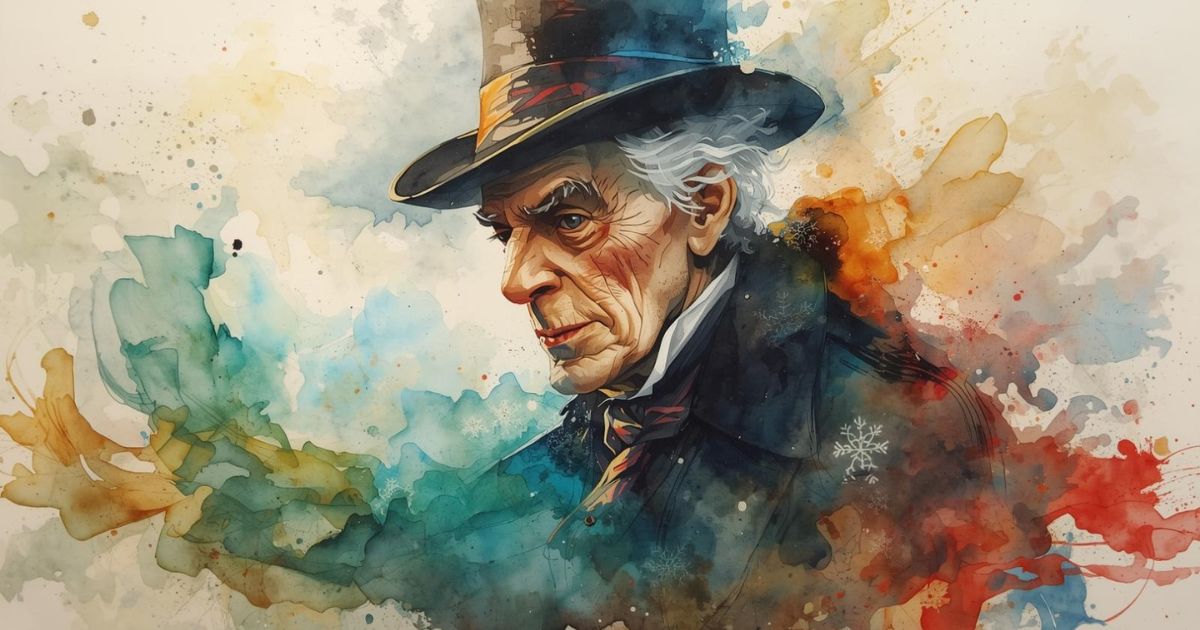
An excerpt from the original text.(complete · 5385 words)
STAVE FOUR
THE LAST OF THE SPIRITS
The Phantom slowly, gravely, silently approached. When it came near him,
Scrooge bent down upon his knee; for in the very air through which this
Spirit moved it seemed to scatter gloom and mystery.
It was shrouded in a deep black garment, which concealed its head, its
face, its form, and left nothing of it visible, save one outstretched
hand. But for this, it would have been difficult to detach its figure
from the night, and separate it from the darkness by which it was
surrounded.
He felt that it was tall and stately when it came beside him, and that
its mysterious presence filled him with a solemn dread. He knew no more,
for the Spirit neither spoke nor moved.
'I am in the presence of the Ghost of Christmas Yet to Come?' said
Scrooge.
The Spirit answered not, but pointed onward with its hand.
'You are about to show me shadows of the things that have not happened,
but will happen in the time before us,' Scrooge pursued. 'Is that so,
Spirit?'
The upper portion of the garment was contracted for an instant in its
folds, as if the Spirit had inclined its head. That was the only answer
he received.
Although well used to ghostly company by this time, Scrooge feared the
silent shape so much that his legs trembled beneath him, and he found
that he could hardly stand when he prepared to follow it. The Spirit
paused a moment, as observing his condition, and giving him time to
recover.
But Scrooge was all the worse for this. It thrilled him with a vague,
uncertain horror to know that, behind the dusky shroud, there were
ghostly eyes intently fixed upon him, while he, though he stretched his
own to the utmost, could see nothing but a spectral hand and one great
heap of black.
'Ghost of the Future!' he exclaimed, 'I fear you more than any spectre
I have seen. But as I know your purpose is to do me good, and as I hope
to live to be another man from what I was, I am prepared to bear your
company, and do it with a thankful heart. Will you not speak to me?'
It gave him no reply. The hand was pointed straight before them.
'Lead on!' said Scrooge. 'Lead on! The night is waning fast, and it is
precious time to me, I know. Lead on, Spirit!'
The Phantom moved away as it had come towards him. Scrooge followed in
the shadow of its dress, which bore him up, he thought, and carried him
along.
They scarcely seemed to enter the City; for the City rather seemed to
spring up about them, and encompass them of its own act. But there they
were in the heart of it; on 'Change, amongst the merchants, who hurried
up and down, and chinked the money in their pockets, and conversed in
groups, and looked at their watches, and trifled thoughtfully with their
great gold seals, and so forth, as Scrooge had seen them often.
The Spirit stopped beside one little knot of business men. Observing
that the hand was pointed to them, Scrooge advanced to listen to their
talk.
'No,' said a great fat man with a monstrous chin, 'I don't know much
about it either way. I only know he's dead.'
'When did he die?' inquired another.
'Last night, I believe.'
'Why, what was the matter with him?' asked a third, taking a vast
quantity of snuff out of a very large snuff-box. 'I thought he'd never
die.'
'God knows,' said the first, with a yawn.
'What has he done with his money?' asked a red-faced gentleman with a
pendulous excrescence on the end of his nose, that shook like the gills
of a turkey-cock.
'I haven't heard,' said the man with the large chin, yawning again.
'Left it to his company, perhaps. He hasn't left it to me. That's all
I know.'
This pleasantry was received with a general laugh.
'It's likely to be a very cheap funeral,' said the same speaker; 'for,
upon my life, I don't know of anybody to go to it. Suppose we make up a
party, and volunteer?'
'I don't mind going if a lunch is provided,' observed the gentleman with
the excrescence on his nose. 'But I must be fed if I make one.'
Another laugh.
[Illustration:
"How are you?" said one.
"How are you?" returned the other.
"Well!" said the first. "Old Scratch has got his own at last, hey?"
]
'Well, I am the most disinterested among you, after all,' said the first
speaker, 'for I never wear black gloves, and I never eat lunch. But I'll
offer to go if anybody else will. When I come to think of it, I'm not
at all sure that I wasn't his most particular friend; for we used to
stop and speak whenever we met. Bye, bye!'
Speakers and listeners strolled away, and mixed with other groups.
Scrooge knew the men, and looked towards the Spirit for an explanation.
The phantom glided on into a street. Its finger pointed to two persons
meeting. Scrooge listened again, thinking that the explanation might lie
here.
He knew these men, also, perfectly. They were men of business: very
wealthy, and of great importance. He had made a point always of standing
well in their esteem in a business point of view, that is; strictly in a
business point of view.
'How are you?' said one.
'How are you?' returned the other.
'Well!' said the first, 'old Scratch has got his own at last, hey?'
'So I am told,' returned the second. 'Cold, isn't it?'
'Seasonable for Christmas-time. You are not a skater, I suppose?'
'No, no. Something else to think of. Good-morning!'
Not another word. That was their meeting, their conversation, and their
parting.
Scrooge was at first inclined to be surprised that the Spirit should
attach importance to conversations apparently so trivial; but feeling
assured that they must have some hidden purpose, he set himself to
consider what it was likely to be. They could scarcely be supposed to
have any bearing on the death of Jacob, his old partner, for that was
Past, and this Ghost's province was the Future. Nor could he think of
any one immediately connected with himself to whom he could apply them.
But nothing doubting that, to whomsoever they applied, they had some
latent moral for his own improvement, he resolved to treasure up every
word he heard, and everything he saw; and especially to observe the
shadow of himself when it appeared. For he had an expectation that the
conduct of his future self would give him the clue he missed, and would
render the solution of these riddles easy.
He looked about in that very place for his own image, but another man
stood in his accustomed corner; and though the clock pointed to his
usual time of day for being there, he saw no likeness of himself among
the multitudes that poured in through the Porch. It gave him little
surprise, however; for he had been revolving in his mind a change of
life, and thought and hoped he saw his new-born resolutions carried out
in this.
Quiet and dark, beside him stood the Phantom, with its outstretched
hand. When he roused himself from his thoughtful quest, he fancied,
from the turn of the hand, and its situation in reference to himself,
that the Unseen Eyes were looking at him keenly. It made him shudder,
and feel very cold.
They left the busy scene, and went into an obscure part of the town,
where Scrooge had never penetrated before, although he recognised its
situation and its bad repute. The ways were foul and narrow; the shop
and houses wretched; the people half naked, drunken, slipshod, ugly.
Alleys and archways, like so many cesspools, disgorged their offences of
smell and dirt, and life upon the straggling streets; and the whole
quarter reeked with crime, with filth, and misery.
Far in this den of infamous resort, there was a low-browed, beetling
shop, below a penthouse roof, where iron, old rags, bottles, bones, and
greasy offal were bought. Upon the floor within were piled up heaps of
rusty keys, nails, chains, hinges, files, scales, weights, and refuse
iron of all kinds. Secrets that few would like to scrutinise were bred
and hidden in mountains of unseemly rags, masses of corrupted fat, and
sepulchres of bones. Sitting in among the wares he dealt in, by a
charcoal stove made of old bricks, was a grey-haired rascal, nearly
seventy years of age, who had screened himself from the cold air without
by a frouzy curtaining of miscellaneous tatters hung upon a line and
smoked his pipe in all the luxury of calm retirement.
Scrooge and the Phantom came into the presence of this man, just as a
woman with a heavy bundle slunk into the shop. But she had scarcely
entered, when another woman, similarly laden, came in too; and she was
closely followed by a man in faded black, who was no less startled by
the sight of them than they had been upon the recognition of each other.
After a short period of blank astonishment, in which the old man with
the pipe had joined them, they all three burst into a laugh.
'Let the charwoman alone to be the first!' cried she who had entered
first. 'Let the laundress alone to be the second; and let the
undertaker's man alone to be the third. Look here, old Joe, here's a
chance! If we haven't all three met here without meaning it!'
'You couldn't have met in a better place,' said old Joe, removing his
pipe from his mouth. 'Come into the parlour. You were made free of it
long ago, you know; and the other two an't strangers. Stop till I shut
the door of the shop. Ah! how it skreeks! There an't such a rusty bit of
metal in the place as its own hinges, I believe; and I'm sure there's no
such old bones here as mine. Ha! ha! We're all suitable to our calling,
we're well matched. Come into the parlour. Come into the parlour.'
The parlour was the space behind the screen of rags. The old man raked
the fire together with an old stair-rod, and having trimmed his smoky
lamp (for it was night) with the stem of his pipe, put it into his mouth
again.
While he did this, the woman who had already spoken threw her bundle on
the floor, and sat down in a flaunting manner on a stool, crossing her
elbows on her knees, and looking with a bold defiance at the other two.
'What odds, then? What odds, Mrs. Dilber?' said the woman. 'Every person
has a right to take care of themselves. He always did!'
'That's true, indeed!' said the laundress. 'No man more so.'
'Why, then, don't stand staring as if you was afraid, woman! Who's the
wiser? We're not going to pick holes in each other's coats, I suppose?'
'No, indeed!' said Mrs. Dilber and the man together. 'We should hope
not.'
'Very well then!' cried the woman. 'That's enough. Who's the worse for
the loss of a few things like these? Not a dead man, I suppose?'
'No, indeed,' said Mrs. Dilber, laughing.
'If he wanted to keep 'em after he was dead, a wicked old screw,'
pursued the woman, 'why wasn't he natural in his lifetime? If he had
been, he'd have had somebody to look after him when he was struck with
Death, instead of lying gasping out his last there, alone by himself.'
'It's the truest word that ever was spoke,' said Mrs. Dilber. 'It's a
judgment on him.'
'I wish it was a little heavier judgment,' replied the woman: 'and it
should have been, you may depend upon it, if I could have laid my hands
on anything else. Open that bundle, old Joe, and let me know the value
of it. Speak out plain. I'm not afraid to be the first, nor afraid for
them to see it. We knew pretty well that we were helping ourselves
before we met here, I believe. It's no sin. Open the bundle, Joe.'
But the gallantry of her friends would not allow of this; and the man in
faded black, mounting the breach first, produced his plunder. It was
not extensive. A seal or two, a pencil-case, a pair of sleeve-buttons,
and a brooch of no great value, were all. They were severally examined
and appraised by old Joe, who chalked the sums he was disposed to give
for each upon the wall, and added them up into a total when he found
that there was nothing more to come.
'That's your account,' said Joe, 'and I wouldn't give another sixpence,
if I was to be boiled for not doing it. Who's next?'
[Illustration: "What do you call this?" said Joe. "Bed-curtains."]
Mrs. Dilber was next. Sheets and towels, a little wearing apparel, two
old fashioned silver teaspoons, a pair of sugar-tongs, and a few
boots. Her account was stated on the wall in the same manner.
'I always give too much to ladies. It's a weakness of mine, and that's
the way I ruin myself,' said old Joe. 'That's your account. If you asked
me for another penny, and made it an open question, I'd repent of being
so liberal, and knock off half-a-crown.'
'And now undo my bundle, Joe,' said the first woman.
Joe went down on his knees for the greater convenience of opening it,
and, having unfastened a great many knots, dragged out a large heavy
roll of some dark stuff.
'What do you call this?' said Joe. 'Bed-curtains?'
'Ah!' returned the woman, laughing and leaning forward on her crossed
arms. 'Bed-curtains!'
'You don't mean to say you took 'em down, rings and all, with him lying
there?' said Joe.
'Yes, I do,' replied the woman. 'Why not?'
'You were born to make your fortune,' said Joe, 'and you'll certainly do
it.'
'I certainly shan't hold my hand, when I can get anything in it by
reaching it out, for the sake of such a man as he was, I promise you,
Joe,' returned the woman coolly. 'Don't drop that oil upon the blankets,
now.'
'His blankets?' asked Joe.
'Whose else's do you think?' replied the woman. 'He isn't likely to take
cold without 'em, I dare say.'
'I hope he didn't die of anything catching? Eh?' said old Joe, stopping
in his work, and looking up.
'Don't you be afraid of that,' returned the woman. 'I an't so fond of
his company that I'd loiter about him for such things, if he did. Ah!
you may look through that shirt till your eyes ache, but you won't find
a hole in it, nor a threadbare place. It's the best he had, and a fine
one too. They'd have wasted it, if it hadn't been for me.'
'What do you call wasting of it?' asked old Joe.
'Putting it on him to be buried in, to be sure,' replied the woman, with
a laugh. 'Somebody was fool enough to do it, but I took it off again. If
calico an't good enough for such a purpose, it isn't good enough for
anything. It's quite as becoming to the body. He can't look uglier than
he did in that one.'
Scrooge listened to this dialogue in horror. As they sat grouped about
their spoil, in the scanty light afforded by the old man's lamp, he
viewed them with a detestation and disgust which could hardly have been
greater, though they had been obscene demons marketing the corpse
itself.
'Ha, ha!' laughed the same woman when old Joe producing a flannel bag
with money in it, told out their several gains upon the ground. 'This
is the end of it, you see! He frightened every one away from him when he
was alive, to profit us when he was dead! Ha, ha, ha!'
'Spirit!' said Scrooge, shuddering from head to foot. 'I see, I see. The
case of this unhappy man might be my own. My life tends that way now.
Merciful heaven, what is this?'
He recoiled in terror, for the scene had changed, and now he almost
touched a bed--a bare, uncurtained bed--on which, beneath a ragged
sheet, there lay a something covered up, which, though it was dumb,
announced itself in awful language.
The room was very dark, too dark to be observed with any accuracy,
though Scrooge glanced round it in obedience to a secret impulse,
anxious to know what kind of room it was. A pale light, rising in the
outer air, fell straight upon the bed; and on it, plundered and bereft,
unwatched, unwept, uncared for, was the body of this man.
Scrooge glanced towards the Phantom. Its steady hand was pointed to the
head. The cover was so carelessly adjusted that the slightest raising of
it, the motion of a finger upon Scrooge's part, would have disclosed the
face. He thought of it, felt how easy it would be to do, and longed to
do it; but he had no more power to withdraw the veil than to dismiss the
spectre at his side.
Oh, cold, cold, rigid, dreadful Death, set up thine altar here, and
dress it with such terrors as thou hast at thy command; for this is thy
dominion! But of the loved, revered, and honoured head thou canst not
turn one hair to thy dread purposes, or make one feature odious. It is
not that the hand is heavy, and will fall down when released; it is not
that the heart and pulse are still; but that the hand was open,
generous, and true; the heart brave, warm, and tender, and the pulse a
man's. Strike, Shadow, strike! And see his good deeds springing from the
wound, to sow the world with life immortal!
No voice pronounced these words in Scrooge's ears, and yet he heard them
when he looked upon the bed. He thought, if this man could be raised up
now, what would be his foremost thoughts? Avarice, hard dealing, griping
cares? They have brought him to a rich end, truly!
He lay in the dark, empty house, with not a man, a woman, or a child to
say he was kind to me in this or that, and for the memory of one kind
word I will be kind to him. A cat was tearing at the door, and there was
a sound of gnawing rats beneath the hearthstone. What they wanted in
the room of death, and why they were so restless and disturbed, Scrooge
did not dare to think.
'Spirit!' he said, 'this is a fearful place. In leaving it, I shall not
leave its lesson, trust me. Let us go!'
Still the Ghost pointed with an unmoved finger to the head.
'I understand you,' Scrooge returned, 'and I would do it if I could. But
I have not the power, Spirit. I have not the power.'
Again it seemed to look upon him.
'If there is any person in the town who feels emotion caused by this
man's death,' said Scrooge, quite agonised, 'show that person to me,
Spirit, I beseech you!'
The Phantom spread its dark robe before him for a moment, like a wing;
and, withdrawing it, revealed a room by daylight, where a mother and her
children were.
She was expecting some one, and with anxious eagerness; for she walked
up and down the room, started at every sound, looked out from the
window, glanced at the clock, tried, but in vain, to work with her
needle, and could hardly bear the voices of her children in their play.
At length the long-expected knock was heard. She hurried to the door,
and met her husband; a man whose face was careworn and depressed, though
he was young. There was a remarkable expression in it now, a kind of
serious delight of which he felt ashamed, and which he struggled to
repress.
He sat down to the dinner that had been hoarding for him by the fire,
and when she asked him faintly what news (which was not until after a
long silence), he appeared embarrassed how to answer.
'Is it good,' she said, 'or bad?' to help him.
'Bad,' he answered.
'We are quite ruined?'
'No. There is hope yet, Caroline.'
'If he relents,' she said, amazed, 'there is! Nothing is past hope, if
such a miracle has happened.'
'He is past relenting,' said her husband. 'He is dead.'
She was a mild and patient creature, if her face spoke truth; but she
was thankful in her soul to hear it, and she said so with clasped hands.
She prayed forgiveness the next moment, and was sorry; but the first was
the emotion of her heart.
'What the half-drunken woman, whom I told you of last night, said to me
when I tried to see him and obtain a week's delay--and what I thought
was a mere excuse to avoid me--turns out to have been quite true. He was
not only very ill, but dying, then.'
'To whom will our debt be transferred?'
'I don't know. But, before that time, we shall be ready with the money;
and even though we were not, it would be bad fortune indeed to find so
merciless a creditor in his successor. We may sleep to-night with light
hearts, Caroline!'
Yes. Soften it as they would, their hearts were lighter. The children's
faces, hushed and clustered round to hear what they so little
understood, were brighter; and it was a happier house for this man's
death! The only emotion that the Ghost could show him, caused by the
event, was one of pleasure.
'Let me see some tenderness connected with a death,' said Scrooge; 'or
that dark chamber, Spirit, which we left just now, will be for ever
present to me.'
The Ghost conducted him through several streets familiar to his feet;
and as they went along, Scrooge looked here and there to find himself,
but nowhere was he to be seen. They entered poor Bob Cratchit's house;
the dwelling he had visited before; and found the mother and the
children seated round the fire.
Quiet. Very quiet. The noisy little Cratchits were as still as statues
in one corner, and sat looking up at Peter, who had a book before him.
The mother and her daughters were engaged in sewing. But surely they
were very quiet!
'"And he took a child, and set him in the midst of them."'
Where had Scrooge heard those words? He had not dreamed them. The boy
must have read them out as he and the Spirit crossed the threshold. Why
did he not go on?
The mother laid her work upon the table, and put her hand up to her
face.
'The colour hurts my eyes,' she said.
The colour? Ah, poor Tiny Tim!
'They're better now again,' said Cratchit's wife. 'It makes them weak by
candle-light; and I wouldn't show weak eyes to your father when he comes
home for the world. It must be near his time.'
'Past it rather,' Peter answered, shutting up his book. 'But I think he
has walked a little slower than he used, these few last evenings,
mother.'
They were very quiet again. At last she said, and in a steady, cheerful
voice, that only faltered once:
'I have known him walk with--I have known him walk with Tiny Tim upon
his shoulder very fast indeed.'
'And so have I,' cried Peter. 'Often.'
'And so have I,' exclaimed another. So had all.
'But he was very light to carry,' she resumed, intent upon her work,
'and his father loved him so, that it was no trouble, no trouble. And
there is your father at the door!'
She hurried out to meet him; and little Bob in his comforter--he had
need of it, poor fellow--came in. His tea was ready for him on the hob,
and they all tried who should help him to it most. Then the two young
Cratchits got upon his knees, and laid, each child, a little cheek
against his face, as if they said, 'Don't mind it, father. Don't be
grieved!'
Bob was very cheerful with them, and spoke pleasantly to all the family.
He looked at the work upon the table, and praised the industry and speed
of Mrs. Cratchit and the girls. They would be done long before Sunday,
he said.
'Sunday! You went to-day, then, Robert?' said his wife.
'Yes, my dear,' returned Bob. 'I wish you could have gone. It would have
done you good to see how green a place it is. But you'll see it often. I
promised him that I would walk there on a Sunday. My little, little
child!' cried Bob. 'My little child!'
He broke down all at once. He couldn't help it. If he could have helped
it, he and his child would have been farther apart, perhaps, than they
were.
He left the room, and went upstairs into the room above, which was
lighted cheerfully, and hung with Christmas. There was a chair set close
beside the child, and there were signs of some one having been there
lately. Poor Bob sat down in it, and when he had thought a little and
composed himself, he kissed the little face. He was reconciled to what
had happened, and went down again quite happy.
They drew about the fire, and talked, the girls and mother working
still. Bob told them of the extraordinary kindness of Mr. Scrooge's
nephew, whom he had scarcely seen but once, and who, meeting him in the
street that day, and seeing that he looked a little--'just a little
down, you know,' said Bob, inquired what had happened to distress him.
'On which,' said Bob, 'for he is the pleasantest-spoken gentleman you
ever heard, I told him. "I am heartily sorry for it, Mr. Cratchit," he
said, "and heartily sorry for your good wife." By-the-bye, how he ever
knew that I don't know.'
'Knew what, my dear?'
'Why, that you were a good wife,' replied Bob.
'Everybody knows that,' said Peter.
'Very well observed, my boy!' cried Bob. 'I hope they do. "Heartily
sorry," he said, "for your good wife. If I can be of service to you in
any way," he said, giving me his card, "that's where I live. Pray come
to me." Now, it wasn't,' cried Bob, 'for the sake of anything he might
be able to do for us, so much as for his kind way, that this was quite
delightful. It really seemed as if he had known our Tiny Tim, and felt
with us.'
'I'm sure he's a good soul!' said Mrs. Cratchit.
'You would be sure of it, my dear,' returned Bob, 'if you saw and spoke
to him. I shouldn't be at all surprised--mark what I say!--if he got
Peter a better situation.'
'Only hear that, Peter,' said Mrs. Cratchit.
'And then,' cried one of the girls, 'Peter will be keeping company with
some one, and setting up for himself.'
'Get along with you!' retorted Peter, grinning.
'It's just as likely as not,' said Bob, 'one of these days; though
there's plenty of time for that, my dear. But, however and whenever we
part from one another, I am sure we shall none of us forget poor Tiny
Tim--shall we--or this first parting that there was among us?'
'Never, father!' cried they all.
'And I know,' said Bob, 'I know, my dears, that when we recollect how
patient and how mild he was; although he was a little, little child; we
shall not quarrel easily among ourselves, and forget poor Tiny Tim in
doing it.'
'No, never, father!' they all cried again.
'I am very happy,' said little Bob, 'I am very happy!'
Mrs. Cratchit kissed him, his daughters kissed him, the two young
Cratchits kissed him, and Peter and himself shook hands. Spirit of Tiny
Tim, thy childish essence was from God!
'Spectre,' said Scrooge, 'something informs me that our parting moment
is at hand. I know it but I know not how. Tell me what man that was whom
we saw lying dead?'
The Ghost of Christmas Yet to Come conveyed him, as before--though at a
different time, he thought: indeed there seemed no order in these latter
visions, save that they were in the Future--into the resorts of business
men, but showed him not himself. Indeed, the Spirit did not stay for
anything, but went straight on, as to the end just now desired, until
besought by Scrooge to tarry for a moment.
'This court,' said Scrooge, 'through which we hurry now, is where my
place of occupation is, and has been for a length of time. I see the
house. Let me behold what I shall be in days to come.'
The Spirit stopped; the hand was pointed elsewhere.
'The house is yonder,' Scrooge exclaimed. 'Why do you point away?'
The inexorable finger underwent no change.
Scrooge hastened to the window of his office, and looked in. It was an
office still, but not his. The furniture was not the same, and the
figure in the chair was not himself. The Phantom pointed as before.
He joined it once again, and, wondering why and whither he had gone,
accompanied it until they reached an iron gate. He paused to look round
before entering.
A churchyard. Here, then, the wretched man, whose name he had now to
learn, lay underneath the ground. It was a worthy place. Walled in by
houses; overrun by grass and weeds, the growth of vegetation's death,
not life; choked up with too much burying; fat with repleted appetite. A
worthy place!
The Spirit stood among the graves, and pointed down to One. He advanced
towards it trembling. The Phantom was exactly as it had been, but he
dreaded that he saw new meaning in its solemn shape.
'Before I draw nearer to that stone to which you point,' said Scrooge,
'answer me one question. Are these the shadows of the things that Will
be, or are they shadows of the things that May be only?'
Still the Ghost pointed downward to the grave by which it stood.
'Men's courses will foreshadow certain ends, to which, if persevered in,
they must lead,' said Scrooge. 'But if the courses be departed from, the
ends will change. Say it is thus with what you show me!'
The Spirit was immovable as ever.
Scrooge crept towards it, trembling as he went; and, following the
finger, read upon the stone of the neglected grave his own name,
EBENEZER SCROOGE.
'Am I that man who lay upon the bed?' he cried upon his knees.
The finger pointed from the grave to him, and back again.
'No, Spirit! Oh no, no!'
The finger still was there.
'Spirit!' he cried, tight clutching at its robe, 'hear me! I am not the
man I was. I will not be the man I must have been but for this
intercourse. Why show me this, if I am past all hope?'
For the first time the hand appeared to shake.
'Good Spirit,' he pursued, as down upon the ground he fell before it,
'your nature intercedes for me, and pities me. Assure me that I yet may
change these shadows you have shown me by an altered life?'
The kind hand trembled.
'I will honour Christmas in my heart, and try to keep it all the year. I
will live in the Past, the Present, and the Future. The Spirits of all
Three shall strive within me. I will not shut out the lessons that they
teach. Oh, tell me I may sponge away the writing on this stone!'
In his agony he caught the spectral hand. It sought to free itself, but
he was strong in his entreaty, and detained it. The Spirit stronger yet,
repulsed him.
Holding up his hands in a last prayer to have his fate reversed, he saw
an alteration in the Phantom's hood and dress. It shrunk, collapsed, and
dwindled down into a bedpost.
Master this chapter. Complete your experience
Purchase the complete book to access all chapters and support classic literature
As an Amazon Associate, we earn a small commission from qualifying purchases at no additional cost to you.
Available in paperback, hardcover, and e-book formats
Let's Analyse the Pattern
The depth of grief at your death directly reflects the depth of love you invested in life.
Why This Matters
Connect literature to life
This chapter teaches how to audit your relationships before it's too late—measuring wealth in connections, not just cash.
Practice This Today
This week, notice who you interact with daily and ask yourself: 'Do they know my name, and do I know theirs?' Start there.
Now let's explore the literary elements.
Key Quotes & Analysis
"If there is any person in the town, who feels emotion caused by this man's death, show that person to me, Spirit, I beseech you."
Context: Scrooge desperately asks to see someone who cares about the dead man's passing
This shows Scrooge finally understanding that being remembered with love matters more than being rich. He's starting to grasp what really makes a life worthwhile.
In Today's Words:
Please show me somebody - anybody - who actually gives a damn that this guy died.
"It's likely to be a very cheap funeral, for upon my life I don't know of anybody to go to it."
Context: Men casually discussing Scrooge's death like a business transaction
The casual cruelty here shows how Scrooge is viewed - not as a person, but as an inconvenience. Even his funeral is seen through the lens of cost and convenience.
In Today's Words:
Nobody's gonna show up to this funeral, so at least it won't cost much.
"Assure me that I yet may change these shadows by an altered life."
Context: Scrooge's desperate plea after seeing his own gravestone
This is Scrooge's moment of complete surrender and genuine desire to change. He's finally willing to do the hard work of becoming a better person.
In Today's Words:
Tell me I can still fix this mess if I completely change how I live.
Thematic Threads
Legacy
In This Chapter
Two contrasting legacies: Scrooge's unloved death versus Tiny Tim's mourned passing
Development
Builds on earlier themes of isolation and connection, showing their ultimate consequences
In Your Life:
You might realize your own legacy is being written in every daily interaction you have.
Class
In This Chapter
The poor Cratchit family shows more dignity in grief than the wealthy who strip Scrooge's corpse
Development
Continues revealing how moral worth transcends economic status
In Your Life:
You might see how character matters more than bank account in determining who truly respects you.
Relationships
In This Chapter
The stark contrast between dying surrounded by love versus dying alone and forgotten
Development
Culminates the journey from isolation to understanding connection's true value
In Your Life:
You might evaluate whether you're building relationships that will sustain you or just using people.
Redemption
In This Chapter
Scrooge's desperate plea for a second chance shows recognition that change is still possible
Development
Reaches the crisis point where transformation becomes urgent necessity
In Your Life:
You might recognize it's never too late to start treating people better, even if you've been selfish for years.
Identity
In This Chapter
Scrooge finally sees his true self reflected in how others react to his death
Development
Completes the identity crisis by showing the ultimate consequence of his choices
In Your Life:
You might realize your reputation is built not on what you think of yourself, but on how you make others feel.
You now have the context. Time to form your own thoughts.
Discussion Questions
- 1
What's the difference between how people react to the unnamed dead man versus how they react to Tiny Tim's death?
analysis • surface - 2
Why do the businessmen, servants, and even the debtor family show no sadness about the mysterious man's death?
analysis • medium - 3
Think about people you know who've left jobs, moved away, or passed on - what made some forgettable while others left a real hole?
application • medium - 4
If you discovered you'd be forgotten like Scrooge's future self, what specific changes would you make starting tomorrow?
application • deep - 5
What does this chapter suggest about the real measure of a successful life?
reflection • deep
Critical Thinking Exercise
Write Your Own Eulogy - Two Versions
Write two brief eulogies for yourself. First, write what would honestly be said about you if you died today based on how you currently treat people. Then write the eulogy you'd want - what people would say if you lived up to your best self. Keep each to 3-4 sentences focusing on relationships, not achievements.
Consider:
- •Be brutally honest in the first version - what do your daily interactions actually communicate to others?
- •In the second version, focus on how you made people feel, not what you accomplished
- •Notice the gap between the two versions - that's your roadmap for change
Journaling Prompt
Write about one specific relationship where you've been making withdrawals instead of deposits. What would it look like to start investing in that person this week?
Coming Up Next...
Chapter 5: The Transformation Complete
After his terrifying glimpse of a lonely death, Scrooge wakes up with a chance to prove that people really can change. But can someone who's been selfish for decades truly transform overnight?



