
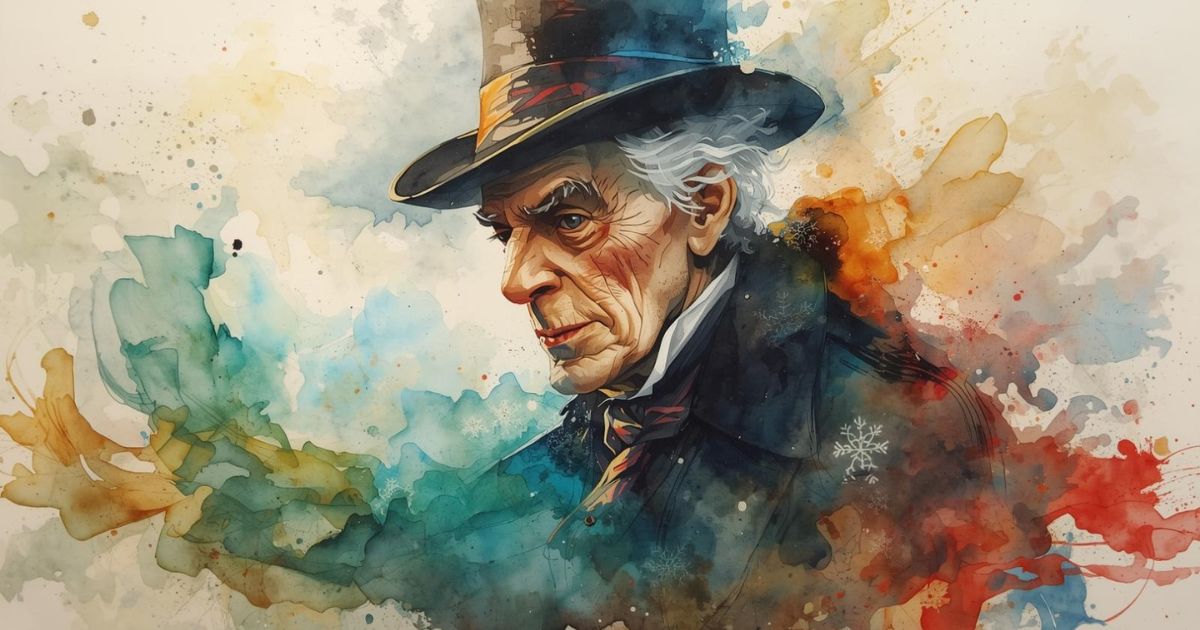
An excerpt from the original text.(complete · 5255 words)
STAVE FIVE
[Illustration]
THE END OF IT
Yes! and the bedpost was his own. The bed was his own, the room was his
own. Best and happiest of all, the Time before him was his own, to make
amends in!
'I will live in the Past, the Present, and the Future!' Scrooge repeated
as he scrambled out of bed. 'The Spirits of all Three shall strive
within me. O Jacob Marley! Heaven and the Christmas Time be praised for
this! I say it on my knees, old Jacob; on my knees!'
He was so fluttered and so glowing with his good intentions, that his
broken voice would scarcely answer to his call. He had been sobbing
violently in his conflict with the Spirit, and his face was wet with
tears.
'They are not torn down,' cried Scrooge, folding one of his bed-curtains
in his arms, 'They are not torn down, rings and all. They are here--I am
here--the shadows of the things that would have been may be dispelled.
They will be. I know they will!'
His hands were busy with his garments all this time: turning them inside
out, putting them on upside down, tearing them, mislaying them, making
them parties to every kind of extravagance.
'I don't know what to do!' cried Scrooge, laughing and crying in the
same breath, and making a perfect Laocoon of himself with his stockings.
'I am as light as a feather, I am as happy as an angel, I am as merry as
a schoolboy, I am as giddy as a drunken man. A merry Christmas to
everybody! A happy New Year to all the world! Hallo here! Whoop! Hallo!'
He had frisked into the sitting-room, and was now standing there,
perfectly winded.
'There's the saucepan that the gruel was in!' cried Scrooge, starting
off again, and going round the fireplace. 'There's the door by which the
Ghost of Jacob Marley entered! There's the corner where the Ghost of
Christmas Present sat! There's the window where I saw the wandering
Spirits! It's all right, it's all true, it all happened. Ha, ha, ha!'
Really, for a man who had been out of practice for so many years, it was
a splendid laugh, a most illustrious laugh. The father of a long, long
line of brilliant laughs!
'I don't know what day of the month it is,' said Scrooge. 'I don't know
how long I have been among the Spirits. I don't know anything. I'm quite
a baby. Never mind. I don't care. I'd rather be a baby. Hallo! Whoop!
Hallo here!'
He was checked in his transports by the churches ringing out the
lustiest peals he had ever heard. Clash, clash, hammer; ding, dong,
bell! Bell, dong, ding; hammer, clash, clash! Oh, glorious, glorious!
Running to the window, he opened it, and put out his head. No fog, no
mist; clear, bright, jovial, stirring, cold; cold, piping for the blood
to dance to; golden sunlight; heavenly sky; sweet fresh air; merry
bells. Oh, glorious! Glorious!
'What's to-day?' cried Scrooge, calling downward to a boy in Sunday
clothes, who perhaps had loitered in to look about him.
'EH?' returned the boy with all his might of wonder.
'What's to-day, my fine fellow?' said Scrooge.
'To-day!' replied the boy. 'Why, CHRISTMAS DAY.'
'It's Christmas Day!' said Scrooge to himself. 'I haven't missed it. The
Spirits have done it all in one night. They can do anything they like.
Of course they can. Of course they can. Hallo, my fine fellow!'
'Hallo!' returned the boy.
'Do you know the poulterer's in the next street but one, at the corner?'
Scrooge inquired.
'I should hope I did,' replied the lad.
'An intelligent boy!' said Scrooge. 'A remarkable boy! Do you know
whether they've sold the prize turkey that was hanging up there?--Not
the little prize turkey: the big one?'
'What! the one as big as me?' returned the boy.
'What a delightful boy!' said Scrooge. 'It's a pleasure to talk to him.
Yes, my buck!'
'It's hanging there now,' replied the boy.
'Is it?' said Scrooge. 'Go and buy it.'
'Walk-ER!' exclaimed the boy.
'No, no,' said Scrooge. 'I am in earnest. Go and buy it, and tell 'em to
bring it here, that I may give them the directions where to take it.
Come back with the man, and I'll give you a shilling. Come back with him
in less than five minutes, and I'll give you half-a-crown!'
The boy was off like a shot. He must have had a steady hand at a trigger
who could have got a shot off half as fast.
'I'll send it to Bob Cratchit's,' whispered Scrooge, rubbing his hands,
and splitting with a laugh. 'He shan't know who sends it. It's twice the
size of Tiny Tim. Joe Miller never made such a joke as sending it to
Bob's will be!'
The hand in which he wrote the address was not a steady one; but write
it he did, somehow, and went downstairs to open the street-door, ready
for the coming of the poulterer's man. As he stood there, waiting his
arrival, the knocker caught his eye.
'I shall love it as long as I live!' cried Scrooge, patting it with his
hand. 'I scarcely ever looked at it before. What an honest expression it
has in its face! It's a wonderful knocker!--Here's the turkey. Hallo!
Whoop! How are you! Merry Christmas!'
It was a turkey! He never could have stood upon his legs, that bird.
He would have snapped 'em short off in a minute, like sticks of
sealing-wax.
'Why, it's impossible to carry that to Camden Town,' said Scrooge. 'You
must have a cab.'
The chuckle with which he said this, and the chuckle with which he paid
for the turkey, and the chuckle with which he paid for the cab, and the
chuckle with which he recompensed the boy, were only to be exceeded by
the chuckle with which he sat down breathless in his chair again, and
chuckled till he cried.
Shaving was not an easy task, for his hand continued to shake very much;
and shaving requires attention, even when you don't dance while you are
at it. But if he had cut the end of his nose off, he would have put a
piece of sticking-plaster over it, and been quite satisfied.
He dressed himself 'all in his best,' and at last got out into the
streets. The people were by this time pouring forth, as he had seen them
with the Ghost of Christmas Present; and, walking with his hands behind
him, Scrooge regarded every one with a delighted smile. He looked so
irresistibly pleasant, in a word, that three or four good-humoured
fellows said, 'Good-morning, sir! A merry Christmas to you!' And Scrooge
said often afterwards that, of all the blithe sounds he had ever heard,
those were the blithest in his ears.
He had not gone far when, coming on towards him, he beheld the portly
gentleman who had walked into his counting-house the day before, and
said, 'Scrooge and Marley's, I believe?' It sent a pang across his heart
to think how this old gentleman would look upon him when they met; but
he knew what path lay straight before him, and he took it.
'My dear sir,' said Scrooge, quickening his pace, and taking the old
gentleman by both his hands, 'how do you do? I hope you succeeded
yesterday. It was very kind of you. A merry Christmas to you, sir!'
'Mr. Scrooge?'
'Yes,' said Scrooge. 'That is my name, and I fear it may not be pleasant
to you. Allow me to ask your pardon. And will you have the goodness----'
Here Scrooge whispered in his ear.
'Lord bless me!' cried the gentleman, as if his breath were taken away.
'My dear Mr. Scrooge, are you serious?'
'If you please,' said Scrooge. 'Not a farthing less. A great many
back-payments are included in it, I assure you. Will you do me that
favour?'
'My dear sir,' said the other, shaking hands with him, 'I don't know
what to say to such munifi----'
'Don't say anything, please,' retorted Scrooge. 'Come and see me. Will
you come and see me?'
'I will!' cried the old gentleman. And it was clear he meant to do it.
'Thankee,' said Scrooge. 'I am much obliged to you. I thank you fifty
times. Bless you!'
He went to church, and walked about the streets, and watched the people
hurrying to and fro, and patted the children on the head, and questioned
beggars, and looked down into the kitchens of houses, and up to the
windows; and found that everything could yield him pleasure. He had
never dreamed that any walk--that anything--could give him so much
happiness. In the afternoon he turned his steps towards his nephew's
house.
He passed the door a dozen times before he had the courage to go up and
knock. But he made a dash and did it.
'Is your master at home, my dear?' said Scrooge to the girl. 'Nice girl!
Very.'
'Yes, sir.'
'Where is he, my love?' said Scrooge.
'He's in the dining-room, sir, along with mistress. I'll show you
upstairs, if you please.'
'Thankee. He knows me,' said Scrooge, with his hand already on the
dining-room lock. 'I'll go in here, my dear.'
He turned it gently, and sidled his face in round the door. They were
looking at the table (which was spread out in great array); for these
young housekeepers are always nervous on such points, and like to see
that everything is right.
'Fred!' said Scrooge.
Dear heart alive, how his niece by marriage started! Scrooge had
forgotten, for the moment, about her sitting in the corner with the
footstool, or he wouldn't have done it on any account.
'Why, bless my soul!' cried Fred, 'who's that?'
[Illustration: "It's I, your uncle Scrooge. I have come to dinner. Will
you let me in, Fred?"]
'It's I. Your uncle Scrooge. I have come to dinner. Will you let me in,
Fred?'
Let him in! It is a mercy he didn't shake his arm off. He was at home in
five minutes. Nothing could be heartier. His niece looked just the same.
So did Topper when he came. So did the plump sister when she came.
So did every one when they came. Wonderful party, wonderful games,
wonderful unanimity, won-der-ful happiness!
But he was early at the office next morning. Oh, he was early there! If
he could only be there first, and catch Bob Cratchit coming late! That
was the thing he had set his heart upon.
And he did it; yes, he did! The clock struck nine. No Bob. A quarter
past. No Bob. He was full eighteen minutes and a half behind his time.
Scrooge sat with his door wide open, that he might see him come into the
tank.
His hat was off before he opened the door; his comforter too. He was on
his stool in a jiffy, driving away with his pen, as if he were trying to
overtake nine o'clock.
'Hallo!' growled Scrooge in his accustomed voice as near as he could
feign it. 'What do you mean by coming here at this time of day?'
'I am very sorry, sir,' said Bob. 'I am behind my time.'
'You are!' repeated Scrooge. 'Yes, I think you are. Step this way, sir,
if you please.'
'It's only once a year, sir,' pleaded Bob, appearing from the tank. 'It
shall not be repeated. I was making rather merry yesterday, sir.'
'Now, I'll tell you what, my friend,' said Scrooge. 'I am not going to
stand this sort of thing any longer. And therefore,' he continued,
leaping from his stool, and giving Bob such a dig in the waistcoat that
he staggered back into the tank again--'and therefore I am about to
raise your salary!'
Bob trembled, and got a little nearer to the ruler. He had a momentary
idea of knocking Scrooge down with it, holding him, and calling to the
people in the court for help and a strait-waistcoat.
'A merry Christmas, Bob!' said Scrooge, with an earnestness that could
not be mistaken, as he clapped him on the back. 'A merrier Christmas,
Bob, my good fellow, than I have given you for many a year! I'll raise
your salary, and endeavour to assist your struggling family, and we will
discuss your affairs this very afternoon, over a Christmas bowl of
smoking bishop, Bob! Make up the fires and buy another coal-scuttle
before you dot another i, Bob Cratchit!'
[Illustration: "Now, I'll tell you what, my friend," said Scrooge. "I
am not going to stand this sort of thing any longer."]
Scrooge was better than his word. He did it all, and infinitely more;
and to Tiny Tim, who did NOT die, he was a second father. He became as
good a friend, as good a master, and as good a man as the good old
City knew, or any other good old city, town, or borough in the good old
world. Some people laughed to see the alteration in him, but he let them
laugh, and little heeded them; for he was wise enough to know that
nothing ever happened on this globe, for good, at which some people did
not have their fill of laughter in the outset; and knowing that such as
these would be blind anyway, he thought it quite as well that they
should wrinkle up their eyes in grins as have the malady in less
attractive forms. His own heart laughed, and that was quite enough for
him.
He had no further intercourse with Spirits, but lived upon the
Total-Abstinence Principle ever afterwards; and it was always said of
him that he knew how to keep Christmas well, if any man alive possessed
the knowledge. May that be truly said of us, and all of us! And so, as
Tiny Tim observed, God bless Us, Every One!
[Illustration]
+---------------------------------------------------------------+
|Transcriber's note: The Contents were added by the transcriber.|
+---------------------------------------------------------------+
*** END OF THE PROJECT GUTENBERG EBOOK A CHRISTMAS CAROL ***
Updated editions will replace the previous one—the old editions will
be renamed.
Creating the works from print editions not protected by U.S. copyright
law means that no one owns a United States copyright in these works,
so the Foundation (and you!) can copy and distribute it in the United
States without permission and without paying copyright
royalties. Special rules, set forth in the General Terms of Use part
of this license, apply to copying and distributing Project
Gutenberg™ electronic works to protect the PROJECT GUTENBERG™
concept and trademark. Project Gutenberg is a registered trademark,
and may not be used if you charge for an eBook, except by following
the terms of the trademark license, including paying royalties for use
of the Project Gutenberg trademark. If you do not charge anything for
copies of this eBook, complying with the trademark license is very
easy. You may use this eBook for nearly any purpose such as creation
of derivative works, reports, performances and research. Project
Gutenberg eBooks may be modified and printed and given away—you may
do practically ANYTHING in the United States with eBooks not protected
by U.S. copyright law. Redistribution is subject to the trademark
license, especially commercial redistribution.
START: FULL LICENSE
THE FULL PROJECT GUTENBERG LICENSE
PLEASE READ THIS BEFORE YOU DISTRIBUTE OR USE THIS WORK
To protect the Project Gutenberg™ mission of promoting the free
distribution of electronic works, by using or distributing this work
(or any other work associated in any way with the phrase “Project
Gutenberg”), you agree to comply with all the terms of the Full
Project Gutenberg™ License available with this file or online at
www.gutenberg.org/license.
Section 1. General Terms of Use and Redistributing Project Gutenberg™
electronic works
1.A. By reading or using any part of this Project Gutenberg™
electronic work, you indicate that you have read, understand, agree to
and accept all the terms of this license and intellectual property
(trademark/copyright) agreement. If you do not agree to abide by all
the terms of this agreement, you must cease using and return or
destroy all copies of Project Gutenberg™ electronic works in your
possession. If you paid a fee for obtaining a copy of or access to a
Project Gutenberg™ electronic work and you do not agree to be bound
by the terms of this agreement, you may obtain a refund from the person
or entity to whom you paid the fee as set forth in paragraph 1.E.8.
1.B. “Project Gutenberg” is a registered trademark. It may only be
used on or associated in any way with an electronic work by people who
agree to be bound by the terms of this agreement. There are a few
things that you can do with most Project Gutenberg™ electronic works
even without complying with the full terms of this agreement. See
paragraph 1.C below. There are a lot of things you can do with Project
Gutenberg™ electronic works if you follow the terms of this
agreement and help preserve free future access to Project Gutenberg™
electronic works. See paragraph 1.E below.
1.C. The Project Gutenberg Literary Archive Foundation (“the
Foundation” or PGLAF), owns a compilation copyright in the collection
of Project Gutenberg™ electronic works. Nearly all the individual
works in the collection are in the public domain in the United
States. If an individual work is unprotected by copyright law in the
United States and you are located in the United States, we do not
claim a right to prevent you from copying, distributing, performing,
displaying or creating derivative works based on the work as long as
all references to Project Gutenberg are removed. Of course, we hope
that you will support the Project Gutenberg™ mission of promoting
free access to electronic works by freely sharing Project Gutenberg™
works in compliance with the terms of this agreement for keeping the
Project Gutenberg™ name associated with the work. You can easily
comply with the terms of this agreement by keeping this work in the
same format with its attached full Project Gutenberg™ License when
you share it without charge with others.
1.D. The copyright laws of the place where you are located also govern
what you can do with this work. Copyright laws in most countries are
in a constant state of change. If you are outside the United States,
check the laws of your country in addition to the terms of this
agreement before downloading, copying, displaying, performing,
distributing or creating derivative works based on this work or any
other Project Gutenberg™ work. The Foundation makes no
representations concerning the copyright status of any work in any
country other than the United States.
1.E. Unless you have removed all references to Project Gutenberg:
1.E.1. The following sentence, with active links to, or other
immediate access to, the full Project Gutenberg™ License must appear
prominently whenever any copy of a Project Gutenberg™ work (any work
on which the phrase “Project Gutenberg” appears, or with which the
phrase “Project Gutenberg” is associated) is accessed, displayed,
performed, viewed, copied or distributed:
This eBook is for the use of anyone anywhere in the United States and most
other parts of the world at no cost and with almost no restrictions
whatsoever. You may copy it, give it away or re-use it under the terms
of the Project Gutenberg License included with this eBook or online
at www.gutenberg.org. If you
are not located in the United States, you will have to check the laws
of the country where you are located before using this eBook.
1.E.2. If an individual Project Gutenberg™ electronic work is
derived from texts not protected by U.S. copyright law (does not
contain a notice indicating that it is posted with permission of the
copyright holder), the work can be copied and distributed to anyone in
the United States without paying any fees or charges. If you are
redistributing or providing access to a work with the phrase “Project
Gutenberg” associated with or appearing on the work, you must comply
either with the requirements of paragraphs 1.E.1 through 1.E.7 or
obtain permission for the use of the work and the Project Gutenberg™
trademark as set forth in paragraphs 1.E.8 or 1.E.9.
1.E.3. If an individual Project Gutenberg™ electronic work is posted
with the permission of the copyright holder, your use and distribution
must comply with both paragraphs 1.E.1 through 1.E.7 and any
additional terms imposed by the copyright holder. Additional terms
will be linked to the Project Gutenberg™ License for all works
posted with the permission of the copyright holder found at the
beginning of this work.
1.E.4. Do not unlink or detach or remove the full Project Gutenberg™
License terms from this work, or any files containing a part of this
work or any other work associated with Project Gutenberg™.
1.E.5. Do not copy, display, perform, distribute or redistribute this
electronic work, or any part of this electronic work, without
prominently displaying the sentence set forth in paragraph 1.E.1 with
active links or immediate access to the full terms of the Project
Gutenberg™ License.
1.E.6. You may convert to and distribute this work in any binary,
compressed, marked up, nonproprietary or proprietary form, including
any word processing or hypertext form. However, if you provide access
to or distribute copies of a Project Gutenberg™ work in a format
other than “Plain Vanilla ASCII” or other format used in the official
version posted on the official Project Gutenberg™ website
(www.gutenberg.org), you must, at no additional cost, fee or expense
to the user, provide a copy, a means of exporting a copy, or a means
of obtaining a copy upon request, of the work in its original “Plain
Vanilla ASCII” or other form. Any alternate format must include the
full Project Gutenberg™ License as specified in paragraph 1.E.1.
1.E.7. Do not charge a fee for access to, viewing, displaying,
performing, copying or distributing any Project Gutenberg™ works
unless you comply with paragraph 1.E.8 or 1.E.9.
1.E.8. You may charge a reasonable fee for copies of or providing
access to or distributing Project Gutenberg™ electronic works
provided that:
• You pay a royalty fee of 20% of the gross profits you derive from
the use of Project Gutenberg™ works calculated using the method
you already use to calculate your applicable taxes. The fee is owed
to the owner of the Project Gutenberg™ trademark, but he has
agreed to donate royalties under this paragraph to the Project
Gutenberg Literary Archive Foundation. Royalty payments must be paid
within 60 days following each date on which you prepare (or are
legally required to prepare) your periodic tax returns. Royalty
payments should be clearly marked as such and sent to the Project
Gutenberg Literary Archive Foundation at the address specified in
Section 4, “Information about donations to the Project Gutenberg
Literary Archive Foundation.”
• You provide a full refund of any money paid by a user who notifies
you in writing (or by e-mail) within 30 days of receipt that s/he
does not agree to the terms of the full Project Gutenberg™
License. You must require such a user to return or destroy all
copies of the works possessed in a physical medium and discontinue
all use of and all access to other copies of Project Gutenberg™
works.
• You provide, in accordance with paragraph 1.F.3, a full refund of
any money paid for a work or a replacement copy, if a defect in the
electronic work is discovered and reported to you within 90 days of
receipt of the work.
• You comply with all other terms of this agreement for free
distribution of Project Gutenberg™ works.
1.E.9. If you wish to charge a fee or distribute a Project
Gutenberg™ electronic work or group of works on different terms than
are set forth in this agreement, you must obtain permission in writing
from the Project Gutenberg Literary Archive Foundation, the manager of
the Project Gutenberg™ trademark. Contact the Foundation as set
forth in Section 3 below.
1.F.
1.F.1. Project Gutenberg volunteers and employees expend considerable
effort to identify, do copyright research on, transcribe and proofread
works not protected by U.S. copyright law in creating the Project
Gutenberg™ collection. Despite these efforts, Project Gutenberg™
electronic works, and the medium on which they may be stored, may
contain “Defects,” such as, but not limited to, incomplete, inaccurate
or corrupt data, transcription errors, a copyright or other
intellectual property infringement, a defective or damaged disk or
other medium, a computer virus, or computer codes that damage or
cannot be read by your equipment.
1.F.2. LIMITED WARRANTY, DISCLAIMER OF DAMAGES - Except for the “Right
of Replacement or Refund” described in paragraph 1.F.3, the Project
Gutenberg Literary Archive Foundation, the owner of the Project
Gutenberg™ trademark, and any other party distributing a Project
Gutenberg™ electronic work under this agreement, disclaim all
liability to you for damages, costs and expenses, including legal
fees. YOU AGREE THAT YOU HAVE NO REMEDIES FOR NEGLIGENCE, STRICT
LIABILITY, BREACH OF WARRANTY OR BREACH OF CONTRACT EXCEPT THOSE
PROVIDED IN PARAGRAPH 1.F.3. YOU AGREE THAT THE FOUNDATION, THE
TRADEMARK OWNER, AND ANY DISTRIBUTOR UNDER THIS AGREEMENT WILL NOT BE
LIABLE TO YOU FOR ACTUAL, DIRECT, INDIRECT, CONSEQUENTIAL, PUNITIVE OR
INCIDENTAL DAMAGES EVEN IF YOU GIVE NOTICE OF THE POSSIBILITY OF SUCH
DAMAGE.
1.F.3. LIMITED RIGHT OF REPLACEMENT OR REFUND - If you discover a
defect in this electronic work within 90 days of receiving it, you can
receive a refund of the money (if any) you paid for it by sending a
written explanation to the person you received the work from. If you
received the work on a physical medium, you must return the medium
with your written explanation. The person or entity that provided you
with the defective work may elect to provide a replacement copy in
lieu of a refund. If you received the work electronically, the person
or entity providing it to you may choose to give you a second
opportunity to receive the work electronically in lieu of a refund. If
the second copy is also defective, you may demand a refund in writing
without further opportunities to fix the problem.
1.F.4. Except for the limited right of replacement or refund set forth
in paragraph 1.F.3, this work is provided to you ‘AS-IS’, WITH NO
OTHER WARRANTIES OF ANY KIND, EXPRESS OR IMPLIED, INCLUDING BUT NOT
LIMITED TO WARRANTIES OF MERCHANTABILITY OR FITNESS FOR ANY PURPOSE.
1.F.5. Some states do not allow disclaimers of certain implied
warranties or the exclusion or limitation of certain types of
damages. If any disclaimer or limitation set forth in this agreement
violates the law of the state applicable to this agreement, the
agreement shall be interpreted to make the maximum disclaimer or
limitation permitted by the applicable state law. The invalidity or
unenforceability of any provision of this agreement shall not void the
remaining provisions.
1.F.6. INDEMNITY - You agree to indemnify and hold the Foundation, the
trademark owner, any agent or employee of the Foundation, anyone
providing copies of Project Gutenberg™ electronic works in
accordance with this agreement, and any volunteers associated with the
production, promotion and distribution of Project Gutenberg™
electronic works, harmless from all liability, costs and expenses,
including legal fees, that arise directly or indirectly from any of
the following which you do or cause to occur: (a) distribution of this
or any Project Gutenberg™ work, (b) alteration, modification, or
additions or deletions to any Project Gutenberg™ work, and (c) any
Defect you cause.
Section 2. Information about the Mission of Project Gutenberg™
Project Gutenberg™ is synonymous with the free distribution of
electronic works in formats readable by the widest variety of
computers including obsolete, old, middle-aged and new computers. It
exists because of the efforts of hundreds of volunteers and donations
from people in all walks of life.
Volunteers and financial support to provide volunteers with the
assistance they need are critical to reaching Project Gutenberg™’s
goals and ensuring that the Project Gutenberg™ collection will
remain freely available for generations to come. In 2001, the Project
Gutenberg Literary Archive Foundation was created to provide a secure
and permanent future for Project Gutenberg™ and future
generations. To learn more about the Project Gutenberg Literary
Archive Foundation and how your efforts and donations can help, see
Sections 3 and 4 and the Foundation information page at www.gutenberg.org.
Section 3. Information about the Project Gutenberg Literary Archive Foundation
The Project Gutenberg Literary Archive Foundation is a non-profit
501(c)(3) educational corporation organized under the laws of the
state of Mississippi and granted tax exempt status by the Internal
Revenue Service. The Foundation’s EIN or federal tax identification
number is 64-6221541. Contributions to the Project Gutenberg Literary
Archive Foundation are tax deductible to the full extent permitted by
U.S. federal laws and your state’s laws.
The Foundation’s business office is located at 809 North 1500 West,
Salt Lake City, UT 84116, (801) 596-1887. Email contact links and up
to date contact information can be found at the Foundation’s website
and official page at www.gutenberg.org/contact
Section 4. Information about Donations to the Project Gutenberg
Literary Archive Foundation
Project Gutenberg™ depends upon and cannot survive without widespread
public support and donations to carry out its mission of
increasing the number of public domain and licensed works that can be
freely distributed in machine-readable form accessible by the widest
array of equipment including outdated equipment. Many small donations
($1 to $5,000) are particularly important to maintaining tax exempt
status with the IRS.
The Foundation is committed to complying with the laws regulating
charities and charitable donations in all 50 states of the United
States. Compliance requirements are not uniform and it takes a
considerable effort, much paperwork and many fees to meet and keep up
with these requirements. We do not solicit donations in locations
where we have not received written confirmation of compliance. To SEND
DONATIONS or determine the status of compliance for any particular state
visit www.gutenberg.org/donate.
While we cannot and do not solicit contributions from states where we
have not met the solicitation requirements, we know of no prohibition
against accepting unsolicited donations from donors in such states who
approach us with offers to donate.
International donations are gratefully accepted, but we cannot make
any statements concerning tax treatment of donations received from
outside the United States. U.S. laws alone swamp our small staff.
Please check the Project Gutenberg web pages for current donation
methods and addresses. Donations are accepted in a number of other
ways including checks, online payments and credit card donations. To
donate, please visit: www.gutenberg.org/donate.
Section 5. General Information About Project Gutenberg™ electronic works
Professor Michael S. Hart was the originator of the Project
Gutenberg™ concept of a library of electronic works that could be
freely shared with anyone. For forty years, he produced and
distributed Project Gutenberg™ eBooks with only a loose network of
volunteer support.
Project Gutenberg™ eBooks are often created from several printed
editions, all of which are confirmed as not protected by copyright in
the U.S. unless a copyright notice is included. Thus, we do not
necessarily keep eBooks in compliance with any particular paper
edition.
Most people start at our website which has the main PG search
facility: www.gutenberg.org.
This website includes information about Project Gutenberg™,
including how to make donations to the Project Gutenberg Literary
Archive Foundation, how to help produce our new eBooks, and how to
subscribe to our email newsletter to hear about new eBooks.
Master this chapter. Complete your experience
Purchase the complete book to access all chapters and support classic literature
As an Amazon Associate, we earn a small commission from qualifying purchases at no additional cost to you.
Available in paperback, hardcover, and e-book formats
Let's Analyse the Pattern
The space between emotional breakthrough and sustained behavioral change, where real transformation either succeeds or fails.
Why This Matters
Connect literature to life
This chapter teaches how to distinguish between temporary emotional highs and genuine transformation by looking for sustained behavioral patterns.
Practice This Today
This week, notice when someone promises to change—look for concrete actions, not just words, and measure consistency over time rather than dramatic gestures.
Now let's explore the literary elements.
Key Quotes & Analysis
"I will honour Christmas in my heart, and try to keep it all the year."
Context: Scrooge's promise to himself as he begins his transformation
This shows that real change isn't just about feeling different - it's about making a commitment to act differently every day. Scrooge understands that transformation is ongoing work, not a one-time event.
In Today's Words:
I'm going to be a better person every single day, not just when I'm feeling good about it.
"I'll raise your salary, and endeavour to assist your struggling family."
Context: Scrooge's promise to Bob Cratchit after pretending to scold him
This demonstrates that Scrooge's change goes beyond emotional transformation to practical action. He uses his power and wealth to directly improve the lives of those who depend on him.
In Today's Words:
I'm giving you a raise and I'm going to help your family get back on their feet.
"God bless Us, Every One!"
Context: The story's final line, representing universal hope and inclusion
This blessing extends to everyone - rich and poor, good and bad. It suggests that redemption and blessing are available to all people, regardless of their past mistakes or current circumstances.
In Today's Words:
May everyone find happiness and hope, no matter who they are.
"He became as good a friend, as good a master, and as good a man, as the good old city knew."
Context: Description of Scrooge's lasting transformation
This shows that Scrooge's change was recognized by his entire community and sustained over time. Real transformation affects not just the individual but everyone around them.
In Today's Words:
He became the kind of person everyone in town could count on to do the right thing.
Thematic Threads
Personal Growth
In This Chapter
Scrooge's transformation from emotional revelation to sustained daily practice of generosity and connection
Development
Culmination of the entire journey - moving from resistance to breakthrough to implementation
In Your Life:
You might recognize this when you have a major realization about needed changes but struggle to maintain new behaviors consistently.
Human Relationships
In This Chapter
Scrooge actively rebuilding connections through vulnerable acts - knocking on doors, admitting wrongs, offering help
Development
Complete reversal from isolation and rejection to active relationship building
In Your Life:
You might see this when you realize you've damaged relationships and must take concrete steps to repair them, despite the discomfort.
Class
In This Chapter
Scrooge using his wealth and position to lift others up rather than maintain distance and superiority
Development
Final transformation from class-based exploitation to class-conscious generosity
In Your Life:
You might experience this when you gain some advantage or privilege and must choose whether to pull others up or protect your position.
Identity
In This Chapter
Scrooge becoming known as someone who 'knew how to keep Christmas well' - his reputation completely transformed through consistent action
Development
Complete identity reconstruction from miser to generous community member
In Your Life:
You might recognize this when you're trying to change how others see you and realize it requires sustained behavioral change, not just good intentions.
Social Expectations
In This Chapter
Scrooge actively defying his established social role and surprising everyone with generosity and joy
Development
Final rejection of society's expectation that he remain the cold, isolated miser
In Your Life:
You might face this when you want to change but worry about others' reactions to your new behavior or choices.
You now have the context. Time to form your own thoughts.
Discussion Questions
- 1
Why does Scrooge pass his nephew's door twelve times before knocking? What does this tell us about the difference between wanting to change and actually changing?
analysis • surface - 2
Scrooge starts with small actions—sending a turkey, finding the charity collectors—before the bigger challenge of facing his nephew. Why might this order matter for lasting change?
analysis • medium - 3
Think about someone you know who made a major life change (quitting smoking, leaving a bad relationship, changing careers). What small daily actions did they have to practice to make it stick?
application • medium - 4
Scrooge becomes known as someone who 'knew how to keep Christmas well' year-round. What would it look like in your life to 'keep' a positive change consistently, not just when you feel motivated?
application • deep - 5
The story suggests that changing yourself can change the world around you—Tiny Tim thrives, the Cratchits prosper, London notices. When have you seen one person's transformation ripple out to affect others?
reflection • deep
Critical Thinking Exercise
Map Your Implementation Gap
Think of a change you want to make in your life—big or small. Write down the emotional 'why' (your motivation), then list the specific daily or weekly actions required to make it happen. Finally, identify what might make you 'walk past the door twelve times'—what fears or obstacles could derail you?
Consider:
- •Start with the smallest possible action that moves you forward
- •Consider who in your life could witness and support your change
- •Think about how you'll measure progress by consistency, not perfection
Journaling Prompt
Write about a time when you had an emotional breakthrough about something you needed to change, but struggled to follow through. What was the gap between knowing and doing? What would you do differently now?



