
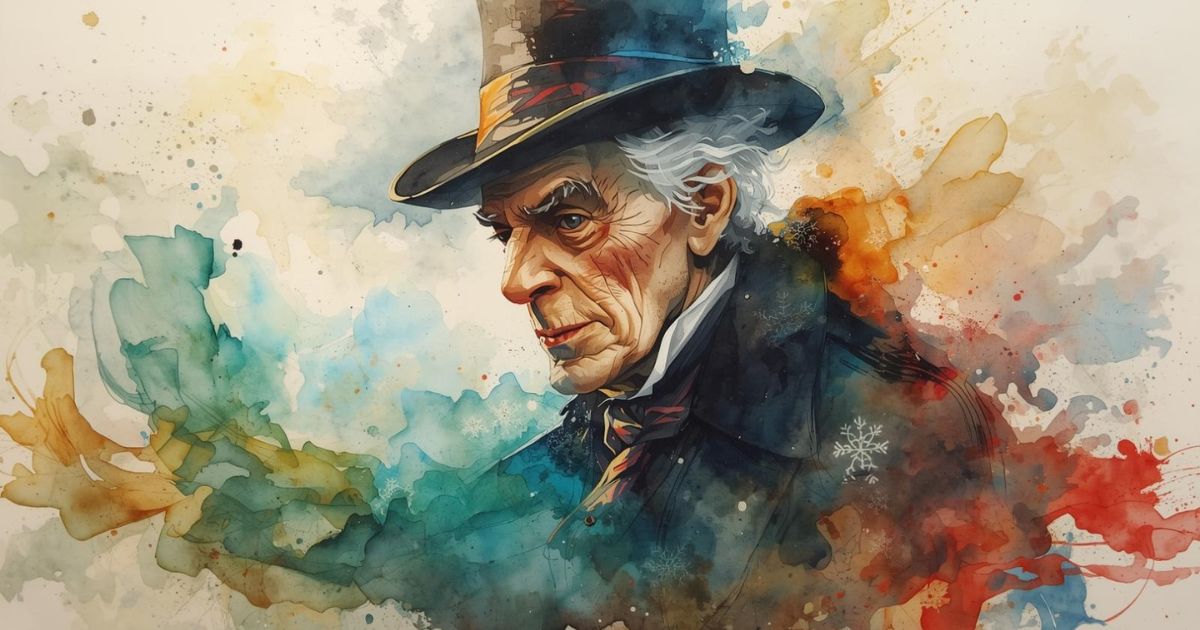
An excerpt from the original text.(complete · 6209 words)
STAVE TWO
[Illustration]
THE FIRST OF THE THREE SPIRITS
When Scrooge awoke it was so dark, that, looking out of bed, he could
scarcely distinguish the transparent window from the opaque walls of his
chamber. He was endeavouring to pierce the darkness with his ferret
eyes, when the chimes of a neighbouring church struck the four quarters.
So he listened for the hour.
To his great astonishment, the heavy bell went on from six to seven, and
from seven to eight, and regularly up to twelve; then stopped. Twelve!
It was past two when he went to bed. The clock was wrong. An icicle must
have got into the works. Twelve!
He touched the spring of his repeater, to correct this most preposterous
clock. Its rapid little pulse beat twelve, and stopped.
'Why, it isn't possible,' said Scrooge, 'that I can have slept through a
whole day and far into another night. It isn't possible that anything
has happened to the sun, and this is twelve at noon!'
The idea being an alarming one, he scrambled out of bed, and groped his
way to the window. He was obliged to rub the frost off with the sleeve
of his dressing-gown before he could see anything; and could see very
little then. All he could make out was, that it was still very foggy and
extremely cold, and that there was no noise of people running to and
fro, and making a great stir, as there unquestionably would have been if
night had beaten off bright day, and taken possession of the world. This
was a great relief, because 'Three days after sight of this First of
Exchange pay to Mr. Ebenezer Scrooge or his order,' and so forth, would
have become a mere United States security if there were no days to count
by.
Scrooge went to bed again, and thought, and thought, and thought it over
and over, and could make nothing of it. The more he thought, the more
perplexed he was; and, the more he endeavoured not to think, the more he
thought.
Marley's Ghost bothered him exceedingly. Every time he resolved within
himself, after mature inquiry that it was all a dream, his mind flew
back again, like a strong spring released, to its first position, and
presented the same problem to be worked all through, 'Was it a dream or
not?'
Scrooge lay in this state until the chime had gone three-quarters more,
when he remembered, on a sudden, that the Ghost had warned him of a
visitation when the bell tolled one. He resolved to lie awake until the
hour was passed; and, considering that he could no more go to sleep than
go to heaven, this was, perhaps, the wisest resolution in his power.
The quarter was so long, that he was more than once convinced he must
have sunk into a doze unconsciously, and missed the clock. At length it
broke upon his listening ear.
'Ding, dong!'
'A quarter past,' said Scrooge, counting.
'Ding, dong!'
'Half past,' said Scrooge.
'Ding, dong!'
'A quarter to it.' said Scrooge.
'Ding, dong!'
'The hour itself,' said Scrooge triumphantly, 'and nothing else!'
He spoke before the hour bell sounded, which it now did with a deep,
dull, hollow, melancholy ONE. Light flashed up in the room upon the
instant, and the curtains of his bed were drawn.
The curtains of his bed were drawn aside, I tell you, by a hand. Not
the curtains at his feet, nor the curtains at his back, but those to
which his face was addressed. The curtains of his bed were drawn aside;
and Scrooge, starting up into a half-recumbent attitude, found himself
face to face with the unearthly visitor who drew them: as close to it as
I am now to you, and I am standing in the spirit at your elbow.
It was a strange figure--like a child; yet not so like a child as like
an old man, viewed through some supernatural medium, which gave him the
appearance of having receded from the view, and being diminished to a
child's proportions. Its hair, which hung about its neck and down its
back, was white, as if with age; and yet the face had not a wrinkle in
it, and the tenderest bloom was on the skin. The arms were very long and
muscular; the hands the same, as if its hold were of uncommon strength.
Its legs and feet, most delicately formed, were, like those upper
members, bare. It wore a tunic of the purest white; and round its waist
was bound a lustrous belt, the sheen of which was beautiful. It held a
branch of fresh green holly in its hand; and, in singular contradiction
of that wintry emblem, had its dress trimmed with summer flowers. But
the strangest thing about it was, that from the crown of its head there
sprang a bright clear jet of light, by which all this was visible; and
which was doubtless the occasion of its using, in its duller moments, a
great extinguisher for a cap, which it now held under its arm.
Even this, though, when Scrooge looked at it with increasing steadiness,
was not its strangest quality. For, as its belt sparkled and
glittered, now in one part and now in another, and what was light one
instant at another time was dark, so the figure itself fluctuated in its
distinctness; being now a thing with one arm, now with one leg, now with
twenty legs, now a pair of legs without a head, now a head without a
body: of which dissolving parts no outline would be visible in the dense
gloom wherein they melted away. And, in the very wonder of this, it
would be itself again; distinct and clear as ever.
'Are you the Spirit, sir, whose coming was foretold to me?' asked
Scrooge.
'I am!'
The voice was soft and gentle. Singularly low, as if, instead of being
so close behind him, it were at a distance.
'Who and what are you?' Scrooge demanded.
'I am the Ghost of Christmas Past.'
'Long Past?' inquired Scrooge, observant of its dwarfish stature.
'No. Your past.'
Perhaps Scrooge could not have told anybody why, if anybody could have
asked him; but he had a special desire to see the Spirit in his cap,
and begged him to be covered.
'What!' exclaimed the Ghost, 'would you so soon put out, with worldly
hands, the light I give? Is it not enough that you are one of those
whose passions made this cap, and force me through whole trains of years
to wear it low upon my brow?'
Scrooge reverently disclaimed all intention to offend or any knowledge
of having wilfully 'bonneted' the Spirit at any period of his life. He
then made bold to inquire what business brought him there.
'Your welfare!' said the Ghost.
Scrooge expressed himself much obliged, but could not help thinking that
a night of unbroken rest would have been more conducive to that end. The
Spirit must have heard him thinking, for it said immediately--
'Your reclamation, then. Take heed!'
It put out its strong hand as it spoke, and clasped him gently by the
arm.
'Rise! and walk with me!'
It would have been in vain for Scrooge to plead that the weather and the
hour were not adapted to pedestrian purposes; that bed was warm, and the
thermometer a long way below freezing; that he was clad but lightly in
his slippers, dressing-gown, and nightcap; and that he had a cold upon
him at that time. The grasp, though gentle as a woman's hand, was not
to be resisted. He rose; but, finding that the Spirit made towards the
window, clasped its robe in supplication.
'I am a mortal,' Scrooge remonstrated, 'and liable to fall.'
'Bear but a touch of my hand there,' said the Spirit, laying it upon
his heart, 'and you shall be upheld in more than this!'
As the words were spoken, they passed through the wall, and stood upon
an open country road, with fields on either hand. The city had entirely
vanished. Not a vestige of it was to be seen. The darkness and the mist
had vanished with it, for it was a clear, cold, winter day, with snow
upon the ground.
'Good Heaven!' said Scrooge, clasping his hands together, as he looked
about him. 'I was bred in this place. I was a boy here!'
The Spirit gazed upon him mildly. Its gentle touch, though it had been
light and instantaneous, appeared still present to the old man's sense
of feeling. He was conscious of a thousand odours floating in the air,
each one connected with a thousand thoughts, and hopes, and joys, and
cares long, long forgotten!
'Your lip is trembling,' said the Ghost. 'And what is that upon your
cheek?'
Scrooge muttered, with an unusual catching in his voice, that it was a
pimple; and begged the Ghost to lead him where he would.
'You recollect the way?' inquired the Spirit.
'Remember it!' cried Scrooge with fervour; 'I could walk it blindfold.'
'Strange to have forgotten it for so many years!' observed the Ghost.
'Let us go on.'
They walked along the road, Scrooge recognising every gate, and post,
and tree, until a little market-town appeared in the distance, with its
bridge, its church, and winding river. Some shaggy ponies now were seen
trotting towards them with boys upon their backs, who called to other
boys in country gigs and carts, driven by farmers. All these boys were
in great spirits, and shouted to each other, until the broad fields were
so full of merry music, that the crisp air laughed to hear it.
'These are but shadows of the things that have been,' said the Ghost.
'They have no consciousness of us.'
The jocund travellers came on; and as they came, Scrooge knew and named
them every one. Why was he rejoiced beyond all bounds to see them? Why
did his cold eye glisten, and his heart leap up as they went past? Why
was he filled with gladness when he heard them give each other Merry
Christmas, as they parted at cross-roads and by-ways for their several
homes? What was merry Christmas to Scrooge? Out upon merry Christmas!
What good had it ever done to him?
'The school is not quite deserted,' said the Ghost. 'A solitary child,
neglected by his friends, is left there still.'
Scrooge said he knew it. And he sobbed.
They left the high-road by a well-remembered lane and soon approached a
mansion of dull red brick, with a little weather-cock surmounted cupola
on the roof, and a bell hanging in it. It was a large house, but one of
broken fortunes; for the spacious offices were little used, their walls
were damp and mossy, their windows broken, and their gates decayed.
Fowls clucked and strutted in the stables; and the coach-houses and
sheds were overrun with grass. Nor was it more retentive of its ancient
state within; for, entering the dreary hall, and glancing through the
open doors of many rooms, they found them poorly furnished, cold, and
vast. There was an earthy savour in the air, a chilly bareness in the
place, which associated itself somehow with too much getting up by
candle light and not too much to eat.
They went, the Ghost and Scrooge, across the hall, to a door at the back
of the house. It opened before them, and disclosed a long, bare,
melancholy room, made barer still by lines of plain deal forms and
desks. At one of these a lonely boy was reading near a feeble fire; and
Scrooge sat down upon a form, and wept to see his poor forgotten self as
he had used to be.
Not a latent echo in the house, not a squeak and scuffle from the mice
behind the panelling, not a drip from the half-thawed waterspout in the
dull yard behind, not a sigh among the leafless boughs of one despondent
poplar, not the idle swinging of an empty storehouse door, no, not a
clicking in the fire, but fell upon the heart of Scrooge with softening
influence, and gave a freer passage to his tears.
The Spirit touched him on the arm, and pointed to his younger self,
intent upon his reading. Suddenly a man in foreign garments, wonderfully
real and distinct to look at, stood outside the window, with an axe
stuck in his belt, and leading by the bridle an ass laden with wood.
'Why, it's Ali Baba!' Scrooge exclaimed in ecstasy. 'It's dear old
honest Ali Baba! Yes, yes, I know. One Christmas-time, when yonder
solitary child was left here all alone, he did come, for the first
time, just like that. Poor boy! And Valentine,' said Scrooge, 'and his
wild brother, Orson; there they go! And what's his name, who was put
down in his drawers, asleep, at the gate of Damascus; don't you see him?
And the Sultan's Groom turned upside down by the Genii; there he is upon
his head! Serve him right! I'm glad of it. What business had he to be
married to the Princess?'
To hear Scrooge expending all the earnestness of his nature on such
subjects, in a most extraordinary voice between laughing and crying; and
to see his heightened and excited face; would have been a surprise to
his business friends in the City, indeed.
'There's the Parrot!' cried Scrooge. 'Green body and yellow tail, with a
thing like a lettuce growing out of the top of his head; there he is!
Poor Robin Crusoe he called him, when he came home again after sailing
round the island. "Poor Robin Crusoe, where have you been, Robin
Crusoe?" The man thought he was dreaming, but he wasn't. It was the
Parrot, you know. There goes Friday, running for his life to the little
creek! Halloa! Hoop! Halloo!'
Then, with a rapidity of transition very foreign to his usual character,
he said, in pity for his former self, 'Poor boy!' and cried again.
'I wish,' Scrooge muttered, putting his hand in his pocket, and looking
about him, after drying his eyes with his cuff; 'but it's too late now.'
'What is the matter?' asked the Spirit.
'Nothing,' said Scrooge. 'Nothing. There was a boy singing a Christmas
carol at my door last night. I should like to have given him something:
that's all.'
The Ghost smiled thoughtfully, and waved its hand, saying as it did so,
'Let us see another Christmas!'
Scrooge's former self grew larger at the words, and the room became a
little darker and more dirty. The panels shrunk, the windows cracked;
fragments of plaster fell out of the ceiling, and the naked laths were
shown instead; but how all this was brought about Scrooge knew no more
than you do. He only knew that it was quite correct; that everything had
happened so; that there he was, alone again, when all the other boys had
gone home for the jolly holidays.
He was not reading now, but walking up and down despairingly. Scrooge
looked at the Ghost, and, with a mournful shaking of his head, glanced
anxiously towards the door.
It opened; and a little girl, much younger than the boy, came darting
in, and, putting her arms about his neck, and often kissing him,
addressed him as her 'dear, dear brother.'
'I have come to bring you home, dear brother!' said the child, clapping
her tiny hands, and bending down to laugh. 'To bring you home, home,
home!'
'Home, little Fan?' returned the boy.
'Yes!' said the child, brimful of glee. 'Home for good and all. Home for
ever and ever. Father is so much kinder than he used to be, that home's
like heaven! He spoke so gently to me one dear night when I was going to
bed, that I was not afraid to ask him once more if you might come home;
and he said Yes, you should; and sent me in a coach to bring you. And
you're to be a man!' said the child, opening her eyes; 'and are never to
come back here; but first we're to be together all the Christmas long,
and have the merriest time in all the world.'
'You are quite a woman, little Fan!' exclaimed the boy.
She clapped her hands and laughed, and tried to touch his head; but,
being too little laughed again, and stood on tiptoe to embrace him. Then
she began to drag him, in her childish eagerness, towards the door; and
he, nothing loath to go, accompanied her.
A terrible voice in the hall cried, 'Bring down Master Scrooge's box,
there!' and in the hall appeared the schoolmaster himself, who glared on
Master Scrooge with a ferocious condescension, and threw him into a
dreadful state of mind by shaking hands with him. He then conveyed him
and his sister into the veriest old well of a shivering best parlour
that ever was seen, where the maps upon the wall, and the celestial and
terrestrial globes in the windows, were waxy with cold. Here he produced
a decanter of curiously light wine, and a block of curiously heavy cake,
and administered instalments of those dainties to the young people; at
the same time sending out a meagre servant to offer a glass of
'something' to the postboy, who answered that he thanked the gentleman,
but, if it was the same tap as he had tasted before, he had rather not.
Master Scrooge's trunk being by this time tied on to the top of the
chaise, the children bade the schoolmaster good-bye right willingly;
and, getting into it, drove gaily down the garden sweep; the quick
wheels dashing the hoar-frost and snow from off the dark leaves of the
evergreens like spray.
[Illustration: HE PRODUCED A DECANTER OF CURIOUSLY LIGHT WINE, AND A
BLOCK OF CURIOUSLY HEAVY CAKE]
'Always a delicate creature, whom a breath might have withered,' said
the Ghost. 'But she had a large heart!'
'So she had,' cried Scrooge. 'You're right. I will not gainsay it,
Spirit. God forbid!'
'She died a woman,' said the Ghost, 'and had, as I think, children.'
'One child,' Scrooge returned.
'True,' said the Ghost. 'Your nephew!'
Scrooge seemed uneasy in his mind, and answered briefly, 'Yes.'
Although they had but that moment left the school behind them, they were
now in the busy thoroughfares of a city, where shadowy passengers passed
and re-passed; where shadowy carts and coaches battled for the way, and
all the strife and tumult of a real city were. It was made plain enough,
by the dressing of the shops, that here, too, it was Christmas-time
again; but it was evening, and the streets were lighted up.
The Ghost stopped at a certain warehouse door, and asked Scrooge if he
knew it.
'Know it!' said Scrooge. 'Was I apprenticed here?'
They went in. At sight of an old gentleman in a Welsh wig, sitting
behind such a high desk, that if he had been two inches taller, he must
have knocked his head against the ceiling, Scrooge cried in great
excitement--
'Why, it's old Fezziwig! Bless his heart, it's Fezziwig alive again!'
Old Fezziwig laid down his pen, and looked up at the clock, which
pointed to the hour of seven. He rubbed his hands; adjusted his
capacious waistcoat; laughed all over himself, from his shoes to his
organ of benevolence; and called out, in a comfortable, oily, rich, fat,
jovial voice--
'Yo ho, there! Ebenezer! Dick!'
Scrooge's former self, now grown a young man, came briskly in,
accompanied by his fellow-'prentice.
'Dick Wilkins, to be sure!' said Scrooge to the Ghost. 'Bless me, yes.
There he is. He was very much attached to me, was Dick. Poor Dick! Dear,
dear!'
'Yo ho, my boys!' said Fezziwig. 'No more work to-night. Christmas Eve,
Dick. Christmas, Ebenezer! Let's have the shutters up,' cried old
Fezziwig, with a sharp clap of his hands, 'before a man can say Jack
Robinson!'
You wouldn't believe how those two fellows went at it! They charged into
the street with the shutters--one, two, three--had 'em up in their
places--four, five, six--barred 'em and pinned 'em--seven, eight,
nine--and came back before you could have got to twelve, panting like
racehorses.
'Hilli-ho!' cried old Fezziwig, skipping down from the high desk with
wonderful agility. 'Clear away, my lads, and let's have lots of room
here! Hilli-ho, Dick! Chirrup, Ebenezer!'
Clear away! There was nothing they wouldn't have cleared away, or
couldn't have cleared away, with old Fezziwig looking on. It was done in
a minute. Every movable was packed off, as if it were dismissed from
public life for evermore; the floor was swept and watered, the lamps
were trimmed, fuel was heaped upon the fire; and the warehouse was as
snug, and warm, and dry, and bright a ball-room as you would desire to
see upon a winter's night.
In came a fiddler with a music-book, and went up to the lofty desk, and
made an orchestra of it, and tuned like fifty stomach-aches. In came
Mrs. Fezziwig, one vast substantial smile. In came the three Miss
Fezziwigs, beaming and lovable. In came the six young followers whose
hearts they broke. In came all the young men and women employed in the
business. In came the housemaid, with her cousin the baker. In came the
cook with her brother's particular friend the milkman. In came the boy
from over the way, who was suspected of not having board enough from his
master; trying to hide himself behind the girl from next door but one,
who was proved to have had her ears pulled by her mistress. In they all
came, one after another; some shyly, some boldly, some gracefully, some
awkwardly, some pushing, some pulling; in they all came, any how and
every how. Away they all went, twenty couple at once; hands half round
and back again the other way; down the middle and up again; round and
round in various stages of affectionate grouping; old top couple always
turning up in the wrong place; new top couple starting off again as soon
as they got there; all top couples at last, and not a bottom one to help
them! When this result was brought about, old Fezziwig, clapping his
hands to stop the dance, cried out, 'Well done!' and the fiddler plunged
his hot face into a pot of porter, especially provided for that purpose.
But, scorning rest upon his reappearance, he instantly began again,
though there were no dancers yet, as if the other fiddler had been
carried home, exhausted, on a shutter, and he were a bran-new man
resolved to beat him out of sight, or perish.
[Illustration: Then old Fezziwig stood out to dance with Mrs.
Fezziwig]
There were more dances, and there were forfeits, and more dances, and
there was cake, and there was negus, and there was a great piece of Cold
Roast, and there was a great piece of Cold Boiled, and there were
mince-pies, and plenty of beer. But the great effect of the evening came
after the Roast and Boiled, when the fiddler (an artful dog, mind! The
sort of man who knew his business better than you or I could have told
it him!) struck up 'Sir Roger de Coverley.' Then old Fezziwig stood
out to dance with Mrs. Fezziwig. Top couple, too; with a good stiff
piece of work cut out for them; three or four and twenty pair of
partners; people who were not to be trifled with; people who would
dance, and had no notion of walking.
But if they had been twice as many--ah! four times--old Fezziwig would
have been a match for them, and so would Mrs. Fezziwig. As to her, she
was worthy to be his partner in every sense of the term. If that's not
high praise, tell me higher, and I'll use it. A positive light appeared
to issue from Fezziwig's calves. They shone in every part of the dance
like moons. You couldn't have predicted, at any given time, what would
become of them next. And when old Fezziwig and Mrs. Fezziwig had gone
all through the dance; advance and retire, both hands to your partner,
bow and curtsy, cork-screw, thread-the-needle, and back again to your
place: Fezziwig 'cut'--cut so deftly, that he appeared to wink with his
legs, and came upon his feet again without a stagger.
When the clock struck eleven, this domestic ball broke up. Mr. and Mrs.
Fezziwig took their stations, one on either side the door, and, shaking
hands with every person individually as he or she went out, wished him
or her a Merry Christmas. When everybody had retired but the two
'prentices, they did the same to them; and thus the cheerful voices died
away, and the lads were left to their beds; which were under a counter
in the back-shop.
During the whole of this time Scrooge had acted like a man out of his
wits. His heart and soul were in the scene, and with his former self. He
corroborated everything, remembered everything, enjoyed everything, and
underwent the strangest agitation. It was not until now, when the bright
faces of his former self and Dick were turned from them, that he
remembered the Ghost, and became conscious that it was looking full upon
him, while the light upon its head burnt very clear.
'A small matter,' said the Ghost, 'to make these silly folks so full of
gratitude.'
'Small!' echoed Scrooge.
The Spirit signed to him to listen to the two apprentices, who were
pouring out their hearts in praise of Fezziwig; and when he had done so,
said:
'Why! Is it not? He has spent but a few pounds of your mortal money:
three or four, perhaps. Is that so much that he deserves this praise?'
'It isn't that,' said Scrooge, heated by the remark, and speaking
unconsciously like his former, not his latter self. 'It isn't that,
Spirit. He has the power to render us happy or unhappy; to make our
service light or burdensome; a pleasure or a toil. Say that his power
lies in words and looks; in things so slight and insignificant that it
is impossible to add and count 'em up: what then? The happiness he gives
is quite as great as if it cost a fortune.'
He felt the Spirit's glance, and stopped.
'What is the matter?' asked the Ghost.
'Nothing particular,' said Scrooge.
'Something, I think?' the Ghost insisted.
'No,' said Scrooge, 'no. I should like to be able to say a word or two
to my clerk just now. That's all.'
His former self turned down the lamps as he gave utterance to the wish;
and Scrooge and the Ghost again stood side by side in the open air.
'My time grows short,' observed the Spirit. 'Quick!'
This was not addressed to Scrooge, or to any one whom he could see, but
it produced an immediate effect. For again Scrooge saw himself. He was
older now; a man in the prime of life. His face had not the harsh and
rigid lines of later years; but it had begun to wear the signs of care
and avarice. There was an eager, greedy, restless motion in the eye,
which showed the passion that had taken root, and where the shadow of
the growing tree would fall.
He was not alone, but sat by the side of a fair young girl in a mourning
dress: in whose eyes there were tears, which sparkled in the light that
shone out of the Ghost of Christmas Past.
'It matters little,' she said softly. 'To you, very little. Another idol
has displaced me; and, if it can cheer and comfort you in time to come
as I would have tried to do, I have no just cause to grieve.'
'What Idol has displaced you?' he rejoined.
'A golden one.'
'This is the even-handed dealing of the world!' he said. 'There is
nothing on which it is so hard as poverty; and there is nothing it
professes to condemn with such severity as the pursuit of wealth!'
'You fear the world too much,' she answered gently. 'All your other
hopes have merged into the hope of being beyond the chance of its sordid
reproach. I have seen your nobler aspirations fall off one by one, until
the master passion, Gain, engrosses you. Have I not?'
'What then?' he retorted. 'Even if I have grown so much wiser, what
then? I am not changed towards you.'
She shook her head.
'Am I?'
'Our contract is an old one. It was made when we were both poor, and
content to be so, until, in good season, we could improve our worldly
fortune by our patient industry. You are changed. When it was made you
were another man.'
'I was a boy,' he said impatiently.
'Your own feeling tells you that you were not what you are,' she
returned. 'I am. That which promised happiness when we were one in heart
is fraught with misery now that we are two. How often and how keenly I
have thought of this I will not say. It is enough that I have thought
of it, and can release you.'
'Have I ever sought release?'
'In words. No. Never.'
'In what, then?'
'In a changed nature; in an altered spirit; in another atmosphere of
life; another Hope as its great end. In everything that made my love of
any worth or value in your sight. If this had never been between us,'
said the girl, looking mildly, but with steadiness, upon him; 'tell me,
would you seek me out and try to win me now? Ah, no!'
He seemed to yield to the justice of this supposition in spite of
himself. But he said, with a struggle, 'You think not.'
'I would gladly think otherwise if I could,' she answered. 'Heaven
knows! When I have learned a Truth like this, I know how strong and
irresistible it must be. But if you were free to-day, to-morrow,
yesterday, can even I believe that you would choose a dowerless
girl--you who, in your very confidence with her, weigh everything by
Gain: or, choosing her, if for a moment you were false enough to your
one guiding principle to do so, do I not know that your repentance and
regret would surely follow? I do; and I release you. With a full heart,
for the love of him you once were.'
[Illustration: SHE LEFT HIM, AND THEY PARTED]
He was about to speak; but, with her head turned from him, she resumed:
'You may--the memory of what is past half makes me hope you will--have
pain in this. A very, very brief time, and you will dismiss the
recollection of it gladly, as an unprofitable dream, from which it
happened well that you awoke. May you be happy in the life you have
chosen!'
She left him, and they parted.
'Spirit!' said Scrooge, 'show me no more! Conduct me home. Why do you
delight to torture me?'
'One shadow more!' exclaimed the Ghost.
'No more!' cried Scrooge. 'No more! I don't wish to see it. Show me no
more!'
But the relentless Ghost pinioned him in both his arms, and forced him
to observe what happened next.
They were in another scene and place; a room, not very large or
handsome, but full of comfort. Near to the winter fire sat a beautiful
young girl, so like that last that Scrooge believed it was the same,
until he saw her, now a comely matron, sitting opposite her daughter.
The noise in this room was perfectly tumultuous, for there were more
children there than Scrooge in his agitated state of mind could count;
and, unlike the celebrated herd in the poem, they were not forty
children conducting themselves like one, but every child was conducting
itself like forty. The consequences were uproarious beyond belief; but
no one seemed to care; on the contrary, the mother and daughter laughed
heartily, and enjoyed it very much; and the latter, soon beginning to
mingle in the sports, got pillaged by the young brigands most
ruthlessly. What would I not have given to be one of them! Though I
never could have been so rude, no, no! I wouldn't for the wealth of all
the world have crushed that braided hair, and torn it down; and for the
precious little shoe, I wouldn't have plucked it off, God bless my soul!
to save my life. As to measuring her waist in sport, as they did, bold
young brood, I couldn't have done it; I should have expected my arm to
have grown round it for a punishment, and never come straight again. And
yet I should have dearly liked, I own, to have touched her lips; to have
questioned her, that she might have opened them; to have looked upon the
lashes of her downcast eyes, and never raised a blush; to have let loose
waves of hair, an inch of which would be a keepsake beyond price: in
short, I should have liked, I do confess, to have had the lightest
license of a child, and yet to have been man enough to know its value.
[Illustration: A flushed and boisterous group]
But now a knocking at the door was heard, and such a rush immediately
ensued that she, with laughing face and plundered dress, was borne
towards it the centre of a flushed and boisterous group, just in time to
greet the father, who came home attended by a man laden with Christmas
toys and presents. Then the shouting and the struggling, and the
onslaught that was made on the defenceless porter! The scaling him, with
chairs for ladders, to dive into his pockets, despoil him of
brown-paper parcels, hold on tight by his cravat, hug him round his
neck, pummel his back, and kick his legs in irrepressible affection! The
shouts of wonder and delight with which the development of every package
was received! The terrible announcement that the baby had been taken in
the act of putting a doll's frying pan into his mouth, and was more than
suspected of having swallowed a fictitious turkey, glued on a wooden
platter! The immense relief of finding this a false alarm! The joy, and
gratitude, and ecstasy! They are all indescribable alike. It is enough
that, by degrees, the children and their emotions got out of the
parlour, and, by one stair at a time, up to the top of the house, where
they went to bed, and so subsided.
And now Scrooge looked on more attentively than ever, when the master of
the house, having his daughter leaning fondly on him, sat down with her
and her mother at his own fireside; and when he thought that such
another creature, quite as graceful and as full of promise, might have
called him father, and been a spring-time in the haggard winter of his
life, his sight grew very dim indeed.
'Belle,' said the husband, turning to his wife with a smile, 'I saw an
old friend of yours this afternoon.'
'Who was it?'
'Guess!'
'How can I? Tut, don't I know?' she added in the same breath, laughing
as he laughed. 'Mr. Scrooge.'
'Mr. Scrooge it was. I passed his office window; and as it was not shut
up, and he had a candle inside, I could scarcely help seeing him. His
partner lies upon the point of death, I hear; and there he sat alone.
Quite alone in the world, I do believe.'
'Spirit!' said Scrooge in a broken voice, 'remove me from this place.'
'I told you these were shadows of the things that have been,' said the
Ghost. 'That they are what they are do not blame me!'
'Remove me!' Scrooge exclaimed, 'I cannot bear it!'
He turned upon the Ghost, and seeing that it looked upon him with a
face, in which in some strange way there were fragments of all the faces
it had shown him, wrestled with it.
'Leave me! Take me back. Haunt me no longer!'
In the struggle, if that can be called a struggle in which the Ghost
with no visible resistance on its own part was undisturbed by any effort
of its adversary, Scrooge observed that its light was burning high and
bright; and dimly connecting that with its influence over him, he seized
the extinguisher-cap, and by a sudden action pressed it down upon its
head.
[Illustration: Laden with Christmas toys and presents]
The Spirit dropped beneath it, so that the extinguisher covered its
whole form; but though Scrooge pressed it down with all his force, he
could not hide the light, which streamed from under it, in an unbroken
flood upon the ground.
He was conscious of being exhausted, and overcome by an irresistible
drowsiness; and, further, of being in his own bedroom. He gave the cap a
parting squeeze, in which his hand relaxed; and had barely time to reel
to bed, before he sank into a heavy sleep.
[Illustration]
Master this chapter. Complete your experience
Purchase the complete book to access all chapters and support classic literature
As an Amazon Associate, we earn a small commission from qualifying purchases at no additional cost to you.
Available in paperback, hardcover, and e-book formats
Let's Analyse the Pattern
How unhealed wounds create defensive behaviors that eventually isolate us from the very connections and experiences that could heal us.
Why This Matters
Connect literature to life
This chapter teaches how to identify when your coping mechanisms have become your cage, trapping you in the very isolation you were trying to avoid.
Practice This Today
This week, notice when you pull back from connection after being hurt—ask yourself if you're protecting your heart or imprisoning it.
Now let's explore the literary elements.
Key Quotes & Analysis
"I should like to have given him something: that's all."
Context: Watching his lonely childhood self, thinking of the carol singer he dismissed
This shows Scrooge beginning to feel empathy and regret. Seeing his own childhood loneliness makes him understand how small kindnesses matter. It's the first crack in his hardened heart.
In Today's Words:
I wish I'd been nicer to that kid who was just trying to spread some Christmas cheer.
"He has the power to render us happy or unhappy; to make our service light or burdensome; a pleasure or a toil."
Context: Defending Mr. Fezziwig to the Ghost, explaining how a boss's attitude affects workers
Scrooge recognizes that leadership is about more than money - it's about how you treat people. This wisdom makes his current treatment of Bob Cratchit even more inexcusable.
In Today's Words:
A good boss can make even a tough job feel worth it, while a bad boss makes everything miserable.
"Another idol has displaced me; and if it can cheer and comfort you in time to come, as I would have tried to do, I release you."
Context: Breaking their engagement because Scrooge now loves money more than her
Belle sees clearly what Scrooge can't - that his obsession with wealth has killed his capacity for love. She's not angry, just heartbroken, which makes it more devastating.
In Today's Words:
You love money more than you love me, so I'm letting you go to be with what you really want.
Thematic Threads
Childhood Wounds
In This Chapter
Young Scrooge's abandonment at school and his desperate attachment to fictional characters for comfort
Development
Introduced here as the root cause of adult dysfunction
In Your Life:
You might recognize how your own childhood experiences of feeling left out or unprotected still influence your adult relationships and choices.
The Cost of Protection
In This Chapter
Scrooge's gradual shift from vulnerability with Belle to choosing financial security over love
Development
Shows how protective mechanisms become self-destructive
In Your Life:
You might see how your own walls built to prevent hurt also prevent the good things from getting in.
Leadership and Influence
In This Chapter
Fezziwig's ability to create joy and meaning with minimal resources through genuine care for his employees
Development
Contrasts with Scrooge's miserly approach to business relationships
In Your Life:
You might recognize how small acts of recognition and celebration can transform your workplace or family dynamics.
Lost Possibilities
In This Chapter
The vision of Belle's happy family life—the future Scrooge could have had
Development
Introduces the weight of choices and their long-term consequences
In Your Life:
You might feel the ache of paths not taken and wonder what different choices might have brought you.
Truth and Denial
In This Chapter
Scrooge's desperate attempt to extinguish the spirit's light, trying to stop the painful revelations
Development
Shows how we resist uncomfortable truths about ourselves
In Your Life:
You might recognize your own tendency to avoid or shut down conversations that force you to confront difficult realities about your choices.
You now have the context. Time to form your own thoughts.
Discussion Questions
- 1
What specific moments from Scrooge's past does the Ghost show him, and how does each one reveal something different about who he used to be?
analysis • surface - 2
Why does Scrooge try to extinguish the Ghost's light at the end of the chapter, and what does this tell us about how people handle painful truths?
analysis • medium - 3
Where do you see people today building emotional walls to protect themselves, and how do those walls sometimes become prisons?
application • medium - 4
If you were Belle, Scrooge's former fiancée, how would you handle loving someone who was slowly changing into someone you couldn't recognize?
application • deep - 5
What does Scrooge's journey from lonely child to bitter adult teach us about the difference between protecting ourselves and imprisoning ourselves?
reflection • deep
Critical Thinking Exercise
Track Your Own Hardening Points
Think about a time when you got hurt and decided to 'never let that happen again.' Map out how that protective decision affected your behavior over time. Did it keep you safe, or did it also block out good things? Write down three specific ways that old hurt still influences your choices today.
Consider:
- •Notice the difference between reasonable caution and total shutdown
- •Consider what opportunities or connections you might have missed
- •Think about whether your protective strategies still serve you or limit you
Journaling Prompt
Write about a relationship or situation where you've been slowly pulling back to protect yourself. What would it look like to stay open while still being wise?
Coming Up Next...
Chapter 3: The Spirit of Christmas Present
As Scrooge collapses into exhausted sleep, another spirit waits to continue his journey. The Ghost of Christmas Present will show him not the past, but what's happening right now—revealing the current cost of his choices and the lives he's affecting today.



