An excerpt from the original text.(complete · 2351 words)
hortly after nine o’clock that evening, Weyrother drove with his
plans to Kutúzov’s quarters where the council of war was to be
held. All the commanders of columns were summoned to the commander in
chief’s and with the exception of Prince Bagratión, who declined to
come, were all there at the appointed time.
Weyrother, who was in full control of the proposed battle, by his
eagerness and briskness presented a marked contrast to the dissatisfied
and drowsy Kutúzov, who reluctantly played the part of chairman and
president of the council of war. Weyrother evidently felt himself to be
at the head of a movement that had already become unrestrainable. He was
like a horse running downhill harnessed to a heavy cart. Whether he was
pulling it or being pushed by it he did not know, but rushed along at
headlong speed with no time to consider what this movement might lead
to. Weyrother had been twice that evening to the enemy’s picket
line to reconnoiter personally, and twice to the Emperors, Russian and
Austrian, to report and explain, and to his headquarters where he had
dictated the dispositions in German, and now, much exhausted, he arrived
at Kutúzov’s.
He was evidently so busy that he even forgot to be polite to the
commander in chief. He interrupted him, talked rapidly and indistinctly,
without looking at the man he was addressing, and did not reply to
questions put to him. He was bespattered with mud and had a pitiful,
weary, and distracted air, though at the same time he was haughty and
self-confident.
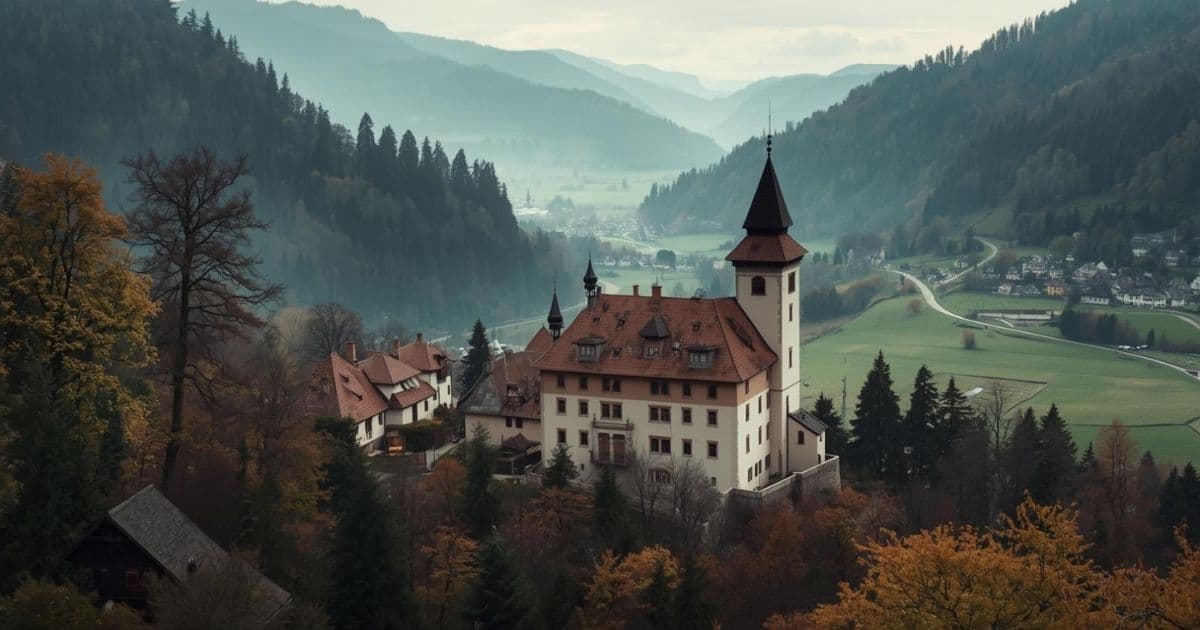
Kutúzov was occupying a nobleman’s castle of modest dimensions near
Ostralitz. In the large drawing room which had become the commander
in chief’s office were gathered Kutúzov himself, Weyrother, and the
members of the council of war. They were drinking tea, and only awaited
Prince Bagratión to begin the council. At last Bagratión’s orderly
came with the news that the prince could not attend. Prince Andrew came
in to inform the commander in chief of this and, availing himself
of permission previously given him by Kutúzov to be present at the
council, he remained in the room.
“Since Prince Bagratión is not coming, we may begin,” said
Weyrother, hurriedly rising from his seat and going up to the table on
which an enormous map of the environs of Brünn was spread out.
Kutúzov, with his uniform unbuttoned so that his fat neck bulged over
his collar as if escaping, was sitting almost asleep in a low chair,
with his podgy old hands resting symmetrically on its arms. At the sound
of Weyrother’s voice, he opened his one eye with an effort.
“Yes, yes, if you please! It is already late,” said he, and nodding
his head he let it droop and again closed his eye.
If at first the members of the council thought that Kutúzov was
pretending to sleep, the sounds his nose emitted during the reading that
followed proved that the commander in chief at that moment was absorbed
by a far more serious matter than a desire to show his contempt for
the dispositions or anything else—he was engaged in satisfying the
irresistible human need for sleep. He really was asleep. Weyrother, with
the gesture of a man too busy to lose a moment, glanced at Kutúzov and,
having convinced himself that he was asleep, took up a paper and in
a loud, monotonous voice began to read out the dispositions for the
impending battle, under a heading which he also read out:
“Dispositions for an attack on the enemy position behind Kobelnitz and
Sokolnitz, November 30, 1805.”
The dispositions were very complicated and difficult. They began as
follows:
“As the enemy’s left wing rests on wooded hills and his right
extends along Kobelnitz and Sokolnitz behind the ponds that are there,
while we, on the other hand, with our left wing by far outflank his
right, it is advantageous to attack the enemy’s latter wing especially
if we occupy the villages of Sokolnitz and Kobelnitz, whereby we
can both fall on his flank and pursue him over the plain between
Schlappanitz and the Thuerassa forest, avoiding the defiles of
Schlappanitz and Bellowitz which cover the enemy’s front. For this
object it is necessary that... The first column marches... The second
column marches... The third column marches...” and so on, read
Weyrother.
The generals seemed to listen reluctantly to the difficult dispositions.
The tall, fair-haired General Buxhöwden stood, leaning his back against
the wall, his eyes fixed on a burning candle, and seemed not to listen
or even to wish to be thought to listen. Exactly opposite Weyrother,
with his glistening wide-open eyes fixed upon him and his mustache
twisted upwards, sat the ruddy Milorádovich in a military pose, his
elbows turned outwards, his hands on his knees, and his shoulders
raised. He remained stubbornly silent, gazing at Weyrother’s face,
and only turned away his eyes when the Austrian chief of staff finished
reading. Then Milorádovich looked round significantly at the other
generals. But one could not tell from that significant look whether he
agreed or disagreed and was satisfied or not with the arrangements. Next
to Weyrother sat Count Langeron who, with a subtle smile that never left
his typically southern French face during the whole time of the reading,
gazed at his delicate fingers which rapidly twirled by its corners
a gold snuffbox on which was a portrait. In the middle of one of the
longest sentences, he stopped the rotary motion of the snuffbox, raised
his head, and with inimical politeness lurking in the corners of his
thin lips interrupted Weyrother, wishing to say something. But the
Austrian general, continuing to read, frowned angrily and jerked his
elbows, as if to say: “You can tell me your views later, but now be so
good as to look at the map and listen.” Langeron lifted his eyes with
an expression of perplexity, turned round to Milorádovich as if seeking
an explanation, but meeting the latter’s impressive but meaningless
gaze drooped his eyes sadly and again took to twirling his snuffbox.
“A geography lesson!” he muttered as if to himself, but loud enough
to be heard.
Przebyszéwski, with respectful but dignified politeness, held his
hand to his ear toward Weyrother, with the air of a man absorbed in
attention. Dohktúrov, a little man, sat opposite Weyrother, with
an assiduous and modest mien, and stooping over the outspread map
conscientiously studied the dispositions and the unfamiliar locality. He
asked Weyrother several times to repeat words he had not clearly heard
and the difficult names of villages. Weyrother complied and Dohktúrov
noted them down.
When the reading which lasted more than an hour was over, Langeron again
brought his snuffbox to rest and, without looking at Weyrother or at
anyone in particular, began to say how difficult it was to carry out
such a plan in which the enemy’s position was assumed to be known,
whereas it was perhaps not known, since the enemy was in movement.
Langeron’s objections were valid but it was obvious that their chief
aim was to show General Weyrother—who had read his dispositions with
as much self-confidence as if he were addressing school children—that
he had to do, not with fools, but with men who could teach him something
in military matters.
When the monotonous sound of Weyrother’s voice ceased, Kutúzov opened
his eye as a miller wakes up when the soporific drone of the mill wheel
is interrupted. He listened to what Langeron said, as if remarking,
“So you are still at that silly business!” quickly closed his eye
again, and let his head sink still lower.
Langeron, trying as virulently as possible to sting Weyrother’s vanity
as author of the military plan, argued that Bonaparte might easily
attack instead of being attacked, and so render the whole of this
plan perfectly worthless. Weyrother met all objections with a firm and
contemptuous smile, evidently prepared beforehand to meet all objections
be they what they might.
“If he could attack us, he would have done so today,” said he.
“So you think he is powerless?” said Langeron.
“He has forty thousand men at most,” replied Weyrother, with the
smile of a doctor to whom an old wife wishes to explain the treatment of
a case.
“In that case he is inviting his doom by awaiting our attack,” said
Langeron, with a subtly ironical smile, again glancing round for support
to Milorádovich who was near him.
But Milorádovich was at that moment evidently thinking of anything
rather than of what the generals were disputing about.
“Ma foi!” said he, “tomorrow we shall see all that on the
battlefield.”
Weyrother again gave that smile which seemed to say that to him it was
strange and ridiculous to meet objections from Russian generals and to
have to prove to them what he had not merely convinced himself of, but
had also convinced the sovereign Emperors of.
“The enemy has quenched his fires and a continual noise is heard from
his camp,” said he. “What does that mean? Either he is retreating,
which is the only thing we need fear, or he is changing his position.”
(He smiled ironically.) “But even if he also took up a position in
the Thuerassa, he merely saves us a great deal of trouble and all our
arrangements to the minutest detail remain the same.”
“How is that?...” began Prince Andrew, who had for long been waiting
an opportunity to express his doubts.
Kutúzov here woke up, coughed heavily, and looked round at the
generals.
“Gentlemen, the dispositions for tomorrow—or rather for today, for
it is past midnight—cannot now be altered,” said he. “You have
heard them, and we shall all do our duty. But before a battle, there is
nothing more important...” he paused, “than to have a good sleep.”
He moved as if to rise. The generals bowed and retired. It was past
midnight. Prince Andrew went out.
The council of war, at which Prince Andrew had not been able to
express his opinion as he had hoped to, left on him a vague and uneasy
impression. Whether Dolgorúkov and Weyrother, or Kutúzov, Langeron,
and the others who did not approve of the plan of attack, were
right—he did not know. “But was it really not possible for Kutúzov
to state his views plainly to the Emperor? Is it possible that on
account of court and personal considerations tens of thousands of lives,
and my life, my life,” he thought, “must be risked?”
“Yes, it is very likely that I shall be killed tomorrow,” he
thought. And suddenly, at this thought of death, a whole series of most
distant, most intimate, memories rose in his imagination: he remembered
his last parting from his father and his wife; he remembered the days
when he first loved her. He thought of her pregnancy and felt sorry for
her and for himself, and in a nervously emotional and softened mood he
went out of the hut in which he was billeted with Nesvítski and began
to walk up and down before it.
The night was foggy and through the fog the moonlight gleamed
mysteriously. “Yes, tomorrow, tomorrow!” he thought. “Tomorrow
everything may be over for me! All these memories will be no more, none
of them will have any meaning for me. Tomorrow perhaps, even certainly,
I have a presentiment that for the first time I shall have to show all
I can do.” And his fancy pictured the battle, its loss, the
concentration of fighting at one point, and the hesitation of all the
commanders. And then that happy moment, that Toulon for which he had
so long waited, presents itself to him at last. He firmly and clearly
expresses his opinion to Kutúzov, to Weyrother, and to the Emperors.
All are struck by the justness of his views, but no one undertakes to
carry them out, so he takes a regiment, a division—stipulates that no
one is to interfere with his arrangements—leads his division to
the decisive point, and gains the victory alone. “But death and
suffering?” suggested another voice. Prince Andrew, however, did not
answer that voice and went on dreaming of his triumphs. The dispositions
for the next battle are planned by him alone. Nominally he is only an
adjutant on Kutúzov’s staff, but he does everything alone. The next
battle is won by him alone. Kutúzov is removed and he is appointed...
“Well and then?” asked the other voice. “If before that you are
not ten times wounded, killed, or betrayed, well... what then?...”
“Well then,” Prince Andrew answered himself, “I don’t know
what will happen and don’t want to know, and can’t, but if I want
this—want glory, want to be known to men, want to be loved by them, it
is not my fault that I want it and want nothing but that and live only
for that. Yes, for that alone! I shall never tell anyone, but, oh God!
what am I to do if I love nothing but fame and men’s esteem? Death,
wounds, the loss of family—I fear nothing. And precious and dear
as many persons are to me—father, sister, wife—those dearest to
me—yet dreadful and unnatural as it seems, I would give them all at
once for a moment of glory, of triumph over men, of love from men I
don’t know and never shall know, for the love of these men here,” he
thought, as he listened to voices in Kutúzov’s courtyard. The voices
were those of the orderlies who were packing up; one voice, probably a
coachman’s, was teasing Kutúzov’s old cook whom Prince Andrew knew,
and who was called Tit. He was saying, “Tit, I say, Tit!”
“Well?” returned the old man.
“Go, Tit, thresh a bit!” said the wag.
“Oh, go to the devil!” called out a voice, drowned by the laughter
of the orderlies and servants.
“All the same, I love and value nothing but triumph over them all, I
value this mystic power and glory that is floating here above me in this
mist!”
Master this chapter. Complete your experience
Purchase the complete book to access all chapters and support classic literature
As an Amazon Associate, we earn a small commission from qualifying purchases at no additional cost to you.
Available in paperback, hardcover, and e-book formats
Let's Analyse the Pattern
When decision-makers are insulated from the results of their choices, they consistently make worse decisions that harm those who have no voice in the process.
Why This Matters
Connect literature to life
This chapter teaches how to identify when decision-makers are insulated from the consequences of their choices.
Practice This Today
This week, notice when someone proposes a solution they won't personally experience—ask yourself who benefits and who pays the price.
Now let's explore the literary elements.
Key Quotes & Analysis
"He was like a horse running downhill harnessed to a heavy cart. Whether he was pulling it or being pushed by it he did not know, but rushed along at headlong speed with no time to consider what this movement might lead to."
Context: Describing Weyrother's frantic energy as he prepares for battle
This metaphor perfectly captures how bureaucratic momentum can carry people toward disaster. Weyrother has become trapped by his own process, unable to step back and question whether he's making the right choices.
In Today's Words:
He was caught up in his own hype and couldn't hit the brakes even if he wanted to.
"The old man's drowsiness and lack of interest were even more striking in contrast to the restless energy of the Austrian."
Context: Contrasting Kutuzov's apparent disengagement with Weyrother's enthusiasm
Kutuzov's sleepiness isn't weakness - it's wisdom disguised as indifference. He knows the plan is doomed but can't say so directly, so he shows his contempt through body language.
In Today's Words:
The old guy checking out during the presentation wasn't tired - he was done with this nonsense.
"Yes, I want glory, I want to be known to men, I want to be loved by them."
Context: Andrew's honest self-reflection after the council
This brutal self-honesty reveals how the desire for recognition can override our moral compass. Andrew admits that his ambition matters more to him than the lives at stake, showing how good people can become complicit in bad systems.
In Today's Words:
I want people to notice me and think I'm special, even if it means stepping on others.
Thematic Threads
Power
In This Chapter
Military hierarchy prevents honest feedback about a doomed battle plan
Development
Introduced here
In Your Life:
You might see this when your manager makes policies they'll never have to follow.
Pride
In This Chapter
Weyrother's arrogance blinds him to flaws in his strategy
Development
Introduced here
In Your Life:
You might catch yourself defending bad decisions just because they were your ideas.
Identity
In This Chapter
Andrew realizes his craving for glory corrupts his judgment about what matters
Development
Building from earlier chapters where Andrew sought meaning
In Your Life:
You might recognize moments when wanting to look good overrides doing good.
Class
In This Chapter
Officers make life-and-death decisions while soldiers bear all consequences
Development
Continuing theme of social hierarchy determining fate
In Your Life:
You might notice how those making rules rarely have to live under them.
Human Relationships
In This Chapter
Andrew's ambition threatens his love for family and friends
Development
Evolving from earlier focus on social connections
In Your Life:
You might see how career ambition can make you sacrifice relationships that actually matter.
You now have the context. Time to form your own thoughts.
Discussion Questions
- 1
What does Kutuzov's decision to sleep through the presentation tell us about his opinion of the battle plan?
analysis • surface - 2
Why can't the generals who disagree with Weyrother's plan speak up directly, and what does this reveal about how power works in their system?
analysis • medium - 3
Where do you see this same pattern today—people making decisions they won't have to live with while those affected have no voice?
application • medium - 4
Prince Andrew admits he wants glory more than he wants his family safe. What does this tell us about how ambition can corrupt even good people?
reflection • deep - 5
If you were in a meeting where you knew the plan was wrong but couldn't speak up directly, what strategies would you use to protect yourself and others?
application • deep
Critical Thinking Exercise
Map the Decision-Consequence Gap
Think of a recent decision that affected you—at work, school, or in your community. Draw two columns: 'Who Made the Decision' and 'Who Lives with the Results.' Fill in both sides, then analyze what happens when these groups don't overlap. This exercise helps you spot dangerous power dynamics before they hurt you.
Consider:
- •Look for situations where decision-makers are insulated from consequences
- •Notice how people behave differently when their own skin isn't in the game
- •Consider what incentives really drive the decision-makers' choices
Journaling Prompt
Write about a time when you had to live with someone else's risk-free decision. How did it affect you? What would you do differently if you faced that situation again?
Coming Up Next...
Chapter 62: Night Watch and Napoleon's Fire
As dawn approaches, the elaborate battle plan begins to unfold on the field. But reality has a way of destroying even the most detailed strategies, and the fog of war will soon reveal which leaders truly understand the cost of their decisions.