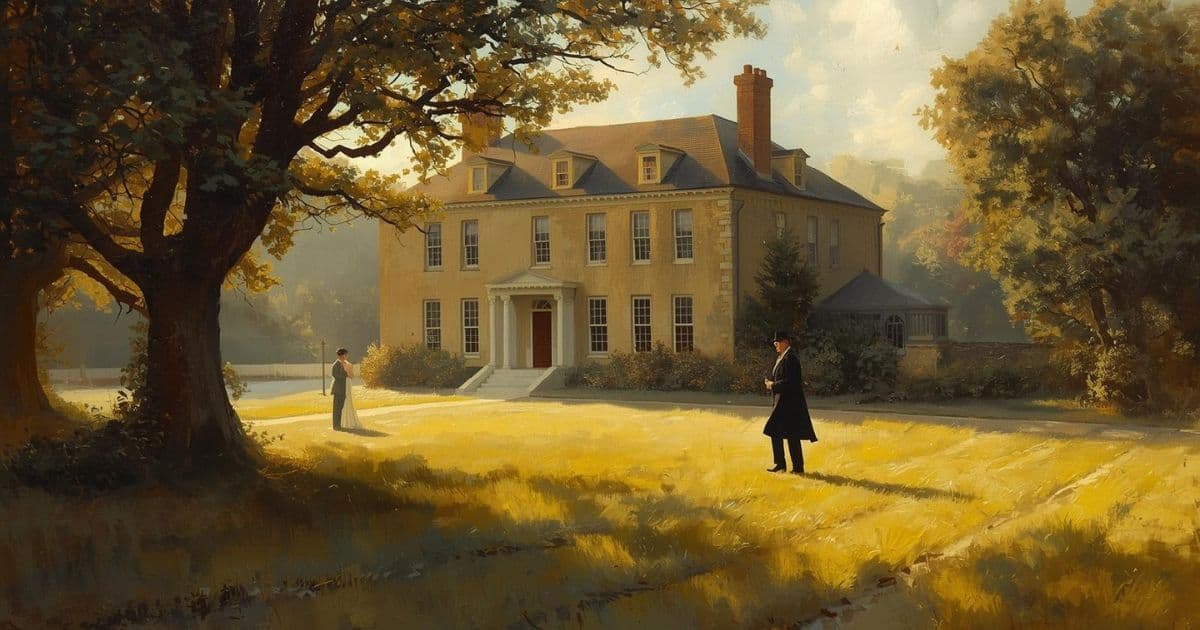
An excerpt from the original text.(complete · 22460 words)
pisode 17: Ithaca
What parallel courses did Bloom and Stephen follow returning?
Starting united both at normal walking pace from Beresford place they
followed in the order named Lower and Middle Gardiner streets and
Mountjoy square, west: then, at reduced pace, each bearing left,
Gardiner’s place by an inadvertence as far as the farther corner of
Temple street: then, at reduced pace with interruptions of halt,
bearing right, Temple street, north, as far as Hardwicke place.
Approaching, disparate, at relaxed walking pace they crossed both the
circus before George’s church diametrically, the chord in any circle
being less than the arc which it subtends.
Of what did the duumvirate deliberate during their itinerary?
Music, literature, Ireland, Dublin, Paris, friendship, woman,
prostitution, diet, the influence of gaslight or the light of arc and
glowlamps on the growth of adjoining paraheliotropic trees, exposed
corporation emergency dustbuckets, the Roman catholic church,
ecclesiastical celibacy, the Irish nation, jesuit education, careers,
the study of medicine, the past day, the maleficent influence of the
presabbath, Stephen’s collapse.
Did Bloom discover common factors of similarity between their
respective like and unlike reactions to experience?
Both were sensitive to artistic impressions, musical in preference to
plastic or pictorial. Both preferred a continental to an insular manner
of life, a cisatlantic to a transatlantic place of residence. Both
indurated by early domestic training and an inherited tenacity of
heterodox resistance professed their disbelief in many orthodox
religious, national, social and ethical doctrines. Both admitted the
alternately stimulating and obtunding influence of heterosexual
magnetism.
Were their views on some points divergent?
Stephen dissented openly from Bloom’s views on the importance of
dietary and civic selfhelp while Bloom dissented tacitly from Stephen’s
views on the eternal affirmation of the spirit of man in literature.
Bloom assented covertly to Stephen’s rectification of the anachronism
involved in assigning the date of the conversion of the Irish nation to
christianity from druidism by Patrick son of Calpornus, son of Potitus,
son of Odyssus, sent by pope Celestine I in the year 432 in the reign
of Leary to the year 260 or thereabouts in the reign of Cormac MacArt
(† 266 A.D.), suffocated by imperfect deglutition of aliment at Sletty
and interred at Rossnaree. The collapse which Bloom ascribed to gastric
inanition and certain chemical compounds of varying degrees of
adulteration and alcoholic strength, accelerated by mental exertion and
the velocity of rapid circular motion in a relaxing atmosphere, Stephen
attributed to the reapparition of a matutinal cloud (perceived by both
from two different points of observation Sandycove and Dublin) at first
no bigger than a woman’s hand.
Was there one point on which their views were equal and negative?
The influence of gaslight or electric light on the growth of adjoining
paraheliotropic trees.
Had Bloom discussed similar subjects during nocturnal perambulations in
the past?
In 1884 with Owen Goldberg and Cecil Turnbull at night on public
thoroughfares between Longwood avenue and Leonard’s corner and
Leonard’s corner and Synge street and Synge street and Bloomfield
avenue. In 1885 with Percy Apjohn in the evenings, reclined against the
wall between Gibraltar villa and Bloomfield house in Crumlin, barony of
Uppercross. In 1886 occasionally with casual acquaintances and
prospective purchasers on doorsteps, in front parlours, in third class
railway carriages of suburban lines. In 1888 frequently with major
Brian Tweedy and his daughter Miss Marion Tweedy, together and
separately on the lounge in Matthew Dillon’s house in Roundtown. Once
in 1892 and once in 1893 with Julius (Juda) Mastiansky, on both
occasions in the parlour of his (Bloom’s) house in Lombard street,
west.
What reflection concerning the irregular sequence of dates 1884, 1885,
1886, 1888, 1892, 1893, 1904 did Bloom make before their arrival at
their destination?
He reflected that the progressive extension of the field of individual
development and experience was regressively accompanied by a
restriction of the converse domain of interindividual relations.
As in what ways?
From inexistence to existence he came to many and was as one received:
existence with existence he was with any as any with any: from
existence to nonexistence gone he would be by all as none perceived.
What act did Bloom make on their arrival at their destination?
At the housesteps of the 4th of the equidifferent uneven numbers,
number 7 Eccles street, he inserted his hand mechanically into the back
pocket of his trousers to obtain his latchkey.
Was it there?
It was in the corresponding pocket of the trousers which he had worn on
the day but one preceding.
Why was he doubly irritated?
Because he had forgotten and because he remembered that he had reminded
himself twice not to forget.
What were then the alternatives before the, premeditatedly
(respectively) and inadvertently, keyless couple?
To enter or not to enter. To knock or not to knock.
Bloom’s decision?
A stratagem. Resting his feet on the dwarf wall, he climbed over the
area railings, compressed his hat on his head, grasped two points at
the lower union of rails and stiles, lowered his body gradually by its
length of five feet nine inches and a half to within two feet ten
inches of the area pavement and allowed his body to move freely in
space by separating himself from the railings and crouching in
preparation for the impact of the fall.
Did he fall?
By his body’s known weight of eleven stone and four pounds in
avoirdupois measure, as certified by the graduated machine for
periodical selfweighing in the premises of Francis Froedman,
pharmaceutical chemist of 19 Frederick street, north, on the last feast
of the Ascension, to wit, the twelfth day of May of the bissextile year
one thousand nine hundred and four of the christian era (jewish era
five thousand six hundred and sixtyfour, mohammadan era one thousand
three hundred and twentytwo), golden number 5, epact 13, solar cycle 9,
dominical letters C B, Roman indiction 2, Julian period 6617, MCMIV.
Did he rise uninjured by concussion?
Regaining new stable equilibrium he rose uninjured though concussed by
the impact, raised the latch of the area door by the exertion of force
at its freely moving flange and by leverage of the first kind applied
at its fulcrum, gained retarded access to the kitchen through the
subadjacent scullery, ignited a lucifer match by friction, set free
inflammable coal gas by turning on the ventcock, lit a high flame
which, by regulating, he reduced to quiescent candescence and lit
finally a portable candle.
What discrete succession of images did Stephen meanwhile perceive?
Reclined against the area railings he perceived through the transparent
kitchen panes a man regulating a gasflame of 14 CP, a man lighting a
candle of 1 CP, a man removing in turn each of his two boots, a man
leaving the kitchen holding a candle.
Did the man reappear elsewhere?
After a lapse of four minutes the glimmer of his candle was discernible
through the semitransparent semicircular glass fanlight over the
halldoor. The halldoor turned gradually on its hinges. In the open
space of the doorway the man reappeared without his hat, with his
candle.
Did Stephen obey his sign?
Yes, entering softly, he helped to close and chain the door and
followed softly along the hallway the man’s back and listed feet and
lighted candle past a lighted crevice of doorway on the left and
carefully down a turning staircase of more than five steps into the
kitchen of Bloom’s house.
What did Bloom do?
He extinguished the candle by a sharp expiration of breath upon its
flame, drew two spoonseat deal chairs to the hearthstone, one for
Stephen with its back to the area window, the other for himself when
necessary, knelt on one knee, composed in the grate a pyre of crosslaid
resintipped sticks and various coloured papers and irregular polygons
of best Abram coal at twentyone shillings a ton from the yard of Messrs
Flower and M’Donald of 14 D’Olier street, kindled it at three
projecting points of paper with one ignited lucifer match, thereby
releasing the potential energy contained in the fuel by allowing its
carbon and hydrogen elements to enter into free union with the oxygen
of the air.
Of what similar apparitions did Stephen think?
Of others elsewhere in other times who, kneeling on one knee or on two,
had kindled fires for him, of Brother Michael in the infirmary of the
college of the Society of Jesus at Clongowes Wood, Sallins, in the
county of Kildare: of his father, Simon Dedalus, in an unfurnished room
of his first residence in Dublin, number thirteen Fitzgibbon street: of
his godmother Miss Kate Morkan in the house of her dying sister Miss
Julia Morkan at 15 Usher’s Island: of his aunt Sara, wife of Richie
(Richard) Goulding, in the kitchen of their lodgings at 62 Clanbrassil
street: of his mother Mary, wife of Simon Dedalus, in the kitchen of
number twelve North Richmond street on the morning of the feast of
Saint Francis Xavier 1898: of the dean of studies, Father Butt, in the
physics’ theatre of university College, 16 Stephen’s Green, north: of
his sister Dilly (Delia) in his father’s house in Cabra.
What did Stephen see on raising his gaze to the height of a yard from
the fire towards the opposite wall?
Under a row of five coiled spring housebells a curvilinear rope,
stretched between two holdfasts athwart across the recess beside the
chimney pier, from which hung four smallsized square handkerchiefs
folded unattached consecutively in adjacent rectangles and one pair of
ladies’ grey hose with Lisle suspender tops and feet in their habitual
position clamped by three erect wooden pegs two at their outer
extremities and the third at their point of junction.
What did Bloom see on the range?
On the right (smaller) hob a blue enamelled saucepan: on the left
(larger) hob a black iron kettle.
What did Bloom do at the range?
He removed the saucepan to the left hob, rose and carried the iron
kettle to the sink in order to tap the current by turning the faucet to
let it flow.
Did it flow?
Yes. From Roundwood reservoir in county Wicklow of a cubic capacity of
2400 million gallons, percolating through a subterranean aqueduct of
filter mains of single and double pipeage constructed at an initial
plant cost of £ 5 per linear yard by way of the Dargle, Rathdown, Glen
of the Downs and Callowhill to the 26 acre reservoir at Stillorgan, a
distance of 22 statute miles, and thence, through a system of relieving
tanks, by a gradient of 250 feet to the city boundary at Eustace
bridge, upper Leeson street, though from prolonged summer drouth and
daily supply of 12 1/2 million gallons the water had fallen below the
sill of the overflow weir for which reason the borough surveyor and
waterworks engineer, Mr Spencer Harty, C. E., on the instructions of
the waterworks committee had prohibited the use of municipal water for
purposes other than those of consumption (envisaging the possibility of
recourse being had to the impotable water of the Grand and Royal canals
as in 1893) particularly as the South Dublin Guardians, notwithstanding
their ration of 15 gallons per day per pauper supplied through a 6 inch
meter, had been convicted of a wastage of 20,000 gallons per night by a
reading of their meter on the affirmation of the law agent of the
corporation, Mr Ignatius Rice, solicitor, thereby acting to the
detriment of another section of the public, selfsupporting taxpayers,
solvent, sound.
What in water did Bloom, waterlover, drawer of water, watercarrier,
returning to the range, admire?
Its universality: its democratic equality and constancy to its nature
in seeking its own level: its vastness in the ocean of Mercator’s
projection: its unplumbed profundity in the Sundam trench of the
Pacific exceeding 8000 fathoms: the restlessness of its waves and
surface particles visiting in turn all points of its seaboard: the
independence of its units: the variability of states of sea: its
hydrostatic quiescence in calm: its hydrokinetic turgidity in neap and
spring tides: its subsidence after devastation: its sterility in the
circumpolar icecaps, arctic and antarctic: its climatic and commercial
significance: its preponderance of 3 to 1 over the dry land of the
globe: its indisputable hegemony extending in square leagues over all
the region below the subequatorial tropic of Capricorn: the
multisecular stability of its primeval basin: its luteofulvous bed: its
capacity to dissolve and hold in solution all soluble substances
including millions of tons of the most precious metals: its slow
erosions of peninsulas and islands, its persistent formation of
homothetic islands, peninsulas and downwardtending promontories: its
alluvial deposits: its weight and volume and density: its
imperturbability in lagoons and highland tarns: its gradation of
colours in the torrid and temperate and frigid zones: its vehicular
ramifications in continental lakecontained streams and confluent
oceanflowing rivers with their tributaries and transoceanic currents,
gulfstream, north and south equatorial courses: its violence in
seaquakes, waterspouts, Artesian wells, eruptions, torrents, eddies,
freshets, spates, groundswells, watersheds, waterpartings, geysers,
cataracts, whirlpools, maelstroms, inundations, deluges, cloudbursts:
its vast circumterrestrial ahorizontal curve: its secrecy in springs
and latent humidity, revealed by rhabdomantic or hygrometric
instruments and exemplified by the well by the hole in the wall at
Ashtown gate, saturation of air, distillation of dew: the simplicity of
its composition, two constituent parts of hydrogen with one constituent
part of oxygen: its healing virtues: its buoyancy in the waters of the
Dead Sea: its persevering penetrativeness in runnels, gullies,
inadequate dams, leaks on shipboard: its properties for cleansing,
quenching thirst and fire, nourishing vegetation: its infallibility as
paradigm and paragon: its metamorphoses as vapour, mist, cloud, rain,
sleet, snow, hail: its strength in rigid hydrants: its variety of forms
in loughs and bays and gulfs and bights and guts and lagoons and atolls
and archipelagos and sounds and fjords and minches and tidal estuaries
and arms of sea: its solidity in glaciers, icebergs, icefloes: its
docility in working hydraulic millwheels, turbines, dynamos, electric
power stations, bleachworks, tanneries, scutchmills: its utility in
canals, rivers, if navigable, floating and graving docks: its
potentiality derivable from harnessed tides or watercourses falling
from level to level: its submarine fauna and flora (anacoustic,
photophobe), numerically, if not literally, the inhabitants of the
globe: its ubiquity as constituting 90
% of the human body: the noxiousness of its effluvia in lacustrine
% marshes,
pestilential fens, faded flowerwater, stagnant pools in the waning
moon.
Having set the halffilled kettle on the now burning coals, why did he
return to the stillflowing tap?
To wash his soiled hands with a partially consumed tablet of
Barrington’s lemonflavoured soap, to which paper still adhered, (bought
thirteen hours previously for fourpence and still unpaid for), in fresh
cold neverchanging everchanging water and dry them, face and hands, in
a long redbordered holland cloth passed over a wooden revolving roller.
What reason did Stephen give for declining Bloom’s offer?
That he was hydrophobe, hating partial contact by immersion or total by
submersion in cold water, (his last bath having taken place in the
month of October of the preceding year), disliking the aqueous
substances of glass and crystal, distrusting aquacities of thought and
language.
What impeded Bloom from giving Stephen counsels of hygiene and
prophylactic to which should be added suggestions concerning a
preliminary wetting of the head and contraction of the muscles with
rapid splashing of the face and neck and thoracic and epigastric region
in case of sea or river bathing, the parts of the human anatomy most
sensitive to cold being the nape, stomach and thenar or sole of foot?
The incompatibility of aquacity with the erratic originality of genius.
What additional didactic counsels did he similarly repress?
Dietary: concerning the respective percentage of protein and caloric
energy in bacon, salt ling and butter, the absence of the former in the
lastnamed and the abundance of the latter in the firstnamed.
Which seemed to the host to be the predominant qualities of his guest?
Confidence in himself, an equal and opposite power of abandonment and
recuperation.
What concomitant phenomenon took place in the vessel of liquid by the
agency of fire?
The phenomenon of ebullition. Fanned by a constant updraught of
ventilation between the kitchen and the chimneyflue, ignition was
communicated from the faggots of precombustible fuel to polyhedral
masses of bituminous coal, containing in compressed mineral form the
foliated fossilised decidua of primeval forests which had in turn
derived their vegetative existence from the sun, primal source of heat
(radiant), transmitted through omnipresent luminiferous diathermanous
ether. Heat (convected), a mode of motion developed by such combustion,
was constantly and increasingly conveyed from the source of
calorification to the liquid contained in the vessel, being radiated
through the uneven unpolished dark surface of the metal iron, in part
reflected, in part absorbed, in part transmitted, gradually raising the
temperature of the water from normal to boiling point, a rise in
temperature expressible as the result of an expenditure of 72 thermal
units needed to raise 1 pound of water from 50° to 212° Fahrenheit.
What announced the accomplishment of this rise in temperature?
A double falciform ejection of water vapour from under the kettlelid at
both sides simultaneously.
For what personal purpose could Bloom have applied the water so boiled?
To shave himself.
What advantages attended shaving by night?
A softer beard: a softer brush if intentionally allowed to remain from
shave to shave in its agglutinated lather: a softer skin if
unexpectedly encountering female acquaintances in remote places at
incustomary hours: quiet reflections upon the course of the day: a
cleaner sensation when awaking after a fresher sleep since matutinal
noises, premonitions and perturbations, a clattered milkcan, a
postman’s double knock, a paper read, reread while lathering,
relathering the same spot, a shock, a shoot, with thought of aught he
sought though fraught with nought might cause a faster rate of shaving
and a nick on which incision plaster with precision cut and humected
and applied adhered: which was to be done.
Why did absence of light disturb him less than presence of noise?
Because of the surety of the sense of touch in his firm full masculine
feminine passive active hand.
What quality did it (his hand) possess but with what counteracting
influence?
The operative surgical quality but that he was reluctant to shed human
blood even when the end justified the means, preferring, in their
natural order, heliotherapy, psychophysicotherapeutics, osteopathic
surgery.
What lay under exposure on the lower, middle and upper shelves of the
kitchen dresser, opened by Bloom?
On the lower shelf five vertical breakfast plates, six horizontal
breakfast saucers on which rested inverted breakfast cups, a
moustachecup, uninverted, and saucer of Crown Derby, four white
goldrimmed eggcups, an open shammy purse displaying coins, mostly
copper, and a phial of aromatic (violet) comfits. On the middle shelf a
chipped eggcup containing pepper, a drum of table salt, four
conglomerated black olives in oleaginous paper, an empty pot of
Plumtree’s potted meat, an oval wicker basket bedded with fibre and
containing one Jersey pear, a halfempty bottle of William Gilbey and
Co’s white invalid port, half disrobed of its swathe of coralpink
tissue paper, a packet of Epps’s soluble cocoa, five ounces of Anne
Lynch’s choice tea at 2/- per lb in a crinkled leadpaper bag, a
cylindrical canister containing the best crystallised lump sugar, two
onions, one, the larger, Spanish, entire, the other, smaller, Irish,
bisected with augmented surface and more redolent, a jar of Irish Model
Dairy’s cream, a jug of brown crockery containing a naggin and a
quarter of soured adulterated milk, converted by heat into water,
acidulous serum and semisolidified curds, which added to the quantity
subtracted for Mr Bloom’s and Mrs Fleming’s breakfasts, made one
imperial pint, the total quantity originally delivered, two cloves, a
halfpenny and a small dish containing a slice of fresh ribsteak. On the
upper shelf a battery of jamjars (empty) of various sizes and
proveniences.
What attracted his attention lying on the apron of the dresser?
Four polygonal fragments of two lacerated scarlet betting tickets,
numbered 8 87, 88 6.
What reminiscences temporarily corrugated his brow?
Reminiscences of coincidences, truth stranger than fiction,
preindicative of the result of the Gold Cup flat handicap, the official
and definitive result of which he had read in the Evening Telegraph,
late pink edition, in the cabman’s shelter, at Butt bridge.
Where had previous intimations of the result, effected or projected,
been received by him?
In Bernard Kiernan’s licensed premises 8, 9 and 10 little Britain
street: in David Byrne’s licensed premises, 14 Duke street: in
O’Connell street lower, outside Graham Lemon’s when a dark man had
placed in his hand a throwaway (subsequently thrown away), advertising
Elijah, restorer of the church in Zion: in Lincoln place outside the
premises of F. W. Sweny and Co (Limited), dispensing chemists, when,
when Frederick M. (Bantam) Lyons had rapidly and successively
requested, perused and restituted the copy of the current issue of the
Freeman’s Journal and National Press which he had been about to
throw away (subsequently thrown away), he had proceeded towards the
oriental edifice of the Turkish and Warm Baths, 11 Leinster street,
with the light of inspiration shining in his countenance and bearing in
his arms the secret of the race, graven in the language of prediction.
What qualifying considerations allayed his perturbations?
The difficulties of interpretation since the significance of any event
followed its occurrence as variably as the acoustic report followed the
electrical discharge and of counterestimating against an actual loss by
failure to interpret the total sum of possible losses proceeding
originally from a successful interpretation.
His mood?
He had not risked, he did not expect, he had not been disappointed, he
was satisfied.
What satisfied him?
To have sustained no positive loss. To have brought a positive gain to
others. Light to the gentiles.
How did Bloom prepare a collation for a gentile?
He poured into two teacups two level spoonfuls, four in all, of Epps’s
soluble cocoa and proceeded according to the directions for use printed
on the label, to each adding after sufficient time for infusion the
prescribed ingredients for diffusion in the manner and in the quantity
prescribed.
What supererogatory marks of special hospitality did the host show his
guest?
Relinquishing his symposiarchal right to the moustache cup of imitation
Crown Derby presented to him by his only daughter, Millicent (Milly),
he substituted a cup identical with that of his guest and served
extraordinarily to his guest and, in reduced measure, to himself the
viscous cream ordinarily reserved for the breakfast of his wife Marion
(Molly).
Was the guest conscious of and did he acknowledge these marks of
hospitality?
His attention was directed to them by his host jocosely, and he
accepted them seriously as they drank in jocoserious silence Epps’s
massproduct, the creature cocoa.
Were there marks of hospitality which he contemplated but suppressed,
reserving them for another and for himself on future occasions to
complete the act begun?
The reparation of a fissure of the length of 1 1/2 inches in the right
side of his guest’s jacket. A gift to his guest of one of the four
lady’s handkerchiefs, if and when ascertained to be in a presentable
condition.
Who drank more quickly?
Bloom, having the advantage of ten seconds at the initiation and
taking, from the concave surface of a spoon along the handle of which a
steady flow of heat was conducted, three sips to his opponent’s one,
six to two, nine to three.
What cerebration accompanied his frequentative act?
Concluding by inspection but erroneously that his silent companion was
engaged in mental composition he reflected on the pleasures derived
from literature of instruction rather than of amusement as he himself
had applied to the works of William Shakespeare more than once for the
solution of difficult problems in imaginary or real life.
Had he found their solution?
In spite of careful and repeated reading of certain classical passages,
aided by a glossary, he had derived imperfect conviction from the text,
the answers not bearing in all points.
What lines concluded his first piece of original verse written by him,
potential poet, at the age of 11 in 1877 on the occasion of the
offering of three prizes of 10/-, 5/- and 2/6 respectively for
competition by the Shamrock, a weekly newspaper?
An ambition to squint
At my verses in print
Makes me hope that for these you’ll find room.
If you so condescend
Then please place at the end
The name of yours truly, L. Bloom.
Did he find four separating forces between his temporary guest and him?
Name, age, race, creed.
What anagrams had he made on his name in youth?
Leopold Bloom
Ellpodbomool
Molldopeloob
Bollopedoom
Old Ollebo, M. P.
What acrostic upon the abbreviation of his first name had he (kinetic
poet) sent to Miss Marion (Molly) Tweedy on the 14 February 1888?
Poets oft have sung in rhyme
Of music sweet their praise divine.
Let them hymn it nine times nine.
Dearer far than song or wine.
You are mine. The world is mine.
What had prevented him from completing a topical song (music by R. G.
Johnston) on the events of the past, or fixtures for the actual, years,
entitled If Brian Boru could but come back and see old Dublin now,
commissioned by Michael Gunn, lessee of the Gaiety Theatre, 46, 47, 48,
49 South King street, and to be introduced into the sixth scene, the
valley of diamonds, of the second edition (30 January 1893) of the
grand annual Christmas pantomime Sinbad the Sailor (produced by R.
Shelton 26 December 1892, written by Greenleaf Whittier, scenery by
George A. Jackson and Cecil Hicks, costumes by Mrs and Miss Whelan
under the personal supervision of Mrs Michael Gunn, ballets by Jessie
Noir, harlequinade by Thomas Otto) and sung by Nelly Bouverist,
principal girl?
Firstly, oscillation between events of imperial and of local interest,
the anticipated diamond jubilee of Queen Victoria (born 1820, acceded
1837) and the posticipated opening of the new municipal fish market:
secondly, apprehension of opposition from extreme circles on the
questions of the respective visits of Their Royal Highnesses the duke
and duchess of York (real) and of His Majesty King Brian Boru
(imaginary): thirdly, a conflict between professional etiquette and
professional emulation concerning the recent erections of the Grand
Lyric Hall on Burgh Quay and the Theatre Royal in Hawkins street:
fourthly, distraction resultant from compassion for Nelly Bouverist’s
non-intellectual, non-political, non-topical expression of countenance
and concupiscence caused by Nelly Bouverist’s revelations of white
articles of non-intellectual, non-political, non-topical underclothing
while she (Nelly Bouverist) was in the articles: fifthly, the
difficulties of the selection of appropriate music and humorous
allusions from Everybody’s Book of Jokes (1000 pages and a laugh in
every one): sixthly, the rhymes, homophonous and cacophonous,
associated with the names of the new lord mayor, Daniel Tallon, the new
high sheriff, Thomas Pile and the new solicitorgeneral, Dunbar Plunket
Barton.
What relation existed between their ages?
16 years before in 1888 when Bloom was of Stephen’s present age Stephen
was 6. 16 years after in 1920 when Stephen would be of Bloom’s present
age Bloom would be 54. In 1936 when Bloom would be 70 and Stephen 54
their ages initially in the ratio of 16 to 0 would be as 17 1/2 to 13
1/2, the proportion increasing and the disparity diminishing according
as arbitrary future years were added, for if the proportion existing in
1883 had continued immutable, conceiving that to be possible, till then
1904 when Stephen was 22 Bloom would be 374 and in 1920 when Stephen
would be 38, as Bloom then was, Bloom would be 646 while in 1952 when
Stephen would have attained the maximum postdiluvian age of 70 Bloom,
being 1190 years alive having been born in the year 714, would have
surpassed by 221 years the maximum antediluvian age, that of
Methusalah, 969 years, while, if Stephen would continue to live until
he would attain that age in the year 3072 A.D., Bloom would have been
obliged to have been alive 83,300 years, having been obliged to have
been born in the year 81,396 B.C.
What events might nullify these calculations?
The cessation of existence of both or either, the inauguration of a new
era or calendar, the annihilation of the world and consequent
extermination of the human species, inevitable but impredictable.
How many previous encounters proved their preexisting acquaintance?
Two. The first in the lilacgarden of Matthew Dillon’s house, Medina
Villa, Kimmage road, Roundtown, in 1887, in the company of Stephen’s
mother, Stephen being then of the age of 5 and reluctant to give his
hand in salutation. The second in the coffeeroom of Breslin’s hotel on
a rainy Sunday in the January of 1892, in the company of Stephen’s
father and Stephen’s granduncle, Stephen being then 5 years older.
Did Bloom accept the invitation to dinner given then by the son and
afterwards seconded by the father?
Very gratefully, with grateful appreciation, with sincere appreciative
gratitude, in appreciatively grateful sincerity of regret, he declined.
Did their conversation on the subject of these reminiscences reveal a
third connecting link between them?
Mrs Riordan (Dante), a widow of independent means, had resided in the
house of Stephen’s parents from 1 September 1888 to 29 December 1891
and had also resided during the years 1892, 1893 and 1894 in the City
Arms Hotel owned by Elizabeth O’Dowd of 54 Prussia street where, during
parts of the years 1893 and 1894, she had been a constant informant of
Bloom who resided also in the same hotel, being at that time a clerk in
the employment of Joseph Cuffe of 5 Smithfield for the superintendence
of sales in the adjacent Dublin Cattle market on the North Circular
road.
Had he performed any special corporal work of mercy for her?
He had sometimes propelled her on warm summer evenings, an infirm widow
of independent, if limited, means, in her convalescent bathchair with
slow revolutions of its wheels as far as the corner of the North
Circular road opposite Mr Gavin Low’s place of business where she had
remained for a certain time scanning through his onelensed binocular
fieldglasses unrecognisable citizens on tramcars, roadster bicycles
equipped with inflated pneumatic tyres, hackney carriages, tandems,
private and hired landaus, dogcarts, ponytraps and brakes passing from
the city to the Phoenix Park and vice versa.
Why could he then support that his vigil with the greater equanimity?
Because in middle youth he had often sat observing through a rondel of
bossed glass of a multicoloured pane the spectacle offered with
continual changes of the thoroughfare without, pedestrians, quadrupeds,
velocipedes, vehicles, passing slowly, quickly, evenly, round and round
and round the rim of a round and round precipitous globe.
What distinct different memories had each of her now eight years
deceased?
The older, her bezique cards and counters, her Skye terrier, her
suppositious wealth, her lapses of responsiveness and incipient
catarrhal deafness: the younger, her lamp of colza oil before the
statue of the Immaculate Conception, her green and maroon brushes for
Charles Stewart Parnell and for Michael Davitt, her tissue papers.
Were there no means still remaining to him to achieve the rejuvenation
which these reminiscences divulged to a younger companion rendered the
more desirable?
The indoor exercises, formerly intermittently practised, subsequently
abandoned, prescribed in Eugen Sandow’s Physical Strength and How to
Obtain It which, designed particularly for commercial men engaged in
sedentary occupations, were to be made with mental concentration in
front of a mirror so as to bring into play the various families of
muscles and produce successively a pleasant rigidity, a more pleasant
relaxation and the most pleasant repristination of juvenile agility.
Had any special agility been his in earlier youth?
Though ringweight lifting had been beyond his strength and the full
circle gyration beyond his courage yet as a High school scholar he had
excelled in his stable and protracted execution of the half lever
movement on the parallel bars in consequence of his abnormally
developed abdominal muscles.
Did either openly allude to their racial difference?
Neither.
What, reduced to their simplest reciprocal form, were Bloom’s thoughts
about Stephen’s thoughts about Bloom and about Stephen’s thoughts about
Bloom’s thoughts about Stephen?
He thought that he thought that he was a jew whereas he knew that he
knew that he knew that he was not.
What, the enclosures of reticence removed, were their respective
parentages?
Bloom, only born male transubstantial heir of Rudolf Virag
(subsequently Rudolph Bloom) of Szombathely, Vienna, Budapest, Milan,
London and Dublin and of Ellen Higgins, second daughter of Julius
Higgins (born Karoly) and Fanny Higgins (born Hegarty). Stephen, eldest
surviving male consubstantial heir of Simon Dedalus of Cork and Dublin
and of Mary, daughter of Richard and Christina Goulding (born Grier).
Had Bloom and Stephen been baptised, and where and by whom, cleric or
layman?
Bloom (three times), by the reverend Mr Gilmer Johnston M. A., alone,
in the protestant church of Saint Nicholas Without, Coombe, by James
O’Connor, Philip Gilligan and James Fitzpatrick, together, under a pump
in the village of Swords, and by the reverend Charles Malone C. C., in
the church of the Three Patrons, Rathgar. Stephen (once) by the
reverend Charles Malone C. C., alone, in the church of the Three
Patrons, Rathgar.
Did they find their educational careers similar?
Substituting Stephen for Bloom Stoom would have passed successively
through a dame’s school and the high school. Substituting Bloom for
Stephen Blephen would have passed successively through the preparatory,
junior, middle and senior grades of the intermediate and through the
matriculation, first arts, second arts and arts degree courses of the
royal university.
Why did Bloom refrain from stating that he had frequented the
university of life?
Because of his fluctuating incertitude as to whether this observation
had or had not been already made by him to Stephen or by Stephen to
him.
What two temperaments did they individually represent?
The scientific. The artistic.
What proofs did Bloom adduce to prove that his tendency was towards
applied, rather than towards pure, science?
Certain possible inventions of which he had cogitated when reclining in
a state of supine repletion to aid digestion, stimulated by his
appreciation of the importance of inventions now common but once
revolutionary, for example, the aeronautic parachute, the reflecting
telescope, the spiral corkscrew, the safety pin, the mineral water
siphon, the canal lock with winch and sluice, the suction pump.
Were these inventions principally intended for an improved scheme of
kindergarten?
Yes, rendering obsolete popguns, elastic airbladders, games of hazard,
catapults. They comprised astronomical kaleidoscopes exhibiting the
twelve constellations of the zodiac from Aries to Pisces, miniature
mechanical orreries, arithmetical gelatine lozenges, geometrical to
correspond with zoological biscuits, globemap playing balls,
historically costumed dolls.
What also stimulated him in his cogitations?
The financial success achieved by Ephraim Marks and Charles A. James,
the former by his 1d bazaar at 42 George’s street, south, the latter at
his 6 1/2d shop and world’s fancy fair and waxwork exhibition at 30
Henry street, admission 2d, children 1d: and the infinite possibilities
hitherto unexploited of the modern art of advertisement if condensed in
triliteral monoideal symbols, vertically of maximum visibility
(divined), horizontally of maximum legibility (deciphered) and of
magnetising efficacy to arrest involuntary attention, to interest, to
convince, to decide.
Such as?
K. 11. Kino’s 11/— Trousers.
House of Keys. Alexander J. Keyes.
Such as not?
Look at this long candle. Calculate when it burns out and you receive
gratis 1 pair of our special non-compo boots, guaranteed 1 candle
power. Address: Barclay and Cook, 18 Talbot street.
Bacilikil (Insect Powder).
Veribest (Boot Blacking).
Uwantit (Combined pocket twoblade penknife with corkscrew, nailfile and
pipecleaner).
Such as never?
What is home without Plumtree’s Potted Meat?
Incomplete.
With it an abode of bliss.
Manufactured by George Plumtree, 23 Merchants’ quay, Dublin, put up in
4 oz pots, and inserted by Councillor Joseph P. Nannetti, M. P.,
Rotunda Ward, 19 Hardwicke street, under the obituary notices and
anniversaries of deceases. The name on the label is Plumtree. A
plumtree in a meatpot, registered trade mark. Beware of imitations.
Peatmot. Trumplee. Moutpat. Plamtroo.
Which example did he adduce to induce Stephen to deduce that
originality, though producing its own reward, does not invariably
conduce to success?
His own ideated and rejected project of an illuminated showcart, drawn
by a beast of burden, in which two smartly dressed girls were to be
seated engaged in writing.
What suggested scene was then constructed by Stephen?
Solitary hotel in mountain pass. Autumn. Twilight. Fire lit. In dark
corner young man seated. Young woman enters. Restless. Solitary. She
sits. She goes to window. She stands. She sits. Twilight. She thinks.
On solitary hotel paper she writes. She thinks. She writes. She sighs.
Wheels and hoofs. She hurries out. He comes from his dark corner. He
seizes solitary paper. He holds it towards fire. Twilight. He reads.
Solitary.
What?
In sloping, upright and backhands: Queen’s Hotel, Queen’s Hotel,
Queen’s Hotel. Queen’s Ho...
What suggested scene was then reconstructed by Bloom?
The Queen’s Hotel, Ennis, county Clare, where Rudolph Bloom (Rudolf
Virag) died on the evening of the 27 June 1886, at some hour unstated,
in consequence of an overdose of monkshood (aconite) selfadministered
in the form of a neuralgic liniment composed of 2 parts of aconite
liniment to 1 of chloroform liniment (purchased by him at 10.20 a.m. on
the morning of 27 June 1886 at the medical hall of Francis Dennehy, 17
Church street, Ennis) after having, though not in consequence of
having, purchased at 3.15 p.m. on the afternoon of 27 June 1886 a new
boater straw hat, extra smart (after having, though not in consequence
of having, purchased at the hour and in the place aforesaid, the toxin
aforesaid), at the general drapery store of James Cullen, 4 Main
street, Ennis.
Did he attribute this homonymity to information or coincidence or
intuition?
Coincidence.
Did he depict the scene verbally for his guest to see?
He preferred himself to see another’s face and listen to another’s
words by which potential narration was realised and kinetic temperament
relieved.
Did he see only a second coincidence in the second scene narrated to
him, described by the narrator as A Pisgah Sight of Palestine or The
Parable of the Plums?
It, with the preceding scene and with others unnarrated but existent by
implication, to which add essays on various subjects or moral apothegms
(e.g. My Favourite Hero or Procrastination is the Thief of Time)
composed during schoolyears, seemed to him to contain in itself and in
conjunction with the personal equation certain possibilities of
financial, social, personal and sexual success, whether specially
collected and selected as model pedagogic themes (of cent per cent
merit) for the use of preparatory and junior grade students or
contributed in printed form, following the precedent of Philip Beaufoy
or Doctor Dick or Heblon’s Studies in Blue, to a publication of
certified circulation and solvency or employed verbally as intellectual
stimulation for sympathetic auditors, tacitly appreciative of
successful narrative and confidently augurative of successful
achievement, during the increasingly longer nights gradually following
the summer solstice on the day but three following, videlicet, Tuesday,
21 June (S. Aloysius Gonzaga), sunrise 3.33 a.m., sunset 8.29 p.m.
Which domestic problem as much as, if not more than, any other
frequently engaged his mind?
What to do with our wives.
What had been his hypothetical singular solutions?
Parlour games (dominos, halma, tiddledywinks, spilikins, cup and ball,
nap, spoil five, bezique, twentyfive, beggar my neighbour, draughts,
chess or backgammon): embroidery, darning or knitting for the
policeaided clothing society: musical duets, mandoline and guitar,
piano and flute, guitar and piano: legal scrivenery or envelope
addressing: biweekly visits to variety entertainments: commercial
activity as pleasantly commanding and pleasingly obeyed mistress
proprietress in a cool dairy shop or warm cigar divan: the clandestine
satisfaction of erotic irritation in masculine brothels, state
inspected and medically controlled: social visits, at regular
infrequent prevented intervals and with regular frequent preventive
superintendence, to and from female acquaintances of recognised
respectability in the vicinity: courses of evening instruction
specially designed to render liberal instruction agreeable.
What instances of deficient mental development in his wife inclined him
in favour of the lastmentioned (ninth) solution?
In disoccupied moments she had more than once covered a sheet of paper
with signs and hieroglyphics which she stated were Greek and Irish and
Hebrew characters. She had interrogated constantly at varying intervals
as to the correct method of writing the capital initial of the name of
a city in Canada, Quebec. She understood little of political
complications, internal, or balance of power, external. In calculating
the addenda of bills she frequently had recourse to digital aid. After
completion of laconic epistolary compositions she abandoned the
implement of calligraphy in the encaustic pigment, exposed to the
corrosive action of copperas, green vitriol and nutgall. Unusual
polysyllables of foreign origin she interpreted phonetically or by
false analogy or by both: metempsychosis (met him pike hoses), alias
(a mendacious person mentioned in sacred scripture).
What compensated in the false balance of her intelligence for these and
such deficiencies of judgment regarding persons, places and things?
The false apparent parallelism of all perpendicular arms of all
balances, proved true by construction. The counterbalance of her
proficiency of judgment regarding one person, proved true by
experiment.
How had he attempted to remedy this state of comparative ignorance?
Variously. By leaving in a conspicuous place a certain book open at a
certain page: by assuming in her, when alluding explanatorily, latent
knowledge: by open ridicule in her presence of some absent other’s
ignorant lapse.
With what success had he attempted direct instruction?
She followed not all, a part of the whole, gave attention with interest
comprehended with surprise, with care repeated, with greater difficulty
remembered, forgot with ease, with misgiving reremembered, rerepeated
with error.
What system had proved more effective?
Indirect suggestion implicating selfinterest.
Example?
She disliked umbrella with rain, he liked woman with umbrella, she
disliked new hat with rain, he liked woman with new hat, he bought new
hat with rain, she carried umbrella with new hat.
Accepting the analogy implied in his guest’s parable which examples of
postexilic eminence did he adduce?
Three seekers of the pure truth, Moses of Egypt, Moses Maimonides,
author of More Nebukim (Guide of the Perplexed) and Moses Mendelssohn
of such eminence that from Moses (of Egypt) to Moses (Mendelssohn)
there arose none like Moses (Maimonides).
What statement was made, under correction, by Bloom concerning a fourth
seeker of pure truth, by name Aristotle, mentioned, with permission, by
Stephen?
That the seeker mentioned had been a pupil of a rabbinical philosopher,
name uncertain.
Were other anapocryphal illustrious sons of the law and children of a
selected or rejected race mentioned?
Felix Bartholdy Mendelssohn (composer), Baruch Spinoza (philosopher),
Mendoza (pugilist), Ferdinand Lassalle (reformer, duellist).
What fragments of verse from the ancient Hebrew and ancient Irish
languages were cited with modulations of voice and translation of texts
by guest to host and by host to guest?
By Stephen: suil, suil, suil arun, suil go siocair agus suil go cuin
(walk, walk, walk your way, walk in safety, walk with care).
By Bloom: Kifeloch, harimon rakatejch m’baad l’zamatejch (thy temple
amid thy hair is as a slice of pomegranate).
How was a glyphic comparison of the phonic symbols of both languages
made in substantiation of the oral comparison?
By juxtaposition. On the penultimate blank page of a book of inferior
literary style, entituled Sweets of Sin (produced by Bloom and so
manipulated that its front cover came in contact with the surface of
the table) with a pencil (supplied by Stephen) Stephen wrote the Irish
characters for gee, eh, dee, em, simple and modified, and Bloom in turn
wrote the Hebrew characters ghimel, aleph, daleth and (in the absence
of mem) a substituted qoph, explaining their arithmetical values as
ordinal and cardinal numbers, videlicet 3, 1, 4, and 100.
Was the knowledge possessed by both of each of these languages, the
extinct and the revived, theoretical or practical?
Theoretical, being confined to certain grammatical rules of accidence
and syntax and practically excluding vocabulary.
What points of contact existed between these languages and between the
peoples who spoke them?
The presence of guttural sounds, diacritic aspirations, epenthetic and
servile letters in both languages: their antiquity, both having been
taught on the plain of Shinar 242 years after the deluge in the
seminary instituted by Fenius Farsaigh, descendant of Noah, progenitor
of Israel, and ascendant of Heber and Heremon, progenitors of Ireland:
their archaeological, genealogical, hagiographical, exegetical,
homiletic, toponomastic, historical and religious literatures
comprising the works of rabbis and culdees, Torah, Talmud (Mischna and
Ghemara), Massor, Pentateuch, Book of the Dun Cow, Book of Ballymote,
Garland of Howth, Book of Kells: their dispersal, persecution, survival
and revival: the isolation of their synagogical and ecclesiastical
rites in ghetto (S. Mary’s Abbey) and masshouse (Adam and Eve’s
tavern): the proscription of their national costumes in penal laws and
jewish dress acts: the restoration in Chanah David of Zion and the
possibility of Irish political autonomy or devolution.
What anthem did Bloom chant partially in anticipation of that multiple,
ethnically irreducible consummation?
Kolod balejwaw pnimah
Nefesch, jehudi, homijah.
Why was the chant arrested at the conclusion of this first distich?
In consequence of defective mnemotechnic.
How did the chanter compensate for this deficiency?
By a periphrastic version of the general text.
In what common study did their mutual reflections merge?
The increasing simplification traceable from the Egyptian epigraphic
hieroglyphs to the Greek and Roman alphabets and the anticipation of
modern stenography and telegraphic code in the cuneiform inscriptions
(Semitic) and the virgular quinquecostate ogham writing (Celtic).
Did the guest comply with his host’s request?
Doubly, by appending his signature in Irish and Roman characters.
What was Stephen’s auditive sensation?
He heard in a profound ancient male unfamiliar melody the accumulation
of the past.
What was Bloom’s visual sensation?
He saw in a quick young male familiar form the predestination of a
future.
What were Stephen’s and Bloom’s quasisimultaneous volitional
quasisensations of concealed identities?
Visually, Stephen’s: The traditional figure of hypostasis, depicted by
Johannes Damascenus, Lentulus Romanus and Epiphanius Monachus as
leucodermic, sesquipedalian with winedark hair.
Auditively, Bloom’s: The traditional accent of the ecstasy of
catastrophe.
What future careers had been possible for Bloom in the past and with
what exemplars?
In the church, Roman, Anglican or Nonconformist: exemplars, the very
reverend John Conmee S. J., the reverend T. Salmon, D. D., provost of
Trinity college, Dr Alexander J. Dowie. At the bar, English or Irish:
exemplars, Seymour Bushe, K. C., Rufus Isaacs, K. C. On the stage,
modern or Shakespearean: exemplars, Charles Wyndham, high comedian,
Osmond Tearle († 1901), exponent of Shakespeare.
Did the host encourage his guest to chant in a modulated voice a
strange legend on an allied theme?
Reassuringly, their place, where none could hear them talk, being
secluded, reassured, the decocted beverages, allowing for subsolid
residual sediment of a mechanical mixture, water plus sugar plus cream
plus cocoa, having been consumed.
Recite the first (major) part of this chanted legend.
Little Harry Hughes and his schoolfellows all
Went out for to play ball.
And the very first ball little Harry Hughes played
He drove it o’er the jew’s garden wall.
And the very second ball little Harry Hughes played
He broke the jew’s windows all.
[Illustration]
How did the son of Rudolph receive this first part?
With unmixed feeling. Smiling, a jew, he heard with pleasure and saw
the unbroken kitchen window.
Recite the second part (minor) of the legend.
Then out there came the jew’s daughter
And she all dressed in green.
“Come back, come back, you pretty little boy,
And play your ball again.”
I can’t come back and I won’t come back
Without my schoolfellows all.
For if my master he did hear
He’d make it a sorry ball.”
She took him by the lilywhite hand
And led him along the hall
Until she led him to a room
Where none could hear him call.
She took a penknife out of her pocket
And cut off his little head.
And now he’ll play his ball no more
For he lies among the dead.
[Illustration]
How did the father of Millicent receive this second part?
With mixed feelings. Unsmiling, he heard and saw with wonder a jew’s
daughter, all dressed in green.
Condense Stephen’s commentary.
One of all, the least of all, is the victim predestined. Once by
inadvertence twice by design he challenges his destiny. It comes when
he is abandoned and challenges him reluctant and, as an apparition of
hope and youth, holds him unresisting. It leads him to a strange
habitation, to a secret infidel apartment, and there, implacable,
immolates him, consenting.
Why was the host (victim predestined) sad?
He wished that a tale of a deed should be told of a deed not by him
should by him not be told.
Why was the host (reluctant, unresisting) still?
In accordance with the law of the conservation of energy.
Why was the host (secret infidel) silent?
He weighed the possible evidences for and against ritual murder: the
incitations of the hierarchy, the superstition of the populace, the
propagation of rumour in continued fraction of veridicity, the envy of
opulence, the influence of retaliation, the sporadic reappearance of
atavistic delinquency, the mitigating circumstances of fanaticism,
hypnotic suggestion and somnambulism.
From which (if any) of these mental or physical disorders was he not
totally immune?
From hypnotic suggestion: once, waking, he had not recognised his
sleeping apartment: more than once, waking, he had been for an
indefinite time incapable of moving or uttering sounds. From
somnambulism: once, sleeping, his body had risen, crouched and crawled
in the direction of a heatless fire and, having attained its
destination, there, curled, unheated, in night attire had lain,
sleeping.
Had this latter or any cognate phenomenon declared itself in any member
of his family?
Twice, in Holles street and in Ontario terrace, his daughter Millicent
(Milly) at the ages of 6 and 8 years had uttered in sleep an
exclamation of terror and had replied to the interrogations of two
figures in night attire with a vacant mute expression.
What other infantile memories had he of her?
15 June 1889. A querulous newborn female infant crying to cause and
lessen congestion. A child renamed Padney Socks she shook with shocks
her moneybox: counted his three free moneypenny buttons, one, tloo,
tlee: a doll, a boy, a sailor she cast away: blond, born of two dark,
she had blond ancestry, remote, a violation, Herr Hauptmann Hainau,
Austrian army, proximate, a hallucination, lieutenant Mulvey, British
navy.
What endemic characteristics were present?
Conversely the nasal and frontal formation was derived in a direct line
of lineage which, though interrupted, would continue at distant
intervals to more distant intervals to its most distant intervals.
What memories had he of her adolescence?
She relegated her hoop and skippingrope to a recess. On the duke’s
lawn, entreated by an English visitor, she declined to permit him to
make and take away her photographic image (objection not stated). On
the South Circular road in the company of Elsa Potter, followed by an
individual of sinister aspect, she went half way down Stamer street and
turned abruptly back (reason of change not stated). On the vigil of the
15th anniversary of her birth she wrote a letter from Mullingar, county
Westmeath, making a brief allusion to a local student (faculty and year
not stated).
Did that first division, portending a second division, afflict him?
Less than he had imagined, more than he had hoped.
What second departure was contemporaneously perceived by him similarly,
if differently?
A temporary departure of his cat.
Why similarly, why differently?
Similarly, because actuated by a secret purpose the quest of a new male
(Mullingar student) or of a healing herb (valerian). Differently,
because of different possible returns to the inhabitants or to the
habitation.
In other respects were their differences similar?
In passivity, in economy, in the instinct of tradition, in
unexpectedness.
As?
Inasmuch as leaning she sustained her blond hair for him to ribbon it
for her (cf neckarching cat). Moreover, on the free surface of the lake
in Stephen’s green amid inverted reflections of trees her uncommented
spit, describing concentric circles of waterrings, indicated by the
constancy of its permanence the locus of a somnolent prostrate fish (cf
mousewatching cat). Again, in order to remember the date, combatants,
issue and consequences of a famous military engagement she pulled a
plait of her hair (cf earwashing cat). Furthermore, silly Milly, she
dreamed of having had an unspoken unremembered conversation with a
horse whose name had been Joseph to whom (which) she had offered a
tumblerful of lemonade which it (he) had appeared to have accepted (cf
hearthdreaming cat). Hence, in passivity, in economy, in the instinct
of tradition, in unexpectedness, their differences were similar.
In what way had he utilised gifts (1) an owl, 2) a clock, given as
matrimonial auguries, to interest and to instruct her?
As object lessons to explain: 1) the nature and habits of oviparous
animals, the possibility of aerial flight, certain abnormalities of
vision, the secular process of imbalsamation: 2) the principle of the
pendulum, exemplified in bob, wheelgear and regulator, the translation
in terms of human or social regulation of the various positions of
clockwise moveable indicators on an unmoving dial, the exactitude of
the recurrence per hour of an instant in each hour when the longer and
the shorter indicator were at the same angle of inclination,
videlicet, 5 5/11 minutes past each hour per hour in arithmetical
progression.
In what manners did she reciprocate?
She remembered: on the 27th anniversary of his birth she presented to
him a breakfast moustachecup of imitation Crown Derby porcelain ware.
She provided: at quarter day or thereabouts if or when purchases had
been made by him not for her she showed herself attentive to his
necessities, anticipating his desires. She admired: a natural
phenomenon having been explained by him to her she expressed the
immediate desire to possess without gradual acquisition a fraction of
his science, the moiety, the quarter, a thousandth part.
What proposal did Bloom, diambulist, father of Milly, somnambulist,
make to Stephen, noctambulist?
To pass in repose the hours intervening between Thursday (proper) and
Friday (normal) on an extemporised cubicle in the apartment immediately
above the kitchen and immediately adjacent to the sleeping apartment of
his host and hostess.
What various advantages would or might have resulted from a
prolongation of such an extemporisation?
For the guest: security of domicile and seclusion of study. For the
host: rejuvenation of intelligence, vicarious satisfaction. For the
hostess: disintegration of obsession, acquisition of correct Italian
pronunciation.
Why might these several provisional contingencies between a guest and a
hostess not necessarily preclude or be precluded by a permanent
eventuality of reconciliatory union between a schoolfellow and a jew’s
daughter?
Because the way to daughter led through mother, the way to mother
through daughter.
To what inconsequent polysyllabic question of his host did the guest
return a monosyllabic negative answer?
If he had known the late Mrs Emily Sinico, accidentally killed at
Sydney Parade railway station, 14 October 1903.
What inchoate corollary statement was consequently suppressed by the
host?
A statement explanatory of his absence on the occasion of the interment
of Mrs Mary Dedalus (born Goulding), 26 June 1903, vigil of the
anniversary of the decease of Rudolph Bloom (born Virag).
Was the proposal of asylum accepted?
Promptly, inexplicably, with amicability, gratefully it was declined.
What exchange of money took place between host and guest?
The former returned to the latter, without interest, a sum of money (£
1-7-0), one pound seven shillings sterling, advanced by the latter to
the former.
What counterproposals were alternately advanced, accepted, modified,
declined, restated in other terms, reaccepted, ratified, reconfirmed?
To inaugurate a prearranged course of Italian instruction, place the
residence of the instructed. To inaugurate a course of vocal
instruction, place the residence of the instructress. To inaugurate a
series of static, semistatic and peripatetic intellectual dialogues,
places the residence of both speakers (if both speakers were resident
in the same place), the Ship hotel and tavern, 6 Lower Abbey street
(W. and E. Connery, proprietors), the National Library of Ireland, 10
Kildare street, the National Maternity Hospital, 29, 30 and 31 Holles
street, a public garden, the vicinity of a place of worship, a
conjunction of two or more public thoroughfares, the point of bisection
of a right line drawn between their residences (if both speakers were
resident in different places).
What rendered problematic for Bloom the realisation of these mutually
selfexcluding propositions?
The irreparability of the past: once at a performance of Albert
Hengler’s circus in the Rotunda, Rutland square, Dublin, an intuitive
particoloured clown in quest of paternity had penetrated from the ring
to a place in the auditorium where Bloom, solitary, was seated and had
publicly declared to an exhilarated audience that he (Bloom) was his
(the clown’s) papa. The imprevidibility of the future: once in the
summer of 1898 he (Bloom) had marked a florin (2/-) with three notches
on the milled edge and tendered it in payment of an account due to and
received by J. and T. Davy, family grocers, 1 Charlemont Mall, Grand
Canal, for circulation on the waters of civic finance, for possible,
circuitous or direct, return.
Was the clown Bloom’s son?
No.
Had Bloom’s coin returned?
Never.
Why would a recurrent frustration the more depress him?
Because at the critical turningpoint of human existence he desired to
amend many social conditions, the product of inequality and avarice and
international animosity.
He believed then that human life was infinitely perfectible,
eliminating these conditions?
There remained the generic conditions imposed by natural, as distinct
from human law, as integral parts of the human whole: the necessity of
destruction to procure alimentary sustenance: the painful character of
the ultimate functions of separate existence, the agonies of birth and
death: the monotonous menstruation of simian and (particularly) human
females extending from the age of puberty to the menopause: inevitable
accidents at sea, in mines and factories: certain very painful maladies
and their resultant surgical operations, innate lunacy and congenital
criminality, decimating epidemics: catastrophic cataclysms which make
terror the basis of human mentality: seismic upheavals the epicentres
of which are located in densely populated regions: the fact of vital
growth, through convulsions of metamorphosis, from infancy through
maturity to decay.
Why did he desist from speculation?
Because it was a task for a superior intelligence to substitute other
more acceptable phenomena in the place of the less acceptable phenomena
to be removed.
Did Stephen participate in his dejection?
He affirmed his significance as a conscious rational animal proceeding
syllogistically from the known to the unknown and a conscious rational
reagent between a micro and a macrocosm ineluctably constructed upon
the incertitude of the void.
Was this affirmation apprehended by Bloom?
Not verbally. Substantially.
What comforted his misapprehension?
That as a competent keyless citizen he had proceeded energetically from
the unknown to the known through the incertitude of the void.
In what order of precedence, with what attendant ceremony was the
exodus from the house of bondage to the wilderness of inhabitation
effected?
Lighted Candle in Stick borne by
BLOOM
Diaconal Hat on Ashplant borne by
STEPHEN
With what intonation secreto of what commemorative psalm?
The 113th, modus peregrinus: In exitu Israël de Egypto: domus Jacob de
populo barbaro.
What did each do at the door of egress?
Bloom set the candlestick on the floor. Stephen put the hat on his
head.
For what creature was the door of egress a door of ingress?
For a cat.
What spectacle confronted them when they, first the host, then the
guest, emerged silently, doubly dark, from obscurity by a passage from
the rere of the house into the penumbra of the garden?
The heaventree of stars hung with humid nightblue fruit.
With what meditations did Bloom accompany his demonstration to his
companion of various constellations?
Meditations of evolution increasingly vaster: of the moon invisible in
incipient lunation, approaching perigee: of the infinite lattiginous
scintillating uncondensed milky way, discernible by daylight by an
observer placed at the lower end of a cylindrical vertical shaft 5000
ft deep sunk from the surface towards the centre of the earth: of
Sirius (alpha in Canis Maior) 10 lightyears (57,000,000,000,000 miles)
distant and in volume 900 times the dimension of our planet: of
Arcturus: of the precession of equinoxes: of Orion with belt and
sextuple sun theta and nebula in which 100 of our solar systems could
be contained: of moribund and of nascent new stars such as Nova in
1901: of our system plunging towards the constellation of Hercules: of
the parallax or parallactic drift of socalled fixed stars, in reality
evermoving wanderers from immeasurably remote eons to infinitely remote
futures in comparison with which the years, threescore and ten, of
allotted human life formed a parenthesis of infinitesimal brevity.
Were there obverse meditations of involution increasingly less vast?
Of the eons of geological periods recorded in the stratifications of
the earth: of the myriad minute entomological organic existences
concealed in cavities of the earth, beneath removable stones, in hives
and mounds, of microbes, germs, bacteria, bacilli, spermatozoa: of the
incalculable trillions of billions of millions of imperceptible
molecules contained by cohesion of molecular affinity in a single
pinhead: of the universe of human serum constellated with red and white
bodies, themselves universes of void space constellated with other
bodies, each, in continuity, its universe of divisible component bodies
of which each was again divisible in divisions of redivisible component
bodies, dividends and divisors ever diminishing without actual division
till, if the progress were carried far enough, nought nowhere was never
reached.
Why did he not elaborate these calculations to a more precise result?
Because some years previously in 1886 when occupied with the problem of
the quadrature of the circle he had learned of the existence of a
number computed to a relative degree of accuracy to be of such
magnitude and of so many places, e.g., the 9th power of the 9th power
of 9, that, the result having been obtained, 33 closely printed volumes
of 1000 pages each of innumerable quires and reams of India paper would
have to be requisitioned in order to contain the complete tale of its
printed integers of units, tens, hundreds, thousands, tens of
thousands, hundreds of thousands, millions, tens of millions, hundreds
of millions, billions, the nucleus of the nebula of every digit of
every series containing succinctly the potentiality of being raised to
the utmost kinetic elaboration of any power of any of its powers.
Did he find the problems of the inhabitability of the planets and their
satellites by a race, given in species, and of the possible social and
moral redemption of said race by a redeemer, easier of solution?
Of a different order of difficulty. Conscious that the human organism,
normally capable of sustaining an atmospheric pressure of 19 tons, when
elevated to a considerable altitude in the terrestrial atmosphere
suffered with arithmetical progression of intensity, according as the
line of demarcation between troposphere and stratosphere was
approximated from nasal hemorrhage, impeded respiration and vertigo,
when proposing this problem for solution, he had conjectured as a
working hypothesis which could not be proved impossible that a more
adaptable and differently anatomically constructed race of beings might
subsist otherwise under Martian, Mercurial, Veneral, Jovian, Saturnian,
Neptunian or Uranian sufficient and equivalent conditions, though an
apogean humanity of beings created in varying forms with finite
differences resulting similar to the whole and to one another would
probably there as here remain inalterably and inalienably attached to
vanities, to vanities of vanities and to all that is vanity.
And the problem of possible redemption?
The minor was proved by the major.
Which various features of the constellations were in turn considered?
The various colours significant of various degrees of vitality (white,
yellow, crimson, vermilion, cinnabar): their degrees of brilliancy:
their magnitudes revealed up to and including the 7th: their positions:
the waggoner’s star: Walsingham way: the chariot of David: the annular
cinctures of Saturn: the condensation of spiral nebulae into suns: the
interdependent gyrations of double suns: the independent synchronous
discoveries of Galileo, Simon Marius, Piazzi, Le Verrier, Herschel,
Galle: the systematisations attempted by Bode and Kepler of cubes of
distances and squares of times of revolution: the almost infinite
compressibility of hirsute comets and their vast elliptical egressive
and reentrant orbits from perihelion to aphelion: the sidereal origin
of meteoric stones: the Libyan floods on Mars about the period of the
birth of the younger astroscopist: the annual recurrence of meteoric
showers about the period of the feast of S. Lawrence (martyr, 10
August): the monthly recurrence known as the new moon with the old moon
in her arms: the posited influence of celestial on human bodies: the
appearance of a star (1st magnitude) of exceeding brilliancy dominating
by night and day (a new luminous sun generated by the collision and
amalgamation in incandescence of two nonluminous exsuns) about the
period of the birth of William Shakespeare over delta in the recumbent
neversetting constellation of Cassiopeia and of a star (2nd magnitude)
of similar origin but of lesser brilliancy which had appeared in and
disappeared from the constellation of the Corona Septentrionalis about
the period of the birth of Leopold Bloom and of other stars of
(presumably) similar origin which had (effectively or presumably)
appeared in and disappeared from the constellation of Andromeda about
the period of the birth of Stephen Dedalus, and in and from the
constellation of Auriga some years after the birth and death of Rudolph
Bloom, junior, and in and from other constellations some years before
or after the birth or death of other persons: the attendant phenomena
of eclipses, solar and lunar, from immersion to emersion, abatement of
wind, transit of shadow, taciturnity of winged creatures, emergence of
nocturnal or crepuscular animals, persistence of infernal light,
obscurity of terrestrial waters, pallor of human beings.
His (Bloom’s) logical conclusion, having weighed the matter and
allowing for possible error?
That it was not a heaventree, not a heavengrot, not a heavenbeast, not
a heavenman. That it was a Utopia, there being no known method from the
known to the unknown: an infinity renderable equally finite by the
suppositious apposition of one or more bodies equally of the same and
of different magnitudes: a mobility of illusory forms immobilised in
space, remobilised in air: a past which possibly had ceased to exist as
a present before its probable spectators had entered actual present
existence.
Was he more convinced of the esthetic value of the spectacle?
Indubitably in consequence of the reiterated examples of poets in the
delirium of the frenzy of attachment or in the abasement of rejection
invoking ardent sympathetic constellations or the frigidity of the
satellite of their planet.
Did he then accept as an article of belief the theory of astrological
influences upon sublunary disasters?
It seemed to him as possible of proof as of confutation and the
nomenclature employed in its selenographical charts as attributable to
verifiable intuition as to fallacious analogy: the lake of dreams, the
sea of rains, the gulf of dews, the ocean of fecundity.
What special affinities appeared to him to exist between the moon and
woman?
Her antiquity in preceding and surviving successive tellurian
generations: her nocturnal predominance: her satellitic dependence: her
luminary reflection: her constancy under all her phases, rising and
setting by her appointed times, waxing and waning: the forced
invariability of her aspect: her indeterminate response to
inaffirmative interrogation: her potency over effluent and refluent
waters: her power to enamour, to mortify, to invest with beauty, to
render insane, to incite to and aid delinquency: the tranquil
inscrutability of her visage: the terribility of her isolated dominant
implacable resplendent propinquity: her omens of tempest and of calm:
the stimulation of her light, her motion and her presence: the
admonition of her craters, her arid seas, her silence: her splendour,
when visible: her attraction, when invisible.
What visible luminous sign attracted Bloom’s, who attracted Stephen’s,
gaze?
In the second storey (rere) of his (Bloom’s) house the light of a
paraffin oil lamp with oblique shade projected on a screen of roller
blind supplied by Frank O’Hara, window blind, curtain pole and
revolving shutter manufacturer, 16 Aungier street.
How did he elucidate the mystery of an invisible attractive person, his
wife Marion (Molly) Bloom, denoted by a visible splendid sign, a lamp?
With indirect and direct verbal allusions or affirmations: with subdued
affection and admiration: with description: with impediment: with
suggestion.
Both then were silent?
Silent, each contemplating the other in both mirrors of the reciprocal
flesh of theirhisnothis fellowfaces.
Were they indefinitely inactive?
At Stephen’s suggestion, at Bloom’s instigation both, first Stephen,
then Bloom, in penumbra urinated, their sides contiguous, their organs
of micturition reciprocally rendered invisible by manual
circumposition, their gazes, first Bloom’s, then Stephen’s, elevated to
the projected luminous and semiluminous shadow.
Similarly?
The trajectories of their, first sequent, then simultaneous, urinations
were dissimilar: Bloom’s longer, less irruent, in the incomplete form
of the bifurcated penultimate alphabetical letter, who in his ultimate
year at High School (1880) had been capable of attaining the point of
greatest altitude against the whole concurrent strength of the
institution, 210 scholars: Stephen’s higher, more sibilant, who in the
ultimate hours of the previous day had augmented by diuretic
consumption an insistent vesical pressure.
What different problems presented themselves to each concerning the
invisible audible collateral organ of the other?
To Bloom: the problems of irritability, tumescence, rigidity,
reactivity, dimension, sanitariness, pilosity.
To Stephen: the problem of the sacerdotal integrity of Jesus
circumcised (1 January, holiday of obligation to hear mass and abstain
from unnecessary servile work) and the problem as to whether the divine
prepuce, the carnal bridal ring of the holy Roman catholic apostolic
church, conserved in Calcata, were deserving of simple hyperduly or of
the fourth degree of latria accorded to the abscission of such divine
excrescences as hair and toenails.
What celestial sign was by both simultaneously observed?
A star precipitated with great apparent velocity across the firmament
from Vega in the Lyre above the zenith beyond the stargroup of the
Tress of Berenice towards the zodiacal sign of Leo.
How did the centripetal remainer afford egress to the centrifugal
departer?
By inserting the barrel of an arruginated male key in the hole of an
unstable female lock, obtaining a purchase on the bow of the key and
turning its wards from right to left, withdrawing a bolt from its
staple, pulling inward spasmodically an obsolescent unhinged door and
revealing an aperture for free egress and free ingress.
How did they take leave, one of the other, in separation?
Standing perpendicular at the same door and on different sides of its
base, the lines of their valedictory arms, meeting at any point and
forming any angle less than the sum of two right angles.
What sound accompanied the union of their tangent, the disunion of
their (respectively) centrifugal and centripetal hands?
The sound of the peal of the hour of the night by the chime of the
bells in the church of Saint George.
What echoes of that sound were by both and each heard?
By Stephen:
Liliata rutilantium. Turma circumdet.
Iubilantium te virginum. Chorus excipiat.
By Bloom:
Heigho, heigho,
Heigho, heigho.
Where were the several members of the company which with Bloom that day
at the bidding of that peal had travelled from Sandymount in the south
to Glasnevin in the north?
Martin Cunningham (in bed), Jack Power (in bed), Simon Dedalus (in
bed), Ned Lambert (in bed), Tom Kernan (in bed), Joe Hynes (in bed),
John Henry Menton (in bed), Bernard Corrigan (in bed), Patsy Dignam (in
bed), Paddy Dignam (in the grave).
Alone, what did Bloom hear?
The double reverberation of retreating feet on the heavenborn earth,
the double vibration of a jew’s harp in the resonant lane.
Alone, what did Bloom feel?
The cold of interstellar space, thousands of degrees below freezing
point or the absolute zero of Fahrenheit, Centigrade or Réaumur: the
incipient intimations of proximate dawn.
Of what did bellchime and handtouch and footstep and lonechill remind
him?
Of companions now in various manners in different places defunct: Percy
Apjohn (killed in action, Modder River), Philip Gilligan (phthisis,
Jervis Street hospital), Matthew F. Kane (accidental drowning, Dublin
Bay), Philip Moisel (pyemia, Heytesbury street), Michael Hart
(phthisis, Mater Misericordiae hospital), Patrick Dignam (apoplexy,
Sandymount).
What prospect of what phenomena inclined him to remain?
The disparition of three final stars, the diffusion of daybreak, the
apparition of a new solar disk.
Had he ever been a spectator of those phenomena?
Once, in 1887, after a protracted performance of charades in the house
of Luke Doyle, Kimmage, he had awaited with patience the apparition of
the diurnal phenomenon, seated on a wall, his gaze turned in the
direction of Mizrach, the east.
He remembered the initial paraphenomena?
More active air, a matutinal distant cock, ecclesiastical clocks at
various points, avine music, the isolated tread of an early wayfarer,
the visible diffusion of the light of an invisible luminous body, the
first golden limb of the resurgent sun perceptible low on the horizon.
Did he remain?
With deep inspiration he returned, retraversing the garden, reentering
the passage, reclosing the door. With brief suspiration he reassumed
the candle, reascended the stairs, reapproached the door of the front
room, hallfloor, and reentered.
What suddenly arrested his ingress?
The right temporal lobe of the hollow sphere of his cranium came into
contact with a solid timber angle where, an infinitesimal but sensible
fraction of a second later, a painful sensation was located in
consequence of antecedent sensations transmitted and registered.
Describe the alterations effected in the disposition of the articles of
furniture.
A sofa upholstered in prune plush had been translocated from opposite
the door to the ingleside near the compactly furled Union Jack (an
alteration which he had frequently intended to execute): the blue and
white checker inlaid majolicatopped table had been placed opposite the
door in the place vacated by the prune plush sofa: the walnut sideboard
(a projecting angle of which had momentarily arrested his ingress) had
been moved from its position beside the door to a more advantageous but
more perilous position in front of the door: two chairs had been moved
from right and left of the ingleside to the position originally
occupied by the blue and white checker inlaid majolicatopped table.
Describe them.
One: a squat stuffed easychair, with stout arms extended and back
slanted to the rere, which, repelled in recoil, had then upturned an
irregular fringe of a rectangular rug and now displayed on its amply
upholstered seat a centralised diffusing and diminishing
discolouration. The other: a slender splayfoot chair of glossy cane
curves, placed directly opposite the former, its frame from top to seat
and from seat to base being varnished dark brown, its seat being a
bright circle of white plaited rush.
What significances attached to these two chairs?
Significances of similitude, of posture, of symbolism, of
circumstantial evidence, of testimonial supermanence.
What occupied the position originally occupied by the sideboard?
A vertical piano (Cadby) with exposed keyboard, its closed coffin
supporting a pair of long yellow ladies’ gloves and an emerald ashtray
containing four consumed matches, a partly consumed cigarette and two
discoloured ends of cigarettes, its musicrest supporting the music in
the key of G natural for voice and piano of Love’s Old Sweet Song
(words by G. Clifton Bingham, composed by J. L. Molloy, sung by Madam
Antoinette Sterling) open at the last page with the final indications
ad libitum, forte, pedal, animato, sustained pedal, ritirando,
close.
With what sensations did Bloom contemplate in rotation these objects?
With strain, elevating a candlestick: with pain, feeling on his right
temple a contused tumescence: with attention, focussing his gaze on a
large dull passive and a slender bright active: with solicitation,
bending and downturning the upturned rugfringe: with amusement,
remembering Dr Malachi Mulligan’s scheme of colour containing the
gradation of green: with pleasure, repeating the words and antecedent
act and perceiving through various channels of internal sensibility the
consequent and concomitant tepid pleasant diffusion of gradual
discolouration.
His next proceeding?
From an open box on the majolicatopped table he extracted a black
diminutive cone, one inch in height, placed it on its circular base on
a small tin plate, placed his candlestick on the right corner of the
mantelpiece, produced from his waistcoat a folded page of prospectus
(illustrated) entitled Agendath Netaim, unfolded the same, examined it
superficially, rolled it into a thin cylinder, ignited it in the
candleflame, applied it when ignited to the apex of the cone till the
latter reached the stage of rutilance, placed the cylinder in the basin
of the candlestick disposing its unconsumed part in such a manner as to
facilitate total combustion.
What followed this operation?
The truncated conical crater summit of the diminutive volcano emitted a
vertical and serpentine fume redolent of aromatic oriental incense.
What homothetic objects, other than the candlestick, stood on the
mantelpiece?
A timepiece of striated Connemara marble, stopped at the hour of 4.46
a.m. on the 21 March 1896, matrimonial gift of Matthew Dillon: a dwarf
tree of glacial arborescence under a transparent bellshade, matrimonial
gift of Luke and Caroline Doyle: an embalmed owl, matrimonial gift of
Alderman John Hooper.
What interchanges of looks took place between these three objects and
Bloom?
In the mirror of the giltbordered pierglass the undecorated back of the
dwarf tree regarded the upright back of the embalmed owl. Before the
mirror the matrimonial gift of Alderman John Hooper with a clear
melancholy wise bright motionless compassionate gaze regarded Bloom
while Bloom with obscure tranquil profound motionless compassionated
gaze regarded the matrimonial gift of Luke and Caroline Doyle.
What composite asymmetrical image in the mirror then attracted his
attention?
The image of a solitary (ipsorelative) mutable (aliorelative) man.
Why solitary (ipsorelative)?
Brothers and sisters had he none.
Yet that man’s father was his grandfather’s son.
Why mutable (aliorelative)?
From infancy to maturity he had resembled his maternal procreatrix.
From maturity to senility he would increasingly resemble his paternal
procreator.
What final visual impression was communicated to him by the mirror?
The optical reflection of several inverted volumes improperly arranged
and not in the order of their common letters with scintillating titles
on the two bookshelves opposite.
Catalogue these books.
Thom’s Dublin Post Office Directory, 1886.
Denis Florence M’Carthy’s Poetical Works (copper beechleaf bookmark
at p. 5).
Shakespeare’s Works (dark crimson morocco, goldtooled).
The Useful Ready Reckoner (brown cloth).
The Secret History of the Court of Charles II (red cloth, tooled
binding).
The Child’s Guide (blue cloth).
The Beauties of Killarney (wrappers).
When We Were Boys by William O’Brien M. P. (green cloth, slightly
faded, envelope bookmark at p. 217).
Thoughts from Spinoza (maroon leather).
The Story of the Heavens by Sir Robert Ball (blue cloth).
Ellis’s Three Trips to Madagascar (brown cloth, title obliterated).
The Stark-Munro Letters by A. Conan Doyle, property of the City of
Dublin Public Library, 106 Capel street, lent 21 May (Whitsun Eve)
1904, due 4 June 1904, 13 days overdue (black cloth binding, bearing
white letternumber ticket).
Voyages in China by “Viator” (recovered with brown paper, red ink
title).
Philosophy of the Talmud (sewn pamphlet).
Lockhart’s Life of Napoleon (cover wanting, marginal annotations,
minimising victories, aggrandising defeats of the protagonist).
Soll und Haben by Gustav Freytag (black boards, Gothic characters,
cigarette coupon bookmark at p. 24).
Hozier’s History of the Russo-Turkish War (brown cloth, 2 volumes,
with gummed label, Garrison Library, Governor’s Parade, Gibraltar, on
verso of cover).
Laurence Bloomfield in Ireland by William Allingham (second edition,
green cloth, gilt trefoil design, previous owner’s name on recto of
flyleaf erased).
A Handbook of Astronomy (cover, brown leather, detached, 5 plates,
antique letterpress long primer, author’s footnotes nonpareil, marginal
clues brevier, captions small pica).
The Hidden Life of Christ (black boards).
In the Track of the Sun (yellow cloth, titlepage missing, recurrent
title intestation).
Physical Strength and How to Obtain It by Eugen Sandow (red cloth).
Short but yet Plain Elements of Geometry written in French by F.
Ignat. Pardies and rendered into Engliſh by John Harris D. D. London,
printed for R. Knaplock at the Biſhop’s Head, MDCCXI, with dedicatory
epiſtle to his worthy friend Charles Cox, eſquire, Member of Parliament
for the burgh of Southwark and having ink calligraphed statement on the
flyleaf certifying that the book was the property of Michael Gallagher,
dated this 10th day of May 1822 and requeſting the perſon who should
find it, if the book should be loſt or go aſtray, to reſtore it to
Michael Gallagher, carpenter, Dufery Gate, Enniſcorthy, county Wicklow,
the fineſt place in the world.
What reflections occupied his mind during the process of reversion of
the inverted volumes?
The necessity of order, a place for everything and everything in its
place: the deficient appreciation of literature possessed by females:
the incongruity of an apple incuneated in a tumbler and of an umbrella
inclined in a closestool: the insecurity of hiding any secret document
behind, beneath or between the pages of a book.
Which volume was the largest in bulk?
Hozier’s History of the Russo-Turkish War.
What among other data did the second volume of the work in question
contain?
The name of a decisive battle (forgotten), frequently remembered by a
decisive officer, major Brian Cooper Tweedy (remembered).
Why, firstly and secondly, did he not consult the work in question?
Firstly, in order to exercise mnemotechnic: secondly, because after an
interval of amnesia, when, seated at the central table, about to
consult the work in question, he remembered by mnemotechnic the name of
the military engagement, Plevna.
What caused him consolation in his sitting posture?
The candour, nudity, pose, tranquility, youth, grace, sex, counsel of a
statue erect in the centre of the table, an image of Narcissus
purchased by auction from P. A. Wren, 9 Bachelor’s Walk.
What caused him irritation in his sitting posture?
Inhibitory pressure of collar (size 17) and waistcoat (5 buttons), two
articles of clothing superfluous in the costume of mature males and
inelastic to alterations of mass by expansion.
How was the irritation allayed?
He removed his collar, with contained black necktie and collapsible
stud, from his neck to a position on the left of the table. He
unbuttoned successively in reversed direction waistcoat, trousers,
shirt and vest along the medial line of irregular incrispated black
hairs extending in triangular convergence from the pelvic basin over
the circumference of the abdomen and umbilicular fossicle along the
medial line of nodes to the intersection of the sixth pectoral
vertebrae, thence produced both ways at right angles and terminating in
circles described about two equidistant points, right and left, on the
summits of the mammary prominences. He unbraced successively each of
six minus one braced trouser buttons, arranged in pairs, of which one
incomplete.
What involuntary actions followed?
He compressed between 2 fingers the flesh circumjacent to a cicatrice
in the left infracostal region below the diaphragm resulting from a
sting inflicted 2 weeks and 3 days previously (23 May 1904) by a bee.
He scratched imprecisely with his right hand, though insensible of
prurition, various points and surfaces of his partly exposed, wholly
abluted skin. He inserted his left hand into the left lower pocket of
his waistcoat and extracted and replaced a silver coin (1 shilling),
placed there (presumably) on the occasion (17 October 1903) of the
interment of Mrs Emily Sinico, Sydney Parade.
Compile the budget for 16 June 1904.
Debit
£. s. d.
1 Pork kidney 0—0—3
1 Copy Freeman’s Journal 0—0—1
1 Bath and Gratification 0—1—6
Tramfare 0—0—1
1 In Memoriam Patrick Dignam 0—5—0
2 Banbury cakes 0—0—1
1 Lunch 0—0—7
1 Renewal fee for book 0—1—0
1 Packet Notepaper and Envelopes 0—0—2
1 Dinner and Gratification 0—2—0
1 Postal Order and Stamp 0—2—8
Tramfare 0—0—1
1 Pig’s Foot 0—0—4
1 Sheep’s Trotter 0—0—3
1 Cake Fry’s Plain Chocolate 0—0—1
1 Square Soda Bread 0—0—4
1 Coffee and Bun 0—0—4
Loan (Stephen Dedalus) refunded 1—7—0
BALANCE 0—16—6
—————
2—19—3
Credit
£. s. d.
Cash in hand 0—4—9
Commission recd. Freeman’s Journal 1—7—6
Loan (Stephen Dedalus) 1—7—0
—————
2—19—3
Did the process of divestiture continue?
Did the process of divestiture continue?
Sensible of a benignant persistent ache in his footsoles he extended
his foot to one side and observed the creases, protuberances and
salient points caused by foot pressure in the course of walking
repeatedly in several different directions, then, inclined, he disnoded
the laceknots, unhooked and loosened the laces, took off each of his
two boots for the second time, detached the partially moistened right
sock through the fore part of which the nail of his great toe had again
effracted, raised his right foot and, having unhooked a purple elastic
sock suspender, took off his right sock, placed his unclothed right
foot on the margin of the seat of his chair, picked at and gently
lacerated the protruding part of the great toenail, raised the part
lacerated to his nostrils and inhaled the odour of the quick, then,
with satisfaction, threw away the lacerated ungual fragment.
Why with satisfaction?
Because the odour inhaled corresponded to other odours inhaled of other
ungual fragments, picked and lacerated by Master Bloom, pupil of Mrs
Ellis’s juvenile school, patiently each night in the act of brief
genuflection and nocturnal prayer and ambitious meditation.
In what ultimate ambition had all concurrent and consecutive ambitions
now coalesced?
Not to inherit by right of primogeniture, gavelkind or borough English,
or possess in perpetuity an extensive demesne of a sufficient number of
acres, roods and perches, statute land measure (valuation £ 42), of
grazing turbary surrounding a baronial hall with gatelodge and carriage
drive nor, on the other hand, a terracehouse or semidetached villa,
described as Rus in Urbe or Qui si sana, but to purchase by private
treaty in fee simple a thatched bungalowshaped 2 storey dwellinghouse
of southerly aspect, surmounted by vane and lightning conductor,
connected with the earth, with porch covered by parasitic plants (ivy
or Virginia creeper), halldoor, olive green, with smart carriage finish
and neat doorbrasses, stucco front with gilt tracery at eaves and
gable, rising, if possible, upon a gentle eminence with agreeable
prospect from balcony with stone pillar parapet over unoccupied and
unoccupyable interjacent pastures and standing in 5 or 6 acres of its
own ground, at such a distance from the nearest public thoroughfare as
to render its houselights visible at night above and through a quickset
hornbeam hedge of topiary cutting, situate at a given point not less
than 1 statute mile from the periphery of the metropolis, within a time
limit of not more than 15 minutes from tram or train line (e.g.,
Dundrum, south, or Sutton, north, both localities equally reported by
trial to resemble the terrestrial poles in being favourable climates
for phthisical subjects), the premises to be held under feefarm grant,
lease 999 years, the messuage to consist of 1 drawingroom with
baywindow (2 lancets), thermometer affixed, 1 sittingroom, 4 bedrooms,
2 servants’ rooms, tiled kitchen with close range and scullery, lounge
hall fitted with linen wallpresses, fumed oak sectional bookcase
containing the Encyclopaedia Britannica and New Century Dictionary,
transverse obsolete medieval and oriental weapons, dinner gong,
alabaster lamp, bowl pendant, vulcanite automatic telephone receiver
with adjacent directory, handtufted Axminster carpet with cream ground
and trellis border, loo table with pillar and claw legs, hearth with
massive firebrasses and ormolu mantel chronometer clock, guaranteed
timekeeper with cathedral chime, barometer with hygrographic chart,
comfortable lounge settees and corner fitments, upholstered in ruby
plush with good springing and sunk centre, three banner Japanese screen
and cuspidors (club style, rich winecoloured leather, gloss renewable
with a minimum of labour by use of linseed oil and vinegar) and
pyramidically prismatic central chandelier lustre, bentwood perch with
fingertame parrot (expurgated language), embossed mural paper at 10/-
per dozen with transverse swags of carmine floral design and top crown
frieze, staircase, three continuous flights at successive right angles,
of varnished cleargrained oak, treads and risers, newel, balusters and
handrail, with steppedup panel dado, dressed with camphorated wax:
bathroom, hot and cold supply, reclining and shower: water closet on
mezzanine provided with opaque singlepane oblong window, tipup seat,
bracket lamp, brass tierod and brace, armrests, footstool and artistic
oleograph on inner face of door: ditto, plain: servants’ apartments
with separate sanitary and hygienic necessaries for cook, general and
betweenmaid (salary, rising by biennial unearned increments of £ 2,
with comprehensive fidelity insurance, annual bonus (£ 1) and retiring
allowance (based on the 65 system) after 30 years’ service), pantry,
buttery, larder, refrigerator, outoffices, coal and wood cellarage with
winebin (still and sparkling vintages) for distinguished guests, if
entertained to dinner (evening dress), carbon monoxide gas supply
throughout.
What additional attractions might the grounds contain?
As addenda, a tennis and fives court, a shrubbery, a glass summerhouse
with tropical palms, equipped in the best botanical manner, a rockery
with waterspray, a beehive arranged on humane principles, oval
flowerbeds in rectangular grassplots set with eccentric ellipses of
scarlet and chrome tulips, blue scillas, crocuses, polyanthus, sweet
William, sweet pea, lily of the valley (bulbs obtainable from sir James
W. Mackey (Limited) wholesale and retail seed and bulb merchants and
nurserymen, agents for chemical manures, 23 Sackville street, upper),
an orchard, kitchen garden and vinery, protected against illegal
trespassers by glasstopped mural enclosures, a lumbershed with padlock
for various inventoried implements.
As?
Eeltraps, lobsterpots, fishingrods, hatchet, steelyard, grindstone,
clodcrusher, swatheturner, carriagesack, telescope ladder, 10 tooth
rake, washing clogs, haytedder, tumbling rake, billhook, paintpot,
brush, hoe and so on.
What improvements might be subsequently introduced?
A rabbitry and fowlrun, a dovecote, a botanical conservatory, 2
hammocks (lady’s and gentleman’s), a sundial shaded and sheltered by
laburnum or lilac trees, an exotically harmonically accorded Japanese
tinkle gatebell affixed to left lateral gatepost, a capacious
waterbutt, a lawnmower with side delivery and grassbox, a lawnsprinkler
with hydraulic hose.
What facilities of transit were desirable?
When citybound frequent connection by train or tram from their
respective intermediate station or terminal. When countrybound
velocipedes, a chainless freewheel roadster cycle with side basketcar
attached, or draught conveyance, a donkey with wicker trap or smart
phaeton with good working solidungular cob (roan gelding, 14 h).
What might be the name of this erigible or erected residence?
Bloom Cottage. Saint Leopold’s. Flowerville.
Could Bloom of 7 Eccles street foresee Bloom of Flowerville?
In loose allwool garments with Harris tweed cap, price 8/6, and useful
garden boots with elastic gussets and wateringcan, planting aligned
young firtrees, syringing, pruning, staking, sowing hayseed, trundling
a weedladen wheelbarrow without excessive fatigue at sunset amid the
scent of newmown hay, ameliorating the soil, multiplying wisdom,
achieving longevity.
What syllabus of intellectual pursuits was simultaneously possible?
Snapshot photography, comparative study of religions, folklore relative
to various amatory and superstitious practices, contemplation of the
celestial constellations.
What lighter recreations?
Outdoor: garden and fieldwork, cycling on level macadamised causeways,
ascents of moderately high hills, natation in secluded fresh water and
unmolested river boating in secure wherry or light curricle with kedge
anchor on reaches free from weirs and rapids (period of estivation),
vespertinal perambulation or equestrian circumprocession with
inspection of sterile landscape and contrastingly agreeable cottagers’
fires of smoking peat turves (period of hibernation). Indoor:
discussion in tepid security of unsolved historical and criminal
problems: lecture of unexpurgated exotic erotic masterpieces: house
carpentry with toolbox containing hammer, awl, nails, screws, tintacks,
gimlet, tweezers, bullnose plane and turnscrew.
Might he become a gentleman farmer of field produce and live stock?
Not impossibly, with 1 or 2 stripper cows, 1 pike of upland hay and
requisite farming implements, e.g., an end-to-end churn, a turnip
pulper etc.
What would be his civic functions and social status among the county
families and landed gentry?
Arranged successively in ascending powers of hierarchical order, that
of gardener, groundsman, cultivator, breeder, and at the zenith of his
career, resident magistrate or justice of the peace with a family crest
and coat of arms and appropriate classical motto (Semper paratus),
duly recorded in the court directory (Bloom, Leopold P., M. P., P. C.,
K. P., L. L. D. (honoris causa), Bloomville, Dundrum) and mentioned
in court and fashionable intelligence (Mr and Mrs Leopold Bloom have
left Kingstown for England).
What course of action did he outline for himself in such capacity?
A course that lay between undue clemency and excessive rigour: the
dispensation in a heterogeneous society of arbitrary classes,
incessantly rearranged in terms of greater and lesser social
inequality, of unbiassed homogeneous indisputable justice, tempered
with mitigants of the widest possible latitude but exactable to the
uttermost farthing with confiscation of estate, real and personal, to
the crown. Loyal to the highest constituted power in the land, actuated
by an innate love of rectitude his aims would be the strict maintenance
of public order, the repression of many abuses though not of all
simultaneously (every measure of reform or retrenchment being a
preliminary solution to be contained by fluxion in the final solution),
the upholding of the letter of the law (common, statute and law
merchant) against all traversers in covin and trespassers acting in
contravention of bylaws and regulations, all resuscitators (by trespass
and petty larceny of kindlings) of venville rights, obsolete by
desuetude, all orotund instigators of international persecution, all
perpetuators of international animosities, all menial molestors of
domestic conviviality, all recalcitrant violators of domestic
connubiality.
Prove that he had loved rectitude from his earliest youth.
To Master Percy Apjohn at High School in 1880 he had divulged his
disbelief in the tenets of the Irish (protestant) church (to which his
father Rudolf Virag (later Rudolph Bloom) had been converted from the
Israelitic faith and communion in 1865 by the Society for promoting
Christianity among the jews) subsequently abjured by him in favour of
Roman catholicism at the epoch of and with a view to his matrimony in
1888. To Daniel Magrane and Francis Wade in 1882 during a juvenile
friendship (terminated by the premature emigration of the former) he
had advocated during nocturnal perambulations the political theory of
colonial (e.g. Canadian) expansion and the evolutionary theories of
Charles Darwin, expounded in The Descent of Man and The Origin of
Species. In 1885 he had publicly expressed his adherence to the
collective and national economic programme advocated by James Fintan
Lalor, John Fisher Murray, John Mitchel, J. F. X. O’Brien and others,
the agrarian policy of Michael Davitt, the constitutional agitation of
Charles Stewart Parnell (M. P. for Cork City), the programme of peace,
retrenchment and reform of William Ewart Gladstone (M. P. for
Midlothian, N. B.) and, in support of his political convictions, had
climbed up into a secure position amid the ramifications of a tree on
Northumberland road to see the entrance (2 February 1888) into the
capital of a demonstrative torchlight procession of 20,000
torchbearers, divided into 120 trade corporations, bearing 2000 torches
in escort of the marquess of Ripon and (honest) John Morley.
How much and how did he propose to pay for this country residence?
As per prospectus of the Industrious Foreign Acclimatised Nationalised
Friendly Stateaided Building Society (incorporated 1874), a maximum of
£ 60 per annum, being 1/6 of an assured income, derived from giltedged
securities, representing at 5 % simple interest on capital of £ 1200
(estimate of price at 20 years’ purchase), of which 1/3 to be paid on
acquisition and the balance in the form of annual rent, viz. £ 800 plus
2 1/2 % interest on the same, repayable quarterly in equal annual
instalments until extinction by amortisation of loan advanced for
purchase within a period of 20 years, amounting to an annual rental of
£ 64, headrent included, the titledeeds to remain in possession of the
lender or lenders with a saving clause envisaging forced sale,
foreclosure and mutual compensation in the event of protracted failure
to pay the terms assigned, otherwise the messuage to become the
absolute property of the tenant occupier upon expiry of the period of
years stipulated.
What rapid but insecure means to opulence might facilitate immediate
purchase?
A private wireless telegraph which would transmit by dot and dash
system the result of a national equine handicap (flat or steeplechase)
of 1 or more miles and furlongs won by an outsider at odds of 50 to 1
at 3 hr 8 m p.m. at Ascot (Greenwich time), the message being received
and available for betting purposes in Dublin at 2.59 p.m. (Dunsink
time). The unexpected discovery of an object of great monetary value
(precious stone, valuable adhesive or impressed postage stamps (7
schilling, mauve, imperforate, Hamburg, 1866: 4 pence, rose, blue
paper, perforate, Great Britain, 1855: 1 franc, stone, official,
rouletted, diagonal surcharge, Luxemburg, 1878), antique dynastical
ring, unique relic) in unusual repositories or by unusual means: from
the air (dropped by an eagle in flight), by fire (amid the carbonised
remains of an incendiated edifice), in the sea (amid flotsam, jetsam,
lagan and derelict), on earth (in the gizzard of a comestible fowl). A
Spanish prisoner’s donation of a distant treasure of valuables or
specie or bullion lodged with a solvent banking corporation 100 years
previously at 5% compound interest of the collective worth of £
5,000,000 stg (five million pounds sterling). A contract with an
inconsiderate contractee for the delivery of 32 consignments of some
given commodity in consideration of cash payment on delivery per
delivery at the initial rate of 1/4d to be increased constantly in the
geometrical progression of 2 (1/4d, 1/2d, 1d, 2d, 4d, 8d, 1s 4d, 2s 8d
to 32 terms). A prepared scheme based on a study of the laws of
probability to break the bank at Monte Carlo. A solution of the secular
problem of the quadrature of the circle, government premium £ 1,000,000
sterling.
Was vast wealth acquirable through industrial channels?
The reclamation of dunams of waste arenary soil, proposed in the
prospectus of Agendath Netaim, Bleibtreustrasse, Berlin, W. 15, by the
cultivation of orange plantations and melonfields and reafforestation.
The utilisation of waste paper, fells of sewer rodents, human excrement
possessing chemical properties, in view of the vast production of the
first, vast number of the second and immense quantity of the third,
every normal human being of average vitality and appetite producing
annually, cancelling byproducts of water, a sum total of 80 lbs. (mixed
animal and vegetable diet), to be multiplied by 4,386,035, the total
population of Ireland according to census returns of 1901.
Were there schemes of wider scope?
A scheme to be formulated and submitted for approval to the harbour
commissioners for the exploitation of white coal (hydraulic power),
obtained by hydroelectric plant at peak of tide at Dublin bar or at
head of water at Poulaphouca or Powerscourt or catchment basins of main
streams for the economic production of 500,000 W. H. P. of electricity.
A scheme to enclose the peninsular delta of the North Bull at
Dollymount and erect on the space of the foreland, used for golf links
and rifle ranges, an asphalted esplanade with casinos, booths, shooting
galleries, hotels, boardinghouses, readingrooms, establishments for
mixed bathing. A scheme for the use of dogvans and goatvans for the
delivery of early morning milk. A scheme for the development of Irish
tourist traffic in and around Dublin by means of petrolpropelled
riverboats, plying in the fluvial fairway between Island bridge and
Ringsend, charabancs, narrow gauge local railways, and pleasure
steamers for coastwise navigation (10/- per person per day, guide
(trilingual) included). A scheme for the repristination of passenger
and goods traffics over Irish waterways, when freed from weedbeds. A
scheme to connect by tramline the Cattle Market (North Circular road
and Prussia street) with the quays (Sheriff street, lower, and East
Wall), parallel with the Link line railway laid (in conjunction with
the Great Southern and Western railway line) between the cattle park,
Liffey junction, and terminus of Midland Great Western Railway 43 to 45
North Wall, in proximity to the terminal stations or Dublin branches of
Great Central Railway, Midland Railway of England, City of Dublin Steam
Packet Company, Lancashire and Yorkshire Railway Company, Dublin and
Glasgow Steam Packet Company, Glasgow, Dublin and Londonderry Steam
Packet Company (Laird line), British and Irish Steam Packet Company,
Dublin and Morecambe Steamers, London and North Western Railway
Company, Dublin Port and Docks Board Landing Sheds and transit sheds of
Palgrave, Murphy and Company, steamship owners, agents for steamers
from Mediterranean, Spain, Portugal, France, Belgium and Holland and
for Liverpool Underwriters’ Association, the cost of acquired rolling
stock for animal transport and of additional mileage operated by the
Dublin United Tramways Company, limited, to be covered by graziers’
fees.
Positing what protasis would the contraction for such several schemes
become a natural and necessary apodosis?
Given a guarantee equal to the sum sought, the support, by deed of gift
and transfer vouchers during donor’s lifetime or by bequest after
donor’s painless extinction, of eminent financiers (Blum Pasha,
Rothschild, Guggenheim, Hirsch, Montefiore, Morgan, Rockefeller)
possessing fortunes in 6 figures, amassed during a successful life, and
joining capital with opportunity the thing required was done.
What eventuality would render him independent of such wealth?
The independent discovery of a goldseam of inexhaustible ore.
For what reason did he meditate on schemes so difficult of realisation?
It was one of his axioms that similar meditations or the automatic
relation to himself of a narrative concerning himself or tranquil
recollection of the past when practised habitually before retiring for
the night alleviated fatigue and produced as a result sound repose and
renovated vitality.
His justifications?
As a physicist he had learned that of the 70 years of complete human
life at least 2/7, viz. 20 years are passed in sleep. As a philosopher
he knew that at the termination of any allotted life only an
infinitesimal part of any person’s desires has been realised. As a
physiologist he believed in the artificial placation of malignant
agencies chiefly operative during somnolence.
What did he fear?
The committal of homicide or suicide during sleep by an aberration of
the light of reason, the incommensurable categorical intelligence
situated in the cerebral convolutions.
What were habitually his final meditations?
Of some one sole unique advertisement to cause passers to stop in
wonder, a poster novelty, with all extraneous accretions excluded,
reduced to its simplest and most efficient terms not exceeding the span
of casual vision and congruous with the velocity of modern life.
What did the first drawer unlocked contain?
A Vere Foster’s handwriting copybook, property of Milly (Millicent)
Bloom, certain pages of which bore diagram drawings, marked Papli,
which showed a large globular head with 5 hairs erect, 2 eyes in
profile, the trunk full front with 3 large buttons, 1 triangular foot:
2 fading photographs of queen Alexandra of England and of Maud
Branscombe, actress and professional beauty: a Yuletide card, bearing
on it a pictorial representation of a parasitic plant, the legend
Mizpah, the date Xmas 1892, the name of the senders: from Mr + Mrs M.
Comerford, the versicle: May this Yuletide bring to thee, Joy and
peace and welcome glee: a butt of red partly liquefied sealing wax,
obtained from the stores department of Messrs Hely’s, Ltd., 89, 90, and
91 Dame street: a box containing the remainder of a gross of gilt “J”
pennibs, obtained from same department of same firm: an old sandglass
which rolled containing sand which rolled: a sealed prophecy (never
unsealed) written by Leopold Bloom in 1886 concerning the consequences
of the passing into law of William Ewart Gladstone’s Home Rule bill of
1886 (never passed into law): a bazaar ticket, No 2004, of S. Kevin’s
Charity Fair, price 6d, 100 prizes: an infantile epistle, dated, small
em monday, reading: capital pee Papli comma capital aitch How are you
note of interrogation capital eye I am very well full stop new
paragraph signature with flourishes capital em Milly no stop: a cameo
brooch, property of Ellen Bloom (born Higgins), deceased: a cameo
scarfpin, property of Rudolph Bloom (born Virag), deceased: 3
typewritten letters, addressee, Henry Flower, c/o. P. O. Westland Row,
addresser, Martha Clifford, c/o. P. O. Dolphin’s Barn: the
transliterated name and address of the addresser of the 3 letters in
reversed alphabetic boustrophedonic punctated quadrilinear cryptogram
(vowels suppressed) N. IGS./WI. UU. OX/W. OKS. MH/Y. IM: a press
cutting from an English weekly periodical Modern Society, subject
corporal chastisement in girls’ schools: a pink ribbon which had
festooned an Easter egg in the year 1899: two partly uncoiled rubber
preservatives with reserve pockets, purchased by post from Box 32, P.
O., Charing Cross, London, W. C.: 1 pack of 1 dozen creamlaid envelopes
and feintruled notepaper, watermarked, now reduced by 3: some assorted
Austrian-Hungarian coins: 2 coupons of the Royal and Privileged
Hungarian Lottery: a lowpower magnifying glass: 2 erotic photocards
showing a) buccal coition between nude senorita (rere presentation,
superior position) and nude torero (fore presentation, inferior
position) b) anal violation by male religious (fully clothed, eyes
abject) of female religious (partly clothed, eyes direct), purchased by
post from Box 32, P. O., Charing Cross, London, W. C.: a press cutting
of recipe for renovation of old tan boots: a 1d adhesive stamp,
lavender, of the reign of Queen Victoria: a chart of the measurements
of Leopold Bloom compiled before, during and after 2 months’
consecutive use of Sandow-Whiteley’s pulley exerciser (men’s 15/-,
athlete’s 20/-) viz. chest 28 in and 29 1/2 in, biceps 9 in and 10 in,
forearm 8 1/2 in and 9 in, thigh 10 in and 12 in, calf 11 in and 12 in:
1 prospectus of The Wonderworker, the world’s greatest remedy for
rectal complaints, direct from Wonderworker, Coventry House, South
Place, London E C, addressed (erroneously) to Mrs L. Bloom with brief
accompanying note commencing (erroneously): Dear Madam.
Quote the textual terms in which the prospectus claimed advantages for
this thaumaturgic remedy.
It heals and soothes while you sleep, in case of trouble in breaking
wind, assists nature in the most formidable way, insuring instant
relief in discharge of gases, keeping parts clean and free natural
action, an initial outlay of 7/6 making a new man of you and life worth
living. Ladies find Wonderworker especially useful, a pleasant surprise
when they note delightful result like a cool drink of fresh spring
water on a sultry summer’s day. Recommend it to your lady and gentlemen
friends, lasts a lifetime. Insert long round end. Wonderworker.
Were there testimonials?
Numerous. From clergyman, British naval officer, wellknown author, city
man, hospital nurse, lady, mother of five, absentminded beggar.
How did absentminded beggar’s concluding testimonial conclude?
What a pity the government did not supply our men with wonderworkers
during the South African campaign! What a relief it would have been!
What object did Bloom add to this collection of objects?
A 4th typewritten letter received by Henry Flower (let H. F. be L. B.)
from Martha Clifford (find M. C.).
What pleasant reflection accompanied this action?
The reflection that, apart from the letter in question, his magnetic
face, form and address had been favourably received during the course
of the preceding day by a wife (Mrs Josephine Breen, born Josie
Powell), a nurse, Miss Callan (Christian name unknown), a maid,
Gertrude (Gerty, family name unknown).
What possibility suggested itself?
The possibility of exercising virile power of fascination in the not
immediate future after an expensive repast in a private apartment in
the company of an elegant courtesan, of corporal beauty, moderately
mercenary, variously instructed, a lady by origin.
What did the 2nd drawer contain?
Documents: the birth certificate of Leopold Paula Bloom: an endowment
assurance policy of £ 500 in the Scottish Widows’ Assurance Society,
intestated Millicent (Milly) Bloom, coming into force at 25 years as
with profit policy of £ 430, £ 462-10-0 and £ 500 at 60 years or death,
65 years or death and death, respectively, or with profit policy
(paidup) of £ 299-10-0 together with cash payment of £ 133-10-0, at
option: a bank passbook issued by the Ulster Bank, College Green branch
showing statement of a/c for halfyear ending 31 December 1903, balance
in depositor’s favour: £ 18-14-6 (eighteen pounds, fourteen shillings
and sixpence, sterling), net personalty: certificate of possession of £
900, Canadian 4% (inscribed) government stock (free of stamp duty):
dockets of the Catholic Cemeteries’ (Glasnevin) Committee, relative to
a graveplot purchased: a local press cutting concerning change of name
by deedpoll.
Quote the textual terms of this notice.
I, Rudolph Virag, now resident at no 52 Clanbrassil street, Dublin,
formerly of Szombathely in the kingdom of Hungary, hereby give notice
that I have assumed and intend henceforth upon all occasions and at all
times to be known by the name of Rudolph Bloom.
What other objects relative to Rudolph Bloom (born Virag) were in the
2nd drawer?
An indistinct daguerreotype of Rudolf Virag and his father Leopold
Virag executed in the year 1852 in the portrait atelier of their
(respectively) 1st and 2nd cousin, Stefan Virag of Szesfehervar,
Hungary. An ancient haggadah book in which a pair of hornrimmed convex
spectacles inserted marked the passage of thanksgiving in the ritual
prayers for Pessach (Passover): a photocard of the Queen’s Hotel,
Ennis, proprietor, Rudolph Bloom: an envelope addressed: To My Dear
Son Leopold.
What fractions of phrases did the lecture of those five whole words
evoke?
Tomorrow will be a week that I received... it is no use Leopold to be
... with your dear mother... that is not more to stand... to her... all
for me is out... be kind to Athos, Leopold... my dear son... always...
of me... das Herz... Gott... dein...
What reminiscences of a human subject suffering from progressive
melancholia did these objects evoke in Bloom?
An old man, widower, unkempt of hair, in bed, with head covered,
sighing: an infirm dog, Athos: aconite, resorted to by increasing doses
of grains and scruples as a palliative of recrudescent neuralgia: the
face in death of a septuagenarian, suicide by poison.
Why did Bloom experience a sentiment of remorse?
Because in immature impatience he had treated with disrespect certain
beliefs and practices.
As?
The prohibition of the use of fleshmeat and milk at one meal: the
hebdomadary symposium of incoordinately abstract, perfervidly concrete
mercantile coexreligionist excompatriots: the circumcision of male
infants: the supernatural character of Judaic scripture: the
ineffability of the tetragrammaton: the sanctity of the sabbath.
How did these beliefs and practices now appear to him?
Not more rational than they had then appeared, not less rational than
other beliefs and practices now appeared.
What first reminiscence had he of Rudolph Bloom (deceased)?
Rudolph Bloom (deceased) narrated to his son Leopold Bloom (aged 6) a
retrospective arrangement of migrations and settlements in and between
Dublin, London, Florence, Milan, Vienna, Budapest, Szombathely with
statements of satisfaction (his grandfather having seen Maria Theresia,
empress of Austria, queen of Hungary), with commercial advice (having
taken care of pence, the pounds having taken care of themselves).
Leopold Bloom (aged 6) had accompanied these narrations by constant
consultation of a geographical map of Europe (political) and by
suggestions for the establishment of affiliated business premises in
the various centres mentioned.
Had time equally but differently obliterated the memory of these
migrations in narrator and listener?
In narrator by the access of years and in consequence of the use of
narcotic toxin: in listener by the access of years and in consequence
of the action of distraction upon vicarious experiences.
What idiosyncracies of the narrator were concomitant products of
amnesia?
Occasionally he ate without having previously removed his hat.
Occasionally he drank voraciously the juice of gooseberry fool from an
inclined plate. Occasionally he removed from his lips the traces of
food by means of a lacerated envelope or other accessible fragment of
paper.
What two phenomena of senescence were more frequent?
The myopic digital calculation of coins, eructation consequent upon
repletion.
What object offered partial consolation for these reminiscences?
The endowment policy, the bank passbook, the certificate of the
possession of scrip.
Reduce Bloom by cross multiplication of reverses of fortune, from which
these supports protected him, and by elimination of all positive values
to a negligible negative irrational unreal quantity.
Successively, in descending helotic order: Poverty: that of the outdoor
hawker of imitation jewellery, the dun for the recovery of bad and
doubtful debts, the poor rate and deputy cess collector. Mendicancy:
that of the fraudulent bankrupt with negligible assets paying 1/4d in
the £, sandwichman, distributor of throwaways, nocturnal vagrant,
insinuating sycophant, maimed sailor, blind stripling, superannuated
bailiff’s man, marfeast, lickplate, spoilsport, pickthank, eccentric
public laughingstock seated on bench of public park under discarded
perforated umbrella. Destitution: the inmate of Old Man’s House (Royal
Hospital), Kilmainham, the inmate of Simpson’s Hospital for reduced but
respectable men permanently disabled by gout or want of sight. Nadir of
misery: the aged impotent disfranchised ratesupported moribund lunatic
pauper.
With which attendant indignities?
The unsympathetic indifference of previously amiable females, the
contempt of muscular males, the acceptance of fragments of bread, the
simulated ignorance of casual acquaintances, the latration of
illegitimate unlicensed vagabond dogs, the infantile discharge of
decomposed vegetable missiles, worth little or nothing, nothing or less
than nothing.
By what could such a situation be precluded?
By decease (change of state): by departure (change of place).
Which preferably?
The latter, by the line of least resistance.
What considerations rendered departure not entirely undesirable?
Constant cohabitation impeding mutual toleration of personal defects.
The habit of independent purchase increasingly cultivated. The
necessity to counteract by impermanent sojourn the permanence of
arrest.
What considerations rendered departure not irrational?
The parties concerned, uniting, had increased and multiplied, which
being done, offspring produced and educed to maturity, the parties, if
not disunited were obliged to reunite for increase and multiplication,
which was absurd, to form by reunion the original couple of uniting
parties, which was impossible.
What considerations rendered departure desirable?
The attractive character of certain localities in Ireland and abroad,
as represented in general geographical maps of polychrome design or in
special ordnance survey charts by employment of scale numerals and
hachures.
In Ireland?
The cliffs of Moher, the windy wilds of Connemara, lough Neagh with
submerged petrified city, the Giant’s Causeway, Fort Camden and Fort
Carlisle, the Golden Vale of Tipperary, the islands of Aran, the
pastures of royal Meath, Brigid’s elm in Kildare, the Queen’s Island
shipyard in Belfast, the Salmon Leap, the lakes of Killarney.
Abroad?
Ceylon (with spicegardens supplying tea to Thomas Kernan, agent for
Pulbrook, Robertson and Co, 2 Mincing Lane, London, E. C., 5 Dame
street, Dublin), Jerusalem, the holy city (with mosque of Omar and gate
of Damascus, goal of aspiration), the straits of Gibraltar (the unique
birthplace of Marion Tweedy), the Parthenon (containing statues of nude
Grecian divinities), the Wall street money market (which controlled
international finance), the Plaza de Toros at La Linea, Spain (where
O’Hara of the Camerons had slain the bull), Niagara (over which no
human being had passed with impunity), the land of the Eskimos (eaters
of soap), the forbidden country of Thibet (from which no traveller
returns), the bay of Naples (to see which was to die), the Dead Sea.
Under what guidance, following what signs?
At sea, septentrional, by night the polestar, located at the point of
intersection of the right line from beta to alpha in Ursa Maior
produced and divided externally at omega and the hypotenuse of the
rightangled triangle formed by the line alpha omega so produced and the
line alpha delta of Ursa Maior. On land, meridional, a bispherical
moon, revealed in imperfect varying phases of lunation through the
posterior interstice of the imperfectly occluded skirt of a carnose
negligent perambulating female, a pillar of the cloud by day.
What public advertisement would divulge the occultation of the
departed?
£ 5 reward, lost, stolen or strayed from his residence 7 Eccles street,
missing gent about 40, answering to the name of Bloom, Leopold (Poldy),
height 5 ft 9 1/2 inches, full build, olive complexion, may have since
grown a beard, when last seen was wearing a black suit. Above sum will
be paid for information leading to his discovery.
What universal binomial denominations would be his as entity and
nonentity?
Assumed by any or known to none. Everyman or Noman.
What tributes his?
Honour and gifts of strangers, the friends of Everyman. A nymph
immortal, beauty, the bride of Noman.
Would the departed never nowhere nohow reappear?
Ever he would wander, selfcompelled, to the extreme limit of his
cometary orbit, beyond the fixed stars and variable suns and telescopic
planets, astronomical waifs and strays, to the extreme boundary of
space, passing from land to land, among peoples, amid events. Somewhere
imperceptibly he would hear and somehow reluctantly, suncompelled, obey
the summons of recall. Whence, disappearing from the constellation of
the Northern Crown he would somehow reappear reborn above delta in the
constellation of Cassiopeia and after incalculable eons of
peregrination return an estranged avenger, a wreaker of justice on
malefactors, a dark crusader, a sleeper awakened, with financial
resources (by supposition) surpassing those of Rothschild or the silver
king.
What would render such return irrational?
An unsatisfactory equation between an exodus and return in time through
reversible space and an exodus and return in space through irreversible
time.
What play of forces, inducing inertia, rendered departure undesirable?
The lateness of the hour, rendering procrastinatory: the obscurity of
the night, rendering invisible: the uncertainty of thoroughfares,
rendering perilous: the necessity for repose, obviating movement: the
proximity of an occupied bed, obviating research: the anticipation of
warmth (human) tempered with coolness (linen), obviating desire and
rendering desirable: the statue of Narcissus, sound without echo,
desired desire.
What advantages were possessed by an occupied, as distinct from an
unoccupied bed?
The removal of nocturnal solitude, the superior quality of human
(mature female) to inhuman (hotwaterjar) calefaction, the stimulation
of matutinal contact, the economy of mangling done on the premises in
the case of trousers accurately folded and placed lengthwise between
the spring mattress (striped) and the woollen mattress (biscuit
section).
What past consecutive causes, before rising preapprehended, of
accumulated fatigue did Bloom, before rising, silently recapitulate?
The preparation of breakfast (burnt offering): intestinal congestion
and premeditative defecation (holy of holies): the bath (rite of John):
the funeral (rite of Samuel): the advertisement of Alexander Keyes
(Urim and Thummim): the unsubstantial lunch (rite of Melchisedek): the
visit to museum and national library (holy place): the bookhunt along
Bedford row, Merchants’ Arch, Wellington Quay (Simchath Torah): the
music in the Ormond Hotel (Shira Shirim): the altercation with a
truculent troglodyte in Bernard Kiernan’s premises (holocaust): a blank
period of time including a cardrive, a visit to a house of mourning, a
leavetaking (wilderness): the eroticism produced by feminine
exhibitionism (rite of Onan): the prolonged delivery of Mrs Mina
Purefoy (heave offering): the visit to the disorderly house of Mrs
Bella Cohen, 82 Tyrone street, lower, and subsequent brawl and chance
medley in Beaver street (Armageddon): nocturnal perambulation to and
from the cabman’s shelter, Butt Bridge (atonement).
What selfimposed enigma did Bloom about to rise in order to go so as to
conclude lest he should not conclude involuntarily apprehend?
The cause of a brief sharp unforeseen heard loud lone crack emitted by
the insentient material of a strainveined timber table.
What selfinvolved enigma did Bloom risen, going, gathering
multicoloured multiform multitudinous garments, voluntarily
apprehending, not comprehend?
Who was M’Intosh?
What selfevident enigma pondered with desultory constancy during 30
years did Bloom now, having effected natural obscurity by the
extinction of artificial light, silently suddenly comprehend?
Where was Moses when the candle went out?
What imperfections in a perfect day did Bloom, walking, charged with
collected articles of recently disvested male wearing apparel,
silently, successively, enumerate?
A provisional failure to obtain renewal of an advertisement: to obtain
a certain quantity of tea from Thomas Kernan (agent for Pulbrook,
Robertson and Co, 5 Dame Street, Dublin, and 2 Mincing Lane, London E.
C.): to certify the presence or absence of posterior rectal orifice in
the case of Hellenic female divinities: to obtain admission (gratuitous
or paid) to the performance of Leah by Mrs Bandmann Palmer at the
Gaiety Theatre, 46, 47, 48, 49 South King street.
What impression of an absent face did Bloom, arrested, silently recall?
The face of her father, the late Major Brian Cooper Tweedy, Royal
Dublin Fusiliers, of Gibraltar and Rehoboth, Dolphin’s Barn.
What recurrent impressions of the same were possible by hypothesis?
Retreating, at the terminus of the Great Northern Railway, Amiens
street, with constant uniform acceleration, along parallel lines
meeting at infinity, if produced: along parallel lines, reproduced from
infinity, with constant uniform retardation, at the terminus of the
Great Northern Railway, Amiens street, returning.
What miscellaneous effects of female personal wearing apparel were
perceived by him?
A pair of new inodorous halfsilk black ladies’ hose, a pair of new
violet garters, a pair of outsize ladies’ drawers of India mull, cut on
generous lines, redolent of opoponax, jessamine and Muratti’s Turkish
cigarettes and containing a long bright steel safety pin, folded
curvilinear, a camisole of batiste with thin lace border, an accordion
underskirt of blue silk moirette, all these objects being disposed
irregularly on the top of a rectangular trunk, quadruple battened,
having capped corners, with multicoloured labels, initialled on its
fore side in white lettering B. C. T. (Brian Cooper Tweedy).
What impersonal objects were perceived?
A commode, one leg fractured, totally covered by square cretonne
cutting, apple design, on which rested a lady’s black straw hat.
Orangekeyed ware, bought of Henry Price, basket, fancy goods, chinaware
and ironmongery manufacturer, 21, 22, 23 Moore street, disposed
irregularly on the washstand and floor and consisting of basin,
soapdish and brushtray (on the washstand, together), pitcher and night
article (on the floor, separate).
Bloom’s acts?
He deposited the articles of clothing on a chair, removed his remaining
articles of clothing, took from beneath the bolster at the head of the
bed a folded long white nightshirt, inserted his head and arms into the
proper apertures of the nightshirt, removed a pillow from the head to
the foot of the bed, prepared the bedlinen accordingly and entered the
bed.
How?
With circumspection, as invariably when entering an abode (his own or
not his own): with solicitude, the snakespiral springs of the mattress
being old, the brass quoits and pendent viper radii loose and tremulous
under stress and strain: prudently, as entering a lair or ambush of
lust or adders: lightly, the less to disturb: reverently, the bed of
conception and of birth, of consummation of marriage and of breach of
marriage, of sleep and of death.
What did his limbs, when gradually extended, encounter?
New clean bedlinen, additional odours, the presence of a human form,
female, hers, the imprint of a human form, male, not his, some crumbs,
some flakes of potted meat, recooked, which he removed.
If he had smiled why would he have smiled?
To reflect that each one who enters imagines himself to be the first to
enter whereas he is always the last term of a preceding series even if
the first term of a succeeding one, each imagining himself to be first,
last, only and alone whereas he is neither first nor last nor only nor
alone in a series originating in and repeated to infinity.
What preceding series?
Assuming Mulvey to be the first term of his series, Penrose, Bartell
d’Arcy, professor Goodwin, Julius Mastiansky, John Henry Menton, Father
Bernard Corrigan, a farmer at the Royal Dublin Society’s Horse Show,
Maggot O’Reilly, Matthew Dillon, Valentine Blake Dillon (Lord Mayor of
Dublin), Christopher Callinan, Lenehan, an Italian organgrinder, an
unknown gentleman in the Gaiety Theatre, Benjamin Dollard, Simon
Dedalus, Andrew (Pisser) Burke, Joseph Cuffe, Wisdom Hely, Alderman
John Hooper, Dr Francis Brady, Father Sebastian of Mount Argus, a
bootblack at the General Post Office, Hugh E. (Blazes) Boylan and so
each and so on to no last term.
What were his reflections concerning the last member of this series and
late occupant of the bed?
Reflections on his vigour (a bounder), corporal proportion (a
billsticker), commercial ability (a bester), impressionability (a
boaster).
Why for the observer impressionability in addition to vigour, corporal
proportion and commercial ability?
Because he had observed with augmenting frequency in the preceding
members of the same series the same concupiscence, inflammably
transmitted, first with alarm, then with understanding, then with
desire, finally with fatigue, with alternating symptoms of epicene
comprehension and apprehension.
With what antagonistic sentiments were his subsequent reflections
affected?
Envy, jealousy, abnegation, equanimity.
Envy?
Of a bodily and mental male organism specially adapted for the
superincumbent posture of energetic human copulation and energetic
piston and cylinder movement necessary for the complete satisfaction of
a constant but not acute concupiscence resident in a bodily and mental
female organism, passive but not obtuse.
Jealousy?
Because a nature full and volatile in its free state, was alternately
the agent and reagent of attraction. Because attraction between
agent(s) and reagent(s) at all instants varied, with inverse proportion
of increase and decrease, with incessant circular extension and radial
reentrance. Because the controlled contemplation of the fluctuation of
attraction produced, if desired, a fluctuation of pleasure.
Abnegation?
In virtue of a) acquaintance initiated in September 1903 in the
establishment of George Mesias, merchant tailor and outfitter, 5 Eden
Quay, b) hospitality extended and received in kind, reciprocated and
reappropriated in person, c) comparative youth subject to impulses of
ambition and magnanimity, colleagual altruism and amorous egoism, d)
extraracial attraction, intraracial inhibition, supraracial
prerogative, e) an imminent provincial musical tour, common current
expenses, net proceeds divided.
Equanimity?
As as natural as any and every natural act of a nature expressed or
understood executed in natured nature by natural creatures in
accordance with his, her and their natured natures, of dissimilar
similarity. As not so calamitous as a cataclysmic annihilation of the
planet in consequence of a collision with a dark sun. As less
reprehensible than theft, highway robbery, cruelty to children and
animals, obtaining money under false pretences, forgery, embezzlement,
misappropriation of public money, betrayal of public trust,
malingering, mayhem, corruption of minors, criminal libel, blackmail,
contempt of court, arson, treason, felony, mutiny on the high seas,
trespass, burglary, jailbreaking, practice of unnatural vice, desertion
from armed forces in the field, perjury, poaching, usury, intelligence
with the king’s enemies, impersonation, criminal assault, manslaughter,
wilful and premeditated murder. As not more abnormal than all other
parallel processes of adaptation to altered conditions of existence,
resulting in a reciprocal equilibrium between the bodily organism and
its attendant circumstances, foods, beverages, acquired habits,
indulged inclinations, significant disease. As more than inevitable,
irreparable.
Why more abnegation than jealousy, less envy than equanimity?
From outrage (matrimony) to outrage (adultery) there arose nought but
outrage (copulation) yet the matrimonial violator of the matrimonially
violated had not been outraged by the adulterous violator of the
adulterously violated.
What retribution, if any?
Assassination, never, as two wrongs did not make one right. Duel by
combat, no. Divorce, not now. Exposure by mechanical artifice
(automatic bed) or individual testimony (concealed ocular witnesses),
not yet. Suit for damages by legal influence or simulation of assault
with evidence of injuries sustained (selfinflicted), not impossibly.
Hushmoney by moral influence, possibly. If any, positively, connivance,
introduction of emulation (material, a prosperous rival agency of
publicity: moral, a successful rival agent of intimacy), depreciation,
alienation, humiliation, separation protecting the one separated from
the other, protecting the separator from both.
By what reflections did he, a conscious reactor against the void of
incertitude, justify to himself his sentiments?
The preordained frangibility of the hymen: the presupposed
intangibility of the thing in itself: the incongruity and disproportion
between the selfprolonging tension of the thing proposed to be done and
the selfabbreviating relaxation of the thing done: the fallaciously
inferred debility of the female: the muscularity of the male: the
variations of ethical codes: the natural grammatical transition by
inversion involving no alteration of sense of an aorist preterite
proposition (parsed as masculine subject, monosyllabic onomatopoeic
transitive verb with direct feminine object) from the active voice into
its correlative aorist preterite proposition (parsed as feminine
subject, auxiliary verb and quasimonosyllabic onomatopoeic past
participle with complementary masculine agent) in the passive voice:
the continued product of seminators by generation: the continual
production of semen by distillation: the futility of triumph or protest
or vindication: the inanity of extolled virtue: the lethargy of
nescient matter: the apathy of the stars.
In what final satisfaction did these antagonistic sentiments and
reflections, reduced to their simplest forms, converge?
Satisfaction at the ubiquity in eastern and western terrestrial
hemispheres, in all habitable lands and islands explored or unexplored
(the land of the midnight sun, the islands of the blessed, the isles of
Greece, the land of promise), of adipose anterior and posterior female
hemispheres, redolent of milk and honey and of excretory sanguine and
seminal warmth, reminiscent of secular families of curves of amplitude,
insusceptible of moods of impression or of contrarieties of expression,
expressive of mute immutable mature animality.
The visible signs of antesatisfaction?
An approximate erection: a solicitous adversion: a gradual elevation: a
tentative revelation: a silent contemplation.
Then?
He kissed the plump mellow yellow smellow melons of her rump, on each
plump melonous hemisphere, in their mellow yellow furrow, with obscure
prolonged provocative melonsmellonous osculation.
The visible signs of postsatisfaction?
A silent contemplation: a tentative velation: a gradual abasement: a
solicitous aversion: a proximate erection.
What followed this silent action?
Somnolent invocation, less somnolent recognition, incipient excitation,
catechetical interrogation.
With what modifications did the narrator reply to this interrogation?
Negative: he omitted to mention the clandestine correspondence between
Martha Clifford and Henry Flower, the public altercation at, in and in
the vicinity of the licensed premises of Bernard Kiernan and Co,
Limited, 8, 9 and 10 Little Britain street, the erotic provocation and
response thereto caused by the exhibitionism of Gertrude (Gerty),
surname unknown. Positive: he included mention of a performance by Mrs
Bandmann Palmer of Leah at the Gaiety Theatre, 46, 47, 48, 49 South
King street, an invitation to supper at Wynn’s (Murphy’s) Hotel, 35, 36
and 37 Lower Abbey street, a volume of peccaminous pornographical
tendency entituled Sweets of Sin, anonymous author a gentleman of
fashion, a temporary concussion caused by a falsely calculated movement
in the course of a postcenal gymnastic display, the victim (since
completely recovered) being Stephen Dedalus, professor and author,
eldest surviving son of Simon Dedalus, of no fixed occupation, an
aeronautical feat executed by him (narrator) in the presence of a
witness, the professor and author aforesaid, with promptitude of
decision and gymnastic flexibility.
Was the narration otherwise unaltered by modifications?
Absolutely.
Which event or person emerged as the salient point of his narration?
Stephen Dedalus, professor and author.
What limitations of activity and inhibitions of conjugal rights were
perceived by listener and narrator concerning themselves during the
course of this intermittent and increasingly more laconic narration?
By the listener a limitation of fertility inasmuch as marriage had been
celebrated 1 calendar month after the 18th anniversary of her birth (8
September 1870), viz. 8 October, and consummated on the same date with
female issue born 15 June 1889, having been anticipatorily consummated
on the 10 September of the same year and complete carnal intercourse,
with ejaculation of semen within the natural female organ, having last
taken place 5 weeks previous, viz. 27 November 1893, to the birth on 29
December 1893 of second (and only male) issue, deceased 9 January 1894,
aged 11 days, there remained a period of 10 years, 5 months and 18 days
during which carnal intercourse had been incomplete, without
ejaculation of semen within the natural female organ. By the narrator a
limitation of activity, mental and corporal, inasmuch as complete
mental intercourse between himself and the listener had not taken place
since the consummation of puberty, indicated by catamenic hemorrhage,
of the female issue of narrator and listener, 15 September 1903, there
remained a period of 9 months and 1 day during which, in consequence of
a preestablished natural comprehension in incomprehension between the
consummated females (listener and issue), complete corporal liberty of
action had been circumscribed.
How?
By various reiterated feminine interrogation concerning the masculine
destination whither, the place where, the time at which, the duration
for which, the object with which in the case of temporary absences,
projected or effected.
What moved visibly above the listener’s and the narrator’s invisible
thoughts?
The upcast reflection of a lamp and shade, an inconstant series of
concentric circles of varying gradations of light and shadow.
In what directions did listener and narrator lie?
Listener, S. E. by E.: Narrator, N. W. by W.: on the 53rd parallel of
latitude, N., and 6th meridian of longitude, W.: at an angle of 45° to
the terrestrial equator.
In what state of rest or motion?
At rest relatively to themselves and to each other. In motion being
each and both carried westward, forward and rereward respectively, by
the proper perpetual motion of the earth through everchanging tracks of
neverchanging space.
In what posture?
Listener: reclined semilaterally, left, left hand under head, right leg
extended in a straight line and resting on left leg, flexed, in the
attitude of Gea-Tellus, fulfilled, recumbent, big with seed. Narrator:
reclined laterally, left, with right and left legs flexed, the index
finger and thumb of the right hand resting on the bridge of the nose,
in the attitude depicted in a snapshot photograph made by Percy Apjohn,
the childman weary, the manchild in the womb.
Womb? Weary?
He rests. He has travelled.
With?
Sinbad the Sailor and Tinbad the Tailor and Jinbad the Jailer and
Whinbad the Whaler and Ninbad the Nailer and Finbad the Failer and
Binbad the Bailer and Pinbad the Pailer and Minbad the Mailer and
Hinbad the Hailer and Rinbad the Railer and Dinbad the Kailer and
Vinbad the Quailer and Linbad the Yailer and Xinbad the Phthailer.
When?
Going to dark bed there was a square round Sinbad the Sailor roc’s
auk’s egg in the night of the bed of all the auks of the rocs of
Darkinbad the Brightdayler.
Where?
•
Master this chapter. Complete your experience
Purchase the complete book to access all chapters and support classic literature
As an Amazon Associate, we earn a small commission from qualifying purchases at no additional cost to you.
Available in paperback, hardcover, and e-book formats
Let's Analyse the Pattern
Using systematic thinking and methodical analysis to maintain functionality and dignity during emotional crises or personal betrayals.
Why This Matters
Connect literature to life
This chapter teaches how to use analytical thinking as a survival tool when emotions threaten to overwhelm judgment and decision-making ability.
Practice This Today
Next time you face a personal crisis, resist the urge to react immediately - instead, spend 24 hours gathering information and identifying patterns before making any major decisions.
Now let's explore the literary elements.
Key Quotes & Analysis
"What did Bloom do at the range? He removed the saucepan to the left hob, rose and carried the iron kettle to the sink in order to tap the current by turning the faucet to let it flow."
Context: Bloom methodically prepares cocoa for himself and Stephen
Joyce's clinical description of simple actions shows how Bloom's mind works systematically through even basic tasks. This methodical approach extends to how he processes emotional challenges.
In Today's Words:
He moved the pot and filled the kettle like he does everything else - step by careful step.
"What did Bloom see on the range? On the right (smaller) hob a blue enamelled saucepan: on the left (larger) hob a black iron kettle."
Context: Bloom observing his kitchen with scientific precision
The obsessive detail reveals Bloom's need to catalog and understand his environment as a way of maintaining control when his personal life feels chaotic.
In Today's Words:
He noticed every single detail in his kitchen, the way people do when they're trying to stay calm.
"With what antagonistic sentiments were his subsequent reflections affected? Envy, jealousy, abnegation, equanimity."
Context: Bloom processing his feelings about Molly's affair
This progression shows Bloom moving from natural human emotions like envy and jealousy toward acceptance and peace. It demonstrates emotional maturity and philosophical wisdom.
In Today's Words:
He felt jealous and hurt at first, but then he let it go and found his peace with it.
Thematic Threads
Rational Processing
In This Chapter
Bloom processes Molly's adultery through scientific observation and logical analysis rather than emotional reaction
Development
Culmination of Bloom's methodical nature shown throughout the book
In Your Life:
You might use this when facing divorce papers, job loss, or medical diagnosis—analyzing options instead of panicking.
Acceptance
In This Chapter
Bloom achieves philosophical acceptance of adultery as natural human behavior rather than personal failure
Development
Evolution from earlier jealousy and suspicion to mature understanding
In Your Life:
You might recognize this when accepting a family member's addiction or a friend's repeated poor choices.
Human Connection
In This Chapter
Despite age and background differences, Bloom and Stephen find genuine common ground and mutual respect
Development
Builds on their earlier encounters, showing relationship potential across social divides
In Your Life:
You might experience this when connecting with a coworker from a different generation or background.
Domestic Reality
In This Chapter
Bloom's detailed inventory of household concerns reveals the weight of daily responsibilities and dreams
Development
Consistent thread showing how mundane details shape larger life patterns
In Your Life:
You might see this in your own mental cataloging of bills, repairs, and family needs that consume your thinking.
Forgiveness
In This Chapter
Bloom's capacity to forgive Molly's betrayal through understanding rather than judgment
Development
Represents the culmination of his empathetic nature shown throughout
In Your Life:
You might apply this when deciding whether to maintain relationships after trust has been broken.
You now have the context. Time to form your own thoughts.
Discussion Questions
- 1
How does Bloom react when he discovers evidence of Molly's affair, and what specific steps does he take to process this information?
analysis • surface - 2
Why does Bloom choose to analyze his situation methodically rather than react emotionally, and what does this reveal about his character?
analysis • medium - 3
Where do you see people today using systematic thinking to handle personal crises instead of being overwhelmed by emotions?
application • medium - 4
When facing a major betrayal or disappointment, how could you use Bloom's approach of gathering facts and seeking patterns before making decisions?
application • deep - 5
What does Bloom's response teach us about the difference between suppressing emotions and managing them intelligently?
reflection • deep
Critical Thinking Exercise
Create Your Crisis Navigation Toolkit
Think of a recent situation that triggered strong emotions—a conflict at work, family drama, financial stress, or relationship issue. Write down three questions Bloom might ask to analyze this situation systematically, then answer each question as objectively as possible. Focus on facts, patterns, and options rather than feelings.
Consider:
- •What information do you need before making any decisions?
- •What aspects of this situation can you actually control or influence?
- •What similar situations have you or others navigated successfully before?
Journaling Prompt
Write about a time when your immediate emotional reaction to a crisis made things worse, and how taking a step back to analyze the situation might have led to better outcomes.
Coming Up Next...
Chapter 18: Molly's Final Yes
The final chapter shifts to Molly Bloom's consciousness as she lies awake beside her husband, her thoughts flowing in an uninterrupted stream that will reveal her own perspective on the day's events, her marriage, and her affair.