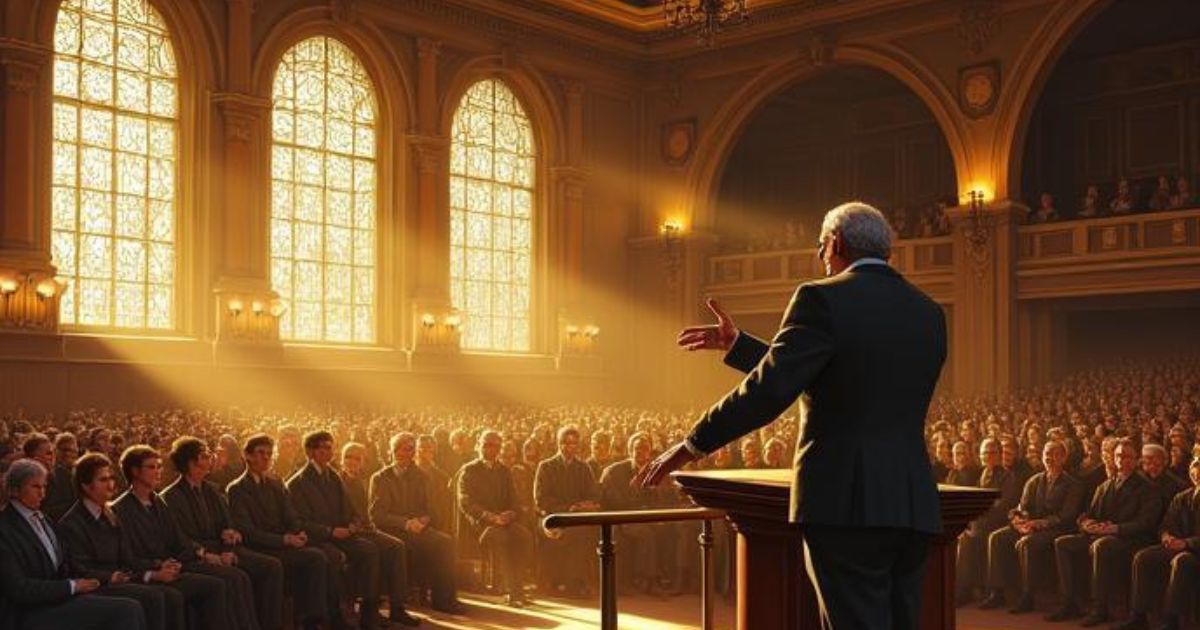
An excerpt from the original text.(complete · 3991 words)
f the origin of ambition, and of the distinction of ranks.
It is because mankind are disposed to sympathize
more entirely with our joy than with our sorrow,
that we make parade of our riches, and conceal
our poverty. Nothing is so mortifying as to
75be obliged to expose our distress to the view of the
public, and to feel, that though our situation is
open to the eyes of all mankind, no mortal conceives
for us the half of what we suffer. Nay, it
is chiefly from this regard to the sentiments of
mankind, that we pursue riches and avoid poverty.
For to what purpose is all the toil and bustle of
this world? what is the end of avarice and ambition,
of the pursuit of wealth, of power, and pre-eminence?
Is it to supply the necessities of nature?
The wages of the meanest labourer can
supply them. We see that they afford him food
and clothing, the comfort of a house, and of a family.
If we examine his œconomy with rigor, we
should find that he spends a great part of them upon
conveniences, which may be regarded as superfluities,
and that, upon extraordinary occasions, he
can give something even to vanity and distinction.
What then is the cause of our aversion to his situation,
and why should those who have been educated
in the higher ranks of life, regard it as worse than
death, to be reduced to live, even without labour,
upon the same simple fare with him, to dwell under
the same lowly roof, and to be clothed in the
same humble attire? Do they imagine that their
stomach is better, or their sleep sounder in a palace
than in a cottage? the contrary has been so often
observed, and, indeed, is so very obvious, though it
had never been observed, that there is no body ignorant
of it. From whence, then, arises that emulation
which runs through all the different ranks
of men, and what are the advantages which we
propose by that great purpose of human life which
we call bettering our condition? To be observed,
76to be attended to, to be taken notice of with sympathy,
complacency, and approbation, are all the
advantages which we can propose to derive from
it. It is the vanity, not the ease, or the pleasure,
which interests us. But vanity is always founded
upon the belief of our being the object of attention
and approbation. The rich man glories in
his riches, because he feels that they naturally draw
upon him the attention of the world, and that
mankind are disposed to go along with him in all
those agreeable emotions with which the advantages
of his situation so readily inspire him. At
the thought of this, his heart seems to swell
and dilate itself within him, and he is fonder of
his wealth upon this account, than for all the
other advantages it procures him. The poor man,
on the contrary, is ashamed of his poverty. He
feels that it either places him out of the sight of
mankind, or, that, if they take any notice of him,
they have, however, scarce any fellow-feeling with
the misery and distress which he suffers. He is
mortified upon both accounts; for though to be
overlooked, and to be disapproved of, are things
entirely different, yet as obscurity covers us from
the daylight of honour and approbation, to feel
that we are taken no notice of necessarily damps
the most agreeable hope, and disappoints the most
ardent desire, of human nature. The poor man
goes out and comes in unheeded, and when in the
midst of a croud is in the same obscurity as if shut
up in his own hovel. Those humble cares and
painful attentions which occupy those in his situation,
afford no amusement to the dissipated and the
gay. They turn away their eyes from him, or if
the extremity of his distress forces them to look
77at him, it is only to spurn so disagreeable an object
from among them. The fortunate and the proud
wonder at the insolence of human wretchedness,
that it should dare to present itself before them,
and with the loathsome aspect of its misery, presume
to disturb the serenity of their happiness. The
man of rank and distinction, on the contrary, is
observed by all the world. Every body is eager to
look at him, and to conceive, at least by sympathy,
that joy and exultation with which his
circumstances naturally inspire him. His actions
are the objects of the public care. Scarce a word,
scarce a gesture, can fall from him that is altogether
neglected. In a great assembly he is the person
upon whom all direct their eyes; it is upon him that
their passions seem all to wait with expectation,
in order to receive that movement and direction
which he shall impress upon them; and if his
behaviour is not altogether absurd, he has, every
moment, an opportunity of interesting mankind,
and of rendering himself the object of
the observation and fellow-feeling of every body
about him. It is this, which notwithstanding the
restraint it imposes, notwithstanding the loss of liberty
with which it is attended, renders greatness
the object of envy, and compensates in the opinion
of mankind, all that toil, all that anxiety, all
those mortifications which must be undergone in
the pursuit of it; and what is of yet more consequence,
all that leisure, all that ease, all that
careless security, which are forfeited for ever by the
acquisition.
When we consider the condition of the great,
in those delusive colours in which the imagination
is apt to paint it, it seems to be almost the abstract
78idea of a perfect and happy state. It is the
very state which, in all our waking dreams and
idle reveries, we had sketched out to ourselves as
the final object of all our desires. We feel, therefore,
a peculiar sympathy with the satisfaction of
those who are in it. We favour all their inclinations,
and forward all their wishes. What
pity, we think, that any thing should spoil and
corrupt so agreeable a situation! We could even
wish them immortal; and it seems hard to us,
that death should at last put an end to such perfect
enjoyment. It is cruel, we think, in Nature,
to compel them from their exalted stations
to that humble, but hospitable home, which she
has provided for all her children. Great King,
live for ever! is the compliment, which after the
manner of eastern adulation, we should readily
make them, if experience did not teach us its
absurdity. Every calamity that befalls them, every
injury that is done them, excites in the breast of
the spectator ten times more compassion and resentment
than he would have felt, had the same
things happened to other men. It is the misfortunes
of Kings only which afford the proper subjects
for tragedy. They resemble, in this respect,
the misfortunes of lovers. Those two situations
are the chief which interest us upon the
theatre; because, in spite of all that reason and
experience can tell us to the contrary, the prejudices
of the imagination attach to these two
states a happiness superior to any other. To disturb,
or to put an end to such perfect enjoyment,
seems to be the most atrocious of all injuries.
The traitor who conspires against the life
of his monarch, is thought a greater monster than
79any other murderer. All the innocent blood that
was shed in the civil wars, provoked less indignation
than the death of Charles I. A stranger
to human nature, who saw the indifference of
men about the misery of their inferiors, and the
regret and indignation which they feel for the
misfortunes and sufferings of those above them,
would be apt to imagine, that pain must be more
agonizing, and the convulsions of death more terrible
to persons of higher rank, than to those of
meaner stations.
Upon this disposition of mankind, to go along
with all the passions of the rich and the powerful,
is founded the distinction of ranks, and the order
of society. Our obsequiousness to our superiors
more frequently arises from our admiration for
the advantages of their situation, than from any
private expectations of benefit from their good-will.
Their benefits can extend but to a few;
but their fortunes interest almost every body. We
are eager to assist them in compleating a system
of happiness that approaches so near to perfection;
and we desire to serve them for their own
sake, without any other recompense but the vanity
or the honour of obliging them. Neither is
our deference to their inclinations founded chiefly,
or altogether, upon a regard to the utility of such
submission, and to the order of society, which is
best supported by it. Even when the order of society
seems to require that we should oppose them,
we can hardly bring ourselves to do it. That kings
are the servants of the people, to be obeyed, resisted,
deposed, or punished, as the public conveniency
may require, is the doctrine of reason
and philosophy; but it is not the doctrine of
80Nature. Nature would teach us to submit to
them, for their own sake, to tremble and bow
down before their exalted station, to regard their
smile as a reward sufficient to compensate any
services, and to dread their displeasure, though
no other evil was to follow from it, as the severest
of all mortifications. To treat them in
any respect as men, to reason and dispute with
them upon ordinary occasions, requires such resolution,
that there are few men whose magnanimity
can support them in it, unless they are
likewise assisted by familiarity and acquaintance.
The strongest motives, the most furious passions,
fear, hatred, and resentment, are scarce sufficient
to balance this natural disposition to respect them:
and their conduct must, either justly or unjustly,
have excited the highest degree of all those passions,
before the bulk of the people can be brought
to oppose them with violence, or to desire to see
them either punished or deposed. Even when
the people have been brought this length, they
are apt to relent every moment, and easily relapse
into their habitual state of deference to those
whom they have been accustomed to look upon
as their natural superiors. They cannot stand the
mortification of their monarch. Compassion soon
takes the place of resentment, they forget all past
provocations, their old principles of loyalty revive,
and they run to re-establish the ruined authority
of their old master, with the same violence
with which they had opposed it. The death
of Charles I. brought about the Restoration of the
royal family. Compassion for James II. when he
was seized by the populace in making his escape
on ship-board, had almost prevented the Revolution,
81and made it go on more heavily than
before.
Do the great seem insensible of the easy price
at which they may acquire the public admiration;
or do they seem to imagine that to them,
as to other men, it must be the purchase either of
sweat or of blood? By what important accomplishments
is the young nobleman instructed to
support the dignity of his rank, and to render
himself worthy of that superiority over his fellow-citizens,
to which the virtue of his ancestors had
raised them? Is it by knowledge, by industry,
by patience, by self-denial, or by virtue of any
kind? As all his words, as all his motions are
attended to, he learns an habitual regard to every
circumstance of ordinary behaviour, and studies to
perform all those small duties with the most exact
propriety. As he is conscious how much he
is observed, and how much mankind are disposed
to favour all his inclinations, he acts, upon the
most indifferent occasions, with that freedom and
elevation which the thought of this naturally
inspires. His air, his manner, his deportment, all
mark that elegant and graceful sense of his own
superiority, which those who are born to inferior
stations can hardly ever arrive at: these are the
arts by which he proposes to make mankind more
easily submit to his authority, and to govern their
inclinations according to his own pleasure: and
in this he is seldom disappointed. These arts,
supported by rank and pre-eminence, are, upon
ordinary occasions, sufficient to govern the world.
Lewis XIV. during the greater part of his reign,
was regarded, not only in France, but over all
82Europe, as the most perfect model of a great
prince. But what were the talents and virtues by
which he acquired this great reputation? Was it
by the scrupulous and inflexible justice of all his
undertakings, by the immense dangers and difficulties
with which they were attended, or by
the unwearied and unrelenting application with
which he pursued them? Was it by his extensive
knowledge, by his exquisite judgment, or by his
heroic valour? It was by none of these qualities.
But he was, first of all, the most powerful prince
in Europe, and consequently held the highest rank
among kings; and then, says his historian, “he
surpassed all his courtiers in the gracefulness of
his shape, and the majestic beauty of his features.
The sound of his voice, noble and affecting,
gained those hearts which his presence intimidated.
He had a step and deportment which
could suit only him and his rank, and which
would have been ridiculous in any other person.
The embarrassment which he occasioned
to those who spoke to him, flattered that secret
satisfaction with which he felt his own superiority.
The old officer, who was confounded
and faultered in asking him a favour, and not
being able to conclude his discourse, said to him,
Sir, your majesty, I hope, will believe that I
do not tremble thus before your enemies: had
no difficulty to obtain what he demanded.”
These frivolous accomplishments, supported by his
rank, and, no doubt, too, by a degree of other
talents and virtues, which seems, however, not
to have been much above mediocrity, established
this prince in the esteem of his own age, and
have drawn, even from posterity, a good deal of
83respect for his memory. Compared with those
of his own times, and in his own presence, no
other virtue, it seems, appeared to have any merit.
Knowledge, industry, valour, and beneficence,
trembled, were abashed, and lost all dignity before
them.
But it is not by accomplishments of this kind,
that the man of inferior rank must hope to distinguish
himself. Politeness is so much the virtue
of the great, that it will do little honour to any
body but themselves. The coxcomb, who imitates
their manner, and affects to be eminent by
the superior propriety of his ordinary behaviour,
is rewarded with a double share of contempt for his
folly and presumption. Why should the man, whom
nobody thinks it worth while to look at, be very
anxious about the manner in which he holds up his
head, or disposes of his arms while he walks through
a room? He is occupied surely with a very superfluous
attention, and with an attention too that
marks a sense of his own importance, which no
other mortal can go along with. The most perfect
modesty and plainness, joined to as much negligence
as is consistent with the respect due to
the company, ought to be the chief characteristics
of the behaviour of a private man. If ever
he hopes to distinguish himself, it must be by
more important virtues. He must acquire dependants
to balance the dependants of the great,
and he has no other fund to pay them from,
but the labour of his body, and the activity of
his mind. He must cultivate these therefore: he
must acquire superior knowledge in his profession,
and superior industry in the exercise of it. He
84must be patient in labour, resolute in danger, and
firm in distress. These talents he must bring into
public view, by the difficulty, importance, and, at
the same time, good judgment of his undertakings,
and by the severe and unrelenting application
with which he pursues them. Probity and prudence,
generosity and frankness, must characterize
his behaviour upon all ordinary occasions;
and he must, at the same time, be forward to
engage in all those situations in which it requires
the greatest talents and virtues to act with propriety,
but in which the greatest applause is to
be acquired by those who can acquit themselves
with honour. With what impatience does the man
of spirit and ambition, who is depressed by his
situation, look round for some great opportunity
to distinguish himself? No circumstances,
which can afford this, appear to him undesirable.
He even looks forward with satisfaction to the
prospect of foreign war, or civil dissension; and,
with secret transport and delight, sees through
all the confusion and bloodshed which attend them,
the probability of those wished for occasions presenting
themselves, in which he may draw upon himself
the attention and admiration of mankind. The
man of rank and distinction, on the contrary,
whose whole glory consists in the propriety of his
ordinary behaviour, who is contented with the
humble renown which this can afford him, and
has no talents to acquire any other, is unwilling
to embarrass himself with what can be attended
either with difficulty or distress. To figure at a
ball is his great triumph, and to succeed in
an intrigue of gallantry, his highest exploit. He
has an aversion to all public confusions, not from
85the love of mankind, for the great never look
upon their inferiors as their fellow-creatures; nor
yet from want of courage, for in that he is seldom
defective; but from a consciousness that he
possesses none of the virtues which are required
in such situations, and that the public attention
will certainly be drawn away from him by others.
He may be willing to expose himself to some
little danger, and to make a campaign when it
happens to be the fashion. But he shudders with
horror at the thought of any situation which demands
the continual and long exertion of patience,
industry, fortitude, and application of thought.
These virtues are hardly ever to be met with in
men who are born to those high stations. In all governments
accordingly, even in monarchies, the
highest offices are generally possessed, and the whole
detail of the administration conducted by men who
were educated in the middle and inferior ranks of
life, who have been carried forward by their own
industry and abilities, though loaded with the
jealousy, and opposed by the resentment of all those
who were born their superiors, and to whom the
great, after having regarded them first with contempt,
and afterwards with envy, are at last contented
to truckle with the same abject meanness
with which they desire that the rest of mankind
should behave to themselves.
It is the loss of this easy empire over the affections
of mankind which renders the fall from
greatness so insupportable. When the family of
the King of Macedon was led in triumph by
Paulus Æmilius, their misfortunes, it is said, made
them divide with their conqueror the attention
86of the Roman people. The sight of the royal
children, whose tender age rendered them insensible
of their situation, struck the spectators, amidst
the public rejoicings and prosperity, with
the tenderest sorrow and compassion. The King
appeared next in the procession; and seemed like
one confounded and astonished, and bereft of all
sentiment, by the greatness of his calamities. His
friends and ministers followed after him. As they
moved along, they often cast their eye upon their
fallen sovereign, and always burst into tears at the
sight; their whole behaviour demonstrating that
they thought not of their misfortunes, but were
occupied entirely by the superior greatness of his.
The generous Romans, on the contrary, beheld
him with disdain and indignation, and regarded
as unworthy of all compassion the man who could
be so mean-spirited as to bear to live under such
calamities. Yet what did those calamities amount
to? According to the greater part of historians,
he was to spend the remainder of his days under
the protection of a powerful and humane
people, in a state which in itself should seem
worthy of envy, a state of plenty, ease, leisure, and
security, from which it was impossible for him
even by his own folly to fall. But he was no
longer to be surrounded by that admiring mob
of fools, flatterers, and dependants, who had formerly
been accustomed to attend upon all his
motions. He was no longer to be gazed upon
by multitudes, nor to have it in his power to
render himself the object of their respect, their
gratitude, their love, their admiration. The passions
of nations were no longer to mould themselves
87upon his inclinations. This was that insupportable
calamity which bereaved the King of all
sentiment; which made his friends forget their own
misfortunes; and which the Roman magnanimity
could scarce conceive how any man could be so
mean-spirited as to bear to survive.
“Love, says my Lord Rochefoucault, is commonly
succeeded by ambition; but ambition
is hardly ever succeeded by love.” That passion
when once it has got entire possession of
the breast, will admit neither a rival nor a successor.
To those who have been accustomed to
the possession, or even to the hope of public admiration,
all other pleasures sicken and decay. Of
all the discarded statesmen who for their own
ease have studied to get the better of ambition,
and to despise those honours which they could no
longer arrive at, how few have been able to succeed?
The greater part have spent their time in
the most listless and insipid indolence, chagrined
at the thoughts of their own insignificancy, incapable
of being interested in the occupations
of private life, without enjoyment except when
they talked of their former greatness, and without
satisfaction except when they were employed
in some vain project to recover it. Are you in
earnest resolved never to barter your liberty for
the lordly servitude of a Court, but to live free,
fearless, and independent? There seems to be one
way to continue in that virtuous resolution; and
perhaps but one. Never enter the place from
whence so few have been able to return; never
come within the circle of ambition; nor even bring
yourself into comparison with those masters of the
88earth who have already engrossed the attention of
half mankind before you.
Of such mighty importance does it appear to be,
in the imaginations of men, to stand in that situation
which sets them most in the view of general sympathy
and attention. And thus, place, that great object
which divides the wives of aldermen, is the end
of half the labours of life; and is the cause of all the
tumult and bustle, all the rapine and injustice, which
avarice and ambition have introduced into this world.
People of sense, it is said, indeed despise place; that
is, they despise sitting at the head of the table, and
are indifferent who it is that is pointed out to the
company by that frivolous circumstance, which the
smallest advantage is capable of overbalancing. But
rank, distinction, pre-eminence, no man despises,
unless he is either raised very much above, or sunk
very much below, the ordinary standard of human
nature; unless he is either so confirmed in wisdom
and real philosophy, as to be satisfied that, while the
propriety of his conduct renders him the just object
of approbation, it is of little consequence though he
be neither attended to, nor approved of; or so habituated
to the idea of his own meanness, so sunk in
slothful and sottish indifference, as entirely to have
forgot the desire, and almost the very wish, for superiority.
89
Master this chapter. Complete your experience
Purchase the complete book to access all chapters and support classic literature
As an Amazon Associate, we earn a small commission from qualifying purchases at no additional cost to you.
Available in paperback, hardcover, and e-book formats
Let's Analyse the Pattern
The compulsive pursuit of status and attention that drives people to sacrifice genuine happiness for the illusion of being admired.
Why This Matters
Connect literature to life
This chapter teaches how to distinguish between people seeking genuine improvement versus those performing for recognition and social approval.
Practice This Today
This week, notice when someone's behavior changes based on who's watching—are they solving problems or seeking applause?
Now let's explore the literary elements.
Key Quotes & Analysis
"It is because mankind are disposed to sympathize more entirely with our joy than with our sorrow, that we make parade of our riches, and conceal our poverty."
Context: Opening explanation of why people show off wealth but hide financial struggles
This reveals the core psychological truth driving status behavior. People naturally pay more attention to success than suffering, so we perform wealth to get that attention. It explains why social media is full of highlight reels.
In Today's Words:
People care more about your good news than your problems, so you show off when things go well and hide when they don't.
"For to what purpose is all the toil and bustle of this world? what is the end of avarice and ambition, of the pursuit of wealth, of power, and pre-eminence?"
Context: Smith questioning why people work so hard for money when basic needs are easily met
These rhetorical questions force us to examine our real motivations. Smith is about to reveal that it's not about survival or even comfort - it's about being seen and admired by others.
In Today's Words:
Why do we bust our butts chasing money and status? What's the real point of all this hustle?
"The wages of the meanest labourer can supply them. We see that they afford him food and clothing, the comfort of a house, and of a family."
Context: Pointing out that even low-wage workers have their basic needs covered
Smith dismantles the idea that wealth pursuit is about survival. Even the lowest-paid workers have shelter, food, and family life. This sets up his argument that class anxiety is really about social recognition, not material need.
In Today's Words:
Even minimum-wage workers can cover the basics - food, housing, family life.
Thematic Threads
Class
In This Chapter
Smith exposes how class differences aren't really about money but about attention and recognition—the poor suffer from invisibility more than material lack
Development
Builds on earlier chapters about social judgment to show class as a system of attention distribution
In Your Life:
You might notice how you treat people differently based on their job titles or possessions, or how being ignored hurts more than actual hardship
Identity
In This Chapter
People define themselves through others' eyes rather than their own experience—the wealthy person's identity depends on constant admiration
Development
Deepens the theme of external validation by showing how it becomes the core of self-worth
In Your Life:
You might catch yourself feeling good or bad about yourself based on how much attention you're getting rather than how you're actually doing
Social Expectations
In This Chapter
Society naturally defers to wealth and status, creating expectations that the rich are happier and more worthy of attention
Development
Shows how social expectations create and maintain inequality through assumed superiority
In Your Life:
You might notice yourself assuming wealthy or successful people have better lives, or feeling you need to prove your worth through achievements
Human Relationships
In This Chapter
Relationships become performances for an audience rather than genuine connections—people relate to status rather than person
Development
Reveals how status-seeking corrupts authentic human connection
In Your Life:
You might realize some of your relationships are based more on what others can do for your image than genuine care or compatibility
Personal Growth
In This Chapter
Those born into privilege learn grace but not skills, while those climbing up must develop real talents through struggle
Development
Introduces the paradox that advantage can prevent growth while disadvantage can force it
In Your Life:
You might recognize that your struggles have actually built strengths that people with easier paths never developed
You now have the context. Time to form your own thoughts.
Discussion Questions
- 1
According to Smith, what do people really want when they chase wealth—comfort or attention?
analysis • surface - 2
Why does Smith say the poor person suffers more from being ignored than from lacking basic needs?
analysis • medium - 3
Where do you see this pattern of chasing recognition instead of genuine happiness in your daily life—at work, on social media, or in your community?
application • medium - 4
How can you tell the difference between doing something for yourself versus doing it for the audience in your head?
application • deep - 5
What does this chapter reveal about why people stay trapped in cycles of status-seeking even when it makes them miserable?
reflection • deep
Critical Thinking Exercise
Track Your Recognition Addiction
For the next 24 hours, notice when you make choices for recognition versus genuine satisfaction. Keep a simple tally: every time you post something, choose an outfit, speak up in a meeting, or make a purchase, ask yourself 'Am I doing this for me or for the audience in my head?' Mark down which motivation drove each decision.
Consider:
- •Pay attention to decisions that feel automatic—these often reveal hidden recognition-seeking
- •Notice the physical feeling when you imagine others' approval versus when you focus on your own satisfaction
- •Consider how much mental energy you spend imagining others' reactions to your choices
Journaling Prompt
Write about a time when you achieved something you thought would bring recognition, but it left you feeling empty. What were you really seeking, and how might you find genuine satisfaction instead?
Coming Up Next...
Chapter 13: The Stoic Way of Life
Having exposed our obsession with status and attention, Smith next examines the Stoic philosophers' radical alternative—their attempt to find happiness by rejecting society's approval entirely. Can anyone truly escape the need for recognition?