
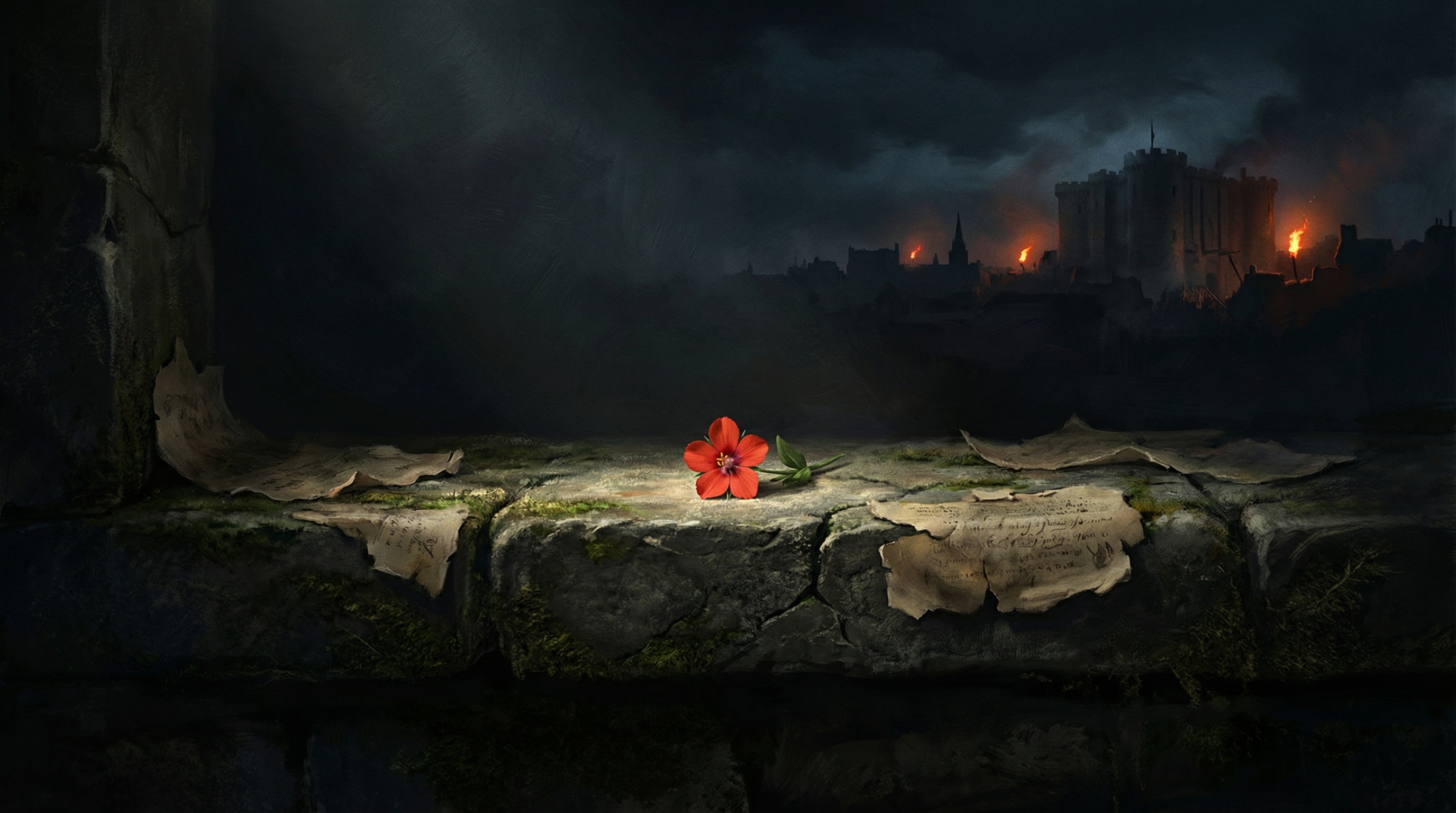
An excerpt from the original text.(complete · 2652 words)
NE O’CLOCK PRECISELY!
Supper had been extremely gay. All those present declared that never
had Lady Blakeney been more adorable, nor that “demmed idiot” Sir Percy
more amusing.
His Royal Highness had laughed until the tears streamed down his cheeks
at Blakeney’s foolish yet funny repartees. His doggerel verse, “We seek
him here, we seek him there,” etc., was sung to the tune of “Ho! Merry
Britons!” and to the accompaniment of glasses knocked loudly against
the table. Lord Grenville, moreover, had a most perfect cook—some wags
asserted that he was a scion of the old French noblesse, who, having
lost his fortune, had come to seek it in the cuisine of the Foreign
Office.
Marguerite Blakeney was in her most brilliant mood, and surely not a
soul in that crowded supper-room had even an inkling of the terrible
struggle which was raging within her heart.
The clock was ticking so mercilessly on. It was long past midnight, and
even the Prince of Wales was thinking of leaving the supper-table.
Within the next half-hour the destinies of two brave men would be
pitted against one another—the dearly-beloved brother and he, the
unknown hero.
Marguerite had not even tried to see Chauvelin during this last hour;
she knew that his keen, fox-like eyes would terrify her at once, and
incline the balance of her decision towards Armand. Whilst she did not
see him, there still lingered in her heart of hearts a vague, undefined
hope that “something” would occur, something big, enormous,
epoch-making, which would shift from her young, weak shoulders this
terrible burden of responsibility, of having to choose between two such
cruel alternatives.
But the minutes ticked on with that dull monotony which they invariably
seem to assume when our very nerves ache with their incessant ticking.
After supper, dancing was resumed. His Royal Highness had left, and
there was general talk of departing among the older guests; the young
ones were indefatigable and had started on a new gavotte, which would
fill the next quarter of an hour.
Marguerite did not feel equal to another dance; there is a limit to the
most enduring self-control. Escorted by a Cabinet Minister, she had
once more found her way to the tiny boudoir, still the most deserted
among all the rooms. She knew that Chauvelin must be lying in wait for
her somewhere, ready to seize the first possible opportunity for a
tête-à-tête. His eyes had met hers for a moment after the
’fore-supper minuet, and she knew that the keen diplomatist, with those
searching pale eyes of his, had divined that her work was accomplished.
Fate had willed it so. Marguerite, torn by the most terrible conflict
heart of woman can ever know, had resigned herself to its decrees. But
Armand must be saved at any cost; he, first of all, for he was her
brother, had been mother, father, friend to her ever since she, a tiny
babe, had lost both her parents. To think of Armand dying a traitor’s
death on the guillotine was too horrible even to dwell upon—impossible,
in fact. That could never be, never. . . . As for the stranger, the
hero . . . well! there, let Fate decide. Marguerite would redeem her
brother’s life at the hands of the relentless enemy, then let that
cunning Scarlet Pimpernel extricate himself after that.
Perhaps—vaguely—Marguerite hoped that the daring plotter, who for so
many months had baffled an army of spies, would still manage to evade
Chauvelin and remain immune to the end.
She thought of all this, as she sat listening to the witty discourse of
the Cabinet Minister, who, no doubt, felt that he had found in Lady
Blakeney a most perfect listener. Suddenly she saw the keen, fox-like
face of Chauvelin peeping through the curtained doorway.
“Lord Fancourt,” she said to the Minister, “will you do me a service?”
“I am entirely at your ladyship’s service,” he replied gallantly.
“Will you see if my husband is still in the card-room? And if he is,
will you tell him that I am very tired, and would be glad to go home
soon.”
The commands of a beautiful woman are binding on all mankind, even on
Cabinet Ministers. Lord Fancourt prepared to obey instantly.
“I do not like to leave your ladyship alone,” he said.
“Never fear. I shall be quite safe here—and, I think, undisturbed . . .
but I am really tired. You know Sir Percy will drive back to Richmond.
It is a long way, and we shall not—an we do not hurry—get home before
daybreak.”
Lord Fancourt had perforce to go.
The moment he had disappeared, Chauvelin slipped into the room, and the
next instant stood calm and impassive by her side.
“You have news for me?” he said.
An icy mantle seemed to have suddenly settled round Marguerite’s
shoulders; though her cheeks glowed with fire, she felt chilled and
numbed. Oh, Armand! will you ever know the terrible sacrifice of pride,
of dignity, of womanliness a devoted sister is making for your sake?
“Nothing of importance,” she said, staring mechanically before her,
“but it might prove a clue. I contrived—no matter how—to detect Sir
Andrew Ffoulkes in the very act of burning a paper at one of these
candles, in this very room. That paper I succeeded in holding between
my fingers for the space of two minutes, and to cast my eye on it for
that of ten seconds.”
“Time enough to learn its contents?” asked Chauvelin, quietly.
She nodded. Then she continued in the same even, mechanical tone of
voice—
“In the corner of the paper there was the usual rough device of a small
star-shaped flower. Above it I read two lines, everything else was
scorched and blackened by the flame.”
“And what were these two lines?”
Her throat seemed suddenly to have contracted. For an instant she felt
that she could not speak the words, which might send a brave man to his
death.
“It is lucky that the whole paper was not burned,” added Chauvelin,
with dry sarcasm, “for it might have fared ill with Armand St. Just.
What were the two lines, citoyenne?”
“One was, ‘I start myself to-morrow,’” she said quietly; “the other—‘If
you wish to speak to me, I shall be in the supper-room at one o’clock
precisely.’”
Chauvelin looked up at the clock just above the mantelpiece.
“Then I have plenty of time,” he said placidly.
“What are you going to do?” she asked.
She was pale as a statue, her hands were icy cold, her head and heart
throbbed with the awful strain upon her nerves. Oh, this was cruel!
cruel! What had she done to have deserved all this? Her choice was
made: had she done a vile action or one that was sublime? The recording
angel, who writes in the book of gold, alone could give an answer.
“What are you going to do?” she repeated mechanically.
“Oh, nothing for the present. After that it will depend.”
“On what?”
“On whom I shall see in the supper-room at one o’clock precisely.”
“You will see the Scarlet Pimpernel, of course. But you do not know
him.”
“No. But I shall presently.”
“Sir Andrew will have warned him.”
“I think not. When you parted from him after the minuet he stood and
watched you, for a moment or two, with a look which gave me to
understand that something had happened between you. It was only
natural, was it not? that I should make a shrewd guess as to the nature
of that ‘something.’ I thereupon engaged the young gallant in a long
and animated conversation—we discussed Herr Glück’s singular success in
London—until a lady claimed his arm for supper.”
“Since then?”
“I did not lose sight of him through supper. When we all came upstairs
again, Lady Portarles buttonholed him and started on the subject of
pretty Mlle. Suzanne de Tournay. I knew he would not move until Lady
Portarles had exhausted the subject, which will not be for another
quarter of an hour at least, and it is five minutes to one now.”
He was preparing to go, and went up to the doorway, where, drawing
aside the curtain, he stood for a moment pointing out to Marguerite the
distant figure of Sir Andrew Ffoulkes in close conversation with Lady
Portarles.
“I think,” he said, with a triumphant smile, “that I may safely expect
to find the person I seek in the dining-room, fair lady.”
“There may be more than one.”
“Whoever is there, as the clock strikes one, will be shadowed by one of
my men; of these, one, or perhaps two, or even three, will leave for
France to-morrow. One of these will be the ‘Scarlet Pimpernel.’”
“Yes?—And?”
“I also, fair lady, will leave for France to-morrow. The papers found
at Dover upon the person of Sir Andrew Ffoulkes speak of the
neighbourhood of Calais, of an inn which I know well, called ‘Le Chat
Gris,’ of a lonely place somewhere on the coast—the Père Blanchard’s
hut—which I must endeavour to find. All these places are given as the
point where this meddlesome Englishman has bidden the traitor de
Tournay and others to meet his emissaries. But it seems that he has
decided not to send his emissaries, that ‘he will start himself
to-morrow.’ Now, one of those persons whom I shall see anon in the
supper-room, will be journeying to Calais, and I shall follow that
person, until I have tracked him to where those fugitive aristocrats
await him; for that person, fair lady, will be the man whom I have
sought for, for nearly a year, the man whose energy has outdone me,
whose ingenuity has baffled me, whose audacity has set me
wondering—yes! me!—who have seen a trick or two in my time—the
mysterious and elusive Scarlet Pimpernel.”
“And Armand?” she pleaded.
“Have I ever broken my word? I promise you that the day the Scarlet
Pimpernel and I start for France, I will send you that imprudent letter
of his by special courier. More than that, I will pledge you the word
of France, that the day I lay hands on that meddlesome Englishman, St.
Just will be here in England, safe in the arms of his charming sister.”
And with a deep and elaborate bow and another look at the clock,
Chauvelin glided out of the room.
It seemed to Marguerite that through all the noise, all the din of
music, dancing, and laughter, she could hear his cat-like tread,
gliding through the vast reception-rooms; that she could hear him go
down the massive staircase, reach the dining-room and open the door.
Fate had decided, had made her speak, had made her do a vile and
abominable thing, for the sake of the brother she loved. She lay back
in her chair, passive and still, seeing the figure of her relentless
enemy ever present before her aching eyes.
When Chauvelin reached the supper-room it was quite deserted. It had
that woebegone, forsaken, tawdry appearance, which reminds one so much
of a ball-dress, the morning after.
Half-empty glasses littered the table, unfolded napkins lay about, the
chairs—turned towards one another in groups of twos and threes—seemed
like the seats of ghosts, in close conversation with one another. There
were sets of two chairs—very close to one another—in the far corners of
the room, which spoke of recent whispered flirtations, over cold
game-pie and champagne; there were sets of three and four chairs, that
recalled pleasant, animated discussions over the latest scandals; there
were chairs straight up in a row that still looked starchy, critical,
acid, like antiquated dowagers; there were a few isolated, single
chairs, close to the table, that spoke of gourmands intent on the most
recherché dishes, and others overturned on the floor, that spoke
volumes on the subject of my Lord Grenville’s cellars.
It was a ghostlike replica, in fact, of that fashionable gathering
upstairs; a ghost that haunts every house where balls and good suppers
are given; a picture drawn with white chalk on grey cardboard, dull and
colourless, now that the bright silk dresses and gorgeously embroidered
coats were no longer there to fill in the foreground, and now that the
candles flickered sleepily in their sockets.
Chauvelin smiled benignly, and rubbing his long, thin hands together,
he looked round the deserted supper-room, whence even the last flunkey
had retired in order to join his friends in the hall below. All was
silence in the dimly-lighted room, whilst the sound of the gavotte, the
hum of distant talk and laughter, and the rumble of an occasional coach
outside, only seemed to reach this palace of the Sleeping Beauty as the
murmur of some flitting spooks far away.
It all looked so peaceful, so luxurious, and so still, that the keenest
observer—a veritable prophet—could never have guessed that, at this
present moment, that deserted supper-room was nothing but a trap laid
for the capture of the most cunning and audacious plotter those
stirring times had ever seen.
Chauvelin pondered and tried to peer into the immediate future. What
would this man be like, whom he and the leaders of a whole revolution
had sworn to bring to his death? Everything about him was weird and
mysterious; his personality, which he had so cunningly concealed, the
power he wielded over nineteen English gentlemen who seemed to obey his
every command blindly and enthusiastically, the passionate love and
submission he had roused in his little trained band, and, above all,
his marvellous audacity, the boundless impudence which had caused him
to beard his most implacable enemies, within the very walls of Paris.
No wonder that in France the sobriquet of the mysterious Englishman
roused in the people a superstitious shudder. Chauvelin himself as he
gazed round the deserted room, where presently the weird hero would
appear, felt a strange feeling of awe creeping all down his spine.
But his plans were well laid. He felt sure that the Scarlet Pimpernel
had not been warned, and felt equally sure that Marguerite Blakeney had
not played him false. If she had . . . a cruel look, that would have
made her shudder, gleamed in Chauvelin’s keen, pale eyes. If she had
played him a trick, Armand St. Just would suffer the extreme penalty.
But no, no! of course she had not played him false!
Fortunately the supper-room was deserted: this would make Chauvelin’s
task all the easier, when presently that unsuspecting enigma would
enter it alone. No one was here now save Chauvelin himself.
Stay! as he surveyed with a satisfied smile the solitude of the room,
the cunning agent of the French Government became aware of the
peaceful, monotonous breathing of some one of my Lord Grenville’s
guests, who, no doubt, had supped both wisely and well, and was
enjoying a quiet sleep, away from the din of the dancing above.
Chauvelin looked round once more, and there in the corner of a sofa, in
the dark angle of the room, his mouth open, his eyes shut, the sweet
sounds of peaceful slumbers proceeding from his nostrils, reclined the
gorgeously-apparelled, long-limbed husband of the cleverest woman in
Europe.
Chauvelin looked at him as he lay there, placid, unconscious, at peace
with all the world and himself, after the best of suppers, and a smile,
that was almost one of pity, softened for a moment the hard lines of
the Frenchman’s face and the sarcastic twinkle of his pale eyes.
Evidently the slumberer, deep in dreamless sleep, would not interfere
with Chauvelin’s trap for catching that cunning Scarlet Pimpernel.
Again he rubbed his hands together, and, following the example of Sir
Percy Blakeney, he, too, stretched himself out in the corner of another
sofa, shut his eyes, opened his mouth, gave forth sounds of peaceful
breathing, and . . . waited!
Master this chapter. Complete your experience
Purchase the complete book to access all chapters and support classic literature
As an Amazon Associate, we earn a small commission from qualifying purchases at no additional cost to you.
Available in paperback, hardcover, and e-book formats
Let's Analyse the Pattern
When external pressure creates the illusion that you must choose between two harmful options, preventing you from finding creative alternatives.
Why This Matters
Connect literature to life
This chapter teaches how to spot when someone creates artificial either-or scenarios to pressure you into quick decisions that benefit them.
Practice This Today
This week, notice when someone says 'you have to choose' or creates urgent deadlines—ask yourself who benefits from your rushed decision and whether a third option exists.
Now let's explore the literary elements.
Key Quotes & Analysis
"The clock was ticking so mercilessly on."
Context: As Marguerite realizes time is running out before she must make her terrible choice
This shows how external pressures create internal torment. The clock becomes a symbol of fate closing in, making the decision unavoidable. It captures that feeling when you know something terrible is coming and you can't stop it.
In Today's Words:
Time was running out and there was nothing she could do about it.
"Within the next half-hour the destinies of two brave men would be pitted against one another—the dearly-beloved brother and he, the unknown hero."
Context: Describing the impossible choice Marguerite faces between Armand and the Scarlet Pimpernel
This captures the agony of having to choose between two people you care about. It shows how life sometimes forces us into situations where there's no good option. The word 'destinies' emphasizes how big the consequences will be.
In Today's Words:
In thirty minutes, she'd have to choose which man would live and which would die.
"She knew that his keen, fox-like eyes would terrify her at once, and incline the balance of her decision towards Armand."
Context: Explaining why Marguerite avoids looking at Chauvelin during the party
This shows how manipulators use psychological pressure to get what they want. Marguerite knows that seeing Chauvelin's calculating stare will remind her of the threat to Armand and push her toward betrayal. It reveals how fear influences our choices.
In Today's Words:
She knew that if she looked at him, his threatening stare would scare her into doing what he wanted.
Thematic Threads
Moral Compromise
In This Chapter
Marguerite betrays her principles to save someone she loves, justifying the betrayal as necessary
Development
Escalates from earlier hints of moral flexibility to active betrayal
In Your Life:
You might compromise your values at work to protect your job or family's security
Social Performance
In This Chapter
Marguerite maintains her brilliant party facade while her heart breaks internally
Development
Continues the theme of public masks hiding private torment
In Your Life:
You smile through family gatherings while dealing with personal crisis, protecting others from your pain
Information as Power
In This Chapter
Chauvelin's entire plan depends on controlling who knows what when
Development
Builds on earlier scenes of strategic information sharing and withholding
In Your Life:
You might withhold bad news from family members to protect them, or reveal secrets strategically
Deceptive Appearances
In This Chapter
Percy appears completely oblivious and harmless while potentially being the target
Development
Reinforces the ongoing theme that nothing is as it seems in this world
In Your Life:
You might underestimate quiet coworkers or assume the loudest person in the room has the most power
Protective Love
In This Chapter
Marguerite's love for Armand drives her to betray the Scarlet Pimpernel
Development
Shows how protective love can lead to morally questionable choices
In Your Life:
You might lie to protect someone you love, even when honesty would serve them better
You now have the context. Time to form your own thoughts.
Discussion Questions
- 1
What impossible choice does Marguerite face, and what information does she finally give Chauvelin?
analysis • surface - 2
Why does Chauvelin create such tight timing and pressure around Marguerite's decision?
analysis • medium - 3
When have you seen someone use artificial deadlines or pressure to force a quick decision in real life?
application • medium - 4
If you were Marguerite's friend, what would you advise her to do when facing this 'choose between two people you love' scenario?
application • deep - 5
What does this chapter reveal about how people behave when they believe they have no good options?
reflection • deep
Critical Thinking Exercise
Spot the False Binary
Think of a recent situation where someone presented you with an either-or choice that felt urgent or pressured. Write down the two options you were given, then brainstorm at least three alternative solutions that weren't mentioned. Consider who benefited from you believing you only had two choices.
Consider:
- •Was there really a deadline, or was urgency artificially created?
- •What might have happened if you had asked for more time to think?
- •Could you have changed the question instead of just picking from the given answers?
Journaling Prompt
Write about a time when you felt trapped between two bad choices. Looking back, what third option might have existed that you couldn't see at the time?
Coming Up Next...
Chapter 15: The Agony of Waiting
As the clock strikes one, someone will enter that supper room - but will it be the person Chauvelin expects? With Sir Percy sleeping nearby and the trap perfectly laid, doubt begins to creep into even the most carefully planned schemes.



