
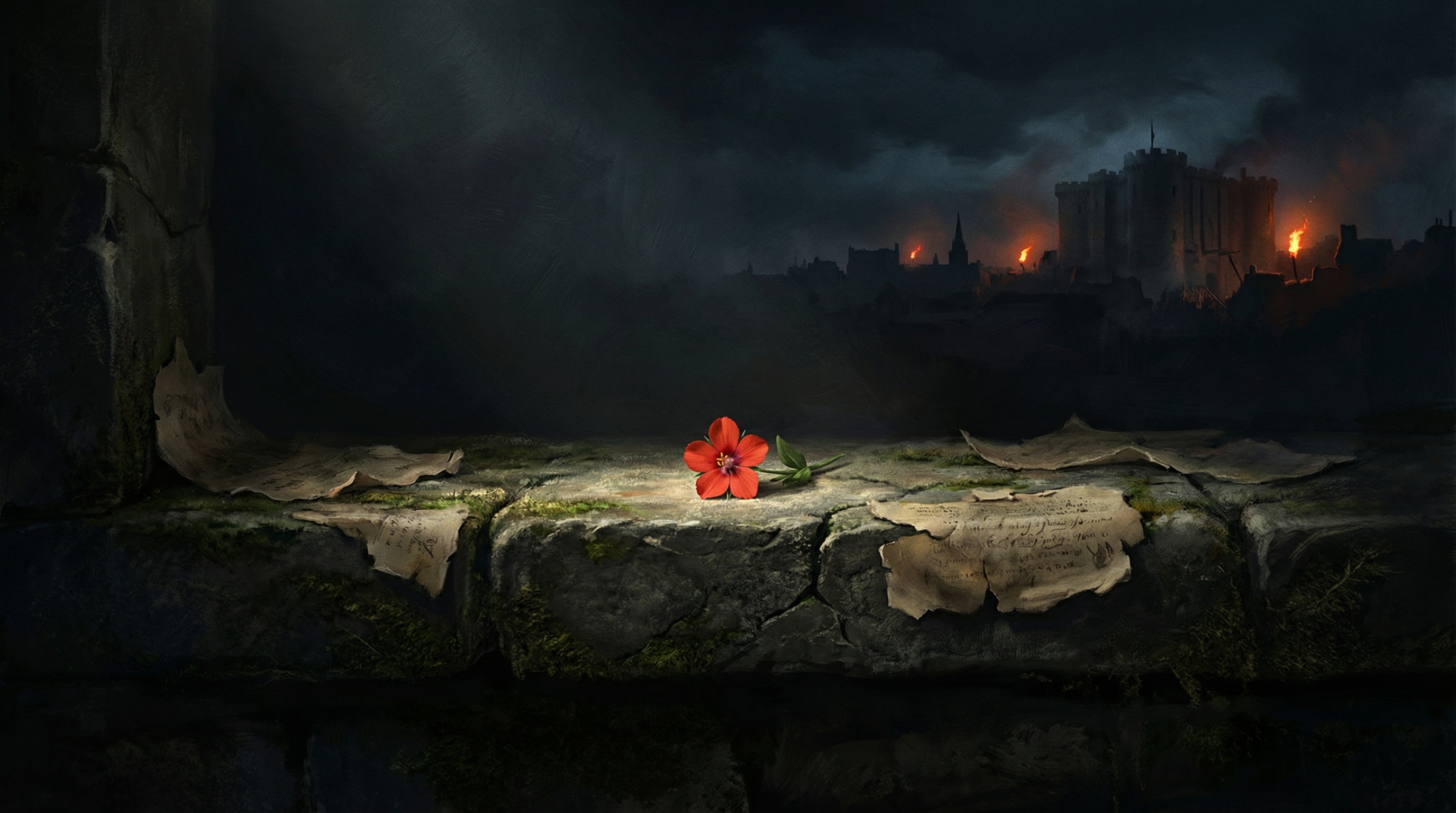
An excerpt from the original text.(complete · 815 words)
ITHER—OR?
The few words which Marguerite Blakeney had managed to read on the
half-scorched piece of paper, seemed literally to be the words of Fate.
“Start myself to-morrow. . . .” This she had read quite distinctly;
then came a blur caused by the smoke of the candle, which obliterated
the next few words; but, right at the bottom, there was another
sentence, which was now standing clearly and distinctly, like letters
of fire, before her mental vision. “If you wish to speak to me again, I
shall be in the supper-room at one o’clock precisely.” The whole was
signed with the hastily-scrawled little device—a tiny star-shaped
flower, which had become so familiar to her.
One o’clock precisely! It was now close upon eleven, the last minuet
was being danced, with Sir Andrew Ffoulkes and beautiful Lady Blakeney
leading the couples, through its delicate and intricate figures.
Close upon eleven! the hands of the handsome Louis XV. clock upon its
ormolu bracket seemed to move along with maddening rapidity. Two hours
more, and her fate and that of Armand would be sealed. In two hours she
must make up her mind whether she will keep the knowledge so cunningly
gained to herself, and leave her brother to his fate, or whether she
will wilfully betray a brave man, whose life was devoted to his
fellow-men, who was noble, generous, and above all, unsuspecting. It
seemed a horrible thing to do. But then, there was Armand! Armand, too,
was noble and brave, Armand, too, was unsuspecting. And Armand loved
her, would have willingly trusted his life in her hands, and now, when
she could save him from death, she hesitated. Oh! it was monstrous; her
brother’s kind, gentle face, so full of love for her, seemed to be
looking reproachfully at her. “You might have saved me, Margot!” he
seemed to say to her, “and you chose the life of a stranger, a man you
do not know, whom you have never seen, and preferred that he should be
safe, whilst you sent me to the guillotine!”
All these conflicting thoughts raged through Marguerite’s brain, while,
with a smile upon her lips, she glided through the graceful mazes of
the minuet. She noted—with that acute sense of hers—that she had
succeeded in completely allaying Sir Andrew’s fears. Her self-control
had been absolutely perfect—she was a finer actress at this moment, and
throughout the whole of this minuet, than she had ever been upon the
boards of the Comédie Française; but then, a beloved brother’s life had
not depended upon her histrionic powers.
She was too clever to overdo her part, and made no further allusions to
the supposed billet doux, which had caused Sir Andrew Ffoulkes such
an agonising five minutes. She watched his anxiety melting away under
her sunny smile, and soon perceived that, whatever doubt may have
crossed his mind at the moment, she had, by the time the last bars of
the minuet had been played, succeeded in completely dispelling it; he
never realised in what a fever of excitement she was, what effort it
cost her to keep up a constant ripple of banal conversation.
When the minuet was over, she asked Sir Andrew to take her into the
next room.
“I have promised to go down to supper with His Royal Highness,” she
said, “but before we part, tell me . . . am I forgiven?”
“Forgiven?”
“Yes! Confess, I gave you a fright just now. . . . But, remember, I am
not an Englishwoman, and I do not look upon the exchanging of billet
doux as a crime, and I vow I’ll not tell my little Suzanne. But now,
tell me, shall I welcome you at my water-party on Wednesday?”
“I am not sure, Lady Blakeney,” he replied evasively. “I may have to
leave London to-morrow.”
“I would not do that, if I were you,” she said earnestly; then seeing
the anxious look once more reappearing in his eyes, she added gaily;
“No one can throw a ball better than you can, Sir Andrew, we should so
miss you on the bowling-green.”
He had led her across the room, to one beyond, where already His Royal
Highness was waiting for the beautiful Lady Blakeney.
“Madame, supper awaits us,” said the Prince, offering his arm to
Marguerite, “and I am full of hope. The goddess Fortune has frowned so
persistently on me at hazard, that I look with confidence for the
smiles of the goddess of Beauty.”
“Your Highness has been unfortunate at the card tables?” asked
Marguerite, as she took the Prince’s arm.
“Aye! most unfortunate. Blakeney, not content with being the richest
among my father’s subjects, has also the most outrageous luck. By the
way, where is that inimitable wit? I vow, Madam, that this life would
be but a dreary desert without your smiles and his sallies.”
Master this chapter. Complete your experience
Purchase the complete book to access all chapters and support classic literature
As an Amazon Associate, we earn a small commission from qualifying purchases at no additional cost to you.
Available in paperback, hardcover, and e-book formats
Let's Analyse the Pattern
When life forces us to choose between two deeply held values, creating moral paralysis that others can exploit.
Why This Matters
Connect literature to life
This chapter teaches how to recognize when someone uses your love and loyalty as weapons against you.
Practice This Today
This week, notice when someone frames a request as 'if you really cared about me, you would...' and ask yourself who benefits from that framing.
Now let's explore the literary elements.
Key Quotes & Analysis
"If you wish to speak to me again, I shall be in the supper-room at one o'clock precisely."
Context: Marguerite reads this on the partially burned paper she found
This innocent-seeming appointment becomes the focal point of Marguerite's agony. The precise timing creates unbearable pressure - she has exactly two hours to decide her brother's fate.
In Today's Words:
Meet me in the break room at exactly 1 PM if you want to talk.
"Two hours more, and her fate and that of Armand would be sealed."
Context: As Marguerite watches the clock during the ball
The ticking clock becomes a character itself, creating mounting tension. Every passing minute brings her closer to an impossible decision that will destroy either her brother or her conscience.
In Today's Words:
In two hours, everything would be decided - no going back.
"It seemed a horrible thing to do. But then, there was Armand!"
Context: As she wrestles with whether to betray the Scarlet Pimpernel
This perfectly captures the torture of impossible choices. Her moral compass says betrayal is wrong, but love for her brother makes it feel necessary. The exclamation shows how family loyalty can override ethics.
In Today's Words:
I know this is wrong, but it's my brother we're talking about!
Thematic Threads
Identity
In This Chapter
Marguerite must perform the role of carefree socialite while her world crumbles, using her theatrical training as survival skill
Development
Evolved from earlier focus on public persona—now identity performance becomes life-or-death necessity
In Your Life:
You might recognize this when you're putting on a brave face at work while dealing with family crisis at home.
Class
In This Chapter
The aristocratic social setting becomes the stage where life-and-death decisions play out behind elegant facades
Development
Continues the theme of how class structures create spaces where real power operates invisibly
In Your Life:
You see this in professional settings where serious consequences are discussed in casual, polite language.
Human Relationships
In This Chapter
Love becomes both Marguerite's greatest strength and her most exploitable weakness
Development
Deepens from earlier exploration of marriage dynamics to show how all deep bonds create vulnerability
In Your Life:
This appears whenever someone uses your care for others to pressure you into uncomfortable decisions.
Social Expectations
In This Chapter
Marguerite must maintain perfect social performance even while facing impossible moral choices
Development
Intensifies the earlier theme—now social expectations become a mask for survival rather than mere propriety
In Your Life:
You experience this when you must act 'normal' in social situations while dealing with private turmoil.
Personal Growth
In This Chapter
Crisis reveals Marguerite's hidden strengths—her acting ability becomes a tool for navigating deadly situations
Development
Shows how growth often emerges from impossible circumstances rather than comfortable ones
In Your Life:
You might discover unexpected capabilities when facing situations that demand more than you thought you could handle.
You now have the context. Time to form your own thoughts.
Discussion Questions
- 1
What two impossible choices is Marguerite forced to decide between, and why does each choice feel like a betrayal?
analysis • surface - 2
How does Chauvelin use Marguerite's love for her brother as a weapon against her? What does this reveal about how manipulators operate?
analysis • medium - 3
Think of a time when someone used your caring nature against you - perhaps a boss, family member, or friend who made you feel guilty for setting boundaries. How is that similar to what's happening to Marguerite?
application • medium - 4
If you were Marguerite's friend, what advice would you give her about finding a third option that doesn't involve being manipulated by either side?
application • deep - 5
Why do people who love deeply often find themselves in these impossible choice situations? What does this chapter teach us about protecting ourselves while still caring for others?
reflection • deep
Critical Thinking Exercise
Map Your Impossible Choice
Think of a current situation where you feel torn between two important things - maybe work and family time, helping a friend and protecting yourself, or standing up for what's right versus keeping the peace. Write down both sides of your dilemma, then identify who benefits when you stay stuck in this paralysis. Look for the hidden third option that puts you back in control.
Consider:
- •Who gains power when you're frozen between two bad choices?
- •What would happen if you refused to play by their rules entirely?
- •How might your caring nature be used as leverage against you?
Journaling Prompt
Write about a time when you realized someone was using your love or loyalty to manipulate your decisions. How did you recognize the pattern, and what did you do to reclaim your power?
Coming Up Next...
Chapter 14: The Trap Is Set
The clock strikes one, and Marguerite must finally face the Scarlet Pimpernel. Will she choose her brother's life over her conscience, or find another way out of this impossible trap?



