
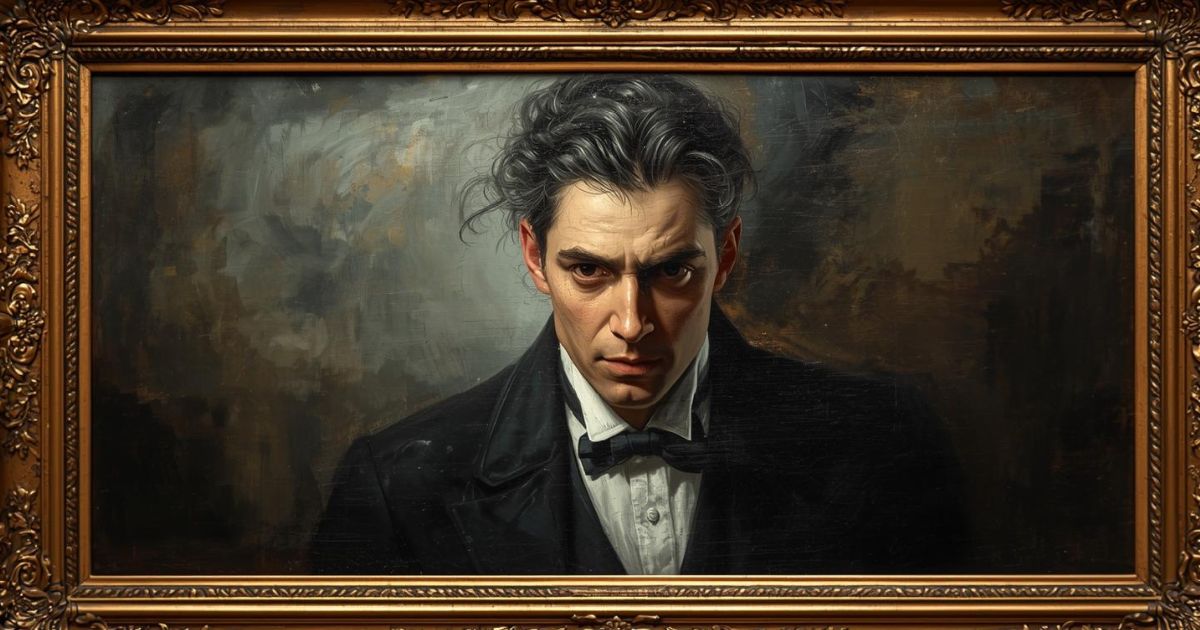
An excerpt from the original text.(complete · 4919 words)
he studio was filled with the rich odour of roses, and when the light
summer wind stirred amidst the trees of the garden, there came through
the open door the heavy scent of the lilac, or the more delicate
perfume of the pink-flowering thorn.
From the corner of the divan of Persian saddle-bags on which he was
lying, smoking, as was his custom, innumerable cigarettes, Lord Henry
Wotton could just catch the gleam of the honey-sweet and honey-coloured
blossoms of a laburnum, whose tremulous branches seemed hardly able to
bear the burden of a beauty so flamelike as theirs; and now and then
the fantastic shadows of birds in flight flitted across the long
tussore-silk curtains that were stretched in front of the huge window,
producing a kind of momentary Japanese effect, and making him think of
those pallid, jade-faced painters of Tokyo who, through the medium of
an art that is necessarily immobile, seek to convey the sense of
swiftness and motion. The sullen murmur of the bees shouldering their
way through the long unmown grass, or circling with monotonous
insistence round the dusty gilt horns of the straggling woodbine,
seemed to make the stillness more oppressive. The dim roar of London
was like the bourdon note of a distant organ.
In the centre of the room, clamped to an upright easel, stood the
full-length portrait of a young man of extraordinary personal beauty,
and in front of it, some little distance away, was sitting the artist
himself, Basil Hallward, whose sudden disappearance some years ago
caused, at the time, such public excitement and gave rise to so many
strange conjectures.
As the painter looked at the gracious and comely form he had so
skilfully mirrored in his art, a smile of pleasure passed across his
face, and seemed about to linger there. But he suddenly started up, and
closing his eyes, placed his fingers upon the lids, as though he sought
to imprison within his brain some curious dream from which he feared he
might awake.
“It is your best work, Basil, the best thing you have ever done,” said
Lord Henry languidly. “You must certainly send it next year to the
Grosvenor. The Academy is too large and too vulgar. Whenever I have
gone there, there have been either so many people that I have not been
able to see the pictures, which was dreadful, or so many pictures that
I have not been able to see the people, which was worse. The Grosvenor
is really the only place.”
“I don’t think I shall send it anywhere,” he answered, tossing his head
back in that odd way that used to make his friends laugh at him at
Oxford. “No, I won’t send it anywhere.”
Lord Henry elevated his eyebrows and looked at him in amazement through
the thin blue wreaths of smoke that curled up in such fanciful whorls
from his heavy, opium-tainted cigarette. “Not send it anywhere? My dear
fellow, why? Have you any reason? What odd chaps you painters are! You
do anything in the world to gain a reputation. As soon as you have one,
you seem to want to throw it away. It is silly of you, for there is
only one thing in the world worse than being talked about, and that is
not being talked about. A portrait like this would set you far above
all the young men in England, and make the old men quite jealous, if
old men are ever capable of any emotion.”
“I know you will laugh at me,” he replied, “but I really can’t exhibit
it. I have put too much of myself into it.”
Lord Henry stretched himself out on the divan and laughed.
“Yes, I knew you would; but it is quite true, all the same.”
“Too much of yourself in it! Upon my word, Basil, I didn’t know you
were so vain; and I really can’t see any resemblance between you, with
your rugged strong face and your coal-black hair, and this young
Adonis, who looks as if he was made out of ivory and rose-leaves. Why,
my dear Basil, he is a Narcissus, and you—well, of course you have an
intellectual expression and all that. But beauty, real beauty, ends
where an intellectual expression begins. Intellect is in itself a mode
of exaggeration, and destroys the harmony of any face. The moment one
sits down to think, one becomes all nose, or all forehead, or something
horrid. Look at the successful men in any of the learned professions.
How perfectly hideous they are! Except, of course, in the Church. But
then in the Church they don’t think. A bishop keeps on saying at the
age of eighty what he was told to say when he was a boy of eighteen,
and as a natural consequence he always looks absolutely delightful.
Your mysterious young friend, whose name you have never told me, but
whose picture really fascinates me, never thinks. I feel quite sure of
that. He is some brainless beautiful creature who should be always here
in winter when we have no flowers to look at, and always here in summer
when we want something to chill our intelligence. Don’t flatter
yourself, Basil: you are not in the least like him.”
“You don’t understand me, Harry,” answered the artist. “Of course I am
not like him. I know that perfectly well. Indeed, I should be sorry to
look like him. You shrug your shoulders? I am telling you the truth.
There is a fatality about all physical and intellectual distinction,
the sort of fatality that seems to dog through history the faltering
steps of kings. It is better not to be different from one’s fellows.
The ugly and the stupid have the best of it in this world. They can sit
at their ease and gape at the play. If they know nothing of victory,
they are at least spared the knowledge of defeat. They live as we all
should live—undisturbed, indifferent, and without disquiet. They
neither bring ruin upon others, nor ever receive it from alien hands.
Your rank and wealth, Harry; my brains, such as they are—my art,
whatever it may be worth; Dorian Gray’s good looks—we shall all suffer
for what the gods have given us, suffer terribly.”
“Dorian Gray? Is that his name?” asked Lord Henry, walking across the
studio towards Basil Hallward.
“Yes, that is his name. I didn’t intend to tell it to you.”
“But why not?”
“Oh, I can’t explain. When I like people immensely, I never tell their
names to any one. It is like surrendering a part of them. I have grown
to love secrecy. It seems to be the one thing that can make modern life
mysterious or marvellous to us. The commonest thing is delightful if
one only hides it. When I leave town now I never tell my people where I
am going. If I did, I would lose all my pleasure. It is a silly habit,
I dare say, but somehow it seems to bring a great deal of romance into
one’s life. I suppose you think me awfully foolish about it?”
“Not at all,” answered Lord Henry, “not at all, my dear Basil. You seem
to forget that I am married, and the one charm of marriage is that it
makes a life of deception absolutely necessary for both parties. I
never know where my wife is, and my wife never knows what I am doing.
When we meet—we do meet occasionally, when we dine out together, or go
down to the Duke’s—we tell each other the most absurd stories with the
most serious faces. My wife is very good at it—much better, in fact,
than I am. She never gets confused over her dates, and I always do. But
when she does find me out, she makes no row at all. I sometimes wish
she would; but she merely laughs at me.”
“I hate the way you talk about your married life, Harry,” said Basil
Hallward, strolling towards the door that led into the garden. “I
believe that you are really a very good husband, but that you are
thoroughly ashamed of your own virtues. You are an extraordinary
fellow. You never say a moral thing, and you never do a wrong thing.
Your cynicism is simply a pose.”
“Being natural is simply a pose, and the most irritating pose I know,”
cried Lord Henry, laughing; and the two young men went out into the
garden together and ensconced themselves on a long bamboo seat that
stood in the shade of a tall laurel bush. The sunlight slipped over the
polished leaves. In the grass, white daisies were tremulous.
After a pause, Lord Henry pulled out his watch. “I am afraid I must be
going, Basil,” he murmured, “and before I go, I insist on your
answering a question I put to you some time ago.”
“What is that?” said the painter, keeping his eyes fixed on the ground.
“You know quite well.”
“I do not, Harry.”
“Well, I will tell you what it is. I want you to explain to me why you
won’t exhibit Dorian Gray’s picture. I want the real reason.”
“I told you the real reason.”
“No, you did not. You said it was because there was too much of
yourself in it. Now, that is childish.”
“Harry,” said Basil Hallward, looking him straight in the face, “every
portrait that is painted with feeling is a portrait of the artist, not
of the sitter. The sitter is merely the accident, the occasion. It is
not he who is revealed by the painter; it is rather the painter who, on
the coloured canvas, reveals himself. The reason I will not exhibit
this picture is that I am afraid that I have shown in it the secret of
my own soul.”
Lord Henry laughed. “And what is that?” he asked.
“I will tell you,” said Hallward; but an expression of perplexity came
over his face.
“I am all expectation, Basil,” continued his companion, glancing at
him.
“Oh, there is really very little to tell, Harry,” answered the painter;
“and I am afraid you will hardly understand it. Perhaps you will hardly
believe it.”
Lord Henry smiled, and leaning down, plucked a pink-petalled daisy from
the grass and examined it. “I am quite sure I shall understand it,” he
replied, gazing intently at the little golden, white-feathered disk,
“and as for believing things, I can believe anything, provided that it
is quite incredible.”
The wind shook some blossoms from the trees, and the heavy
lilac-blooms, with their clustering stars, moved to and fro in the
languid air. A grasshopper began to chirrup by the wall, and like a
blue thread a long thin dragon-fly floated past on its brown gauze
wings. Lord Henry felt as if he could hear Basil Hallward’s heart
beating, and wondered what was coming.
“The story is simply this,” said the painter after some time. “Two
months ago I went to a crush at Lady Brandon’s. You know we poor
artists have to show ourselves in society from time to time, just to
remind the public that we are not savages. With an evening coat and a
white tie, as you told me once, anybody, even a stock-broker, can gain
a reputation for being civilized. Well, after I had been in the room
about ten minutes, talking to huge overdressed dowagers and tedious
academicians, I suddenly became conscious that some one was looking at
me. I turned half-way round and saw Dorian Gray for the first time.
When our eyes met, I felt that I was growing pale. A curious sensation
of terror came over me. I knew that I had come face to face with some
one whose mere personality was so fascinating that, if I allowed it to
do so, it would absorb my whole nature, my whole soul, my very art
itself. I did not want any external influence in my life. You know
yourself, Harry, how independent I am by nature. I have always been my
own master; had at least always been so, till I met Dorian Gray.
Then—but I don’t know how to explain it to you. Something seemed to
tell me that I was on the verge of a terrible crisis in my life. I had
a strange feeling that fate had in store for me exquisite joys and
exquisite sorrows. I grew afraid and turned to quit the room. It was
not conscience that made me do so: it was a sort of cowardice. I take
no credit to myself for trying to escape.”
“Conscience and cowardice are really the same things, Basil. Conscience
is the trade-name of the firm. That is all.”
“I don’t believe that, Harry, and I don’t believe you do either.
However, whatever was my motive—and it may have been pride, for I used
to be very proud—I certainly struggled to the door. There, of course, I
stumbled against Lady Brandon. ‘You are not going to run away so soon,
Mr. Hallward?’ she screamed out. You know her curiously shrill voice?”
“Yes; she is a peacock in everything but beauty,” said Lord Henry,
pulling the daisy to bits with his long nervous fingers.
“I could not get rid of her. She brought me up to royalties, and people
with stars and garters, and elderly ladies with gigantic tiaras and
parrot noses. She spoke of me as her dearest friend. I had only met her
once before, but she took it into her head to lionize me. I believe
some picture of mine had made a great success at the time, at least had
been chattered about in the penny newspapers, which is the
nineteenth-century standard of immortality. Suddenly I found myself
face to face with the young man whose personality had so strangely
stirred me. We were quite close, almost touching. Our eyes met again.
It was reckless of me, but I asked Lady Brandon to introduce me to him.
Perhaps it was not so reckless, after all. It was simply inevitable. We
would have spoken to each other without any introduction. I am sure of
that. Dorian told me so afterwards. He, too, felt that we were destined
to know each other.”
“And how did Lady Brandon describe this wonderful young man?” asked his
companion. “I know she goes in for giving a rapid précis of all her
guests. I remember her bringing me up to a truculent and red-faced old
gentleman covered all over with orders and ribbons, and hissing into my
ear, in a tragic whisper which must have been perfectly audible to
everybody in the room, the most astounding details. I simply fled. I
like to find out people for myself. But Lady Brandon treats her guests
exactly as an auctioneer treats his goods. She either explains them
entirely away, or tells one everything about them except what one wants
to know.”
“Poor Lady Brandon! You are hard on her, Harry!” said Hallward
listlessly.
“My dear fellow, she tried to found a salon, and only succeeded in
opening a restaurant. How could I admire her? But tell me, what did she
say about Mr. Dorian Gray?”
“Oh, something like, ‘Charming boy—poor dear mother and I absolutely
inseparable. Quite forget what he does—afraid he—doesn’t do
anything—oh, yes, plays the piano—or is it the violin, dear Mr. Gray?’
Neither of us could help laughing, and we became friends at once.”
“Laughter is not at all a bad beginning for a friendship, and it is far
the best ending for one,” said the young lord, plucking another daisy.
Hallward shook his head. “You don’t understand what friendship is,
Harry,” he murmured—“or what enmity is, for that matter. You like every
one; that is to say, you are indifferent to every one.”
“How horribly unjust of you!” cried Lord Henry, tilting his hat back
and looking up at the little clouds that, like ravelled skeins of
glossy white silk, were drifting across the hollowed turquoise of the
summer sky. “Yes; horribly unjust of you. I make a great difference
between people. I choose my friends for their good looks, my
acquaintances for their good characters, and my enemies for their good
intellects. A man cannot be too careful in the choice of his enemies. I
have not got one who is a fool. They are all men of some intellectual
power, and consequently they all appreciate me. Is that very vain of
me? I think it is rather vain.”
“I should think it was, Harry. But according to your category I must be
merely an acquaintance.”
“My dear old Basil, you are much more than an acquaintance.”
“And much less than a friend. A sort of brother, I suppose?”
“Oh, brothers! I don’t care for brothers. My elder brother won’t die,
and my younger brothers seem never to do anything else.”
“Harry!” exclaimed Hallward, frowning.
“My dear fellow, I am not quite serious. But I can’t help detesting my
relations. I suppose it comes from the fact that none of us can stand
other people having the same faults as ourselves. I quite sympathize
with the rage of the English democracy against what they call the vices
of the upper orders. The masses feel that drunkenness, stupidity, and
immorality should be their own special property, and that if any one of
us makes an ass of himself, he is poaching on their preserves. When
poor Southwark got into the divorce court, their indignation was quite
magnificent. And yet I don’t suppose that ten per cent of the
proletariat live correctly.”
“I don’t agree with a single word that you have said, and, what is
more, Harry, I feel sure you don’t either.”
Lord Henry stroked his pointed brown beard and tapped the toe of his
patent-leather boot with a tasselled ebony cane. “How English you are
Basil! That is the second time you have made that observation. If one
puts forward an idea to a true Englishman—always a rash thing to do—he
never dreams of considering whether the idea is right or wrong. The
only thing he considers of any importance is whether one believes it
oneself. Now, the value of an idea has nothing whatsoever to do with
the sincerity of the man who expresses it. Indeed, the probabilities
are that the more insincere the man is, the more purely intellectual
will the idea be, as in that case it will not be coloured by either his
wants, his desires, or his prejudices. However, I don’t propose to
discuss politics, sociology, or metaphysics with you. I like persons
better than principles, and I like persons with no principles better
than anything else in the world. Tell me more about Mr. Dorian Gray.
How often do you see him?”
“Every day. I couldn’t be happy if I didn’t see him every day. He is
absolutely necessary to me.”
“How extraordinary! I thought you would never care for anything but
your art.”
“He is all my art to me now,” said the painter gravely. “I sometimes
think, Harry, that there are only two eras of any importance in the
world’s history. The first is the appearance of a new medium for art,
and the second is the appearance of a new personality for art also.
What the invention of oil-painting was to the Venetians, the face of
Antinous was to late Greek sculpture, and the face of Dorian Gray will
some day be to me. It is not merely that I paint from him, draw from
him, sketch from him. Of course, I have done all that. But he is much
more to me than a model or a sitter. I won’t tell you that I am
dissatisfied with what I have done of him, or that his beauty is such
that art cannot express it. There is nothing that art cannot express,
and I know that the work I have done, since I met Dorian Gray, is good
work, is the best work of my life. But in some curious way—I wonder
will you understand me?—his personality has suggested to me an entirely
new manner in art, an entirely new mode of style. I see things
differently, I think of them differently. I can now recreate life in a
way that was hidden from me before. ‘A dream of form in days of
thought’—who is it who says that? I forget; but it is what Dorian Gray
has been to me. The merely visible presence of this lad—for he seems to
me little more than a lad, though he is really over twenty—his merely
visible presence—ah! I wonder can you realize all that that means?
Unconsciously he defines for me the lines of a fresh school, a school
that is to have in it all the passion of the romantic spirit, all the
perfection of the spirit that is Greek. The harmony of soul and
body—how much that is! We in our madness have separated the two, and
have invented a realism that is vulgar, an ideality that is void.
Harry! if you only knew what Dorian Gray is to me! You remember that
landscape of mine, for which Agnew offered me such a huge price but
which I would not part with? It is one of the best things I have ever
done. And why is it so? Because, while I was painting it, Dorian Gray
sat beside me. Some subtle influence passed from him to me, and for the
first time in my life I saw in the plain woodland the wonder I had
always looked for and always missed.”
“Basil, this is extraordinary! I must see Dorian Gray.”
Hallward got up from the seat and walked up and down the garden. After
some time he came back. “Harry,” he said, “Dorian Gray is to me simply
a motive in art. You might see nothing in him. I see everything in him.
He is never more present in my work than when no image of him is there.
He is a suggestion, as I have said, of a new manner. I find him in the
curves of certain lines, in the loveliness and subtleties of certain
colours. That is all.”
“Then why won’t you exhibit his portrait?” asked Lord Henry.
“Because, without intending it, I have put into it some expression of
all this curious artistic idolatry, of which, of course, I have never
cared to speak to him. He knows nothing about it. He shall never know
anything about it. But the world might guess it, and I will not bare my
soul to their shallow prying eyes. My heart shall never be put under
their microscope. There is too much of myself in the thing, Harry—too
much of myself!”
“Poets are not so scrupulous as you are. They know how useful passion
is for publication. Nowadays a broken heart will run to many editions.”
“I hate them for it,” cried Hallward. “An artist should create
beautiful things, but should put nothing of his own life into them. We
live in an age when men treat art as if it were meant to be a form of
autobiography. We have lost the abstract sense of beauty. Some day I
will show the world what it is; and for that reason the world shall
never see my portrait of Dorian Gray.”
“I think you are wrong, Basil, but I won’t argue with you. It is only
the intellectually lost who ever argue. Tell me, is Dorian Gray very
fond of you?”
The painter considered for a few moments. “He likes me,” he answered
after a pause; “I know he likes me. Of course I flatter him dreadfully.
I find a strange pleasure in saying things to him that I know I shall
be sorry for having said. As a rule, he is charming to me, and we sit
in the studio and talk of a thousand things. Now and then, however, he
is horribly thoughtless, and seems to take a real delight in giving me
pain. Then I feel, Harry, that I have given away my whole soul to some
one who treats it as if it were a flower to put in his coat, a bit of
decoration to charm his vanity, an ornament for a summer’s day.”
“Days in summer, Basil, are apt to linger,” murmured Lord Henry.
“Perhaps you will tire sooner than he will. It is a sad thing to think
of, but there is no doubt that genius lasts longer than beauty. That
accounts for the fact that we all take such pains to over-educate
ourselves. In the wild struggle for existence, we want to have
something that endures, and so we fill our minds with rubbish and
facts, in the silly hope of keeping our place. The thoroughly
well-informed man—that is the modern ideal. And the mind of the
thoroughly well-informed man is a dreadful thing. It is like a
bric-à-brac shop, all monsters and dust, with everything priced above
its proper value. I think you will tire first, all the same. Some day
you will look at your friend, and he will seem to you to be a little
out of drawing, or you won’t like his tone of colour, or something. You
will bitterly reproach him in your own heart, and seriously think that
he has behaved very badly to you. The next time he calls, you will be
perfectly cold and indifferent. It will be a great pity, for it will
alter you. What you have told me is quite a romance, a romance of art
one might call it, and the worst of having a romance of any kind is
that it leaves one so unromantic.”
“Harry, don’t talk like that. As long as I live, the personality of
Dorian Gray will dominate me. You can’t feel what I feel. You change
too often.”
“Ah, my dear Basil, that is exactly why I can feel it. Those who are
faithful know only the trivial side of love: it is the faithless who
know love’s tragedies.” And Lord Henry struck a light on a dainty
silver case and began to smoke a cigarette with a self-conscious and
satisfied air, as if he had summed up the world in a phrase. There was
a rustle of chirruping sparrows in the green lacquer leaves of the ivy,
and the blue cloud-shadows chased themselves across the grass like
swallows. How pleasant it was in the garden! And how delightful other
people’s emotions were!—much more delightful than their ideas, it
seemed to him. One’s own soul, and the passions of one’s friends—those
were the fascinating things in life. He pictured to himself with silent
amusement the tedious luncheon that he had missed by staying so long
with Basil Hallward. Had he gone to his aunt’s, he would have been sure
to have met Lord Goodbody there, and the whole conversation would have
been about the feeding of the poor and the necessity for model
lodging-houses. Each class would have preached the importance of those
virtues, for whose exercise there was no necessity in their own lives.
The rich would have spoken on the value of thrift, and the idle grown
eloquent over the dignity of labour. It was charming to have escaped
all that! As he thought of his aunt, an idea seemed to strike him. He
turned to Hallward and said, “My dear fellow, I have just remembered.”
“Remembered what, Harry?”
“Where I heard the name of Dorian Gray.”
“Where was it?” asked Hallward, with a slight frown.
“Don’t look so angry, Basil. It was at my aunt, Lady Agatha’s. She told
me she had discovered a wonderful young man who was going to help her
in the East End, and that his name was Dorian Gray. I am bound to state
that she never told me he was good-looking. Women have no appreciation
of good looks; at least, good women have not. She said that he was very
earnest and had a beautiful nature. I at once pictured to myself a
creature with spectacles and lank hair, horribly freckled, and tramping
about on huge feet. I wish I had known it was your friend.”
“I am very glad you didn’t, Harry.”
“Why?”
“I don’t want you to meet him.”
“You don’t want me to meet him?”
“No.”
“Mr. Dorian Gray is in the studio, sir,” said the butler, coming into
the garden.
“You must introduce me now,” cried Lord Henry, laughing.
The painter turned to his servant, who stood blinking in the sunlight.
“Ask Mr. Gray to wait, Parker: I shall be in in a few moments.” The man
bowed and went up the walk.
Then he looked at Lord Henry. “Dorian Gray is my dearest friend,” he
said. “He has a simple and a beautiful nature. Your aunt was quite
right in what she said of him. Don’t spoil him. Don’t try to influence
him. Your influence would be bad. The world is wide, and has many
marvellous people in it. Don’t take away from me the one person who
gives to my art whatever charm it possesses: my life as an artist
depends on him. Mind, Harry, I trust you.” He spoke very slowly, and
the words seemed wrung out of him almost against his will.
“What nonsense you talk!” said Lord Henry, smiling, and taking Hallward
by the arm, he almost led him into the house.
Master this chapter. Complete your experience
Purchase the complete book to access all chapters and support classic literature
As an Amazon Associate, we earn a small commission from qualifying purchases at no additional cost to you.
Available in paperback, hardcover, and e-book formats
Let's Analyse the Pattern
When multiple people compete to shape your choices, each believing their approach serves your best interests while actually serving their own needs.
Why This Matters
Connect literature to life
This chapter teaches how to spot when someone's advice serves their interests more than yours, even when they seem genuinely caring.
Practice This Today
This week, notice when someone gives you strong advice—ask yourself what they gain if you follow it, and whether they're asking what you actually want.
Now let's explore the literary elements.
Key Quotes & Analysis
"The only way to get rid of a temptation is to yield to it."
Context: Henry's philosophy about giving in to desires rather than fighting them
This reveals Henry's hedonistic worldview and his talent for making self-destruction sound like wisdom. It's the kind of advice that sounds liberating but leads to chaos.
In Today's Words:
Just do whatever you want - fighting your urges is pointless anyway.
"I can resist everything except temptation."
Context: Another of Henry's witty paradoxes about human weakness
Henry presents moral weakness as sophisticated self-knowledge. He makes giving up sound clever rather than admitting it's actually giving up control of your life.
In Today's Words:
I have zero self-control, but I'll make it sound like a personality trait instead of a problem.
"Every portrait that is painted with feeling is a portrait of the artist, not of the sitter."
Context: Basil explaining why he doesn't want to exhibit the portrait
Basil admits the painting reveals his obsession with Dorian more than it shows Dorian himself. It's about the danger of putting too much of yourself into another person.
In Today's Words:
When you're obsessed with someone, everything you create about them is really about your feelings, not who they actually are.
"Youth is the only thing worth having."
Context: Henry's philosophy about the supreme value of being young and beautiful
This sets up the central theme of the novel - the worship of youth and beauty above all else. It's the toxic idea that drives Dorian's eventual downfall.
In Today's Words:
Being young and hot is all that matters - everything else is just settling for less.
Thematic Threads
Influence
In This Chapter
Henry and Basil compete to shape Dorian through different approaches—protection versus corruption
Development
Introduced here
In Your Life:
You see this when different people give you conflicting advice, each convinced they know what's best for you.
Beauty
In This Chapter
Dorian's physical perfection becomes both his power and his vulnerability, attracting dangerous attention
Development
Introduced here
In Your Life:
Any natural gift—looks, talent, intelligence—can become a magnet for people who want to use or possess it.
Class
In This Chapter
The luxurious studio setting establishes a world of privilege where people become objects of aesthetic appreciation
Development
Introduced here
In Your Life:
You encounter this in any environment where wealth creates different rules and expectations for behavior.
Identity
In This Chapter
Dorian exists primarily through others' perceptions—he's defined by how Basil sees him and how Henry wants to shape him
Development
Introduced here
In Your Life:
This happens when you find yourself becoming who others expect rather than discovering who you actually are.
Art
In This Chapter
The portrait represents the power of creation and representation—Basil captures Dorian's essence but also traps it
Development
Introduced here
In Your Life:
You see this whenever someone's image or reputation becomes more important than their actual self.
You now have the context. Time to form your own thoughts.
Discussion Questions
- 1
What are the three different ways Basil, Henry, and Dorian each view the portrait being painted?
analysis • surface - 2
Why does Basil warn Henry not to influence Dorian, and what does this tell us about Henry's character?
analysis • medium - 3
Think about your own life - who are the people trying to influence your major decisions right now, and what does each person want from the outcome?
application • medium - 4
If you were Dorian's friend watching this scene unfold, how would you help him recognize what's happening and make his own choice?
application • deep - 5
What does this chapter suggest about the difference between people who love us and people who want to control us?
reflection • deep
Critical Thinking Exercise
Map Your Influence Triangle
Think of a current decision you're facing - big or small. Draw three circles and label them with the names of people giving you advice about this decision. Under each name, write what they're telling you to do and what they might gain if you follow their advice. Then write what YOU actually want in the center.
Consider:
- •Notice if anyone's advice benefits them more than it benefits you
- •Pay attention to who asks what you want versus who tells you what you should want
- •Consider whether anyone is helping you think through options versus pushing one specific choice
Journaling Prompt
Write about a time when you followed someone else's advice and later realized it served their interests more than yours. What would you do differently now?
Coming Up Next...
Chapter 2
Dorian Gray himself finally appears, and his first meeting with the charismatic Lord Henry will plant seeds that will grow into his ultimate downfall. The portrait is finished, but the real transformation is just beginning.



