
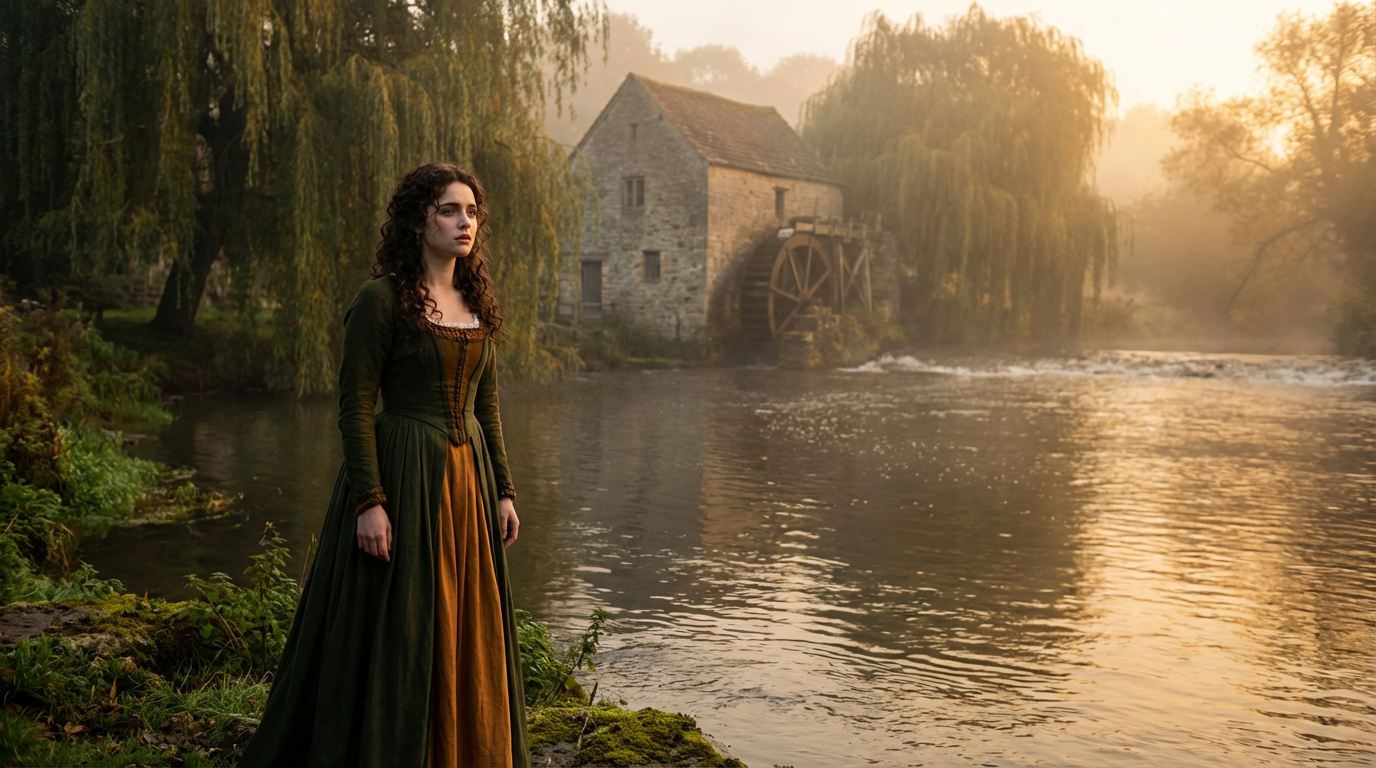
An excerpt from the original text.(complete · 4079 words)
lustrating the Laws of Attraction
It is evident to you now that Maggie had arrived at a moment in her
life which must be considered by all prudent persons as a great
opportunity for a young woman. Launched into the higher society of St
Ogg’s, with a striking person, which had the advantage of being quite
unfamiliar to the majority of beholders, and with such moderate
assistance of costume as you have seen foreshadowed in Lucy’s anxious
colloquy with aunt Pullet, Maggie was certainly at a new starting-point
in life. At Lucy’s first evening party, young Torry fatigued his facial
muscles more than usual in order that “the dark-eyed girl there in the
corner” might see him in all the additional style conferred by his
eyeglass; and several young ladies went home intending to have short
sleeves with black lace, and to plait their hair in a broad coronet at
the back of their head,—“That cousin of Miss Deane’s looked so very
well.” In fact, poor Maggie, with all her inward consciousness of a
painful past and her presentiment of a troublous future, was on the way
to become an object of some envy,—a topic of discussion in the newly
established billiard-room, and between fair friends who had no secrets
from each other on the subject of trimmings. The Miss Guests, who
associated chiefly on terms of condescension with the families of St
Ogg’s, and were the glass of fashion there, took some exception to
Maggie’s manners. She had a way of not assenting at once to the
observations current in good society, and of saying that she didn’t
know whether those observations were true or not, which gave her an air
of gaucherie, and impeded the even flow of conversation; but it is a
fact capable of an amiable interpretation that ladies are not the worst
disposed toward a new acquaintance of their own sex because she has
points of inferiority. And Maggie was so entirely without those pretty
airs of coquetry which have the traditional reputation of driving
gentlemen to despair that she won some feminine pity for being so
ineffective in spite of her beauty. She had not had many advantages,
poor thing! and it must be admitted there was no pretension about her;
her abruptness and unevenness of manner were plainly the result of her
secluded and lowly circumstances. It was only a wonder that there was
no tinge of vulgarity about her, considering what the rest of poor
Lucy’s relations were—an allusion which always made the Miss Guests
shudder a little. It was not agreeable to think of any connection by
marriage with such people as the Gleggs and the Pullets; but it was of
no use to contradict Stephen when once he had set his mind on anything,
and certainly there was no possible objection to Lucy in herself,—no
one could help liking her. She would naturally desire that the Miss
Guests should behave kindly to this cousin of whom she was so fond, and
Stephen would make a great fuss if they were deficient in civility.
Under these circumstances the invitations to Park House were not
wanting; and elsewhere, also, Miss Deane was too popular and too
distinguished a member of society in St Ogg’s for any attention toward
her to be neglected.
Thus Maggie was introduced for the first time to the young lady’s life,
and knew what it was to get up in the morning without any imperative
reason for doing one thing more than another. This new sense of leisure
and unchecked enjoyment amidst the soft-breathing airs and
garden-scents of advancing spring—amidst the new abundance of music,
and lingering strolls in the sunshine, and the delicious dreaminess of
gliding on the river—could hardly be without some intoxicating effect
on her, after her years of privation; and even in the first week Maggie
began to be less haunted by her sad memories and anticipations. Life
was certainly very pleasant just now; it was becoming very pleasant to
dress in the evening, and to feel that she was one of the beautiful
things of this spring-time. And there were admiring eyes always
awaiting her now; she was no longer an unheeded person, liable to be
chid, from whom attention was continually claimed, and on whom no one
felt bound to confer any. It was pleasant, too, when Stephen and Lucy
were gone out riding, to sit down at the piano alone, and find that the
old fitness between her fingers and the keys remained, and revived,
like a sympathetic kinship not to be worn out by separation; to get the
tunes she had heard the evening before, and repeat them again and again
until she had found out a way of producing them so as to make them a
more pregnant, passionate language to her. The mere concord of octaves
was a delight to Maggie, and she would often take up a book of studies
rather than any melody, that she might taste more keenly by abstraction
the more primitive sensation of intervals. Not that her enjoyment of
music was of the kind that indicates a great specific talent; it was
rather that her sensibility to the supreme excitement of music was only
one form of that passionate sensibility which belonged to her whole
nature, and made her faults and virtues all merge in each other; made
her affections sometimes an impatient demand, but also prevented her
vanity from taking the form of mere feminine coquetry and device, and
gave it the poetry of ambition. But you have known Maggie a long while,
and need to be told, not her characteristics, but her history, which is
a thing hardly to be predicted even from the completest knowledge of
characteristics. For the tragedy of our lives is not created entirely
from within. “Character,” says Novalis, in one of his questionable
aphorisms,—“character is destiny.” But not the whole of our destiny.
Hamlet, Prince of Denmark, was speculative and irresolute, and we have
a great tragedy in consequence. But if his father had lived to a good
old age, and his uncle had died an early death, we can conceive
Hamlet’s having married Ophelia, and got through life with a reputation
of sanity, notwithstanding many soliloquies, and some moody sarcasms
toward the fair daughter of Polonius, to say nothing of the frankest
incivility to his father-in-law.
Maggie’s destiny, then, is at present hidden, and we must wait for it
to reveal itself like the course of an unmapped river; we only know
that the river is full and rapid, and that for all rivers there is the
same final home. Under the charm of her new pleasures, Maggie herself
was ceasing to think, with her eager prefiguring imagination, of her
future lot; and her anxiety about her first interview with Philip was
losing its predominance; perhaps, unconsciously to herself, she was not
sorry that the interview had been deferred.
For Philip had not come the evening he was expected, and Mr Stephen
Guest brought word that he was gone to the coast,—probably, he thought,
on a sketching expedition; but it was not certain when he would return.
It was just like Philip, to go off in that way without telling any one.
It was not until the twelfth day that he returned, to find both Lucy’s
notes awaiting him; he had left before he knew of Maggie’s arrival.
Perhaps one had need be nineteen again to be quite convinced of the
feelings that were crowded for Maggie into those twelve days; of the
length to which they were stretched for her by the novelty of her
experience in them, and the varying attitudes of her mind. The early
days of an acquaintance almost always have this importance for us, and
fill up a larger space in our memory than longer subsequent periods,
which have been less filled with discovery and new impressions. There
were not many hours in those ten days in which Mr Stephen Guest was not
seated by Lucy’s side, or standing near her at the piano, or
accompanying her on some outdoor excursion; his attentions were clearly
becoming more assiduous, and that was what every one had expected. Lucy
was very happy, all the happier because Stephen’s society seemed to
have become much more interesting and amusing since Maggie had been
there. Playful discussions—sometimes serious ones—were going forward,
in which both Stephen and Maggie revealed themselves, to the admiration
of the gentle, unobtrusive Lucy; and it more than once crossed her mind
what a charming quartet they should have through life when Maggie
married Philip. Is it an inexplicable thing that a girl should enjoy
her lover’s society the more for the presence of a third person, and be
without the slightest spasm of jealousy that the third person had the
conversation habitually directed to her? Not when that girl is as
tranquil-hearted as Lucy, thoroughly possessed with a belief that she
knows the state of her companions’ affections, and not prone to the
feelings which shake such a belief in the absence of positive evidence
against it. Besides, it was Lucy by whom Stephen sat, to whom he gave
his arm, to whom he appealed as the person sure to agree with him; and
every day there was the same tender politeness toward her, the same
consciousness of her wants and care to supply them. Was there really
the same? It seemed to Lucy that there was more; and it was no wonder
that the real significance of the change escaped her. It was a subtle
act of conscience in Stephen that even he himself was not aware of. His
personal attentions to Maggie were comparatively slight, and there had
even sprung up an apparent distance between them, that prevented the
renewal of that faint resemblance to gallantry into which he had fallen
the first day in the boat. If Stephen came in when Lucy was out of the
room, if Lucy left them together, they never spoke to each other;
Stephen, perhaps, seemed to be examining books or music, and Maggie
bent her head assiduously over her work. Each was oppressively
conscious of the other’s presence, even to the finger-ends. Yet each
looked and longed for the same thing to happen the next day. Neither of
them had begun to reflect on the matter, or silently to ask, “To what
does all this tend?” Maggie only felt that life was revealing something
quite new to her; and she was absorbed in the direct, immediate
experience, without any energy left for taking account of it and
reasoning about it. Stephen wilfully abstained from self-questioning,
and would not admit to himself that he felt an influence which was to
have any determining effect on his conduct. And when Lucy came into the
room again, they were once more unconstrained; Maggie could contradict
Stephen, and laugh at him, and he could recommend to her consideration
the example of that most charming heroine, Miss Sophia Western, who had
a great “respect for the understandings of men.” Maggie could look at
Stephen, which, for some reason or other she always avoided when they
were alone; and he could even ask her to play his accompaniment for
him, since Lucy’s fingers were so busy with that bazaar-work, and
lecture her on hurrying the tempo, which was certainly Maggie’s weak
point.
One day—it was the day of Philip’s return—Lucy had formed a sudden
engagement to spend the evening with Mrs Kenn, whose delicate state of
health, threatening to become confirmed illness through an attack of
bronchitis, obliged her to resign her functions at the coming bazaar
into the hands of other ladies, of whom she wished Lucy to be one. The
engagement had been formed in Stephen’s presence, and he had heard Lucy
promise to dine early and call at six o’clock for Miss Torry, who
brought Mrs Kenn’s request.
“Here is another of the moral results of this idiotic bazaar,” Stephen
burst forth, as soon as Miss Torry had left the room,—“taking young
ladies from the duties of the domestic hearth into scenes of
dissipation among urn-rugs and embroidered reticules! I should like to
know what is the proper function of women, if it is not to make reasons
for husbands to stay at home, and still stronger reasons for bachelors
to go out. If this goes on much longer, the bonds of society will be
dissolved.”
“Well, it will not go on much longer,” said Lucy, laughing, “for the
bazaar is to take place on Monday week.”
“Thank Heaven!” said Stephen. “Kenn himself said the other day that he
didn’t like this plan of making vanity do the work of charity; but just
as the British public is not reasonable enough to bear direct taxation,
so St Ogg’s has not got force of motive enough to build and endow
schools without calling in the force of folly.”
“Did he say so?” said little Lucy, her hazel eyes opening wide with
anxiety. “I never heard him say anything of that kind; I thought he
approved of what we were doing.”
“I’m sure he approves you,” said Stephen, smiling at her
affectionately; “your conduct in going out to-night looks vicious, I
own, but I know there is benevolence at the bottom of it.”
“Oh, you think too well of me,” said Lucy, shaking her head, with a
pretty blush, and there the subject ended. But it was tacitly
understood that Stephen would not come in the evening; and on the
strength of that tacit understanding he made his morning visit the
longer, not saying good-bye until after four.
Maggie was seated in the drawing-room, alone, shortly after dinner,
with Minny on her lap, having left her uncle to his wine and his nap,
and her mother to the compromise between knitting and nodding, which,
when there was no company, she always carried on in the dining-room
till tea-time. Maggie was stooping to caress the tiny silken pet, and
comforting him for his mistress’s absence, when the sound of a footstep
on the gravel made her look up, and she saw Mr Stephen Guest walking up
the garden, as if he had come straight from the river. It was very
unusual to see him so soon after dinner! He often complained that their
dinner-hour was late at Park House. Nevertheless, there he was, in his
black dress; he had evidently been home, and must have come again by
the river. Maggie felt her cheeks glowing and her heart beating; it was
natural she should be nervous, for she was not accustomed to receive
visitors alone. He had seen her look up through the open window, and
raised his hat as he walked toward it, to enter that way instead of by
the door. He blushed too, and certainly looked as foolish as a young
man of some wit and self-possession can be expected to look, as he
walked in with a roll of music in his hand, and said, with an air of
hesitating improvisation,—
“You are surprised to see me again, Miss Tulliver; I ought to apologise
for coming upon you by surprise, but I wanted to come into the town,
and I got our man to row me; so I thought I would bring these things
from the ‘Maid of Artois’ for your cousin; I forgot them this morning.
Will you give them to her?”
“Yes,” said Maggie, who had risen confusedly with Minny in her arms,
and now, not quite knowing what else to do, sat down again.
Stephen laid down his hat, with the music, which rolled on the floor,
and sat down in the chair close by her. He had never done so before,
and both he and Maggie were quite aware that it was an entirely new
position.
“Well, you pampered minion!” said Stephen, leaning to pull the long
curly ears that drooped over Maggie’s arm. It was not a suggestive
remark, and as the speaker did not follow it up by further development,
it naturally left the conversation at a standstill. It seemed to
Stephen like some action in a dream that he was obliged to do, and
wonder at himself all the while,—to go on stroking Minny’s head. Yet it
was very pleasant; he only wished he dared look at Maggie, and that she
would look at him,—let him have one long look into those deep, strange
eyes of hers, and then he would be satisfied and quite reasonable after
that. He thought it was becoming a sort of monomania with him, to want
that long look from Maggie; and he was racking his invention
continually to find out some means by which he could have it without
its appearing singular and entailing subsequent embarrassment. As for
Maggie, she had no distinct thought, only the sense of a presence like
that of a closely hovering broad-winged bird in the darkness, for she
was unable to look up, and saw nothing but Minny’s black wavy coat.
But this must end some time, perhaps it ended very soon, and only
seemed long, as a minute’s dream does. Stephen at last sat upright
sideways in his chair, leaning one hand and arm over the back and
looking at Maggie. What should he say?
“We shall have a splendid sunset, I think; sha’n’t you go out and see
it?”
“I don’t know,” said Maggie. Then courageously raising her eyes and
looking out of the window, “if I’m not playing cribbage with my uncle.”
A pause; during which Minny is stroked again, but has sufficient
insight not to be grateful for it, to growl rather.
“Do you like sitting alone?”
A rather arch look came over Maggie’s face, and, just glancing at
Stephen, she said, “Would it be quite civil to say ‘yes’?”
“It was rather a dangerous question for an intruder to ask,” said
Stephen, delighted with that glance, and getting determined to stay for
another. “But you will have more than half an hour to yourself after I
am gone,” he added, taking out his watch. “I know Mr Deane never comes
in till half-past seven.”
Another pause, during which Maggie looked steadily out of the window,
till by a great effort she moved her head to look down at Minny’s back
again, and said,—
“I wish Lucy had not been obliged to go out. We lose our music.”
“We shall have a new voice to-morrow night,” said Stephen. “Will you
tell your cousin that our friend Philip Wakem is come back? I saw him
as I went home.”
Maggie gave a little start,—it seemed hardly more than a vibration that
passed from head to foot in an instant. But the new images summoned by
Philip’s name dispersed half the oppressive spell she had been under.
She rose from her chair with a sudden resolution, and laying Minny on
his cushion, went to reach Lucy’s large work-basket from its corner.
Stephen was vexed and disappointed; he thought perhaps Maggie didn’t
like the name of Wakem to be mentioned to her in that abrupt way, for
he now recalled what Lucy had told him of the family quarrel. It was of
no use to stay any longer. Maggie was seating herself at the table with
her work, and looking chill and proud; and he—he looked like a
simpleton for having come. A gratuitous, entirely superfluous visit of
that sort was sure to make a man disagreeable and ridiculous. Of course
it was palpable to Maggie’s thinking that he had dined hastily in his
own room for the sake of setting off again and finding her alone.
A boyish state of mind for an accomplished young gentleman of
five-and-twenty, not without legal knowledge! But a reference to
history, perhaps, may make it not incredible.
At this moment Maggie’s ball of knitting-wool rolled along the ground,
and she started up to reach it. Stephen rose too, and picking up the
ball, met her with a vexed, complaining look that gave his eyes quite a
new expression to Maggie, whose own eyes met them as he presented the
ball to her.
“Good-bye,” said Stephen, in a tone that had the same beseeching
discontent as his eyes. He dared not put out his hand; he thrust both
hands into his tail-pockets as he spoke. Maggie thought she had perhaps
been rude.
“Won’t you stay?” she said timidly, not looking away, for that would
have seemed rude again.
“No, thank you,” said Stephen, looking still into the half-unwilling,
half-fascinated eyes, as a thirsty man looks toward the track of the
distant brook. “The boat is waiting for me. You’ll tell your cousin?”
“Yes.”
“That I brought the music, I mean?”
“Yes.”
“And that Philip is come back?”
“Yes.” (Maggie did not notice Philip’s name this time.)
“Won’t you come out a little way into the garden?” said Stephen, in a
still gentler tone; but the next moment he was vexed that she did not
say “No,” for she moved away now toward the open window, and he was
obliged to take his hat and walk by her side. But he thought of
something to make him amends.
“Do take my arm,” he said, in a low tone, as if it were a secret.
There is something strangely winning to most women in that offer of the
firm arm; the help is not wanted physically at that moment, but the
sense of help, the presence of strength that is outside them and yet
theirs, meets a continual want of the imagination. Either on that
ground or some other, Maggie took the arm. And they walked together
round the grassplot and under the drooping green of the laburnums, in
the same dim, dreamy state as they had been in a quarter of an hour
before; only that Stephen had had the look he longed for, without yet
perceiving in himself the symptoms of returning reasonableness, and
Maggie had darting thoughts across the dimness,—how came he to be
there? Why had she come out? Not a word was spoken. If it had been,
each would have been less intensely conscious of the other.
“Take care of this step,” said Stephen at last.
“Oh, I will go in now,” said Maggie, feeling that the step had come
like a rescue. “Good-evening.”
In an instant she had withdrawn her arm, and was running back to the
house. She did not reflect that this sudden action would only add to
the embarrassing recollections of the last half-hour. She had no
thought left for that. She only threw herself into the low arm-chair,
and burst into tears.
“Oh, Philip, Philip, I wish we were together again—so quietly—in the
Red Deeps.”
Stephen looked after her a moment, then went on to the boat, and was
soon landed at the wharf. He spent the evening in the billiard-room,
smoking one cigar after another, and losing “lives” at pool. But he
would not leave off. He was determined not to think,—not to admit any
more distinct remembrance than was urged upon him by the perpetual
presence of Maggie. He was looking at her, and she was on his arm.
But there came the necessity of walking home in the cool starlight, and
with it the necessity of cursing his own folly, and bitterly
determining that he would never trust himself alone with Maggie again.
It was all madness; he was in love, thoroughly attached to Lucy, and
engaged,—engaged as strongly as an honourable man need be. He wished he
had never seen this Maggie Tulliver, to be thrown into a fever by her
in this way; she would make a sweet, strange, troublesome, adorable
wife to some man or other, but he would never have chosen her himself.
Did she feel as he did? He hoped she did—not. He ought not to have
gone. He would master himself in future. He would make himself
disagreeable to her, quarrel with her perhaps. Quarrel with her? Was it
possible to quarrel with a creature who had such eyes,—defying and
deprecating, contradicting and clinging, imperious and beseeching,—full
of delicious opposites? To see such a creature subdued by love for one
would be a lot worth having—to another man.
There was a muttered exclamation which ended this inward soliloquy, as
Stephen threw away the end of his last cigar, and thrusting his hands
into his pockets, stalked along at a quieter pace through the
shrubbery. It was not of a benedictory kind.
Master this chapter. Complete your experience
Purchase the complete book to access all chapters and support classic literature
As an Amazon Associate, we earn a small commission from qualifying purchases at no additional cost to you.
Available in paperback, hardcover, and e-book formats
Let's Analyse the Pattern
When sudden access to a higher social level intoxicates us into reaching for things that don't belong to us, forgetting our real commitments and values.
Why This Matters
Connect literature to life
This chapter teaches how to identify when temporary access to a higher social level creates dangerous entitlement and poor judgment.
Practice This Today
This week, notice when a promotion, invitation, or new opportunity makes you feel like 'normal rules don't apply'—that's your warning signal to pause and reassess.
Now let's explore the literary elements.
Key Quotes & Analysis
"Poor Maggie, with all her inward consciousness of a painful past and her presentiment of a troublous future, was on the way to become an object of some envy."
Context: As Maggie enjoys her first taste of social success
This captures the irony of Maggie's situation - others envy her new status, but she carries emotional baggage they can't see. The word 'poor' shows the narrator's sympathy for what's coming.
In Today's Words:
Everyone thought Maggie had it made now, but she knew her past wasn't behind her and more trouble was coming.
"She had a way of not assenting at once to the observations current in good society, and of saying that she didn't know whether those things were true or not, which gave her an air of gaucherie."
Context: Describing why the Miss Guests find fault with Maggie's manners
Maggie's honesty and independent thinking mark her as an outsider to people who value conformity over authenticity. Her refusal to automatically agree makes her seem awkward to those who follow social scripts.
In Today's Words:
She didn't just nod along with whatever everyone else was saying, which made her seem like she didn't know how to fit in.
"It was very charming to be taken care of in that kind, graceful manner by someone whose glance had such delicious influence on her."
Context: Maggie's reaction to Stephen offering his arm during their garden walk
Shows how starved Maggie has been for gentle treatment and how dangerously appealing Stephen's attention feels. The word 'delicious' reveals the sensual nature of her attraction.
In Today's Words:
It felt amazing to have someone treat her so nicely, especially someone who made her feel things just by looking at her.
Thematic Threads
Social Mobility
In This Chapter
Maggie experiences her first taste of leisure and high society admiration through Lucy's connections
Development
Evolved from her childhood poverty and recent struggles into dangerous new territory
In Your Life:
You might recognize this when a promotion, new relationship, or windfall suddenly changes how others treat you.
Forbidden Attraction
In This Chapter
Maggie and Stephen's mutual attraction grows stronger precisely because it's suppressed and wrong
Development
Introduced here as a new dangerous undercurrent threatening existing relationships
In Your Life:
You might see this in workplace attractions, friendships that cross boundaries, or any desire that grows stronger when denied.
Identity Confusion
In This Chapter
Maggie struggles between her elevated social position and her true self, ending in tears and longing for simpler times
Development
Continues her lifelong struggle with who she is versus who others want her to be
In Your Life:
You might feel this when success or new circumstances make you question which version of yourself is real.
Loyalty vs. Desire
In This Chapter
Stephen tries to convince himself he's not falling for the wrong woman while Maggie flees from temptation
Development
Introduced here as a central conflict that will drive future action
In Your Life:
You might face this when what you want conflicts with what you owe to family, friends, or existing commitments.
Emotional Danger
In This Chapter
The chapter shows how social elevation creates new forms of emotional risk and temptation
Development
Builds on earlier themes of how external changes create internal chaos
In Your Life:
You might notice this when new opportunities bring unexpected complications to your emotional life.
You now have the context. Time to form your own thoughts.
Discussion Questions
- 1
What changes in Maggie when she enters St. Ogg's high society, and how does she respond to suddenly being the center of attention?
analysis • surface - 2
Why does Maggie become attracted to Stephen specifically when she's in this elevated social position, rather than when she was in her normal circumstances?
analysis • medium - 3
Where do you see this pattern of 'borrowed elevation' today - people making risky choices when they temporarily gain access to a higher social level?
application • medium - 4
If you were Maggie's friend watching this unfold, what specific advice would you give her to help her navigate this dangerous attraction?
application • deep - 5
What does this chapter reveal about how social elevation affects our judgment and sense of what we deserve?
reflection • deep
Critical Thinking Exercise
Map Your Own Elevation Moments
Think of a time when you gained temporary access to a higher social level - a promotion, new relationship, windfall, or social circle upgrade. Write down what you suddenly felt entitled to that you hadn't wanted before. Then identify what existing commitment or relationship you started to devalue during this period.
Consider:
- •Notice how elevation changes what feels 'normal' or 'deserved' to you
- •Pay attention to which existing relationships started feeling limiting or beneath you
- •Consider whether you made any choices during elevation that you later regretted
Journaling Prompt
Write about how you can recognize when you're experiencing borrowed elevation and what strategies you'll use to stay grounded in your real values and commitments during these intoxicating moments.
Coming Up Next...
Chapter 46: Philip Re-enters
Philip's return to St. Ogg's will force all the carefully maintained pretenses to crumble. His reunion with Maggie promises to complicate an already tangled web of affections and obligations.



